


 |
市场调查报告书
商品编码
1913455
照护现场超音波市场:机会、成长要素、产业趋势分析及2026年至2035年预测Point of Care Ultrasound (POCUS) Market Opportunity, Growth Drivers, Industry Trend Analysis, and Forecast 2026 - 2035 |
||||||

全球照护现场超音波市场预计到 2025 年将达到 42 亿美元,到 2035 年将达到 84 亿美元,年复合成长率为 7.2%。
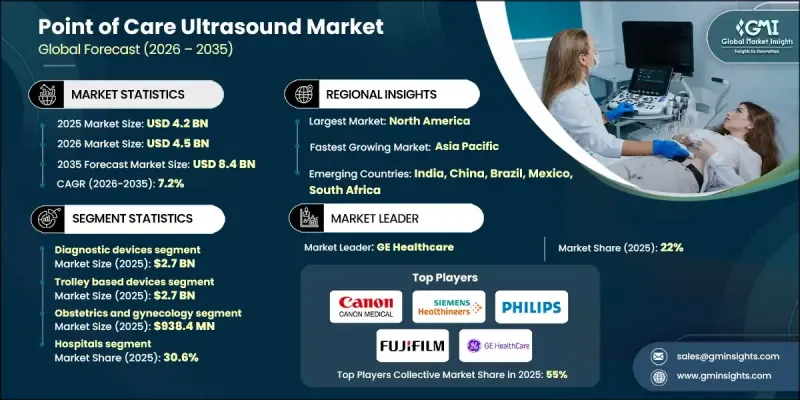
市场扩张的驱动因素包括长期健康问题发病率的上升、携带式超音波技术的持续创新以及全球人口老化的快速增长。非传染性疾病负担的加重显着增加了对快速、便利、可靠的诊断解决方案的需求。照护现场超音波使临床医生能够在床边进行即时成像,从而加快诊断、疾病监测和临床干预的决策速度。它无需依赖集中式影像科室即可提供即时视觉化影像,提高了医疗机构的工作流程效率。随着医疗系统更加重视早期发现、及时治疗和改善患者预后,照护现场超音波正成为不可或缺的诊断工具。设备便携性、影像品质和易用性的提升进一步促进了其在医院、诊所和急诊等场所的应用。
| 市场覆盖范围 | |
|---|---|
| 开始年份 | 2025 |
| 预测年份 | 2026-2035 |
| 起始值 | 42亿美元 |
| 预测金额 | 84亿美元 |
| 复合年增长率 | 7.2% |
人口老化加剧,持续推动照护现场超音波解决方案的需求成长。随着人口老化,慢性病和退化性疾病的盛行率上升,对频繁诊断评估的需求也随之增加。照护现场超音波是指在患者现场直接使用小型影像系统进行即时临床评估。这些设备使医护人员能够快速取得诊断影像并指导诊疗操作,避免了传统影像流程的延误,从而提高了患者照护的效率和应对力。
预计到2025年,诊断设备市场规模将达到27亿美元,占市占率的62.8%。这些系统广泛应用于包括急诊、重症监护和门诊在内的各种医疗环境中,以辅助快速评估。它们能够即时显示内部结构,有助于及时做出临床决策,并支持提供有效的床边护理。
预计到2025年,以推车为基础的医疗设备市场规模将达27亿美元。这些系统广泛应用于医院和大型医疗机构,满足临床空间内高品质诊断影像和移动性的需求。其设计兼顾了跨多个临床区域的稳定性能和操作柔软性。
美国照护现场超音波市场预计2025年将达到17亿美元。推动市场成长的主要因素是慢性病盛行率上升带来的诊断需求增加,以及高流量医疗环境中对快速影像解决方案的需求。照护现场超音波系统的便携性和操作效率使其在急诊和重症监护等需要及时诊断的环境中广泛应用。
目录
第一章调查方法和范围
第二章执行摘要
第三章业界考察
- 生态系分析
- 产业影响因素
- 司机
- 慢性病发生率呈上升趋势
- 对床边诊断的需求日益增长
- 床边超音波系统的技术进步
- 人口老化趋势日益加剧
- 产业潜在风险与挑战
- 床边超音波设备高成本
- 严格的法规环境
- 市场机会
- 新兴经济体医疗保健扩张进展
- 司机
- 成长潜力分析
- 监管环境
- 北美洲
- 欧洲
- 亚太地区
- 技术进步
- 当前技术趋势
- 新兴技术
- 2024年定价分析
- 未来市场趋势
- 波特五力分析
- PESTEL 分析
第四章 竞争情势
- 介绍
- 公司市占率分析
- 企业矩阵分析
- 主要市场公司的竞争分析
- 竞争定位矩阵
- 重大进展
- 併购
- 合作伙伴关係和合资企业
- 新产品发布
- 扩张计划
第五章 按类型分類的市场估算与预测,2022-2035年
- 诊断设备
- 治疗设备
第六章 市场估算与预测:2022-2035年手机性别分布
- 基于手推车的设备
- 手持装置
第七章 按应用领域分類的市场估算与预测,2022-2035年
- 紧急医疗护理
- 循环系统
- 妇产科
- 泌尿系统
- 血管外科
- 肌肉骨骼系统
- 其他最终用户
第八章 依最终用途分類的市场估算与预测,2022-2035年
- 医院
- 诊所
- 妇产科中心
- 门诊手术中心(ASC)
- 其他用途
第九章 2022-2035年各地区市场估算与预测
- 北美洲
- 美国
- 加拿大
- 欧洲
- 德国
- 英国
- 法国
- 西班牙
- 义大利
- 荷兰
- 亚太地区
- 中国
- 印度
- 日本
- 澳洲
- 韩国
- 拉丁美洲
- 巴西
- 墨西哥
- 阿根廷
- 中东和非洲
- 沙乌地阿拉伯
- 南非
- 阿拉伯聯合大公国
第十章:公司简介
- Butterfly Network
- Canon Medical Systems
- Clarius Mobile Health
- Chison Medical Imaging
- Esaote SpA
- Fujifilm
- Fukuda Denshi
- BenQ Medical Technology
- GE Healthcare
- Koninklijke Philips
- Shenzhen Mindray
- Siemens Healthineers
- SAMSUNG Healthcare
- Viatom Technology
- Vave Health
The Global Point of Care Ultrasound Market was valued at USD 4.2 billion in 2025 and is estimated to grow at a CAGR of 7.2% to reach USD 8.4 billion by 2035.
Market expansion is supported by the growing incidence of long-term health conditions, continuous innovation in portable ultrasound technologies, and the rapid increase in the aging population worldwide. The rising burden of non-communicable diseases is significantly increasing the need for fast, accessible, and reliable diagnostic solutions. Point of care ultrasound enables clinicians to perform immediate imaging at the bedside, improving decision-making speed for diagnosis, disease monitoring, and clinical interventions. Its ability to deliver real-time visualization without reliance on centralized imaging departments is improving workflow efficiency across healthcare settings. As healthcare systems focus on early detection, timely treatment, and improved patient outcomes, point of care ultrasound is becoming an integral diagnostic tool. Advancements in device portability, image quality, and ease of use are further strengthening adoption across hospitals, clinics, and emergency care environments.
| Market Scope | |
|---|---|
| Start Year | 2025 |
| Forecast Year | 2026-2035 |
| Start Value | $4.2 Billion |
| Forecast Value | $8.4 Billion |
| CAGR | 7.2% |
The expanding geriatric population continues to play a critical role in driving demand for point of care ultrasound solutions. Aging populations are more susceptible to chronic and degenerative conditions, increasing the need for frequent diagnostic evaluations. Point of care ultrasound refers to the use of compact imaging systems directly at the patient location to support immediate clinical assessment. These devices allow healthcare professionals to obtain diagnostic images and guide procedures without delays associated with traditional imaging workflows, enhancing patient care efficiency and responsiveness.
The diagnostic devices segment generated USD 2.7 billion in 2025 and accounted for a market share of 62.8%. These systems are widely used to support rapid evaluations across emergency, critical care, and outpatient settings. Their ability to provide instant visualization of internal structures enables timely clinical decisions and supports effective bedside care delivery.
The trolley-based devices segment was valued at USD 2.7 billion in 2025. These systems are commonly deployed in hospitals and large medical facilities where high-quality imaging and mobility within clinical spaces are required. Their design supports consistent performance across multiple care areas while maintaining operational flexibility.
US Point of Care Ultrasound Market reached USD 1.7 billion in 2025. Growth is being driven by increasing diagnostic demand linked to chronic disease prevalence and the need for rapid imaging solutions in high-volume care environments. The portability and operational efficiency of point of care ultrasound systems support their widespread use in emergency and intensive care settings, where timely diagnosis is critical.
Key companies operating in the Global Point of Care Ultrasound Market include GE Healthcare, Siemens Healthineers, Koninklijke Philips, SAMSUNG Healthcare, Fujifilm, Canon Medical Systems, Shenzhen Mindray, Esaote SpA, Butterfly Network, BenQ Medical Technology, Fukuda Denshi, Chison Medical Imaging, Clarius Mobile Health, Viatom Technology, and Vave Health. Companies in the Global Point of Care Ultrasound Market are strengthening their competitive position by investing heavily in product innovation, particularly in portable and wireless imaging technologies. Many players are focusing on improving image clarity, battery performance, and user-friendly interfaces to enhance clinical usability. Strategic collaborations with healthcare providers and digital health platforms are expanding adoption and integration into care workflows. Firms are also prioritizing affordability and scalable product lines to reach a wider range of healthcare settings.
Table of Contents
Chapter 1 Methodology and Scope
- 1.1 Market scope and definition
- 1.2 Research design
- 1.2.1 Research approach
- 1.2.2 Data collection methods
- 1.3 Data mining sources
- 1.3.1 Global
- 1.3.2 Regional/Country
- 1.4 Base estimates and calculations
- 1.4.1 Base year calculation
- 1.4.2 Key trends for market estimation
- 1.5 Primary research and validation
- 1.5.1 Primary sources
- 1.6 Forecast model
- 1.7 Research assumptions and limitations
Chapter 2 Executive Summary
- 2.1 Industry 360° synopsis
- 2.2 Key market trends
- 2.2.1 Regional trends
- 2.2.2 Type trends
- 2.2.3 Portability trends
- 2.2.4 Application trends
- 2.2.5 End use trends
- 2.3 CXO perspectives: Strategic imperatives
- 2.3.1 Key decision points for industry executives
- 2.3.2 Critical success factors for market players
- 2.4 Future outlook and strategic recommendations
Chapter 3 Industry Insights
- 3.1 Industry ecosystem analysis
- 3.2 Industry impact forces
- 3.2.1 Growth drivers
- 3.2.1.1 Increasing prevalence of chronic diseases
- 3.2.1.2 Rising demand for bedside diagnostics
- 3.2.1.3 Technological advancements in POCUS systems
- 3.2.1.4 Growing geriatric population base
- 3.2.2 Industry pitfalls and challenges
- 3.2.2.1 High cost of POCUS devices
- 3.2.2.2 Stringent regulatory scenario
- 3.2.3 Market opportunities
- 3.2.3.1 Growing healthcare expansion in emerging economies
- 3.2.1 Growth drivers
- 3.3 Growth potential analysis
- 3.4 Regulatory landscape
- 3.4.1 North America
- 3.4.2 Europe
- 3.4.3 Asia Pacific
- 3.5 Technological advancements
- 3.5.1 Current technological trends
- 3.5.2 Emerging technologies
- 3.6 Pricing analysis, 2024
- 3.7 Future market trends
- 3.8 Porter's analysis
- 3.9 PESTEL analysis
Chapter 4 Competitive Landscape, 2024
- 4.1 Introduction
- 4.2 Company market share analysis
- 4.3 Company matrix analysis
- 4.4 Competitive analysis of major market players
- 4.5 Competitive positioning matrix
- 4.6 Key developments
- 4.6.1 Mergers and acquisitions
- 4.6.2 Partnerships and collaborations
- 4.6.3 New product launches
- 4.6.4 Expansion plans
Chapter 5 Market Estimates and Forecast, By Type, 2022 - 2035 ($ Mn)
- 5.1 Key trends
- 5.2 Diagnostic devices
- 5.3 Therapeutic devices
Chapter 6 Market Estimates and Forecast, By Portability, 2022 - 2035 ($ Mn)
- 6.1 Key trends
- 6.2 Trolley based devices
- 6.3 Handheld devices
Chapter 7 Market Estimates and Forecast, By Application, 2022 - 2035 ($ Mn)
- 7.1 Key trends
- 7.2 Emergency medicine
- 7.3 Cardiology
- 7.4 Obstetrics and gynecology
- 7.5 Urology
- 7.6 Vascular surgery
- 7.7 Musculoskeletal
- 7.8 Other end users
Chapter 8 Market Estimates and Forecast, By End Use, 2022 - 2035 ($ Mn)
- 8.1 Key trends
- 8.2 Hospitals
- 8.3 Clinics
- 8.4 Maternity centers
- 8.5 Ambulatory surgical centers (ASCs)
- 8.6 Other end use
Chapter 9 Market Estimates and Forecast, By Region, 2022 - 2035 ($ Mn)
- 9.1 Key trends
- 9.2 North America
- 9.2.1 U.S.
- 9.2.2 Canada
- 9.3 Europe
- 9.3.1 Germany
- 9.3.2 UK
- 9.3.3 France
- 9.3.4 Spain
- 9.3.5 Italy
- 9.3.6 Netherlands
- 9.4 Asia Pacific
- 9.4.1 China
- 9.4.2 India
- 9.4.3 Japan
- 9.4.4 Australia
- 9.4.5 South Korea
- 9.5 Latin America
- 9.5.1 Brazil
- 9.5.2 Mexico
- 9.5.3 Argentina
- 9.6 Middle East and Africa
- 9.6.1 Saudi Arabia
- 9.6.2 South Africa
- 9.6.3 UAE
Chapter 10 Company Profiles
- 10.1 Butterfly Network
- 10.2 Canon Medical Systems
- 10.3 Clarius Mobile Health
- 10.4 Chison Medical Imaging
- 10.5 Esaote SpA
- 10.6 Fujifilm
- 10.7 Fukuda Denshi
- 10.8 BenQ Medical Technology
- 10.9 GE Healthcare
- 10.10 Koninklijke Philips
- 10.11 Shenzhen Mindray
- 10.12 Siemens Healthineers
- 10.13 SAMSUNG Healthcare
- 10.14 Viatom Technology
- 10.15 Vave Health

 2026年全球即时医疗连接解决方案市场报告2026年全球即时检测技术市场报告2026年全球即时诊断设备及仪器市场报告2026年全球就地检验市场报告2026年全球照护现场设备市场报告
 基层医疗即时诊断市场分析及预测(至2035年):按类型、产品类型、服务、技术、应用、最终用户、设备、部署类型、安装类型和解决方案照护现场
 全球即时诊断市场规模、份额、趋势和成长分析报告(2026-2034)
 即时诊断市场-全球产业规模、份额、趋势、机会及预测(按产品、平台、购买模式、最终用户、地区和竞争格局划分,2021-2031年)
 按产品类型、技术、检体类型、应用和最终用户分類的即时检测或快速诊断市场—2026-2032年全球预测
 日本照护现场诊断市场依产品类型、平台、处方模式、最终用户和地区划分,2026-2034年