


 |
市场调查报告书
商品编码
1928895
美髮造型工具市场机会、成长要素、产业趋势分析及预测(2026年至2035年)Hair Styling Tools Market Opportunity, Growth Drivers, Industry Trend Analysis, and Forecast 2026 - 2035 |
||||||

全球美髮造型工具市场预计到 2025 年将达到 381 亿美元,到 2035 年将达到 660 亿美元,年复合成长率为 5.8%。
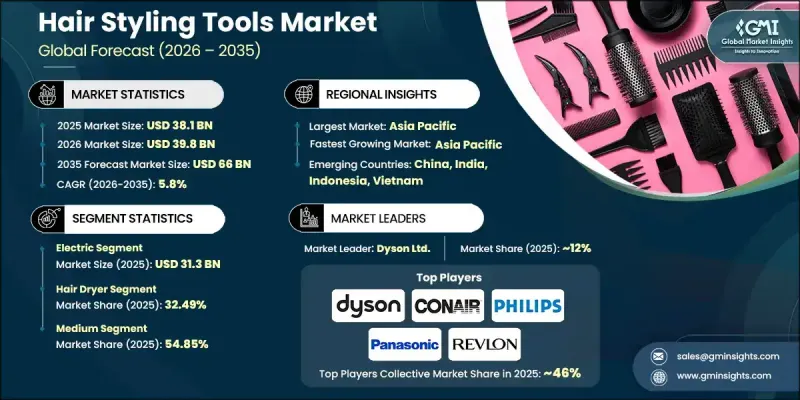
这一增长主要源自于消费者在日常生活、职场和社交场合中日益重视整装仪容。美髮工具越来越被视为必备品,能够帮助消费者在家中轻鬆打造专业级造型,且更便利灵活。消费者对自身形象标准的日益重视,促使他们投资购买适合不同髮质和造型偏好的工具,从而带动了各年龄层消费者的消费增长。实体店和电商平台的普及进一步增强了市场需求,使消费者能够轻鬆比较产品的功能、价格和易用性。强调产品简洁、安全和性能的品牌讯息持续影响消费者的购买行为,尤其是在首次购买者。此外,消费者越来越重视自我护理,并将美髮工具融入日常整装仪容打理,从而推动了重复购买。这些因素共同支撑着强劲的全球需求和持续的市场扩张。
| 市场覆盖范围 | |
|---|---|
| 开始年份 | 2025 |
| 预测年份 | 2026-2035 |
| 起始值 | 381亿美元 |
| 预测金额 | 660亿美元 |
| 复合年增长率 | 5.8% |
预计2025年,电动美髮工具市场规模将达3,13亿美元,2026年至2035年的复合年增长率(CAGR)为6.1%。该市场主导的地位得益于其卓越的性能、稳定的功率输出以及对各种髮质的适应性。先进的温度控制和以用户为中心的设计提高了造型的精准度,同时降低了头髮损伤的风险,使电动美髮工具成为个人和商用的热门选择。
预计到2025年,吹风机市占率将达到32.49%,并预计在2035年之前以6.5%的复合年增长率成长。整装仪容在日常仪容打理中的重要作用,以及其高效的干髮效果和多样化的造型功能,推动了其日益增长的受欢迎程度。而能够提升气流控制和头髮保护性能的技术创新,也持续激发消费者的购买热情。
中国美髮造型工具市场预计到2025年将达到48亿美元,2026年至2035年复合年增长率(CAGR)为6.3%。市场成长的主要驱动因素包括都市化加快、可支配所得增加、个人仪容意识提升。专业美容服务的拓展和零售分销网络的扩张也进一步增强了市场需求和品牌知名度。
目录
第一章调查方法和范围
第二章执行摘要
第三章业界考察
- 生态系分析
- 供应商情况
- 利润率
- 每个阶段的附加价值
- 影响价值链的因素
- 产业影响因素
- 司机
- 消费者对整装仪容和外表的关注度日益提高。
- 在全球拓展专业沙龙和水疗服务
- 社群媒体和美妆部落客的影响力日益增长
- 挑战与困难
- 频繁使用热工具会伤害头髮。
- 新兴市场和大众消费族群对价格高度敏感
- 机会
- 对无线便携式造型工具的需求不断增长
- 配备温度感测器和应用程式连接功能的智慧工具正变得越来越受欢迎。
- 司机
- 成长潜力分析
- 未来市场趋势
- 科技与创新趋势
- 当前技术趋势
- 新兴技术
- 价格趋势
- 按地区
- 副产品
- 监管环境
- 标准和合规要求
- 区域法规结构
- 认证标准
- 贸易统计(HS编码-8516)
- 主要进口国
- 主要出口国
- 波特分析
- PESTEL 分析
第四章 竞争情势
- 介绍
- 公司市占率分析
- 按地区
- 北美洲
- 欧洲
- 亚太地区
- 拉丁美洲
- 中东和非洲
- 按地区
- 企业矩阵分析
- 主要市场公司的竞争分析
- 竞争定位矩阵
- 重大进展
- 併购
- 伙伴关係与合作
- 新产品发布
- 扩张计划
第五章 按类型分類的市场估算与预测,2022-2035年
- 手动的
- 电的
第六章 依产品类型分類的市场估算与预测,2022-2035年
- 捲髮器
- 吹风机
- 直髮器
- 压接工具和韦伯
- 髮刷和梳子
- 多功能造型器
- 其他的
第七章 2022-2035年按价格区间分類的市场估计与预测
- 低价位
- 中号
- 高价位范围
第八章 按应用领域分類的市场估算与预测,2022-2035年
- 家用
- 商业的
9. 2022-2035年按分销管道分類的市场估算与预测
- 离线
- 在线的
第十章 2022-2035年各地区市场估计与预测
- 北美洲
- 我们
- 加拿大
- 欧洲
- 德国
- 英国
- 法国
- 义大利
- 西班牙
- 亚太地区
- 中国
- 印度
- 日本
- 韩国
- 澳洲
- 拉丁美洲
- 巴西
- 墨西哥
- 阿根廷
- 中东和非洲
- 沙乌地阿拉伯
- 阿拉伯聯合大公国
- 南非
第十一章:公司简介
- Andis Company
- Bio Ionic
- Conair Corporation
- Dyson Ltd.
- Elchim
- FHI Brands
- GHD(Good Hair Day)
- Helen of Troy
- Panasonic Corporation
- Philips
- Revlon
- Spectrum Brands
- T3 Micro
- TESCOM
- Wahl Clipper Corporation
The Global Hair Styling Tools Market was valued at USD 38.1 billion in 2025 and is estimated to grow at a CAGR of 5.8% to reach USD 66 billion by 2035.
Growth is supported by rising consumer focus on personal grooming and appearance across daily, professional, and social settings. Hair styling tools are increasingly viewed as essential devices that enable consumers to achieve professional-looking results at home with greater convenience and control. Growing awareness of appearance standards has encouraged individuals to invest in tools suited to diverse hair textures and styling preferences, driving higher spending across demographics. Improved accessibility through both physical retail and digital commerce platforms has further strengthened demand, allowing consumers to compare features, pricing, and usability with ease. Brand messaging that highlights simplicity, safety, and performance continues to influence purchasing behavior, especially among first-time buyers. Additionally, the growing emphasis on self-care routines has increased repeat purchases, as users integrate styling tools into their regular grooming habits. These combined factors continue to support strong global demand and sustained market expansion.
| Market Scope | |
|---|---|
| Start Year | 2025 |
| Forecast Year | 2026-2035 |
| Start Value | $38.1 Billion |
| Forecast Value | $66 Billion |
| CAGR | 5.8% |
The electric hair styling tools segment generated USD 31.3 billion in 2025 and is projected to grow at a CAGR of 6.1% from 2026 to 2035. This segment leads due to its superior performance, consistent output, and adaptability across hair types. Advanced temperature regulation and user-focused designs enhance styling precision while reducing the risk of hair damage, making electric tools widely preferred for both personal and professional use.
The hair dryers segment accounted for 32.49% share in 2025 and is expected to register a CAGR of 6.5% through 2035. Their widespread adoption is supported by their role in daily grooming routines and their ability to combine drying efficiency with styling versatility. Technological advancements that improve airflow control and hair protection continue to boost consumer appeal.
China Hair Styling Tools Market reached USD 4.8 billion in 2025 and is forecast to grow at a CAGR of 6.3% from 2026 to 2035. Market growth is driven by urbanization, rising disposable incomes, and increasing awareness of personal grooming. Expanding professional beauty services and broader retail availability are also strengthening demand and brand visibility.
Key companies operating in the Global Hair Styling Tools Market include Dyson Ltd., Philips, Panasonic Corporation, Conair Corporation, GHD (Good Hair Day), Revlon, Helen of Troy, Spectrum Brands, Wahl Clipper Corporation, Andis Company, T3 Micro, Bio Ionic, FHI Brands, Elchim, and TESCOM. Companies in the Global Hair Styling Tools Market focus on reinforcing their market position through continuous product innovation and design enhancement. Manufacturers invest in advanced heating technologies, improved safety features, and ergonomic designs to elevate user experience. Strong branding and targeted digital marketing help attract new consumers while maintaining loyalty among existing users. Expanding direct-to-consumer platforms and strengthening retail partnerships improve global reach and accessibility. Many players also emphasize product differentiation through premium positioning and performance-based value propositions.
Table of Contents
Chapter 1 Methodology & Scope
- 1.1 Market scope and definition
- 1.2 Research design
- 1.2.1 Research approach
- 1.2.2 Data collection methods
- 1.3 Data mining sources
- 1.3.1 Global
- 1.3.2 Regional/Country
- 1.4 Base estimates and calculations
- 1.4.1 Base year calculation
- 1.4.2 Key trends for market estimation
- 1.5 Primary research and validation
- 1.5.1 Primary sources
- 1.6 Forecast model
- 1.7 Research assumptions and limitations
Chapter 2 Executive Summary
- 2.1 Industry 360° synopsis
- 2.2 Key market trends
- 2.2.1 Regional
- 2.2.2 Type
- 2.2.3 Product type
- 2.2.4 Price range
- 2.2.5 Application
- 2.2.6 Distribution channel
- 2.3 CXO perspectives: Strategic imperatives
- 2.3.1 Key decision points for industry executives
- 2.3.2 Critical success factors for market players
- 2.4 Future outlook and strategic recommendations
Chapter 3 Industry Insights
- 3.1 Industry ecosystem analysis
- 3.1.1 Supplier landscape
- 3.1.2 Profit margin
- 3.1.3 Value addition at each stage
- 3.1.4 Factor affecting the value chain
- 3.2 Industry impact forces
- 3.2.1 Growth drivers
- 3.2.1.1 Growing consumer focus on personal grooming and appearance
- 3.2.1.2 Expansion of professional salon and spa services globally
- 3.2.1.3 Rising influence of social media and beauty influencers
- 3.2.2 Pitfalls & Challenges
- 3.2.2.1 Risk of hair damage associated with frequent heat exposure
- 3.2.2.2 High price sensitivity in emerging and mass consumer segments
- 3.2.3 Opportunities
- 3.2.3.1 Growing demand for cordless and travel-friendly styling tools
- 3.2.3.2 Rising adoption of smart tools with temperature sensors and app connectivity
- 3.2.1 Growth drivers
- 3.3 Growth potential analysis
- 3.4 Future market trends
- 3.5 Technology and innovation landscape
- 3.5.1 Current technological trends
- 3.5.2 Emerging technologies
- 3.6 Price trends
- 3.6.1 By region
- 3.6.2 By product
- 3.7 Regulatory landscape
- 3.7.1 Standards and compliance requirements
- 3.7.2 Regional regulatory frameworks
- 3.7.3 Certification standards
- 3.8 Trade statistics (HS Code - 8516)
- 3.8.1 Major importing countries
- 3.8.2 Major exporting countries
- 3.9 Porter';s analysis
- 3.10 PESTEL analysis
Chapter 4 Competitive Landscape, 2025
- 4.1 Introduction
- 4.2 Company market share analysis
- 4.2.1 By Region
- 4.2.1.1 North America
- 4.2.1.2 Europe
- 4.2.1.3 Asia Pacific
- 4.2.1.4 Latin America
- 4.2.1.5 Middle East & Africa
- 4.2.1 By Region
- 4.3 Company matrix analysis
- 4.4 Competitive analysis of major market players
- 4.5 Competitive positioning matrix
- 4.6 Key developments
- 4.6.1 Mergers & acquisitions
- 4.6.2 Partnerships & collaborations
- 4.6.3 New product launches
- 4.6.4 Expansion plans
Chapter 5 Market Estimates & Forecast, By Type, 2022 - 2035, (USD Billion) (Thousand Units)
- 5.1 Key trends
- 5.2 Manual
- 5.3 Electric
Chapter 6 Market Estimates & Forecast, By Product Type, 2022 - 2035, (USD Billion) (Thousand Units)
- 6.1 Key trends
- 6.2 Hair curler
- 6.3 Hair dryer
- 6.4 Hair straightener
- 6.5 Crimpers and wavers
- 6.6 Hairbrushes & combs
- 6.7 Multistylers
- 6.8 Others
Chapter 7 Market Estimates & Forecast, By Price Range, 2022 - 2035, (USD Billion) (Thousand Units)
- 7.1 Key trends
- 7.2 Low
- 7.3 Medium
- 7.4 High
Chapter 8 Market Estimates & Forecast, By Application, 2022 - 2035, (USD Billion) (Thousand Units)
- 8.1 Key trends
- 8.2 Household
- 8.3 Commercial
Chapter 9 Market Estimates & Forecast, By Distribution Channel, 2022 - 2035, (USD Billion) (Thousand Units)
- 9.1 Key trends
- 9.2 Offline
- 9.3 Online
Chapter 10 Market Estimates & Forecast, By Region, 2022 - 2035, (USD Billion) (Thousand Units)
- 10.1 Key trends
- 10.2 North America
- 10.2.1 U.S.
- 10.2.2 Canada
- 10.3 Europe
- 10.3.1 Germany
- 10.3.2 UK
- 10.3.3 France
- 10.3.4 Italy
- 10.3.5 Spain
- 10.4 Asia Pacific
- 10.4.1 China
- 10.4.2 India
- 10.4.3 Japan
- 10.4.4 South Korea
- 10.4.5 Australia
- 10.5 Latin America
- 10.5.1 Brazil
- 10.5.2 Mexico
- 10.5.3 Argentina
- 10.6 MEA
- 10.6.1 Saudi Arabia
- 10.6.2 UAE
- 10.6.3 South Africa
Chapter 11 Company Profiles
- 11.1 Andis Company
- 11.2 Bio Ionic
- 11.3 Conair Corporation
- 11.4 Dyson Ltd.
- 11.5 Elchim
- 11.6 FHI Brands
- 11.7 GHD (Good Hair Day)
- 11.8 Helen of Troy
- 11.9 Panasonic Corporation
- 11.10 Philips
- 11.11 Revlon
- 11.12 Spectrum Brands
- 11.13 T3 Micro
- 11.14 TESCOM
- 11.15 Wahl Clipper Corporation

 美髮造型设备市场:2026-2032年全球市场预测(依产品、电源、价格范围、最终用户及通路划分)髮胶喷雾市场:2026-2032年全球市场预测(依产品类型、最终用户、应用、配方及通路划分)
 全球美髮造型产品市场规模、份额、趋势及成长分析报告(2026-2034)全球美髮造型工具市场规模、份额、趋势及成长分析报告(2026-2034年)
 美髮产品及造型工具市场分析及预测(至2035年):依类型、产品、技术、应用、形态、材料类型、最终用户、功能、安装类型及解决方案划分全球髮蜡棒市场规模、份额、趋势和成长分析报告(2026-2034年)
 头髮最后加工棒市场机会、成长要素、产业趋势分析及预测(2026年至2035年)男士刮鬍刀市场按电源、使用方式、技术、最终用户和通路划分-2026-2032年全球预测
 美髮造型产品市场规模、份额和成长分析(按类别、配方、类型、价格分布、性别、最终用途、分销管道和地区划分)—2026-2033年行业预测
 美髮造型工具市场规模、份额及成长分析(按产品、通路、应用及地区划分)-产业预测(2026-2033)