


 |
市场调查报告书
商品编码
1928916
汽车软体市场机会、成长要素、产业趋势分析及2026年至2035年预测Automotive Software Market Opportunity, Growth Drivers, Industry Trend Analysis, and Forecast 2026 - 2035 |
||||||

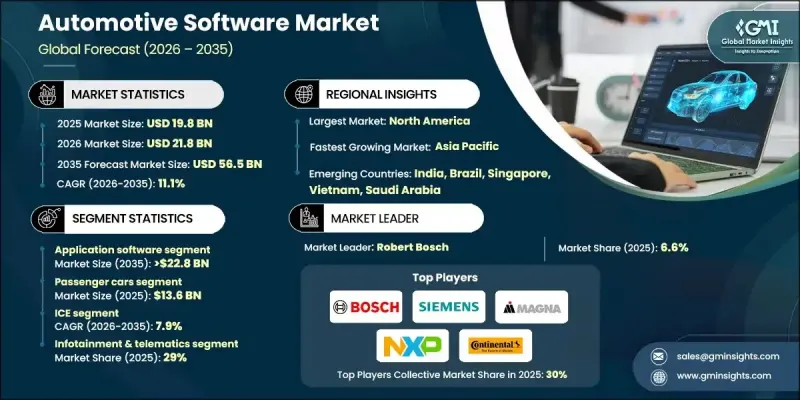
全球汽车软体市场预计到 2025 年将达到 198 亿美元,到 2035 年将达到 565 亿美元,年复合成长率为 11.1%。
随着汽车製造商从传统的以硬体为中心的架构转向软体定义汽车,整个产业正在经历一场变革。这种以软体解决方案支撑关键功能、性能和差异化的演进,正在推动对贯穿整个车辆生命週期的作业系统、中间件和应用程式的需求。电动车和电动化汽车的兴起,增加了电池管理、能量优化、热力系统和电力电子等领域的软体复杂性。与内燃机车相比,电动车的单车软体含量更高,进一步扩大了市场。监管机构对安全性的要求以及消费者对高阶驾驶辅助系统(ADAS)的期望,正在加速ADAS的普及。 ADAS依赖即时软体进行感测器整合、决策和控制。联网汽车平台、空中下载(OTA)更新和远端资讯处理技术,不仅在销售点之外创造了持续的收入,也提升了车辆的功能。车辆架构正朝着集中式和分区式运算的方向发展,从而提高了系统范围内的软体整合度和效率。
| 市场覆盖范围 | |
|---|---|
| 开始年份 | 2025 |
| 预测年份 | 2026-2035 |
| 起始值 | 198亿美元 |
| 预测金额 | 565亿美元 |
| 复合年增长率 | 11.1% |
预计到2025年,乘用车市场规模将达到136亿美元,占全球市场份额的68%。乘用车正日益采用软体定义架构,从而实现先进的资讯娱乐系统、高级驾驶辅助系统(ADAS)以及个人化的空中下载(OTA)更新。这些功能提升了用户体验,实现了车辆的持续升级,并延长了车辆的生命週期价值,使软体成为汽车製造商的关键差异化优势。
预计2026年至2035年间,内燃机(ICE)市场将以7.9%的复合年增长率成长。儘管电动车(EV)蓬勃发展,但内燃机汽车仍依赖软体来监控引擎性能、满足排放气体法规并确保机械安全。製造商不断发布软体更新,以提高效率、确保合规性并提供渐进式功能增强,从而维持了对汽车软体解决方案的持续需求。
预计2025年,美国汽车软体市场规模将达38亿美元。美国汽车製造商和电动汽车Start-Ups正优先采用软体定义架构、集中式运算和空中下载(OTA)更新。持续的软体创新使企业能够实现车辆的数位化差异化,从而在以硬体为中心的升级方式中脱颖而出,并在整个生命週期内提升车辆功能。
目录
第一章调查方法
第二章执行摘要
第三章业界考察
- 生态系分析
- 供应商情况
- 利润率分析
- 成本结构
- 每个阶段的附加价值
- 影响价值链的因素
- 中断
- 产业影响因素
- 司机
- 软体定义车辆
- 电动车的普及
- ADAS与安全法规
- 联网汽车和OTA
- 车辆电气化法规
- 产业潜在风险与挑战
- 软体复杂性与整合挑战
- 网路安全和资料隐私问题
- 市场机会
- 订阅软体获利
- 集中式建筑与分区式建筑
- 整合人工智慧和数据分析
- 新兴市场与新型旅游模式
- 成长潜力分析
- 监管环境
- 北美洲
- 美国:NHTSA汽车网路安全最佳实践
- 加拿大:加拿大机动车辆安全标准(CMVSS)
- 欧洲
- 英国:联合国欧洲经济委员会第13号条例-车辆煞车与稳定性控制系统
- 德国:ISO 26262 - 道路车辆电气和电子系统的功能安全
- 法国:联合国欧洲经济委员会第79号条例-转向与车辆控制系统
- 义大利:ISO 21434 - 道路车辆网路安全工程
- 西班牙:ISO 14001 - 环境管理体系
- 亚太地区
- 中国:GB/T 38628 - 汽车软体和OTA更新安全要求
- 日本:ISO 26262 - 道路车辆电气和电子系统的功能安全
- 印度:AIS 155 - 汽车软体的网路安全和OTA要求
- 拉丁美洲
- 巴西:ABNT NBR ISO 26262 - 道路车辆功能安全
- 墨西哥:NOM-194-SCFI-车辆安全性能标准
- 阿根廷:ISO 9001 - 汽车软体开发品质管理体系
- 中东和非洲
- 阿联酋:联合国欧洲经济委员会第155号条例-网路安全与网路安全管理系统
- 南非:ISO 26262 - 道路车辆电气和电子系统的功能安全
- 沙乌地阿拉伯:SASO汽车技术法规 - 网路安全和软体合规性
- 北美洲
- 波特分析
- PESTEL 分析
- 技术与创新展望
- 当前技术趋势
- 新兴技术
- 成本細項分析
- 开发成本结构
- 研发成本分析
- 行销和销售成本
- 专利分析
- 永续性和环境方面
- 永续实践
- 减少废弃物策略
- 生产中的能源效率
- 环保倡议
- 未来市场展望与机会
- 汽车软体架构和堆迭分析
- 汽车软体堆迭架构
- 集中式与分区式电子电气架构的影响
- 硬体和软体分离的趋势
- 汽车製造商的软体策略及内部开发与外包框架
- 汽车製造商内部软体开发趋势
- 决定是自主开发、外包还是共同开发
- 对一级软体供应商和独立软体供应商的影响
- 软体货币化和收入模式
- 汽车软体负责人和采购分析
- 对数据、云端和OTA生态系统的依赖
第四章 竞争情势
- 介绍
- 公司市占率分析
- 北美洲
- 欧洲
- 亚太地区
- 拉丁美洲
- 中东和非洲
- 主要市场公司的竞争分析
- 竞争定位矩阵
- 战略展望矩阵
- 重大进展
- 併购
- 伙伴关係与合作
- 新产品发布
- 企业扩张计画和资金筹措
第五章 依产品类型分類的市场估算与预测,2022-2035年
- 作业系统
- 中介软体
- 应用软体
第六章 依车辆类型分類的市场估计与预测,2022-2035年
- 搭乘用车
- 掀背车
- 轿车
- SUV
- 商用车辆
- 轻型商用车(LCV)
- 中型商用车(MCV)
- 重型商用车(HCV)
7. 2022-2035年按推进方式分類的市场估计与预测
- 内燃机(ICE)
- 电动车
- 电池式电动车(BEV)
- PHEV
- 燃料电池汽车(FCEV)
第八章 依实施类型分類的市场估算与预测,2022-2035年
- 基于云端的
- 本地部署
第九章 依销售管道分類的市场估计与预测,2022-2035年
- OEM
- 售后市场
第十章 依应用领域分類的市场估计与预测,2022-2035年
- 安全系统
- 资讯娱乐和车载资讯系统
- 动力传动系统和底盘
- 身体控制和舒适度
- 其他的
第十一章 2022-2035年各地区市场估计与预测
- 北美洲
- 我们
- 加拿大
- 欧洲
- 德国
- 英国
- 法国
- 义大利
- 西班牙
- 俄罗斯
- 北欧国家
- 葡萄牙
- 克罗埃西亚
- 比荷卢经济联盟
- 亚太地区
- 中国
- 印度
- 日本
- 澳洲
- 韩国
- 新加坡
- 泰国
- 印尼
- 越南
- 拉丁美洲
- 巴西
- 墨西哥
- 阿根廷
- 哥伦比亚
- 中东和非洲
- 南非
- 沙乌地阿拉伯
- 阿拉伯聯合大公国
- 土耳其
第十二章:公司简介
- 世界玩家
- Robert Bosch
- NVIDIA
- Siemens
- Continental
- Aptiv
- NXP Semiconductors
- Denso
- Magna International
- HARMAN International
- Qualcomm Technologies
- Intel
- Samsung Electronics
- 区域玩家
- Valeo
- ZF Friedrichshafen
- Hitachi Astemo
- Panasonic Automotive
- Renesas Electronics
- Tata Elxsi
- KPIT Technologies
- Luxoft
- Elektrobit
- TomTom
- Emerging/Disruptor Players
- BlackBerry
- Mobileye
- Aurora Innovation
- Wind River Systems
- Sonatus
- CARIAD
- Arrival Software
- ECARX
The Global Automotive Software Market was valued at USD 19.8 billion in 2025 and is estimated to grow at a CAGR of 11.1% to reach USD 56.5 billion by 2035.
The industry is transformed as automakers shift from traditional hardware-focused architectures to software-defined vehicles, where key features, performance, and differentiation rely on software solutions. This evolution is fueling demand for operating systems, middleware, and applications throughout the entire vehicle lifecycle. The rise of electric and electrified vehicles has added software complexity in areas such as battery management, energy optimization, thermal systems, and power electronics. Compared with internal combustion engine vehicles, EVs require more software content per unit, further expanding the market. Regulatory mandates for safety and consumer expectations for advanced driving assistance are accelerating the adoption of ADAS, relying on real-time software for sensor integration, decision-making, and control. Connected vehicle platforms, over-the-air updates, and telematics are generating recurring revenue and enhancing vehicle functionality beyond the point of sale. Vehicle architectures are evolving toward centralized and zonal computing, increasing software integration and efficiency across systems.
| Market Scope | |
|---|---|
| Start Year | 2025 |
| Forecast Year | 2026-2035 |
| Start Value | $19.8 Billion |
| Forecast Value | $56.5 Billion |
| CAGR | 11.1% |
The passenger car segment held 68% share and was valued at USD 13.6 billion in 2025. Passenger vehicles are increasingly leveraging software-defined architectures, enabling advanced infotainment, ADAS, and personalized OTA updates. These capabilities enhance user experience, allow continuous vehicle upgrades, and extend lifecycle value, positioning software as a key differentiator for automakers.
The internal combustion engine (ICE) segment is expected to grow at a CAGR of 7.9% between 2026 and 2035. Despite the rise of EVs, ICE vehicles continue to rely on software to monitor engine performance, emissions compliance, and mechanical safety. Manufacturers release software updates to improve efficiency, ensure regulatory compliance, and introduce incremental enhancements, maintaining ongoing demand for automotive software solutions.
U.S. Automotive Software Market reached USD 3.8 billion in 2025. Automakers and EV startups in the U.S. are prioritizing software-defined architectures, centralized computing, and over-the-air functionality. Continuous software innovation allows companies to differentiate their vehicles digitally, providing competitive advantages over hardware-focused upgrades and enhancing vehicle features throughout the lifecycle.
Key players operating in the Global Automotive Software Market include Continental, Aptiv, HARMAN International, NVIDIA, Robert Bosch, Siemens, Denso, Magna International, and NXP Semiconductors. Companies in the Global Automotive Software Market are strengthening their positions through strategic innovation, partnerships, and expansion into new markets. Investment in research and development enables them to offer advanced software platforms for connected, electric, and autonomous vehicles. Strategic collaborations with OEMs and technology firms enhance product integration and accelerate adoption. Over-the-air software deployment, cybersecurity features, and continuous updates create recurring revenue opportunities and improve customer loyalty. Geographic expansion, targeted acquisitions, and open-platform ecosystems allow firms to access broader markets while maintaining technological leadership and competitive differentiation.
Table of Contents
Chapter 1 Methodology
- 1.1 Research approach
- 1.2 Quality commitments
- 1.2.1 GMI AI policy & data integrity commitment
- 1.3 Research trail & confidence scoring
- 1.3.1 Research trail components
- 1.3.2 Scoring components
- 1.4 Data collection
- 1.4.1 Partial list of primary sources
- 1.5 Data mining sources
- 1.5.1 Paid sources
- 1.6 Base estimates and calculations
- 1.6.1 Base year calculation
- 1.7 Forecast
- 1.8 Research transparency addendum
Chapter 2 Executive Summary
- 2.1 Industry 360° synopsis, 2022 - 2035
- 2.2 Key market trends
- 2.2.1 Regional
- 2.2.2 Offering
- 2.2.3 Vehicle
- 2.2.4 Propulsion
- 2.2.5 Deployment mode
- 2.2.6 Sales channel
- 2.2.7 Application
- 2.3 TAM Analysis, 2026-2034
- 2.4 CXO perspectives: Strategic imperatives
- 2.4.1 Executive decision points
- 2.4.2 Critical success factors
- 2.5 Future outlook & strategic recommendations
Chapter 3 Industry Insights
- 3.1 Industry ecosystem analysis
- 3.1.1 Supplier landscape
- 3.1.2 Profit margin analysis
- 3.1.3 Cost structure
- 3.1.4 Value addition at each stage
- 3.1.5 Factor affecting the value chain
- 3.1.6 Disruptions
- 3.2 Industry impact forces
- 3.2.1.1 Growth drivers
- 3.2.1.2 Software-defined vehicles
- 3.2.1.3 Electric vehicle adoption
- 3.2.1.4 ADAS and safety regulations
- 3.2.1.5 Connected vehicles and OTA
- 3.2.1.6 Vehicle electrification regulations
- 3.2.2 Industry pitfalls and challenges
- 3.2.2.1 Software complexity and integration challenges
- 3.2.2.2 Cybersecurity and data privacy concerns
- 3.2.3 Market opportunities
- 3.2.3.1 Subscription-based software monetization
- 3.2.3.2 Centralized and zonal architectures
- 3.2.3.3 AI and data analytics integration
- 3.2.3.4 Emerging markets and new mobility models
- 3.3 Growth potential analysis
- 3.4 Regulatory landscape
- 3.4.1 North America
- 3.4.1.1 United States: NHTSA Automotive Cybersecurity Best Practices
- 3.4.1.2 Canada: Canadian Motor Vehicle Safety Standards (CMVSS)
- 3.4.2 Europe
- 3.4.2.1 United Kingdom: UNECE Regulation No. 13 - Vehicle Braking and Stability Systems
- 3.4.2.2 Germany: ISO 26262 - Functional Safety of Electrical and Electronic Systems in Road Vehicles
- 3.4.2.3 France: UNECE Regulation No. 79 - Steering and Vehicle Control Systems
- 3.4.2.4 Italy: ISO 21434 - Road Vehicles Cybersecurity Engineering
- 3.4.2.5 Spain: ISO 14001 - Environmental Management Systems
- 3.4.3 Asia Pacific
- 3.4.3.1 China: GB/T 38628 - Automotive Software and OTA Update Security Requirements
- 3.4.3.2 Japan: ISO 26262 - Functional Safety of Electrical and Electronic Systems in Road Vehicles
- 3.4.3.3 India: AIS 155 - Cybersecurity and OTA Requirements for Automotive Software
- 3.4.4 Latin America
- 3.4.4.1 Brazil: ABNT NBR ISO 26262 - Functional Safety for Road Vehicles
- 3.4.4.2 Mexico: NOM-194-SCFI - Vehicle Safety and Performance Standards
- 3.4.4.3 Argentina: ISO 9001 - Quality Management Systems for Automotive Software Development
- 3.4.5 Middle East & Africa
- 3.4.5.1 United Arab Emirates: UNECE Regulation No. 155 - Cybersecurity and Cybersecurity Management Systems
- 3.4.5.2 South Africa: ISO 26262 - Functional Safety of Electrical and Electronic Systems in Road Vehicles
- 3.4.5.3 Saudi Arabia: SASO Automotive Technical Regulations - Cybersecurity and Software Compliance
- 3.4.1 North America
- 3.5 Porter';s analysis
- 3.6 PESTEL analysis
- 3.7 Technology and innovation landscape
- 3.7.1 Current technological trends
- 3.7.2 Emerging technologies
- 3.8 Cost breakdown analysis
- 3.8.1 Development cost structure
- 3.8.2 R&D cost analysis
- 3.8.3 Marketing & sales costs
- 3.9 Patent analysis
- 3.10 Sustainability and environmental aspects
- 3.10.1 Sustainable practices
- 3.10.2 Waste reduction strategies
- 3.10.3 Energy efficiency in production
- 3.10.4 Eco-friendly Initiatives
- 3.11 Future market outlook & opportunities
- 3.12 Automotive Software Architecture & Stack Analysis
- 3.12.1 Automotive software stack architecture
- 3.12.2 Centralized vs zonal E/E architecture impact
- 3.12.3 Hardware-software decoupling trends
- 3.13 OEM Software Strategy & Build-vs-Buy Framework
- 3.13.1 OEM in-house software development trends
- 3.13.2 Build vs buy vs co-develop decisions
- 3.13.3 Impact on Tier-1 and independent software vendors
- 3.14 Software Monetization & Revenue Models
- 3.15 Automotive Software Buyer & Procurement Analysis
- 3.16 Data, Cloud & OTA Ecosystem Dependencies
Chapter 4 Competitive Landscape, 2025
- 4.1 Introduction
- 4.2 Company market share analysis
- 4.2.1 North America
- 4.2.2 Europe
- 4.2.3 Asia Pacific
- 4.2.4 LATAM
- 4.2.5 MEA
- 4.3 Competitive analysis of major market players
- 4.4 Competitive positioning matrix
- 4.5 Strategic outlook matrix
- 4.6 Key developments
- 4.6.1 Mergers & acquisitions
- 4.6.2 Partnerships & collaborations
- 4.6.3 New Product Launches
- 4.6.4 Expansion Plans and funding
Chapter 5 Market Estimates & Forecast, By Offering, 2022 - 2035 ($Bn)
- 5.1 Key trends
- 5.2 Operating system
- 5.3 Middleware
- 5.4 Application software
Chapter 6 Market Estimates & Forecast, By Vehicle, 2022 - 2035 ($Bn)
- 6.1 Key trends
- 6.2 Passenger cars
- 6.2.1 Hatchback
- 6.2.2 Sedan
- 6.2.3 SUV
- 6.3 Commercial vehicles
- 6.3.1 Light Commercial Vehicles (LCV)
- 6.3.2 Medium Commercial Vehicles (MCV)
- 6.3.3 Heavy Commercial Vehicles (HCV)
Chapter 7 Market Estimates & Forecast, By Propulsion, 2022 - 2035 ($Bn)
- 7.1 Key trends
- 7.2 ICE
- 7.3 Electric vehicle
- 7.3.1 BEV
- 7.3.2 PHEV
- 7.3.3 FCEV
Chapter 8 Market Estimates & Forecast, By Deployment mode, 2022 - 2035 ($Bn)
- 8.1 Key trends
- 8.2 Cloud based
- 8.3 On premises
Chapter 9 Market Estimates & Forecast, By Sales Channel, 2022 - 2035 ($Bn)
- 9.1 Key trends
- 9.2 OEM
- 9.3 Aftermarket
Chapter 10 Market Estimates & Forecast, By Application, 2022 - 2035 ($Bn)
- 10.1 Key trends
- 10.2 Safety systems
- 10.3 Infotainment & telematics
- 10.4 Powertrain & chassis
- 10.5 Body control & comfort
- 10.6 Others
Chapter 11 Market Estimates & Forecast, By Region, 2022 - 2035 ($Bn)
- 11.1 Key trends
- 11.2 North America
- 11.2.1 US
- 11.2.2 Canada
- 11.3 Europe
- 11.3.1 Germany
- 11.3.2 UK
- 11.3.3 France
- 11.3.4 Italy
- 11.3.5 Spain
- 11.3.6 Russia
- 11.3.7 Nordics
- 11.3.8 Portugal
- 11.3.9 Croatia
- 11.3.10 Benelux
- 11.4 Asia Pacific
- 11.4.1 China
- 11.4.2 India
- 11.4.3 Japan
- 11.4.4 Australia
- 11.4.5 South Korea
- 11.4.6 Singapore
- 11.4.7 Thailand
- 11.4.8 Indonesia
- 11.4.9 Vietnam
- 11.5 Latin America
- 11.5.1 Brazil
- 11.5.2 Mexico
- 11.5.3 Argentina
- 11.5.4 Colombia
- 11.6 MEA
- 11.6.1 South Africa
- 11.6.2 Saudi Arabia
- 11.6.3 UAE
- 11.6.4 Turkey
Chapter 12 Company Profiles
- 12.1 Global Players
- 12.1.1 Robert Bosch
- 12.1.2 NVIDIA
- 12.1.3 Siemens
- 12.1.4 Continental
- 12.1.5 Aptiv
- 12.1.6 NXP Semiconductors
- 12.1.7 Denso
- 12.1.8 Magna International
- 12.1.9 HARMAN International
- 12.1.10 Qualcomm Technologies
- 12.1.11 Intel
- 12.1.12 Samsung Electronics
- 12.2 Regional Players
- 12.2.1 Valeo
- 12.2.2 ZF Friedrichshafen
- 12.2.3 Hitachi Astemo
- 12.2.4 Panasonic Automotive
- 12.2.5 Renesas Electronics
- 12.2.6 Tata Elxsi
- 12.2.7 KPIT Technologies
- 12.2.8 Luxoft
- 12.2.9 Elektrobit
- 12.2.10 TomTom
- 12.3 Emerging / Disruptor Players
- 12.3.1 BlackBerry
- 12.3.2 Mobileye
- 12.3.3 Aurora Innovation
- 12.3.4 Wind River Systems
- 12.3.5 Sonatus
- 12.3.6 CARIAD
- 12.3.7 Arrival Software
- 12.3.8 ECARX

 电池管理系统硬体在环测试市场(按最终用途、车辆类型、组件类型、测试模式、应用和BMS类型划分),全球预测,2026-2032年
 汽车保固管理软体市场规模、份额和成长分析(按产品类型、部署模式、组织规模、垂直产业和地区划分)-2026-2033年产业预测
 全球汽车终端认证市场规模、份额、趋势和成长分析报告(2026-2034)汽车软体市场规模、占有率、成长及全球产业分析:依类型、应用和地区划分的洞察与预测(2026-2034)
 汽车软体市场-全球产业规模、份额、趋势、机会及预测(依车辆类型、应用、软体层级、地区及竞争格局划分,2021-2031年)高阶驾驶辅助系统的硬体在环测试市场,按测试类型、测试阶段、车辆类型和应用划分,全球预测(2026-2032年)
 汽车软体:市场占有率分析、产业趋势与统计、成长预测(2026-2031)
 日本汽车软体市场按产品类型、车辆类型、应用和地区划分,2026-2034年
 汽车软体市场规模、份额和成长分析(按软体类型、应用、最终用途、部署类型和地区划分)-2026-2033年产业预测
 车载娱乐系统市场预测至2032年:按系统类型、组件、车辆类型、通路和地区分類的全球分析