


 |
市场调查报告书
商品编码
1928939
液体洗手剂市场机会、成长要素、产业趋势分析及2026年至2035年预测Liquid Hand Soap Market Opportunity, Growth Drivers, Industry Trend Analysis, and Forecast 2026 - 2035 |
||||||

全球液体洗手剂市场预计到 2025 年价值 90 亿美元,到 2035 年将达到 164 亿美元,年复合成长率为 6.2%。
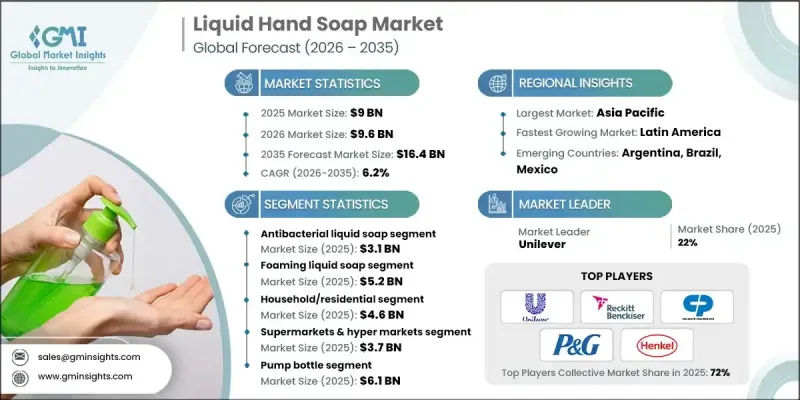
市场扩张主要受个人卫生意识提升的推动,尤其是在新冠疫情爆发后,勤洗手已成为家庭和机构的日常习惯。卫生标准的强化监管和持续进行的公共卫生宣传活动巩固了洗手剂液作为全球必备卫生用品的地位。消费者偏好正转向天然、植物和环保配方,许多新产品都采用有机和植物成分。各公司正加速研发使用芦荟、草本萃取物和精油的产品,以吸引註重健康和环保的消费者。新兴国家可支配收入的成长进一步推动了对具有卓越护肤功效、怡人香氛和环保包装的高端洗手剂的需求。高端趋势、永续配方以及家用和商用领域的科技创新,都推动着市场持续发展。
| 市场覆盖范围 | |
|---|---|
| 开始年份 | 2025 |
| 预测年份 | 2026-2035 |
| 起始值 | 90亿美元 |
| 预测金额 | 164亿美元 |
| 复合年增长率 | 6.2% |
预计2025年,抗菌液体肥皂市场规模将达31亿美元。其主导地位主要得益于家庭、医疗保健和商业环境中对杀菌防护的强劲需求。监管合规性、频繁使用和品牌忠诚度也为其强大的市场地位做出了贡献。
预计到2025年,泡沫液体肥皂市场规模将达到52亿美元,成为以配方分類的最大细分市场。其受欢迎程度主要得益于便捷的按压式包装、可控的用量、良好的卫生印像以及经济实惠的价格。医疗保健、商业和酒店业的广泛应用进一步巩固了其稳定的需求和高端市场定位。
预计到2025年,北美液体洗手剂市场规模将达到25亿美元,占全球市场份额的28%。美国凭藉其大规模的消费群以及医疗机构、办公室、学校和餐饮服务业等机构的强劲需求,引领着该地区市场。消费者对液体和泡沫洗手液的需求逐渐超过固态洗手液,抗菌和低致敏产品的普及也推动了市场的快速成长。此外,消费者对经皮肤科医生测试、无香精和植物来源产品的需求不断增长,进一步推动了美国和加拿大市场的优质化趋势。
目录
第一章调查方法和范围
第二章执行摘要
第三章业界考察
- 生态系分析
- 供应商情况
- 利润率
- 每个阶段的附加价值
- 影响价值链的因素
- 中断
- 产业影响因素
- 司机
- 新冠感染疾病后,人们对卫生的意识有所提升。
- 对有机和天然个人保健产品的需求不断增长
- 可支配所得增加和高级产品消费成长
- 产业潜在风险与挑战
- 抗菌效果和皮肤安全性
- 实现有机和天然配方的成本效益
- 市场机会
- 开发环境永续配方
- 可重复填充和零浪费包装的创新
- 司机
- 成长潜力分析
- 监管环境
- 北美洲
- 欧洲
- 亚太地区
- 拉丁美洲
- 中东和非洲
- 波特分析
- PESTEL 分析
- 价格趋势
- 按地区
- 产品类型
- 未来市场趋势
- 科技与创新趋势
- 当前技术趋势
- 新兴技术
- 专利状态
- 贸易统计(HS编码)(註:仅提供主要国家的贸易统计)
- 主要进口国
- 主要出口国
- 永续性和环境方面
- 永续努力
- 减少废弃物策略
- 生产中的能源效率
- 环保倡议
- 碳足迹考量
第四章 竞争情势
- 介绍
- 公司市占率分析
- 按地区
- 北美洲
- 欧洲
- 亚太地区
- 拉丁美洲
- 中东和非洲
- 按地区
- 企业矩阵分析
- 主要市场公司的竞争分析
- 竞争定位矩阵
- 重大进展
- 併购
- 伙伴关係与合作
- 新产品发布
- 扩张计划
第五章 依产品类型分類的市场估算与预测,2022-2035年
- 抗菌液体肥皂
- 含有保湿滋养成分的液体肥皂
- 无香型液体肥皂,适合敏感肌肤
- 有机/草本液体肥皂
- 其他的
第六章 依配方分類的市场估计与预测,2022-2035年
- 泡沫液体肥皂
- 普通液体肥皂(非泡沫型)
7. 依最终用途分類的市场估计与预测,2022-2035 年
- 家庭/住宅
- 商业和公共设施
- 饭店及餐饮业
- 医疗设施
- 办公室/企业空间
- 教育机构
- 工业/製造业
第八章 按分销管道分類的市场估算与预测,2022-2035年
- 超级市场和大卖场
- 便利商店
- 药房和药品商店
- 电子商务/线上零售
- 专卖店
第九章 按包装类型分類的市场估算与预测,2022-2035年
- 泵浦瓶
- 填充用装
- 旅行尺寸/便携尺寸
- 自动分配器
第十章 2022-2035年各地区市场估计与预测
- 北美洲
- 我们
- 加拿大
- 欧洲
- 德国
- 英国
- 法国
- 西班牙
- 义大利
- 其他欧洲地区
- 亚太地区
- 中国
- 印度
- 日本
- 澳洲
- 韩国
- 亚太其他地区
- 拉丁美洲
- 巴西
- 墨西哥
- 阿根廷
- 其他拉丁美洲地区
- 中东和非洲
- 沙乌地阿拉伯
- 南非
- 阿拉伯聯合大公国
- 其他中东和非洲地区
第十一章 公司简介
- Henkel Corporation
- Sigma Industries
- ANUSPA HERITAGE PRODUCTS PVT LTD
- Vanguard Soap
- Vermont Soap
- Colgate-Palmolive
- Procter &Gamble
- Unilever
- 3M
- Reckitt Benckiser
- Johnson &Johnson
- Medline Industries
- Wipro Consumer Care &Lighting, ITC Ltd
- Gojo Industries
- JR Watkins &Co
The Global Liquid Hand Soap Market was valued at USD 9 billion in 2025 and is estimated to grow at a CAGR of 6.2% to reach USD 16.4 billion by 2035.
The market expansion is driven by heightened hygiene awareness, particularly following the COVID-19 pandemic, which has reinforced frequent handwashing as a daily habit across households and institutions. Regulatory emphasis on sanitation standards and ongoing public health campaigns have strengthened liquid hand soap's position as an essential hygiene product worldwide. Consumer preferences are shifting toward natural, plant-based, and eco-friendly formulations, with a significant portion of new product launches featuring organic or botanical ingredients. Companies are increasingly innovating with aloe vera, herbal extracts, and essential oils to appeal to health-conscious and environmentally aware consumers. Rising disposable incomes in emerging economies are further driving demand for premium liquid hand soaps that offer enhanced skincare benefits, appealing fragrances, and environmentally responsible packaging. The market continues to evolve with premiumization trends, sustainable formulations, and innovation in both household and institutional segments.
| Market Scope | |
|---|---|
| Start Year | 2025 |
| Forecast Year | 2026-2035 |
| Start Value | $9 Billion |
| Forecast Value | $16.4 Billion |
| CAGR | 6.2% |
The antibacterial liquid soap segment reached USD 3.1 billion in 2025. Its leadership is supported by high demand for germ protection in households, medical, and commercial settings. Regulatory compliance, frequent use, and brand loyalty sustain its strong market presence.
The foaming liquid soap segment accounted for USD 5.2 billion in 2025, making it the largest segment in terms of formulation. Its popularity is driven by convenient dispensing, controlled usage, hygiene perception, and cost efficiency. High adoption across healthcare, commercial, and hospitality sectors reinforces consistent demand and premium positioning.
North America Liquid Hand Soap Market contributed USD 2.5 billion in 2025, representing 28% share. The United States dominates the regional market due to a large consumer base and a robust institutional presence in healthcare, offices, schools, and foodservice establishments. The adoption of liquid and foaming soaps over bar formulations, along with antibacterial and skin-sensitive variants, supports rapid growth. Rising demand for dermatologist-tested, fragrance-free, and plant-based products further drives premiumization trends in the U.S. and Canada.
Major players in the Global Liquid Hand Soap Market include Henkel Corporation, Colgate-Palmolive, Unilever, Johnson & Johnson, 3M, Procter & Gamble, Medline Industries, Sigma Industries, Gojo Industries, JR Watkins & Co, ANUSPA Heritage Products Pvt Ltd, Wipro Consumer Care & Lighting, ITC Ltd, Vermont Soap, and Vanguard Soap. Companies in the Global Liquid Hand Soap Market are strengthening their positions through product innovation, focusing on natural, organic, and eco-friendly formulations to meet evolving consumer preferences. Strategic partnerships, mergers, and acquisitions allow firms to expand their geographic reach and broaden product portfolios. Premiumization strategies, including the introduction of fragrance-free, dermatologist-tested, and plant-based options, enhance brand positioning. Firms are also investing in sustainable packaging, marketing campaigns emphasizing hygiene and wellness, and tailored institutional solutions to capture B2B demand.
Table of Contents
Chapter 1 Methodology & Scope
- 1.1 Market scope and definition
- 1.2 Research design
- 1.2.1 Research approach
- 1.2.2 Data collection methods
- 1.3 Data mining sources
- 1.3.1 Global
- 1.3.2 Regional/Country
- 1.4 Base estimates and calculations
- 1.4.1 Base year calculation
- 1.4.2 Key trends for market estimation
- 1.5 Primary research and validation
- 1.5.1 Primary sources
- 1.6 Forecast model
- 1.7 Research assumptions and limitations
Chapter 2 Executive Summary
- 2.1 Industry 360° synopsis
- 2.2 Key market trends
- 2.2.1 Regional
- 2.2.2 Product type
- 2.2.3 Formulation
- 2.2.4 End Use
- 2.2.5 Distribution channel
- 2.2.6 Packaging
- 2.3 TAM Analysis, 2026-2035
- 2.4 CXO perspectives: Strategic imperatives
- 2.4.1 Executive decision points
- 2.4.2 Critical success factors
- 2.5 Future Outlook and Strategic Recommendations
Chapter 3 Industry Insights
- 3.1 Industry ecosystem analysis
- 3.1.1 Supplier Landscape
- 3.1.2 Profit Margin
- 3.1.3 Value addition at each stage
- 3.1.4 Factor affecting the value chain
- 3.1.5 Disruptions
- 3.2 Industry impact forces
- 3.2.1 Growth drivers
- 3.2.1.1 Heightened hygiene awareness post-covid-19 pandemic
- 3.2.1.2 Growing demand for organic & natural personal care products
- 3.2.1.3 Rising disposable income & premium product adoption
- 3.2.2 Industry pitfalls and challenges
- 3.2.2.1 Balancing antimicrobial efficacy with skin safety
- 3.2.2.2 Achieving cost-effectiveness in organic/natural formulations
- 3.2.3 Market opportunities
- 3.2.3.1 Development of eco-friendly & sustainable formulations
- 3.2.3.2 Innovation in refillable & zero-waste packaging
- 3.2.1 Growth drivers
- 3.3 Growth potential analysis
- 3.4 Regulatory landscape
- 3.4.1 North America
- 3.4.2 Europe
- 3.4.3 Asia Pacific
- 3.4.4 Latin America
- 3.4.5 Middle East & Africa
- 3.5 Porter';s analysis
- 3.6 PESTEL analysis
- 3.7 Price trends
- 3.7.1 By region
- 3.7.2 Product type
- 3.8 Future market trends
- 3.9 Technology and Innovation Landscape
- 3.9.1 Current technological trends
- 3.9.2 Emerging technologies
- 3.10 Patent Landscape
- 3.11 Trade statistics (HS code) (Note: the trade statistics will be provided for key countries only)
- 3.11.1 Major importing countries
- 3.11.2 Major exporting countries
- 3.12 Sustainability and environmental aspects
- 3.12.1 Sustainable practices
- 3.12.2 Waste reduction strategies
- 3.12.3 Energy efficiency in production
- 3.12.4 Eco-friendly initiatives
- 3.13 Carbon footprint considerations
Chapter 4 Competitive Landscape, 2025
- 4.1 Introduction
- 4.2 Company market share analysis
- 4.2.1 By region
- 4.2.1.1 North America
- 4.2.1.2 Europe
- 4.2.1.3 Asia Pacific
- 4.2.1.4 LATAM
- 4.2.1.5 MEA
- 4.2.1 By region
- 4.3 Company matrix analysis
- 4.4 Competitive analysis of major market players
- 4.5 Competitive positioning matrix
- 4.6 Key developments
- 4.6.1 Mergers & acquisitions
- 4.6.2 Partnerships & collaborations
- 4.6.3 New product launches
- 4.6.4 Expansion plans
Chapter 5 Market Estimates and Forecast, By Product Type, 2022 - 2035 (USD Million) (Kilo Ton)
- 5.1 Key trends
- 5.2 Antibacterial liquid soap
- 5.3 Moisturizing/nourishing liquid soap
- 5.4 Fragrance-free/sensitive skin liquid soap
- 5.5 Organic/herbal liquid soap
- 5.6 Others
Chapter 6 Market Estimates and Forecast, By Formulation, 2022 - 2035 (USD Million) (Kilo Ton)
- 6.1 Key trends
- 6.2 Foaming liquid soap
- 6.3 Regular liquid soap (non-foaming)
Chapter 7 Market Estimates and Forecast, By End Use, 2022 - 2035 (USD Million) (Kilo Ton)
- 7.1 Key trends
- 7.2 Household/residential
- 7.3 Commercial/institutional
- 7.3.1 Hotels & hospitality
- 7.3.2 Healthcare facilities
- 7.3.3 Offices & corporate spaces
- 7.3.4 Educational institutions
- 7.4 Industrial/manufacturing
Chapter 8 Market Estimates and Forecast, By Distribution Channel, 2022 - 2035 (USD Million) (Kilo Ton)
- 8.1 Key trends
- 8.2 Supermarkets & hypermarkets
- 8.3 Convenience stores
- 8.4 Pharmacies & drug stores
- 8.5 E-commerce/online retail
- 8.6 Specialty stores
Chapter 9 Market Estimates and Forecast, By Packaging, 2022 - 2035 (USD Million) (Kilo Ton)
- 9.1 Key trends
- 9.2 Pump bottle
- 9.3 Refill pouch
- 9.4 Travel/portable size
- 9.5 Automatic dispenser
Chapter 10 Market Estimates and Forecast, By Region, 2022 - 2035 (USD Million) (Kilo Ton)
- 10.1 Key trends
- 10.2 North America
- 10.2.1 U.S.
- 10.2.2 Canada
- 10.3 Europe
- 10.3.1 Germany
- 10.3.2 UK
- 10.3.3 France
- 10.3.4 Spain
- 10.3.5 Italy
- 10.3.6 Rest of Europe
- 10.4 Asia Pacific
- 10.4.1 China
- 10.4.2 India
- 10.4.3 Japan
- 10.4.4 Australia
- 10.4.5 South Korea
- 10.4.6 Rest of Asia Pacific
- 10.5 Latin America
- 10.5.1 Brazil
- 10.5.2 Mexico
- 10.5.3 Argentina
- 10.5.3 Rest of Latin America
- 10.6 Middle East and Africa
- 10.6.1 Saudi Arabia
- 10.6.2 South Africa
- 10.6.3 UAE
- 10.6.4 Rest of Middle East and Africa
Chapter 11 Company Profiles
- 11.1 Henkel Corporation
- 11.2 Sigma Industries
- 11.3 ANUSPA HERITAGE PRODUCTS PVT LTD
- 11.4 Vanguard Soap
- 11.5 Vermont Soap
- 11.6 Colgate-Palmolive
- 11.7 Procter & Gamble
- 11.8 Unilever
- 11.9 3M
- 11.10 Reckitt Benckiser
- 11.11 Johnson & Johnson
- 11.12 Medline Industries
- 11.13 Wipro Consumer Care & Lighting, ITC Ltd
- 11.14 Gojo Industries
- 11.15 JR Watkins & Co


