


 |
市场调查报告书
商品编码
1928946
感应电动机市场机会、成长要素、产业趋势分析及预测(2026年至2035年)Induction Motor Market Opportunity, Growth Drivers, Industry Trend Analysis, and Forecast 2026 - 2035 |
||||||

全球感应电动机市场预计到 2025 年将达到 215 亿美元,到 2035 年将达到 399 亿美元,年复合成长率为 6.4%。
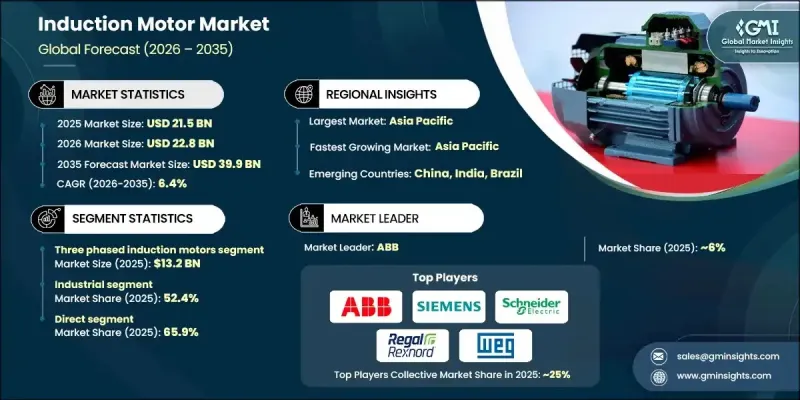
由于感应电动机寿命长、可靠性高、效率卓越,其在自动化系统中的广泛应用推动了这一成长。随着各行业越来越多地采用自动化来提高生产力和降低人事费用,对感应电动机的需求持续成长。即使在负载条件变化的情况下,感应马达也能保持稳定的性能,因此被广泛整合到各行业的自动化流程中。人们对能源优化的日益关注也推动了感应马达的应用,企业优先考虑那些能够在保持产量的同时降低电力消耗的设备。此外,感应电动机也因其与先进控制技术的兼容性而备受青睐,这些技术能够提高效率和运行精度。製造业和基础建设中对能源效率的追求,进一步强化了感应马达在现代工业环境中的作用。随着自动化的扩展和永续性目标的扩充性重要,感应电动机仍然是全球高效、可扩展和经济高效营运的核心支撑。
| 市场覆盖范围 | |
|---|---|
| 开始年份 | 2025 |
| 预测年份 | 2026-2035 |
| 起始值 | 215亿美元 |
| 预测金额 | 399亿美元 |
| 复合年增长率 | 6.4% |
预计到2025年,三相感应电动机市场规模将达到132亿美元,2026年至2035年的复合年增长率(CAGR)为6.5%。由于其能够在高功率下保持稳定的性能,这些马达被广泛应用于严苛的运作环境中。其设计确保了平稳运行、降低机械应力并具有长期可靠性,因此在各种工业应用中已广泛应用。此外,其低维护需求和稳定的效率也持续巩固了其市场地位。
预计到2025年,工业应用领域将占据52.4%的市场份额,并在2026年至2035年间以6.2%的复合年增长率成长。由于高产能环境下需要连续运行,工业需求仍占据主导地位。感应电动机因其耐用性、适应性和支援连续工作流程的能力而备受青睐,在大规模製造和加工环境中发挥着至关重要的作用。
美国感应电动机市场预计到2025年将达到49亿美元,2026年至2035年的复合年增长率(CAGR)为6.4%。先进的製造能力、对自动化领域的大力投资以及节能马达技术的广泛应用是推动市场成长的主要因素。日益严格的能源效率标准法规也持续刺激多个终端应用领域的需求。
目录
第一章调查方法和范围
第二章执行摘要
第三章业界考察
- 生态系分析
- 供应商情况
- 利润率
- 每个阶段的附加价值
- 影响价值链的因素
- 产业影响因素
- 司机
- 工业自动化正在兴起
- 节能解决方案的需求日益增长
- 电动车(EV)市场的扩张
- 挑战与困难
- 节能马达初始成本高
- 维护和营运挑战
- 机会
- 与智慧和物联网系统的集成
- 扩大可再生能源和电动车 (EV) 应用
- 司机
- 成长潜力分析
- 未来市场趋势
- 科技与创新趋势
- 当前技术趋势
- 新兴技术
- 价格趋势
- 按地区
- 副产品
- 监管环境
- 北美洲
- 美国:消费品安全委员会 (CPSC) 联邦法规第 16 篇 (CFR) 第 1512 部分
- 加拿大:国际标准化组织(ISO)4210
- 欧洲
- 德国:德国标准化协会 (DIN) 欧洲标准 (EN) ISO 4210
- 英国:欧洲标准 (EN) ISO 4210/英国合格评定 (UKCA)
- 法国:欧洲标准 (EN) ISO 4210
- 亚太地区
- 中国:国家标誌(GB)3565
- 印度:印度标准 (IS) 10613
- 日本:日本工业标准(JIS)D 9110
- 拉丁美洲
- 巴西:巴西技术标准协会 (ABNT) 巴西标准 (NBR) ISO 4210
- 墨西哥:国际标准化组织(ISO)4210
- 中东和非洲
- 南非:南非国家标准 (SANS) 311
- 沙乌地阿拉伯:沙乌地阿拉伯标准、计量和品质组织 (SASO) 海湾标准组织 (GSO) ISO 4210
- 北美洲
- 贸易统计(HS编码-8501)
- 主要进口国
- 主要出口国
- 波特分析
- PESTEL 分析
第四章 竞争情势
- 介绍
- 公司市占率分析
- 按地区
- 北美洲
- 欧洲
- 亚太地区
- 拉丁美洲
- 中东和非洲
- 按地区
- 企业矩阵分析
- 主要市场公司的竞争分析
- 竞争定位矩阵
- 重大进展
- 併购
- 伙伴关係与合作
- 新产品发布
- 扩张计划
第五章 依产品类型分類的市场估算与预测,2022-2035年
- 单相感应电动机
- 分相
- 电容启动
- 电容驱动
- 遮荫桿
- 三相感应电动机
- 松鼠笼式电机
- 滑环电机
第六章 按应用领域分類的市场估算与预测,2022-2035年
- 家用电器
- 商用设备
- 工业应用
7. 2022-2035年按分销管道分類的市场估算与预测
- 直销
- 间接
第八章 2022-2035年各地区市场估算与预测
- 北美洲
- 我们
- 加拿大
- 欧洲
- 德国
- 英国
- 法国
- 义大利
- 西班牙
- 亚太地区
- 中国
- 印度
- 日本
- 韩国
- 澳洲
- 拉丁美洲
- 巴西
- 墨西哥
- 阿根廷
- 中东和非洲
- 沙乌地阿拉伯
- 阿拉伯聯合大公国
- 南非
第九章:公司简介
- ABB
- Allied Motion Technologies
- AMETEK
- Emerson
- Hitachi
- Johnson Electric
- Mitsubishi
- Nidec
- Oriental Motor
- Regal Rexnord
- Rockwell Automation
- Schneider Electric
- Siemens
- Toshiba
- WEG Electric
The Global Induction Motor Market was valued at USD 21.5 billion in 2025 and is estimated to grow at a CAGR of 6.4% to reach USD 39.9 billion by 2035.
The growth is driven by the widespread use of induction motors across automated systems due to their long service life, operational reliability, and high efficiency. As industries increasingly adopt automation to improve productivity and reduce labor-related costs, demand for induction motors continues to rise. These motors are widely integrated into automated processes across multiple sectors because they deliver stable performance under varying load conditions. Rising focus on energy optimization is further supporting adoption, as organizations prioritize equipment that reduces power consumption while maintaining output. Induction motors are also recognized for their compatibility with advanced control technologies, which enhances efficiency and operational precision. The shift toward energy-conscious manufacturing and infrastructure development is reinforcing their role across modern industrial environments. As automation expands and sustainability targets become more prominent, induction motors remain central to supporting efficient, scalable, and cost-effective operations globally.
| Market Scope | |
|---|---|
| Start Year | 2025 |
| Forecast Year | 2026-2035 |
| Start Value | $21.5 Billion |
| Forecast Value | $39.9 Billion |
| CAGR | 6.4% |
The three-phase induction motor segment generated USD 13.2 billion in 2025 and is expected to grow at a CAGR of 6.5% from 2026 to 2035. These motors are widely used in demanding operating environments due to their ability to deliver high power with stable performance. Their design supports smooth operation, reduced mechanical stress, and long-term reliability, which has led to strong adoption across a broad range of industrial uses. Low maintenance needs and consistent efficiency continue to strengthen their market position.
The industrial application segment accounted for 52.4% share in 2025 and is projected to grow at a CAGR of 6.2% during 2026-2035. Industrial demand remains dominant due to the need for uninterrupted operation in high-capacity settings. Induction motors are valued for their durability, adaptability, and ability to support continuous workflows, making them essential to large-scale production and processing environments.
U.S. Induction Motor Market generated USD 4.9 billion in 2025 and is anticipated to grow at a CAGR of 6.4% from 2026 to 2035. Market leadership is supported by advanced manufacturing capabilities, strong investment in automation, and widespread adoption of energy-efficient motor technologies. Regulatory emphasis on efficiency standards continues to stimulate demand across multiple end-use sectors.
Key companies active in the Global Induction Motor Market include Siemens, ABB, Nidec, WEG Electric, Schneider Electric, Mitsubishi, Regal Rexnord, Toshiba, Rockwell Automation, Emerson, Hitachi, Johnson Electric, AMETEK, Oriental Motor, and Allied Motion Technologies. Companies operating in the Global Induction Motor Market are strengthening their competitive positions through innovation, efficiency-focused product development, and global expansion strategies. Many manufacturers are investing in advanced motor designs that support lower energy consumption and improved performance. Strategic partnerships and acquisitions are being used to expand product portfolios and regional reach. Increased focus on customization and application-specific solutions is helping companies meet diverse customer requirements. Firms are also enhancing service offerings, including maintenance and digital monitoring capabilities, to build long-term customer relationships.
Table of Contents
Chapter 1 Methodology & Scope
- 1.1 Market scope & definitions
- 1.2 Research design
- 1.2.1 Research approach
- 1.2.2 Data collection methods
- 1.3 Base estimates and calculations
- 1.3.1 Base year calculation
- 1.3.2 Market estimates & forecasts parameters
- 1.4 Forecast Model
- 1.4.1 Key trends for market estimates
- 1.4.2 Quantified market impact analysis
- 1.4.2.1 Mathematical impact of growth parameters on forecast
- 1.4.3 Scenario analysis framework
- 1.5 Primary research and validation
- 1.5.1 Some of the primary sources (but not limited to)
- 1.6 Data mining sources
- 1.6.1 Paid Sources
- 1.7 Primary research and validation
- 1.7.1 Primary sources
- 1.8 Research Trail & confidence scoring
- 1.8.1 Research trail components
- 1.8.2 Scoring components
- 1.9 Research transparency addendum
- 1.9.1 Source attribution framework
- 1.9.2 Quality assurance metrics
- 1.9.3 Our commitment to trust
- 1.10 Market Definitions
Chapter 2 Executive Summary
- 2.1 Industry 3600 synopsis
- 2.2 Key market trends
- 2.2.1 Regional
- 2.2.2 Product type
- 2.2.3 Application
- 2.2.4 Distribution channels
- 2.3 CXO perspectives: Strategic imperatives
- 2.3.1 Key decision points for industry executives
- 2.3.2 Critical success factors for market players
- 2.4 Future outlook and strategic recommendations
Chapter 3 Industry Insights
- 3.1 Industry ecosystem analysis
- 3.1.1 Supplier landscape
- 3.1.2 Profit margin
- 3.1.3 Value addition at each stage
- 3.1.4 Factor affecting the value chain
- 3.2 Industry impact forces
- 3.2.1 Growth drivers
- 3.2.1.1 Increasing industrial automation
- 3.2.1.2 Rising demand for energy-efficient solutions
- 3.2.1.3 Expansion of the electric vehicle (EV) market
- 3.2.2 Pitfalls & Challenges
- 3.2.2.1 High initial cost for energy-efficient motors
- 3.2.2.2 Maintenance and operational challenges
- 3.2.3 Opportunities
- 3.2.3.1 Integration with smart and IoT systems
- 3.2.3.2 Expansion in renewable energy and EV applications
- 3.2.1 Growth drivers
- 3.3 Growth potential analysis
- 3.4 Future market trends
- 3.5 Technology and innovation landscape
- 3.5.1 Current technological trends
- 3.5.2 Emerging technologies
- 3.6 Price trends
- 3.6.1 By region
- 3.6.2 By product
- 3.7 Regulatory landscape
- 3.7.1 North America
- 3.7.1.1 US: Consumer Product Safety Commission (CPSC) 16 Code of Federal Regulations (CFR) part 1512
- 3.7.1.2 Canada: International Organization for Standardization (ISO) 4210
- 3.7.2 Europe
- 3.7.2.1 Germany: Deutsches Institut fur Normung (DIN) European Norm (EN) ISO 4210
- 3.7.2.2 UK: European Norm (EN) ISO 4210 / United Kingdom Conformity Assessed (UKCA)
- 3.7.2.3 France: European Norm (EN) ISO 4210
- 3.7.3 Asia Pacific
- 3.7.3.1 China: Guobiao (GB) 3565
- 3.7.3.2 India: Indian Standard (IS) 10613
- 3.7.3.3 Japan: Japanese Industrial Standard (JIS) D 9110
- 3.7.4 Latin America
- 3.7.4.1 Brazil: Associacao Brasileira de Normas Tecnicas (ABNT) Norma Brasileira (NBR) ISO 4210
- 3.7.4.2 Mexico: International Organization for Standardization (ISO) 4210
- 3.7.5 Middle East & Africa
- 3.7.5.1 South Africa: South African National Standard (SANS) 311
- 3.7.5.2 Saudi Arabia: Saudi Standards, Metrology and Quality Organization (SASO) Gulf Standardization Organization (GSO) ISO 4210
- 3.7.1 North America
- 3.8 Trade statistics (HS Code - 8501)
- 3.8.1 Major importing countries
- 3.8.2 Major exporting countries
- 3.9 Porter';s analysis
- 3.10 PESTEL analysis
Chapter 4 Competitive Landscape, 2025
- 4.1 Introduction
- 4.2 Company market share analysis
- 4.2.1 By region
- 4.2.1.1 North America
- 4.2.1.2 Europe
- 4.2.1.3 Asia Pacific
- 4.2.1.4 Latin America
- 4.2.1.5 Middle East & Africa
- 4.2.1 By region
- 4.3 Company matrix analysis
- 4.4 Competitive analysis of major market players
- 4.5 Competitive positioning matrix
- 4.6 Key developments
- 4.6.1 Mergers & acquisitions
- 4.6.2 Partnerships & collaborations
- 4.6.3 New product launches
- 4.6.4 Expansion plans
Chapter 5 Market Estimates & Forecast, By Product Type, 2022 - 2035, (USD Billion) (Million Units)
- 5.1 Key trends
- 5.2 Single-phase induction motors
- 5.2.1 Split phase
- 5.2.2 Capacitor-start
- 5.2.3 Capacitor-run
- 5.2.4 Shaded pole
- 5.3 Three-phase induction motors
- 5.3.1 Squirrel cage motors
- 5.3.2 Slip ring motors
Chapter 6 Market Estimates & Forecast, By Application, 2022 - 2035, (USD Billion) (Million Units)
- 6.1 Key trends
- 6.2 Household appliances
- 6.3 Commercial appliances
- 6.4 Industrial applications
Chapter 7 Market Estimates & Forecast, By Distribution Channel, 2022 - 2035, (USD Billion) (Million Units)
- 7.1 Key trends
- 7.2 Direct
- 7.3 Indirect
Chapter 8 Market Estimates & Forecast, By Region, 2022 - 2035, (USD Billion) (Million Units)
- 8.1 Key trends
- 8.2 North America
- 8.2.1 U.S.
- 8.2.2 Canada
- 8.3 Europe
- 8.3.1 Germany
- 8.3.2 UK
- 8.3.3 France
- 8.3.4 Italy
- 8.3.5 Spain
- 8.4 Asia Pacific
- 8.4.1 China
- 8.4.2 India
- 8.4.3 Japan
- 8.4.4 South Korea
- 8.4.5 Australia
- 8.5 Latin America
- 8.5.1 Brazil
- 8.5.2 Mexico
- 8.5.3 Argentina
- 8.6 MEA
- 8.6.1 Saudi Arabia
- 8.6.2 UAE
- 8.6.3 South Africa
Chapter 9 Company Profiles
- 9.1 ABB
- 9.2 Allied Motion Technologies
- 9.3 AMETEK
- 9.4 Emerson
- 9.5 Hitachi
- 9.6 Johnson Electric
- 9.7 Mitsubishi
- 9.8 Nidec
- 9.9 Oriental Motor
- 9.10 Regal Rexnord
- 9.11 Rockwell Automation
- 9.12 Schneider Electric
- 9.13 Siemens
- 9.14 Toshiba
- 9.15 WEG Electric

 2026-2034年感应电动机市场规模、份额、趋势及预测(依产品类型、最终用途产业及地区划分)
 以相数、机壳、电压、额定功率、转速、安装方式和应用分類的鼠笼式感应电动机市场-2026-2032年全球预测
 感应马达市场-全球产业规模、份额、趋势、机会及预测(细分、按类型、按应用、按地区、按竞争,2020-2030 年预测)
 北美低压感应马达:市场占有率分析、产业趋势和成长预测(2025-2030 年)亚太地区感应电动机:市场占有率分析、产业趋势和成长预测(2025-2030 年)北美感应马达:市场占有率分析、产业趋势与统计、成长预测(2025-2030 年)感应马达:市场占有率分析、产业趋势与统计、成长预测(2025-2030 年)欧洲感应电动机:市场占有率分析、产业趋势与统计、成长预测(2025-2030)