


 |
市场调查报告书
商品编码
1928962
往復式发动机市场机会、成长要素、产业趋势分析及2026年至2035年预测Reciprocating Engine Market Opportunity, Growth Drivers, Industry Trend Analysis, and Forecast 2026 - 2035 |
||||||

全球往復式引擎市场预计到 2025 年将达到 788 亿美元,到 2035 年将达到 1,270 亿美元,年复合成长率为 4.8%。
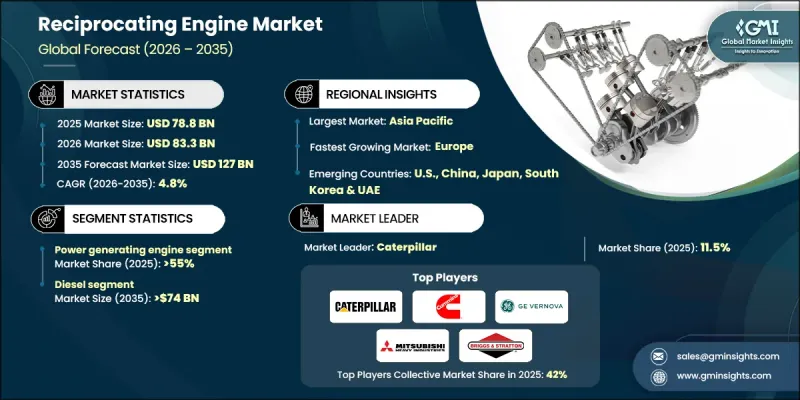
市场成长的驱动力在于模组化和简化引擎设计的持续创新,这些创新提升了运行柔软性和可维护性。燃油效率技术的日益普及,以及日益严格的排放法规,正在塑造下一代往復式引擎。先进的数位监控系统和预测性维护工具的集成,提高了可靠性并最大限度地减少了停机时间。现代往復式引擎融合了强大的工程和运行策略,可在各种应用中提供稳定且高效的动力。它们提高了燃烧效率,保持了热稳定性,并可与多种燃料类型相容。在涵盖工业、商业和分散式电力系统的应用中,这些引擎支援能源弹性,并可与再生能源来源无缝整合。混合动力技术、燃料优化和控制系统的进步进一步提升了性能,使其成为紧急和持续发电的理想选择。
| 市场覆盖范围 | |
|---|---|
| 开始年份 | 2025 |
| 预测年份 | 2026-2035 |
| 起始值 | 788亿美元 |
| 预测金额 | 1270亿美元 |
| 复合年增长率 | 4.8% |
电力领域在2025年占据55%的市场份额,预计到2035年将以4%的复合年增长率成长。其成长主要受对可靠电力解决方案、灵活模组化设计的需求不断增长以及分散式发电系统日益普及的推动。往復式引擎因其启动速度快、效率高以及能够与可再生能源整合等优点,在该领域备受青睐。
受氮氧化物、二氧化硫和颗粒物排放降低的推动,预计到2035年,燃气引擎市场将以5.5%的复合年增长率成长。这些清洁运转特性使燃气引擎成为优先考虑永续性目标的企业的理想选择。
预计到2035年,北美往復式发动机市场规模将达到200亿美元,这主要得益于能源基础设施的现代化、对高性能低排放发动机的需求增长以及工业的持续扩张。引擎性能和效率方面的持续技术创新有望进一步巩固全部区域的市场前景。
目录
第一章调查方法和范围
第二章执行摘要
第三章业界考察
- 生态系分析
- 原物料供应及采购分析
- 製造能力评估
- 供应链韧性与风险因素
- 配电网路分析
- 监管环境
- 产业影响因素
- 司机
- 产业潜在风险与挑战
- 成长潜力分析
- 波特分析
- 供应商的议价能力
- 买方的议价能力
- 新进入者的威胁
- 替代品的威胁
- PESTEL 分析
- 往復式引擎成本结构分析
- 价格趋势分析(美元/兆瓦)
- 按地区
- 按额定输出
- 新的机会与趋势
- 数位化和物联网集成
- 拓展新兴市场
- 投资分析及未来展望
第四章 竞争情势
- 介绍
- 按地区分類的公司市占率分析
- 北美洲
- 欧洲
- 亚太地区
- 中东和非洲
- 拉丁美洲
- 战略仪錶板
- 策略倡议
- 重要伙伴关係与合作
- 重大併购活动
- 产品创新与新产品发布
- 市场扩大策略
- 竞争标竿分析
- 创新与永续性格局
第五章 依燃料类型分類的市场规模及预测(2022-2035年)
- 柴油引擎
- 气体
- 其他的
第六章 依额定产量区分的市场规模及预测,2022-2035年
- 0.5 MW~1 MW
- 1兆瓦以上~2兆瓦
- 2兆瓦至3.5兆瓦
- 3.5兆瓦~5兆瓦以上
- 5兆瓦以上~7.5兆瓦
- 超过7.5兆瓦
第七章 依应用领域分類的市场规模及预测(2022-2035年)
- 电力
- 船
- 机器
8. 依汽缸配置分類的市场规模及预测,2022-2035年
- 系列
- V型
- 径向
- 对置活塞
第九章 2022-2035年各地区市场规模及预测
- 北美洲
- 我们
- 加拿大
- 墨西哥
- 欧洲
- 英国
- 法国
- 德国
- 俄罗斯
- 义大利
- 西班牙
- 荷兰
- 丹麦
- 亚太地区
- 中国
- 印度
- 日本
- 韩国
- 澳洲
- 泰国
- 新加坡
- 中东和非洲
- 阿拉伯聯合大公国
- 沙乌地阿拉伯
- 卡达
- 阿曼
- 科威特
- 埃及
- 土耳其
- 南非
- 拉丁美洲
- 巴西
- 阿根廷
- 智利
第十章:公司简介
- AB Volvo Penta
- Briggs &Stratton
- Caterpillar
- Cummins
- GE Vernova
- Guascor Energy
- Honda Motor
- IHI Corporation
- JC Bamford Excavators
- Kawasaki Heavy Industries
- KUBOTA Corporation
- Lister Petter
- MAN Energy Solutions
- Mitsubishi Heavy Industries
- Perkins Engines
- Rehlko
- Rolls-Royce
- Wartsila
- Yamaha Motor
- Yanmar Holdings
The Global Reciprocating Engine Market was valued at USD 78.8 billion in 2025 and is estimated to grow at a CAGR of 4.8% to reach USD 127 billion by 2035.
The market growth is fueled by continuous innovation in modular and simplified engine designs, which provide greater operational flexibility and ease of maintenance. Increasing adoption of fuel-efficient technologies, coupled with strict emission regulations, is shaping the next generation of reciprocating engines. Integration of advanced digital monitoring systems and predictive maintenance tools is enhancing reliability and minimizing downtime. Modern reciprocating engines combine robust engineering with operational strategies to deliver consistent, efficient power across diverse applications. They improve combustion efficiency, maintain thermal stability, and offer compatibility with multiple fuel types. With applications spanning industrial, commercial, and distributed generation systems, these engines support energy resilience while integrating seamlessly with renewable energy sources. Advancements in hybrid technologies, fuel optimization, and control systems further enhance performance, making them ideal for both standby and continuous power generation.
| Market Scope | |
|---|---|
| Start Year | 2025 |
| Forecast Year | 2026-2035 |
| Start Value | $78.8 Billion |
| Forecast Value | $127 Billion |
| CAGR | 4.8% |
The power segment accounted for 55% share in 2025 and is expected to grow at a CAGR of 4% through 2035. Its expansion is supported by rising demand for reliable power solutions, flexible modular designs, and the increasing deployment of distributed generation systems. Reciprocating engines in this segment are favored for their fast start-up, high efficiency, and compatibility with renewable energy integration.
The gas-fired engine segment is expected to grow at a CAGR of 5.5% by 2035, driven by lower emissions of nitrogen oxides, sulfur dioxide, and particulates. These cleaner operations make gas engines an attractive choice for companies prioritizing compliance with environmental regulations and global sustainability objectives.
North America Reciprocating Engine Market is projected to reach USD 20 billion by 2035, driven by modernization efforts in energy infrastructure, adoption of high-performance, low-emission engines, and ongoing industrial expansion. Continuous technological advancements in engine performance and efficiency are expected to strengthen the market outlook across the region.
Major players in the Global Reciprocating Engine Market include AB Volvo Penta, Cummins, GE Vernova, MAN Energy Solutions, Mitsubishi Heavy Industries, Yamaha Motor, Perkins Engines, Honda Motor, Lister Petter, Briggs & Stratton, Rehlko, J C Bamford Excavators, Wartsila, Kawasaki Heavy Industries, KUBOTA Corporation, Caterpillar, Yanmar Holdings, Guascor Energy, and Rolls-Royce.
Companies in the Global Reciprocating Engine Market focus on several strategies to maintain and expand their market position. Product innovation remains central, with firms developing modular, fuel-efficient, and hybrid-compatible engines. Strategic partnerships and collaborations help expand global distribution networks and access new customer segments. Investment in digital technologies, predictive maintenance, and IoT-enabled monitoring improves reliability and customer value. Companies also adopt sustainability-driven strategies, focusing on low-emission engines and compliance with environmental regulations. After-sales services, extended warranties, and technical support enhance customer loyalty. Mergers and acquisitions are leveraged to consolidate market share, expand product portfolios, and strengthen regional presence, while targeted marketing and R&D investments ensure competitiveness in evolving energy and industrial sectors.
Table of Contents
Chapter 1 Methodology & Scope
- 1.1 Research design
- 1.2 Quality commitment
- 1.2.1 GMI AI policy & data integrity commitment
- 1.2.1.1 Source consistency protocol
- 1.2.1 GMI AI policy & data integrity commitment
- 1.3 Research Trail & Confidence Scoring
- 1.3.1 Research Trail Components
- 1.3.2 Scoring Components
- 1.4 Data Collection
- 1.4.1 Partial list of primary sources
- 1.5 Data mining sources
- 1.5.1 Paid sources
- 1.5.1.1 Sources, by region
- 1.5.1 Paid sources
- 1.6 Base estimates and calculations
- 1.6.1 Base year calculation for any one approach
- 1.7 Market estimates & forecasts parameters
- 1.8 Forecast model
- 1.9 Research transparency addendum
- 1.9.1 Source attribution framework
- 1.9.2 Quality assurance metrics
- 1.9.3 Our commitment to trust
- 1.10 Market definitions
Chapter 2 Executive Summary
- 2.1 Industry synopsis, 2022 - 2035
- 2.2 Business trends
- 2.3 Fuel trends
- 2.4 Rated power trends
- 2.5 Application trends
- 2.6 Cylinder configuration trends
- 2.7 Regional trends
Chapter 3 Industry Insights
- 3.1 Industry ecosystem analysis
- 3.1.1 Raw material availability & sourcing analysis
- 3.1.2 Manufacturing capacity assessment
- 3.1.3 Supply chain resilience & risk factors
- 3.1.4 Distribution network analysis
- 3.2 Regulatory landscape
- 3.3 Industry impact forces
- 3.3.1 Growth drivers
- 3.3.2 Industry pitfalls & challenges
- 3.4 Growth potential analysis
- 3.5 Porter';s analysis
- 3.5.1 Bargaining power of suppliers
- 3.5.2 Bargaining power of buyers
- 3.5.3 Threat of new entrants
- 3.5.4 Threat of substitutes
- 3.6 PESTEL analysis
- 3.6.1 Political factors
- 3.6.2 Economic factors
- 3.6.3 Social factors
- 3.6.4 Technological factors
- 3.6.5 Legal factors
- 3.6.6 Environmental factors
- 3.7 Cost structure analysis of reciprocating engines
- 3.8 Price trend analysis (USD/MW)
- 3.8.1 By region
- 3.8.2 By rated power
- 3.9 Emerging opportunities & trends
- 3.9.1 Digitalization & IoT integration
- 3.9.2 Emerging market penetration
- 3.10 Investment analysis & future outlook
Chapter 4 Competitive Landscape, 2026
- 4.1 Introduction
- 4.2 Company market share analysis, by region, 2025
- 4.2.1 North America
- 4.2.2 Europe
- 4.2.3 Asia Pacific
- 4.2.4 Middle East & Africa
- 4.2.5 Latin America
- 4.3 Strategic dashboard
- 4.4 Strategic initiatives
- 4.4.1 Key partnerships & collaborations
- 4.4.2 Major M&A activities
- 4.4.3 Product innovations & launches
- 4.4.4 Market expansion strategies
- 4.5 Competitive benchmarking
- 4.6 Innovation & sustainability landscape
Chapter 5 Market Size and Forecast, By Fuel, 2022 - 2035 (USD Million & MW)
- 5.1 Key trends
- 5.2 Diesel
- 5.3 Gas
- 5.4 Others
Chapter 6 Market Size and Forecast, By Rated Power, 2022 - 2035 (USD Million & MW)
- 6.1 Key trends
- 6.2 0.5 MW - 1 MW
- 6.3 > 1 MW - 2 MW
- 6.4 > 2 MW - 3.5 MW
- 6.5 > 3.5 MW - 5 MW
- 6.6 > 5 MW - 7.5 MW
- 6.7 > 7.5 MW
Chapter 7 Market Size and Forecast, By Application, 2022 - 2035 (USD Million & MW)
- 7.1 Key trends
- 7.2 Power
- 7.3 Marine
- 7.4 Mechanical
Chapter 8 Market Size and Forecast, By Cylinder Configuration, 2022 - 2035 (USD Million & MW)
- 8.1 Key trends
- 8.2 Inline
- 8.3 V-Type
- 8.4 Radial
- 8.5 Opposed piston
Chapter 9 Market Size and Forecast, By Region, 2022 - 2035 (USD Million & MW)
- 9.1 Key trends
- 9.2 North America
- 9.2.1 U.S.
- 9.2.2 Canada
- 9.2.3 Mexico
- 9.3 Europe
- 9.3.1 UK
- 9.3.2 France
- 9.3.3 Germany
- 9.3.4 Russia
- 9.3.5 Italy
- 9.3.6 Spain
- 9.3.7 Netherlands
- 9.3.8 Denmark
- 9.4 Asia Pacific
- 9.4.1 China
- 9.4.2 India
- 9.4.3 Japan
- 9.4.4 South Korea
- 9.4.5 Australia
- 9.4.6 Thailand
- 9.4.7 Singapore
- 9.5 Middle East & Africa
- 9.5.1 UAE
- 9.5.2 Saudi Arabia
- 9.5.3 Qatar
- 9.5.4 Oman
- 9.5.5 Kuwait
- 9.5.6 Egypt
- 9.5.7 Turkey
- 9.5.8 South Africa
- 9.6 Latin America
- 9.6.1 Brazil
- 9.6.2 Argentina
- 9.6.3 Chile
Chapter 10 Company Profiles
- 10.1 AB Volvo Penta
- 10.2 Briggs & Stratton
- 10.3 Caterpillar
- 10.4 Cummins
- 10.5 GE Vernova
- 10.6 Guascor Energy
- 10.7 Honda Motor
- 10.8 IHI Corporation
- 10.9 J C Bamford Excavators
- 10.10 Kawasaki Heavy Industries
- 10.11 KUBOTA Corporation
- 10.12 Lister Petter
- 10.13 MAN Energy Solutions
- 10.14 Mitsubishi Heavy Industries
- 10.15 Perkins Engines
- 10.16 Rehlko
- 10.17 Rolls-Royce
- 10.18 Wartsila
- 10.19 Yamaha Motor
- 10.20 Yanmar Holdings

 先进触媒技术市场分析及预测(至2035年):类型、产品、技术、应用、材料类型、最终用户、製程、组件、安装类型
 汽车引擎活塞环:市场占有率分析、产业趋势与统计、成长预测(2026-2031)
 2026年全球铝活塞市场报告2026年全球氢内燃机市场报告
 机械往復式发动机市场机会、成长要素、产业趋势分析及预测(2026年至2035年)
 双燃料氨发动机市场:按功率输出、发动机类型、燃料混合比、最终用途和应用分類的全球预测(2026-2032年)引擎油底壳市场按车辆类型、材质、油底壳类型、通路和最终用途产业划分-2026-2032年全球预测氨柴油发动机市场按燃料类型、发动机类型、功率、应用和最终用途划分,全球预测(2026-2032)氨气汽油引擎市场:按燃料类型、引擎排气量、技术和应用划分,全球预测(2026-2032)
 汽车油底壳市场:依应用、技术、产品类型、配销通路、最终用户、国家及地区划分-全球产业分析、市场规模、市场占有率及2025-2032年预测