


 |
市场调查报告书
商品编码
1929004
宠物食品原料市场机会、成长要素、产业趋势分析及2026年至2035年预测Pet Food Ingredients Market Opportunity, Growth Drivers, Industry Trend Analysis, and Forecast 2026 - 2035 |
||||||

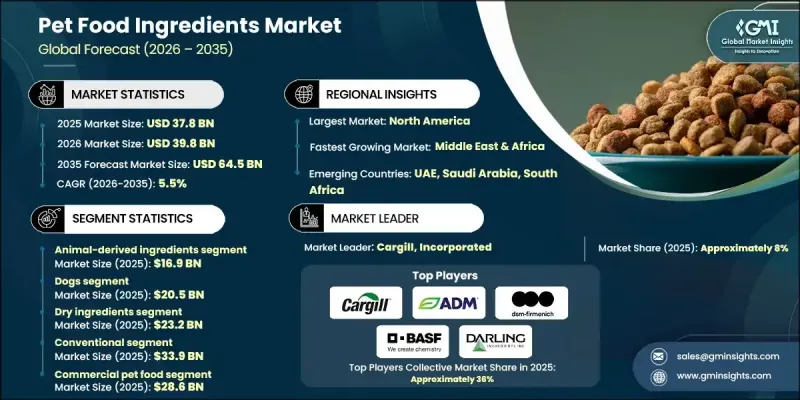
全球宠物食品原料市场预计到 2025 年将达到 378 亿美元,到 2035 年将达到 645 亿美元,年复合成长率为 5.5%。
宠物饲养家庭数量的增加以及饲主对高品质、营养均衡的宠物食品日益增长的偏好,推动了宠物食品市场的成长。都市化和可支配所得的提高,使得人们越来越倾向于将宠物视为家庭成员,从而带动了对功能性和营养强化型成分的需求。宠物食品的配方正从基础饲料发展到含有蛋白质、维生素、益生菌和其他功能性添加剂的高级混合配方。消费者越来越意识到饮食与宠物健康之间的联繫,因此对天然、有机和永续成分的需求激增。这种转变促进了植物性蛋白质、ω脂肪酸、抗氧化剂和其他特殊添加剂领域的创新。製造商正大力投资研发,以改善消化健康、增强免疫力和控制体重,进一步推动市场扩张。
| 市场覆盖范围 | |
|---|---|
| 开始年份 | 2025 |
| 预测年份 | 2026-2035 |
| 起始值 | 378亿美元 |
| 预测金额 | 645亿美元 |
| 复合年增长率 | 5.5% |
预计2025年,动物性原料市场规模将达到1,69亿美元,2026年至2035年的复合年增长率(CAGR)为5.3%。虽然动物性蛋白质作为一种偏好、营养丰富的来源仍然十分重要,但植物来源原料正越来越多地被用作纤维、碳水化合物和替代蛋白的来源。维生素、矿物质、抗氧化剂和酵素等功能性添加剂也被添加到配方中,以增强健康益处,从而创造出多元化的原料组合,为标准和特种宠物食品提供支持。
预计到2025年,犬类宠物食品市场规模将达到205亿美元,2026年至2035年的复合年增长率(CAGR)为5.2%。不同物种的营养需求各不相同,因此对宠物食品原料的需求也存在差异,其中犬猫食品占最大份额。人们对鸟类、鱼类、小型哺乳动物和爬虫类的最佳营养需求日益增长,推动了专用蛋白质、油脂和微量营养素的使用。这一趋势促使供应商开发针对特定物种的原料混合物,以满足不同宠物物种的配方需求,并为小众、高附加价值产品创造机会。
预计2025年,北美宠物食品原料市场规模将达139亿美元。该地区市场扩张的驱动力包括宠物食品配方的不断改进、功能性添加剂的创新以及对均衡蛋白质混合物日益增长的需求。製造商正在丰富其原料组合,以实现产品差异化和个人化营养选择。先进的加工基础设施以及高品质原料解决方案在宠物食品各个品类中的整合,正在支撑市场的稳定成长,使北美成为宠物食品原料产业的关键区域。
目录
第一章调查方法
第二章执行摘要
第三章业界考察
- 生态系分析
- 供应商情况
- 利润率
- 每个阶段的附加价值
- 影响价值链的因素
- 中断
- 产业影响因素
- 司机
- 产业潜在风险与挑战
- 市场机会
- 成长潜力分析
- 监管环境
- 北美洲
- 欧洲
- 亚太地区
- 拉丁美洲
- 中东和非洲
- 波特分析
- PESTEL 分析
- 价格趋势
- 按地区
- 副产品
- 未来市场趋势
- 科技与创新趋势
- 当前技术趋势
- 新兴技术
- 专利状态
- 贸易统计(註:仅提供主要国家的贸易统计)
- 主要进口国
- 主要出口国
- 永续性和环境方面
- 永续实践
- 减少废弃物策略
- 生产中的能源效率
- 环保倡议
- 碳足迹考量
第四章 竞争情势
- 介绍
- 公司市占率分析
- 按地区
- 北美洲
- 欧洲
- 亚太地区
- 拉丁美洲
- 中东和非洲
- 按地区
- 企业矩阵分析
- 主要市场公司的竞争分析
- 竞争定位矩阵
- 重大进展
- 併购
- 伙伴关係与合作
- 新产品发布
- 业务拓展计划
第五章 依原料类型分類的市场估算与预测,2022-2035年
- 动物源性原料
- 肉品
- 鱼产品
- 动物脂肪和油脂
- 植物来源原料
- 谷物和豆类(玉米、小麦、米)
- 油籽和豆类(大豆、豌豆)
- 水果和蔬菜
- 添加剂
- 维生素和矿物质
- 酵素
- 益生菌和益生元
- 调味剂/色素
- 防腐剂
- 其他的
- 新型蛋白质(昆虫来源蛋白质、藻类蛋白质)
- 功能性成分(Omega-3、抗氧化剂)
第六章 依宠物类型分類的市场估算与预测,2022-2035年
- 狗
- 猫
- 鸟类
- 鱼
- 其他的
第七章 按类型分類的市场估计与预测,2022-2035年
- 干燥原料
- 湿原料
- 液态原料
8. 2022-2035年按来源分類的市场估计与预测
- 传统的
- 有机的
第九章 按应用领域分類的市场估算与预测,2022-2035年
- 商业宠物食品
- 自製宠物食品
- 点心
- 其他的
第十章 2022-2035年各地区市场估计与预测
- 北美洲
- 我们
- 加拿大
- 欧洲
- 德国
- 英国
- 法国
- 义大利
- 西班牙
- 其他欧洲地区
- 亚太地区
- 中国
- 印度
- 日本
- 澳洲
- 韩国
- 亚太其他地区
- 拉丁美洲
- 巴西
- 墨西哥
- 阿根廷
- 其他拉丁美洲地区
- 中东和非洲
- 沙乌地阿拉伯
- 南非
- 阿拉伯聯合大公国
- 其他中东和非洲地区
第十一章:公司简介
- DSM-Firmenich
- Cargill, Incorporated
- Archer-Daniels-Midland Company(ADM)
- Evonik Industries AG
- BASF SE
- Adisseo France SAS
- Kemin Industries, Inc.
- Symrise AG
- Darling Ingredients Inc.
- Ingredion, Inc.
- Prinova
- Novus International
The Global Pet Food Ingredients Market was valued at USD 37.8 billion in 2025 and is estimated to grow at a CAGR of 5.5% to reach USD 64.5 billion by 2035.
The growth is driven by the rising number of pet owners and their increasing preference for high-quality, nutritionally balanced diets for their pets. Urbanization and higher disposable income levels are encouraging pet owners to treat pets as family members, leading to greater demand for functional and fortified ingredients. Pet food formulations are evolving from basic feed to advanced blends containing proteins, vitamins, probiotics, and other functional additives. Consumers are increasingly aware of the link between diet and pet health, prompting a surge in natural, organic, and sustainable ingredient adoption. This shift has accelerated innovation in plant-based proteins, omega fatty acids, antioxidants, and other specialized additives. Manufacturers are investing heavily in research and development to address digestive health, immunity enhancement, and weight management, further supporting market expansion.
| Market Scope | |
|---|---|
| Start Year | 2025 |
| Forecast Year | 2026-2035 |
| Start Value | $37.8 Billion |
| Forecast Value | $64.5 Billion |
| CAGR | 5.5% |
The animal-derived ingredients segment was valued at USD 16.9 billion in 2025 and is estimated to grow at a CAGR of 5.3% from 2026 to 2035. Animal-based proteins remain crucial for palatability and high-quality nutrition, while plant-derived ingredients are increasingly incorporated as sources of fiber, carbohydrates, and alternative proteins. Functional additives such as vitamins, minerals, antioxidants, and enzymes are being integrated into formulations to improve health outcomes, resulting in a versatile ingredient portfolio that supports both standard and specialized pet food products.
The dog segment accounted for USD 20.5 billion in 2025 and is expected to grow at a CAGR of 5.2% during 2026-2035. Demand for pet food ingredients varies based on species-specific nutritional needs, with dog and cat foods representing the largest share. Growing awareness of optimal nutrition for birds, fish, small mammals, and reptiles is driving the use of specialized proteins, oils, and micronutrients. These trends are prompting suppliers to develop species-specific ingredient blends, highlighting differences in formulation requirements across pet types and creating opportunities for niche and high-value products.
North America Pet Food Ingredients Market reached USD 13.9 billion in 2025. The region's expansion is fueled by continuous pet food reformulations, innovations in functional additives, and the rising demand for balanced protein mixes. Manufacturers are diversifying their ingredient portfolios to enable product differentiation and personalized nutrition options. Advanced processing infrastructure and integration of high-quality ingredient solutions across pet categories have supported steady market growth, making North America a key region for the pet food ingredients industry.
Major players in the Global Pet Food Ingredients Market include DSM-Firmenich, Darling Ingredients Inc., Cargill, Incorporated, BASF SE, Archer-Daniels-Midland Company (ADM), and others. These companies are leveraging strong research and development capabilities, expanding production facilities, and forming strategic partnerships with pet food manufacturers to maintain market leadership. Key strategies adopted by companies in the Pet Food Ingredients Market include investing in R&D to develop functional, species-specific, and fortified ingredients tailored to evolving consumer preferences. Firms are expanding manufacturing capacities to meet growing demand in urban and high-income regions. Strategic partnerships with pet food brands and distributors allow companies to penetrate new markets and ensure product availability.
Table of Contents
Chapter 1 Methodology
- 1.1 Market scope and definition
- 1.2 Research design
- 1.2.1 Research approach
- 1.2.2 Data collection methods
- 1.3 Data mining sources
- 1.3.1 Global
- 1.3.2 Regional/Country
- 1.4 Base estimates and calculations
- 1.4.1 Base year calculation
- 1.4.2 Key trends for market estimation
- 1.5 Primary research and validation
- 1.5.1 Primary sources
- 1.6 Forecast model
- 1.7 Research assumptions and limitations
Chapter 2 Executive Summary
- 2.1 Industry 360° synopsis
- 2.2 Key market trends
- 2.2.1 Regional
- 2.2.2 Ingredient Type
- 2.2.3 Pet Type
- 2.2.4 Form
- 2.2.5 Source
- 2.2.6 Application
- 2.3 TAM Analysis, 2026-2035
- 2.4 CXO perspectives: Strategic imperatives
- 2.4.1 Executive decision points
- 2.4.2 Critical success factors
- 2.5 Future Outlook and Strategic Recommendations
Chapter 3 Industry Insights
- 3.1 Industry ecosystem analysis
- 3.1.1 Supplier Landscape
- 3.1.2 Profit Margin
- 3.1.3 Value addition at each stage
- 3.1.4 Factor affecting the value chain
- 3.1.5 Disruptions
- 3.2 Industry impact forces
- 3.2.1 Growth drivers
- 3.2.2 Industry pitfalls and challenges
- 3.2.3 Market opportunities
- 3.3 Growth potential analysis
- 3.4 Regulatory landscape
- 3.4.1 North America
- 3.4.2 Europe
- 3.4.3 Asia Pacific
- 3.4.4 Latin America
- 3.4.5 Middle East & Africa
- 3.5 Porter';s analysis
- 3.6 PESTEL analysis
- 3.7 Price trends
- 3.7.1 By region
- 3.7.2 By product
- 3.8 Future market trends
- 3.9 Technology and Innovation landscape
- 3.9.1 Current technological trends
- 3.9.2 Emerging technologies
- 3.10 Patent Landscape
- 3.11 Trade statistics (Note: the trade statistics will be provided for key countries only)
- 3.11.1 Major importing countries
- 3.11.2 Major exporting countries
- 3.12 Sustainability and Environmental Aspects
- 3.12.1 Sustainable Practices
- 3.12.2 Waste Reduction Strategies
- 3.12.3 Energy Efficiency in Production
- 3.12.4 Eco-friendly Initiatives
- 3.13 Carbon Footprint Considerations
Chapter 4 Competitive Landscape, 2025
- 4.1 Introduction
- 4.2 Company market share analysis
- 4.2.1 By region
- 4.2.1.1 North America
- 4.2.1.2 Europe
- 4.2.1.3 Asia Pacific
- 4.2.1.4 LATAM
- 4.2.1.5 MEA
- 4.2.1 By region
- 4.3 Company matrix analysis
- 4.4 Competitive analysis of major market players
- 4.5 Competitive positioning matrix
- 4.6 Key developments
- 4.6.1 Mergers & acquisitions
- 4.6.2 Partnerships & collaborations
- 4.6.3 New Product Launches
- 4.6.4 Expansion Plans
Chapter 5 Market Estimates and Forecast, By Ingredient Type, 2022- 2035 (USD Billion, Kilo Tons)
- 5.1 Key trends
- 5.2 Animal-Derived Ingredients
- 5.2.1 Meat Products
- 5.2.2 Fish Products
- 5.2.3 Animal Fats
- 5.3 Plant-Derived Ingredients
- 5.3.1 Cereals & Grains (corn, wheat, rice)
- 5.3.2 Oilseeds & Pulses (soybean, peas)
- 5.3.3 Fruits & Vegetables
- 5.4 Additives
- 5.4.1 Vitamins & Minerals
- 5.4.2 Enzymes
- 5.4.3 Probiotics & Prebiotics
- 5.4.4 Flavors & Colorants
- 5.4.5 Preservatives
- 5.5 Others
- 5.5.1 Novel Proteins (insect protein, algae)
- 5.5.2 Functional Ingredients (omega-3, antioxidants)
Chapter 6 Market Estimates and Forecast, By Pet Type, 2022- 2035 (USD Billion, Kilo Tons)
- 6.1 Key trends
- 6.2 Dogs
- 6.3 Cats
- 6.4 Birds
- 6.5 Fish
- 6.6 Others
Chapter 7 Market Estimates and Forecast, By Form, 2022 - 2035 (USD Billion, Kilo Tons)
- 7.1 Key trends
- 7.2 Dry Ingredients
- 7.3 Wet Ingredients
- 7.4 Liquid Ingredients
Chapter 8 Market Estimates and Forecast, By Source, 2022 - 2035 (USD Billion, Kilo Tons)
- 8.1 Key trends
- 8.2 Conventional
- 8.3 Organic
Chapter 9 Market Estimates and Forecast, By Application, 2022 - 2035 (USD Billion, Kilo Tons)
- 9.1 Key trends
- 9.2 Commercial Pet Food
- 9.3 Homemade Pet Food
- 9.4 Treats & Snacks
- 9.5 Others
Chapter 10 Market Estimates and Forecast, By Region, 2022 - 2035 (USD Billion, Kilo Tons)
- 10.1 Key trends
- 10.2 North America
- 10.2.1 U.S.
- 10.2.2 Canada
- 10.3 Europe
- 10.3.1 Germany
- 10.3.2 UK
- 10.3.3 France
- 10.3.4 Italy
- 10.3.5 Spain
- 10.3.6 Rest of Europe
- 10.4 Asia Pacific
- 10.4.1 China
- 10.4.2 India
- 10.4.3 Japan
- 10.4.4 Australia
- 10.4.5 South Korea
- 10.4.6 Rest of Asia Pacific
- 10.5 Latin America
- 10.5.1 Brazil
- 10.5.2 Mexico
- 10.5.3 Argentina
- 10.5.4 Rest of Latin America
- 10.6 Middle East & Africa
- 10.6.1 Saudi Arabia
- 10.6.2 South Africa
- 10.6.3 UAE
- 10.6.4 Rest of Middle East & Africa
Chapter 11 Company Profiles
- 11.1 DSM-Firmenich
- 11.2 Cargill, Incorporated
- 11.3 Archer-Daniels-Midland Company (ADM)
- 11.4 Evonik Industries AG
- 11.5 BASF SE
- 11.6 Adisseo France SAS
- 11.7 Kemin Industries, Inc.
- 11.8 Symrise AG
- 11.9 Darling Ingredients Inc.
- 11.10 Ingredion, Inc.
- 11.11 Prinova
- 11.12 Novus International

 全球宠物食品原料市场规模、份额、趋势及成长分析报告(2026-2034年)
 宠物食品原料市场-全球产业规模、份额、趋势、机会及预测(依原料、类型、形态、地区及竞争格局划分,2021-2031年)
 宠物食品蛋白水解物市场机会、成长驱动因素、产业趋势分析及预测(2025-2034年)宠物食品原料市场:未来预测(2025-2030)
 宠物食品成分市场规模、份额及成长分析(按宠物类型、来源、成分、形态和地区)-2025-2032 年产业预测
 全球宠物食品成分市场:按类别、成分、应用、分销管道和地区预测(至 2032 年)宠物食品配料市场:依地区划分,2024-20312024-2030 年全球宠物食品配料产业的成长机会
 2030 年宠物食品原料市场预测:按类型、动物和地区分類的全球分析
 全球宠物食品原料市场