


 |
市场调查报告书
商品编码
1936525
医疗设备热可塑性橡胶市场机会、成长驱动因素、产业趋势分析及预测(2026-2035年)Thermoplastic Elastomers in Medical Devices Market Opportunity, Growth Drivers, Industry Trend Analysis, and Forecast 2026 - 2035 |
||||||

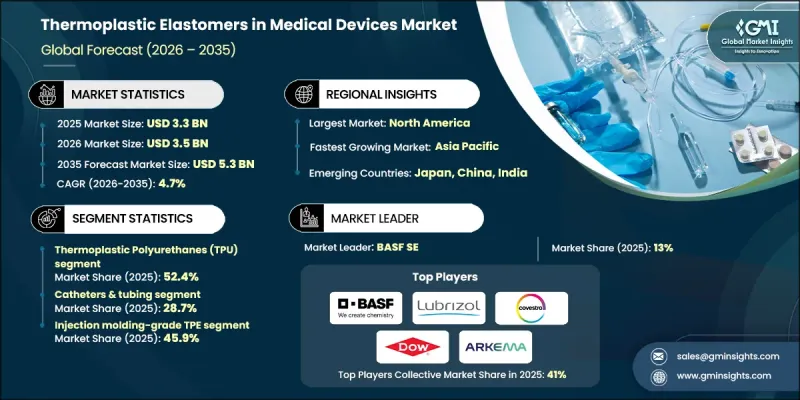
全球医疗设备用热可塑性橡胶市场预计到 2025 年将达到 33 亿美元,到 2035 年将达到 53 亿美元,年复合成长率为 4.7%。
热可塑性橡胶(TPE) 已从小众材料稳步发展成为现代医疗製造中不可或缺的组成部分。其弹性、生物相容性和高效加工性能的结合,满足了人们对耐用、对患者友好的医疗技术日益增长的需求。医疗机构越来越关注能够提升病患舒适度并提供稳定性能的解决方案,这使得 TPE 成为下一代医疗设备开发的首选材料。在严格的安全标准和环境法规的推动下,永续性和负责任的材料管理已成为医用 TPE 领域的核心挑战。向低生态影响、高耐灭菌性的可再生材料的转变,正持续加速其应用。持续的技术创新提高了配方安全性、机械稳定性、耐化学性和整体使用寿命,从而解决了传统弹性体长期存在的许多问题。持续的临床和环境测试体现了该行业致力于推进材料科学发展并支持更安全医疗结果的承诺。
| 市场覆盖范围 | |
|---|---|
| 开始年份 | 2025 |
| 预测年份 | 2026-2035 |
| 起始金额 | 33亿美元 |
| 预测金额 | 53亿美元 |
| 复合年增长率 | 4.7% |
预计到2025年,热塑性聚氨酯(TPU)将占据52.4%的市场份额,并在2035年之前以5%的复合年增长率成长。 TPU因其优异的柔软性和强度平衡性,仍是应用最广泛的医用级热可塑性橡胶(TPE),能够在不影响结构完整性的前提下精确控制其柔软度。这些特性满足了复杂的医疗工程需求,并在各种医疗应用中提供稳定的性能。
预计到2025年,导管和管材市场份额将达到28.7%,并在2026年至2035年间以5.5%的复合年增长率增长。这一市场主导地位主要得益于材料的特性,这些特性使其在较长的使用週期内仍能保持生物相容性、柔软性和无菌性。热塑性弹性体(TPE)确保了从常规医疗程序到先进治疗系统的可靠性能,进一步巩固了其在该领域的重要性。
预计到2025年,北美医疗设备热可塑性橡胶市占率将达到35%。该地区受益于成熟的医疗保健基础设施、严格的监管以及医疗设备製造商的高度集中。对聚合物研究的持续投入以及以合规为导向的创新,正透过提升安全标准、增强器材功能和改善病患体验,巩固该地区的领先地位。
目录
第一章调查方法和范围
第二章执行摘要
第三章业界考察
- 生态系分析
- 供应商情况
- 利润率
- 每个阶段的附加价值
- 影响价值链的因素
- 中断
- 产业影响因素
- 成长驱动因素
- 从聚氯乙烯过渡到不含邻苯二甲酸酯的替代品
- 对不含乳胶的医疗产品的需求不断增长
- 老化与慢性病盛行率
- 产业潜在风险与挑战
- 原料成本上涨和通用PVC
- 与热固性树脂相比,耐热性有限
- 市场机会
- 永续的生物基TPE配方
- 抗菌和感染预防材料
- 成长驱动因素
- 成长潜力分析
- 监管环境
- 北美洲
- 欧洲
- 亚太地区
- 拉丁美洲
- 中东和非洲
- 波特五力分析
- PESTEL 分析
- 价格趋势
- 按地区
- 透过TPE化学结构
- 未来市场趋势
- 科技与创新趋势
- 当前技术趋势
- 新兴技术
- 专利状态
- 贸易统计(HS编码)
- 主要进口国
- 主要出口国
- 永续性和环境方面
- 永续努力
- 减少废弃物策略
- 生产中的能源效率
- 环保倡议
- 考虑到碳足迹
第四章 竞争情势
- 介绍
- 公司市占率分析
- 按地区
- 北美洲
- 欧洲
- 亚太地区
- 拉丁美洲
- 中东和非洲
- 按地区
- 企业矩阵分析
- 主要市场公司的竞争分析
- 竞争定位矩阵
- 重大进展
- 併购
- 伙伴关係与合作
- 新产品发布
- 业务拓展计划
第五章 市场估算与预测:依TPE成分划分,2022-2035年
- 热塑性聚氨酯(TPU)
- 聚醚基TPU
- 聚酯基TPU
- 苯乙烯基嵌段共聚物(TPE-S/SEBS)
- SEBS(氢化苯乙烯)
- SBS 和其他苯乙烯类化合物
- 热塑性硫化橡胶(TPV)
- PP/EPDM动态硫化橡胶
- 热塑性共聚酯弹性体(COPE/TPC-ET)
- 聚醚二醇/PBT嵌段共聚物
- 热塑性聚酰胺弹性体(PEBA/TPE-A)
- 热塑性烯烃弹性体(TPE-O/TPO)
第六章 按应用领域分類的市场估算与预测,2022-2035年
- 导尿管
- 静脉导管
- 泌尿系统
- 心血管导管和球囊导管
- 单腔和多腔医用导管
- 药物输送/输液管
- 医疗设备和器械
- 用于治疗磨牙症的牙科牙套
- 蠕动泵管
- 尿道导管手把和组件
- 呼吸防护面罩贴纸
- 一次性医疗用品
- 咽拭子刷
- 检查手套(非乳胶)
- 一次性口罩和衣物
- 医用薄膜、包装袋和包装材料
- 输液袋和生理食盐水水袋
- 生物製药储存袋
- 经肠营养及肠外营养袋
- 腹膜透析袋
- 医用耳塞和垫圈
- 点滴瓶盖及密封装置
- 注射器垫圈和柱塞头
- 管瓶瓶塞和隔膜
- 外科手术及诊断器械
- 手术器械的握柄和手柄
- 诊断设备机壳
- 医用鞋
- 植入式医疗设备及其组件
- 外科用网片(聚合物)
- 聚合物假体零件
- 弹性体植入块
第七章 依加工方式分類的市场估算与预测,2022-2035年
- 射出成型级TPE
- 挤出级TPE
- 吹塑成型级TPE
- 包覆成型/共注塑级TPE
第八章 2022-2035年各地区市场估算与预测
- 北美洲
- 我们
- 加拿大
- 欧洲
- 德国
- 英国
- 法国
- 西班牙
- 义大利
- 其他欧洲地区
- 亚太地区
- 中国
- 印度
- 日本
- 澳洲
- 韩国
- 亚太其他地区
- 拉丁美洲
- 巴西
- 墨西哥
- 阿根廷
- 其他拉丁美洲地区
- 中东和非洲
- 沙乌地阿拉伯
- 南非
- 阿拉伯聯合大公国
- 其他中东和非洲地区
第九章:公司简介
- BASF SE
- Lubrizol Corporation
- Covestro AG
- Dow Chemical
- Arkema
- Teknor Apex
- Kraiburg TPE
- Hexpol/Elastron
- Kuraray
- RTP Company
- Evonik
- Kraton
- DSM Biomedical
- Trinseo
- Mitsubishi Chemical
The Global Thermoplastic Elastomers in Medical Devices Market was valued at USD 3.3 billion in 2025 and is estimated to grow at a CAGR of 4.7% to reach USD 5.3 billion by 2035.
Thermoplastic elastomers have steadily evolved from niche materials into indispensable components within modern medical manufacturing. Their combination of elasticity, biocompatibility, and efficient processing supports the growing demand for durable, patient-friendly medical technologies. Healthcare providers increasingly prioritize solutions that deliver consistent performance while improving patient comfort, positioning TPEs as a preferred material class for next-generation device development. Sustainability and responsible material management have become central to the medical TPE landscape, driven by strict safety standards and environmental regulations. The shift toward recyclable materials with lower ecological impact and high sterilization resistance continues to accelerate adoption. Ongoing innovation addresses long-standing concerns related to conventional elastomers by improving formulation safety, mechanical stability, chemical resistance, and overall lifespan. Continuous clinical and environmental testing reflects the industry's commitment to advancing material science while supporting safer healthcare outcomes.
| Market Scope | |
|---|---|
| Start Year | 2025 |
| Forecast Year | 2026-2035 |
| Start Value | $3.3 Billion |
| Forecast Value | $5.3 Billion |
| CAGR | 4.7% |
Thermoplastic Polyurethanes accounted for 52.4% share in 2025 and are forecast to grow at a CAGR of 5% through 2035. TPU remains the most widely adopted medical-grade TPE due to its balance of flexibility and strength, which allows precise control over softness without compromising structural reliability. These attributes support complex medical engineering requirements and contribute to consistent performance across a wide range of medical applications.
The catheters and tubing segment held a 28.7% share in 2025 and is anticipated to grow at a CAGR of 5.5% during 2026-2035. This dominance is supported by the material's ability to maintain biocompatibility, flexibility, and sterility throughout extended use cycles. TPEs ensure reliable performance across both routine medical procedures and advanced therapeutic systems, reinforcing their importance within this segment.
North America Thermoplastic Elastomers in Medical Devices Market held a 35% share in 2025. The region benefits from a mature healthcare infrastructure, rigorous regulatory oversight, and a strong concentration of medical device manufacturers. Continued investment in polymer research and compliance-focused innovation strengthens regional leadership by enhancing safety standards, device functionality, and patient experience.
Key companies operating in the Global Thermoplastic Elastomers in Medical Devices Market include Lubrizol Corporation, BASF SE, Covestro AG, Arkema, Dow Chemical, Kuraray, Kraiburg TPE, Teknor Apex, Hexpol/Elastron, RTP Company, Kraton, Evonik, Mitsubishi Chemical, Trinseo, and DSM Biomedical. Companies operating in the Thermoplastic Elastomers in Medical Devices Market focus on material innovation, regulatory alignment, and long-term partnerships to strengthen their competitive position. Manufacturers invest heavily in research to improve formulation safety, mechanical performance, and sterilization compatibility while meeting evolving compliance requirements. Strategic collaborations with medical device producers allow early integration of customized materials into product design cycles. Firms also prioritize sustainability initiatives by developing recyclable and low-impact elastomer solutions. Capacity expansion, geographic diversification, and portfolio optimization further support market penetration, while consistent quality assurance and clinical validation help build trust with healthcare providers and regulatory bodies.
Table of Contents
Chapter 1 Methodology & Scope
- 1.1 Market scope and definition
- 1.2 Research design
- 1.2.1 Research approach
- 1.2.2 Data collection methods
- 1.3 Data mining sources
- 1.3.1 Global
- 1.3.2 Regional/Country
- 1.4 Base estimates and calculations
- 1.4.1 Base year calculation
- 1.4.2 Key trends for market estimation
- 1.5 Primary research and validation
- 1.5.1 Primary sources
- 1.6 Forecast model
- 1.7 Research assumptions and limitations
Chapter 2 Executive Summary
- 2.1 Industry 360° synopsis
- 2.2 Key market trends
- 2.2.1 Regional
- 2.2.2 TPE Chemistry
- 2.2.3 Application
- 2.2.4 Processing Method
- 2.3 TAM Analysis, 2026-2035
- 2.4 CXO perspectives: Strategic imperatives
- 2.4.1 Executive decision points
- 2.4.2 Critical success factors
- 2.5 Future Outlook and Strategic Recommendations
Chapter 3 Industry Insights
- 3.1 Industry ecosystem analysis
- 3.1.1 Supplier landscape
- 3.1.2 Profit margin
- 3.1.3 Value addition at each stage
- 3.1.4 Factor affecting the value chain
- 3.1.5 Disruptions
- 3.2 Industry impact forces
- 3.2.1 Growth drivers
- 3.2.1.1 Shift from PVC to phthalate-free alternatives
- 3.2.1.2 Growing demand for latex-free medical products
- 3.2.1.3 Aging population & chronic disease prevalence
- 3.2.2 Industry pitfalls and challenges
- 3.2.2.1 Higher material cost vs. Commodity PVC
- 3.2.2.2 Limited high-temperature resistance vs. Thermosets
- 3.2.3 Market opportunities
- 3.2.3.1 Sustainable & bio-based TPE formulations
- 3.2.3.2 Antimicrobial & infection-prevention materials
- 3.2.1 Growth drivers
- 3.3 Growth potential analysis
- 3.4 Regulatory landscape
- 3.4.1 North America
- 3.4.2 Europe
- 3.4.3 Asia Pacific
- 3.4.4 Latin America
- 3.4.5 Middle East & Africa
- 3.5 Porter's analysis
- 3.6 PESTEL analysis
- 3.7 Price trends
- 3.7.1 By region
- 3.7.2 By TPE Chemistry
- 3.8 Future market trends
- 3.9 Technology and Innovation landscape
- 3.9.1 Current technological trends
- 3.9.2 Emerging technologies
- 3.10 Patent Landscape
- 3.11 Trade statistics (HS code)
- 3.11.1 Major importing countries
- 3.11.2 Major exporting countries
- 3.12 Sustainability and environmental aspects
- 3.12.1 Sustainable practices
- 3.12.2 Waste reduction strategies
- 3.12.3 Energy efficiency in production
- 3.12.4 Eco-friendly initiatives
- 3.13 Carbon footprint consideration
Chapter 4 Competitive Landscape, 2025
- 4.1 Introduction
- 4.2 Company market share analysis
- 4.2.1 By region
- 4.2.1.1 North America
- 4.2.1.2 Europe
- 4.2.1.3 Asia Pacific
- 4.2.1.4 LATAM
- 4.2.1.5 MEA
- 4.2.1 By region
- 4.3 Company matrix analysis
- 4.4 Competitive analysis of major market players
- 4.5 Competitive positioning matrix
- 4.6 Key developments
- 4.6.1 Mergers & acquisitions
- 4.6.2 Partnerships & collaborations
- 4.6.3 New Product Launches
- 4.6.4 Expansion Plans
Chapter 5 Market Estimates and Forecast, By TPE Chemistry, 2022-2035 (USD Billion) (Kilo Tons)
- 5.1 Key trends
- 5.2 Thermoplastic Polyurethanes (TPU)
- 5.2.1 Polyether-Based TPU
- 5.2.2 Polyester-Based TPU
- 5.3 Styrenic Block Copolymers (TPE-S/SEBS)
- 5.3.1 SEBS (Hydrogenated Styrenic)
- 5.3.2 SBS & Other Styrenic Variants
- 5.4 Thermoplastic Vulcanizates (TPV)
- 5.4.1 PP/EPDM Dynamic Vulcanizates
- 5.5 Thermoplastic Copolyester Elastomers (COPE/TPC-ET)
- 5.5.1 Polyether Glycol/PBT Block Copolymers
- 5.6 Thermoplastic Polyamide Elastomers (PEBA/TPE-A)
- 5.7 Thermoplastic Olefin Elastomers (TPE-O/TPO)
Chapter 6 Market Estimates and Forecast, By Application, 2022-2035 (USD Billion) (Kilo Tons)
- 6.1 Key trends
- 6.2 Catheters & tubing
- 6.2.1 Intravenous (iv) catheters
- 6.2.2 Urological catheters
- 6.2.3 Cardiovascular catheters & balloon catheters
- 6.2.4 Single & multi-lumen medical tubing
- 6.2.5 Drug delivery & infusion tubing
- 6.3 Medical equipment & devices
- 6.3.1 Dental guards for bruxism disease
- 6.3.2 Peristaltic pump tubes
- 6.3.3 Urine catheter grips & components
- 6.3.4 Respiratory face masks & seals
- 6.4 Disposable medical goods
- 6.4.1 Throat swab brushes
- 6.4.2 Examination gloves (non-latex)
- 6.4.3 Disposable masks & garments
- 6.5 Medical films, bags & packaging
- 6.5.1 Iv & saline bags
- 6.5.2 Biopharmaceutical storage bags
- 6.5.3 Enteral & parenteral nutrition bags
- 6.5.4 Peritoneal & dialysis bags
- 6.6 Medical tips & gaskets
- 6.6.1 Infusion bottle caps & closures
- 6.6.2 Syringe gaskets & plunger tips
- 6.6.3 Vial stoppers & septa
- 6.7 Surgical & diagnostic instruments
- 6.7.1 Surgical instrument grips & handles
- 6.7.2 Diagnostic equipment housings
- 6.8 Medical footwear
- 6.9 Implantable devices & components
- 6.9.1 Surgical meshes (polymeric)
- 6.9.2 Polymeric prostheses components
- 6.9.3 Elastomeric implant blocks
Chapter 7 Market Estimates and Forecast, By Processing Method, 2022-2035 (USD Billion) (Kilo Tons)
- 7.1 Key trends
- 7.2 Injection Molding-Grade TPE
- 7.3 Extrusion-Grade TPE
- 7.4 Blow Molding-Grade TPE
- 7.5 Overmolding & Co-Injection Grade TPE
Chapter 8 Market Estimates and Forecast, By Region, 2022-2035 (USD Billion) (Kilo Tons)
- 8.1 Key trends
- 8.2 North America
- 8.2.1 U.S.
- 8.2.2 Canada
- 8.3 Europe
- 8.3.1 Germany
- 8.3.2 UK
- 8.3.3 France
- 8.3.4 Spain
- 8.3.5 Italy
- 8.3.6 Rest of Europe
- 8.4 Asia Pacific
- 8.4.1 China
- 8.4.2 India
- 8.4.3 Japan
- 8.4.4 Australia
- 8.4.5 South Korea
- 8.4.6 Rest of Asia Pacific
- 8.5 Latin America
- 8.5.1 Brazil
- 8.5.2 Mexico
- 8.5.3 Argentina
- 8.5.4 Rest of Latin America
- 8.6 Middle East and Africa
- 8.6.1 Saudi Arabia
- 8.6.2 South Africa
- 8.6.3 UAE
- 8.6.4 Rest of Middle East and Africa
Chapter 9 Company Profiles
- 9.1 BASF SE
- 9.2 Lubrizol Corporation
- 9.3 Covestro AG
- 9.4 Dow Chemical
- 9.5 Arkema
- 9.6 Teknor Apex
- 9.7 Kraiburg TPE
- 9.8 Hexpol/Elastron
- 9.9 Kuraray
- 9.10 RTP Company
- 9.11 Evonik
- 9.12 Kraton
- 9.13 DSM Biomedical
- 9.14 Trinseo
- 9.15 Mitsubishi Chemical

 热可塑性橡胶市场:2026-2032年全球市场预测(依产品类型、製造流程、形状、应用及分销通路划分)
 全球热塑性聚酰胺弹性体市场规模、份额、趋势和成长分析报告(2026-2034年)
 全球热可塑性橡胶市场:市场规模、份额和趋势分析(按应用、材料和地区划分),细分市场预测(2026-2033 年)
 2026年全球热可塑性橡胶市场报告
 热可塑性橡胶市场规模、份额和成长分析(按类型、应用和地区划分)-2026-2033年产业预测北美热可塑性橡胶市场规模、份额和趋势分析报告:按等级、材料、应用、国家和细分市场预测(2025-2033 年)
 2032年热可塑性橡胶市场预测:按产品类型、加工方法、应用和地区分類的全球分析
 热可塑性橡胶(TPE):市场占有率分析、产业趋势、统计数据和成长预测(2025-2030 年)
 热可塑性橡胶市场:2030 年全球预测(按类型、最终用途产业和地区)
 热塑性聚酰胺弹性体(TPA)全球市场需求分析(依类型、应用及预测至2034年)