


 |
市场调查报告书
商品编码
1936573
运输管理系统市场机会、成长要素、产业趋势分析及预测(2026-2035年)Traffic Management System Market Opportunity, Growth Drivers, Industry Trend Analysis, and Forecast 2026 - 2035 |
||||||

全球交通管理系统市场预计到 2025 年将达到 346 亿美元,到 2035 年将达到 1,070 亿美元,年复合成长率为 12.4%。
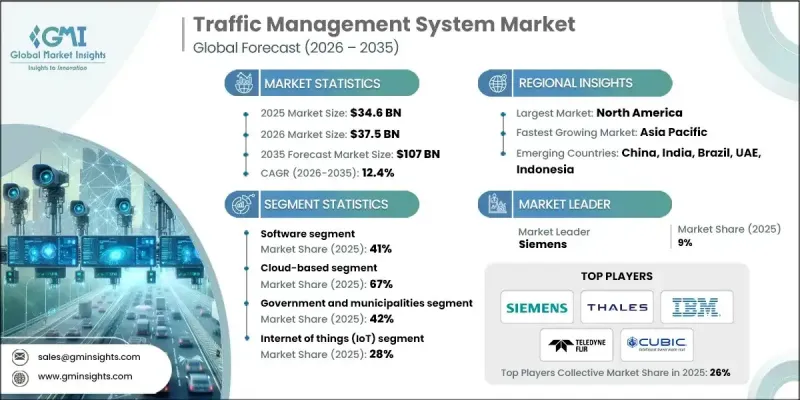
现代都市区高度依赖交通管理系统,透过整合硬体、软体和服务来改善交通出行、缓解拥塞并提昇道路安全。快速的都市化、基础设施现代化以及日益增长的交通拥堵经济成本(根据国际能源总署 (IEA) 估计,已开发经济体的交通拥堵成本占年度 GDP 的 2% 至 4%)是推动这一市场发展的因素。交通管理系统正越来越多地利用人工智慧 (AI)、物联网 (IoT)、云端运算和巨量资料,以实现即时监控、预测分析和智慧交通解决方案。基于云端的部署能够实现集中管理、可扩展的城市级部署,并与车联网 (V2X) 等联网汽车技术整合。分阶段部署通常从讯号最佳化和即时监控开始,逐步发展到预测分析、自动驾驶车辆协调和多模态交通管理。
| 市场覆盖范围 | |
|---|---|
| 开始年份 | 2025 |
| 预测年份 | 2026-2035 |
| 起始值 | 346亿美元 |
| 预测金额 | 1070亿美元 |
| 复合年增长率 | 12.4% |
到 2025 年,云端部署模式将占 67% 的市场份额,到 2035 年将以 12.7% 的复合年增长率成长。云端解决方案提供弹性可扩展性、即时处理大量感测器资料流以及无缝的第三方集成,同时将对高成本的本地基础设施的依赖性降低 40-60%。
预计到2025年,软体解决方案领域将占据41%的市场份额,并在2035年之前以11.5%的复合年增长率成长,这主要得益于人工智慧驱动的分析、自适应交通号誌控制和自动事件侦测技术。这些平台利用机器学习演算法进行交通预测,利用电脑视觉进行即时监控,并利用最佳化引擎改善城市交通流量。
预计从 2026 年到 2035 年,美国交通管理系统市场将以 11.9% 的复合年增长率成长。联邦倡议,例如拨款 1,100 亿美元用于交通基础设施现代化的《基础设施投资和就业法案》,以及美国运输部智慧型运输系统联合计画办公室的指导,正在加速美国各地交通管理系统的普及。
目录
第一章调查方法
第二章执行摘要
第三章业界考察
- 生态系分析
- 供应商情况
- 利润率分析
- 成本结构
- 每个阶段的附加价值
- 影响价值链的因素
- 中断
- 产业影响因素
- 司机
- 全球都市化进程
- 政府投资和监管支持
- 交通管理系统的技术进步
- 对高效率交通运输的需求日益增长
- 先进分析技术和巨量资料的广泛应用
- 产业潜在风险与挑战
- 高昂的初始投资和营运成本
- 隐私和资料安全问题
- 市场机会
- 智慧城市计划推动TMS(交通管理系统)的普及
- 都市区汽车数量的增加正在推动需求成长。
- 与联网汽车自动驾驶车辆的集成
- 紧急服务和公共支持
- 更合理的交通流可以减少排放和燃料消耗。
- 成长潜力分析
- 监管环境
- 北美洲
- 美国联邦智慧交通系统标准与联网汽车指南
- 加拿大—国家智慧交通系统策略与省级交通法规
- 欧洲
- 德国——道路交通法和欧盟智慧交通系统指令
- 英国—交通管理法与城市交通框架
- 法国——国家智慧交通系统优化策略
- 义大利-智慧交通系统行动计画和道路安全义务
- 亚太地区
- 中国—国家智慧交通系统标准与智慧城市交通指南
- 印度—机动车法和智慧城市倡议
- 日本——交通政策与道路交通法
- 澳洲 - ADR 和 ITS 交通管制指南
- LATAM
- 墨西哥 - 交通监控和智慧交通系统解决方案的 NOM 标准
- 阿根廷 - 国家交通法与智慧型运输系统 (ITS) 框架
- 中东和非洲
- 南非共和国 - 道路交通法与智慧运输政策
- 沙乌地阿拉伯—交通法规与2030愿景智慧交通系统倡议
- 北美洲
- 波特五力分析
- PESTEL 分析
- 科技与创新趋势
- 当前技术趋势
- 新兴技术
- 专利分析
- 用例和成功案例
- 永续性和环境方面
- 永续实践
- 减少废弃物策略
- 生产中的能源效率
- 环保倡议
- 碳足迹考量
- 未来前景与机会
- 经营模式和定价框架
- 前期硬体投资成本(CAPEX)与持续软体营运成本(OPEX)
- 基于授权和基于订阅的软体定价
- 託管服务和经常性收入模式
- 基于绩效的合约(KPI、拥塞缓解服务水准协议)
- PPP和基于绩效的支付结构
- 成本经济学:初始成本与持续费用
- 互通性和标准合规性
第四章 竞争情势
- 介绍
- 公司市占率分析
- 北美洲
- 欧洲
- 亚太地区
- 拉丁美洲
- 中东和非洲
- 主要市场公司的竞争分析
- 竞争定位矩阵
- 战略展望矩阵
- 重大进展
- 併购
- 伙伴关係与合作
- 新产品发布
- 企业扩张计画和资金筹措
第五章 按技术分類的市场估算与预测,2022-2035年
- 人工智慧和机器学习
- 物联网 (IoT)
- 基于云端的
- 巨量资料分析
- 其他的
第六章 按组件分類的市场估算与预测,2022-2035年
- 硬体
- 交通号誌及控制设备
- 感应器
- 摄影机和监视器系统
- 可变讯息显示屏
- 软体
- 交通分析
- 智慧型讯号系统
- 路线引导
- 交通监控
- 服务
- 咨询
- 部署与集成
- 支援与维护
第七章 按应用领域分類的市场估算与预测,2022-2035年
- 城市交通管理
- 公路交通管理
- 公共运输管理
- 停车场管理
- 事件管理
- 综合走廊管理(ICM)
- 其他的
第八章 依实施类型分類的市场估算与预测,2022-2035年
- 本地部署
- 基于云端的
9. 依最终用途分類的市场估计与预测,2022-2035 年
- 政府和地方政府
- 运输
- 私人组织
- 其他的
第十章 2022-2035年各地区市场估计与预测
- 北美洲
- 我们
- 加拿大
- 欧洲
- 德国
- 英国
- 法国
- 义大利
- 西班牙
- 俄罗斯
- 北欧国家
- 比荷卢经济联盟
- 亚太地区
- 中国
- 印度
- 日本
- 澳洲
- 韩国
- 新加坡
- 泰国
- 印尼
- 越南
- 拉丁美洲
- 巴西
- 墨西哥
- 阿根廷
- 哥伦比亚
- 中东和非洲
- 南非
- 沙乌地阿拉伯
- 阿拉伯聯合大公国
第十一章 公司简介
- 世界公司
- Cisco
- Huawei Technologies
- IBM
- Intel
- Siemens
- Swarco
- Teledyne FLIR
- Thales
- TomTom International
- 区域玩家
- Cubic
- Iteris
- Jenoptik
- Kapsch
- Metro Infrasys
- Omnitec Systems
- Q-Free
- TransCore
- 新兴科技创新者
- Acyclica
- Cohda Wireless
- Miovision
- Radwin
- Sensys Networks
- Sick
- Sumitomo
- Vayyar Imaging
The Global Traffic Management System Market was valued at USD 34.6 billion in 2025 and is estimated to grow at a CAGR of 12.4% to reach USD 107 billion by 2035.
Modern urban centers rely heavily on traffic management systems to improve mobility, reduce congestion, and enhance road safety by integrating hardware, software, and services. The market is driven by rapid urbanization, infrastructure modernization, and rising economic costs of traffic congestion, which the International Energy Agency estimates to be 2-4% of GDP in developed economies annually. Traffic management systems increasingly leverage AI, IoT, cloud computing, and big data to enable real-time monitoring, predictive analytics, and intelligent transport solutions. Cloud-based deployments allow centralized control, scalable citywide implementation, and integration with connected vehicle technologies such as vehicle-to-everything (V2X) communication. Phased implementations typically begin with signal optimization and real-time monitoring and evolve to predictive analytics, autonomous vehicle coordination, and multi-modal transport management.
| Market Scope | |
|---|---|
| Start Year | 2025 |
| Forecast Year | 2026-2035 |
| Start Value | $34.6 Billion |
| Forecast Value | $107 Billion |
| CAGR | 12.4% |
The cloud deployment model accounted for 67% share in 2025 and is growing at a CAGR of 12.7% through 2035. Cloud solutions provide elastic scalability, real-time processing of massive sensor data streams, and seamless third-party integration while reducing reliance on costly on-premises infrastructure by 40-60%.
The software solutions segment held 41% share in 2025, with growth at a CAGR of 11.5% through 2035, driven by AI-powered analytics, adaptive signal control, and automated incident detection technologies. These platforms use machine learning algorithms for traffic prediction, computer vision for real-time monitoring, and optimization engines to improve urban traffic flow.
U.S. Traffic Management System Market will grow at a CAGR of 11.9% from 2026 to 2035. Federal initiatives such as the Infrastructure Investment and Jobs Act, which allocates USD 110 billion for modernizing transportation infrastructure, and guidance from the U.S. Department of Transportation's Intelligent Transportation Systems Joint Program Office, are accelerating TMS adoption across the country.
Key players in the Global Traffic Management System Market include Siemens, Iteris, Teledyne FLIR, Intel, Thales, Cubic, IBM, Jenoptik, Swarco, and Transcore. Companies in the traffic management system market strengthen their position by investing in AI-driven traffic analytics, expanding cloud-based service offerings, and developing modular, scalable solutions for urban deployments. Strategic collaborations with smart city projects, integration with connected vehicle and V2X technologies, and continuous R&D into predictive traffic optimization and real-time monitoring tools help firms expand their market footprint. Additionally, partnerships with government agencies and transportation authorities enable these companies to secure long-term contracts and maintain competitive advantage, while global expansion strategies and regional deployment customization support growth across emerging and mature markets.
Table of Contents
Chapter 1 Methodology
- 1.1 Research approach
- 1.2 Quality commitments
- 1.3 Research trail and confidence scoring
- 1.3.1 Research trail components
- 1.3.2 Scoring components
- 1.4 Data collection
- 1.4.1 Partial list of primary sources
- 1.5 Data mining sources
- 1.5.1 Paid sources
- 1.6 Best estimates and calculations
- 1.6.1 Base year calculation for any one approach
- 1.7 Forecast model
- 1.8 Research transparency addendum
Chapter 2 Executive Summary
- 2.1 Industry 360° synopsis, 2022 - 2035
- 2.2 Key market trends
- 2.2.1 Regional
- 2.2.2 Technology
- 2.2.3 Components
- 2.2.4 Application
- 2.2.5 Deployment Mode
- 2.2.6 End Use
- 2.3 TAM Analysis, 2026-2035
- 2.4 CXO perspectives: Strategic imperatives
- 2.4.1 Executive decision points
- 2.4.2 Critical success factors
- 2.5 Future outlook and strategic recommendations
Chapter 3 Industry Insights
- 3.1 Industry ecosystem analysis
- 3.1.1 Supplier landscape
- 3.1.2 Profit margin analysis
- 3.1.3 Cost structure
- 3.1.4 Value addition at each stage
- 3.1.5 Factor affecting the value chain
- 3.1.6 Disruptions
- 3.2 Industry impact forces
- 3.2.1.1 Growth drivers
- 3.2.1.2 Increasing global urbanization
- 3.2.1.3 Government investments and regulatory support
- 3.2.1.4 Technological advancements in traffic management systems
- 3.2.1.5 Increased demand for efficient transportation
- 3.2.1.6 Rising adoption of advanced analytics and big data
- 3.2.2 Industry pitfalls and challenges
- 3.2.2.1 High initial investment and operational costs
- 3.2.2.2 Privacy and data security concerns
- 3.2.3 Market opportunities
- 3.2.3.1 Smart city projects drive TMS adoption
- 3.2.3.2 Rising urban vehicle populations increase demand
- 3.2.3.3 Integration with connected and autonomous vehicles
- 3.2.3.4 Support for emergency services and public safety
- 3.2.3.5 Reduce emissions and fuel consumption through smart traffic flow
- 3.3 Growth potential analysis
- 3.4 Regulatory landscape
- 3.4.1 North America
- 3.4.1.1 US- Federal ITS standards and Connected Vehicle Guidelines
- 3.4.1.2 Canada - National ITS strategy and provincial traffic regulations
- 3.4.2 Europe
- 3.4.2.1 Germany- Road Traffic Act and EU ITS directives
- 3.4.2.2 UK- Traffic Management Act and urban mobility frameworks
- 3.4.2.3 France- National ITS strategy for traffic optimization
- 3.4.2.4 Italy- ITS action plans and road safety mandates
- 3.4.3 Asia Pacific
- 3.4.3.1 China- National ITS standards and smart city traffic guidelines
- 3.4.3.2 India- Motor vehicles act and smart city mission initiatives
- 3.4.3.3 Japan- i-Transportation policies and road traffic act
- 3.4.3.4 Australia- ADR and ITS guidelines for traffic control
- 3.4.4 LATAM
- 3.4.4.1 Mexico- NOM standards for traffic monitoring and ITS solutions
- 3.4.4.2 Argentina- National Traffic Law and ITS frameworks
- 3.4.5 MEA
- 3.4.5.1 South Africa- Road Traffic Act and smart mobility initiatives
- 3.4.5.2 Saudi Arabia- Traffic regulations and Vision 2030 ITS initiatives
- 3.4.1 North America
- 3.5 Porter's analysis
- 3.6 PESTEL analysis
- 3.7 Technology and innovation landscape
- 3.7.1 Current technological trends
- 3.7.2 Emerging technologies
- 3.8 Patent analysis
- 3.9 Use cases & success stories
- 3.10 Sustainability and environmental aspects
- 3.10.1 Sustainable practices
- 3.10.2 Waste reduction strategies
- 3.10.3 Energy efficiency in production
- 3.10.4 Eco-friendly Initiatives
- 3.10.5 Carbon footprint considerations
- 3.11 Future outlook and opportunities
- 3.12 Business Model & Pricing Framework
- 3.12.1 One-time hardware CAPEX vs recurring software OPEX
- 3.12.2 License-based vs subscription-based software pricing
- 3.12.3 Managed services & annuity revenue models
- 3.12.4 Performance-based contracts (KPIs, congestion reduction SLAs)
- 3.12.5 PPP and outcome-based payment structures
- 3.13 Cost Economics: Upfront vs Recurring Spend
- 3.14 Interoperability & Standards Compliance
Chapter 4 Competitive Landscape, 2025
- 4.1 Introduction
- 4.2 Company market share analysis
- 4.2.1 North America
- 4.2.2 Europe
- 4.2.3 Asia Pacific
- 4.2.4 LATAM
- 4.2.5 MEA
- 4.3 Competitive analysis of major market players
- 4.4 Competitive positioning matrix
- 4.5 Strategic outlook matrix
- 4.6 Key developments
- 4.6.1 Mergers & acquisitions
- 4.6.2 Partnerships & collaborations
- 4.6.3 New product launches
- 4.6.4 Expansion plans and funding
Chapter 5 Market Estimates & Forecast, By Technology, 2022 - 2035 ($Bn)
- 5.1 Key trends
- 5.2 AI & ML
- 5.3 Internet of things (IoT)
- 5.4 Cloud-based
- 5.5 Big data analytics
- 5.6 Others
Chapter 6 Market Estimates & Forecast, By Component, 2022 - 2035 ($Bn)
- 6.1 Key trends
- 6.2 Hardware
- 6.2.1 Traffic signals and controllers
- 6.2.2 Sensors
- 6.2.3 Camera and surveillance systems
- 6.2.4 Variable message signs
- 6.3 Software
- 6.3.1 Traffic analytics
- 6.3.2 Smart signaling
- 6.3.3 Route guidance
- 6.3.4 Traffic monitoring
- 6.4 Services
- 6.4.1 Consulting
- 6.4.2 Deployment and integration
- 6.4.3 Support and maintenance
Chapter 7 Market Estimates & Forecast, By Application, 2022 - 2035 ($Bn)
- 7.1 Key trends
- 7.2 Urban traffic management
- 7.3 Highway traffic management
- 7.4 Public transportation management
- 7.5 Parking management
- 7.6 Incident management
- 7.7 Integrated corridor management (ICM)
- 7.8 Others
Chapter 8 Market Estimates & Forecast, By Deployment Mode, 2022 - 2035 ($Bn)
- 8.1 Key trends
- 8.2 On-premises
- 8.3 Cloud-based
Chapter 9 Market Estimates & Forecast, By End Use, 2022 - 2035 ($Bn)
- 9.1 Key trends
- 9.2 Government and municipalities
- 9.3 Transportation agencies
- 9.4 Private organizations
- 9.5 Others
Chapter 10 Market Estimates & Forecast, By Region, 2022 - 2035 ($Bn)
- 10.1 Key trends
- 10.2 North America
- 10.2.1 US
- 10.2.2 Canada
- 10.3 Europe
- 10.3.1 Germany
- 10.3.2 UK
- 10.3.3 France
- 10.3.4 Italy
- 10.3.5 Spain
- 10.3.6 Russia
- 10.3.7 Nordics
- 10.3.8 Benelux
- 10.4 Asia Pacific
- 10.4.1 China
- 10.4.2 India
- 10.4.3 Japan
- 10.4.4 Australia
- 10.4.5 South Korea
- 10.4.6 Singapore
- 10.4.7 Thailand
- 10.4.8 Indonesia
- 10.4.9 Vietnam
- 10.5 Latin America
- 10.5.1 Brazil
- 10.5.2 Mexico
- 10.5.3 Argentina
- 10.5.4 Colombia
- 10.6 MEA
- 10.6.1 South Africa
- 10.6.2 Saudi Arabia
- 10.6.3 UAE
Chapter 11 Company Profiles
- 11.1 Global Players
- 11.1.1 Cisco
- 11.1.2 Huawei Technologies
- 11.1.3 IBM
- 11.1.4 Intel
- 11.1.5 Siemens
- 11.1.6 Swarco
- 11.1.7 Teledyne FLIR
- 11.1.8 Thales
- 11.1.9 TomTom International
- 11.2 Regional Players
- 11.2.1 Cubic
- 11.2.2 Iteris
- 11.2.3 Jenoptik
- 11.2.4 Kapsch
- 11.2.5 Metro Infrasys
- 11.2.6 Omnitec Systems
- 11.2.7 Q-Free
- 11.2.8 TransCore
- 11.3 Emerging Technology Innovators
- 11.3.1 Acyclica
- 11.3.2 Cohda Wireless
- 11.3.3 Miovision
- 11.3.4 Radwin
- 11.3.5 Sensys Networks
- 11.3.6 Sick
- 11.3.7 Sumitomo
- 11.3.8 Vayyar Imaging

 交通管理市场:按组件、技术、应用、最终用户和部署模式划分-2026-2032年全球市场预测
 智慧交通管理系统市场预测至2034年-按解决方案、技术、最终用户和区域分類的全球分析智慧交通管理与物联网赋能道路市场预测:至2034年-按组件、部署模式、技术、应用和区域分類的全球分析智慧交通号誌市场按组件、连接方式、应用、安装和最终用户划分,全球预测(2026-2032年)
 交通管理市场分析及预测(至2035年):依类型、产品类型、服务、技术、组件、应用、设备、部署类型、最终用户及解决方案划分
 交通管理市场规模、份额和成长分析(按组件、系统、应用和地区划分)—产业预测(2026-2033 年)交通管理市场预测至2032年:按组件、系统、部署模式、应用、最终用户和区域分類的全球分析
 智慧交通管理系统市场-全球产业规模、份额、趋势、机会和预测(按组件、按解决方案类型、按应用、按地区和按竞争划分,2020 年至 2030 年)
 智慧交通管理的全球市场:2025-2030年
 交通管理市场按产品、应用领域、最终用户和地区划分 - 预测至 2029 年