


 |
市场调查报告书
商品编码
1936584
金属黏合剂市场机会、成长要素、产业趋势分析及2026年至2035年预测Metal Bonding Adhesives Market Opportunity, Growth Drivers, Industry Trend Analysis, and Forecast 2026 - 2035 |
||||||

全球金属黏合剂市场预计到 2025 年将达到 76 亿美元,并以 7% 的复合年增长率成长,到 2035 年将达到 149 亿美元。
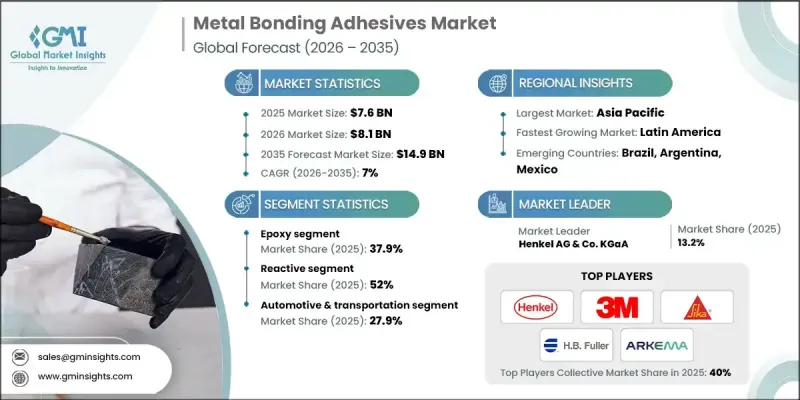
市场成长的驱动力在于传统连接技术向先进黏合剂解决方案的加速转型,这些先进解决方案能够提供高强度、高柔软性、高耐久性和轻量化优势。业界越来越重视那些能够满足现代设计要求、降低材料应力并提升整体结构性能的黏合技术。随着製造商不断强化轻量化策略并将尖端材料整合到下一代汽车平臺中,汽车和交通应用仍然是需求成长的核心。金属黏合剂能够有效黏合各种基材,同时保持结构完整性和设计自由度。航太和国防领域正在推动市场发展。製造商持续依赖高性能黏合剂系统来增强复杂组装的结构稳定性、抗振性和长期耐久性。商业航空领域的日益活跃和国防投资的持续成长正在增强全球製造地的需求。随着各行业寻求提高效率、减少排放和延长产品生命週期,金属黏合剂正成为现代製造和组装流程的重要组成部分。
| 市场覆盖范围 | |
|---|---|
| 开始年份 | 2025 |
| 预测年份 | 2026-2035 |
| 起始值 | 76亿美元 |
| 预测金额 | 149亿美元 |
| 复合年增长率 | 7% |
预计到2025年,环氧树脂黏合剂市占率将达到37.9%,并在2035年之前以6.9%的复合年增长率成长。环氧树脂胶黏剂具有高机械强度、热稳定性、耐化学性和长期耐久性,使其适用于要求严苛的工业、交通运输和航太应用,从而广泛应用。其在各种工况下的适应性也持续支撑着稳定的市场需求。
预计到 2025 年,反应型黏合剂市场份额将达到 52%,到 2035 年将以 7.1% 的复合年增长率成长。这些系统因其能够透过化学固化机制形成持久的结构键而备受青睐,在多个行业的高应力和高负荷条件下都能提供可靠的性能。
美国金属黏合剂市场持续展现强劲的成长潜力,预计到 2025 年将达到 15 亿美元。先进製造业、电气化倡议以及对高价值工业生产的持续投资,正在维持美国各地对高性能黏合剂技术的需求。
目录
第一章调查方法和范围
第二章执行摘要
第三章业界考察
- 生态系分析
- 供应商情况
- 利润率
- 每个阶段的附加价值
- 影响价值链的因素
- 中断
- 产业影响因素
- 司机
- 产业潜在风险与挑战
- 市场机会
- 成长潜力分析
- 监管环境
- 北美洲
- 欧洲
- 亚太地区
- 拉丁美洲
- 中东和非洲
- 波特五力分析
- PESTEL 分析
- 价格趋势
- 按地区
- 依树脂类型
- 未来市场趋势
- 科技与创新趋势
- 当前技术趋势
- 新兴技术
- 专利状态
- 贸易统计(HS编码)
(註:贸易统计数据仅涵盖主要国家。)
- 主要进口国
- 主要出口国
- 永续性和环境方面
- 永续努力
- 减少废弃物策略
- 生产中的能源效率
- 环保倡议
- 考虑到碳足迹
第四章 竞争情势
- 介绍
- 公司市占率分析
- 按地区
- 北美洲
- 欧洲
- 亚太地区
- 拉丁美洲
- 中东和非洲
- 按地区
- 企业矩阵分析
- 主要市场公司的竞争分析
- 竞争定位矩阵
- 重大进展
- 併购
- 伙伴关係与合作
- 新产品发布
- 业务拓展计划
第五章 依树脂类型分類的市场估算与预测,2022-2035年
- 环氧树脂
- 聚氨酯
- 丙烯酸树脂
- 氰基丙烯酸酯
- 厌氧树脂
- 其他的
第六章 按技术分類的市场估计与预测,2022-2035年
- 溶剂型
- 水溶液
- 反应性
- 热熔胶
7. 2022-2035年按最终用途产业分類的市场估算与预测
- 汽车/运输设备
- 搭乘用车
- 商用车辆
- 铁路和地铁系统
- 电动车(EV)
- 船
- 特种车辆
- 航太/国防
- 商业航空
- 军用飞机和装备
- 太空船/卫星
- 无人机
- 电子产品和消费品
- 印刷基板(PCB)
- 半导体和微电子
- 智慧型手机和穿戴式装置
- 电视和显示器
- 家用电器
- 电池和电气组件
- 医疗和药品
- 医疗设备
- 牙科器械和设备
- 外科器械及植入
- 药物输送系统
- 穿戴式健康设备
- 工业设备和机械
- 重型机械
- 通用製造设备
- 机器人和自动化系统
- 帮浦、阀门、压缩机
- 暖通空调系统
- 建筑和基础设施
- 结构钢的黏合
- 建筑幕墙和幕墙
- 金属框架组装
- 建筑面板
- 暖通空调风管/管道连接
- 活力
- 风力发电机叶片组装
- 太阳能板框架
- 电池系统
- 燃料电池
- 输电设备
- 其他的
第八章 2022-2035年各地区市场估算与预测
- 北美洲
- 我们
- 加拿大
- 欧洲
- 德国
- 英国
- 法国
- 西班牙
- 义大利
- 其他欧洲地区
- 亚太地区
- 中国
- 印度
- 日本
- 澳洲
- 韩国
- 亚太其他地区
- 拉丁美洲
- 巴西
- 墨西哥
- 阿根廷
- 其他拉丁美洲地区
- 中东和非洲
- 沙乌地阿拉伯
- 南非
- 阿拉伯聯合大公国
- 其他中东和非洲地区
第九章:公司简介
- 3M Company
- Arkema Group
- Ashland Inc.
- BASF SE
- DELO Industrie Klebstoffe GmbH &Co KGaA
- DuPont
- Dymax Corporation
- Evonik Industries
- HB Fuller
- Henkel AG &Co. KGaA
- Huntsman Corporation
- ITW Performance Polymers
- L&L Products
- LORD Corporation
- Panacol-Elosol GmbH
- Parson Adhesives Inc.
- Permabond LLC
- Sika AG
- Solvay SA
- Toagosei Co., Ltd.
- Others
The Global Metal Bonding Adhesives Market was valued at USD 7.6 billion in 2025 and is estimated to grow at a CAGR of 7% to reach USD 14.9 billion by 2035.
Market expansion is driven by the accelerating shift away from conventional joining techniques toward advanced adhesive solutions that deliver high strength, flexibility, durability, and weight optimization. Industries are increasingly prioritizing bonding technologies that support modern design requirements, reduce material stress, and improve overall structural performance. Automotive and transportation applications remain central to demand growth as manufacturers intensify lightweighting strategies and integrate advanced materials into next-generation vehicle platforms. Metal bonding adhesives enable effective joining of varied substrates while maintaining structural integrity and design freedom. The aerospace and defense sector support market momentum, as manufacturers continue to rely on high-performance adhesive systems to enhance structural stability, vibration resistance, and long-term durability in complex assemblies. Rising activity across commercial aviation and sustained defense investments are reinforcing demand across global manufacturing hubs. As industries pursue improved efficiency, lower emissions, and enhanced product lifecycles, metal bonding adhesives are becoming an essential component of modern fabrication and assembly processes.
| Market Scope | |
|---|---|
| Start Year | 2025 |
| Forecast Year | 2026-2035 |
| Start Value | $7.6 Billion |
| Forecast Value | $14.9 Billion |
| CAGR | 7% |
The epoxy-based adhesives segment accounted for 37.9% share in 2025 and is expected to grow at a CAGR of 6.9% through 2035. Their strong adoption is supported by high mechanical strength, thermal stability, chemical resistance, and long-term durability, making them suitable for demanding industrial, transportation, and aerospace applications. Their adaptability across a wide range of operating conditions continues to support consistent demand.
The reactive adhesives segment held 52% share in 2025 and is projected to grow at a CAGR of 7.1% by 2035. These systems are favored for their ability to form durable structural bonds through chemical curing mechanisms, delivering reliable performance under high stress and load-bearing conditions across multiple industries.
U.S. Metal Bonding Adhesives Market reached USD 1.5 billion in 2025 and continues to show strong growth potential. Ongoing investments in advanced manufacturing, electrification initiatives, and high-value industrial production are sustaining demand for high-performance adhesive technologies across the country.
Key players in the Global Metal Bonding Adhesives Market include Henkel AG & Co. KGaA, 3M Company, BASF SE, Sika AG, Arkema Group, H.B. Fuller, DuPont, Huntsman Corporation, Evonik Industries, Solvay S.A., Ashland Inc., ITW Performance Polymers, Dymax Corporation, LORD Corporation, Panacol-Elosol GmbH, Permabond LLC, L&L Products, Parson Adhesives Inc., Toagosei Co., Ltd., and DELO Industrie Klebstoffe GmbH & Co KGaA. Companies operating in the metal bonding adhesives market are strengthening their market position through continuous innovation, targeted product development, and strategic partnerships with end-use industries. Manufacturers are investing in advanced formulations that improve bonding strength, environmental resistance, and processing efficiency. Expansion of production capabilities in high-growth regions, customization of solutions for industry-specific requirements, and focus on sustainability-driven product portfolios are also central strategies.
Table of Contents
Chapter 1 Methodology & Scope
- 1.1 Market scope and definition
- 1.2 Research design
- 1.2.1 Research approach
- 1.2.2 Data collection methods
- 1.3 Data mining sources
- 1.3.1 Global
- 1.3.2 Regional/Country
- 1.4 Base estimates and calculations
- 1.4.1 Base year calculation
- 1.4.2 Key trends for market estimation
- 1.5 Primary research and validation
- 1.5.1 Primary sources
- 1.6 Forecast model
- 1.7 Research assumptions and limitations
Chapter 2 Executive Summary
- 2.1 Industry 360° synopsis
- 2.2 Key market trends
- 2.2.1 Regional
- 2.2.2 Resin type
- 2.2.3 Technology
- 2.2.4 End use industry
- 2.3 TAM Analysis, 2026-2035
- 2.4 CXO perspectives: Strategic imperatives
- 2.4.1 Executive decision points
- 2.4.2 Critical success factors
- 2.5 Future Outlook and Strategic Recommendations
Chapter 3 Industry Insights
- 3.1 Industry ecosystem analysis
- 3.1.1 Supplier landscape
- 3.1.2 Profit margin
- 3.1.3 Value addition at each stage
- 3.1.4 Factor affecting the value chain
- 3.1.5 Disruptions
- 3.2 Industry impact forces
- 3.2.1 Growth drivers
- 3.2.2 Industry pitfalls and challenges
- 3.2.3 Market opportunities
- 3.3 Growth potential analysis
- 3.4 Regulatory landscape
- 3.4.1 North America
- 3.4.2 Europe
- 3.4.3 Asia Pacific
- 3.4.4 Latin America
- 3.4.5 Middle East & Africa
- 3.5 Porter's analysis
- 3.6 PESTEL analysis
- 3.7 Price trends
- 3.7.1 By region
- 3.7.2 By resin type
- 3.8 Future market trends
- 3.9 Technology and Innovation landscape
- 3.9.1 Current technological trends
- 3.9.2 Emerging technologies
- 3.10 Patent Landscape
- 3.11 Trade statistics (HS code)
( Note: the trade statistics will be provided for key countries only)
- 3.11.1 Major importing countries
- 3.11.2 Major exporting countries
- 3.12 Sustainability and environmental aspects
- 3.12.1 Sustainable practices
- 3.12.2 Waste reduction strategies
- 3.12.3 Energy efficiency in production
- 3.12.4 Eco-friendly initiatives
- 3.13 Carbon footprint consideration
Chapter 4 Competitive Landscape, 2025
- 4.1 Introduction
- 4.2 Company market share analysis
- 4.2.1 By region
- 4.2.1.1 North America
- 4.2.1.2 Europe
- 4.2.1.3 Asia Pacific
- 4.2.1.4 LATAM
- 4.2.1.5 MEA
- 4.2.1 By region
- 4.3 Company matrix analysis
- 4.4 Competitive analysis of major market players
- 4.5 Competitive positioning matrix
- 4.6 Key developments
- 4.6.1 Mergers & acquisitions
- 4.6.2 Partnerships & collaborations
- 4.6.3 New Product Launches
- 4.6.4 Expansion Plans
Chapter 5 Market Estimates and Forecast, By Resin Type, 2022-2035 (USD Billion) (Kilo Tons)
- 5.1 Key trends
- 5.2 Epoxy
- 5.3 Polyurethane
- 5.4 Acrylic
- 5.5 Cyanoacrylate
- 5.6 Anaerobic
- 5.7 Others
Chapter 6 Market Estimates and Forecast, By Technology, 2022-2035 (USD Billion) (Kilo Tons)
- 6.1 Key trends
- 6.2 Solvent-Based
- 6.3 Water-Based
- 6.4 Reactive
- 6.5 Hot Melt
Chapter 7 Market Estimates and Forecast, By End Use Industry, 2022-2035 (USD Billion) (Kilo Tons)
- 7.1 Key trends
- 7.2 Automotive & Transportation
- 7.2.1 Passenger Cars
- 7.2.2 Commercial Vehicles
- 7.2.3 Railways & Metro Systems
- 7.2.4 Electric Vehicles (EVs)
- 7.2.5 Marine
- 7.2.6 Specialty Vehicles
- 7.3 Aerospace & Defense
- 7.3.1 Commercial Aviation
- 7.3.2 Military Aircraft & Equipment
- 7.3.3 Spacecraft & Satellites
- 7.3.4 Unmanned Aerial Vehicles
- 7.4 Electronics & Consumer
- 7.4.1 Printed Circuit Boards (PCBs)
- 7.4.2 Semiconductors & Microelectronics
- 7.4.3 Smartphones & Wearables
- 7.4.4 Televisions & Displays
- 7.4.5 Home Appliances
- 7.4.6 Batteries & Electrical Assemblies
- 7.5 Medical & Pharmaceutical
- 7.5.1 Medical Equipment
- 7.5.2 Dental Instruments & Devices
- 7.5.3 Surgical Tools & Implants
- 7.5.4 Drug Delivery Systems
- 7.5.5 Wearable Health Devices
- 7.6 Industrial Equipment & Machinery
- 7.6.1 Heavy Machinery
- 7.6.2 General Manufacturing Equipment
- 7.6.3 Robotics & Automation Systems
- 7.6.4 Pumps, Valves & Compressors
- 7.6.5 HVAC Systems
- 7.7 Construction & Infrastructure
- 7.7.1 Structural Steel Bonding
- 7.7.2 Facade & Curtain Walls
- 7.7.3 Metal Frame Assembly
- 7.7.4 Architectural Panels
- 7.7.5 HVAC Ducts/Pipe Bonding
- 7.8 Energy
- 7.8.1 Wind Turbine Blade Assembly
- 7.8.2 Solar Panel Framing
- 7.8.3 Battery Systems
- 7.8.4 Fuel Cells
- 7.8.5 Power Transmission Equipment
- 7.9 Others
Chapter 8 Market Estimates and Forecast, By Region, 2022-2035 (USD Billion) (Kilo Tons)
- 8.1 Key trends
- 8.2 North America
- 8.2.1 U.S.
- 8.2.2 Canada
- 8.3 Europe
- 8.3.1 Germany
- 8.3.2 UK
- 8.3.3 France
- 8.3.4 Spain
- 8.3.5 Italy
- 8.3.6 Rest of Europe
- 8.4 Asia Pacific
- 8.4.1 China
- 8.4.2 India
- 8.4.3 Japan
- 8.4.4 Australia
- 8.4.5 South Korea
- 8.4.6 Rest of Asia Pacific
- 8.5 Latin America
- 8.5.1 Brazil
- 8.5.2 Mexico
- 8.5.3 Argentina
- 8.5.4 Rest of Latin America
- 8.6 Middle East and Africa
- 8.6.1 Saudi Arabia
- 8.6.2 South Africa
- 8.6.3 UAE
- 8.6.4 Rest of Middle East and Africa
Chapter 9 Company Profiles
- 9.1 3M Company
- 9.2 Arkema Group
- 9.3 Ashland Inc.
- 9.4 BASF SE
- 9.5 DELO Industrie Klebstoffe GmbH & Co KGaA
- 9.6 DuPont
- 9.7 Dymax Corporation
- 9.8 Evonik Industries
- 9.9 H.B. Fuller
- 9.10 Henkel AG & Co. KGaA
- 9.11 Huntsman Corporation
- 9.12 ITW Performance Polymers
- 9.13 L&L Products
- 9.14 LORD Corporation
- 9.15 Panacol-Elosol GmbH
- 9.16 Parson Adhesives Inc.
- 9.17 Permabond LLC
- 9.18 Sika AG
- 9.19 Solvay S.A.
- 9.20 Toagosei Co., Ltd.
- 9.21 Others


