


 |
市场调查报告书
商品编码
1936588
血栓症药物市场机会、成长要素、产业趋势分析及2026年至2035年预测Thrombosis Drugs Market Opportunity, Growth Drivers, Industry Trend Analysis, and Forecast 2026 - 2035 |
||||||

全球血栓症药物市场预计到 2025 年将达到 473 亿美元,到 2035 年将达到 957 亿美元,年复合成长率为 7.4%。
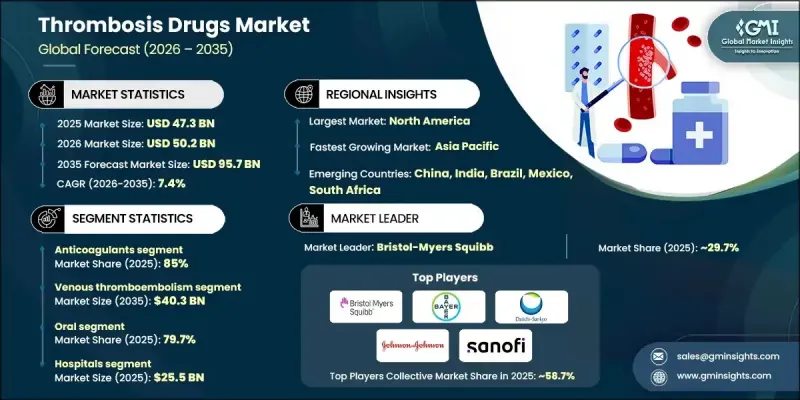
心血管疾病(如心肌梗塞、肺动脉栓塞和缺血性中风)发病率的上升推动了这一增长。在这些疾病中,迅速恢復血流至关重要,因此血栓症治疗在急救中至关重要。血栓症药物旨在预防和治疗血管内血栓形成,包括抑制凝血因子的抗凝血剂、抑制血小板凝集的抗血小板药物以及溶解现有血栓的溶栓剂。直接口服抗凝血剂(DOAC)的日益普及,因其使用方便且安全性更高,进一步推动了市场成长。外科手术量的增加、癌症相关血栓症发生率的上升、抗凝血治疗的延长以及临床上对血栓併发症日益增长的关注,都在推动市场需求。新型口服抗凝血剂(NOAC)因其在预防缺血性中风(尤其是在非瓣膜性心房颤动患者中)方面的确切疗效,已成为首选治疗方法。
| 市场覆盖范围 | |
|---|---|
| 开始年份 | 2025 |
| 预测年份 | 2026-2035 |
| 起始值 | 473亿美元 |
| 预测金额 | 957亿美元 |
| 复合年增长率 | 7.4% |
抗凝血剂市占率占85%,预计到2025年将创造402亿美元的收入。此细分市场包括直接口服抗凝血剂、肝素、维生素K拮抗剂和注射直接凝血酶抑制剂。其主导地位归功于其在预防和治疗领域的广泛应用,包括心房颤动、中风预防、静脉血栓栓塞症的治疗以及术后血栓预防。直接口服抗凝血剂因其完善的临床指南、医生熟悉度高、疗效可预测、给药方便且监测需求低而备受青睐,其日益增长的使用进一步巩固了其在该细分市场的领先地位。
预计到2035年,静脉血栓栓塞症症市场规模将达403亿美元。此领域(包括深层静脉栓塞症和肺动脉栓塞)的成长主要受人口老化、肥胖和癌症发生率上升、住院时间延长以及外科手术数量增加等因素所驱动。医院和门诊机构对血栓预防指引的认识不断提高,并推动了全球诊断率和治疗率的提升。
预计到2025年,北美血栓症药物市占率将达到59.5%。该地区受益于完善的医疗基础设施,包括先进的医院、专业的心臟中心以及口服和注射抗凝血剂的便捷获取途径。心血管疾病、心房颤动和静脉血栓栓塞症的高发生率,尤其是在老年人,推动了血栓症药物的强劲需求。新型口服抗凝血剂(NOAC)的早期应用、完善的医保报销体係以及医护人员对抗血栓通讯协定的广泛了解,进一步巩固了该地区的主导地位。
目录
第一章调查方法和范围
第二章执行摘要
第三章业界考察
- 生态系分析
- 产业影响因素
- 司机
- 心血管和脑血管疾病发生率增加
- 扩大新型口服抗凝血剂(NOACs)的引入
- 手术数量增加
- 溶栓药物製剂的进展
- 产业潜在风险与挑战
- 副作用和不良反应的风险
- 严格的监管核准
- 市场机会
- 扩大预防性心血管护理的覆盖范围
- 下一代上游凝血抑制剂的研发
- 司机
- 成长潜力分析
- 监管环境
- 科技趋势
- 当前技术趋势
- 新兴技术
- 救赎方案
- 管道分析
- 定价分析
- 未来市场趋势
- 差距分析
- 波特五力分析
- PESTEL 分析
第四章 竞争情势
- 介绍
- 公司市占率分析
- 世界
- 北美洲
- 欧洲
- 亚太地区
- 企业矩阵分析
- 主要市场公司的竞争分析
- 竞争定位矩阵
- 重大进展
- 併购
- 伙伴关係与合作
- 新产品发布
- 扩张计划
5. 按药物类别分類的市场估计和预测,2022-2035 年
- 抗凝血剂
- 直接口服抗凝血剂
- 肝素
- 维生素K拮抗剂
- 注射用直接凝血酶原抑制剂(DTIs)
- 抗血小板药物
- P2Y12受体抑制剂
- 阿斯匹灵
- GlicoIIb/IIIa抑制剂
- 溶栓药物
第六章 依疾病类型分類的市场估计与预测,2022-2035年
- 静脉血栓栓塞症
- 深层静脉栓塞症
- 肺动脉栓塞
- 动脉血栓症
- 心房颤动
- 脑血管疾病
- 其他疾病类型
7. 依行政途径分類的市场估计与预测,2022-2035 年
- 口服
- 注射
- 外用
第八章 依最终用途分類的市场估算与预测,2022-2035年
- 医院
- 门诊手术中心
- 其他用途
第九章 2022-2035年各地区市场估算与预测
- 北美洲
- 我们
- 加拿大
- 欧洲
- 德国
- 英国
- 法国
- 西班牙
- 义大利
- 荷兰
- 亚太地区
- 中国
- 印度
- 日本
- 澳洲
- 韩国
- 拉丁美洲
- 巴西
- 墨西哥
- 阿根廷
- 中东和非洲
- 南非
- 沙乌地阿拉伯
- 阿拉伯聯合大公国
第十章:公司简介
- Aspen Pharmacare
- AstraZeneca
- Bayer
- Boehringer Ingelheim
- Bristol-Myers Squibb
- Chiesi Farmaceutici
- Daiichi Sankyo
- Dr. Reddy's Laboratories
- Johnson &Johnson
- Karma Pharmatech
- Lupin
- Microbix Biosystems
- Novartis
- Pfizer
- Sanofi
- Teva Pharmaceuticals
The Global Thrombosis Drugs Market was valued at USD 47.3 billion in 2025 and is estimated to grow at a CAGR of 7.4% to reach USD 95.7 billion by 2035.
The growth is driven by the rising prevalence of cardiovascular disorders, including myocardial infarction, pulmonary embolism, and ischemic stroke, which necessitate rapid restoration of blood flow, making thrombosis treatment critical in emergency care. Thrombosis drugs are designed to prevent and treat clot formation in blood vessels, including anticoagulants that inhibit clotting factors, antiplatelet agents that block platelet aggregation, and thrombolytics that dissolve existing clots. The growing adoption of direct oral anticoagulants, which offer convenience and improved safety profiles, has further accelerated market expansion. Increased surgical procedures, rising incidences of cancer-associated thrombosis, and prolonged anticoagulation therapy, alongside growing clinical focus on thrombotic complications, collectively fuel demand. Novel oral anticoagulants (NOACs) emerge as a preferred therapy, particularly for non-valvular atrial fibrillation, due to their proven efficacy in preventing ischemic stroke.
| Market Scope | |
|---|---|
| Start Year | 2025 |
| Forecast Year | 2026-2035 |
| Start Value | $47.3 Billion |
| Forecast Value | $95.7 Billion |
| CAGR | 7.4% |
The anticoagulants segment held an 85% share, generating USD 40.2 billion in 2025. This segment includes direct oral anticoagulants, heparin, vitamin K antagonists, and injectable direct thrombin inhibitors. Its dominance is attributed to widespread use in both prophylactic and therapeutic settings, including atrial fibrillation, stroke prevention, venous thromboembolism management, and post-surgical thromboprophylaxis. Strong clinical guidelines, physician familiarity, and growing use of direct oral anticoagulants valued for predictable efficacy, convenient dosing, and minimal monitoring have further solidified this segment's leadership.
The venous thromboembolism segment is expected to reach USD 40.3 billion by 2035. It encompasses deep vein thrombosis and pulmonary embolism, with growth driven by aging populations, increasing rates of obesity and cancer, longer hospital stays, and higher volumes of surgical procedures. Greater awareness and implementation of thromboprophylaxis guidelines in both hospital and outpatient settings are contributing to rising diagnosis and treatment rates globally.
North America Thrombosis Drugs Market held a 59.5% share in 2025. The region benefits from a well-established healthcare infrastructure, including advanced hospitals, specialized cardiac centers, and access to both oral and parenteral anticoagulants. High prevalence of cardiovascular diseases, atrial fibrillation, and venous thromboembolism, especially in older populations, drives strong demand for thrombosis therapies. Early adoption of NOACs, supportive reimbursement frameworks, and widespread knowledge of thromboprophylaxis protocols among healthcare professionals further reinforce the region's leadership.
Leading players in the Global Thrombosis Drugs Market include AstraZeneca, Sanofi, Dr. Reddy's Laboratories, Johnson & Johnson, Pfizer, Novartis, Bayer, Boehringer Ingelheim, Microbix Biosystems, Karma Pharmatech, Daiichi Sankyo, Bristol-Myers Squibb, Aspen Pharmacare, Chiesi Farmaceutici, Teva Pharmaceuticals, and Lupin. Key strategies adopted by companies in the Thrombosis Drugs Market to strengthen their market position include heavy investments in research and development to enhance drug efficacy, safety, and patient adherence. Firms are entering strategic collaborations and licensing agreements with hospitals, research institutions, and biotech companies to expand their product portfolios and clinical reach. Expanding into emerging markets and improving supply chain distribution networks ensures wider therapy accessibility.
Table of Contents
Chapter 1 Methodology and Scope
- 1.1 Market scope and definition
- 1.2 Research approach
- 1.3 Quality commitments
- 1.3.1 GMI AI policy and data integrity commitment
- 1.3.2 Source consistency protocol
- 1.4 Research trail and confidence scoring
- 1.4.1 Research trail components
- 1.4.2 Scoring components
- 1.5 Data collection
- 1.5.1 Partial list of primary sources
- 1.6 Data mining sources
- 1.6.1 Paid sources
- 1.6.2 Sources, by region
- 1.7 Base estimates and calculations
- 1.7.1 Revenue share analysis
- 1.7.2 Base year calculation
- 1.8 Forecast model
- 1.9 Research transparency addendum
- 1.9.1 Source attribution framework
- 1.9.2 Quality assurance metrics
- 1.9.3 Our commitment to trust
Chapter 2 Executive Summary
- 2.1 Industry 3600 synopsis
- 2.2 Key market trends
- 2.2.1 Regional trends
- 2.2.2 Drug class trends
- 2.2.3 Disease type trends
- 2.2.4 Route of administration trends
- 2.2.5 End use trends
- 2.3 CXO perspectives: Strategic imperatives
- 2.3.1 Key decision points for industry executives
- 2.3.2 Critical success factors for market players
- 2.4 Future outlook and strategic recommendations
Chapter 3 Industry Insights
- 3.1 Industry ecosystem analysis
- 3.2 Industry impact forces
- 3.2.1 Growth drivers
- 3.2.1.1 Rising incidence of cardiovascular and cerebrovascular events
- 3.2.1.2 Growing adoption of novel oral anticoagulants (NOACs)
- 3.2.1.3 Rising number of surgical procedures
- 3.2.1.4 Advancements in thrombolytic drug formulations
- 3.2.2 Industry pitfalls and challenges
- 3.2.2.1 Risk of adverse reactions and side effects
- 3.2.2.2 Stringent regulatory approval
- 3.2.3 Market opportunities
- 3.2.3.1 Growing shift towards preventive cardiovascular care
- 3.2.3.2 Developing next-generation upstream coagulation inhibitors
- 3.2.1 Growth drivers
- 3.3 Growth potential analysis
- 3.4 Regulatory landscape
- 3.4.1 North America
- 3.4.2 Europe
- 3.4.3 Asia Pacific
- 3.4.4 Latin America
- 3.4.5 Middle East and Africa
- 3.5 Technology landscape
- 3.5.1 Current technological trends
- 3.5.2 Emerging technologies
- 3.6 Reimbursement scenario
- 3.7 Pipeline analysis
- 3.8 Pricing analysis
- 3.9 Future market trends
- 3.10 Gap analysis
- 3.11 Porter's analysis
- 3.12 PESTEL analysis
Chapter 4 Competitive Landscape, 2025
- 4.1 Introduction
- 4.2 Company market share analysis
- 4.2.1 Global
- 4.2.2 North America
- 4.2.3 Europe
- 4.2.4 Asia Pacific
- 4.3 Company matrix analysis
- 4.4 Competitive analysis of major market players
- 4.5 Competitive positioning matrix
- 4.6 Key developments
- 4.6.1 Merger and acquisition
- 4.6.2 Partnership and collaboration
- 4.6.3 New product launches
- 4.6.4 Expansion plans
Chapter 5 Market Estimates and Forecast, By Drug Class, 2022 - 2035 ($ Mn)
- 5.1 Key trends
- 5.2 Anticoagulants
- 5.2.1 Direct oral anticoagulants
- 5.2.2 Heparin
- 5.2.3 Vitamin K antagonists
- 5.2.4 Injectable DTIs
- 5.3 Antiplatelet drugs
- 5.3.1 P2Y12 platelet inhibitor
- 5.3.2 Aspirin
- 5.3.3 Glycoprotein IIb/IIIa inhibitors
- 5.4 Thrombolytic drugs
Chapter 6 Market Estimates and Forecast, By Disease Type, 2022 - 2035 ($ Mn)
- 6.1 Key trends
- 6.2 Venous thromboembolism
- 6.2.1 Deep vein thrombosis
- 6.2.2 Pulmonary embolism
- 6.3 Arterial thrombosis
- 6.4 Atrial fibrillation
- 6.5 Cerebrovascular disorders
- 6.6 Other disease types
Chapter 7 Market Estimates and Forecast, By Route of Administration, 2022 - 2035 ($ Mn)
- 7.1 Key trends
- 7.2 Oral
- 7.3 Parenteral
- 7.4 Topical
Chapter 8 Market Estimates and Forecast, By End Use, 2022 - 2035 ($ Mn)
- 8.1 Key trends
- 8.2 Hospitals
- 8.3 Ambulatory surgical centers
- 8.4 Other end use
Chapter 9 Market Estimates and Forecast, By Region, 2022 - 2035 ($ Mn)
- 9.1 Key trends
- 9.2 North America
- 9.2.1 U.S.
- 9.2.2 Canada
- 9.3 Europe
- 9.3.1 Germany
- 9.3.2 UK
- 9.3.3 France
- 9.3.4 Spain
- 9.3.5 Italy
- 9.3.6 Netherlands
- 9.4 Asia Pacific
- 9.4.1 China
- 9.4.2 India
- 9.4.3 Japan
- 9.4.4 Australia
- 9.4.5 South Korea
- 9.5 Latin America
- 9.5.1 Brazil
- 9.5.2 Mexico
- 9.5.3 Argentina
- 9.6 Middle East and Africa
- 9.6.1 South Africa
- 9.6.2 Saudi Arabia
- 9.6.3 UAE
Chapter 10 Company Profiles
- 10.1 Aspen Pharmacare
- 10.2 AstraZeneca
- 10.3 Bayer
- 10.4 Boehringer Ingelheim
- 10.5 Bristol-Myers Squibb
- 10.6 Chiesi Farmaceutici
- 10.7 Daiichi Sankyo
- 10.8 Dr. Reddy’s Laboratories
- 10.9 Johnson & Johnson
- 10.10 Karma Pharmatech
- 10.11 Lupin
- 10.12 Microbix Biosystems
- 10.13 Novartis
- 10.14 Pfizer
- 10.15 Sanofi
- 10.16 Teva Pharmaceuticals


