


 |
市场调查报告书
商品编码
1936602
越野车座椅市场成长机会、成长要素、产业趋势分析及2026年至2035年预测Off-Road Vehicle Seats Market Opportunity, Growth Drivers, Industry Trend Analysis, and Forecast 2026 - 2035 |
||||||

全球越野车座椅市场预计到 2025 年将达到 4.878 亿美元,到 2035 年将达到 8.695 亿美元,年复合成长率为 6.1%。
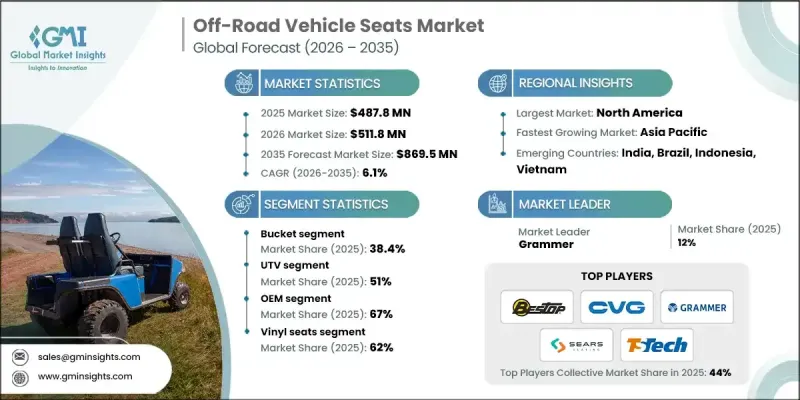
该市场涵盖农业、建筑和矿业车辆以及专为恶劣环境设计的休閒越野车的座椅。市场需求深受车辆使用频率和时长、驾驶舒适度要求以及工业和商业环境中严格的职场安全法规的影响。随着户外活动的日益普及,休閒车辆,尤其是多功能车辆,持续推动售后市场需求。由于操作人员越来越重视舒适性、支撑性和减震性,製造商正致力于开发耐用且符合人体工学的座椅解决方案,以提高安全性并减少长时间工作带来的疲劳。可调节和带衬垫座椅的进步也满足了不断发展的职业安全标准和专业期望。
| 市场覆盖范围 | |
|---|---|
| 开始年份 | 2025 |
| 预测年份 | 2026-2035 |
| 起始值 | 4.878亿美元 |
| 预测金额 | 8.695亿美元 |
| 复合年增长率 | 6.1% |
预计到2025年,凹背单人座椅市占率将达到38.4%,并在2035年之前以5.6%的复合年增长率成长。这类座椅旨在为在崎岖不平地形上驾驶越野车辆的驾驶提供卓越的侧向支撑、稳定性和姿势控制。桶形座椅主要应用于拖拉机、装载机和多用途车辆,在长时间驾驶过程中,舒适性和安全性至关重要。製造商正致力于改进凹背单人座椅的缓衝性能、可调节性和减震性能,以提高驾驶者的工作效率并减轻疲劳。
预计到2025年,UTV(多用途越野车)市占率将达到51%,并在2035年之前以7.1%的复合年增长率成长。 UTV座椅的设计旨在满足各种作业需求,包括运输、拖曳和人员运输,特别注重长时间乘坐的舒适性、安全性和人体工学支撑。 UTV在农业、建筑和休閒娱乐领域的日益普及,推动了对兼具耐用性、增强缓衝性、可调节配置和整合安全功能(例如安全带)的座椅的需求。
预计到2025年,美国越野车座椅市场将占据88%的市场份额,市场规模达2.214亿美元。农业、建筑、采矿和休閒车产业的强劲需求是推动市场成长的主要动力。高运转率和长时间作业促使人们采用重型、减震且符合人体工学设计的座椅系统,以确保操作人员的安全和舒适。农业工人尤其依赖耐用且支撑良好的座椅来保持生产力,并减少长时间工作带来的疲劳。
目录
第一章调查方法
第二章执行摘要
第三章业界考察
- 生态系分析
- 供应商情况
- 利润率分析
- 成本结构
- 每个阶段的附加价值
- 影响价值链的因素
- 中断
- 产业影响因素
- 司机
- 农业和建筑机械化的发展
- 更加重视操作员舒适度与安全标准
- 休閒越野车的使用日益增多
- 产业潜在风险与挑战
- 先进悬吊座椅高成本
- 暴露于恶劣的工作环境中
- 市场机会
- 采用悬吊式和气压悬吊座椅系统
- 替换和售后市场需求不断增长
- 针对特定应用需求进行客製化
- 成长潜力分析
- 监管环境
- 北美洲
- 美国职业安全与健康标准与设备标准
- OSHA座椅和操作员安全指南
- 农业和施工机械合规性
- 加拿大机械安全法规
- 欧洲
- 欧盟机械指令和座椅要求
- 操作手册基于EN标准
- 国家层级的农业机械合规性
- 职场人体工学和振动暴露法规
- 亚太地区
- 中国农业和施工机械法规
- 印度操作员安全与机械标准
- 日本工业设备表指南
- 韩国机械安全合规
- 东协区域设备安全框架
- 拉丁美洲
- 巴西农业机械标准
- 阿根廷设施安全合规性
- 墨西哥工业机械法规
- 区域运营商安全指南
- 中东和非洲
- 阿联酋设施安全和操作人员指南
- 沙乌地阿拉伯工业机械合规性
- 南非职业安全标准
- 区域设施安全框架
- 北美洲
- 波特五力分析
- PESTEL 分析
- 科技与创新趋势
- 当前技术趋势
- 新兴技术
- 价格趋势
- 按地区
- 副产品
- 生产统计
- 生产基地
- 消费基础
- 出口和进口
- 成本細項分析
- 座椅框架和材料成本
- 缓衝悬挂和内装成本
- 组装和品管成本
- 测试和认证费用
- 监理合规成本
- 配送服务及更换费用
- 专利分析
- 永续性和环境方面
- 永续实践
- 减少废弃物策略
- 生产中的能源效率
- 环保倡议
- 碳足迹考量
- 操作员人体工学与健康影响分析
- 全身振动 (WBV) 和悬吊性能基准测试
- 座椅安全与约束系统整合分析
- 客製化和特定应用座椅设计
- 材料耐久性和生命週期性能
- 电气化和智慧座椅相容性
- 未来中断和设计替代风险
第四章 竞争情势
- 介绍
- 公司市占率分析
- 北美洲
- 欧洲
- 亚太地区
- 拉丁美洲
- 中东和非洲
- 主要市场公司的竞争分析
- 竞争定位矩阵
- 战略展望矩阵
- 重大进展
- 併购
- 伙伴关係与合作
- 新产品发布
- 企业扩张计画和资金筹措
第五章 依座位容量分類的市场估算与预测,2022-2035年
- 凹背单人座椅
- 长椅
- 悬挂式座椅
- 折迭式/可调式座椅
第六章 依车辆类型分類的市场估计与预测,2022-2035年
- ATV
- UTV
- 雪上摩托车
- 越野自行车
7. 2022-2035年按分销管道分類的市场估算与预测
- OEM
- 售后市场
第八章 按材料分類的市场估算与预测,2022-2035年
- 织品座椅
- 乙烯基片材
- 真皮座椅
- 其他的
9. 依最终用途分類的市场估计与预测,2022-2035 年
- 个人消费者
- 商业用户
- 赛车运动和赛车队
- 其他的
第十章 依驱动机制分類的市场估计与预测,2022-2035年
- 电动座椅驱动系统(ESAS)
- 手动座椅调整系统(MSAS)
第十一章 2022-2035年各地区市场估计与预测
- 北美洲
- 我们
- 加拿大
- 欧洲
- 德国
- 英国
- 法国
- 义大利
- 西班牙
- 俄罗斯
- 挪威
- 荷兰
- 瑞典
- 亚太地区
- 中国
- 印度
- 日本
- 澳洲
- 韩国
- 新加坡
- 泰国
- 印尼
- 越南
- 拉丁美洲
- 巴西
- 墨西哥
- 阿根廷
- 中东和非洲
- 南非
- 沙乌地阿拉伯
- 阿拉伯聯合大公国
- 土耳其
第十二章:公司简介
- 世界玩家
- CVG Commercial Vehicle
- Grammer
- ISRI Seats
- Lear
- Milsco
- Recaro Automotive Seating
- TS Tech
- Ultra Seat
- KL Seating
- Knoedler
- 本地製造商
- Bestop
- KAB Seating
- National Seating
- Pilot Seating
- Sears Seating
- UnitedSeats
- 新兴企业和利基製造商
- Beard Seats
- Corbeau Seats
- MasterCraft Safety
- OMP Racing
- PRP Seats
- Simpson race products
The Global Off-Road Vehicle Seats Market was valued at USD 487.8 million in 2025 and is estimated to grow at a CAGR of 6.1% to reach USD 869.5 million by 2035.
The market caters to seating for agricultural, construction, and mining vehicles, as well as recreational off-road applications designed for rugged environments. Market demand is strongly influenced by the intensity and duration of vehicle usage, operator comfort requirements, and strict workplace safety regulations across industrial and commercial settings. Recreational vehicles, particularly utility vehicles, continue to drive aftermarket demand as the popularity of outdoor activities grows. Operators prioritize comfort, support, and vibration reduction, prompting manufacturers to focus on durable, ergonomic seating solutions that enhance safety and reduce fatigue over long operational hours. Advances in adjustable and cushioned seating are also aligning with evolving occupational safety standards and professional expectations.
| Market Scope | |
|---|---|
| Start Year | 2025 |
| Forecast Year | 2026-2035 |
| Start Value | $487.8 Million |
| Forecast Value | $869.5 Million |
| CAGR | 6.1% |
The bucket seat segment captured 38.4% of the market in 2025 and is projected to grow at a CAGR of 5.6% through 2035. These seats are engineered to provide superior lateral support, stability, and posture maintenance for operators handling off-road vehicles on rugged or uneven terrain. They are predominantly utilized in tractors, loaders, and utility vehicles, where comfort and safety during prolonged operation are critical. Manufacturers are increasingly focusing on enhancing cushioning, adjustability, and vibration reduction in bucket seats to improve operator productivity and reduce fatigue.
The UTV segment held a 51% share in 2025 and is expected to grow at a CAGR of 7.1% through 2035. UTV seats are specifically designed for long-duration comfort, safety, and ergonomic support, accommodating diverse operational needs such as hauling, towing, and transporting work crews. The growing use of UTVs in agricultural, construction, and recreational applications is driving demand for seats that combine durability with enhanced cushioning, adjustable configurations, and integrated safety features such as seat belts.
US Off-Road Vehicle Seats Market held an 88% share, generating USD 221.4 million in 2025. Market growth is supported by strong demand from the agricultural, construction, mining, and recreational vehicle sectors. High utilization rates and extended operational hours have driven the adoption of robust, vibration-reducing, and ergonomically designed seating systems to protect operators' safety while ensuring comfort. Agricultural operators rely heavily on durable and supportive seats to maintain productivity and reduce fatigue during long working hours.
Key players in the Global Off-Road Vehicle Seats Market include Bestop, CVG Commercial Vehicle, Grammer, ISRI Seats, Lear, Milsco, Recaro Automotive Seating, Sears Seating, TS Tech, and UnitedSeats. Companies in the off-road vehicle seats market are strengthening their presence through continuous innovation in ergonomic and vibration-reducing technologies, expanding their product portfolios for both industrial and recreational vehicles, and investing in advanced materials for durability and comfort. Manufacturers are establishing strategic partnerships with OEMs, focusing on aftermarket solutions to capture recurring demand, and optimizing distribution networks for wider regional penetration. Additionally, companies are leveraging regulatory compliance and certification standards to differentiate products, while offering customizable seating solutions to meet specific end-user requirements.
Table of Contents
Chapter 1 Methodology
- 1.1 Research approach
- 1.2 Quality Commitments
- 1.2.1 GMI AI policy & data integrity commitment
- 1.2.1.1 Source consistency protocol
- 1.2.1 GMI AI policy & data integrity commitment
- 1.3 Research Trail & Confidence Scoring
- 1.3.1 Research Trail Components
- 1.3.2 Scoring Components
- 1.4 Data Collection
- 1.4.1 Partial list of primary sources
- 1.5 Data mining sources
- 1.5.1 Paid sources
- 1.5.1.1 Sources, by region
- 1.5.1 Paid sources
- 1.6 Base estimates and calculations
- 1.6.1 Base year calculation for any one approach
- 1.7 Forecast model
- 1.7.1 Quantified market impact analysis
- 1.7.1.1 Mathematical impact of growth parameters on forecast
- 1.7.1 Quantified market impact analysis
- 1.8 Research transparency addendum
- 1.8.1 Source attribution framework
- 1.8.2 Quality assurance metrics
- 1.8.3 Our commitment to trust
Chapter 2 Executive Summary
- 2.1 Industry 360° synopsis, 2022 - 2035
- 2.2 Key market trends
- 2.2.1 Regional
- 2.2.2 Seat
- 2.2.3 Vehicle
- 2.2.4 Distribution Channel
- 2.2.5 Material
- 2.2.6 End Use
- 2.2.7 Actuation Mechanism
- 2.3 TAM Analysis, 2026-2035
- 2.4 CXO perspectives: Strategic imperatives
- 2.4.1 Executive decision points
- 2.4.2 Critical success factors
- 2.5 Future outlook and strategic recommendations
Chapter 3 Industry Insights
- 3.1 Industry ecosystem analysis
- 3.1.1 Supplier landscape
- 3.1.2 Profit margin analysis
- 3.1.3 Cost structure
- 3.1.4 Value addition at each stage
- 3.1.5 Factor affecting the value chain
- 3.1.6 Disruptions
- 3.2 Industry impact forces
- 3.2.1.1 Growth drivers
- 3.2.1.2 Growth in agricultural and construction mechanization
- 3.2.1.3 Rising focus on operator comfort and safety standards
- 3.2.1.4 Expansion of recreational off road vehicle usage
- 3.2.2 Industry pitfalls and challenges
- 3.2.2.1 High cost of advanced suspension seats
- 3.2.2.2 Exposure to harsh operating conditions
- 3.2.3 Market opportunities
- 3.2.3.1 Adoption of suspension and air ride seating systems
- 3.2.3.2 Rising replacement and aftermarket demand
- 3.2.3.3 Customization for application specific needs
- 3.3 Growth potential analysis
- 3.4 Regulatory landscape
- 3.4.1 North America
- 3.4.1.1 United States Occupational Safety and Equipment Standards
- 3.4.1.2 OSHA Seating and Operator Safety Guidelines
- 3.4.1.3 Agricultural and Construction Equipment Compliance
- 3.4.1.4 Canada Machinery Safety Regulations
- 3.4.2 Europe
- 3.4.2.1 EU Machinery Directive and Seating Requirements
- 3.4.2.2 EN Standards for Operator Seats
- 3.4.2.3 Country Level Agricultural Equipment Compliance
- 3.4.2.4 Workplace Ergonomics and Vibration Exposure Rules
- 3.4.3 Asia Pacific
- 3.4.3.1 China Agricultural and Construction Equipment Regulations
- 3.4.3.2 India Operator Safety and Machinery Standards
- 3.4.3.3 Japan Industrial Equipment Seating Guidelines
- 3.4.3.4 South Korea Machinery Safety Compliance
- 3.4.3.5 ASEAN Regional Equipment Safety Frameworks
- 3.4.4 Latin America
- 3.4.4.1 Brazil Agricultural Machinery Standards
- 3.4.4.2 Argentina Equipment Safety Compliance
- 3.4.4.3 Mexico Industrial Machinery Regulations
- 3.4.4.4 Regional Operator Safety Guidelines
- 3.4.5 Middle East & Africa
- 3.4.5.1 UAE Equipment Safety and Operator Guidelines
- 3.4.5.2 Saudi Arabia Industrial Machinery Compliance
- 3.4.5.3 South Africa Occupational Safety Standards
- 3.4.5.4 Regional Equipment Safety Frameworks
- 3.4.1 North America
- 3.5 Porter's analysis
- 3.6 PESTEL analysis
- 3.7 Technology and innovation landscape
- 3.7.1 Current technological trends
- 3.7.2 Emerging technologies
- 3.8 Price trends
- 3.8.1 By region
- 3.8.2 By product
- 3.9 Production statistics
- 3.9.1 Production hubs
- 3.9.2 Consumption hubs
- 3.9.3 Export and import
- 3.10 Cost breakdown analysis
- 3.10.1 Seat frame and material costs
- 3.10.2 Cushioning suspension and upholstery costs
- 3.10.3 Assembly and quality control costs
- 3.10.4 Testing and certification costs
- 3.10.5 Regulatory compliance costs
- 3.10.6 Distribution service and replacement costs
- 3.11 Patent analysis
- 3.12 Sustainability and environmental aspects
- 3.12.1 Sustainable practices
- 3.12.2 Waste reduction strategies
- 3.12.3 Energy efficiency in production
- 3.12.4 Eco-friendly Initiatives
- 3.12.5 Carbon footprint considerations
- 3.13 Operator Ergonomics & Health Impact Analysis
- 3.14 Whole Body Vibration (WBV) & Suspension Performance Benchmarking
- 3.15 Seat Safety & Restraint Integration Analysis
- 3.16 Customization & Application-Specific Seat Design
- 3.17 Material Durability & Lifecycle Performance
- 3.18 Electrification & Smart Seat Readiness
- 3.19 Future Disruption & Design Substitution Risks
Chapter 4 Competitive Landscape, 2025
- 4.1 Introduction
- 4.2 Company market share analysis
- 4.2.1 North America
- 4.2.2 Europe
- 4.2.3 Asia Pacific
- 4.2.4 LATAM
- 4.2.5 MEA
- 4.3 Competitive analysis of major market players
- 4.4 Competitive positioning matrix
- 4.5 Strategic outlook matrix
- 4.6 Key developments
- 4.6.1 Mergers & acquisitions
- 4.6.2 Partnerships & collaborations
- 4.6.3 New Product Launches
- 4.6.4 Expansion Plans and funding
Chapter 5 Market Estimates & Forecast, By Seat, 2022 - 2035 (USD Mn, Units)
- 5.1 Key trends
- 5.2 Bucket seat
- 5.3 Bench seat
- 5.4 Suspension seats
- 5.5 Foldable/Adjustable seats
Chapter 6 Market Estimates & Forecast, By Vehicle, 2022 - 2035 (USD Mn, Units)
- 6.1 Key trends
- 6.2 ATV
- 6.3 UTV
- 6.4 Snowmobile
- 6.5 Off-Road Motorcycle
Chapter 7 Market Estimates & Forecast, By Distribution Channel, 2022 - 2035 (USD Mn, Units)
- 7.1 Key trends
- 7.2 OEM
- 7.3 Aftermarket
Chapter 8 Market Estimates & Forecast, By Material, 2022 - 2035 (USD Mn, Units)
- 8.1 Key trends
- 8.2 Fabric seats
- 8.3 Vinyl seats
- 8.4 Leather seats
- 8.5 Others
Chapter 9 Market Estimates & Forecast, By End Use, 2022 - 2035 (USD Mn, Units)
- 9.1 Key trends
- 9.2 Individual consumers
- 9.3 Commercial users
- 9.4 Motorsports and racing teams
- 9.5 Others
Chapter 10 Market Estimates & Forecast, By Actuation Mechanism, 2022 - 2035 (USD Mn, Units)
- 10.1 Key trends
- 10.2 Electric seat actuation system (ESAS)
- 10.3 Manual seat actuation system (MSAS)
Chapter 11 Market Estimates & Forecast, By Region, 2022 - 2035 (USD Mn, Units)
- 11.1 Key trends
- 11.2 North America
- 11.2.1 US
- 11.2.2 Canada
- 11.3 Europe
- 11.3.1 Germany
- 11.3.2 UK
- 11.3.3 France
- 11.3.4 Italy
- 11.3.5 Spain
- 11.3.6 Russia
- 11.3.7 Norway
- 11.3.8 Netherlands
- 11.3.9 Sweden
- 11.4 Asia Pacific
- 11.4.1 China
- 11.4.2 India
- 11.4.3 Japan
- 11.4.4 Australia
- 11.4.5 South Korea
- 11.4.6 Singapore
- 11.4.7 Thailand
- 11.4.8 Indonesia
- 11.4.9 Vietnam
- 11.5 Latin America
- 11.5.1 Brazil
- 11.5.2 Mexico
- 11.5.3 Argentina
- 11.6 MEA
- 11.6.1 South Africa
- 11.6.2 Saudi Arabia
- 11.6.3 UAE
- 11.6.4 Turkey
Chapter 12 Company Profiles
- 12.1 Global Players
- 12.1.1 CVG Commercial Vehicle
- 12.1.2 Grammer
- 12.1.3 ISRI Seats
- 12.1.4 Lear
- 12.1.5 Milsco
- 12.1.6 Recaro Automotive Seating
- 12.1.7 TS Tech
- 12.1.8 Ultra Seat
- 12.1.9 KL Seating
- 12.1.10 Knoedler
- 12.2 Regional Players
- 12.2.1 Bestop
- 12.2.2 KAB Seating
- 12.2.3 National Seating
- 12.2.4 Pilot Seating
- 12.2.5 Sears Seating
- 12.2.6 UnitedSeats
- 12.3 Emerging Players and Niche Specialists
- 12.3.1 Beard Seats
- 12.3.2 Corbeau Seats
- 12.3.3 MasterCraft Safety
- 12.3.4 OMP Racing
- 12.3.5 PRP Seats
- 12.3.6 Simpson race products

 汽车皮革座椅市场:2026-2032年全球市场预测(按材料、价格范围、座椅覆盖率、座椅类别、应用和分销管道划分)汽车座椅通风系统市场:按组件、冷却能力、安装类型、控制方式、应用、最终用户和销售管道划分-2026-2032年全球市场预测
 2026年全球汽车座椅框架市场报告汽车座椅马达市场:2026-2032年全球市场预测(按马达类型、电压、功能领域、应用、最终用户和分销管道划分)电动汽车座椅马达市场:按马达类型、功率范围、车辆类型、应用和销售管道划分-2026-2032年全球预测
 汽车座椅市场规模、份额、趋势和预测:按材料、座椅类型、车辆类型、车辆动力来源和地区划分,2026-2034年
 汽车座椅:市占率分析、产业趋势与统计、成长预测(2026-2031)2026年全球汽车座椅及配件市场报告
 汽车座椅市场-全球产业规模、份额、趋势、机会和预测:按材料类型、技术、销售管道、地区和竞争格局划分,2021-2031年宠物汽车座椅套市场:依材质、宠物类型、宠物体型、防水等级、价格范围、应用和销售管道,全球预测,2026-2032年