


 |
市场调查报告书
商品编码
1936631
空间加热器市场机会、成长要素、产业趋势分析及2026年至2035年预测Space Heater Market Opportunity, Growth Drivers, Industry Trend Analysis, and Forecast 2026 - 2035 |
||||||

全球空间加热器市场预计到 2025 年将价值 82 亿美元,到 2035 年达到 161 亿美元,年复合成长率为 6.9%。
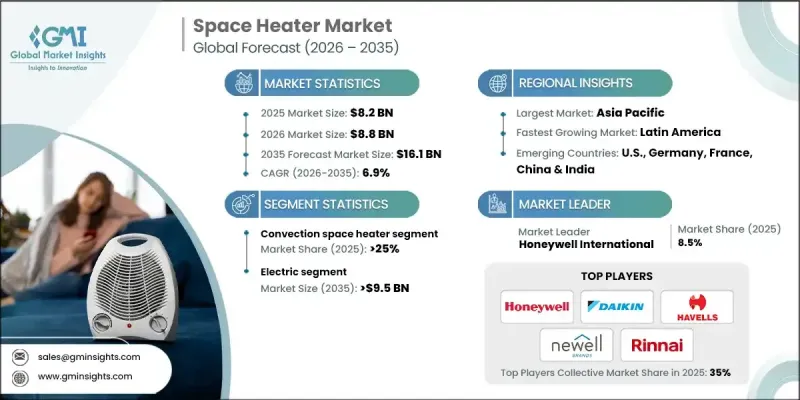
该行业的成长主要受季节性气温波动导致局部供暖解决方案需求增加以及风扇强制供暖技术进步的推动。製造商正致力于开发配备动作感测器、Wi-Fi 连接和可程式逻辑控制器 (PLC) 的智慧节能型加热器,显着加速了此类产品的普及。现代空间加热器结合了精密工程和高效运行,透过优化热量分布、改善气流动力学和先进的安全功能,提供可靠的温暖。政府鼓励节能的奖励,以及消费者对安静便捷的暖气解决方案日益增长的偏好,进一步巩固了市场前景。此外,建筑和住宅维修活动的增加、电子商务平台普及带来的便利性提升、可支配收入的成长以及融资方式的简化,也促进了高端供暖解决方案的普及。
| 市场覆盖范围 | |
|---|---|
| 开始年份 | 2025 |
| 预测年份 | 2026-2035 |
| 起始值 | 82亿美元 |
| 预测金额 | 161亿美元 |
| 复合年增长率 | 6.9% |
预计到2035年,陶瓷电暖器市场规模将达30亿美元。这类电暖器以其快速升温、节能高效而着称,满足了消费者对快速、稳定供暖的需求。陶瓷板能够有效保温,在保持恆温的同时最大限度地降低能耗,使其成为现代家庭的热门选择。
预计到2025年,电暖器市占率将达到61.4%,到2035年将超过95亿美元。电暖器无需复杂的基础设施即可快速供暖,因此备受青睐,是都市区住宅和小规模商业空间的理想选择。其紧凑的设计、美观的外形和多功能性吸引了注重时尚的消费者,而不断增长的都市化和不断扩大的电力基础设施,将持续推动强劲的市场需求。
预计到 2025 年,美国空间加热器市场将占据 70% 的市场份额,市场规模将达到 13 亿美元。这一增长得益于政府推行的各项进步政策,例如补贴、税收优惠和旨在促进节能减排的津贴计划,这些排放正在推动高效供暖解决方案的普及。
目录
第一章调查方法和范围
第二章执行摘要
第三章业界考察
- 生态系分析
- 原物料供应及采购分析
- 製造能力评估
- 供应链韧性与风险因素
- 配电网路分析
- 监管环境
- 产业影响因素
- 司机
- 产业潜在风险与挑战
- 成长潜力分析
- 波特五力分析
- PESTEL 分析
- 空间加热器成本结构分析
- 价格趋势分析(美元/单位)
- 按地区
- 透过技术
- 新兴机会与趋势
- 投资分析及未来展望
- 数位转型与产业4.0融合
- 可持续发展倡议与合规性
第四章 竞争情势
- 介绍
- 按地区分類的公司市占率分析
- 北美洲
- 欧洲
- 亚太地区
- 中东和非洲
- 拉丁美洲
- 战略仪錶板
- 策略倡议
- 重要伙伴关係与合作
- 重大併购活动
- 产品创新与新产品发布
- 市场扩大策略
- 竞争标竿分析
- 创新与永续性格局
第五章 2022-2035年依产品分類的市场规模及预测
- 对流加热器
- 陶瓷加热器
- 辐射/红外线加热器
- 风扇加热器
- 油加热器
- 其他的
第六章 依技术分類的市场规模及预测(2022-2035年)
- 可携式的
- 表面黏着技术型
第七章 依能源来源分類的市场规模及预测,2022-2035年
- 电
- 气体
第八章 依应用领域分類的市场规模及预测(2022-2035年)
- 住宅
- 商业的
第九章 依功率等级分類的市场规模及预测(2022-2035年)
- 1000瓦或以下
- 功率超过1000瓦至1500瓦
- 功率超过1500瓦至2000瓦
- 超过2000瓦
第十章 2022-2035年各地区市场规模及预测
- 北美洲
- 我们
- 加拿大
- 墨西哥
- 欧洲
- 德国
- 义大利
- 法国
- 荷兰
- 西班牙
- 挪威
- 英国
- 瑞典
- 亚太地区
- 中国
- 日本
- 印度
- 澳洲
- 韩国
- 泰国
- 新加坡
- 马来西亚
- 菲律宾
- 越南
- 印尼
- 中东和非洲
- 沙乌地阿拉伯
- 阿拉伯聯合大公国
- 伊朗
- 伊拉克
- 土耳其
- 南非
- 拉丁美洲
- 巴西
- 阿根廷
- 智利
第十一章 公司简介
- Cambridge Air Solutions
- Crane USA
- DAIKIN INDUSTRIES
- EHEAT
- ELMESS Thermosystemtechnik
- Glen Dimplex Deutschland
- Havells India
- Honeywell International
- Lasko Products
- Midea
- Newell Brands
- OPOLAR
- Pelonis
- Rinnai Corporation
- SUNHEAT International
- Tansun
- Tempco Electric Heater
- Twin Star
- Vornado
- Wayfair
The Global Space Heater Market was valued at USD 8.2 billion in 2025 and is estimated to grow at a CAGR of 6.9% to reach USD 16.1 billion by 2035.
Growth in the industry is driven by rising demand for spot heating solutions amid variable seasonal temperatures, as well as advancements in fan-forced heating technologies. Manufacturers are increasingly focusing on smart, energy-efficient heaters equipped with motion sensors, Wi-Fi connectivity, and programmable logic controllers, which are significantly accelerating adoption. Space heaters today represent a blend of engineering precision and operational efficiency, delivering reliable warmth through optimized heat distribution, improved airflow dynamics, and advanced safety features. Government incentives promoting energy efficiency, combined with growing consumer preference for quiet and convenient heating solutions, further strengthen the market outlook. Additionally, increased construction, home renovations, and the proliferation of e-commerce platforms have improved accessibility, while rising disposable incomes and easier financing options support the adoption of premium heating solutions.
| Market Scope | |
|---|---|
| Start Year | 2025 |
| Forecast Year | 2026-2035 |
| Start Value | $8.2 Billion |
| Forecast Value | $16.1 Billion |
| CAGR | 6.9% |
The ceramic space heater segment is expected to reach USD 3 billion by 2035. These heaters are recognized for fast heat generation and energy efficiency, appealing to consumers seeking quick, consistent warmth. Ceramic plates in these units retain heat effectively, maintaining steady temperatures while minimizing electricity usage, making them a preferred choice in modern households.
The electric space heater segment accounted for 61.4% share in 2025 and is projected to exceed USD 9.5 billion by 2035. Electric heaters are valued for delivering instant warmth without requiring complex infrastructure, making them ideal for urban homes and small commercial spaces. Their compact designs, aesthetics, and functional versatility appeal to style-conscious consumers, and growing urbanization alongside expanding electricity infrastructure continues to support strong demand.
U.S. Space Heater Market held 70% share, generating USD 1.3 billion in 2025. Growth is supported by progressive government policies, including subsidies, tax incentives, and grant programs aimed at promoting energy conservation and reducing carbon emissions, which encourage wider adoption of efficient heating solutions.
Key players in the Global Space Heater Market include Cambridge Air Solutions, Glen Dimplex Deutschland, Tempco Electric Heater, DAIKIN INDUSTRIES, Twin Star, Rinnai Corporation, EHEAT, Lasko Products, OPOLAR, SUNHEAT International, Wayfair, Pelonis, Newell Brands, Vornado, Havells India, Honeywell International, Crane USA, Tansun, and ELMESS Thermosystemtechnik. Companies in the Space Heater Market are adopting multiple strategies to strengthen their market presence. They are investing in research and development to introduce energy-efficient, smart, and IoT-enabled heating solutions. Strategic partnerships with retailers, distributors, and e-commerce platforms help expand distribution networks and enhance brand visibility. Market players are also leveraging marketing campaigns, government incentive programs, and product customization to address regional preferences. Continuous innovation in safety, design, and energy-saving technologies, combined with competitive pricing and after-sales support, ensures customer loyalty, broad adoption, and long-term market growth.
Table of Contents
Chapter 1 Methodology & Scope
- 1.1 Research approach
- 1.2 Quality commitments
- 1.2.1 GMI AI policy & data integrity commitment
- 1.2.1.1 Source consistency protocol
- 1.2.1 GMI AI policy & data integrity commitment
- 1.3 Research trail & confidence scoring
- 1.3.1 Research trail components
- 1.3.2 Scoring components
- 1.4 Data collection
- 1.4.1 Partial list of primary sources
- 1.5 Data mining sources
- 1.5.1 Paid sources
- 1.5.1.1 Sources, by region
- 1.5.1 Paid sources
- 1.6 Base estimates and calculations
- 1.6.1 Base year calculation for any one approach
- 1.7 Market estimates & forecasts parameters
- 1.8 Forecast model
- 1.8.1 Quantified market impact analysis
- 1.8.1.1 Mathematical impact of growth parameters on forecast
- 1.8.1 Quantified market impact analysis
- 1.9 Research transparency addendum
- 1.9.1 Source attribution framework
- 1.9.2 Quality assurance metrics
- 1.9.3 Our commitment to trust
- 1.10 Market definitions
Chapter 2 Executive Summary
- 2.1 Industry synopsis, 2022 - 2035
- 2.1.1 Business trends
- 2.1.2 Product trends
- 2.1.3 Technology trends
- 2.1.4 Energy source trends
- 2.1.5 Application trends
- 2.1.6 Power rating trends
- 2.1.7 Regional trends
Chapter 3 Industry Insights
- 3.1 Industry ecosystem analysis
- 3.1.1 Raw material availability & sourcing analysis
- 3.1.2 Manufacturing capacity assessment
- 3.1.3 Supply chain resilience & risk factors
- 3.1.4 Distribution network analysis
- 3.2 Regulatory landscape
- 3.3 Industry impact forces
- 3.3.1 Growth drivers
- 3.3.2 Industry pitfalls & challenges
- 3.4 Growth potential analysis
- 3.5 Porter's analysis
- 3.5.1 Bargaining power of suppliers
- 3.5.2 Bargaining power of buyers
- 3.5.3 Threat of new entrants
- 3.5.4 Threat of substitutes
- 3.6 PESTEL analysis
- 3.6.1 Political factors
- 3.6.2 Economic factors
- 3.6.3 Social factors
- 3.6.4 Technological factors
- 3.6.5 Legal factors
- 3.6.6 Environmental factors
- 3.7 Cost structure analysis of space heater
- 3.8 Price trend analysis (USD/Unit)
- 3.8.1 By region
- 3.8.2 By technology
- 3.9 Emerging opportunities & trends
- 3.10 Investment analysis & future prospects
- 3.11 Digital transformation & industry 4.0 integration
- 3.12 Sustainability initiatives & compliances
Chapter 4 Competitive Landscape, 2026
- 4.1 Introduction
- 4.2 Company market share analysis, by region, 2025
- 4.2.1 North America
- 4.2.2 Europe
- 4.2.3 Asia Pacific
- 4.2.4 Middle East & Africa
- 4.2.5 Latin America
- 4.3 Strategic dashboard
- 4.4 Strategic initiatives
- 4.4.1 Key partnerships & collaborations
- 4.4.2 Major M&A activities
- 4.4.3 Product innovations & launches
- 4.4.4 Market expansion strategies
- 4.5 Competitive benchmarking
- 4.6 Innovation & sustainability landscape
Chapter 5 Market Size and Forecast, By Product, 2022 - 2035 (USD Million & Units)
- 5.1 Key trends
- 5.2 Convection heater
- 5.3 Ceramic heater
- 5.4 Radiant & infrared heater
- 5.5 Fan heater
- 5.6 Oil filled heater
- 5.7 Others
Chapter 6 Market Size and Forecast, By Technology, 2022 - 2035 (USD Million & Units)
- 6.1 Key trends
- 6.2 Portable
- 6.3 Surface-mounted
Chapter 7 Market Size and Forecast, By Energy Source, 2022 - 2035 (USD Million & Units)
- 7.1 Key trends
- 7.2 Electric
- 7.3 Gas
Chapter 8 Market Size and Forecast, By Application, 2022 - 2035 (USD Million & Units)
- 8.1 Key trends
- 8.2 Residential
- 8.3 Commercial
Chapter 9 Market Size and Forecast, By Power Rating, 2022 - 2035 (USD Million & Units)
- 9.1 Key trends
- 9.2 ≤ 1,000 W
- 9.3 > 1,000 W - 1,500 W
- 9.4 > 1,500 W - 2,000 W
- 9.5 > 2,000 W
Chapter 10 Market Size and Forecast, By Region, 2022 - 2035 (USD Million & Units)
- 10.1 Key trends
- 10.2 North America
- 10.2.1 U.S.
- 10.2.2 Canada
- 10.2.3 Mexico
- 10.3 Europe
- 10.3.1 Germany
- 10.3.2 Italy
- 10.3.3 France
- 10.3.4 Netherlands
- 10.3.5 Spain
- 10.3.6 Norway
- 10.3.7 UK
- 10.3.8 Sweden
- 10.4 Asia Pacific
- 10.4.1 China
- 10.4.2 Japan
- 10.4.3 India
- 10.4.4 Australia
- 10.4.5 South Korea
- 10.4.6 Thailand
- 10.4.7 Singapore
- 10.4.8 Malaysia
- 10.4.9 Philippines
- 10.4.10 Vietnam
- 10.4.11 Indonesia
- 10.5 Middle East & Africa
- 10.5.1 Saudi Arabia
- 10.5.2 UAE
- 10.5.3 Iran
- 10.5.4 Iraq
- 10.5.5 Turkey
- 10.5.6 South Africa
- 10.6 Latin America
- 10.6.1 Brazil
- 10.6.2 Argentina
- 10.6.3 Chile
Chapter 11 Company Profiles
- 11.1 Cambridge Air Solutions
- 11.2 Crane USA
- 11.3 DAIKIN INDUSTRIES
- 11.4 EHEAT
- 11.5 ELMESS Thermosystemtechnik
- 11.6 Glen Dimplex Deutschland
- 11.7 Havells India
- 11.8 Honeywell International
- 11.9 Lasko Products
- 11.10 Midea
- 11.11 Newell Brands
- 11.12 OPOLAR
- 11.13 Pelonis
- 11.14 Rinnai Corporation
- 11.15 SUNHEAT International
- 11.16 Tansun
- 11.17 Tempco Electric Heater
- 11.18 Twin Star
- 11.19 Vornado
- 11.20 Wayfair

 智慧房间加热器市场:2026-2032年全球市场预测(依产品类型、输出功率、连接方式、应用和销售管道)壁挂式红外线加热器市场:按加热技术、类型、额定功率、销售管道、应用、最终用户划分,全球预测(2026-2032年)
 工业加热器市场机会、成长要素、产业趋势分析及2026-2035年预测
 2026-2034年全球工业加热器导热油市场规模、份额、趋势及成长分析报告全球单元式加热器市场规模、份额、趋势和成长分析报告(2026-2034年)暖气设备市场规模、份额、成长及全球产业分析:按类型、应用和地区划分,并预测至2026-2034年
 日本工业加热器市场规模、份额、趋势和预测:按产品、技术、最终用户和地区划分,2026-2034年
 2026-2030年全球空间暖气设备市场ITO透明导电加热器市场:2026-2032年全球预测(按基板、沉积技术、设计类型和应用划分)半导体加热器市场:按产品、额定功率、技术、最终用户、应用和分销管道划分,全球预测(2026-2032年)