


 |
市场调查报告书
商品编码
1936635
壳管式热交换器市场机会、成长要素、产业趋势分析及预测(2026-2035年)Shell and Tube Heat Exchanger Market Opportunity, Growth Drivers, Industry Trend Analysis, and Forecast 2026 - 2035 |
||||||

全球壳管式热交换器市场预计到 2025 年将达到 69 亿美元,到 2035 年将达到 152 亿美元,年复合成长率为 8.3%。
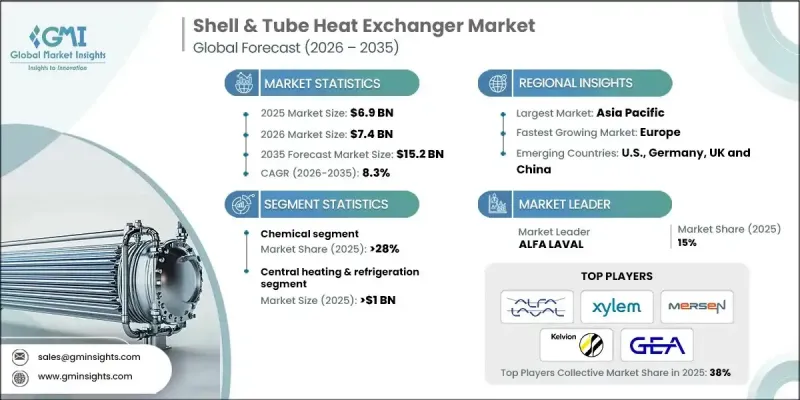
这一成长主要得益于重工业流程投资的增加以及各行业对高效供暖和製冷解决方案日益增长的需求。严格的能源效率标准以及现代工业和暖通空调基础设施对先进温度控管系统需求的不断增长,正在重塑市场格局。工业脱碳政策和对降低能耗的高度重视,正在加速对热回收解决方案的需求。此外,低碳系统的广泛应用、余热利用的整合以及可再生能源发电的扩张,进一步增强了市场动态。企业越来越重视节能营运、热系统的数位化监控以及永续的工业基础设施,这为该行业的长期成长创造了积极的前景。
| 市场覆盖范围 | |
|---|---|
| 开始年份 | 2025 |
| 预测年份 | 2026-2035 |
| 起始金额 | 69亿美元 |
| 预测金额 | 152亿美元 |
| 复合年增长率 | 8.3% |
预计到2025年,化学工业将占全球市场份额的28%,并在2035年之前维持9%的复合年增长率。该行业呈现强劲的成长势头,主要得益于对化学产品需求的不断增长以及节能型热解决方案的日益普及。化学加工设施中严格的安全法规以及用于即时运行管理的数位化监控技术的应用,进一步推动了市场扩张。先进的热交换器系统能够提高製程效率、减少停机时间并提升运作安全性,因此其应用日益广泛,尤其是在高需求的化学製造环境中。
预计到2035年,欧洲壳管式热交换器市场规模将达45亿美元。这一增长得益于严格的环境法规、欧盟的排放目标以及旨在提高能源效率和促进工业脱碳的强有力的政策框架。重工业流程现代化改造、优化余热回收以及实施数位温度控管解决方案的投资,进一步巩固了区域市场。欧洲工业界对兼具高性能、高能源效率和符合环保标准的解决方案的需求不断增长,推动了先进热交换器的长期应用。
目录
第一章调查方法和范围
第二章执行摘要
第三章业界考察
- 生态系分析
- 原物料供应及采购分析
- 影响价值链的关键因素
- 中断
- 监管环境
- 产业影响因素
- 司机
- 产业潜在风险与挑战
- 成长潜力分析
- 波特五力分析
- PESTEL 分析
- 壳管式热交换器的成本结构分析
- 新的机会与趋势
- 利用物联网技术实现数位转型
- 拓展新兴市场
- 投资分析及未来展望
第四章 竞争情势
- 介绍
- 按地区分類的公司市占率分析
- 北美洲
- 欧洲
- 亚太地区
- 中东和非洲
- 拉丁美洲
- 策略倡议
- 重要伙伴关係与合作
- 重大併购活动
- 产品创新与新产品发布
- 市场扩大策略
- 竞争标竿分析
- 战略仪錶板
- 创新与永续性格局
第五章 依应用领域分類的市场规模及预测(2022-2035年)
- 石油和天然气
- 化学
- 发电和冶金
- 船
- 机械工业
- 中央暖气供应和冷
- 食品加工
- 其他的
第六章 2022-2035年各地区市场规模及预测
- 北美洲
- 我们
- 加拿大
- 墨西哥
- 欧洲
- 德国
- 英国
- 法国
- 俄罗斯
- 义大利
- 西班牙
- 波兰
- 土耳其
- 亚太地区
- 中国
- 日本
- 韩国
- 印度
- 印尼
- 马来西亚
- 泰国
- 越南
- 菲律宾
- 澳洲
- 中东和非洲
- 沙乌地阿拉伯
- 阿拉伯聯合大公国
- 埃及
- 南非
- 奈及利亚
- 拉丁美洲
- 巴西
- 阿根廷
- 哥伦比亚
- 智利
第七章 公司简介
- AA Anderson &Co., Inc.
- ALFA LAVAL
- API Heat Transfer
- Bronswerk
- COMP AIR TREATMENT SYSTEM Pvt. Ltd.
- Enerquip Thermal Solutions
- Exergy LLC
- FUNKE Warmeaustauscher Apparatebau GmbH
- GEA Group Aktiengesellschaft
- HRS Process Systems Ltd.
- Kelvion Holding GmbH
- Kinam Engineering Industries Pvt. Ltd.
- Mason Manufacturing LLC
- Mersen Group
- Sterling Thermal Technology
- Thermaline, Inc
- Thermofin
- Thrush Co
- Wessels Company
- Xylem
The Global Shell & Tube Heat Exchanger Market was valued at USD 6.9 billion in 2025 and is estimated to grow at a CAGR of 8.3% to reach USD 15.2 billion by 2035.
Growth is fueled by expanding investments in heavy-duty industrial processes and a rising need for efficient heating and cooling solutions across multiple sectors. The adoption of stringent energy efficiency standards, combined with increasing demand for advanced thermal management systems in modern industrial and HVAC infrastructure, is shaping the market landscape. Industrial decarbonization policies and a strong focus on reducing energy consumption are accelerating demand for heat recovery solutions. Moreover, the increasing use of low-carbon systems, integration of waste heat utilization, and expansion of renewable energy generation are further enhancing market dynamics. Companies are increasingly emphasizing energy-efficient operations, digital monitoring of thermal systems, and sustainable industrial infrastructure, creating a positive outlook for the industry's long-term growth.
| Market Scope | |
|---|---|
| Start Year | 2025 |
| Forecast Year | 2026-2035 |
| Start Value | $6.9 Billion |
| Forecast Value | $15.2 Billion |
| CAGR | 8.3% |
The chemical sector accounted for 28% share in 2025 and is projected to grow at a CAGR of 9% through 2035. The industry is experiencing strong momentum due to rising demand for chemical products and increasing adoption of energy-efficient thermal solutions. Stringent safety regulations in chemical processing facilities and the integration of digital monitoring technologies for real-time operational control are further encouraging market expansion. Advanced heat exchanger systems that improve process efficiency, reduce downtime, and enable safer operations are driving adoption, particularly in high-demand chemical production environments.
Europe Shell & Tube Heat Exchanger Market reached USD 4.5 billion by 2035. The growth is supported by strict environmental regulations, EU-wide emissions reduction targets, and strong policy frameworks promoting energy efficiency and industrial decarbonization. Investments in modernizing heavy-duty industrial processes, optimizing waste heat recovery, and adopting digital thermal management solutions are further strengthening the regional market. European industries are increasingly seeking solutions that combine performance, energy efficiency, and compliance with environmental standards, driving long-term adoption of advanced heat exchangers.
Leading players operating in the Global Shell & Tube Heat Exchanger Market include Enerquip Thermal Solutions, ALFA LAVAL, API Heat Transfer, Xylem, Mason Manufacturing LLC, Bronswerk, COMP AIR TREATMENT SYSTEM Pvt. Ltd., Mersen Group, GEA Group Aktiengesellschaft, HRS Process Systems Ltd., FUNKE Warmeaustauscher Apparatebau GmbH, Thermaline, Inc., Wessels Company, Sterling Thermal Technology, Thermofin, Thrush Co, Kelvion Holding GmbH, Kinam Engineering Industries Pvt. Ltd., A.A. Anderson & Co., Inc., and Exergy LLC. Companies in the shell & tube heat exchanger market are strengthening their position by investing in research and development for more energy-efficient and compact designs. They are focusing on digital integration, enabling real-time monitoring, predictive maintenance, and performance optimization for industrial clients. Strategic partnerships with engineering and industrial solution providers allow expansion into new regional markets and high-demand sectors. Firms are also pursuing product customization, targeting heavy industries and chemical facilities with specialized materials and advanced thermal management capabilities.
Table of Contents
Chapter 1 Methodology & Scope
- 1.1 Research design
- 1.2 Quality commitment
- 1.2.1 GMI AI policy & data integrity commitment
- 1.2.1.1 Source consistency protocol
- 1.2.1 GMI AI policy & data integrity commitment
- 1.3 Research Trail & Confidence Scoring
- 1.3.1 Research Trail Components
- 1.3.2 Scoring components
- 1.4 Data Collection
- 1.4.1 Partial list of primary sources
- 1.5 Data mining sources
- 1.5.1 Paid Sources
- 1.5.1.1 Sources, by region
- 1.5.1 Paid Sources
- 1.6 Base estimates and calculations
- 1.6.1 Base year calculation for any one approach
- 1.7 Forecast model
- 1.8 Research transparency addendum
- 1.8.1 Source attribution framework
- 1.8.2 Quality assurance metrics
- 1.8.3 Our commitment to trust
- 1.9 Market definitions
Chapter 2 Executive Summary
- 2.1 Industry synopsis, 2022 - 2035
- 2.2 Business trends
- 2.3 Application trends
- 2.4 Regional trends
Chapter 3 Industry Insights
- 3.1 Industry ecosystem analysis
- 3.1.1 Raw material availability & sourcing analysis
- 3.1.2 Key factors affecting the value chain
- 3.1.3 Disruptions
- 3.2 Regulatory landscape
- 3.3 Industry impact forces
- 3.3.1 Growth drivers
- 3.3.2 Industry pitfalls & challenges
- 3.4 Growth potential analysis
- 3.5 Porter's analysis
- 3.5.1 Bargaining power of suppliers
- 3.5.2 Bargaining power of buyers
- 3.5.3 Threat of new entrants
- 3.5.4 Threat of substitutes
- 3.6 PESTEL analysis
- 3.6.1 Political factors
- 3.6.2 Economic factors
- 3.6.3 Social factors
- 3.6.4 Technological factors
- 3.6.5 Legal factors
- 3.6.6 Environmental factors
- 3.7 Cost structure analysis of shell & tube heat exchanger
- 3.8 Emerging opportunities & trends
- 3.8.1 Digital transformation with IoT technologies
- 3.8.2 Emerging market penetration
- 3.9 Investment analysis & future outlook
Chapter 4 Competitive Landscape, 2025
- 4.1 Introduction
- 4.2 Company market share analysis, by region, 2025
- 4.2.1 North America
- 4.2.2 Europe
- 4.2.3 Asia Pacific
- 4.2.4 Middle East & Africa
- 4.2.5 Latin America
- 4.3 Strategic initiatives
- 4.3.1 Key partnerships & collaborations
- 4.3.2 Major M&A activities
- 4.3.3 Product innovations & launches
- 4.3.4 Market expansion strategies
- 4.4 Competitive benchmarking
- 4.5 Strategic dashboard
- 4.6 Innovation & sustainability landscape
Chapter 5 Market Size and Forecast, By Application, 2022 - 2035 (USD Million)
- 5.1 Key trends
- 5.2 Oil & gas
- 5.3 Chemical
- 5.4 Power generation & metallurgy
- 5.5 Marine
- 5.6 Mechanical industry
- 5.7 Central heating & refrigeration
- 5.8 Food processing
- 5.9 Others
Chapter 6 Market Size and Forecast, By Region, 2022 - 2035 (USD Million)
- 6.1 Key trends
- 6.2 North America
- 6.2.1 U.S.
- 6.2.2 Canada
- 6.2.3 Mexico
- 6.3 Europe
- 6.3.1 Germany
- 6.3.2 UK
- 6.3.3 France
- 6.3.4 Russia
- 6.3.5 Italy
- 6.3.6 Spain
- 6.3.7 Poland
- 6.3.8 Turkey
- 6.4 Asia Pacific
- 6.4.1 China
- 6.4.2 Japan
- 6.4.3 South Korea
- 6.4.4 India
- 6.4.5 Indonesia
- 6.4.6 Malaysia
- 6.4.7 Thailand
- 6.4.8 Vietnam
- 6.4.9 Philippines
- 6.4.10 Australia
- 6.5 Middle East & Africa
- 6.5.1 Saudi Arabia
- 6.5.2 UAE
- 6.5.3 Egypt
- 6.5.4 South Africa
- 6.5.5 Nigeria
- 6.6 Latin America
- 6.6.1 Brazil
- 6.6.2 Argentina
- 6.6.3 Colombia
- 6.6.4 Chile
Chapter 7 Company Profiles
- 7.1 A.A. Anderson & Co., Inc.
- 7.2 ALFA LAVAL
- 7.3 API Heat Transfer
- 7.4 Bronswerk
- 7.5 COMP AIR TREATMENT SYSTEM Pvt. Ltd.
- 7.6 Enerquip Thermal Solutions
- 7.7 Exergy LLC
- 7.8 FUNKE Warmeaustauscher Apparatebau GmbH
- 7.9 GEA Group Aktiengesellschaft
- 7.10 HRS Process Systems Ltd.
- 7.11 Kelvion Holding GmbH
- 7.12 Kinam Engineering Industries Pvt. Ltd.
- 7.13 Mason Manufacturing LLC
- 7.14 Mersen Group
- 7.15 Sterling Thermal Technology
- 7.16 Thermaline, Inc
- 7.17 Thermofin
- 7.18 Thrush Co
- 7.19 Wessels Company
- 7.20 Xylem

 管壳式热交换器市场:按类型、应用、材质和压力等级划分-2026-2032年全球市场预测
 壳管式热交换器市场-2026-2031年预测
 管壳式热交换器市场-全球产业规模、份额、趋势、机会及预测(按材料、最终用户、地区、竞争细分,2020-2030 年)
 管壳式热交换器市场报告:趋势、预测和竞争分析(至 2030 年)
 到 2030 年管壳式热交换器市场预测:按类型、设计、材料、应用、最终用户和地区进行的全球分析
 管壳式热交换器市场.规模.占有率.趋势.行业分析报告:按材料.按最终用途.按地区 - 2025-2034 年市场预测
 壳管式热交换器市场规模、份额、趋势分析报告:按材料、最终用途、地区、细分市场预测,2025-2030 年