


 |
市场调查报告书
商品编码
1936668
纸浆及造纸酶市场机会、成长要素、产业趋势分析及2026年至2035年预测Paper and Pulp Enzymes Market Opportunity, Growth Drivers, Industry Trend Analysis, and Forecast 2026 - 2035 |
||||||

全球纸浆和造纸酶市场预计到 2025 年将达到 3.511 亿美元,到 2035 年将达到 7.982 亿美元,年复合成长率为 8.6%。
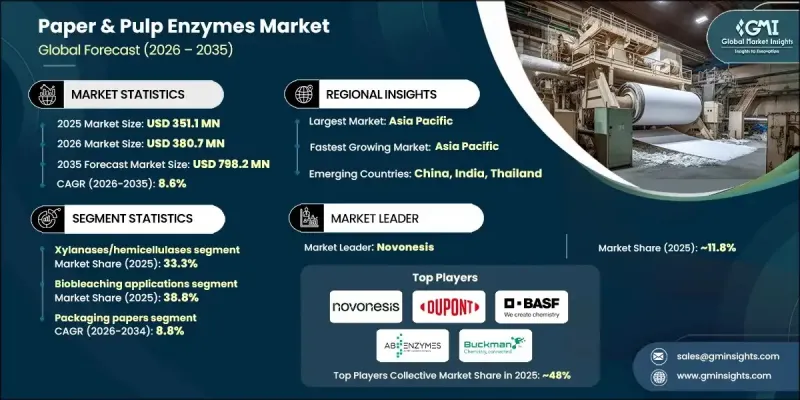
随着纸浆和造纸行业越来越多地采用生物技术解决方案来提高效率、减少化学品用量并提升产品质量,该市场持续稳步增长。微生物酵素在现代造纸製程中发挥关键作用,包括生物漂白、纤维改质、脱墨和废水优化。这些生物催化剂有助于在原生纸浆和再生纸浆製程中保持高品质的生产,同时减少对环境的影响。对永续生产方法的需求不断增长、回收要求日益提高以及先进酶製剂技术的开发,共同造就了一个充满活力的市场。各公司正在投资多酶系统和性能优化,以应用于包装、印刷、生活用纸和特殊纸等领域。遵守环境法规、技术创新以及全球纸张消费量的成长,都推动了北美、欧洲和亚太地区的长期需求和成长。
| 市场覆盖范围 | |
|---|---|
| 开始年份 | 2025 |
| 预测年份 | 2026-2035 |
| 起始值 | 3.511亿美元 |
| 预测金额 | 7.982亿美元 |
| 复合年增长率 | 8.6% |
2025年,木聚醣酶和半纤维素酶占据了33.3%的市场份额,预计到2035年将以8.8%的复合年增长率成长。这些酵素因其高效的木质素降解、纤维释放和选择性半纤维素水解而备受青睐,从而在不影响纤维强度的前提下,提高了漂白过程中化学物质的渗透性。它们在包括牛皮纸浆和化学浆在内的多种纸浆类型中均表现出色,使其成为生物漂白和增白应用的关键材料。木聚醣酶的多功能性使生产商能够在提高纸浆品质的同时,减少氯基化学品的消耗。
2025年,生物漂白应用领域占据了38.8%的市场份额,预计2026年至2035年将以8.8%的复合年增长率成长。生物漂白因其能够减少化学品用量、降低环境排放并提高纸浆加工的经济效益而被广泛采用。酵素辅助漂白製程可减少10-30%的二氧化氯用量,降低有机氮氧化物(AOX)水平,并维持理想的白度标准。这些应用对于无氯(ECF)和完全无氯(TCF)纸浆生产都至关重要,使造纸厂能够在满足监管和永续性目标的同时优化营运绩效。
预计到2025年,美国纸浆和造纸酶市场规模将达到9,090万美元,显示该地区对酵素的需求强劲。美国仍然大规模再生纸生产企业以及利用纤维素酶改善纸张柔软度和强度的大规模卫生纸生产企业。酵素应用技术的持续创新,尤其是在ECF漂白製程的创新,以及日益严格的环境法规,进一步巩固了美国市场的地位。
目录
第一章调查方法和范围
第二章执行摘要
第三章业界考察
- 生态系分析
- 供应商情况
- 利润率
- 每个阶段的附加价值
- 影响价值链的因素
- 中断
- 产业影响因素
- 司机
- 产业潜在风险与挑战
- 市场机会
- 成长潜力分析
- 监管环境
- 北美洲
- 欧洲
- 亚太地区
- 拉丁美洲
- 中东和非洲
- 波特五力分析
- PESTEL 分析
- 科技与创新趋势
- 当前技术趋势
- 新兴技术
- 价格趋势
- 按地区
- 依酶类型
- 未来市场趋势
- 科技与创新趋势
- 当前技术趋势
- 新兴技术
- 专利状态
- 贸易统计(HS编码)(註:仅提供主要国家的贸易统计)
- 主要进口国
- 主要出口国
- 永续性和环境方面
- 永续努力
- 减少废弃物策略
- 生产中的能源效率
- 环保倡议
- 考虑到碳足迹
第四章 竞争情势
- 介绍
- 公司市占率分析
- 按地区
- 北美洲
- 欧洲
- 亚太地区
- 拉丁美洲
- 中东和非洲
- 按地区
- 企业矩阵分析
- 主要市场公司的竞争分析
- 竞争定位矩阵
- 重大进展
- 併购
- 伙伴关係与合作
- 新产品发布
- 扩张计划
第五章 依酵素类型分類的市场估算与预测,2022-2035年
- 淀粉酶
- 木聚醣酶/半纤维素酶
- 脂肪酶
- 纤维素酶
- 果胶酶
- 其他酵素(漆酶、果聚醣酶)
第六章 按应用领域分類的市场估算与预测,2022-2035年
- 生物漂白应用
- 无氯漂白剂
- TCF(完全无氯)工艺
- 纤维改质应用
- 脱墨/回收应用
- 排水和成型加固
- 其他的
7. 依最终用途分類的市场估计与预测,2022-2035 年
- 包装纸
- 瓦楞纸板和牛皮纸衬里
- 折迭纸盒和纸板
- 列印/书写纸
- 未涂布无木浆纸
- 涂布纸和报纸纸张
- 棉纸
- 特种纸
- 其他的
第八章 2022-2035年各地区市场估算与预测
- 北美洲
- 我们
- 加拿大
- 欧洲
- 德国
- 英国
- 法国
- 西班牙
- 义大利
- 其他欧洲地区
- 亚太地区
- 中国
- 印度
- 日本
- 澳洲
- 韩国
- 亚太其他地区
- 拉丁美洲
- 巴西
- 墨西哥
- 阿根廷
- 其他拉丁美洲地区
- 中东和非洲
- 沙乌地阿拉伯
- 南非
- 阿拉伯聯合大公国
- 其他中东和非洲地区
第九章:公司简介
- Novonesis
- Noor Enzymes
- EDT-Enzymatic Deinking Technologies
- Creative Enzymes
- Shandong Longda Bio-Products/Lonct
- AB Enzymes GmbH
- Advanced Enzyme Technologies
- Sunson Industry Group
- DuPont Industrial Biosciences/IFF
- BASF SE
- Buckman
- Metgen Oy
- Jiangsu Boli Bioproducts/Boyang
- Rossari Biotech
- Amano Enzyme Inc.
The Global Paper & Pulp Enzymes Market was valued at USD 351.1 million in 2025 and is estimated to grow at a CAGR of 8.6% to reach USD 798.2 million by 2035.
The market is witnessing consistent growth as the pulp and paper industry increasingly adopts biotechnological solutions to enhance efficiency, reduce chemical usage, and improve product quality. Enzymes derived from microbial sources play a critical role in modern papermaking processes, including biobleaching, fiber modification, deinking, and drainage optimization. These biological catalysts help reduce environmental impact while maintaining high-quality output in both virgin and recycled pulp operations. With growing demand for sustainable production practices, rising recycling requirements, and the development of advanced enzyme formulations, the market is becoming highly dynamic. Companies are investing in multi-enzyme systems and performance optimization across packaging, printing, tissue, and specialty paper applications. The convergence of environmental compliance, technological advancements, and rising global paper consumption ensures strong long-term demand and growth across North America, Europe, and Asia-Pacific regions.
| Market Scope | |
|---|---|
| Start Year | 2025 |
| Forecast Year | 2026-2035 |
| Start Value | $351.1 Million |
| Forecast Value | $798.2 Million |
| CAGR | 8.6% |
The xylanases and hemicellulases segment held 33.3% share in 2025 and is expected to grow at a CAGR of 8.8% through 2035. These enzymes are preferred due to their high efficiency in lignin degradation, fiber liberation, and selective hemicellulose hydrolysis, which improves chemical penetration during bleaching without compromising fiber strength. Their proven performance across diverse pulp types, including kraft and chemical pulps, makes them essential for biobleaching applications and brightness enhancement. Xylanases are widely recognized for their versatility, allowing manufacturers to achieve improved pulp quality while reducing chlorine-based chemical consumption.
The biobleaching applications segment held 38.8% share in 2025 and is projected to grow at a CAGR of 8.8% during 2026-2035. Biobleaching is widely adopted due to its ability to reduce chemical use, lower environmental discharge, and improve economic efficiency in pulp processing. Enzyme-assisted bleaching operations decrease chlorine dioxide consumption by 10-30%, lower AOX levels, and maintain desired brightness standards. These applications are essential in both elemental chlorine-free (ECF) and totally chlorine-free (TCF) pulp production, enabling mills to meet regulatory and sustainability targets while optimizing operational performance.
U.S. Paper & Pulp Enzymes Market accounted for USD 90.9 million in 2025, reflecting strong regional adoption. The United States remains a major driver of enzyme consumption due to its mature integrated pulp mills, extensive recycled paper operations requiring deinking enzymes, and large-scale tissue production leveraging cellulases for softness and paper strength improvements. Continuous innovation in enzyme application technologies, especially within ECF bleaching sequences, alongside stringent environmental regulations, further enhances the U.S. market position.
Major companies operating in the Global Paper & Pulp Enzymes Market include AB Enzymes GmbH, Advanced Enzyme Technologies, Amano Enzyme Inc., Buckman, Creative Enzymes, DuPont Industrial Biosciences / IFF, EDT - Enzymatic Deinking Technologies, Jiangsu Boli Bioproducts / Boyang, Metgen Oy, Novonesis, Noor Enzymes, Rossari Biotech, Shandong Longda Bio-Products / Lonct, Sunson Industry Group, and BASF SE. Companies in the paper & pulp enzymes market are strengthening their presence through multiple strategies. They are investing in R&D to develop high-performance enzyme formulations that target diverse pulp types and specific applications such as biobleaching, deinking, and fiber modification. Strategic partnerships with pulp mills, recycling facilities, and specialty paper manufacturers enhance market reach and product adoption. Expansion of production capacities, introduction of multi-enzyme systems, and customization for regional environmental compliance regulations strengthen competitiveness.
Table of Contents
Chapter 1 Methodology & Scope
- 1.1 Market scope and definition
- 1.2 Research design
- 1.2.1 Research approach
- 1.2.2 Data collection methods
- 1.3 Data mining sources
- 1.3.1 Global
- 1.3.2 Regional/Country
- 1.4 Base estimates and calculations
- 1.4.1 Base year calculation
- 1.4.2 Key trends for market estimation
- 1.5 Primary research and validation
- 1.5.1 Primary sources
- 1.6 Forecast model
- 1.7 Research assumptions and limitations
Chapter 2 Executive Summary
- 2.1 Industry 3600 synopsis
- 2.2 Key market trends
- 2.2.1 Enzyme type
- 2.2.2 Application
- 2.2.3 End use
- 2.2.4 Regional
- 2.3 TAM Analysis, 2026-2035
- 2.4 CXO perspectives: Strategic imperatives
- 2.4.1 Executive decision points
- 2.4.2 Critical success factors
- 2.5 Future outlook and strategic recommendations
Chapter 3 Industry Insights
- 3.1 Industry ecosystem analysis
- 3.1.1 Supplier landscape
- 3.1.2 Profit margin
- 3.1.3 Value addition at each stage
- 3.1.4 Factor affecting the value chain
- 3.1.5 Disruptions
- 3.2 Industry impact forces
- 3.2.1 Growth drivers
- 3.2.2 Industry pitfalls and challenges
- 3.2.3 Market opportunities
- 3.3 Growth potential analysis
- 3.4 Regulatory landscape
- 3.4.1 North America
- 3.4.2 Europe
- 3.4.3 Asia Pacific
- 3.4.4 Latin America
- 3.4.5 Middle East & Africa
- 3.5 Porter's analysis
- 3.6 PESTEL analysis
- 3.7 Technology and innovation landscape
- 3.7.1 Current technological trends
- 3.7.2 Emerging technologies
- 3.8 Price trends
- 3.8.1 By region
- 3.8.2 By enzyme type
- 3.9 Future market trends
- 3.10 Technology and innovation landscape
- 3.10.1 Current technological trends
- 3.10.2 Emerging technologies
- 3.11 Patent landscape
- 3.12 Trade statistics (HS code) ( Note: the trade statistics will be provided for key countries only)
- 3.12.1 Major importing countries
- 3.12.2 Major exporting countries
- 3.13 Sustainability and environmental aspects
- 3.13.1 Sustainable practices
- 3.13.2 Waste reduction strategies
- 3.13.3 Energy efficiency in production
- 3.13.4 Eco-friendly initiatives
- 3.14 Carbon footprint consideration
Chapter 4 Competitive Landscape, 2025
- 4.1 Introduction
- 4.2 Company market share analysis
- 4.2.1 By region
- 4.2.1.1 North America
- 4.2.1.2 Europe
- 4.2.1.3 Asia Pacific
- 4.2.1.4 LATAM
- 4.2.1.5 MEA
- 4.2.1 By region
- 4.3 Company matrix analysis
- 4.4 Competitive analysis of major market players
- 4.5 Competitive positioning matrix
- 4.6 Key developments
- 4.6.1 Mergers & acquisitions
- 4.6.2 Partnerships & collaborations
- 4.6.3 New product launches
- 4.6.4 Expansion plans
Chapter 5 Market Estimates and Forecast, By Enzyme Type, 2022-2035 (USD Million) (Kilo Tons)
- 5.1 Key trends
- 5.2 Amylases
- 5.3 Xylanases / hemicellulases
- 5.4 Lipases
- 5.5 Cellulases
- 5.6 Pectinases
- 5.7 Others (laccases, levanases)
Chapter 6 Market Estimates and Forecast, By Application, 2022-2035 (USD Million) (Kilo Tons)
- 6.1 Key trends
- 6.2 Biobleaching Applications
- 6.2.1 ECF (elemental chlorine free) bleaching
- 6.2.2 TCF (totally chlorine free) processes
- 6.3 Fiber modification applications
- 6.4 Deinking and recycling applications
- 6.5 Drainage and formation enhancement
- 6.6 Others
Chapter 7 Market Estimates and Forecast, By End Use, 2022-2035 (USD Million) (Kilo Tons)
- 7.1 Key trends
- 7.2 Packaging papers
- 7.2.1 Corrugated medium and kraftliner
- 7.2.2 Folding boxboard and cartonboard
- 7.3 Printing & writing papers
- 7.3.1 Uncoated woodfree papers
- 7.3.2 Coated papers and newsprint
- 7.4 Tissue papers
- 7.5 Specialty papers
- 7.6 Others
Chapter 8 Market Estimates and Forecast, By Region, 2022-2035 (USD Million) (Kilo Tons)
- 8.1 Key trends
- 8.2 North America
- 8.2.1 U.S.
- 8.2.2 Canada
- 8.3 Europe
- 8.3.1 Germany
- 8.3.2 UK
- 8.3.3 France
- 8.3.4 Spain
- 8.3.5 Italy
- 8.3.6 Rest of Europe
- 8.4 Asia Pacific
- 8.4.1 China
- 8.4.2 India
- 8.4.3 Japan
- 8.4.4 Australia
- 8.4.5 South Korea
- 8.4.6 Rest of Asia Pacific
- 8.5 Latin America
- 8.5.1 Brazil
- 8.5.2 Mexico
- 8.5.3 Argentina
- 8.5.4 Rest of Latin America
- 8.6 Middle East and Africa
- 8.6.1 Saudi Arabia
- 8.6.2 South Africa
- 8.6.3 UAE
- 8.6.4 Rest of Middle East and Africa
Chapter 9 Company Profiles
- 9.1 Novonesis
- 9.2 Noor Enzymes
- 9.3 EDT - Enzymatic Deinking Technologies
- 9.4 Creative Enzymes
- 9.5 Shandong Longda Bio-Products / Lonct
- 9.6 AB Enzymes GmbH
- 9.7 Advanced Enzyme Technologies
- 9.8 Sunson Industry Group
- 9.9 DuPont Industrial Biosciences / IFF
- 9.10 BASF SE
- 9.11 Buckman
- 9.12 Metgen Oy
- 9.13 Jiangsu Boli Bioproducts / Boyang
- 9.14 Rossari Biotech
- 9.15 Amano Enzyme Inc.

 加工纸浆市场:按等级、纤维类型、加工方法和应用分類的全球市场预测,2026-2032年高速纸浆洗涤机市场:依原料来源、技术、类型、产能、应用和最终用途产业划分-全球预测,2026-2032年
 2034年全球纸浆与造纸自动化市场机会与策略
 纸浆及造纸市场分析及预测(至2035年):依类型、产品、服务、技术、应用、材料类型、製程、最终用户、安装类型、设备划分
 全球纸浆和造纸市场:市场规模、份额、成长率、产业分析、类型、应用和区域分析,未来预测(2026-2034)
 纸浆和造纸市场规模、份额和成长分析(按类别、类型、应用、销售管道和地区划分)-2026-2033年产业预测
 2032 年纸浆和造纸市场预测:按产品类型、原材料、製造流程、应用、最终用户和地区进行的全球分析
 中东和非洲造纸和纸浆产业:市场占有率分析、产业趋势和统计、成长预测(2025-2030 年)