


 |
市场调查报告书
商品编码
1959300
固体雷射市场机会、成长要素、产业趋势分析及2026年至2035年预测Bulk Solid-State Laser Market Opportunity, Growth Drivers, Industry Trend Analysis, and Forecast 2026 - 2035 |
||||||

2025 年全球体固体雷射器市值为 23 亿美元,预计到 2035 年将达到 52 亿美元,年复合成长率为 8.7%。
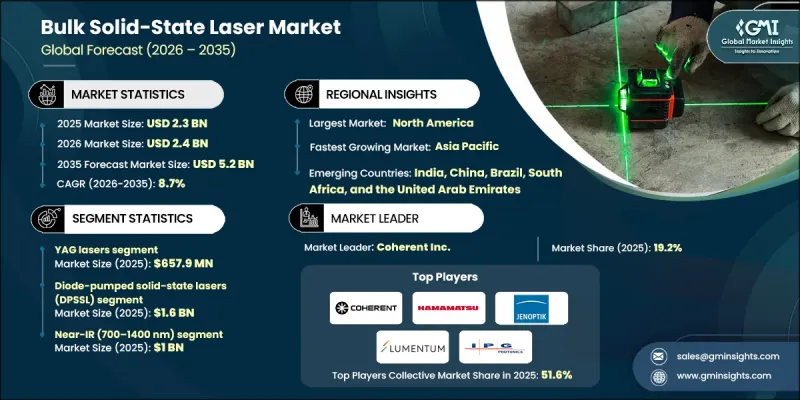
市场成长动力主要来自工业材料加工领域对高功率雷射系统日益增长的需求、半导体和微电子生产的扩张、医疗和美容治疗领域应用的不断扩大、航太和国防系统应用的日益普及,以及晶体生长和激发光源技术的进步。先进电子製造和精密零件加工的扩张持续推动可靠、高精度雷射平台的需求。旨在增强国内製造能力的公共部门资金筹措倡议和区域投资项目正在提升供应链韧性并加速技术发展。体固体雷射系统利用固体晶体或玻璃放大介质,透过光激发产生连贯的高能量雷射光束。其卓越的光束品质、运作稳定性、精度和高功率供给能力使其成为包括工业加工、半导体製造、医疗应用、科学研究和国防活动在内的众多领域不可或缺的工具。
| 市场范围 | |
|---|---|
| 开始年份 | 2025 |
| 预测年份 | 2026-2035 |
| 起始值 | 23亿美元 |
| 预测金额 | 52亿美元 |
| 复合年增长率 | 8.7% |
预计到2025年,Nd:YAG雷射器市场规模将达到6.579亿美元。这些系统以其强大的输出功率和卓越的光束品质而着称,使其在汽车、航太和电子製造等高要求的工业材料加工任务中表现出色。在医疗和美容应用领域,其精准可控的能量输出可最大限度地减少对周围组织的影响,并支持需要稳定临床表现的手术。製造商正优先开发用于工业和医疗应用的高功率Nd:YAG平台,并着重强调产品的耐用性、可扩展配置和全面的售后服务支持,以确保与客户建立长期合作关係并实现持续的收入来源。
预计到2025年,二极体泵浦固体雷射市场规模将达到16亿美元。高能量效率和增强的光束性能是推动其在工业、半导体、航太和医疗领域应用的主要因素。与传统的激励方式相比,二极体泵浦系统具有更长的使用寿命和更低的热应力,从而能够实现连续的高通量生产和关键的国防任务。在保持性能稳定的同时降低营运成本,使其成为大规模生产环境的理想选择。製造商正致力于开发高效二极体架构、模组化功率扩充性和先进的温度控管技术,以在满足工业、医疗和国防领域严格性能要求的同时,优先考虑能量优化。
预计到2025年,北美固体雷射市场份额将达到34.6%。该地区凭藉其强大的工业自动化能力、先进的医疗基础设施和大量的国防投资,保持主导地位。美国是主要的收入来源,这得益于汽车和电子产业持续的研发活动,以及精密製造、航太和医疗雷射应用领域的成长。成熟的工业生态系统和多元化的终端用户产业为下一代固体雷射技术的稳步普及提供了支持。在该地区营运的供应商正在投资开发专为工业和国防应用而设计的稳健、高精度系统,同时加强与研究机构的合作,以扩大其对技术标准的影响力,并加速早期采用者的商业化进程。
目录
第一章:调查方法和范围
第二章执行摘要
第三章业界考察
- 生态系分析
- 供应商情况
- 利润率
- 成本结构
- 每个阶段增加的价值
- 影响价值链的因素
- 中断
- 影响产业的因素
- 促进因素
- 对高功率工业应用的加工材料的需求
- 半导体和微电子製造业的成长
- 扩大医疗和美容领域的招聘
- 国防和航太雷射系统的扩展
- 晶体生长和泵浦技术的进步
- 挑战与困难
- 高成本系统和复杂的製造工艺
- 温度控管和效率限制
- 促进因素
- 成长潜力分析
- 监理情势
- 北美洲
- 欧洲
- 亚太地区
- 拉丁美洲
- 中东和非洲
- 波特的分析
- PESTEL 分析
- 科技与创新趋势
- 当前技术趋势
- 新兴技术
- 新兴经营模式
- 合规要求
- 供应链韧性
- 地缘政治分析
第四章 竞争情势
- 介绍
- 企业市占率分析
- 按地区
- 北美洲
- 欧洲
- 亚太地区
- 拉丁美洲
- 中东和非洲
- 市场集中度分析
- 按地区
- 主要企业的竞争标竿分析
- 产品系列比较
- 产品线的广度
- 科技
- 创新
- 区域企业发展比较
- 全球企业发展分析
- 服务网路覆盖
- 按地区分類的市场渗透率
- 竞争定位矩阵
- 领导企业
- 受让人
- 追踪者
- 小众玩家
- 战略展望矩阵
- 产品系列比较
- 2022-2025 年重大发展
- 併购
- 合作伙伴关係和合资企业
- 技术进步
- 扩张和投资策略
- 永续发展倡议
- 数位转型计划
- 新兴/Start-Ups竞争对手的发展趋势
第五章 市场估算与预测:依雷射类型划分,2022-2035年
- Nd:YAG雷射
- 掺镱体雷射(Yb:YAG、Yb:YLF 和其他镱基质)
- 掺铒雷射 (Er:YAG)
- 钬铥掺杂体雷射(Ho:YAG,Tm:YAG)
- 钛蓝宝石雷射
- 其他的
第六章 市场估计与预测:按激励法,2022-2035年
- 灯泵浦固体雷射
- 二极体泵浦固体雷射(DPSSL)
第七章 市场估计与预测:依波长划分,2022-2035年
- 紫外线(UV,波长小于400奈米)
- 可见光(400-700奈米)
- 近红外线(700-1400奈米)
- 中红外线(1400-3000奈米)
- 远红外线(3000奈米或更长)
第八章 市场估计与预测:依产量划分,2022-2035年
- 低功耗(小于50瓦)
- 中功率(50-500瓦)
- 高功率(超过 500 瓦)
第九章 市场估计与预测:依营运类型划分,2022-2035年
- 脉衝操作
- 奈秒脉衝
- 超短脉衝
- 连续波操作
- 准连续波操作
第十章 市场估价与预测:依应用领域划分,2022-2035年
- 主要趋势
- 工业製造
- 医疗保健
- 国防与安全
- 研究和科学领域
- 其他的
第十一章 市场估价与预测:按地区划分,2022-2035年
- 北美洲
- 我们
- 加拿大
- 欧洲
- 德国
- 英国
- 法国
- 西班牙
- 义大利
- 荷兰
- 亚太地区
- 中国
- 印度
- 日本
- 澳洲
- 韩国
- 拉丁美洲
- 巴西
- 墨西哥
- 阿根廷
- 中东和非洲
- 沙乌地阿拉伯
- 南非
- 阿拉伯聯合大公国
第十二章:公司简介
- 主要企业
- Coherent Inc.
- IPG Photonics
- Northrop Grumman Corporation
- Lumentum Operations LLC
- Jenoptik Laser GmbH
- 按地区分類的主要企业
- 北美洲
- CrystaLaser, LLC
- Edgewave
- Laserglow Technologies
- 欧洲
- ALPHALAS GmbH
- LUMIBIRD
- Quanta System SP
- 亚太地区
- Hamamatsu Photonics KK
- Daheng New Epoch Technology, Inc.
- Jiangsu Lumispot Technology Co., Ltd.
- 北美洲
- 小众/颠覆者
- LASEROPTEK Co., Ltd.
- CryLaS Crystal Laser Systems GmbH
- Bright Solutions Srl
- Light Conversion
- TOPTICA Photonics
The Global Bulk Solid-State Laser Market was valued at USD 2.3 billion in 2025 and is estimated to grow at a CAGR of 8.7% to reach USD 5.2 billion by 2035.
Market momentum is fueled by rising demand for high-power laser systems in industrial material processing, expanding semiconductor and microelectronics production, growing utilization in medical and aesthetic treatments, increasing deployment in aerospace and defense systems, and technological progress in crystal growth and pump sources. The expansion of advanced electronics manufacturing and precision component fabrication continues to drive the need for reliable, high-accuracy laser platforms. Public sector funding initiatives and regional investment programs designed to strengthen domestic manufacturing capabilities are reinforcing supply chain resilience and accelerating technology development. Bulk solid-state laser systems utilize solid crystalline or glass gain media, energized by optical pumping methods to generate coherent, high-energy beams. Their superior beam quality, operational stability, precision, and ability to deliver high power output position them as critical tools across industrial processing, semiconductor fabrication, healthcare applications, scientific research, and defense operations.
| Market Scope | |
|---|---|
| Start Year | 2025 |
| Forecast Year | 2026-2035 |
| Start Value | $2.3 Billion |
| Forecast Value | $5.2 Billion |
| CAGR | 8.7% |
The Nd: YAG laser segment reached USD 657.9 million in 2025. These systems are recognized for delivering strong output power combined with excellent beam quality, making them highly effective in demanding industrial material processing operations across automotive, aerospace, and electronics manufacturing environments. In medical and aesthetic applications, their precision and controlled energy delivery support procedures requiring minimal collateral impact and consistent clinical performance. Manufacturers are prioritizing the development of high-power Nd: YAG platforms designed for both industrial and medical applications, emphasizing durability, scalable configurations, and comprehensive after-sales support to secure long-term customer relationships and recurring revenue streams.
The diode-pumped solid-state laser segment accounted for USD 1.6 billion in 2025. Strong energy efficiency and enhanced beam performance are key factors driving adoption across industrial, semiconductor, aerospace, and medical sectors. Compared with traditional pumping approaches, diode-pumped systems offer extended operational lifespan and reduced thermal stress, enabling continuous high-throughput manufacturing and mission-critical defense operations. Their ability to maintain stable performance while lowering operating costs makes them well-suited for large-scale production environments. Manufacturers are focusing on high-efficiency diode architectures, modular power scalability, and advanced thermal management technologies to meet stringent industrial, medical, and defense performance requirements while prioritizing energy optimization.
North America Bulk Solid-State Laser Market held 34.6% share in 2025. The region maintains a leading position due to strong industrial automation capabilities, advanced healthcare infrastructure, and significant defense investments. The United States represents the primary revenue contributor, driven by precision manufacturing, aerospace engineering, and medical laser applications, alongside sustained research and development activity in automotive and electronics sectors. Established industrial ecosystems and diversified end-use industries support steady adoption of next-generation solid-state laser technologies. Vendors operating in the region are investing in ruggedized, high-precision systems tailored for industrial and defense applications while strengthening collaboration with research institutions to influence technology standards and accelerate commercialization among early adopters.
Major companies active in the Bulk Solid-State Laser Market include IPG Photonics, Coherent Inc., Lumentum Operations LLC, Hamamatsu Photonics K.K., Jenoptik Laser GmbH, Northrop Grumman Corporation, LUMIBIRD, Quanta System SP, ALPHALAS GmbH, CrystaLaser, LLC, LASEROPTEK Co., Ltd., Laserglow Technologies, Daheng New Epoch Technology, Inc., Edgewave, and Jiangsu Lumispot Technology Co., Ltd. Companies operating in the Bulk Solid-State Laser Market are strengthening their competitive standing through continuous innovation, strategic partnerships, and vertical integration. Many players are investing heavily in research and development to improve beam quality, power scalability, and energy efficiency. Expanding production capabilities and enhancing crystal growth technologies help secure supply chain stability and cost control. Strategic collaborations with industrial OEMs, semiconductor manufacturers, medical device companies, and defense contractors support long-term contracts and customized system development.
Table of Contents
Chapter 1 Methodology and Scope
- 1.1 Market scope and definition
- 1.2 Research design
- 1.2.1 Research approach
- 1.2.2 Data collection methods
- 1.3 Data mining sources
- 1.3.1 Global
- 1.3.2 Regional/Country
- 1.4 Base estimates and calculations
- 1.4.1 Base year calculation
- 1.4.2 Key trends for market estimation
- 1.5 Primary research and validation
- 1.5.1 Primary sources
- 1.6 Forecast model
- 1.7 Research assumptions and limitations
Chapter 2 Executive Summary
- 2.1 Industry 360° synopsis
- 2.2 Key market trends
- 2.2.1 Laser type trends
- 2.2.2 Pumping method trends
- 2.2.3 Wavelength trends
- 2.2.4 Power output trends
- 2.2.5 Operation type trends
- 2.2.6 Application trends
- 2.2.7 Regional trends
- 2.3 TAM Analysis, 2026-2035 (USD Million)
- 2.4 CXO perspectives: Strategic imperatives
Chapter 3 Industry Insights
- 3.1 Industry ecosystem analysis
- 3.1.1 Supplier landscape
- 3.1.2 Profit margin
- 3.1.3 Cost structure
- 3.1.4 Value addition at each stage
- 3.1.5 Factor affecting the value chain
- 3.1.6 Disruptions
- 3.2 Industry impact forces
- 3.2.1 Growth drivers
- 3.2.1.1 High-power industrial material processing demand
- 3.2.1.2 Growth in semiconductor and microelectronics manufacturing
- 3.2.1.3 Rising adoption in medical and aesthetic applications
- 3.2.1.4 Expansion of defense and aerospace laser systems
- 3.2.1.5 Advancements in crystal growth and pump technologies
- 3.2.2 Pitfalls and challenges
- 3.2.2.1 High system cost and complex manufacturing
- 3.2.2.2 Thermal management and efficiency limitations
- 3.2.1 Growth drivers
- 3.3 Growth potential analysis
- 3.4 Regulatory landscape
- 3.4.1 North America
- 3.4.2 Europe
- 3.4.3 Asia Pacific
- 3.4.4 Latin America
- 3.4.5 Middle East & Africa
- 3.5 Porter’s analysis
- 3.6 PESTEL analysis
- 3.7 Technology and Innovation landscape
- 3.7.1 Current technological trends
- 3.7.2 Emerging technologies
- 3.8 Emerging Business Models
- 3.9 Compliance Requirements
- 3.10 Supply Chain Resilience
- 3.11 Geopolitical Analysis
Chapter 4 Competitive Landscape, 2025
- 4.1 Introduction
- 4.2 Company market share analysis
- 4.2.1 By region
- 4.2.1.1 North America
- 4.2.1.2 Europe
- 4.2.1.3 Asia Pacific
- 4.2.1.4 Latin America
- 4.2.1.5 Middle East & Africa
- 4.2.2 Market concentration analysis
- 4.2.1 By region
- 4.3 Competitive benchmarking of key players
- 4.3.1 Product portfolio comparison
- 4.3.1.1 Product range breadth
- 4.3.1.2 Technology
- 4.3.1.3 Innovation
- 4.3.2 Geographic presence comparison
- 4.3.2.1 Global footprint analysis
- 4.3.2.2 Service network coverage
- 4.3.2.3 Market penetration by region
- 4.3.3 Competitive positioning matrix
- 4.3.3.1 Leaders
- 4.3.3.2 Challengers
- 4.3.3.3 Followers
- 4.3.3.4 Niche players
- 4.3.4 Strategic outlook matrix
- 4.3.1 Product portfolio comparison
- 4.4 Key developments, 2022-2025
- 4.4.1 Mergers and acquisitions
- 4.4.2 Partnerships and collaborations
- 4.4.3 Technological advancements
- 4.4.4 Expansion and investment strategies
- 4.4.5 Sustainability initiatives
- 4.4.6 Digital transformation initiatives
- 4.5 Emerging/ startup competitors landscape
Chapter 5 Market Estimates and Forecast, By Laser Type, 2022 - 2035 (USD Million)
- 5.1 Key trends
- 5.2 Nd:YAG Lasers
- 5.3 Ytterbium-Doped Bulk Lasers (Yb:YAG, Yb:YLF, Other Yb-hosts)
- 5.4 Erbium-Doped Bulk Lasers (Er:YAG)
- 5.5 Holmium & Thulium-Doped Bulk Lasers (Ho:YAG, Tm:YAG)
- 5.6 Ti:Sapphire Lasers
- 5.7 Others
Chapter 6 Market Estimates and Forecast, By Pumping Method, 2022 - 2035 (USD Million)
- 6.1 Key trends
- 6.2 Lamp-Pumped Solid-State Lasers
- 6.3 Diode-Pumped Solid-State Lasers (DPSSL)
Chapter 7 Market Estimates and Forecast, By Wavelength, 2022 - 2035 (USD Million)
- 7.1 Key trends
- 7.2 UV (<400 nm)
- 7.3 Visible (400-700 nm)
- 7.4 Near-IR (700-1400 nm)
- 7.5 Mid-IR (1400-3000 nm)
- 7.6 Far-IR (>3000 nm)
Chapter 8 Market Estimates and Forecast, By Power Output, 2022 - 2035 (USD Million)
- 8.1 Key trends
- 8.2 Low Power (<50 W)
- 8.3 Medium Power (50-500 W)
- 8.4 High Power (>500 W)
Chapter 9 Market Estimates and Forecast, By Operation Type, 2022 - 2035 (USD Million)
- 9.1 Key trends
- 9.2 Pulsed Operation
- 9.3 Nanosecond Pulsed
- 9.4 Ultrashort Pulsed
- 9.5 Continuous Wave Operation
- 9.6 Quasi Continuous Wave Operation
Chapter 10 Market Estimates and Forecast, By Application, 2022 - 2035 (USD Million)
- 10.1 Key Trends
- 10.2 Industrial Manufacturing
- 10.3 Medical & Healthcare
- 10.4 Defense & Security
- 10.5 Research & Scientific
- 10.6 Others
Chapter 11 Market Estimates and Forecast, By Region, 2022 - 2035 (USD Million)
- 11.1 Key trends
- 11.2 North America
- 11.2.1 U.S.
- 11.2.2 Canada
- 11.3 Europe
- 11.3.1 Germany
- 11.3.2 UK
- 11.3.3 France
- 11.3.4 Spain
- 11.3.5 Italy
- 11.3.6 Netherlands
- 11.4 Asia Pacific
- 11.4.1 China
- 11.4.2 India
- 11.4.3 Japan
- 11.4.4 Australia
- 11.4.5 South Korea
- 11.5 Latin America
- 11.5.1 Brazil
- 11.5.2 Mexico
- 11.5.3 Argentina
- 11.6 Middle East and Africa
- 11.6.1 Saudi Arabia
- 11.6.2 South Africa
- 11.6.3 UAE
Chapter 12 Company Profiles
- 12.1 Global Key Players
- 12.1.1 Coherent Inc.
- 12.1.2 IPG Photonics
- 12.1.3 Northrop Grumman Corporation
- 12.1.4 Lumentum Operations LLC
- 12.1.5 Jenoptik Laser GmbH
- 12.2 Regional Key Players
- 12.2.1 North America
- 12.2.1.1 CrystaLaser, LLC
- 12.2.1.2 Edgewave
- 12.2.1.3 Laserglow Technologies
- 12.2.2 Europe
- 12.2.2.1 ALPHALAS GmbH
- 12.2.2.2 LUMIBIRD
- 12.2.2.3 Quanta System SP
- 12.2.3 Asia Pacific
- 12.2.3.1 Hamamatsu Photonics K.K.
- 12.2.3.2 Daheng New Epoch Technology, Inc.
- 12.2.3.3 Jiangsu Lumispot Technology Co., Ltd.
- 12.2.1 North America
- 12.3 Niche / Disruptors
- 12.3.1 LASEROPTEK Co., Ltd.
- 12.3.2 CryLaS Crystal Laser Systems GmbH
- 12.3.3 Bright Solutions Srl
- 12.3.4 Light Conversion
- 12.3.5 TOPTICA Photonics

 2026年全球固体雷射市场报告
 2025-2033 年固态雷射市场(按类型(连续波雷射、脉衝固态雷射)、应用(航太和国防、汽车、医疗保健等)和地区
 固体雷射器市场机会、成长动力、产业趋势分析及 2025 - 2034 年预测