


 |
市场调查报告书
商品编码
1959331
自修復聚合物市场机会、成长要素、产业趋势分析及2026年至2035年预测。Self-Healing Polymers Market Opportunity, Growth Drivers, Industry Trend Analysis, and Forecast 2026 - 2035 |
||||||

2025 年全球自修復聚合物市场价值为 21 亿美元,预计到 2035 年将达到 130 亿美元,复合年增长率为 20.1%。
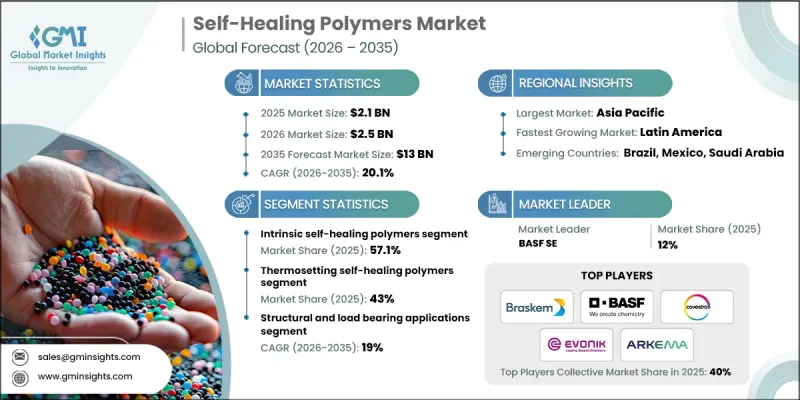
自修復聚合物已从早期的实验室概念发展成为具有商业性可行性的材料,尤其是在2022年至2025年间,随着工业领域对耐久性、延长使用寿命和优化性能的日益重视,这一发展趋势尤为显着。学术和技术文献中关于自修復聚合物的显着增长表明,动态分子网络和响应性化学体系的创新正在不断拓展,这些创新能够实现材料的自主修復。研究活动的激增与製造商对能够在损伤后恢復功能的尖端材料日益增长的需求密切相关。市场需求的驱动力在于对能够减少维护需求、最大限度减少停机时间并提高长期可靠性的材料的需求不断增长。随着研发工作不断从理论探索转向大规模生产,在製造技术的进步以及人们对其经济和性能优势日益认可的推动下,自修復聚合物正被整合到更广泛的高附加价值应用中。
| 市场范围 | |
|---|---|
| 开始年份 | 2025 |
| 预测年份 | 2026-2035 |
| 起始值 | 21亿美元 |
| 预测金额 | 130亿美元 |
| 复合年增长率 | 20.1% |
在工业製造领域,自修復聚合物正被日益广泛地应用于解决材料反覆劣化的难题。这些材料能够将修復机制直接融入涂层和复合材料系统中,从而延长零件的使用寿命,尤其是在高性能应用领域。市场需求也正转向在单一聚合物体系中整合多种功能特性的材料。如今,自修復解决方案旨在将机械修復能力与其他性能特性相结合,从而实现在尖端材料平台上的广泛应用。这种多功能方法有助于简化材料的复杂性,同时提高系统的整体效率和可靠性,从而促进其更广泛的应用。
预计到2025年,热固性自修復聚合物市场占有率将达到43%,并在2026年至2035年间以19.6%的复合年增长率成长。市场趋势表明,对通用材料平台的依赖正在减少,聚合物系统的选择与最终用途的需求之间的匹配度将更高。热固性体系在需要结构完整性和表面保护的应用领域中仍然占据主导地位。同时,热塑性和弹性体系统则适用于需要柔软性的应用场景。透过平衡刚性、韧性、加工性和可重复的自修復能力,共混和互穿网路技术能够实现可自订的效能,从而进一步提升其商业性吸引力。
到2025年,结构和承重应用将占市场份额的29.2%,预计到2035年将以19%的复合年增长率成长。随着越来越多的企业寻求降低整体拥有成本并最大限度地减少运作,结构、防护、电子、生物医学、消费品和能源相关领域的应用持续成长。在承重环境中,自修復能力有助于抑製材料疲劳和裂缝形成;而在防护应用中,表面修復和抵抗环境应力至关重要。这些性能优势持续推动此技术在严苛运作条件下的整合应用。
预计到2025年,北美自修復聚合物市场规模将达到6.525亿美元,2035年将达到19亿美元,年复合成长率(CAGR)为19.3%。全部区域的成长主要得益于涂料、先进复合材料和电子材料领域的高应用率,以及成熟的创新生态系统。美国仍然是商业化活动的中心,这得益于材料製造商、研究机构和製造终端用户之间的密切合作。这些伙伴关係正在加速认证流程,并推动自修復聚合物在多个高效能应用领域的早期部署。
目录
第一章:调查方法和范围
第二章执行摘要
第三章业界考察
- 生态系分析
- 供应商情况
- 利润率
- 每个阶段增加的价值
- 影响价值链的因素
- 中断
- 影响产业的因素
- 促进因素
- 产业潜在风险与挑战
- 市场机会
- 成长潜力分析
- 监理情势
- 北美洲
- 欧洲
- 亚太地区
- 拉丁美洲
- 中东和非洲
- 波特的分析
- PESTEL 分析
- 价格趋势
- 按地区
- 透过癒合机制
- 未来市场趋势
- 科技与创新趋势
- 当前技术趋势
- 新兴技术
- 专利状态
- 贸易统计(HS编码)
(註:贸易统计数据仅涵盖主要国家。)
- 主要进口国
- 主要出口国
- 永续性和环境方面
- 永续倡议
- 减少废弃物策略
- 生产中的能源效率
- 具有环保意识的倡议
- 考虑碳足迹
第四章 竞争情势
- 介绍
- 企业市占率分析
- 按地区
- 北美洲
- 欧洲
- 亚太地区
- 拉丁美洲
- 中东和非洲
- 按地区
- 公司矩阵分析
- 主要市场公司的竞争分析
- 竞争定位矩阵
- 主要进展
- 併购
- 伙伴关係与合作
- 新产品发布
- 业务拓展计划
第五章 市场估计与预测:依治疗机制划分,2022-2035年
- 固有自修復聚合物
- 可逆共用价键体系
- 基于超分子(非共用)相互作用的系统
- 动态交联网络
- 热可逆网络
- 外源性自修復聚合物
- 基于微胶囊的系统
- 血管或微通道系统
- 颗粒状或相分离的自癒合剂
- 植入式形状记忆或刺激反应系统
第六章 市场估算与预测:依聚合物基质类型划分,2022-2035年
- 热固性自修復聚合物
- 热塑性自修復聚合物
- 基于弹性体的自修復聚合物
- 聚合物共混物与互穿网络
第七章 市场估计与预测:依应用领域划分,2022-2035年
- 结构/荷载支撑应用
- 防护涂层和油漆
- 电子设备和软设备
- 生物医学和医疗保健应用
- 消费品和纺织品
- 能源和环境应用
第八章 市场估计与预测:依地区划分,2022-2035年
- 北美洲
- 我们
- 加拿大
- 欧洲
- 德国
- 英国
- 法国
- 西班牙
- 义大利
- 其他欧洲地区
- 亚太地区
- 中国
- 印度
- 日本
- 澳洲
- 韩国
- 亚太其他地区
- 拉丁美洲
- 巴西
- 墨西哥
- 阿根廷
- 其他拉丁美洲地区
- 中东和非洲
- 沙乌地阿拉伯
- 南非
- 阿拉伯聯合大公国
- 其他中东和非洲地区
第九章:公司简介
- BASF SE
- Covestro AG
- Evonik Industries AG
- Arkema SA
- Huntsman Corporation
- The Dow Chemical Company
- 3M Company
- AkzoNobel NV
- Henkel AG &Co. KGaA
- DSM-Firmenich(formerly Royal DSM)
- LG Chem Ltd.
- SABIC
- Mitsubishi Chemical Group
- Toray Industries, Inc.
- Sumitomo Chemical Co., Ltd.
- Nippon Paint Holdings Co., Ltd.
The Global Self-Healing Polymers Market was valued at USD 2.1 billion in 2025 and is estimated to grow at a CAGR of 20.1% to reach USD 13 billion by 2035.
Self-healing polymers have evolved from early-stage laboratory concepts into commercially viable materials, particularly between 2022 and 2025, as industries increasingly focus on durability, lifecycle extension, and performance optimization. A noticeable rise in academic and technical publications referencing self-healing polymers indicates growing innovation around dynamic molecular networks and responsive chemical systems that enable autonomous material repair. This surge in research activity aligns with expanding industrial interest, as manufacturers seek advanced materials capable of restoring functionality after damage. The market benefits from rising demand for materials that reduce maintenance needs, minimize downtime, and improve long-term reliability. As development efforts continue to shift from theoretical exploration to scalable production, self-healing polymers are being integrated into a wider range of high-value applications, supported by improved manufacturing techniques and increasing awareness of their economic and performance advantages.
| Market Scope | |
|---|---|
| Start Year | 2025 |
| Forecast Year | 2026-2035 |
| Start Value | $2.1 Billion |
| Forecast Value | $13 Billion |
| CAGR | 20.1% |
Within industrial manufacturing, self-healing polymers are increasingly adopted to address recurring material degradation challenges. These materials enable original equipment manufacturers to enhance component longevity by embedding repair mechanisms directly into coatings and composite systems, particularly in high-performance sectors. Market demand is also shifting toward materials that combine multiple functional properties within a single polymer system. Self-healing solutions are now designed to integrate mechanical recovery with additional performance attributes, enabling broader applicability across advanced material platforms. This multifunctional approach supports wider adoption by enabling manufacturers to simplify material complexity while enhancing overall system efficiency and reliability.
The thermosetting self-healing polymers segment accounted for held 43% share in 2025 and is projected to grow at a CAGR of 19.6% from 2026 to 2035. The market landscape shows increasing alignment between polymer system selection and end-use requirements rather than reliance on generalized material platforms. Thermosetting systems remain dominant in applications requiring structural integrity and surface protection, while thermoplastic and elastomeric systems support flexibility-driven use cases. Blend and interpenetrating network technologies enable tailored performance by balancing rigidity, toughness, ease of processing, and repeatable healing capability, further strengthening their commercial appeal.
The structural and load-bearing applications held 29.2% share in 2025 and are expected to grow at a CAGR of 19% through 2035. Adoption across structural, protective, electronic, biomedical, consumer, and energy-related segments continues to expand as organizations aim to lower total ownership costs and reduce operational interruptions. In load-bearing environments, self-healing functionality helps slow material fatigue and crack development, while protective applications emphasize surface restoration and resistance to environmental stressors. These performance benefits continue to drive integration across demanding operating conditions.
North America Self-Healing Polymers Market reached USD 652.5 million in 2025 to USD 1.9 billion by 2035 at a CAGR of 19.3%. Growth across the region is supported by strong adoption across coatings, advanced composites, and electronic materials, along with a well-established innovation ecosystem. The United States remains the central hub for commercialization activity, supported by close collaboration among material producers, research institutions, and manufacturing end users. These partnerships accelerate qualification processes and early-stage deployment across multiple high-performance applications.
Prominent participants in the Global Self-Healing Polymers Market include BASF SE, Arkema S.A., Covestro AG, The Dow Chemical Company, Evonik Industries AG, Huntsman Corporation, DSM-Firmenich (formerly Royal DSM), 3M Company, Henkel AG & Co. KGaA, AkzoNobel N.V., SABIC, LG Chem Ltd., Mitsubishi Chemical Group, Toray Industries, Inc., Sumitomo Chemical Co., Ltd., and Nippon Paint Holdings Co., Ltd. Companies active in the self-healing polymers market employ a combination of strategic initiatives to strengthen their competitive positioning. Investment in research and development remains a primary focus, enabling firms to improve healing efficiency, durability, and compatibility with existing manufacturing processes. Strategic partnerships with industrial end users support faster commercialization and application-specific customization. Many companies expand production capabilities to support scaling and cost optimization. Portfolio diversification across coatings, composites, and advanced materials allows suppliers to address multiple industries. Sustainability-focused innovation, including extended material lifespans and reduced maintenance requirements, further enhances market acceptance.
Table of Contents
Chapter 1 Methodology & Scope
- 1.1 Market scope and definition
- 1.2 Research design
- 1.2.1 Research approach
- 1.2.2 Data collection methods
- 1.3 Data mining sources
- 1.3.1 Global
- 1.3.2 Regional/Country
- 1.4 Base estimates and calculations
- 1.4.1 Base year calculation
- 1.4.2 Key trends for market estimation
- 1.5 Primary research and validation
- 1.5.1 Primary sources
- 1.6 Forecast model
- 1.7 Research assumptions and limitations
Chapter 2 Executive Summary
- 2.1 Industry 360° synopsis
- 2.2 Key market trends
- 2.2.1 Regional
- 2.2.2 Healing mechanism
- 2.2.3 Polymer matrix type
- 2.2.4 Application
- 2.3 TAM Analysis, 2026-2035
- 2.4 CXO perspectives: Strategic imperatives
- 2.4.1 Executive decision points
- 2.4.2 Critical success factors
- 2.5 Future Outlook and Strategic Recommendations
Chapter 3 Industry Insights
- 3.1 Industry ecosystem analysis
- 3.1.1 Supplier landscape
- 3.1.2 Profit margin
- 3.1.3 Value addition at each stage
- 3.1.4 Factor affecting the value chain
- 3.1.5 Disruptions
- 3.2 Industry impact forces
- 3.2.1 Growth drivers
- 3.2.2 Industry pitfalls and challenges
- 3.2.3 Market opportunities
- 3.3 Growth potential analysis
- 3.4 Regulatory landscape
- 3.4.1 North America
- 3.4.2 Europe
- 3.4.3 Asia Pacific
- 3.4.4 Latin America
- 3.4.5 Middle East & Africa
- 3.5 Porter’s analysis
- 3.6 PESTEL analysis
- 3.7 Price trends
- 3.7.1 By region
- 3.7.2 By Healing mechanism
- 3.8 Future market trends
- 3.9 Technology and Innovation landscape
- 3.9.1 Current technological trends
- 3.9.2 Emerging technologies
- 3.10 Patent Landscape
- 3.11 Trade statistics (HS code)
( Note: the trade statistics will be provided for key countries only)
- 3.11.1 Major importing countries
- 3.11.2 Major exporting countries
- 3.12 Sustainability and environmental aspects
- 3.12.1 Sustainable practices
- 3.12.2 Waste reduction strategies
- 3.12.3 Energy efficiency in production
- 3.12.4 Eco-friendly initiatives
- 3.13 Carbon footprint consideration
Chapter 4 Competitive Landscape, 2025
- 4.1 Introduction
- 4.2 Company market share analysis
- 4.2.1 By region
- 4.2.1.1 North America
- 4.2.1.2 Europe
- 4.2.1.3 Asia Pacific
- 4.2.1.4 LATAM
- 4.2.1.5 MEA
- 4.2.1 By region
- 4.3 Company matrix analysis
- 4.4 Competitive analysis of major market players
- 4.5 Competitive positioning matrix
- 4.6 Key developments
- 4.6.1 Mergers & acquisitions
- 4.6.2 Partnerships & collaborations
- 4.6.3 New Product Launches
- 4.6.4 Expansion Plans
Chapter 5 Market Estimates and Forecast, By Healing mechanism, 2022-2035 (USD Billion) (Kilo Tons)
- 5.1 Key trends
- 5.2 Intrinsic self-healing polymers
- 5.2.1 Reversible covalent bond-based systems
- 5.2.2 Supramolecular (non-covalent) interaction-based systems
- 5.2.3 Dynamic crosslinked networks
- 5.2.4 Thermally reversible networks
- 5.3 Extrinsic self-healing polymers
- 5.3.1 Microcapsule-based systems
- 5.3.2 Vascular or microchannel-based systems
- 5.3.3 Particulate or phase-separated healing agents
- 5.3.4 Embedded shape-memory or stimulus-triggered systems
Chapter 6 Market Estimates and Forecast, By Polymer matrix type, 2022-2035 (USD Billion) (Kilo Tons)
- 6.1 Key trends
- 6.2 Thermosetting self-healing polymers
- 6.3 Thermoplastic self-healing polymers
- 6.4 Elastomeric self-healing polymers
- 6.5 Polymer blends and interpenetrating networks
Chapter 7 Market Estimates and Forecast, By Application, 2022-2035 (USD Billion) (Kilo Tons)
- 7.1 Key trends
- 7.2 Structural and load-bearing applications
- 7.3 Protective coatings and paints
- 7.4 Electronics and soft devices
- 7.5 Biomedical and healthcare applications
- 7.6 Consumer goods and textiles
- 7.7 Energy and environmental applications
Chapter 8 Market Estimates and Forecast, By Region, 2022-2035 (USD Billion) (Kilo Tons)
- 8.1 Key trends
- 8.2 North America
- 8.2.1 U.S.
- 8.2.2 Canada
- 8.3 Europe
- 8.3.1 Germany
- 8.3.2 UK
- 8.3.3 France
- 8.3.4 Spain
- 8.3.5 Italy
- 8.3.6 Rest of Europe
- 8.4 Asia Pacific
- 8.4.1 China
- 8.4.2 India
- 8.4.3 Japan
- 8.4.4 Australia
- 8.4.5 South Korea
- 8.4.6 Rest of Asia Pacific
- 8.5 Latin America
- 8.5.1 Brazil
- 8.5.2 Mexico
- 8.5.3 Argentina
- 8.5.4 Rest of Latin America
- 8.6 Middle East and Africa
- 8.6.1 Saudi Arabia
- 8.6.2 South Africa
- 8.6.3 UAE
- 8.6.4 Rest of Middle East and Africa
Chapter 9 Company Profiles
- 9.1 BASF SE
- 9.2 Covestro AG
- 9.3 Evonik Industries AG
- 9.4 Arkema S.A.
- 9.5 Huntsman Corporation
- 9.6 The Dow Chemical Company
- 9.7 3M Company
- 9.8 AkzoNobel N.V.
- 9.9 Henkel AG & Co. KGaA
- 9.10 DSM-Firmenich (formerly Royal DSM)
- 9.11 LG Chem Ltd.
- 9.12 SABIC
- 9.13 Mitsubishi Chemical Group
- 9.14 Toray Industries, Inc.
- 9.15 Sumitomo Chemical Co., Ltd.
- 9.16 Nippon Paint Holdings Co., Ltd.

 自修復材料市场预测至2034年-按材料类型、形态、应用和地区分類的全球分析
 2026年全球自修復材料市场报告
 生物降解自组装材料市场分析及预测(至2035年):类型、产品、应用、技术、材料类型、最终用户、功能、安装类型自癒式电子电路市场分析及预测(至2035年):依类型、产品类型、服务、技术、组件、应用、材料类型、装置、功能及最终用户划分自组装奈米电路市场分析及预测(至2035年):依类型、产品类型、服务、技术、组件、应用、材料类型、製程、最终用户、功能划分
 全球自修復材料市场规模、份额、趋势和成长分析报告(2026-2034年)
 自修復材料市场规模、份额和成长分析(按类型、产品、技术、应用和地区划分)-2026-2033年产业预测
 自修復聚合物市场规模、份额和趋势分析报告:按材料、应用、地区和细分市场预测(2025-2033 年)
 自修復材料市场-全球产业规模、份额、趋势、机会和预测,按形态、材料类型、最终用途、地区和竞争格局划分,2020-2030年预测全球基础设施用自修復材料市场:预测至2032年-按材料类型、修復机制、技术、应用、最终用户和地区分類的分析