


 |
市场调查报告书
商品编码
1959342
人工智慧车载驾驶座助理市场:机会、成长要素、产业趋势分析及预测(2026-2035年)AI-Powered In-Vehicle Cockpit and Assistant Market Opportunity, Growth Drivers, Industry Trend Analysis, and Forecast 2026 - 2035 |
||||||

2025 年全球人工智慧车载驾驶座辅助系统市场价值 71 亿美元,预计到 2035 年将以 22.2% 的复合年增长率成长至 501 亿美元。
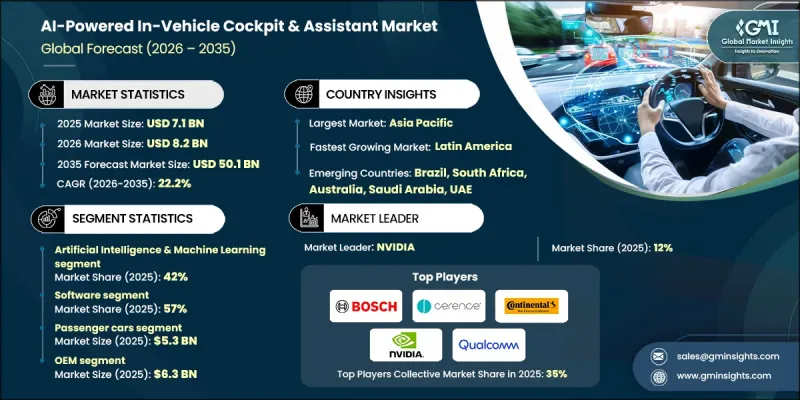
消费者对直觉的语音控制车辆互动和智慧驾驶辅助系统的期望日益增长,推动了市场成长。汽车製造商和一级供应商持续增加对人工智慧、机器学习和自然语言技术的投资,以创造高度个人化和情境察觉的驾驶座环境。这些平台将导航、媒体、通讯和车辆控制整合到一个智慧介面中。向软体定义车辆和灵活驾驶座架构的转变将使製造商能够更快地部署新的人工智慧驱动功能。人工智慧也透过先进的内容管理和偏好的建议,正在改变资讯娱乐系统,从而提升驾驶员和乘客的参与度。同时,可扩展的高效能运算平台支援人工智慧在驾驶座系统和驾驶辅助功能中的应用,随着以软体为中心的设计成为汽车行业的标准,这将缩短开发週期并提高车辆的长期适应性。
| 市场范围 | |
|---|---|
| 开始年份 | 2025 |
| 预测年份 | 2026-2035 |
| 起始金额 | 71亿美元 |
| 预测金额 | 501亿美元 |
| 复合年增长率 | 22.2% |
预计到2025年,软体领域将占据57%的市场份额,并在2026年至2035年间以23.8%的复合年增长率成长。以人工智慧为核心的驾驶座软体,采用模组化和服务导向架构,可提供智慧、互联和自适应的使用者体验。这些平台支援无缝系统集成,并透过空中下载更新快速启动功能,从而提升车辆的长期性能。
预计到2025年,乘用车市场规模将达53亿美元。这一市场将受益于消费者对连网、智慧和个人化车载环境日益增长的需求。人工智慧语音互动、先进的人机互动介面和预测智慧技术,将使用户能够在以乘客为中心的出行平台上,无缝存取导航、通讯、娱乐和车辆操控等功能。
预计2025年,中国人工智慧车载驾驶座辅助系统市场规模将达22亿美元。中国在该领域的主导地位得益于快速的数位转型、国内汽车製造商的强劲创新以及人工智慧技术在全系车型中的大规模应用。凭藉消费者对数位生态系统的高度接受度以及有利的政策框架,驾驶座智慧已成为中国汽车市场的关键竞争优势。
目录
第一章:调查方法和范围
第二章执行摘要
第三章业界考察
- 生态系分析
- 供应商情况
- 零件供应商
- 技术平台提供者
- 系统整合商
- 汽车製造商
- 售后市场销售代理
- 最终用户
- 成本结构
- 利润率
- 每个阶段增加的价值
- 垂直整合趋势
- 颠覆者
- 供应商情况
- 影响因素
- 促进因素
- 联网汽车和软体定义汽车的广泛应用。
- 消费者对个人化和免持操作的需求日益增长。
- 电动车 (EV) 和自动驾驶汽车领域的扩张
- 拓展售后软体升级机会
- 市场机会
- AI驱动的预测和生成助手
- 多模态人机互动的引入
- 云端连线和OTA更新
- 智慧驾驶座的区域部署
- 促进因素
- 技术趋势与创新生态系统
- 目前技术
- 新兴技术
- 成长潜力分析
- 监理情势
- 北美洲
- FMVSS驾驶分心预防指南
- 加拿大运输部连网车辆与资讯娱乐系统指南
- 欧洲
- 欧盟通用安全法规(GSR)
- 汽车资讯娱乐系统的CE认证
- 亚太地区
- 日本汽车电子设备安全标准
- 中国GB标准(用于联网汽车)
- 印度AIS/EMC指南
- 拉丁美洲
- 巴西 INMETRO 标准
- 哥伦比亚汽车互联繫统指南
- 阿根廷关于汽车电子产品和资讯娱乐系统的法规
- 中东和非洲
- 阿联酋联网汽车和语音控制汽车的标准
- 阿曼汽车电子产品指南
- 南非SABS汽车语音与资讯娱乐标准
- 北美洲
- 波特的分析
- PESTEL 分析
- 价格趋势
- OEM定价模式
- 售后市场价格趋势
- 订阅模式与一次性购买模式的比较
- 区域价格波动
- 专利分析
- 永续性和环境方面
- 永续实践
- 减少废弃物策略
- 生产中的能源效率
- 具有环保意识的倡议
- 碳足迹考量
- 供应链分析
- 零件筹资策略
- 半导体晶片供应限制
- 对云端基础架构的依赖
- 区域供应链趋势
- 商业性可行性及开发
- 比较成本竞争力和高端音讯的附加价值效应。
- OEM采购和平台扩充性的吸引力
- 售后升级的潜力以及经销商安装的成本效益
- 本地化、供应链韧性和物流实用性
- 人机介面 (HMI) 和使用者体验基准测试
第四章 竞争情势
- 介绍
- 企业市占率分析
- 北美洲
- 欧洲
- 亚太地区
- 拉丁美洲
- 中东和非洲
- 竞争定位矩阵
- 战略展望矩阵
- 主要进展
- 併购
- 伙伴关係与合作
- 新产品发布
- 业务拓展计划及资金筹措
第五章 市场估计与预测:依技术划分,2022-2035年
- 语音辨识
- 自然语言处理(NLP)
- 人工智慧(AI)
第六章 市场估计与预测:依组件划分,2022-2035年
- 软体
- 内建软体
- 基于云端的软体
- 人工智慧驱动的应用
- 其他的
- 硬体
- 麦克风和扬声器
- 显示面板/萤幕
- 控制单元处理器
- 感应器和摄影机
- 其他的
- 服务
- 整合与实施
- 维护和支援
- 咨询服务
第七章 市场估价与预测:依车辆类型划分,2022-2035年
- 搭乘用车
- 轿车
- 掀背车车
- SUV
- 商用车辆
- 轻型商用车(LCV)
- 中型商用车(MCV)
- 重型商用车(HCV)
第八章 市场估计与预测:依应用领域划分,2022-2035年
- 导航地图
- 娱乐媒体
- 沟通
- 车辆控制和设置
- 其他的
第九章 市场估价与预测:依销售管道划分,2022-2035年
- OEM
- 售后市场
第十章 市场估价与预测:依地区划分,2022-2035年
- 北美洲
- 我们
- 加拿大
- 欧洲
- 英国
- 德国
- 法国
- 义大利
- 西班牙
- 比利时
- 荷兰
- 瑞典
- 俄罗斯
- 亚太地区
- 中国
- 印度
- 日本
- 澳洲
- 新加坡
- 韩国
- 越南
- 印尼
- 拉丁美洲
- 巴西
- 墨西哥
- 阿根廷
- 中东和非洲
- 南非
- 沙乌地阿拉伯
- 阿拉伯聯合大公国
第十一章:公司简介
- 世界公司
- Aptiv
- Continental
- DENSO
- Harman International Industries(Samsung)
- NVIDIA
- Panasonic Automotive Systems
- Qualcomm Technologies
- Robert Bosch
- Valeo
- Visteon
- 当地公司
- Alps Alpine
- Cerence
- Desay SV Automotive
- FORVIA
- Garmin
- Hyundai Mobis
- Pateo Connect Technology
- Pioneer
- 新兴企业
- 42dot
- AEye
- Arbe Robotics
- Prophesee
- Sonatus
- StradVision
The Global AI-Powered In-Vehicle Cockpit & Assistant Market was valued at USD 7.1 billion in 2025 and is estimated to grow at a CAGR of 22.2% to reach USD 50.1 billion by 2035.
Rising consumer expectations for intuitive, voice-enabled vehicle interaction and intelligent driver support fuel growth. Automakers and Tier 1 suppliers continue to accelerate investment in artificial intelligence, machine learning, and natural language technologies to deliver highly personalized and context-aware cockpit environments. These platforms unify navigation, media, communication, and vehicle controls into a single intelligent interface. The shift toward software-defined vehicles and flexible cockpit architectures allows manufacturers to introduce new AI-driven functions at a much faster pace. AI is also reshaping infotainment through advanced content management and preference-based recommendations, increasing engagement for both drivers and passengers. In parallel, scalable high-performance computing platforms are supporting AI deployment across cockpit systems and driver assistance features, enabling quicker development cycles and long-term vehicle adaptability as software-centric design becomes standard across the automotive industry.
| Market Scope | |
|---|---|
| Start Year | 2025 |
| Forecast Year | 2026-2035 |
| Start Value | $7.1 Billion |
| Forecast Value | $50.1 Billion |
| CAGR | 22.2% |
The software segment held a 57% share in 2025 and is forecast to grow at a CAGR of 23.8% from 2026 to 2035. AI-focused cockpit software enables intelligent, connected, and adaptive user experiences by supporting modular and service-oriented architectures. These platforms allow seamless system integration and faster feature activation through over-the-air updates, enhancing long-term vehicle functionality.
The passenger vehicles segment generated USD 5.3 billion in 2025. This segment benefits from strong consumer demand for connected, intelligent, and personalized in-vehicle environments. AI-powered voice interaction, advanced human-machine interfaces, and predictive intelligence support smooth access to navigation, communication, entertainment, and vehicle operation within passenger-focused mobility platforms.
China AI-Powered In-Vehicle Cockpit & Assistant Market reached USD 2.2 billion in 2025. The country's leadership is driven by rapid digital transformation, strong innovation among domestic automakers, and large-scale integration of AI technologies across vehicle lineups. High consumer acceptance of digital ecosystems and supportive policy frameworks have made cockpit intelligence a key competitive differentiator in the Chinese automotive market.
Key companies active in the Global AI-Powered In-Vehicle Cockpit & Assistant Market include Qualcomm Technologies, NVIDIA, Harman International Industries, Robert Bosch, Continental, Aptiv, Visteon, Valeo, DENSO, and Panasonic Automotive Systems. Companies operating in the AI-Powered In-Vehicle Cockpit & Assistant Market focus on strengthening their position through software-centric innovation and ecosystem partnerships. Automakers and suppliers invest heavily in proprietary AI platforms and scalable computing architectures to support long-term feature expansion. Strategic collaboration with semiconductor and software firms improves processing efficiency and accelerates product development. Many players emphasize modular cockpit designs that can be deployed across multiple vehicle platforms. Over-the-air update capabilities are prioritized to ensure continuous performance enhancement and personalization. Firms also concentrate on improving voice intelligence accuracy, user data security, and seamless integration with digital services.
Table of Contents
Chapter 1 Methodology & Scope
- 1.1 Research approach
- 1.2 Quality Commitments
- 1.2.1 GMI AI policy & data integrity commitment
- 1.2.1.1 Source consistency protocol
- 1.2.1 GMI AI policy & data integrity commitment
- 1.3 Research Trail & Confidence Scoring
- 1.3.1 Research Trail Components
- 1.3.2 Scoring Components
- 1.4 Data Collection
- 1.4.1 Partial list of primary sources
- 1.5 Data mining sources
- 1.5.1 Paid sources
- 1.5.1.1 Sources, by region
- 1.5.1 Paid sources
- 1.6 Base estimates and calculations
- 1.6.1 Base year calculation for any one approach
- 1.7 Forecast
- 1.7.1 Quantified market impact analysis
- 1.7.1.1 Mathematical impact of growth parameters on forecast
- 1.7.1 Quantified market impact analysis
- 1.8 Research transparency addendum
- 1.8.1 Source attribution framework
- 1.8.2 Quality assurance metrics
- 1.8.3 Our commitment to trust
Chapter 2 Executive Summary
- 2.1 Industry 360° synopsis
- 2.2 Key market trends
- 2.2.1 Regional
- 2.2.2 Technology
- 2.2.3 Component
- 2.2.4 Vehicle
- 2.2.5 Application
- 2.2.6 Sales Channel
- 2.3 TAM Analysis, 2026-2035
- 2.4 CXO perspectives: Strategic imperatives
- 2.4.1 Key decision points for industry executives
- 2.4.2 Critical success factors for market players
- 2.5 Future outlook and strategic recommendations
Chapter 3 Industry Insights
- 3.1 Industry ecosystem analysis
- 3.1.1 Supplier landscape
- 3.1.1.1 Component suppliers
- 3.1.1.2 Technology platform providers
- 3.1.1.3 System integrators
- 3.1.1.4 Automotive OEMs
- 3.1.1.5 Aftermarket distributors
- 3.1.1.6 End-users
- 3.1.2 Cost structure
- 3.1.3 Profit margin
- 3.1.4 Value addition at each stage
- 3.1.5 Vertical integration trends
- 3.1.6 Disruptors
- 3.1.1 Supplier landscape
- 3.2 Impact on forces
- 3.2.1 Growth drivers
- 3.2.1.1 Growing adoption of connected and software-defined vehicles.
- 3.2.1.2 Rising consumer demand for personalization and hands-free operation
- 3.2.1.3 Expansion of EV and autonomous vehicle segments
- 3.2.1.4 Increasing aftermarket and software upgrade opportunities
- 3.2.2 Industry pitfalls & challenges
- 3.2.2.1 Growing adoption of connected and software-defined vehicles.
- 3.2.2.2 Rising consumer demand for personalization and hands-free operation
- 3.2.3 Market opportunities
- 3.2.3.1 AI-driven predictive and generative assistants
- 3.2.3.2 Multimodal HMI adoption
- 3.2.3.3 Cloud connectivity and OTA updates
- 3.2.3.4 Regional adoption of intelligent cockpits
- 3.2.1 Growth drivers
- 3.3 Technology trends & innovation ecosystem
- 3.3.1 Current technologies
- 3.3.2 Emerging technologies
- 3.4 Growth potential analysis
- 3.5 Regulatory landscape
- 3.5.1 North America
- 3.5.1.1 FMVSS Driver Distraction Guidelines
- 3.5.1.2 Transport Canada Connected Vehicle & Infotainment Guidelines
- 3.5.2 Europe
- 3.5.2.1 EU General Safety Regulation (GSR)
- 3.5.2.2 CE Certification for Automotive Infotainment
- 3.5.3 Asia-Pacific
- 3.5.3.1 Japan Automotive Electronics Safety Standards
- 3.5.3.2 China GB Standards for Connected Vehicles
- 3.5.3.3 India AIS / EMC Guidelines
- 3.5.4 Latin America
- 3.5.4.1 Brazil INMETRO Standards
- 3.5.4.2 Colombia Automotive Connected Systems Guidelines
- 3.5.4.3 Argentina Vehicle Electronics & Infotainment Regulations
- 3.5.5 Middle East & Africa
- 3.5.5.1 UAE Standards for Connected & Voice-Enabled Vehicles
- 3.5.5.2 Oman Automotive Electronics Guidelines
- 3.5.5.3 South Africa SABS Automotive Voice & Infotainment Standards
- 3.5.1 North America
- 3.6 Porter's analysis
- 3.7 PESTEL analysis
- 3.8 Price trends
- 3.8.1 OEM Pricing models
- 3.8.2 Aftermarket pricing trends
- 3.8.3 Subscription vs one-time purchase models
- 3.8.4 Regional price variations
- 3.9 Patent analysis
- 3.10 Sustainability and environmental aspects
- 3.10.1 Sustainable practices
- 3.10.2 Waste reduction strategies
- 3.10.3 Energy efficiency in production
- 3.10.4 Eco-friendly initiatives
- 3.10.5 Carbon footprint considerations
- 3.11 Supply chain analysis
- 3.11.1 Component sourcing strategies
- 3.11.2 Semiconductor chip supply constraints
- 3.11.3 Cloud infrastructure dependencies
- 3.11.4 Regional supply chain dynamics
- 3.12 Commercial viability & deployment
- 3.12.1 Cost competitiveness vs. premium audio upsells value.
- 3.12.2 OEM sourcing attractiveness and platform scalability
- 3.12.3 Aftermarket upgrade potential and dealer fitment economics
- 3.12.4 Localization, supply resilience, and logistics practicality
- 3.13 Human-Machine Interface (HMI) & User Experience Benchmarking
Chapter 4 Competitive Landscape, 2025
- 4.1 Introduction
- 4.2 Company market share analysis
- 4.2.1 North America
- 4.2.2 Europe
- 4.2.3 Asia-Pacific
- 4.2.4 Latin America
- 4.2.5 Middle East & Africa
- 4.3 Competitive positioning matrix
- 4.4 Strategic outlook matrix
- 4.5 Key developments
- 4.5.1 Mergers & acquisitions
- 4.5.2 Partnerships & collaborations
- 4.5.3 New product launches
- 4.5.4 Expansion plans and funding
Chapter 5 Market Estimates & Forecast, By Technology, 2022 - 2035 ($Bn, Units)
- 5.1 Key trends
- 5.2 Speech Recognition
- 5.3 Natural Language Processing (NLP)
- 5.4 Artificial Intelligence (AI)
Chapter 6 Market Estimates & Forecast, By Component, 2022 - 2035 ($Bn, Units)
- 6.1 Key trends
- 6.2 Software
- 6.2.1 Embedded Software
- 6.2.2 Cloud-based Software
- 6.2.3 AI-powered Applications
- 6.2.4 Others
- 6.3 Hardware
- 6.3.1 Microphones & Speakers
- 6.3.2 Display Panels & Screens
- 6.3.3 Control Units & Processors
- 6.3.4 Sensors & Cameras
- 6.3.5 Others
- 6.4 Services
- 6.4.1 Integration & Deployment
- 6.4.2 Maintenance & Support
- 6.4.3 Consulting Services
Chapter 7 Market Estimates & Forecast, By Vehicle, 2022 - 2035 ($Bn, Units)
- 7.1 Key trends
- 7.2 Passenger Cars
- 7.2.1 Sedans
- 7.2.2 Hatchbacks
- 7.2.3 SUVs
- 7.3 Commercial Vehicles
- 7.3.1 Light commercial vehicles (LCV)
- 7.3.2 Medium commercial vehicles (MCV)
- 7.3.3 Heavy commercial vehicles (HCV)
Chapter 8 Market Estimates & Forecast, By Application, 2022 - 2035 ($Bn, Units)
- 8.1 Key trends
- 8.2 Navigation & Mapping
- 8.3 Entertainment & Media
- 8.4 Communication
- 8.5 Vehicle Control & Settings
- 8.6 Others
Chapter 9 Market Estimates & Forecast, By Sales Channel, 2022 - 2035 ($Bn, Units)
- 9.1 Key trends
- 9.2 OEM
- 9.3 Aftermarket
Chapter 10 Market Estimates & Forecast, By Region, 2022 - 2035 ($Bn, Units)
- 10.1 North America
- 10.1.1 US
- 10.1.2 Canada
- 10.2 Europe
- 10.2.1 UK
- 10.2.2 Germany
- 10.2.3 France
- 10.2.4 Italy
- 10.2.5 Spain
- 10.2.6 Belgium
- 10.2.7 Netherlands
- 10.2.8 Sweden
- 10.2.9 Russia
- 10.3 Asia Pacific
- 10.3.1 China
- 10.3.2 India
- 10.3.3 Japan
- 10.3.4 Australia
- 10.3.5 Singapore
- 10.3.6 South Korea
- 10.3.7 Vietnam
- 10.3.8 Indonesia
- 10.4 Latin America
- 10.4.1 Brazil
- 10.4.2 Mexico
- 10.4.3 Argentina
- 10.5 MEA
- 10.5.1 South Africa
- 10.5.2 Saudi Arabia
- 10.5.3 UAE
Chapter 11 Company Profiles
- 11.1 Global Players
- 11.1.1 Aptiv
- 11.1.2 Continental
- 11.1.3 DENSO
- 11.1.4 Harman International Industries (Samsung)
- 11.1.5 NVIDIA
- 11.1.6 Panasonic Automotive Systems
- 11.1.7 Qualcomm Technologies
- 11.1.8 Robert Bosch
- 11.1.9 Valeo
- 11.1.10 Visteon
- 11.2 Regional players
- 11.2.1 Alps Alpine
- 11.2.2 Cerence
- 11.2.3 Desay SV Automotive
- 11.2.4 FORVIA
- 11.2.5 Garmin
- 11.2.6 Hyundai Mobis
- 11.2.7 Pateo Connect Technology
- 11.2.8 Pioneer
- 11.3 Emerging players
- 11.3.1 42dot
- 11.3.2 AEye
- 11.3.3 Arbe Robotics
- 11.3.4 Prophesee
- 11.3.5 Sonatus
- 11.3.6 StradVision


