


 |
市场调查报告书
商品编码
1959560
阿维A酸市场机会、成长要素、产业趋势分析及2026年至2035年预测Acitretin Market Opportunity, Growth Drivers, Industry Trend Analysis, and Forecast 2026 - 2035 |
||||||

2025 年全球阿维A酸市场价值为 3,660 万美元,预计到 2035 年将达到 5,920 万美元,年复合成长率为 5%。
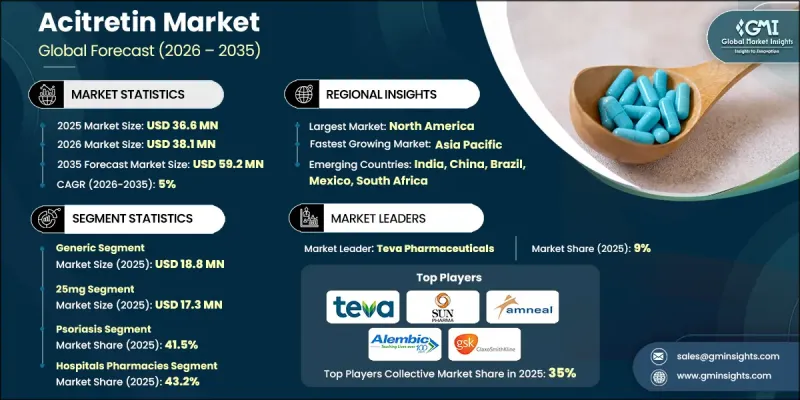
银屑病市场扩张的驱动因素包括多个地区银屑病患病率的上升,以及诊断工具的改进和人口结构的变化。随着更多患者得到早期诊断,对能够提供长期症状管理的系统性疗法的需求持续成长。这一趋势在高所得国家尤为显着,这些国家的银屑病终生患病率不断上升,皮肤科医疗基础设施也在不断完善。全球银屑病负担的加重直接推动了对阿维A酸的稳定且持续的需求。此外,人们对银屑病及其广泛健康影响的认识不断提高,促进了早期诊断和适当治疗。国际社会所进行的公众和政策制定者教育工作有助于减少社会歧视,提高医疗服务的可近性,进而提高已开发市场和新兴市场的干癣检出率。这些因素共同为市场的长期成长奠定了坚实的基础。
| 市场范围 | |
|---|---|
| 开始年份 | 2025 |
| 预测年份 | 2026-2035 |
| 起始值 | 3660万美元 |
| 预测金额 | 5920万美元 |
| 复合年增长率 | 5% |
预计到2025年,非专利阿维A酸市场规模将达到1,880万美元。学名药必须符合严格的监管标准,并证明其与原厂药具有生物等效性,从而确保其安全性和有效性相当。凭藉数十年的临床经验,学名药无需进行大量的重复试验,因此具有很高的成本效益和广泛的可及性。这种价格优势和可近性深受临床医生、支付方和患者的青睐,尤其是在对价格敏感的医疗保健体系中,从而保证了仿製药的广泛应用。
预计到2025年,25毫克剂量组的市场规模将达到1,730万美元。此剂量可进行精确的剂量调整,从而在优化疗效的同时最大限度地减少副作用。较低的剂量可以提高患者的耐受性,减少不良反应,并有助于长期坚持用药,这对于银屑病的持续治疗至关重要。
预计2025年,美国阿维A酸市场规模将达1,370万美元。银屑病的高发病率以及对有效系统性治疗的需求是推动成长要素。对于因禁忌症、费用或缺乏非免疫抑制疗法而无法使用生物製药的患者而言,阿维A酸尤其重要。广泛的诊断手段、沉重的疾病负担以及持续的治疗需求,共同支撑着美国市场的发展。
目录
第一章:调查方法和范围
第二章执行摘要
第三章业界考察
- 生态系分析
- 影响产业的因素
- 促进因素
- 全球银屑病患者数量呈上升趋势
- 治疗方法进展
- 提高认识和诊断水平
- 皮肤科诊所数量增加
- 产业潜在风险与挑战
- 严格的监管要求
- 对副作用和安全性的担忧
- 市场机会
- 对生物製药。
- 促进因素
- 成长潜力分析
- 监理情势
- 北美洲
- 欧洲
- 科技趋势
- 当前技术趋势
- 新兴技术
- 未来市场趋势
- 差距分析
- 波特的分析
- PESTEL 分析
第四章 竞争情势
- 介绍
- 企业市占率分析
- 公司矩阵分析
- 主要市场公司的竞争分析
- 竞争定位矩阵
- 主要进展
- 併购
- 合作伙伴关係和合资企业
- 新产品发布
- 扩张计划
第五章 市场估算与预测:依产品类型划分,2022-2035年
- 品牌商品
- 学名药
第六章 市场估计与预测:依剂型划分,2022-2035年
- 10 mg
- 25mg
- 50mg
第七章 市场估计与预测:依应用领域划分,2022-2035年
- 银屑病
- 鱼鳞病
- 达里尔氏症
- 毛髮红皮症
- 固态器官移植
- 格洛弗病
- 扁平苔癣
- 红斑狼疮
第八章 市场估算与预测:依通路划分,2022-2035年
- 医院药房
- 网路药房
- 零售药房
第九章 市场估计与预测:依地区划分,2022-2035年
- 北美洲
- 我们
- 加拿大
- 欧洲
- 德国
- 英国
- 法国
- 西班牙
- 义大利
- 荷兰
- 亚太地区
- 中国
- 日本
- 印度
- 澳洲
- 韩国
- 拉丁美洲
- 巴西
- 墨西哥
- 阿根廷
- 中东和非洲
- 南非
- 沙乌地阿拉伯
- 阿拉伯聯合大公国
第十章:公司简介
- Amneal Pharmaceuticals, Inc.
- Biophore
- Chongqing Huapont Pharmaceutical Co., Ltd.
- Glenmark Pharmaceuticals Ltd.
- GSK Plc
- Merck KGaA
- Prasco Laboratories
- Sun Pharma Industries Limited
- Teva Pharmaceuticals Industries Ltd
- Alembic Pharmaceuticals Ltd
The Global Acitretin Market was valued at USD 36.6 million in 2025 and is estimated to grow at a CAGR of 5% to reach USD 59.2 million by 2035.
The market's expansion is fueled by the rising prevalence of psoriasis across multiple regions, supported by better diagnostic tools and shifting population demographics. As more patients are diagnosed earlier, the need for systemic therapies that offer long-term symptom management continues to grow. This trend is particularly prominent in high-income countries where lifetime prevalence rates are increasing, as well as in regions enhancing dermatological infrastructure. The growing global burden of psoriasis directly drives steady, sustained demand for acitretin. Furthermore, heightened awareness about psoriasis and its broader health implications is promoting early diagnosis and timely treatment. International initiatives aimed at educating the public and policymakers are helping reduce stigma and encourage medical consultation, increasing detection rates in both developed and emerging markets. Together, these factors are establishing a strong foundation for the market's long-term growth.
| Market Scope | |
|---|---|
| Start Year | 2025 |
| Forecast Year | 2026-2035 |
| Start Value | $36.6 Million |
| Forecast Value | $59.2 Million |
| CAGR | 5% |
The generic acitretin segment accounted for USD 18.8 million in 2025. Generic products follow strict regulatory standards and must demonstrate bioequivalence to the reference drug, ensuring comparable safety and efficacy. With decades of clinical knowledge, generics do not require extensive repeat trials, making them highly cost-effective and widely accessible. This affordability and availability appeal to clinicians, payers, and patients, particularly in price-sensitive healthcare systems, ensuring broad adoption.
The 25 mg segment reached USD 17.3 million in 2025. This strength allows precise dose titration to optimize efficacy while minimizing side effects. Lower doses improve patient tolerance, reduce adverse effects, and support long-term adherence, which is critical for sustained psoriasis management.
U.S. Acitretin Market reached USD 13.7 million in 2025. High psoriasis prevalence and the need for effective systemic therapies are key growth drivers. Acitretin is particularly important for patients who cannot use biologic treatments due to contraindications, cost, or preference for non-immunosuppressive therapies. The combination of widespread diagnosis, significant disease burden, and ongoing treatment requirements continues to support the U.S. market.
Key companies in the Global Acitretin Market include Biophore, Teva Pharmaceuticals Industries Ltd, Glenmark Pharmaceuticals Ltd, Sun Pharma Industries Limited, GSK Plc, Alembic Pharmaceuticals Ltd, Amneal Pharmaceuticals, Inc., Merck KGaA, Chongqing Huapont Pharmaceutical Co., Ltd., and Prasco Laboratories. Market players are strengthening their presence by expanding generic and branded product portfolios, investing in R&D for improved formulations, and focusing on bioequivalence and safety validation to gain regulatory approval. Companies are pursuing strategic collaborations with distributors and healthcare providers to enhance market penetration and accessibility. Pricing strategies, patient assistance programs, and education initiatives for clinicians and patients are used to drive adoption. Additionally, firms leverage digital platforms to increase awareness of psoriasis management and promote treatment adherence, while investing in emerging markets to capture underserved patient populations and sustain long-term growth.
Table of Contents
Chapter 1 Methodology and Scope
- 1.1 Market scope and definitions
- 1.2 Research design
- 1.2.1 Research approach
- 1.2.2 Data collection methods
- 1.3 Data mining sources
- 1.3.1 Global
- 1.3.2 Regional/Country
- 1.4 Base estimates and calculations
- 1.4.1 Base year calculation
- 1.4.2 Key trends for market estimation
- 1.5 Primary research and validation
- 1.5.1 Primary sources
- 1.6 Forecast model
- 1.7 Research assumptions and limitations
Chapter 2 Executive Summary
- 2.1 Industry 3600 synopsis
- 2.2 Key market trends
- 2.2.1 Product type trends
- 2.2.2 Dosage strength trends
- 2.2.3 Application trends
- 2.2.4 Distribution channel trends
- 2.2.5 Regional trends
- 2.3 CXO perspectives: Strategic imperatives
Chapter 3 Industry Insights
- 3.1 Industry ecosystem analysis
- 3.2 Industry impact forces
- 3.2.1 Growth drivers
- 3.2.1.1 Rising prevalence of psoriasis globally
- 3.2.1.2 Advancements in treatment
- 3.2.1.3 Growing awareness and diagnosis
- 3.2.1.4 Growing dermatology specialty clinics
- 3.2.2 Industry pitfalls and challenges
- 3.2.2.1 Stringent regulatory requirements
- 3.2.2.2 Side effects and safety concerns
- 3.2.3 Market opportunities
- 3.2.3.1 Rising demand for cost-effective alternatives to biologics
- 3.2.1 Growth drivers
- 3.3 Growth potential analysis
- 3.4 Regulatory landscape
- 3.4.1 North America
- 3.4.2 Europe
- 3.5 Technology landscape
- 3.5.1 Current technological trends
- 3.5.2 Emerging technologies
- 3.6 Future market trends
- 3.7 Gap analysis
- 3.8 Porter’s analysis
- 3.9 PESTEL analysis
Chapter 4 Competitive Landscape, 2025
- 4.1 Introduction
- 4.2 Company market share analysis
- 4.3 Company matrix analysis
- 4.4 Competitive analysis of major market players
- 4.5 Competitive positioning matrix
- 4.6 Key developments
- 4.6.1 Mergers and acquisitions
- 4.6.2 Partnerships and collaborations
- 4.6.3 New product launches
- 4.6.4 Expansion plans
Chapter 5 Market Estimates and Forecast, By Product Type, 2022 - 2035 ($ Mn)
- 5.1 Key trends
- 5.2 Branded
- 5.3 Generics
Chapter 6 Market Estimates and Forecast, By Dosage Strength, 2022 - 2035 ($ Mn)
- 6.1 Key trends
- 6.2 10 mg
- 6.3 25 mg
- 6.4 50 mg
Chapter 7 Market Estimates and Forecast, By Application, 2022 - 2035 ($ Mn)
- 7.1 Key trends
- 7.2 Psoriasis
- 7.3 Ichthyosis
- 7.4 Darier disease
- 7.5 Pityriasis rubra pilaris
- 7.6 Solid organ transplants
- 7.7 Grover’s disease
- 7.8 Lichen planus
- 7.9 Lupus erythematosus
Chapter 8 Market Estimates and Forecast, By Distribution Channel, 2022 - 2035 ($ Mn)
- 8.1 Key trends
- 8.2 Hospital pharmacies
- 8.3 Online pharmacies
- 8.4 Retail pharmacies
Chapter 9 Market Estimates and Forecast, By Region, 2022 - 2035 ($ Mn)
- 9.1 Key trends
- 9.2 North America
- 1.1.1 U.S.
- 1.1.2 Canada
- 9.3 Europe
- 1.1.3 Germany
- 1.1.4 UK
- 1.1.5 France
- 1.1.6 Spain
- 1.1.7 Italy
- 1.1.8 Netherlands
- 9.4 Asia Pacific
- 1.1.9 China
- 1.1.10 Japan
- 1.1.11 India
- 1.1.12 Australia
- 1.1.13 South Korea
- 9.5 Latin America
- 1.1.14 Brazil
- 1.1.15 Mexico
- 1.1.16 Argentina
- 9.6 Middle East and Africa
- 1.1.17 South Africa
- 1.1.18 Saudi Arabia
- 1.1.19 UAE
Chapter 10 Company Profiles
- 10.1 Amneal Pharmaceuticals, Inc.
- 10.2 Biophore
- 10.3 Chongqing Huapont Pharmaceutical Co., Ltd.
- 10.4 Glenmark Pharmaceuticals Ltd.
- 10.5 GSK Plc
- 10.6 Merck KGaA
- 10.7 Prasco Laboratories
- 10.8 Sun Pharma Industries Limited
- 10.9 Teva Pharmaceuticals Industries Ltd
- 10.10 Alembic Pharmaceuticals Ltd

 银屑病治疗市场:2026-2032年全球市场预测(按药物类别、给药途径、银屑病类型、患者人口统计特征、分销管道和治疗环境划分)
 Tremfya市场分析及至2035年预测:按类型、产品、技术、应用、最终用户、组件、部署、流程、功能和设备划分干癣药物市场分析及预测(至2035年):依类型、产品类型、技术、应用、最终用户、剂型、给药途径及研发阶段划分
 银屑病治疗市场:按治疗方法、通路和地区划分银屑病生物相似药市场按产品类型、给药途径、分销管道和最终用户划分-2026-2032年全球预测
 银屑病治疗市场:2025-2035年
 干癣治疗市场规模、占有率、成长及全球产业分析:依类型、应用和地区划分的洞察与预测(2025-2034)比美珠单抗市场:依适应症、年龄层、性别、最终用户、通路和地区划分
 牛皮癣治疗市场机会、成长动力、产业趋势分析及 2025 - 2034 年预测
 Tremfya 市场 - 全球产业规模、份额、趋势、机会和预测,按应用(斑块银屑病、银屑病关节炎等)、按配销通路、按地区和竞争进行细分,2020-2030 年预测