


 |
市场调查报告书
商品编码
1959561
车联网(V2X)市场机会、成长要素、产业趋势分析及2026年至2035年预测。Automotive Vehicle-to-Everything (V2X) Market Opportunity, Growth Drivers, Industry Trend Analysis, and Forecast 2026 - 2035 |
||||||

2025年全球汽车V2X(车联网)市值为39.8亿美元,预计2035年将以21.8%的复合年增长率成长至291.2亿美元。
人们对道路安全的日益关注以及车辆自动化加速发展,正显着推动车联网(V2X)通讯技术在汽车领域的应用。世界各国政府正在部署智慧交通基础设施和数位收费系统,以改善交通流量管理和紧急应变效率。主要经济体的公共机构正在战略交通走廊沿线推动协同智慧交通系统的部署,并已证明该系统能够显着缓解互联路口的拥塞状况。联网汽车和电动车的日益普及进一步增强了整个V2X生态系统。超低延迟通讯标准的进步正在提升V2X解决方案的商业性可行性。第五代行动通讯系统(5G)将端到端延迟降低到10毫秒以下,因此能够在混合交通环境中实现碰撞规避、车队行驶和协同自动驾驶等即时决策。同时,随着连网汽车每小时产生超过 25 GB 的数据,网路安全和数据管治已成为至关重要的优先事项,汽车製造商和监管机构正在推动实施强大的身份验证、加密通讯协定和安全存取控制系统,以确保在公共道路网路上进行可靠的通讯。
| 市场范围 | |
|---|---|
| 开始年份 | 2025 |
| 预测年份 | 2026-2035 |
| 起始值 | 39.8亿美元 |
| 预测金额 | 291.2亿美元 |
| 复合年增长率 | 21.8% |
预计到2025年,车对车(V2V)通讯市场占有率将达到47.8%,并在2026年至2035年间以20.8%的复合年增长率成长。 V2V通讯实现了车辆之间的直接资料交换,包括速度、位置和煞车行为等资讯。安全机构估计,连网安全技术的广泛应用可以预防相当一部分多车事故,从而推动汽车製造商在乘用车和商用车平台上进行更广泛的整合。车对基础设施(V2I)通讯透过实现车辆与道路系统之间的交互,进一步增强了这个生态系统,支援交通优化和协同出行管理。
预计到2025年,蜂窝V2X市场将占据89%的市场份额,并在2035年之前以22.7%的复合年增长率成长。蜂窝V2X架构提供了一个整合的通讯框架,连接车辆、基础设施、网路营运商和云端平台。这种连接支援持续的软体更新、远距离诊断和分阶段的车辆自动化功能。透过将车辆、行人、路侧系统和后端网路整合到一个统一的通讯生态系统中,蜂巢V2X增强了私家车、商用车和公共交通系统之间的互通性,并加速了可扩展的部署。
中国汽车V2X(车联网)市场目前占63.8%的市场份额,预计2025年将达到12亿美元。强而有力的国家层级协调、大规模的智慧交通倡议以及一体化的智慧城市策略,使中国成为V2X部署的关键环境。国内汽车製造商正与通讯业者和数位服务供应商合作,制定通讯协定,并在都市区和高速公路基础设施中扩展全国范围内的互联互通,同时将V2X功能整合到各个汽车平臺中。
目录
第一章:调查方法
第二章执行摘要
第三章业界考察
- 生态系分析
- 供应商情况
- 利润率分析
- 成本结构
- 每个阶段增加的价值
- 影响价值链的因素
- 中断
- 影响产业的因素
- 促进因素
- 加强道路安全法规
- 联网汽车和自动驾驶汽车的发展
- 扩大智慧城市项目
- 第五代网路简介
- 产业潜在风险与挑战
- 基础建设成本高昂
- 与互通性和标准化相关的挑战
- 市场机会
- 与自动驾驶系统的集成
- 从车辆扩展到基础设施计划
- 电动车和联网汽车数量的增加
- 促进因素
- 成长潜力分析
- 监理情势
- 北美洲
- 美国联网汽车和智慧型运输系统(ITS)法规
- 联邦通讯和频率分配指南
- 车辆安全和互联出行标准
- 加拿大协调智慧型运输系统(ITS)法规
- 欧洲
- 欧盟合作智慧型运输系统(ITS)框架
- V2X 的 ETSI 和 CEN 通讯标准
- 国家层级的联网汽车监管要求
- 互联行动通讯的资料保护与网路安全法规
- 亚太地区
- 中国智慧网联网汽车法规
- 印度互联交通与汽车通讯标准
- 日本合作驾驶与车辆间通讯指南
- 韩国智慧运输与V2X(车对车通讯)的兼容性
- 东协地区的互联交通框架
- 拉丁美洲
- 巴西智慧型运输系统(ITS)与联网汽车法规
- 遵守阿根廷车辆通讯法规
- 墨西哥互联旅游与交通数位化政策
- 区域联网汽车法规结构
- 中东和非洲
- 阿联酋智慧运输和联网汽车法规
- 智慧型运输系统(ITS)在沙乌地阿拉伯的适用性
- 南非联网汽车和道路安全标准
- 区域智慧交通法规结构
- 北美洲
- 波特的分析
- PESTEL 分析
- 科技与创新趋势
- 当前技术趋势
- 新兴技术
- 价格趋势
- 按地区
- 副产品
- 成本細項分析
- 专利分析
- 永续性和环境方面
- 永续实践
- 减少废弃物策略
- 生产中的能源效率
- 具有环保意识的倡议
- 碳足迹考量
- OEM和基础设施投资分析
- 汽车製造商的投资重点
- 公共部门和市政资金筹措趋势
- 私部门和电信投资
- 部署经济性和投资收益(ROI) 评估
- 面向原始设备製造商的成本效益分析
- 公共基础设施投资报酬率 (ROI)
- 特定应用收集期
- 频率分配和通讯可靠性分析
- 许可系统与非许可频谱的比较研究。
- 网路拥塞和效能风险
- 频谱和谐的挑战
- 货币化和经营模式分析
- OEM主导的获利模式
- 订阅和服务型收入来源
- 数据驱动和平台驱动的货币化
第四章 竞争情势
- 介绍
- 企业市占率分析
- 北美洲
- 欧洲
- 亚太地区
- 拉丁美洲
- 中东和非洲
- 主要市场公司的竞争分析
- 竞争定位矩阵
- 战略展望矩阵
- 主要进展
- 併购
- 伙伴关係与合作
- 新产品发布
- 业务拓展计划及资金筹措
第五章 市场估计与预测:依类型划分,2022-2035年
- 车路通讯(V2I)
- 车对车(V2V)通信
- 车行通讯(V2P)
- 其他的
第六章 市场估计与预测:依技术划分,2022-2035年
- 专用短程通讯(DSRC)
- C-V2X(Cellular Vehicle-To-Everything)
第七章 市场估计与预测:依组件划分,2022-2035年
- 硬体
- 追踪和定位
- GNSS/GPS模组(标准)
- 高精准度全球导航卫星系统(DGPS/RTK)
- 安全与认可
- 雷达感测器
- 相机
- LiDAR
- 超音波感测器
- 热成像和飞行时间感测器
- 控制和处理
- V2X电控系统(V2X ECU)
- ADAS ECU
- 网域控制器
- 通讯和连接
- C-V2X数据机
- DSRC无线电
- 5G NR-V2X模组
- 汽车单元(OBU)
- 车载资讯控制单元(TCU)
- V2X天线
- 人机介面
- V2X 显示器
- 抬头显示器(HUD)
- 仪錶丛集警报
- 语音和触觉警报模组
- 其他的
- 追踪和定位
- 软体
- 服务
- 咨询和整合服务
- 网路安全与资料保护服务
- 交通管理和道路安全服务
- 其他的
第八章 市场估计与预测:依应用领域划分,2022-2035年
- 车队管理
- 自动驾驶
- 避免碰撞
- 智慧型运输系统(ITS)
- 停车管理系统
- 其他的
第九章 市场估计与预测:依发展阶段划分,2022-2035年
- 基于云端的
- 现场
第十章 市场估价与预测:依车辆类型划分,2022-2035年
- 搭乘用车
- 轿车
- SUV
- 掀背车
- 商用车辆
- 轻型商用车(LCV)
- 中型商用车(MCV)
- 重型商用车(HCV)
第十一章 市场估价与预测:按地区划分,2022-2035年
- 北美洲
- 我们
- 加拿大
- 欧洲
- 德国
- 英国
- 法国
- 义大利
- 西班牙
- 俄罗斯
- 挪威
- 荷兰
- 瑞典
- 亚太地区
- 中国
- 印度
- 日本
- 澳洲
- 韩国
- 新加坡
- 泰国
- 印尼
- 越南
- 拉丁美洲
- 巴西
- 墨西哥
- 阿根廷
- 中东和非洲
- 南非
- 沙乌地阿拉伯
- 阿拉伯聯合大公国
- 土耳其
第十二章:公司简介
- 世界玩家
- AT&T
- Bosch
- Continental
- Denso
- Harman
- LG Innotek
- Nokia
- NXP
- Qualcomm
- 区域玩家
- Fujitsu
- Huawei Technologies
- Hyundai Mobis
- NEC Corporation
- Panasonic Automotive Systems
- Renesas Electronics
- Toyota Connected
- ZTE Corporation
- 新兴企业和颠覆性公司
- Autotalks
- Cohda Wireless
- Commsignia
- Danlaw
- Kapsch TrafficCom
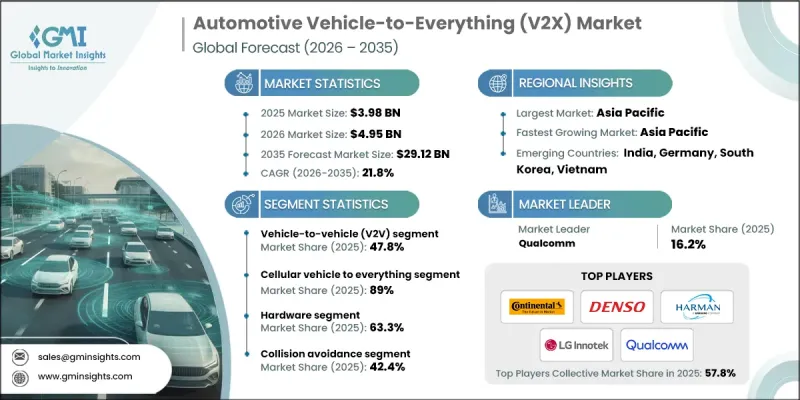
The Global Automotive Vehicle-to-Everything (V2X) Market was valued at USD 3.98 billion in 2025 and is estimated to grow at a CAGR of 21.8% to reach USD 29.12 billion by 2035.
Rising concerns surrounding road safety and the accelerating shift toward vehicle automation are significantly driving the adoption of automotive V2X communication technologies. Governments worldwide are implementing intelligent transportation infrastructure and digital tolling frameworks to enhance traffic flow management and emergency response efficiency. Public authorities across major economies are promoting cooperative intelligent transport deployments along strategic mobility corridors, demonstrating measurable reductions in congestion at connected intersections. The growing penetration of connected and electric vehicles is further strengthening the overall V2X ecosystem. Advancements in ultra-low latency communication standards are improving the commercial viability of V2X solutions, with fifth-generation cellular networks capable of delivering end-to-end latency below 10 milliseconds to enable real-time decision-making for collision avoidance, vehicle platooning, and coordinated autonomous driving in mixed traffic environments. At the same time, cybersecurity and data governance have become critical priorities as connected vehicles generate more than 25 gigabytes of data per hour, prompting OEMs and regulators to implement robust identity authentication, encryption protocols, and secure access control systems to ensure trusted communication across public road networks.
| Market Scope | |
|---|---|
| Start Year | 2025 |
| Forecast Year | 2026-2035 |
| Start Value | $3.98 Billion |
| Forecast Value | $29.12 Billion |
| CAGR | 21.8% |
The vehicle-to-vehicle segment accounted for 47.8% share in 2025 and is expected to grow at a CAGR of 20.8% from 2026 to 2035. V2V communication enables direct data exchange between vehicles, including information related to speed, position, and braking behavior. Safety authorities estimate that a substantial share of multi-vehicle accidents could be prevented through widespread deployment of connected safety technologies, encouraging broader OEM integration across passenger and commercial vehicle platforms. Vehicle-to-infrastructure communication further enhances this ecosystem by enabling interaction between vehicles and roadway systems, supporting traffic optimization and coordinated mobility management.
The cellular vehicle-to-everything segment held 89% share in 2025 and is forecast to grow at a CAGR of 22.7% through 2035. Cellular V2X architecture delivers an integrated communication framework linking vehicles, infrastructure, network operators, and cloud platforms. This connectivity supports continuous software updates, remote diagnostics, and progressive vehicle automation capabilities. By unifying vehicles, pedestrians, roadside systems, and backend networks within a single communication ecosystem, cellular V2X enhances interoperability across private vehicles, commercial fleets, and public transportation systems, accelerating scalable deployment.
China Automotive Vehicle-to-Everything (V2X) Market held 63.8% share, generating USD 1.2 billion in 2025. Strong national coordination, large-scale intelligent transportation initiatives, and integrated smart city strategies have positioned China as a key environment for V2X deployment. Domestic automakers are embedding V2X functionality across vehicle platforms while collaborating with telecom operators and digital service providers to standardize protocols and expand nationwide connectivity across urban and highway infrastructure.
Key companies operating in the Global Automotive Vehicle-to-Everything (V2X) Market include Qualcomm, NXP, Continental, Bosch, Denso, Harman, Nokia, LG Innotek, and AT&T. Companies in the automotive vehicle-to-everything market are strengthening their competitive position through strategic telecom partnerships, advanced chipset development, and software-driven innovation. Leading players are investing heavily in 5G and next-generation connectivity solutions to enhance latency performance and scalability. Collaboration with automotive OEMs enables early integration of V2X modules into new vehicle platforms. Firms are also prioritizing cybersecurity frameworks, secure credential management systems, and over-the-air update capabilities to meet evolving regulatory standards.
Table of Contents
Chapter 1 Methodology
- 1.1 Research approach
- 1.2 Quality Commitments
- 1.2.1 GMI AI policy & data integrity commitment
- 1.2.1.1 Source consistency protocol
- 1.2.1 GMI AI policy & data integrity commitment
- 1.3 Research Trail & Confidence Scoring
- 1.3.1 Research Trail Components
- 1.3.2 Scoring Components
- 1.4 Data Collection
- 1.4.1 Partial list of primary sources
- 1.5 Data mining sources
- 1.5.1 Paid sources
- 1.5.1.1 Sources, by region
- 1.5.1 Paid sources
- 1.6 Base estimates and calculations
- 1.6.1 Base year calculation for any one approach
- 1.7 Forecast model
- 1.7.1 Quantified market impact analysis
- 1.7.1.1 Mathematical impact of growth parameters on forecast
- 1.7.1 Quantified market impact analysis
- 1.8 Research transparency addendum
- 1.8.1 Source attribution framework
- 1.8.2 Quality assurance metrics
- 1.8.3 Our commitment to trust
Chapter 2 Executive Summary
- 2.1 Industry 360° synopsis, 2022 - 2035
- 2.2 Key market trends
- 2.2.1 Regional
- 2.2.2 Type
- 2.2.3 Technology
- 2.2.4 Component
- 2.2.5 Application
- 2.2.6 Deployment
- 2.2.7 Vehicle
- 2.3 TAM Analysis, 2026-2035
- 2.4 CXO perspectives: Strategic imperatives
- 2.4.1 Executive decision points
- 2.4.2 Critical success factors
- 2.5 Future outlook and strategic recommendations
Chapter 3 Industry Insights
- 3.1 Industry ecosystem analysis
- 3.1.1 Supplier landscape
- 3.1.2 Profit margin analysis
- 3.1.3 Cost structure
- 3.1.4 Value addition at each stage
- 3.1.5 Factor affecting the value chain
- 3.1.6 Disruptions
- 3.2 Industry impact forces
- 3.2.1 Growth drivers
- 3.2.1.1 Rising road safety regulations
- 3.2.1.2 Growth of connected and autonomous vehicles
- 3.2.1.3 Expansion of smart city programs
- 3.2.1.4 Deployment of fifth generation networks
- 3.2.2 Industry pitfalls and challenges
- 3.2.2.1 High infrastructure deployment cost
- 3.2.2.2 Interoperability and standardization issues
- 3.2.3 Market opportunities
- 3.2.3.1 Integration with autonomous driving systems
- 3.2.3.2 Expansion of vehicle to infrastructure projects
- 3.2.3.3 Growth in electric and connected vehicle fleets
- 3.2.1 Growth drivers
- 3.3 Growth potential analysis
- 3.4 Regulatory landscape
- 3.4.1 North America
- 3.4.1.1 United States connected vehicle and intelligent transportation regulations
- 3.4.1.2 Federal communications and spectrum allocation guidelines
- 3.4.1.3 Vehicle safety and connected mobility standards
- 3.4.1.4 Canada cooperative intelligent transport system regulations
- 3.4.2 Europe
- 3.4.2.1 European Union cooperative intelligent transport system framework
- 3.4.2.2 ETSI and CEN communication standards for V2X
- 3.4.2.3 Country level connected vehicle compliance requirements
- 3.4.2.4 Data protection and cybersecurity rules for connected mobility
- 3.4.3 Asia Pacific
- 3.4.3.1 China intelligent connected vehicle regulations
- 3.4.3.2 India connected transport and automotive communication standards
- 3.4.3.3 Japan cooperative driving and vehicle communication guidelines
- 3.4.3.4 South Korea smart mobility and V2X compliance
- 3.4.3.5 ASEAN regional connected transport frameworks
- 3.4.4 Latin America
- 3.4.4.1 Brazil intelligent transport and connected vehicle regulations
- 3.4.4.2 Argentina automotive communication compliance
- 3.4.4.3 Mexico connected mobility and transport digitization policies
- 3.4.4.4 Regional connected vehicle regulatory frameworks
- 3.4.5 Middle East & Africa
- 3.4.5.1 UAE smart mobility and connected vehicle regulations
- 3.4.5.2 Saudi Arabia intelligent transport system compliance
- 3.4.5.3 South Africa connected vehicle and road safety standards
- 3.4.5.4 Regional smart transport regulatory frameworks
- 3.4.1 North America
- 3.5 Porter’s analysis
- 3.6 PESTEL analysis
- 3.7 Technology and innovation landscape
- 3.7.1 Current technological trends
- 3.7.2 Emerging technologies
- 3.8 Price trends
- 3.8.1 By region
- 3.8.2 By product
- 3.9 Cost breakdown analysis
- 3.10 Patent analysis
- 3.11 Sustainability and environmental aspects
- 3.11.1 Sustainable practices
- 3.11.2 Waste reduction strategies
- 3.11.3 Energy efficiency in production
- 3.11.4 Eco-friendly Initiatives
- 3.11.5 Carbon footprint considerations
- 3.12 OEM and infrastructure investment analysis
- 3.12.1 Automaker investment priorities
- 3.12.2 Public sector and municipal funding trends
- 3.12.3 Private sector and telecom investments
- 3.13 Deployment economics and ROI assessment
- 3.13.1 Cost benefit analysis for OEMs
- 3.13.2 Infrastructure ROI for public authorities
- 3.13.3 Payback timelines by application
- 3.14 Spectrum allocation and communication reliability analysis
- 3.14.1 Licensed vs unlicensed spectrum considerations
- 3.14.2 Network congestion and performance risks
- 3.14.3 Cross border spectrum harmonization challenges
- 3.15 Monetization and business model analysis
- 3.15.1 OEM led monetization models
- 3.15.2 Subscription and service based revenue streams
- 3.15.3 Data driven and platform based monetization
Chapter 4 Competitive Landscape, 2025
- 4.1 Introduction
- 4.2 Company market share analysis
- 4.2.1 North America
- 4.2.2 Europe
- 4.2.3 Asia Pacific
- 4.2.4 LATAM
- 4.2.5 MEA
- 4.3 Competitive analysis of major market players
- 4.4 Competitive positioning matrix
- 4.5 Strategic outlook matrix
- 4.6 Key developments
- 4.6.1 Mergers & acquisitions
- 4.6.2 Partnerships & collaborations
- 4.6.3 New Product Launches
- 4.6.4 Expansion Plans and funding
Chapter 5 Market Estimates & Forecast, By Type, 2022 - 2035 (USD Mn, Units)
- 5.1 Key trends
- 5.2 Vehicle-to-Infrastructure (V2I)
- 5.3 Vehicle-to-Vehicle (V2V)
- 5.4 Vehicle-to-Pedestrian (V2P)
- 5.5 Others
Chapter 6 Market Estimates & Forecast, By Technology, 2022 - 2035 (USD Mn, Units)
- 6.1 Key trends
- 6.2 Dedicated Short-Range Communications (DSRC)
- 6.3 Cellular Vehicle-to-Everything (C-V2X)
Chapter 7 Market Estimates & Forecast, By Component, 2022 - 2035 (USD Mn, Units)
- 7.1 Key trends
- 7.2 Hardware
- 7.2.1 Tracking and positioning
- 7.2.1.1 GNSS/GPS modules (standard)
- 7.2.1.2 High-precision GNSS (DGPS/RTK)
- 7.2.2 Safety and perception
- 7.2.2.1 Radar sensors
- 7.2.2.2 Cameras
- 7.2.2.3 LiDAR
- 7.2.2.4 Ultrasonic sensors
- 7.2.2.5 Thermal and time-of-flight sensors
- 7.2.3 Control and processing
- 7.2.3.1 V2X electronic control units (V2X ECU)
- 7.2.3.2 ADAS ECUs
- 7.2.3.3 Domain controllers
- 7.2.4 Communication and connectivity
- 7.2.4.1 C-V2X modems
- 7.2.4.2 DSRC radios
- 7.2.4.3 5G NR-V2X modules
- 7.2.4.4 On-board units (OBU)
- 7.2.4.5 Telematics control units (TCU)
- 7.2.4.6 V2X antennas
- 7.2.5 Human-machine interface
- 7.2.5.1 V2X displays
- 7.2.5.2 Head-up displays (HUD)
- 7.2.5.3 Instrument cluster alerts
- 7.2.5.4 Audio and haptic alert modules
- 7.2.6 Others
- 7.2.1 Tracking and positioning
- 7.3 Software
- 7.4 Services
- 7.4.1 Consulting & Integration Services
- 7.4.2 Cybersecurity & Data Protection Services
- 7.4.3 Traffic Management & Road Safety Services
- 7.4.4 Others
Chapter 8 Market Estimates & Forecast, By Application, 2022 - 2035 (USD Mn, Units)
- 8.1 Key trends
- 8.2 Fleet Management
- 8.3 Autonomous Driving
- 8.4 Collision Avoidance
- 8.5 Intelligent Traffic Systems
- 8.6 Parking Management Systems
- 8.7 Others
Chapter 9 Market Estimates & Forecast, By Deployment, 2022 - 2035 (USD Mn, Units)
- 9.1 Key trends
- 9.2 Cloud-based
- 9.3 On-premises
Chapter 10 Market Estimates & Forecast, By Vehicle, 2022 - 2035 (USD Mn, Units)
- 10.1 Key trends
- 10.2 Passenger vehicle
- 10.2.1 Sedan
- 10.2.2 SUV
- 10.2.3 Hatchback
- 10.3 Commercial vehicle
- 10.3.1 Light Commercial Vehicle (LCV)
- 10.3.2 Medium Commercial Vehicle (MCV)
- 10.3.3 Heavy Commercial Vehicle (HCV)
Chapter 11 Market Estimates & Forecast, By Region, 2022 - 2035 (USD Mn, Units)
- 11.1 Key trends
- 11.2 North America
- 11.2.1 US
- 11.2.2 Canada
- 11.3 Europe
- 11.3.1 Germany
- 11.3.2 UK
- 11.3.3 France
- 11.3.4 Italy
- 11.3.5 Spain
- 11.3.6 Russia
- 11.3.7 Norway
- 11.3.8 Netherlands
- 11.3.9 Sweden
- 11.4 Asia Pacific
- 11.4.1 China
- 11.4.2 India
- 11.4.3 Japan
- 11.4.4 Australia
- 11.4.5 South Korea
- 11.4.6 Singapore
- 11.4.7 Thailand
- 11.4.8 Indonesia
- 11.4.9 Vietnam
- 11.5 Latin America
- 11.5.1 Brazil
- 11.5.2 Mexico
- 11.5.3 Argentina
- 11.6 MEA
- 11.6.1 South Africa
- 11.6.2 Saudi Arabia
- 11.6.3 UAE
- 11.6.4 Turkey
Chapter 12 Company Profiles
- 12.1 Global Players
- 12.1.1 AT&T
- 12.1.2 Bosch
- 12.1.3 Continental
- 12.1.4 Denso
- 12.1.5 Harman
- 12.1.6 LG Innotek
- 12.1.7 Nokia
- 12.1.8 NXP
- 12.1.9 Qualcomm
- 12.2 Regional Players
- 12.2.1 Fujitsu
- 12.2.2 Huawei Technologies
- 12.2.3 Hyundai Mobis
- 12.2.4 NEC Corporation
- 12.2.5 Panasonic Automotive Systems
- 12.2.6 Renesas Electronics
- 12.2.7 Toyota Connected
- 12.2.8 ZTE Corporation
- 12.3 Emerging Players and Disruptors
- 12.3.1 Autotalks
- 12.3.2 Cohda Wireless
- 12.3.3 Commsignia
- 12.3.4 Danlaw
- 12.3.5 Kapsch TrafficCom

 2026年全球车对车通讯市场报告2026年全球汽车V2X市场报告
 V2X 资料品质保证市场机会、成长要素、产业趋势分析及 2026 年至 2035 年预测
 全球汽车V2X技术市场规模、份额、趋势和成长分析报告:2026-2034年
 全球汽车AR/VR使用者体验市场预测(至2034年),按车辆类型、技术、分销管道、应用、最终用户和地区划分
 汽车广角扩散器市场按产品类型、原料、推进方式、车辆类型、应用和最终用途划分-2026-2032年全球预测全球V2X通讯和网路市场预测至2032年:按通讯类型、组件、性别、应用和地区划分
 汽车V2X市场规模、份额和成长分析(按通讯类型、交付类型、推进类型、连接性别、车辆类型、技术和地区划分)—产业预测(2026-2033年)
 汽车V2X市场(至2035年):依连接类型、通讯类型、车辆类型、推进类型、技术类型、地区、产业趋势及预测车对车 (V2V) 通讯市场规模、占有率、成长及全球产业分析:依类型、应用和地区划分的洞察与预测 (2024-2032)