


 |
市场调查报告书
商品编码
1959566
真实世界证据解决方案市场:机会、成长要素、产业趋势分析及2026年至2035年预测Real World Evidence Solutions Market Opportunity, Growth Drivers, Industry Trend Analysis, and Forecast 2026 - 2035 |
||||||

2025 年全球真实世界证据 (RWE) 解决方案市值为 26 亿美元,预计到 2035 年将达到 119 亿美元,复合年增长率为 16.3%。
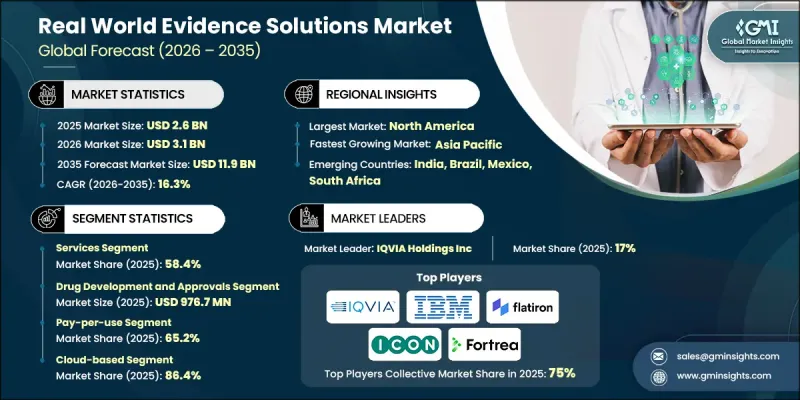
这一强劲的成长动能源自于人们日益重视加速药物研发进程并降低整体研发成本。医疗保健相关人员越来越重视对药物和医疗设备的安全性和有效性进行即时监测,这进一步强化了对先进真实世界证据(RWE)平台的需求。在报销和保险资格决策中对真实世界证据的日益依赖也促进了市场扩张。此外,先进数据分析在临床决策流程中的广泛应用正在改变医疗机构评估治疗结果和疗效的方式。随着医疗保健系统向数据驱动型策略转型,真实世界数据解决方案正成为支持监管申报、优化产品生命週期和提升患者照护品质的关键工具。云端运算、人工智慧和大规模资料整合技术的持续创新正在增强RWE平台的可近性和分析能力,从而实现市场的长期持续成长。
| 市场范围 | |
|---|---|
| 开始年份 | 2025 |
| 预测年份 | 2026-2035 |
| 起始值 | 26亿美元 |
| 预测金额 | 119亿美元 |
| 复合年增长率 | 16.3% |
真实世界数据 (RWE) 解决方案在现代医疗保健中发挥着至关重要的作用,它能够分析日常临床实践中产生的数据。这些平台处理从电子健康记录、理赔资料库、患者登记资料和数位健康技术中收集的医疗信息,为临床、监管和商业性决策提供依据。 RWE 解决方案的应用领域十分广泛,包括药物研发、临床试验规划、上市后安全性监测、监管文件编制以及基于价值的医疗保健项目。随着基于价值的报销模式的推进,对受控临床试验环境之外的全面结果评估的需求日益增长。医疗技术评估机构和支付方正逐步将 RWE 纳入在真实世界条件下进行的治疗效果评估中。分析技术和资料互通性的进步不断改进复杂医疗资料集的整合和解读。
预计到2025年,服务业将占据58.4%的市场份额,凸显其在全球真实世界数据解决方案市场的核心地位。服务业在真实世界数据倡议中提供研究设计、实施和法规遵循的关键专业知识。这些服务帮助医疗保健和生命科学机构在不同的法规环境和临床环境中产生可操作的见解。资料聚合和管理能力尤其重要,它能够协调多个医疗保健资料流,同时确保品管、标准化和符合当地法规。
预计到2025年,药物研发和核准领域的市场规模将达到9.767亿美元。传统研发路径日益复杂、高成本且风险不断上升,促使製药公司将真实世界证据(RWE)融入其临床研究策略。 RWE正被用于优化试验通讯协定、改善病患筛选流程,并透过真实世界数据洞察提升营运效率。此外,这些解决方案还支援在受控试验环境之外进行长期安全性监测和疗效评估。
预计到2025年,北美真实世界证据解决方案市场将占据43.3%的份额,这主要得益于先进的医疗基础设施、电子健康记录系统的广泛应用以及基于云端和人工智慧的分析平台的强劲普及。慢性病的高发生率进一步推动了对持续结果监测和数据驱动型护理模式的需求。该地区的医疗服务提供者、支付者和生命科学公司正在利用真实世界证据平台来识别高风险族群、支持预防策略并评估真实世界中的治疗效果。
目录
第一章:调查方法和范围
第二章执行摘要
第三章业界考察
- 生态系分析
- 影响产业的因素
- 促进因素
- 越来越重视加快药物研发速度和降低成本。
- 对药品和医疗设备。
- 越来越多地采用真实世界证据(RWE)解决方案进行基于资讯的还款决策
- 扩大数据分析服务在临床决策中的应用
- 产业潜在风险与挑战:
- 现实世界数据的整合和互通性缺乏标准化
- 熟练专业人员短缺
- 市场机会
- 癌症以外的新兴治疗领域拓展
- 专注于整合患者产生的健康数据
- 促进因素
- 成长潜力分析
- 监理情势
- 技术进步
- 当前技术趋势
- 新兴技术
- 未来市场趋势
- 波特五力分析
- PESTEL 分析
第四章 竞争情势
- 介绍
- 企业市占率分析
- 公司矩阵分析
- 主要市场公司的竞争分析
- 竞争定位矩阵
- 主要进展
- 併购
- 合作伙伴关係和合资企业
- 新产品发布
- 扩张计划
第五章 市场估计与预测:依组件划分,2022-2035年
- 服务
- CD/集成
- 研究设计与实施
- 前瞻性观察研究
- 回顾性资料库研究
- 以地点为中心的研究
- 基于註册登记的研究
- 混合研究
- 监管和市场进入支持
- 证据网络
- 其他服务
- 数据集
- 异质资料集
- 临床实践数据集
- 发票资料集
- 药房资料集
- 患者主导的资料集
- 基于註册表的资料集
- 综合数据集
- 异质资料集
第六章 市场估计与预测:依应用领域划分,2022-2035年
- 药物研发及核准
- 肿瘤学
- 循环系统疾病
- 神经病学
- 免疫学
- 其他治疗领域
- 医疗设备的研发与核准
- 上市后监测
- 市场进入与报销/保险范围决策
- 临床和监管决策
第七章 市场估计与预测:依所得模式划分,2022-2035年
- 计量收费(按价值定价)
- 订阅
第八章 市场估算与预测:依部署模式划分,2022-2035年
- 现场
- 基于云端的
第九章 市场估计与预测:依最终用途划分,2022-2035年
- 製药公司和医疗设备製造商
- 健康保险提供者
- 医疗保健提供者
- 其他最终用户
第十章 市场估价与预测:依地区划分,2022-2035年
- 北美洲
- 我们
- 加拿大
- 欧洲
- 德国
- 英国
- 法国
- 西班牙
- 义大利
- 荷兰
- 亚太地区
- 中国
- 印度
- 日本
- 澳洲
- 韩国
- 拉丁美洲
- 巴西
- 墨西哥
- 阿根廷
- 中东和非洲
- 沙乌地阿拉伯
- 南非
- 阿拉伯聯合大公国
第十一章:公司简介
- Aetion, Inc.
- Cytel Inc
- Flatiron Health Inc
- Fortrea Holdings Inc
- IBM Corporation
- ICON plc
- IQVIA Holdings Inc.
- Medidata Solutions, Inc.
- Merative
- Oracle Corporation
- Parexel International Corporation
- Syneos Health Inc
- Tempus
- TriNetX
- Thermo Fisher Scientific, Inc
The Global Real World Evidence Solutions Market was valued at USD 2.6 billion in 2025 and is estimated to grow at a CAGR of 16.3% to reach USD 11.9 billion by 2035.
The robust growth trajectory is fueled by the increasing emphasis on accelerating drug development timelines while reducing overall research costs. Healthcare stakeholders are placing greater importance on real-time monitoring of drug and medical device safety and effectiveness, further strengthening demand for advanced RWE platforms. Growing reliance on real world evidence for reimbursement and coverage decisions is also contributing to market expansion. In addition, the broader adoption of advanced data analytics in clinical decision-making processes is transforming how healthcare organizations evaluate outcomes and treatment value. As healthcare systems shift toward data-driven strategies, real world evidence solutions are becoming essential tools for supporting regulatory submissions, optimizing product lifecycles, and improving patient care quality. Continuous innovation in cloud computing, artificial intelligence, and large-scale data integration technologies is enhancing the accessibility and analytical power of RWE platforms, positioning the market for sustained long-term growth.
| Market Scope | |
|---|---|
| Start Year | 2025 |
| Forecast Year | 2026-2035 |
| Start Value | $2.6 Billion |
| Forecast Value | $11.9 Billion |
| CAGR | 16.3% |
Real world evidence solutions serve a critical function in modern healthcare by enabling the analysis of data generated during routine clinical practice. These platforms process healthcare information collected from electronic health records, claims databases, patient registries, and digital health technologies to inform clinical, regulatory, and commercial decisions. RWE solutions are widely applied across drug development, clinical trial planning, post-market safety monitoring, regulatory documentation, and value-based care programs. The ongoing transition toward value-based reimbursement models is increasing the need for comprehensive outcome assessments beyond controlled clinical trial environments. Health technology assessment bodies and payers are progressively incorporating RWE into therapy performance evaluations conducted under real-world conditions. Advancements in analytics and data interoperability continue to improve the integration and interpretation of complex healthcare datasets.
The services segment accounted for 58.4% share in 2025, highlighting its central role within the global real world evidence solutions market. Service offerings provide essential expertise in study design, execution, and regulatory alignment for RWE initiatives. These services support healthcare and life sciences organizations in generating actionable insights across diverse regulatory and clinical settings. Data aggregation and management capabilities are particularly critical, as they enable the harmonization of multiple healthcare data streams while ensuring quality control, standardization, and compliance with regional regulations.
The drug development and approvals segment generated USD 976.7 million in 2025. Increasing complexity, high costs, and elevated risks associated with traditional development pathways are encouraging pharmaceutical companies to integrate real world evidence into clinical research strategies. RWE is being used to refine trial protocols, enhance patient selection processes, and improve operational efficiency through real-world data insights. Additionally, these solutions support long-term safety surveillance and effectiveness assessments beyond controlled trial settings.
North America Real World Evidence Solutions Market held 43.3% share in 2025, supported by advanced healthcare infrastructure, widespread implementation of electronic health record systems, and strong adoption of cloud-based and AI-enabled analytics platforms. High prevalence of chronic diseases further increases demand for continuous outcome monitoring and data-driven care models. Healthcare providers, payers, and life sciences companies in the region leverage RWE platforms to identify high-risk populations, support preventive strategies, and evaluate real-world treatment performance.
Prominent companies operating in the Global Real World Evidence Solutions Market include Aetion, Inc., Cytel Inc, Flatiron Health Inc, Fortrea Holdings Inc, IBM Corporation, ICON plc, IQVIA Holdings Inc., Medidata Solutions, Inc., Merative, Oracle Corporation, Parexel International Corporation, Syneos Health Inc, Tempus, TriNetX, Thermo Fisher Scientific, Inc, and UnitedHealth Group Incorporated. Companies competing in the Global Real World Evidence Solutions Market are strengthening their market presence through strategic collaborations, technology integration, and expansion of analytics capabilities. Leading players are investing in advanced artificial intelligence and machine learning platforms to enhance predictive insights and real-time data interpretation. Partnerships with healthcare providers, payers, and pharmaceutical firms are enabling broader access to diverse datasets. Firms are also prioritizing regulatory compliance expertise to support global study submissions. Cloud-based infrastructure development and scalable data platforms are improving interoperability and client accessibility.
Table of Contents
Chapter 1 Methodology and Scope
- 1.1 Market scope and definition
- 1.2 Research design
- 1.2.1 Research approach
- 1.2.2 Data collection methods
- 1.3 Data mining sources
- 1.3.1 Global
- 1.3.2 Regional/country
- 1.4 Base estimates and calculations
- 1.4.1 Base year calculation
- 1.4.2 Key trends for market estimation
- 1.5 Primary research and validation
- 1.5.1 Primary sources
- 1.6 Forecast model
- 1.7 Research assumptions and limitations
Chapter 2 Executive Summary
- 2.1 Industry 360° synopsis
- 2.2 Key market trends
- 2.2.1 Regional trends
- 2.2.2 Component trends
- 2.2.3 Application trends
- 2.2.4 Revenue model trends
- 2.2.5 Deployment model trends
- 2.2.6 End use trends
- 2.3 CXO perspectives: Strategic imperatives
- 2.3.1 Key decision points for industry executives
- 2.3.2 Critical success factors for market players
- 2.4 Future outlook and strategic recommendations
Chapter 3 Industry Insights
- 3.1 Industry ecosystem analysis
- 3.2 Industry impact forces
- 3.2.1 Growth drivers
- 3.2.1.1 Growing focus towards accelerating drug development and cost reduction
- 3.2.1.2 Growing demand for real-time safety and efficacy monitoring of drugs and medical devices
- 3.2.1.3 Increasing adoption of RWE solutions for informed reimbursement decision-making
- 3.2.1.4 Increasing adoption of data analytics services in clinical decision making.
- 3.2.2 Industry Pitfalls and Challenges:
- 3.2.2.1 Lack of standardization in integration and interoperability of real-world data
- 3.2.2.2 Shortage of skilled professionals
- 3.2.3 Market Opportunities
- 3.2.3.1 Emerging therapeutic areas expansion beyond oncology
- 3.2.3.2 Focus on patient-generated health data integration
- 3.2.1 Growth drivers
- 3.3 Growth potential analysis
- 3.4 Regulatory landscape
- 3.5 Technological advancements
- 3.5.1 Current technological trends
- 3.5.2 Emerging technologies
- 3.6 Future market trends
- 3.7 Porter's analysis
- 3.8 PESTEL analysis
Chapter 4 Competitive Landscape, 2025
- 4.1 Introduction
- 4.2 Company market share analysis
- 4.3 Company matrix analysis
- 4.4 Competitive analysis of major market players
- 4.5 Competitive positioning matrix
- 4.6 Key developments
- 4.6.1 Mergers and acquisitions
- 4.6.2 Partnerships and collaborations
- 4.6.3 New product launches
- 4.6.4 Expansion plans
Chapter 5 Market Estimates and Forecast, By Component, 2022 - 2035 ($ Mn)
- 5.1 Key trends
- 5.2 Services
- 5.2.1 Data collection and integration
- 5.2.2 Study design and execution
- 5.2.2.1 Prospective observational studies
- 5.2.2.2 Retrospective database studies
- 5.2.2.3 Site-centric studies
- 5.2.2.4 Registry-based studies
- 5.2.2.5 Hybrid studies
- 5.2.3 Regulatory and market access support
- 5.2.4 Evidence network
- 5.2.5 Other services
- 5.3 Data sets
- 5.3.1 Disparate data sets
- 5.3.1.1 Clinical settings data sets
- 5.3.1.2 Claims data sets
- 5.3.1.3 Pharmacy data sets
- 5.3.1.4 Patient powered data sets
- 5.3.1.5 Registry-based data sets
- 5.3.2 Integrated data sets
- 5.3.1 Disparate data sets
Chapter 6 Market Estimates and Forecast, By Application, 2022 - 2035 ($ Mn)
- 6.1 Key trends
- 6.2 Drug development and approvals
- 6.2.1 Oncology
- 6.2.2 Cardiovascular disease
- 6.2.3 Neurology
- 6.2.4 Immunology
- 6.2.5 Other therapeutic areas
- 6.3 Medical device development and approvals
- 6.4 Post-market surveillance
- 6.5 Market access and reimbursement/coverage decision-making
- 6.6 Clinical and regulatory decision-making
Chapter 7 Market Estimates and Forecast, By Revenue Model, 2022 - 2035 ($ Mn)
- 7.1 Key trends
- 7.2 Pay-per-use (value-based pricing)
- 7.3 Subscription
Chapter 8 Market Estimates and Forecast, By Deployment Model, 2022 - 2035 ($ Mn)
- 8.1 Key trends
- 8.2 On-premise
- 8.3 Cloud-based
Chapter 9 Market Estimates and Forecast, By End Use, 2022 - 2035 ($ Mn)
- 9.1 Key trends
- 9.2 Pharmaceutical and medical device companies
- 9.3 Healthcare payers
- 9.4 Healthcare providers
- 9.5 Other end users
Chapter 10 Market Estimates and Forecast, By Region, 2022 - 2035 ($ Mn)
- 10.1 Key trends
- 10.2 North America
- 10.2.1 U.S.
- 10.2.2 Canada
- 10.3 Europe
- 10.3.1 Germany
- 10.3.2 UK
- 10.3.3 France
- 10.3.4 Spain
- 10.3.5 Italy
- 10.3.6 Netherlands
- 10.4 Asia Pacific
- 10.4.1 China
- 10.4.2 India
- 10.4.3 Japan
- 10.4.4 Australia
- 10.4.5 South Korea
- 10.5 Latin America
- 10.5.1 Brazil
- 10.5.2 Mexico
- 10.5.3 Argentina
- 10.6 Middle East and Africa
- 10.6.1 Saudi Arabia
- 10.6.2 South Africa
- 10.6.3 UAE
Chapter 11 Company Profiles
- 11.1 Aetion, Inc.
- 11.2 Cytel Inc
- 11.3 Flatiron Health Inc
- 11.4 Fortrea Holdings Inc
- 11.5 IBM Corporation
- 11.6 ICON plc
- 11.7 IQVIA Holdings Inc.
- 11.8 Medidata Solutions, Inc.
- 11.9 Merative
- 11.10 Oracle Corporation
- 11.11 Parexel International Corporation
- 11.12 Syneos Health Inc
- 11.13 Tempus
- 11.14 TriNetX
- 11.15 Thermo Fisher Scientific, Inc

 全球真实世界证据 (RWE) 解决方案市场:按治疗领域、组件、应用、最终用途、国家和地区划分 - 行业分析、市场规模、份额和预测(2025-2032 年)
 真实世界证据(RWE)解决方案市场:依组件(资料集、服务)、应用(药物研发、市场准入、上市后监测)、最终用户(製药和生物技术公司、支付方、医疗服务提供者)和地区划分 - 全球预测(~2036年)
 真实世界证据 (RWE) 市场分析及至 2035 年预测:按类型、产品、服务、技术、应用、最终用户、组件、部署和模式划分
 全球真实世界证据解决方案市场规模、份额、趋势和成长分析报告(2026-2034)全球真实世界证据 (RWE) 解决方案市场:市场规模、占有率、成长率、行业分析、依类型、应用和地区划分的考虑因素以及未来预测 (2026-2034)
 真实世界证据分析市场规模、份额和成长分析(按组件、应用、收入模式、部署类型和地区划分)-2026-2033年产业预测
 真实世界证据解决方案市场规模、份额和成长分析(按组件、应用、收入模式、部署类型、最终用户和地区划分)—2026-2033年产业预测
 真实世界证据解决方案市场规模、份额和趋势分析报告:按组件、应用、最终用途、治疗领域、地区和细分市场预测(2025-2033 年)
 真实世界证据解决方案市场-全球产业规模、份额、趋势、机会和预测,按组件、治疗领域、地区和竞争格局划分,2020-2030 年预测
 美国真实世界证据解决方案市场机会、成长驱动因素、产业趋势分析及预测(2025-2034年)