


 |
市场调查报告书
商品编码
1959576
威胁侦测设备市场机会、成长要素、产业趋势分析及2026年至2035年预测。Threat Detection Equipment Market Opportunity, Growth Drivers, Industry Trend Analysis, and Forecast 2026 - 2035 |
||||||

2025 年全球威胁侦测设备市场价值为 57 亿美元,预计到 2035 年将达到 114 亿美元,年复合成长率为 7.2%。
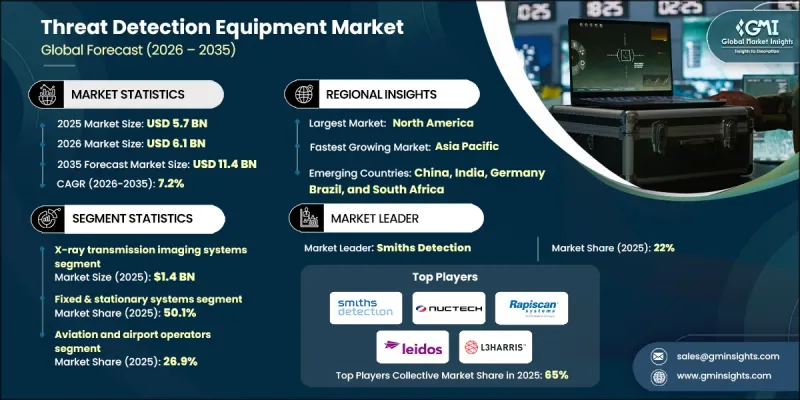
市场扩张的关键驱动因素包括更严格的航空安全法规、不断扩大的城市监控基础设施以及国防和国防安全保障支出的持续成长。此外,贸易量的成长也推动了对能够应对高风险等级的先进货物检查和港口保护技术的需求增加。人工智慧 (AI) 与检测平台的整合显着提高了威胁识别的准确性,减少了误报,并提升了筛检效率。世界各地的安全机构正在加强旅客、行李和货物检查的标准,并加速筛检基础设施的现代化。将影像检查、痕迹侦测、生物识别和辐射监测等技术整合到多层侦测系统中,正在改变产业格局。这一转变在 2010 年代初开始加速,预计将持续到 2030 年,因为营运商优先考虑扩充性和集中式指挥控制整合。此外,随着各组织寻求加强其监控能力、优化人员配置和加快威胁解决速度,远端和集中式筛检模式的采用也正在加速。
| 市场范围 | |
|---|---|
| 开始年份 | 2025 |
| 预测年份 | 2026-2035 |
| 起始值 | 57亿美元 |
| 预测金额 | 114亿美元 |
| 复合年增长率 | 7.2% |
预计到2025年,X射线透射成像系统市场规模将达14亿美元。凭藉其久经考验的可靠性和监管部门的核准,这些系统在交通枢纽、边境检查站、货运设施和人流密集的公共区域中持续保持着较高的应用率。它们能够以极高的处理速度对行李、小包裹和货物进行安检,确保在严苛的安全环境下持续稳定运作。完善的训练体系和熟练的操作技能进一步巩固了这些系统在高通量安检环境中的主导地位。
预计到2025年,固定係统市占率将达到50.1%。这些系统广泛应用于交通枢纽和关键基础设施,满足不间断、高容量的筛检。稳定的性能、合规性以及与集中式管理平台的兼容性,支撑了市场的长期需求。与广泛的安全网路集成,实现了协同监控和高效的响应通讯协定,进一步巩固了公司在威胁侦测设备行业的市场主导地位。
预计到2025年,北美威胁侦测设备市占率将达到31%。该地区的成长主要得益于严格的监管要求、持续的国防安全保障资金投入以及交通和基础设施资产检测技术的不断升级。为了符合不断变化的联邦标准和风险管理框架,政府机构和私人企业正在扩大先进成像技术、电脑断层扫描(CT)、辐射监测和生物识别系统的部署。对人工智慧驱动的分析、自动化检测通道以及整合指挥控制解决方案的投资正在提高全部区域的检测精度和营运效率。
目录
第一章:调查方法和范围
第二章执行摘要
第三章业界考察
- 生态系分析
- 供应商情况
- 利润率
- 成本结构
- 每个阶段增加的价值
- 影响价值链的因素
- 中断
- 影响产业的因素
- 促进因素
- 加强全球航空安全措施
- 都市化正在推动智慧城市监控系统的应用。
- 增加国防和国防安全保障预算
- 透过人工智慧分析提高检测精度
- 跨境贸易与港口成长
- 产业潜在风险与挑战
- 误报导致业务中断
- 旧有系统互通性面临的挑战
- 市场机会
- 对现有检测系统进行人工智慧维修
- 公私合营安全现代化计划
- 成长潜力分析
- 监理情势
- 波特五力分析
- PESTEL 分析
- 科技与创新趋势
- 当前技术趋势
- 新兴技术
- 价格趋势
- 按地区
- 副产品
- 定价策略
- 新兴经营模式
- 合规要求
- 专利和智慧财产权分析
- 地缘政治和贸易趋势
第四章 竞争情势
- 介绍
- 企业市占率分析
- 按地区
- 市场集中度分析
- 主要企业的竞争标竿分析
- 财务绩效比较
- 收入
- 利润率
- 研究与开发
- 产品系列比较
- 产品线的广度
- 科技
- 创新
- 地理位置比较
- 全球扩张分析
- 服务网路覆盖
- 按地区分類的市场渗透率
- 竞争定位矩阵
- 领导企业
- 受让人
- 追踪者
- 小众玩家
- 战略展望矩阵
- 财务绩效比较
- 主要进展
- 併购
- 伙伴关係与合作
- 技术进步
- 扩张和投资策略
- 数位转型计划
- 新兴/Start-Ups竞争对手的发展趋势
第五章 市场估计与预测:依检测技术划分,2022-2035年
- X射线透射成像系统
- 痕迹检测系统
- 光谱检测系统
- 辐射探测系统
- 金属探测系统
- 毫米波成像系统
第六章 市场估计与预测:依已侦测到的威胁类别划分,2022-2035年
- 爆炸物和简易爆炸装置(IED)
- 武器和金属威胁
- 整合威胁侦测系统
- 毒品和走私货
- 生物製剂
- 化学品和危险工业化学品(TICS)
- 辐射和核材料
第七章 市场估算与预测:依产品类型划分,2022-2035年
- 固定/静止系统
- 携带式/可携式系统
- 手持装置
- 车载和移动系统
- 穿戴式检测系统
第八章 市场估算与预测:依部署类型划分,2022-2035年
- 查核点和门禁筛检
- 边界和远端检测
- 区域和环境监测
- 移动/巡逻侦测
- 货物及货物检验
第九章 市场估价与预测:依最终用户划分,2022-2035年
- 航空公司和机场营运商
- 政府安全和监管机构
- 国防/军事组织
- 惩教和司法系统的运作者
- 关键基础设施营运商
- 运输/物流企业经营者
- 私部门
第十章 市场估价与预测:依地区划分,2022-2035年
- 北美洲
- 我们
- 加拿大
- 欧洲
- 德国
- 英国
- 法国
- 西班牙
- 义大利
- 俄罗斯
- 亚太地区
- 中国
- 印度
- 日本
- 澳洲
- 韩国
- 拉丁美洲
- 巴西
- 墨西哥
- 阿根廷
- 中东和非洲
- 南非
- 沙乌地阿拉伯
- 阿拉伯聯合大公国
第十一章:公司简介
- 主要企业
- Smith's Detection
- Raytheon Technologies
- Lockheed Martin
- L3Harris Technologies
- Thales
- 按地区分類的主要企业
- 北美洲
- Rapiscan Systems
- Leidos Holdings, Inc.
- FLIR Systems(Teledyne FLIR)
- Analogic Corporation
- 亚太地区
- Nuctech Company Limited
- 欧洲
- Safran Electronics & Defense
- CEIA SpA
- Chemring Group
- 北美洲
- 特殊玩家/干扰者
- Astrophysics Inc.
- Garrett Metal Detectors
- Honeywell International
The Global Threat Detection Equipment Market was valued at USD 5.7 billion in 2025 and is estimated to grow at a CAGR of 7.2% to reach USD 11.4 billion by 2035.
Market expansion is driven by tightening aviation security regulations, expanding urban surveillance infrastructure, and sustained growth in defense and homeland security spending. Increasing global trade flows are also strengthening demand for advanced cargo inspection and port protection technologies capable of managing elevated risk levels. The integration of artificial intelligence into detection platforms is significantly enhancing threat identification accuracy, reducing false positives, and improving screening efficiency. Security authorities worldwide are reinforcing standards for passenger, baggage, and cargo inspection, accelerating the modernization of screening infrastructure. A transition toward multi-layered detection systems that combine imaging, trace detection, biometric verification, and radiation monitoring into unified platforms is reshaping the industry landscape. This shift, which gained traction earlier in the decade, is expected to continue through 2030 as operators prioritize scalability and centralized command integration. Additionally, remote and centralized screening models are gaining momentum as organizations seek improved oversight, workforce optimization, and faster threat resolution.
| Market Scope | |
|---|---|
| Start Year | 2025 |
| Forecast Year | 2026-2035 |
| Start Value | $5.7 Billion |
| Forecast Value | $11.4 Billion |
| CAGR | 7.2% |
The X-ray transmission imaging systems segment reached USD 1.4 billion in 2025. These systems maintain strong adoption across transportation hubs, border control points, cargo facilities, and high-traffic public locations due to their proven reliability and regulatory acceptance. Their capability to screen baggage, parcels, and freight at high throughput rates supports continuous operations in demanding security environments. Established training frameworks and operational familiarity further reinforce their leadership position in high-volume inspection settings.
The fixed and stationary systems segment accounted for 50.1% share in 2025. These installations are widely deployed at transportation gateways and critical infrastructure facilities where uninterrupted, high-capacity screening is required. Their consistent performance, regulatory compliance, and compatibility with centralized command platforms sustain long-term demand. Integration with broader security networks enables coordinated monitoring and streamlined response protocols, strengthening their dominant share within the threat detection equipment industry.
North America Threat Detection Equipment Market held 31% share in 2025. Regional growth is supported by stringent regulatory requirements, sustained homeland security funding, and continuous upgrades of inspection technologies across transportation and infrastructure assets. Authorities and private operators are increasingly implementing advanced imaging, computed tomography, radiation monitoring, and biometric systems to align with evolving federal standards and risk management frameworks. Investment in AI-driven analytics, automated inspection lanes, and integrated command-and-control solutions is enhancing detection precision and operational efficiency throughout the region.
Key companies operating in the Global Threat Detection Equipment Market include Smiths Detection, Rapiscan Systems, L3Harris Technologies, Thales, Lockheed Martin, Raytheon Technologies, Safran Electronics & Defense, Nuctech Company Limited, Leidos Holdings, Inc., Honeywell International, Analogic Corporation, Astrophysics Inc., Garrett Metal Detectors, Chemring Group, FLIR Systems (Teledyne FLIR), and CEIA S.p.A. Companies in the Threat Detection Equipment Market are reinforcing their competitive advantage through technology innovation, system integration, and long-term government partnerships. Leading vendors are investing in AI-powered analytics, automation capabilities, and multi-sensor fusion platforms to enhance detection accuracy and reduce inspection time. Strategic collaborations with aviation authorities, defense agencies, and border security organizations support multi-year procurement contracts and recurring service revenue. Firms are also expanding global service networks to provide maintenance, upgrades, and training solutions.
Table of Contents
Chapter 1 Methodology and Scope
- 1.1 Market scope and definition
- 1.2 Research design
- 1.2.1 Research approach
- 1.2.2 Data collection methods
- 1.3 Data mining sources
- 1.3.1 Global
- 1.3.2 Regional/Country
- 1.4 Base estimates and calculations
- 1.4.1 Base year calculation
- 1.4.2 Key trends for market estimation
- 1.5 Primary research and validation
- 1.5.1 Primary sources
- 1.6 Forecast model
- 1.7 Research assumptions and limitations
Chapter 2 Executive Summary
- 2.1 Industry 360° synopsis, 2022 - 2035
- 2.2 Key market trends
- 2.2.1 Detection technology trends
- 2.2.2 Threat category detected trends
- 2.2.3 Product form factor trends
- 2.2.4 Deployment mode trends
- 2.2.5 End-User trends
- 2.2.6 Regional trends
- 2.3 TAM Analysis, 2026-2035
- 2.4 CXO perspectives: Strategic imperatives
- 2.4.1 Executive decision points
- 2.4.2 Critical success factors
- 2.5 Future outlook and strategic recommendations
Chapter 3 Industry Insights
- 3.1 Industry ecosystem analysis
- 3.1.1 Supplier Landscape
- 3.1.2 Profit Margin
- 3.1.3 Cost structure
- 3.1.4 Value addition at each stage
- 3.1.5 Factor affecting the value chain
- 3.1.6 Disruptions
- 3.2 Industry impact forces
- 3.2.1 Growth drivers
- 3.2.2 Stricter aviation security mandates worldwide
- 3.2.3 Urbanization driving smart city surveillance deployments
- 3.2.4 Increased defense and homeland security budgets
- 3.2.5 AI-powered analytics improving detection accuracy
- 3.2.6 Growth in cross-border trade and ports
- 3.2.7 Industry pitfalls and challenges
- 3.2.8 False alarms causing operational disruptions
- 3.2.9 Interoperability issues across legacy systems
- 3.2.10 Market opportunities
- 3.2.11 AI retrofits for installed detection systems
- 3.2.12 Public-private security modernization programs
- 3.3 Growth potential analysis
- 3.4 Regulatory landscape
- 3.4.1 North America
- 3.4.2 Europe
- 3.4.3 Asia Pacific
- 3.4.4 Latin America
- 3.4.5 Middle East & Africa
- 3.5 Porter's analysis
- 3.6 PESTEL analysis
- 3.7 Technology and Innovation landscape
- 3.7.1 Current technological trends
- 3.7.2 Emerging technologies
- 3.8 Price trends
- 3.8.1 By region
- 3.8.2 By product
- 3.9 Pricing Strategies
- 3.10 Emerging Business Models
- 3.11 Compliance Requirements
- 3.12 Patent and IP analysis
- 3.13 Geopolitical and trade dynamics
Chapter 4 Competitive Landscape, 2025
- 4.1 Introduction
- 4.2 Company market share analysis
- 4.2.1 By region
- 4.2.1.1 North America
- 4.2.1.2 Europe
- 4.2.1.3 Asia Pacific
- 4.2.1.4 Latin America
- 4.2.1.5 Middle East & Africa
- 4.2.2 Market concentration analysis
- 4.2.1 By region
- 4.3 Competitive benchmarking of key players
- 4.3.1 Financial performance comparison
- 4.3.1.1 Revenue
- 4.3.1.2 Profit margin
- 4.3.1.3 R&D
- 4.3.2 Product portfolio comparison
- 4.3.2.1 Product range breadth
- 4.3.2.2 Technology
- 4.3.2.3 Innovation
- 4.3.3 Geographic presence comparison
- 4.3.3.1 Global footprint analysis
- 4.3.3.2 Service network coverage
- 4.3.3.3 Market penetration by region
- 4.3.4 Competitive positioning matrix
- 4.3.4.1 Leaders
- 4.3.4.2 Challengers
- 4.3.4.3 Followers
- 4.3.4.4 Niche players
- 4.3.5 Strategic outlook matrix
- 4.3.1 Financial performance comparison
- 4.4 Key developments
- 4.4.1 Mergers and acquisitions
- 4.4.2 Partnerships and collaborations
- 4.4.3 Technological advancements
- 4.4.4 Expansion and investment strategies
- 4.4.5 Digital transformation initiatives
- 4.5 Emerging/ startup competitors landscape
Chapter 5 Market Estimates and Forecast, By Detection Technology, 2022 - 2035 (USD Million)
- 5.1 Key trends
- 5.2 X-ray transmission imaging systems
- 5.3 Trace detection systems
- 5.4 Spectroscopy-based detection systems
- 5.5 Radiation detection systems
- 5.6 Metal detection systems
- 5.7 Millimeter-wave imaging systems
Chapter 6 Market Estimates and Forecast, By Threat Category Detected, 2022 - 2035 (USD Million)
- 6.1 Key trends
- 6.2 Explosives & improvised explosive devices (IEDS)
- 6.3 Weapons & metallic threats
- 6.4 Multi-threat detection systems
- 6.5 Narcotics & contraband
- 6.6 Biological agents
- 6.7 Chemical agents & toxic industrial chemicals (TICS)
- 6.8 Radiological & nuclear materials
Chapter 7 Market Estimates and Forecast, By Product Form Factor, 2022 - 2035 (USD Million)
- 7.1 Key trends
- 7.2 Fixed & stationary systems
- 7.3 Portable & transportable systems
- 7.4 Handheld devices
- 7.5 Vehicle-mounted & mobile systems
- 7.6 Wearable detection systems
Chapter 8 Market Estimates and Forecast, By Deployment Mode, 2022 - 2035 (USD Million)
- 8.1 Key trends
- 8.2 Checkpoint & access control screening
- 8.3 Perimeter & standoff detection
- 8.4 Area & ambient monitoring
- 8.5 Mobile & patrol-based detection
- 8.6 Cargo & freight inspection
Chapter 9 Market Estimates and Forecast, By End-User, 2022 - 2035 (USD Million)
- 9.1 Key trends
- 9.2 Aviation & airport operators
- 9.3 Government security & regulatory agencies
- 9.4 Defense & military organizations
- 9.5 Corrections & justice system operators
- 9.6 Critical infrastructure operators
- 9.7 Transportation & logistics operators
- 9.8 Commercial & private sector
Chapter 10 Market Estimates and Forecast, By Region, 2022 - 2035 (USD Million)
- 10.1 Key trends
- 10.2 North America
- 10.2.1 U.S.
- 10.2.2 Canada
- 10.3 Europe
- 10.3.1 Germany
- 10.3.2 UK
- 10.3.3 France
- 10.3.4 Spain
- 10.3.5 Italy
- 10.3.6 Russia
- 10.4 Asia Pacific
- 10.4.1 China
- 10.4.2 India
- 10.4.3 Japan
- 10.4.4 Australia
- 10.4.5 South Korea
- 10.5 Latin America
- 10.5.1 Brazil
- 10.5.2 Mexico
- 10.5.3 Argentina
- 10.6 Middle East and Africa
- 10.6.1 South Africa
- 10.6.2 Saudi Arabia
- 10.6.3 UAE
Chapter 11 Company Profiles
- 11.1 Global Key Players
- 11.1.1 Smith's Detection
- 11.1.2 Raytheon Technologies
- 11.1.3 Lockheed Martin
- 11.1.4 L3Harris Technologies
- 11.1.5 Thales
- 11.2 Regional key players
- 11.2.1 North America
- 11.2.1.1 Rapiscan Systems
- 11.2.1.2 Leidos Holdings, Inc.
- 11.2.1.3 FLIR Systems (Teledyne FLIR)
- 11.2.1.4 Analogic Corporation
- 11.2.2 Asia Pacific
- 11.2.2.1 Nuctech Company Limited
- 11.2.3 Europe
- 11.2.3.1 Safran Electronics & Defense
- 11.2.3.2 CEIA S.p.A.
- 11.2.3.3 Chemring Group
- 11.2.1 North America
- 11.3 Niche Players/Disruptors
- 11.3.1 Astrophysics Inc.
- 11.3.2 Garrett Metal Detectors
- 11.3.3 Honeywell International

 电子安防系统市场:依系统类型、技术、服务类型及最终用户划分-2026-2032年全球市场预测
 2026年东西方威胁侦测设备全球市场报告
 威胁侦测设备市场分析及预测(至2035年):依类型、产品类型、服务、技术、组件、应用、部署类型、最终使用者、功能及安装类型划分监狱邮件侦测与安全系统市场分析及预测(至2035年):依类型、产品、服务、技术、组件、应用、最终使用者、功能及安装类型划分
 电子安防市场机会、成长要素、产业趋势分析及2026年至2035年预测2026年全球携带式工作站市场报告2026年全球安防机器人指挥显示市场报告2026年全球电子安防市场报告
 电子安防市场-全球产业规模、份额、趋势、机会及预测(依产品类型、终端用户产业、地区及竞争格局划分,2020-2030 年预测)
 电子安全系统市场:2025-2030 年预测