


 |
市场调查报告书
商品编码
1959594
汽车电控系统市场机会、成长要素、产业趋势分析及2026年至2035年预测Automotive Electronics Control Unit (ECU) Market Opportunity, Growth Drivers, Industry Trend Analysis, and Forecast 2026 - 2035 |
||||||

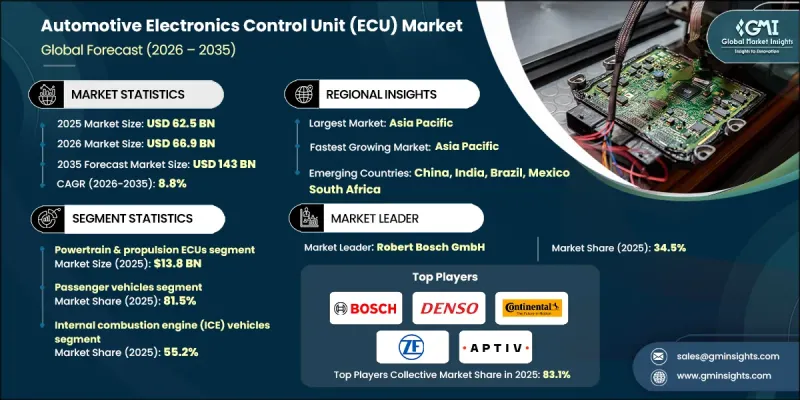
2025 年全球汽车电控系统市场价值为 625 亿美元,预计到 2035 年将达到 1,430 亿美元,年复合成长率为 8.8%。
消费者对连网智慧汽车日益增长的需求正推动现代汽车采用先进的资讯娱乐和数位服务。如今,汽车整合了复杂的系统,提供导航、多媒体、网路连接和无缝的智慧型手机整合。即时路况更新、串流播放和免持通话正逐渐成为驾驶者的标准配备。此外,由电子控制单元 (ECU) 支援的车联网 (V2X) 通讯透过碰撞预警和即时讯号讯息提升了安全性。汽车製造商正大力投资这些技术,以打造集便利性、娱乐性和安全性于一体的智慧连网汽车。旨在提高燃油效率、减少排放气体和增强道路安全的监管要求,例如欧6排放标准和企业平均燃油经济性 (CAFE) 标准,进一步加速了环保和先进技术汽车系统的研发。
| 市场范围 | |
|---|---|
| 开始年份 | 2025 |
| 预测年份 | 2026-2035 |
| 起始值 | 625亿美元 |
| 预测金额 | 1430亿美元 |
| 复合年增长率 | 8.8% |
2025年,动力传动系统和推进ECU(电子控制单元)市场规模将达到138亿美元,预计2026年至2035年将以10.2%的复合年增长率成长。这些ECU能够优化燃油效率、提升车辆性能并控制排放气体。在电动车中,它们与传统引擎和电动马达协同工作,实现无缝动力输出和能量回收。整合多个区域并支援进阶车辆功能、同时降低线路复杂性的集中式ECU架构正日益普及。
预计到2025年,乘用车市占率将达到81.5%,这主要得益于连网服务、先进资讯娱乐系统和安全系统的日益融合。在豪华车和中型车市场,支援ADAS(高级驾驶辅助系统)、电气化和软体驱动功能的优质ECU(电子控制单元)的采用率正在上升,从而提供更卓越、更智慧的驾驶体验。
预计到2025年,北美汽车电控系统)市占率将达到27.7%。该地区的成长主要得益于先进汽车电子产品的早期应用、电动车(EV)的高渗透率以及向软体定义车辆架构的转变。製造商正从分散式ECU系统转向基于域的集中式运算架构,以增强高级驾驶辅助系统(ADAS)、互联性和电动动力传动系统的性能。强大的研发投入、严格的安全法规以及乘用车和商用车对连网服务日益增长的需求,都在推动ECU的普及应用。
目录
第一章:调查方法和范围
第二章执行摘要
第三章业界考察
- 生态系分析
- 供应商情况
- 利润率分析
- 成本结构
- 每个阶段增加的价值
- 影响价值链的因素
- 中断
- 影响产业的因素
- 促进因素
- 扩充连接性和资讯娱乐功能
- 电动车(EV)需求增加
- 车辆系统日益复杂
- 对增强型安全功能的需求
- 自动驾驶技术的进步
- 产业潜在风险与挑战
- 严格的监管标准
- 供应链中断
- 市场机会
- 从分散式ECU迁移到特定领域的集中式架构
- 人工智慧与感测器融合在车辆控制系统中的应用
- 促进因素
- 监管环境
- 北美洲
- 欧洲
- 亚太地区
- 拉丁美洲
- 中东和非洲
- 波特的分析
- PESTEL 分析
- 科技与创新趋势
- 当前技术趋势
- 新兴技术
- 新兴经营模式
- 合规要求
- 专利和智慧财产权分析
- 地缘政治和贸易趋势
第四章 竞争情势
- 介绍
- 企业市占率分析
- 按地区
- 北美洲
- 欧洲
- 亚太地区
- 拉丁美洲
- 中东和非洲
- 按地区
- 主要企业的竞争标竿分析
- 财务绩效比较
- 收入
- 利润率
- 研究与开发
- 产品系列比较
- 产品线的广度
- 科技
- 创新
- 区域扩张比较
- 全球扩张分析
- 服务网路覆盖
- 按地区分類的市场渗透率
- 竞争定位矩阵
- 领导企业
- 受让人
- 追踪者
- 小众玩家
- 战略展望矩阵
- 财务绩效比较
- 2021-2024 年重大发展
- 併购
- 合作伙伴关係和合资企业
- 技术进步
- 扩张和投资策略
- 数位转型计划
- 新兴/Start-Ups竞争对手的发展趋势
第五章 市场估算与预测:依ECU类型划分,2022-2035年
- 动力传动系统及推进系统ECU
- 引擎控制单元(ECU/ECM)
- 变速器控制单元(TCU)
- 混合动力控制单元(HCU)
- 电气化ECU
- 电池管理系统(BMS)
- 逆变器控制单元
- 充电控制单元(车用充电器ECU)
- 电源控制单元(PCU)
- 安全/ADAS ECU
- 基本安全ECU(ABS、ESC、安全气囊)
- ADAS网域控制站(2-3级)
- 自动停车控制单元
- 高度自动化的ECU(4级或更高)
- 车身控制ECU
- 车身控制模组(BCM)
- 照明控制单元
- 暖通空调控制单元
- 资讯娱乐与互联ECU
- 资讯娱乐控制单元(主机)
- 车载资讯控制单元(TCU)
- 网关ECU
- 底盘与动力学ECU
- 转向控制单元
- 悬吊控制单元
- 高阶架构ECU
- 网域控制器
- 区域控制器
- 车辆中央控制单元(CVC)
第六章 市场估价与预测:依车辆类型划分,2022-2035年
- 搭乘用车
- 商用车辆
- 非公路用车辆
第七章 市场估计与预测:依保护类型划分,2022-2035年
- 内燃机车
- 混合动力电动车(HEV)/插电式混合动力电动车(PHEV)
- 电池电动车(BEV)
第八章 市场估算与预测:依最终使用者划分,2022-2035年
- 分散式ECU架构
- 网域控制器架构
- 区域建筑
- 集中式/软体定义车辆(SDV)架构
第九章 市场估计与预测:依地区划分,2022-2035年
- 北美洲
- 我们
- 加拿大
- 欧洲
- 德国
- 英国
- 法国
- 西班牙
- 义大利
- 荷兰
- 亚太地区
- 中国
- 印度
- 日本
- 澳洲
- 韩国
- 拉丁美洲
- 巴西
- 墨西哥
- 阿根廷
- 中东和非洲
- 南非
- 沙乌地阿拉伯
- 阿拉伯聯合大公国
第十章:公司简介
- 主要企业
- Robert Bosch GmbH
- Denso Corporation
- Continental AG
- ZF Friedrichshafen AG
- 按地区分類的主要企业
- 北美洲
- Aptiv PLC
- Autoliv Inc.
- Lear Corporation
- 欧洲
- Valeo SA
- Hella GmbH &Co. KGaA
- Magneti Marelli(a CK Holdings Company)
- 亚太地区
- Hitachi Astemo, Ltd.
- Hyundai Mobis Co., Ltd.
- Mitsubishi Electric Corporation
- 北美洲
- 特殊玩家/干扰者
- Panasonic Holdings Corporation
- United Automotive Electronic Systems(UAES)
The Global Automotive Electronics Control Unit Market was valued at USD 62.5 billion in 2025 and is estimated to grow at a CAGR of 8.8% to reach USD 143 billion by 2035.
Rising consumer demand for connected, intelligent vehicles is driving the adoption of advanced infotainment and digital services in modern automobiles. Vehicles now integrate sophisticated systems that provide navigation, multimedia, internet connectivity, and seamless smartphone integration. Real-time traffic updates, streaming capabilities, and hands-free communication are becoming standard expectations for drivers. Additionally, vehicle-to-everything (V2X) communication supported by ECUs enhances safety by offering collision warnings and live traffic signal information. Automakers are investing heavily in these technologies to deliver smart, connected vehicles that combine convenience, entertainment, and safety. Regulatory mandates aimed at improving fuel efficiency, reducing emissions, and enhancing road safety, such as Euro 6 and Corporate Average Fuel Economy standards, are further accelerating R&D efforts toward eco-friendly and technologically advanced vehicle systems.
| Market Scope | |
|---|---|
| Start Year | 2025 |
| Forecast Year | 2026-2035 |
| Start Value | $62.5 Billion |
| Forecast Value | $143 Billion |
| CAGR | 8.8% |
The powertrain and propulsion ECU segment was valued at USD 13.8 billion in 2025 and is expected to grow at a CAGR of 10.2% from 2026 to 2035. These ECUs optimize fuel efficiency, enhance vehicle performance, and manage emissions. In electrified vehicles, they coordinate conventional engines with electric motors for seamless power delivery and energy recovery. Centralized ECU architectures are gaining momentum, combining multiple domains to reduce wiring complexity while supporting advanced vehicle functionalities.
The passenger vehicle segment held a share of 81.5% in 2025, driven by increasing integration of connected services, advanced infotainment, and safety systems. Luxury and mid-size vehicles are increasingly equipped with premium ECUs supporting advanced driver-assistance systems, electrification, and software-driven features, delivering superior intelligent driving experience.
North America Automotive Electronics Control Unit Market accounted for 27.7% share in 2025. Growth in the region is fueled by early adoption of advanced automotive electronics, high EV penetration, and the shift toward software-defined vehicle architectures. Manufacturers are moving from distributed ECU systems to domain-based and centralized computing architectures to enhance ADAS, connectivity, and electrified powertrain capabilities. Strong R&D investment, stringent safety regulations, and rising demand for connected services across passenger and commercial vehicles are driving ECU adoption.
Prominent players operating in the Global Automotive Electronics Control Unit Market include Aptiv PLC, Autoliv Inc., Continental AG, Denso Corporation, Hella GmbH & Co. KGaA, Hitachi Astemo, Ltd., Hyundai Mobis Co., Ltd., Lear Corporation, Magneti Marelli (a CK Holdings Company), Mitsubishi Electric Corporation, Panasonic Holdings Corporation, Robert Bosch GmbH, United Automotive Electronic Systems (UAES), Valeo SA, and ZF Friedrichshafen AG. Key strategies adopted by companies in the Global Automotive Electronics Control Unit Market include accelerating innovation in centralized and domain-based architectures to simplify vehicle electronics and enhance performance. Manufacturers are focusing on developing high-precision, software-defined ECUs that support advanced driver-assistance systems, infotainment, and electrified powertrains. Strategic partnerships with automakers, software providers, and semiconductor companies allow companies to integrate advanced features while meeting regulatory compliance. Expanding regional presence, particularly in high-growth EV markets, and investing in localized R&D centers enables rapid customization and faster time-to-market.
Table of Contents
Chapter 1 Methodology and Scope
- 1.1 Market scope and definition
- 1.2 Research design
- 1.2.1 Research approach
- 1.2.2 Data collection methods
- 1.3 Data mining sources
- 1.3.1 Global
- 1.3.2 Regional/Country
- 1.4 Base estimates and calculations
- 1.4.1 Base year calculation
- 1.4.2 Key trends for market estimation
- 1.5 Primary research and validation
- 1.5.1 Primary sources
- 1.6 Forecast model
- 1.7 Research assumptions and limitations
Chapter 2 Executive Summary
- 2.1 Industry 360° synopsis, 2021 - 2034
- 2.2 Key market trends
- 2.2.1 ECU type trends
- 2.2.2 Vehicle type trends
- 2.2.3 Propulsion type trends
- 2.2.4 E/E Architecture type trends
- 2.2.5 Regional trends
- 2.3 TAM analysis, 2026-2035
- 2.4 CXO perspectives: Strategic imperatives
- 2.4.1 Executive decision points
- 2.4.2 Critical success factors
- 2.5 Future outlook and strategic recommendations
Chapter 3 Industry Insights
- 3.1 Industry ecosystem analysis
- 3.1.1 Supplier landscape
- 3.1.2 Profit margin analysis
- 3.1.3 Cost structure
- 3.1.4 Value addition at each stage
- 3.1.5 Factor affecting the value chain
- 3.1.6 Disruptions
- 3.2 Industry impact forces
- 3.2.1 Growth drivers
- 3.2.1.1 Growing connectivity and infotainment features
- 3.2.1.2 Rising demand for electric vehicles (EVs)
- 3.2.1.3 Increasing complexity of vehicle systems
- 3.2.1.4 Demand for enhanced safety features
- 3.2.1.5 Advancements in autonomous driving
- 3.2.2 Industry pitfalls and challenges
- 3.2.2.1 Stringent regulatory standards
- 3.2.2.2 Supply chain disruptions
- 3.2.3 Market opportunities
- 3.2.3.1 Transition from distributed ECUs to domain and centralized architectures
- 3.2.3.2 Integration of ai and sensor fusion in vehicle control systems
- 3.2.1 Growth drivers
- 3.3 Regulatory landscape
- 3.3.1 North America
- 3.3.2 Europe
- 3.3.3 Asia Pacific
- 3.3.4 Latin America
- 3.3.5 Middle East & Africa
- 3.4 Porter’s analysis
- 3.5 PESTEL analysis
- 3.6 Technology and innovation landscape
- 3.6.1 Current technological trends
- 3.6.2 Emerging technologies
- 3.7 Emerging business models
- 3.8 Compliance requirements
- 3.9 Patent and IP analysis
- 3.10 Geopolitical and trade dynamics
Chapter 4 Competitive Landscape, 2024
- 4.1 Introduction
- 4.2 Company market share analysis
- 4.2.1 By region
- 4.2.1.1 North America
- 4.2.1.2 Europe
- 4.2.1.3 Asia Pacific
- 4.2.1.4 Latin America
- 4.2.1.5 Middle East & Africa
- 4.2.1 By region
- 4.3 Competitive benchmarking of key players
- 4.3.1 Financial performance comparison
- 4.3.1.1 Revenue
- 4.3.1.2 Profit margin
- 4.3.1.3 R&D
- 4.3.2 Product portfolio comparison
- 4.3.2.1 Product range breadth
- 4.3.2.2 Technology
- 4.3.2.3 Innovation
- 4.3.3 Geographic presence comparison
- 4.3.3.1 Global footprint analysis
- 4.3.3.2 Service network coverage
- 4.3.3.3 Market penetration by region
- 4.3.4 Competitive positioning matrix
- 4.3.4.1 Leaders
- 4.3.4.2 Challengers
- 4.3.4.3 Followers
- 4.3.4.4 Niche players
- 4.3.5 Strategic outlook matrix
- 4.3.1 Financial performance comparison
- 4.4 Key developments, 2021-2024
- 4.4.1 Mergers and acquisitions
- 4.4.2 Partnerships and collaborations
- 4.4.3 Technological advancements
- 4.4.4 Expansion and investment strategies
- 4.4.5 Digital transformation initiatives
- 4.5 Emerging/ startup competitors landscape
Chapter 5 Market Estimates and Forecast, By ECU Type, 2022 - 2035 ($ Bn)
- 5.1 Key trends
- 5.2 Powertrain & propulsion ECUs
- 5.2.1 Engine control units (ECU/ECM)
- 5.2.2 Transmission control units (TCU)
- 5.2.3 Hybrid control units (HCU)
- 5.3 Electrification ECUs
- 5.3.1 Battery management systems (BMS)
- 5.3.2 Inverter control units
- 5.3.3 Charging control units (onboard charger ECU)
- 5.3.4 Power control units (PCU)
- 5.4 Safety & ADAS ECUs
- 5.4.1 Foundation safety ECUs (ABS, ESC, airbag)
- 5.4.2 Adas domain controllers (level 2-3)
- 5.4.3 Automated parking ECUs
- 5.4.4 High-automation ECUs (level 4+)
- 5.5 Body control ECUs
- 5.5.1 Body control modules (BCM)
- 5.5.2 Lighting control units
- 5.5.3 HVAC control units
- 5.6 Infotainment & connectivity ECUs
- 5.6.1 Infotainment control units (head units)
- 5.6.2 Telematics control units (TCU)
- 5.6.3 Gateway ECUs
- 5.7 Chassis & dynamics ECUs
- 5.7.1 Steering control units
- 5.7.2 Suspension control units
- 5.8 Advanced architecture ECUs
- 5.8.1 Domain controllers
- 5.8.2 Zone controllers
- 5.8.3 Central vehicle controllers (CVC)
Chapter 6 Market Estimates and Forecast, By Vehicle Type, 2022 - 2035 ($ Bn)
- 6.1 Key trends
- 6.2 Passenger vehicles
- 6.3 Commercial vehicles
- 6.4 Off-highway vehicles
Chapter 7 Market Estimates and Forecast, By Protection Type, 2022 - 2035 ($ Bn)
- 7.1 Key trends
- 7.2 Internal combustion engine (ICE) vehicles
- 7.3 Hybrid electric vehicles (HEV) / plug-in hybrid electric vehicles (PHEV)
- 7.4 Battery electric vehicles (BEV)
Chapter 8 Market Estimates and Forecast, By End-User, 2022 - 2035 ($ Bn)
- 8.1 Key trends
- 8.2 Distributed ECU architecture
- 8.3 Domain controller architecture
- 8.4 Zonal architecture
- 8.5 Centralized / software-defined vehicle (SDV) architecture
Chapter 9 Market Estimates and Forecast, By Region, 2022 - 2035 ($ Bn)
- 9.1 Key trends
- 9.2 North America
- 9.2.1 U.S.
- 9.2.2 Canada
- 9.3 Europe
- 9.3.1 Germany
- 9.3.2 UK
- 9.3.3 France
- 9.3.4 Spain
- 9.3.5 Italy
- 9.3.6 Netherlands
- 9.4 Asia Pacific
- 9.4.1 China
- 9.4.2 India
- 9.4.3 Japan
- 9.4.4 Australia
- 9.4.5 South Korea
- 9.5 Latin America
- 9.5.1 Brazil
- 9.5.2 Mexico
- 9.5.3 Argentina
- 9.6 Middle East and Africa
- 9.6.1 South Africa
- 9.6.2 Saudi Arabia
- 9.6.3 UAE
Chapter 10 Company Profiles
- 10.1 Global Key Players
- 10.1.1 Robert Bosch GmbH
- 10.1.2 Denso Corporation
- 10.1.3 Continental AG
- 10.1.4 ZF Friedrichshafen AG
- 10.2 Regional Key Players
- 10.2.1 North America
- 10.2.1.1 Aptiv PLC
- 10.2.1.2 Autoliv Inc.
- 10.2.1.3 Lear Corporation
- 10.2.2 Europe
- 10.2.2.1 Valeo SA
- 10.2.2.2 Hella GmbH & Co. KGaA
- 10.2.2.3 Magneti Marelli (a CK Holdings Company)
- 10.2.3 APAC
- 10.2.3.1 Hitachi Astemo, Ltd.
- 10.2.3.2 Hyundai Mobis Co., Ltd.
- 10.2.3.3 Mitsubishi Electric Corporation
- 10.2.1 North America
- 10.3 Niche Players / Disruptors
- 10.3.1 Panasonic Holdings Corporation
- 10.3.2 United Automotive Electronic Systems (UAES)

 电子控制管理市场:2026-2032年全球市场预测(依产品类型、技术、安装类型、应用及最终用户产业划分)汽车电控系统市场:2026-2032年全球市场预测(依车辆类型、动力系统、自动驾驶等级、电子架构、应用与销售管道)硬体在环 (HIL) 模拟市场:按类型、组件、测试类型、应用和最终用户划分-2026-2032 年全球市场预测
 2026年全球汽车ECU市场报告2026年全球汽车智慧驾驶座系统晶片(SoC)市场报告汽车电子控制系统高度感测器市场:依产品类型、技术、车辆类型、应用和销售管道划分-2026-2032年全球市场预测球栅阵列封装市场:依封装类型、基板材料、间距、I/O数量、互连结构及最终用途产业划分-2026年至2032年全球预测全球空气弹簧压缩机ECU市场(按车辆类型、ECU类型、应用和分销管道划分)预测(2026-2032年)
 汽车区域架构及网域控制器市场:机会、成长要素、产业趋势分析及2026年至2035年预测
 全球汽车电控系统(ECU)市场规模、份额、趋势和成长分析报告(2026-2034年)