


 |
市场调查报告书
商品编码
1959610
生髮补充剂及治疗产品市场机会、成长要素、产业趋势分析及预测(2026-2035年)Hair Growth Supplement and Treatment Market Opportunity, Growth Drivers, Industry Trend Analysis, and Forecast 2026 - 2035 |
||||||

2025 年全球生髮补充剂和治疗市场价值 88 亿美元,预计到 2035 年将达到 157 亿美元,年复合成长率为 6.1%。
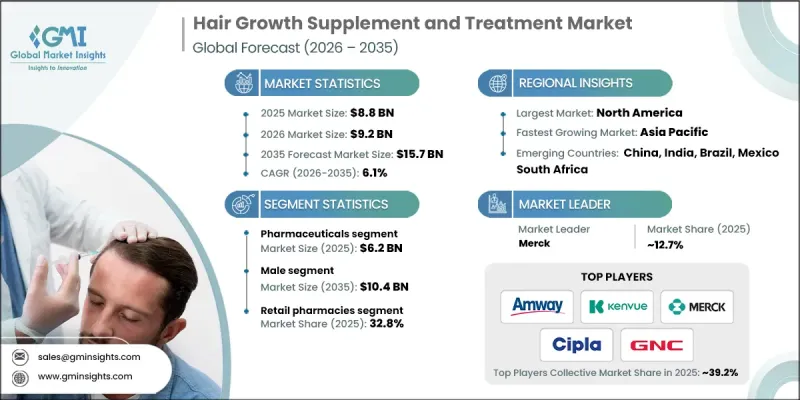
由于斑秃、脱髮症和其他头皮疾病等头髮问题的日益普遍,市场正经历显着扩张。消费者寻求有效的解决方案来改善自身形象并提升自信。头髮脱髮症现象的加剧、整装仪容意识的提高,以及透过零售和线上管道购买到经临床验证的非处方药和处方药,都进一步推动了市场需求。消费者现在更加重视预防性护髮、健康照护和经科学验证的治疗方法,因此营养补充品、外用产品和非侵入性治疗设备的使用率不断提高。意识的提高、产品的可及性以及技术的创新,使得生髮补充剂和疗法成为现代个人护理和健康保健的重要组成部分。
| 市场范围 | |
|---|---|
| 开始年份 | 2025 |
| 预测期 | 2026-2035 |
| 起始金额 | 88亿美元 |
| 预测金额 | 157亿美元 |
| 复合年增长率 | 6.1% |
这个市场涵盖了旨在预防脱髮、促进头髮生长和改善头皮整体健康的各种产品。这些产品包括含有维生素、矿物质和植物萃取物的口服补充剂,以及外用药物和药物疗法(包括处方药和先进的非侵入性设备)。
预计到2025年,医药产业的销售额将达到62亿美元。这主要得益于市场对经临床验证的男性型脱髮症(雄性脱毛症)及其他类型脱髮症治疗方法的需求不断增长。口服药物、外用药物、注射和专用医疗设备因其高效性和显着改善患者预后而持续受到关注。
预计到2035年,男性市场规模将达到104亿美元,复合年增长率(CAGR)为5.9%。男性市场主导的主要原因是男性型脱髮症的高发生率,近一半男性在50岁时受到影响,而大多数男性在80岁时受到影响。便捷的营养补充剂,加上技术先进的外用疗法以及雷射帽和头皮刺激器等非侵入性设备,正在推动男性消费者对这些产品的接受度,并显着促进市场成长。
预计到2025年,北美生髮补充剂和治疗市场将占据44.3%的市场份额,继续保持主导主要得益于该地区较高的脱髮症率以及对创新治疗方法的广泛接受。药品、膳食补充剂和非侵入性设备的进步,以及消费者对天然且经临床验证的护髮方案日益增长的偏好,都进一步推动了市场成长。便利的医疗保健基础设施、消费者意识的提高以及监管支持,也进一步巩固了北美的市场主导地位。
目录
第一章:调查方法和范围
第二章执行摘要
第三章业界考察
- 生态系分析
- 影响产业的因素
- 促进因素
- 脱髮症/秃髮盛行率增加
- 消费者自我护理意识的提升与趋势
- 拓展电子商务和直接面向消费者的销售管道
- 治疗技术和临床研究的进展
- 产业潜在风险与挑战
- 替代治疗方法的选择增多
- 与药物治疗相关的担忧
- 市场机会
- 对个人化和精准解决方案的需求日益增长
- 联合治疗和辅助解决方案的成长
- 促进因素
- 成长潜力分析
- 监理情势
- 管道分析
- 价格分析
- 未来市场趋势
- 波特的分析
- PESTEL 分析
第四章 竞争情势
- 介绍
- 企业市占率分析
- 公司矩阵分析
- 主要市场公司的竞争分析
- 竞争定位矩阵
- 主要进展
- 併购
- 伙伴关係与合作
- 新产品发布
- 扩张计划
第五章 市场估计与预测:依类型划分,2022-2035年
- 补充
- 依产品类型
- 单一成分补充剂
- 复合成分补充剂
- 按剂型
- 粉末
- 软糖
- 药片
- 胶囊
- 液体
- 其他的
- 依产品类型
- 製药
- 口服药物
- 外用和注射製剂
- 医疗设备
第六章 市场估计与预测:性别,2022-2035年
- 男性
- 女士
第七章 市场估价与预测:依通路划分,2022-2035年
- 医院药房
- 电子商务
- 线上零售商
- 品牌官方网站
- 零售药房
- 药局
- 其他的
第八章 市场估计与预测:依地区划分,2022-2035年
- 北美洲
- 我们
- 加拿大
- 欧洲
- 德国
- 英国
- 法国
- 西班牙
- 义大利
- 荷兰
- 亚太地区
- 中国
- 印度
- 日本
- 澳洲
- 韩国
- 拉丁美洲
- 巴西
- 墨西哥
- 阿根廷
- 中东和非洲
- 南非
- 沙乌地阿拉伯
- 阿拉伯聯合大公国
第九章:公司简介
- Hair supplements
- Amway Corporation
- GNC Holdings
- HUM Nutrition
- 大自然的馈赠
- Nutraceutical Wellness
- OUAI Healthcare
- Phyto
- Viviscal Limited(Church &Dwight)
- Hair treatment
- Cipla
- Curallux
- Eli Lilly and Company
- ExoCoBio
- Keranique
- Kenvue
- Lexington International
- Merck
- Pfizer
The Global Hair Growth Supplement and Treatment Market was valued at USD 8.8 billion in 2025 and is estimated to grow at a CAGR of 6.1% to reach USD 15.7 billion by 2035.
The market is witnessing strong expansion due to the rising prevalence of hair disorders such as alopecia areata, telogen effluvium, and other scalp conditions, driving consumers to seek effective solutions that enhance appearance and self-confidence. Increasing hair thinning, growing awareness around personal grooming, and the availability of clinically supported over-the-counter and prescription solutions across both retail and online channels are further fueling demand. Consumers are now prioritizing preventive hair care, wellness, and scientifically validated treatments, which has resulted in rising adoption of dietary supplements, topical solutions, and non-invasive therapeutic devices. The convergence of awareness, accessibility, and technological innovation is positioning hair growth supplements and treatments as a core component of modern personal care and healthcare routines.
| Market Scope | |
|---|---|
| Start Year | 2025 |
| Forecast Year | 2026-2035 |
| Start Value | $8.8 Billion |
| Forecast Value | $15.7 Billion |
| CAGR | 6.1% |
The market includes a broad range of products designed to prevent hair loss, stimulate regrowth, and improve overall scalp health. This encompasses oral supplements containing vitamins, minerals, and botanical extracts, alongside topical and pharmaceutical therapies, which include prescription medications and advanced non-invasive devices.
The pharmaceuticals segment generated USD 6.2 billion in 2025, driven by the growing demand for clinically proven interventions for androgenetic alopecia and other forms of hair loss. Oral medications, topical solutions, injectables, and specialized devices continue to gain traction due to their high efficacy and improved patient outcomes.
The men segment is expected to reach USD 10.4 billion by 2035, growing at a CAGR of 5.9%. Male dominance is largely attributed to the high prevalence of androgenetic alopecia, with nearly half of men affected by age 50 and a significant majority by age 80. The convenience of supplements, coupled with technologically advanced topical treatments and non-invasive devices such as laser caps and scalp stimulators, has strengthened adoption among male consumers, contributing substantially to market growth.
North America Hair Growth Supplement and Treatment Market accounted for 44.3% share in 2025, maintaining leadership due to the region's high hair loss prevalence and strong adoption of innovative treatments. Growth is further supported by advances in pharmaceuticals, dietary supplements, and non-invasive devices, along with rising consumer preference for natural and clinically validated hair care solutions. The combination of accessible healthcare infrastructure, consumer awareness, and regulatory support underpins North America's dominant position.
Key players in the Global Hair Growth Supplement and Treatment Market include GNC Holdings, Cipla Limited, Amway Corporation, Pfizer, Nature's Bounty, HUM Nutrition, ExoCoBio, Eli Lilly and Company, OUAI Healthcare, Merck, Viviscal Limited (Church & Dwight), Kenvue, Lexington International, Curallux, Keranique, and Nutraceutical Wellness. Companies in this market are employing strategies such as investing heavily in R&D to create clinically validated and multi-functional products, expanding product portfolios to target gender-specific and age-specific needs, and leveraging advanced delivery technologies to improve efficacy. Strategic partnerships with dermatologists, wellness influencers, and online health platforms are used to enhance brand credibility and reach. Firms are also focusing on omnichannel distribution, combining e-commerce, retail, and subscription services to boost accessibility and retention, while emphasizing marketing campaigns centered on scientific validation, natural ingredients, and visible results to strengthen their market foothold and consumer trust.
Table of Contents
Chapter 1 Methodology and Scope
- 1.1 Market scope and definition
- 1.2 Research approach
- 1.3 Quality commitments
- 1.3.1 GMI AI policy and data integrity commitment
- 1.3.1.1 Source consistency protocol
- 1.3.1 GMI AI policy and data integrity commitment
- 1.4 Research trail and confidence scoring
- 1.4.1 Research trail components
- 1.4.2 Scoring components
- 1.5 Data collection
- 1.5.1 Partial list of primary sources
- 1.6 Data mining sources
- 1.6.1 Paid sources
- 1.6.1.1 Sources, by region
- 1.6.1 Paid sources
- 1.7 Base estimates and calculations
- 1.7.1 Revenue share analysis
- 1.7.2 Base year calculation
- 1.8 Forecast model
- 1.9 Research transparency addendum
- 1.9.1 Source attribution framework
- 1.9.2 Quality assurance metrics
- 1.9.3 Our commitment to trust
Chapter 2 Executive Summary
- 2.1 Industry 360° synopsis
- 2.2 Key market trends
- 2.2.1 Regional trends
- 2.2.2 Type trends
- 2.2.3 Gender trends
- 2.2.4 Distribution channel trends
- 2.3 CXO perspectives: Strategic imperatives
- 2.3.1 Key decision points for industry executives
- 2.3.2 Critical success factors for market players
- 2.4 Future outlook and strategic recommendations
Chapter 3 Industry Insights
- 3.1 Industry ecosystem analysis
- 3.2 Industry impact forces
- 3.2.1 Growth drivers
- 3.2.1.1 Increasing prevalence of hair loss and alopecia
- 3.2.1.2 Rising consumer awareness and self-care trends
- 3.2.1.3 Expansion of e-commerce and direct-to-consumer channels
- 3.2.1.4 Advancements in treatment technologies and clinical research
- 3.2.2 Industry pitfalls and challenges
- 3.2.2.1 Growing availability of alternative treatment options
- 3.2.2.2 Concerns associated with pharmacological treatments
- 3.2.3 Market opportunities
- 3.2.3.1 Rising demand for personalized and precision solutions
- 3.2.3.2 Growth in combination therapies and adjunct solutions
- 3.2.1 Growth drivers
- 3.3 Growth potential analysis
- 3.4 Regulatory landscape
- 3.4.1 North America
- 3.4.2 Europe
- 3.4.3 Asia Pacific
- 3.4.4 Latin America
- 3.4.5 Middle East and Africa
- 3.5 Pipeline analysis
- 3.6 Pricing analysis
- 3.7 Future market trends
- 3.8 Porter’s analysis
- 3.9 PESTEL analysis
Chapter 4 Competitive Landscape, 2025
- 4.1 Introduction
- 4.2 Company market share analysis
- 4.3 Company matrix analysis
- 4.4 Competitive analysis of major market players
- 4.5 Competitive positioning matrix
- 4.6 Key developments
- 4.6.1 Merger and acquisition
- 4.6.2 Partnership and collaboration
- 4.6.3 New product launches
- 4.6.4 Expansion plans
Chapter 5 Market Estimates and Forecast, By Type, 2022 - 2035 ($ Mn)
- 5.1 Key trends
- 5.2 Supplements
- 5.2.1 By product type
- 5.2.1.1 Single-ingredient supplements
- 5.2.1.2 Multi-ingredient supplements
- 5.2.2 By dosage form
- 5.2.2.1 Powder
- 5.2.2.2 Gummies
- 5.2.2.3 Tablets
- 5.2.2.4 Capsules
- 5.2.2.5 Liquid
- 5.2.2.6 Other dosage forms
- 5.2.1 By product type
- 5.3 Pharmaceuticals
- 5.3.1 Oral medications
- 5.3.2 Topical and injectables
- 5.3.3 Devices
Chapter 6 Market Estimates and Forecast, By Gender, 2022 - 2035 ($ Mn)
- 6.1 Key trends
- 6.2 Male
- 6.3 Female
Chapter 7 Market Estimates and Forecast, By Distribution Channel, 2022 - 2035 ($ Mn)
- 7.1 Key trends
- 7.2 Hospital pharmacies
- 7.3 E-commerce
- 7.3.1 Online retailers
- 7.3.2 Brand-owned websites
- 7.4 Retail pharmacies
- 7.5 Drug stores
- 7.6 Other distribution channels
Chapter 8 Market Estimates and Forecast, By Region, 2022 - 2035 ($ Mn)
- 8.1 Key trends
- 8.2 North America
- 8.2.1 U.S.
- 8.2.2 Canada
- 8.3 Europe
- 8.3.1 Germany
- 8.3.2 UK
- 8.3.3 France
- 8.3.4 Spain
- 8.3.5 Italy
- 8.3.6 Netherlands
- 8.4 Asia Pacific
- 8.4.1 China
- 8.4.2 India
- 8.4.3 Japan
- 8.4.4 Australia
- 8.4.5 South Korea
- 8.5 Latin America
- 8.5.1 Brazil
- 8.5.2 Mexico
- 8.5.3 Argentina
- 8.6 Middle East and Africa
- 8.6.1 South Africa
- 8.6.2 Saudi Arabia
- 8.6.3 UAE
Chapter 9 Company Profiles
- 9.1 Hair supplements
- 9.1.1 Amway Corporation
- 9.1.2 GNC Holdings
- 9.1.3 HUM Nutrition
- 9.1.4 Nature’s Bounty
- 9.1.5 Nutraceutical Wellness
- 9.1.6 OUAI Healthcare
- 9.1.7 Phyto
- 9.1.8 Viviscal Limited (Church & Dwight)
- 9.2 Hair treatment
- 9.2.1 Cipla
- 9.2.2 Curallux
- 9.2.3 Eli Lilly and Company
- 9.2.4 ExoCoBio
- 9.2.5 Keranique
- 9.2.6 Kenvue
- 9.2.7 Lexington International
- 9.2.8 Merck
- 9.2.9 Pfizer


