


 |
市场调查报告书
商品编码
1959612
抗发炎药物市场机会、成长要素、产业趋势分析及2026年至2035年预测Anti-inflammatory Drugs Market Opportunity, Growth Drivers, Industry Trend Analysis, and Forecast 2026 - 2035 |
||||||

2025 年全球抗发炎药物市场价值 1,321 亿美元,预计到 2035 年将达到 2,934 亿美元,年复合成长率为 8.5%。
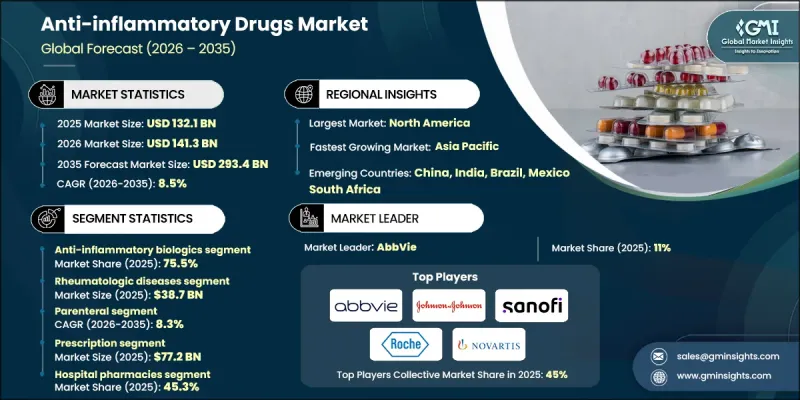
免疫学研究和分子科学的持续进步推动了市场成长,从而促进了更精准、更有效治疗方法的开发。治疗方法正稳步从传统的非类固醇消炎剂(NSAIDs) 和皮质类固醇转向生物目标、单株抗体和先进的小分子抑制剂。这些创新正在改善疾病管理,减少副作用,并为患者带来更好的长期治疗效果。该市场透过多种治疗层级,针对多种急性和慢性发炎性疾病,旨在控制发炎、缓解症状和延缓疾病进展。强有力的健保报销机制和对免疫标靶药物研发的持续投入正在推动治疗方法的广泛应用。口服疗法、缓释注射剂和低频给药生物製药等先进给药平台的出现,提高了患者的用药便利性和依从性。整体而言,在创新法规环境和不断扩展的临床研发管线的支持下,市场正朝着以患者为中心、以精准医疗为基础的疗法方向发展。
| 市场范围 | |
|---|---|
| 开始年份 | 2025 |
| 预测年份 | 2026-2035 |
| 起始值 | 1321亿美元 |
| 预测金额 | 2934亿美元 |
| 复合年增长率 | 8.5% |
预计到2025年,抗发炎生物製药市场占有率将达到75.5%,并在2026年至2035年间以8.6%的复合年增长率成长。其主导地位得益于其高临床疗效、对发炎路径的选择性标靶化以及对中重度疾病的有效治疗。这些治疗方法在高级治疗中备受青睐,因为它们既能缓解症状,又能缓解疾病。
预计到2025年,处方药市场销售额将达到772亿美元,继续维持其主导地位。处方药治疗方法对于需要医生监督和特殊治疗通讯协定的发炎性和自体免疫疾病的长期管理仍然至关重要。生物製药和标靶口服药物的广泛应用,以及健全的医保报销体系和以医院为中心的配送网络,都将继续支持该市场的发展。
预计到2025年,北美抗发炎药市场将占据全球39.1%的份额,从而推动全球需求成长。高疾病盛行率、完善的医疗保健基础设施、早期获得创新疗法的机会以及有利的报销政策,都支撑着该市场的强劲发展。持续的临床研究活动和实力雄厚的製药公司进一步巩固了该地区的主导地位。
目录
第一章:调查方法和范围
第二章执行摘要
第三章业界考察
- 生态系分析
- 影响产业的因素
- 促进因素
- 慢性发炎性疾病和自体免疫疾病的盛行率增加
- 标靶免疫学和生物製药研发的进展
- 支持性的监管途径和快速核准
- 公众意识提高、诊断率提高、以及获得专科医疗服务的途径扩大。
- 产业潜在风险与挑战
- 高昂的医疗成本和对长期经济永续性的担忧
- 安全隐忧和长期耐受性风险
- 市场机会
- 新一代口服疗法和更方便的患者体验
- 生物相似药和联合治疗的生命週期管理
- 促进因素
- 成长潜力分析
- 监管环境
- 北美洲
- 欧洲
- 亚太地区
- 未来市场趋势
- 价格分析
- 波特的分析
- PESTEL 分析
第四章 竞争情势
- 介绍
- 企业市占率分析
- 公司矩阵分析
- 主要市场公司的竞争分析
- 竞争定位矩阵
- 主要进展
- 併购
- 伙伴关係与合作
- 新产品发布
- 扩张计划
第五章 市场估计与预测:依药物类别划分,2022-2035年
- 抗发炎生物製药
- 非类固醇消炎剂(NSAIDs)
- 皮质类固醇
- 其他药物分类
第六章 市场估计与预测:依适应症划分,2022-2035年
- 风湿性疾病
- 类风湿性关节炎
- 骨关节炎
- 干癣性关节炎
- 僵直性脊椎炎
- 其他发炎性关节炎
- 皮肤病
- 银屑病
- 异位性皮肤炎
- 化脓性汗腺炎
- 其他发炎性皮肤病
- 消化系统疾病
- 发炎性肠道疾病(IBD)
- 嗜伊红性食道炎
- 其他发炎性消化系统疾病
- 呼吸系统疾病
- 气喘
- 慢性阻塞性肺病(COPD)
- 过敏性鼻炎
- 其他发炎性呼吸系统疾病
- 神经系统疾病
- 其他迹象
第七章 市场估计与预测:依给药途径划分,2022-2035年
- 口服
- 外用
- 注射药物
- 其他给药途径
第八章 市场估算与预测:依类型划分,2022-2035年
- 处方笺
- 非处方药
第九章 市场估价与预测:依通路划分,2022-2035年
- 医院药房
- 零售药房
- 网路药房
第十章 市场估价与预测:依地区划分,2022-2035年
- 北美洲
- 我们
- 加拿大
- 欧洲
- 德国
- 英国
- 法国
- 西班牙
- 义大利
- 亚太地区
- 中国
- 印度
- 日本
- 澳洲
- 韩国
- 拉丁美洲
- 巴西
- 墨西哥
- 阿根廷
- 中东和非洲
- 南非
- 沙乌地阿拉伯
- 阿拉伯聯合大公国
第十一章:公司简介
- AbbVie
- Abbott Laboratories
- AbbVie
- Amgen
- AstraZeneca
- Bristol-Myers Squibb
- Eli Lilly and Company
- GlaxoSmithKline
- Hoffmann-La Roche
- Johnson &Johnson
- Merck &Co.
- Novartis
- Pfizer
- Sanofi
- Sun Pharmaceutical Industries
- Teva Pharmaceutical
- UCB
The Global Anti-Inflammatory Drugs Market was valued at USD 132.1 billion in 2025 and is estimated to grow at a CAGR of 8.5% to reach USD 293.4 billion by 2035.
Market growth is supported by continued progress in immunology research and molecular science, which is enabling the development of more precise and effective therapies. Treatment approaches are steadily shifting away from traditional nonsteroidal anti-inflammatory drugs and corticosteroids toward targeted biologics, monoclonal antibodies, and advanced small-molecule inhibitors. These innovations are improving disease control, reducing side effects, and delivering better long-term outcomes for patients. The market addresses a wide spectrum of acute and chronic inflammatory conditions through multiple therapeutic classes designed to manage inflammation, ease symptoms, and slow disease progression. Strong reimbursement structures and sustained investment in immune-focused drug discovery are reinforcing adoption. Emerging oral therapies and advanced delivery platforms, including extended-duration injectables and less frequent dosing biologics, are enhancing patient convenience and adherence. Overall, the market is evolving toward precision-based, patient-focused treatments supported by innovation-friendly regulatory environments and expanding clinical pipelines.
| Market Scope | |
|---|---|
| Start Year | 2025 |
| Forecast Year | 2026-2035 |
| Start Value | $132.1 Billion |
| Forecast Value | $293.4 Billion |
| CAGR | 8.5% |
The anti-inflammatory biologics segment accounted for 75.5% share in 2025 and is expected to grow at a CAGR of 8.6% during 2026-2035. Their leadership position is driven by high clinical effectiveness, selective targeting of inflammatory pathways, and their ability to manage moderate to severe disease states. These therapies deliver both symptom relief and long-term disease modification, making them a preferred option in advanced treatment settings.
The prescription segment generated USD 77.2 billion in 2025, maintaining its dominant position. Prescription-based therapies remain essential for long-term management of inflammatory and autoimmune conditions that require physician supervision and specialized treatment protocols. Broad uptake of biologics and targeted oral drugs, combined with strong reimbursement and hospital-centered distribution, continues to support this segment.
North America Anti-inflammatory Drugs Market held a share of 39.1% in 2025, leading global demand. Market strength is supported by high disease prevalence, well-developed healthcare infrastructure, early access to innovative therapies, and favorable reimbursement policies. Ongoing clinical research activity and a strong pharmaceutical presence further reinforce the region's leadership.
Key companies operating in the Global Anti-inflammatory Drugs Market include Pfizer, AbbVie, Johnson & Johnson, Novartis, Sanofi, AstraZeneca, Eli Lilly and Company, Bristol-Myers Squibb, Amgen, Hoffmann-La Roche, Merck & Co., GlaxoSmithKline, UCB, Abbott Laboratories, Teva Pharmaceutical, and Sun Pharmaceutical. Companies in the anti-inflammatory drugs market are strengthening their competitive position through sustained investment in research and development, particularly in targeted therapies and next-generation biologics. Many players are expanding their pipelines through strategic collaborations, licensing agreements, and acquisitions to access novel mechanisms of action. The focus on oral formulations and long-acting delivery systems is improving patient adherence and market reach. Firms are also prioritizing geographic expansion in high-growth regions while securing strong reimbursement positioning in mature markets.
Table of Contents
Chapter 1 Methodology and Scope
- 1.1 Market scope and definition
- 1.2 Research design
- 1.2.1 Research approach
- 1.2.2 Data collection methods
- 1.3 Data mining sources
- 1.3.1 Global
- 1.3.2 Regional/country
- 1.4 Base estimates and calculations
- 1.4.1 Base year calculation
- 1.4.2 Key trends for market estimation
- 1.5 Primary research and validation
- 1.5.1 Primary sources
- 1.6 Forecast model
- 1.7 Research assumptions and limitations
Chapter 2 Executive Summary
- 2.1 Industry 360° synopsis
- 2.2 Key market trends
- 2.2.1 Regional trends
- 2.2.2 Drug class trends
- 2.2.3 Treatment trends
- 2.2.4 Route of administration trends
- 2.2.5 Type trends
- 2.2.6 Distribution channel trends
- 2.3 CXO perspectives: Strategic imperatives
- 2.3.1 Key decision points for industry executives
- 2.3.2 Critical success factors for market players
- 2.4 Future outlook and strategic recommendations
Chapter 3 Industry Insights
- 3.1 Industry ecosystem analysis
- 3.2 Industry impact forces
- 3.2.1 Growth drivers
- 3.2.1.1 Increasing prevalence of chronic inflammatory and autoimmune diseases
- 3.2.1.2 Advancements in targeted immunology and biologic drug development
- 3.2.1.3 Supportive regulatory pathways and accelerated approvals
- 3.2.1.4 Rising awareness, diagnosis rates, and access to specialty care
- 3.2.2 Industry pitfalls and challenges
- 3.2.2.1 High treatment costs and long-term affordability concerns
- 3.2.2.2 Safety concerns and long-term tolerability risks
- 3.2.3 Market opportunities
- 3.2.3.1 Next-generation oral therapies and improved patient convenience
- 3.2.3.2 Lifecycle management through biosimilars and combination therapies
- 3.2.1 Growth drivers
- 3.3 Growth potential analysis
- 3.4 Regulatory landscape
- 3.4.1 North America
- 3.4.2 Europe
- 3.4.3 Asia Pacific
- 3.5 Future market trends
- 3.6 Pricing analysis
- 3.7 Porter’s analysis
- 3.8 PESTEL analysis
Chapter 4 Competitive Landscape, 2025
- 4.1 Introduction
- 4.2 Company market share analysis
- 4.3 Company matrix analysis
- 4.4 Competitive analysis of major market players
- 4.5 Competitive positioning matrix
- 4.6 Key developments
- 4.6.1 Merger and acquisition
- 4.6.2 Partnership and collaboration
- 4.6.3 New product launches
- 4.6.4 Expansion plans
Chapter 5 Market Estimates and Forecast, By Drug Class, 2022 - 2035 ($ Mn)
- 5.1 Key trends
- 5.2 Anti-inflammatory biologics
- 5.3 Nonsteroidal anti inflammatory drugs (NSAIDS)
- 5.4 Corticosteroids
- 5.5 Other drug classes
Chapter 6 Market Estimates and Forecast, By Indication, 2022 - 2035 ($ Mn)
- 6.1 Key trends
- 6.2 Rheumatologic diseases
- 6.2.1 Rheumatoid arthritis
- 6.2.2 Osteoarthritis
- 6.2.3 Psoriatic arthritis
- 6.2.4 Ankylosing spondylitis
- 6.2.5 Other inflammatory arthritis
- 6.3 Dermatological diseases
- 6.3.1 Psoriasis
- 6.3.2 Atopic dermatitis
- 6.3.3 Hidradenitis suppurativa
- 6.3.4 Other inflammatory skin diseases
- 6.4 Gastrointestinal diseases
- 6.4.1 Inflammatory bowel disease (IBD)
- 6.4.2 Eosinophilic esophagitis
- 6.4.3 Other inflammatory GI disorders
- 6.5 Respiratory diseases
- 6.5.1 Asthma
- 6.5.2 Chronic obstructive pulmonary disease (COPD)
- 6.5.3 Allergic rhinitis
- 6.5.4 Other inflammatory respiratory diseases
- 6.6 Neurological disorders
- 6.7 Other indications
Chapter 7 Market Estimates and Forecast, By Route of Administration, 2022 - 2035 ($ Mn)
- 7.1 Key trends
- 7.2 Oral
- 7.3 Topical
- 7.4 Injectable
- 7.5 Other routes of administration
Chapter 8 Market Estimates and Forecast, By Type, 2022 - 2035 ($ Mn)
- 8.1 Key trends
- 8.2 Prescription
- 8.3 Over the counter (OTC)
Chapter 9 Market Estimates and Forecast, By Distribution Channel, 2022 - 2035 ($ Mn)
- 9.1 Key trends
- 9.2 Hospital pharmacies
- 9.3 Retail pharmacies
- 9.4 Online pharmacies
Chapter 10 Market Estimates and Forecast, By Region, 2022 - 2035 ($ Mn)
- 10.1 Key trends
- 10.2 North America
- 10.2.1 U.S.
- 10.2.2 Canada
- 10.3 Europe
- 10.3.1 Germany
- 10.3.2 UK
- 10.3.3 France
- 10.3.4 Spain
- 10.3.5 Italy
- 10.4 Asia Pacific
- 10.4.1 China
- 10.4.2 India
- 10.4.3 Japan
- 10.4.4 Australia
- 10.4.5 South Korea
- 10.5 Latin America
- 10.5.1 Brazil
- 10.5.2 Mexico
- 10.5.3 Argentina
- 10.6 Middle East and Africa
- 10.6.1 South Africa
- 10.6.2 Saudi Arabia
- 10.6.3 UAE
Chapter 11 Company Profiles
- 11.1 AbbVie
- 11.2 Abbott Laboratories
- 11.3 AbbVie
- 11.4 Amgen
- 11.5 AstraZeneca
- 11.6 Bristol-Myers Squibb
- 11.7 Eli Lilly and Company
- 11.8 GlaxoSmithKline
- 11.9 Hoffmann-La Roche
- 11.10 Johnson & Johnson
- 11.11 Merck & Co.
- 11.12 Novartis
- 11.13 Pfizer
- 11.14 Sanofi
- 11.15 Sun Pharmaceutical Industries
- 11.16 Teva Pharmaceutical
- 11.17 UCB

 非类固醇消炎剂市场:2026-2032年全球市场预测(依药物类别、剂型、给药途径、处方状态、上市方式、病患群体、适应症、最终用户和分销管道划分)
 Mometasone市场:依剂型、适应症、给药途径、通路及地区划分。抗发炎治疗市场:2026-2032年全球市场预测(依治疗分类、作用机制、给药途径、适应症、通路及最终用户划分)
 全球抗发炎治疗药物市场规模、份额、趋势和成长分析报告(2026-2034年)
 抗发炎治疗市场分析及预测(至2035年):类型、产品类型、服务、技术、应用、最终用户、组件、部署模式、解决方案、开发阶段全球牙科抗发炎药物市场(按药物分类、给药途径、剂型、应用、最终用途和分销管道划分)预测(2026-2032年)类固醇MRA市场按产品类型、适应症、给药途径、最终用户和分销管道划分-2026-2032年全球预测
 抗发炎治疗药物市场规模、份额和成长分析(按药物类别、适应症、用途、通路和地区划分)-2026-2033年产业预测
 非类固醇抗发炎药市场规模及预测(2021-2031年),全球及区域份额、趋势和成长机会分析报告涵盖:药物类别、给药途径、适应症、配销通路和地理
 治疗途径抗发炎药市场 - 技术,适应症,市场与预测