


 |
市场调查报告书
商品编码
1959645
先进生质燃料市场机会、成长要素、产业趋势分析及2026年至2035年预测Advanced Biofuel Market Opportunity, Growth Drivers, Industry Trend Analysis, and Forecast 2026 - 2035 |
||||||

2025 年全球先进生质燃料市场价值 16 亿美元,预计到 2035 年将达到 63 亿美元,年复合成长率为 15.1%。
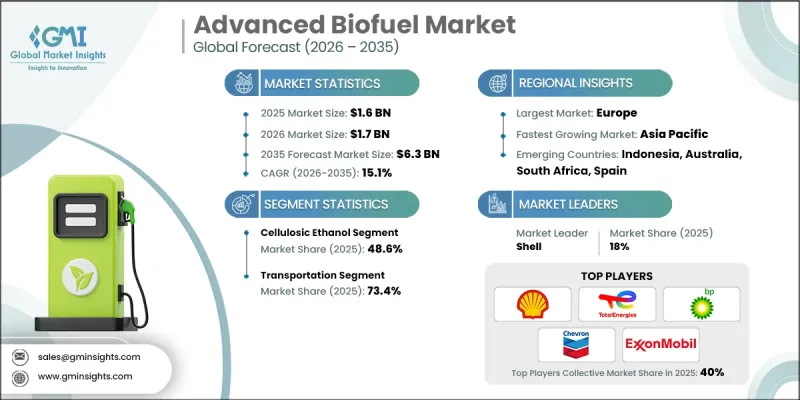
这一增长得益于各国政府致力于减少对进口原油的依赖并加强国家能源安全的努力。各国优先发展国内生产的可再生燃料,以降低供应链脆弱性、避险价格波动风险并增强能源独立性。先进生质燃料对于已开发经济体和新兴经济体建构韧性能源系统至关重要,因为它们提供了可扩展的、与现有燃料基础设施相容的可再生替代燃料。支持永续生质燃料生产的政策奖励、财政津贴和监管要求正在推动市场发展。农业残余物、藻类、废油和木质纤维素材料等非粮食生物质原料供应量的增加,提高了整个生物燃料价值链的永续性,并最大限度地减少了与粮食生产的竞争。技术进步、扶持政策和公私合营的结合正在加速全球的推广应用。
| 市场范围 | |
|---|---|
| 开始年份 | 2025 |
| 预测年份 | 2026-2035 |
| 起始值 | 16亿美元 |
| 预测金额 | 63亿美元 |
| 复合年增长率 | 15.1% |
先进生质燃料利用非食用生物质生产,例如农业残余物、林业废弃物、藻类和废油。这些燃料具有卓越的温室气体减排效果、更高的能源效率,并且与现有的交通运输、发电和工业燃料基础设施高度相容。政府的各项措施和财政奖励正在加速先进生物燃料的推广应用,降低商业化风险,并提升新兴技术计划的资金筹措潜力。扩大原料来源符合循环经济原则,有助于减少对石化燃料的依赖,并增强国家能源安全。此外,该行业还受益于製程改进,例如更高效的生物质预处理、酶水解和发酵技术,这些改进正在推动成本降低和生产规模扩大。
预计到2025年,纤维素乙醇的市占率将达到48.6%,并将在2035年之前以14.8%的复合年增长率持续成长。预处理製程、酵素水解和发酵技术的进步提高了转化效率、酵素性能和原料利用率,从而提升了其经济效益。对非食用生物生质燃料的监管支持也推动了其应用。纤维素乙醇符合燃料混合要求,减少了与粮食作物的竞争,并在其整个生命週期中显着减少了温室气体排放。其与现有燃料基础设施的兼容性使其成为交通燃料脱碳的重要解决方案。
预计到2025年,交通运输领域将占据73.4%的市场份额,并在2035年之前以14.7%的复合年增长率成长。各国和企业为实现净零排放目标而加大力度,推动了先进生质燃料的普及应用。与传统燃料相比,这些燃料可显着减少二氧化碳排放,并为电气化程度较低的产业提供实际的脱碳途径。先进生质燃料正日益融入长期永续性和排放策略,帮助车辆营运商、公共运输业者和物流营运商实现监管和环境目标。
美国先进生质燃料市场预计2025年将占据93.4%的市场份额,到2035年将成长至20亿美元。丰富的农业原材料、日益增长的气候变迁担忧以及强劲的国内生物技术创新正在推动先进生物燃料的普及。主要企业正专注于纤维素和藻类燃料的生产,以扩大营运规模并实现更显着的排放目标,同时充分利用政策支援、研发激励措施和先进的生产技术。
目录
第一章:调查方法和范围
第二章执行摘要
第三章业界考察
- 产业生态系统
- 原物料供应及采购分析
- 製造能力评估
- 供应链韧性与风险因素
- 配电网路分析
- 监管环境
- 影响产业的因素
- 促进因素
- 产业潜在风险与挑战
- 成长潜力分析
- 成本结构分析
- 价格趋势分析(美元/吨)
- 按燃料类型
- 波特五力分析
- PESTEL 分析
- 新机会与趋势
- 数位化和物联网集成
- 进入新兴市场
- 投资分析及未来展望
第四章 竞争情势
- 介绍
- 企业市占率分析:按地区划分
- 北美洲
- 欧洲
- 亚太地区
- 拉丁美洲
- 中东和非洲
- 战略仪錶板
- 策略倡议
- 企业标竿管理
- 创新与科技趋势
第五章 市场规模及预测:依燃料类型划分,2022-2035年
- 纤维素基乙醇
- 生质柴油
- 生物丁醇
- 其他的
第六章 市场规模及预测:依原料划分,2022-2035年
- 农业
- 林业
- 废弃物
- 其他的
第七章 市场规模及预测:依应用领域划分,2022-2035年
- 运输
- 航空领域
- 其他的
第八章 市场规模及预测:依地区划分,2022-2035年
- 北美洲
- 我们
- 加拿大
- 欧洲
- 德国
- 法国
- 西班牙
- 英国
- 义大利
- 亚太地区
- 中国
- 印度
- 印尼
- 澳洲
- 中东和非洲
- 沙乌地阿拉伯
- 南非
- 拉丁美洲
- 巴西
- 阿根廷
第九章:公司简介
- Advance Biofuel
- Aemetis
- Blue Biofuels
- Borregaard
- BP
- Byogy Renewables
- Chevron
- Clariant
- Enerkem
- ExxonMobil
- Gevo
- GranBio
- Green Plains
- Galp
- Indian Oil Corporation Limited
- Logen
- Praj Industries
- Shell
- TotalEnergies
- Votion Biorefineries
The Global Advanced Biofuel Market was valued at USD 1.6 billion in 2025 and is estimated to grow at a CAGR of 15.1% to reach USD 6.3 billion by 2035.
Growth is driven by governments' focus on reducing reliance on imported crude oil and strengthening national energy security. Countries are prioritizing domestically produced renewable fuels to reduce supply chain vulnerabilities, hedge against price volatility, and enhance energy independence. Advanced biofuels offer scalable, renewable alternatives compatible with existing fuel infrastructure, making them critical for both developed and emerging economies seeking resilient energy systems. The market is benefiting from policy incentives, financial grants, and regulatory mandates that support sustainable fuel production. Increasing availability of non-food biomass feedstocks such as agricultural residues, algae, waste oils, and lignocellulosic materials is improving sustainability across the biofuel value chain while minimizing competition with food production. The combination of technological progress, supportive policies, and public-private collaborations is accelerating adoption globally.
| Market Scope | |
|---|---|
| Start Year | 2025 |
| Forecast Year | 2026-2035 |
| Start Value | $1.6 Billion |
| Forecast Value | $6.3 Billion |
| CAGR | 15.1% |
Advanced biofuels are derived from non-food biomass, including agricultural residues, forestry waste, algae, and waste oils. These fuels offer superior greenhouse gas reductions, improved energy efficiency, and high compatibility with existing transport, power generation, and industrial fuel infrastructure. Government initiatives and fiscal incentives are accelerating adoption, mitigating commercialization risks, and enhancing project bankability for emerging technologies. Expanding feedstock availability supports circular economy principles, reduces reliance on fossil fuels, and strengthens national energy security. The industry is also benefiting from process improvements, such as more efficient biomass pretreatment, enzymatic hydrolysis, and fermentation techniques, which are driving cost reductions and increasing production scalability.
The cellulosic ethanol segment held 48.6% share in 2025 and is expected to grow at a CAGR of 14.8% through 2035. Technological advancements in pretreatment processes, enzymatic hydrolysis, and fermentation are improving economic feasibility by enhancing conversion efficiencies, enzyme performance, and feedstock utilization. Regulatory support for non-food-based biofuels is further boosting adoption, as cellulosic ethanol meets blending mandates, reduces competition with food crops, and achieves deeper lifecycle greenhouse gas reductions. Its compatibility with existing fuel infrastructure positions it as a key solution for decarbonizing transport fuels.
The transportation applications segment accounted for 73.4% share in 2025 and is projected to grow at a CAGR of 14.7% through 2035. Rising national and corporate commitments to achieve net-zero targets are driving advanced biofuel adoption. These fuels deliver significant CO2 reductions over conventional fuels and serve as a practical decarbonization pathway in sectors where electrification remains limited. Advanced biofuels are increasingly integrated into long-term sustainability and emission reduction strategies, supporting fleet operators, public transport authorities, and logistics providers in meeting regulatory and environmental targets.
U.S Advanced Biofuel Market held a 93.4% share in 2025 and is projected to generate USD 2 billion by 2035. Abundant agricultural feedstocks, growing climate change concerns, and strong domestic biotechnology innovation are driving adoption. Key players in the U.S. focus on cellulosic and algae-based fuels to achieve deeper emission reductions, leveraging policy support, research incentives, and advanced production technologies to scale operations.
Leading companies in the Global Advanced Biofuel Market include Advance Biofuel, Aemetis, Blue Biofuels, Borregaard, BP, Byogy Renewables, Chevron, Clariant, Enerkem, ExxonMobil, Gevo, GranBio, Green Plains, Galp, Indian Oil Corporation Limited, Logen, Praj Industries, Shell, TotalEnergies, and Votion Biorefineries. Key strategies employed by companies in the Global Advanced Biofuel Market to strengthen their presence include investing in R&D to improve conversion efficiency and feedstock utilization, forming joint ventures with agricultural and industrial partners to secure reliable biomass supply chains, and expanding production facilities globally to reduce delivery times and costs. Firms are leveraging government incentives, blending mandates, and sustainability certification programs to enhance market credibility. They are also deploying innovative process technologies for cellulosic ethanol and algae-based fuels to achieve higher yield and cost-effectiveness. Strategic acquisitions, partnerships, and licensing agreements enable companies to access new technologies, expand market reach, and accelerate commercialization.
Table of Contents
Chapter 1 Methodology & Scope
- 1.1 Research design
- 1.2 Quality commitment
- 1.2.1 GMI AI policy & data integrity commitment
- 1.2.1.1 Source consistency protocol
- 1.2.1 GMI AI policy & data integrity commitment
- 1.3 Research Trail & Confidence Scoring
- 1.3.1 Research Trail Components
- 1.3.2 Scoring Components
- 1.4 Data Collection
- 1.4.1 Partial list of primary sources
- 1.5 Data mining sources
- 1.5.1 Paid sources
- 1.5.1.1 Sources, by region
- 1.5.1 Paid sources
- 1.6 Base estimates and calculations
- 1.6.1 Base year calculation for any one approach
- 1.7 Forecast model
- 1.8 Research transparency addendum
- 1.8.1 Source attribution framework
- 1.8.2 Quality assurance metrics
- 1.8.3 Our commitment to trust
- 1.9 Market definitions
Chapter 2 Executive Summary
- 2.1 Industry synopsis, 2022 - 2035
- 2.2 Business trends
- 2.3 Fuel type trends
- 2.4 Feedstock trends
- 2.5 Application trends
- 2.6 Regional trends
Chapter 3 Industry Insights
- 3.1 Industry ecosystem
- 3.1.1 Raw material availability & sourcing analysis
- 3.1.2 Manufacturing capacity assessment
- 3.1.3 Supply chain resilience & risk factors
- 3.1.4 Distribution network analysis
- 3.2 Regulatory landscape
- 3.3 Industry impact forces
- 3.3.1 Growth drivers
- 3.3.2 Industry pitfalls & challenges
- 3.4 Growth potential analysis
- 3.5 Cost structure analysis
- 3.6 Price trend analysis (USD/Tons)
- 3.6.1 By fuel type
- 3.7 Porter's analysis
- 3.7.1 Bargaining power of suppliers
- 3.7.2 Bargaining power of buyers
- 3.7.3 Threat of new entrants
- 3.7.4 Threat of substitutes
- 3.8 PESTEL analysis
- 3.8.1 Political factors
- 3.8.2 Economic factors
- 3.8.3 Social factors
- 3.8.4 Technological factors
- 3.8.5 Legal factors
- 3.8.6 Environmental factors
- 3.9 Emerging opportunities & trends
- 3.9.1 Digitalization & IoT integration
- 3.9.2 Emerging market penetration
- 3.10 Investment analysis and future outlook
Chapter 4 Competitive landscape, 2026
- 4.1 Introduction
- 4.2 Company market share analysis, by region, 2025
- 4.2.1 North America
- 4.2.2 Europe
- 4.2.3 Asia Pacific
- 4.2.4 Latin America
- 4.2.5 Middle East & Africa
- 4.3 Strategic dashboard
- 4.4 Strategic initiatives
- 4.5 Company benchmarking
- 4.6 Innovation & technology landscape
Chapter 5 Market Size and Forecast, By Fuel type, 2022 - 2035 (USD Million & MT)
- 5.1 Key trends
- 5.2 Cellulosic ethanol
- 5.3 Biodiesel
- 5.4 Biobutanol
- 5.5 Others
Chapter 6 Market Size and Forecast, By Feedstock, 2022 - 2035 (USD Million & MT)
- 6.1 Key trends
- 6.2 Agriculture
- 6.3 Forestry
- 6.4 Waste
- 6.5 Others
Chapter 7 Market Size and Forecast, By Application, 2022 - 2035 (USD Million & MT)
- 7.1 Key trends
- 7.2 Transportation
- 7.3 Aviation
- 7.4 Others
Chapter 8 Market Size and Forecast, By Region, 2022 - 2035 (USD Million & MT)
- 8.1 Key trends
- 8.2 North America
- 8.2.1 U.S.
- 8.2.2 Canada
- 8.3 Europe
- 8.3.1 Germany
- 8.3.2 France
- 8.3.3 Spain
- 8.3.4 UK
- 8.3.5 Italy
- 8.4 Asia Pacific
- 8.4.1 China
- 8.4.2 India
- 8.4.3 Indonesia
- 8.4.4 Australia
- 8.5 Middle East & Africa
- 8.5.1 Saudi Arabia
- 8.5.2 South Africa
- 8.6 Latin America
- 8.6.1 Brazil
- 8.6.2 Argentina
Chapter 9 Company Profiles
- 9.1 Advance Biofuel
- 9.2 Aemetis
- 9.3 Blue Biofuels
- 9.4 Borregaard
- 9.5 BP
- 9.6 Byogy Renewables
- 9.7 Chevron
- 9.8 Clariant
- 9.9 Enerkem
- 9.10 ExxonMobil
- 9.11 Gevo
- 9.12 GranBio
- 9.13 Green Plains
- 9.14 Galp
- 9.15 Indian Oil Corporation Limited
- 9.16 Logen
- 9.17 Praj Industries
- 9.18 Shell
- 9.19 TotalEnergies
- 9.20 Votion Biorefineries


