


 |
市场调查报告书
商品编码
1959655
商用清洁用品市场机会、成长要素、产业趋势分析及2026年至2035年预测Professional Cleaning Products Market Opportunity, Growth Drivers, Industry Trend Analysis, and Forecast 2026 - 2035 |
||||||

2025年全球商用清洁用品市场价值为467亿美元,预计到2035年将达到873亿美元,年复合成长率为6.5%。
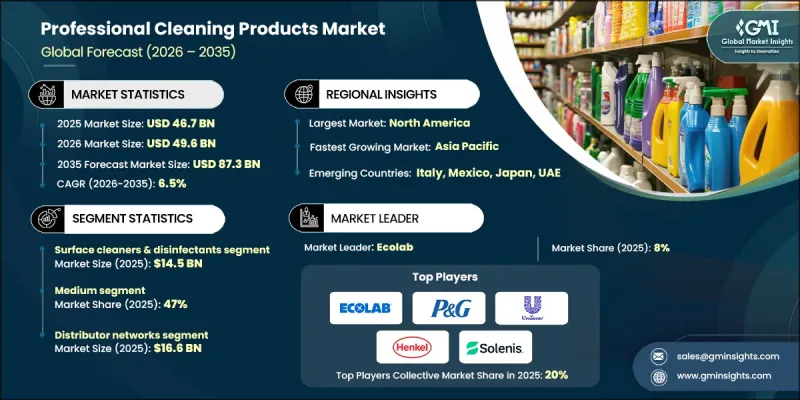
市场发展源自于商业和公共设施对严格卫生标准的日益重视。各机构正越来越多地实施系统化的常规卫生管理措施,以降低健康风险、确保合规性并维护员工、访客和客户的信任。清洁工作曾经是零星进行的,如今已融入日常运营,这导致对专业级消毒剂、清洁剂和清洁剂的需求显着增长。人们对清洁度的期望不断提高,可见的卫生状况已成为影响品牌认知和空间利用决策的关键因素。因此,设施管理人员和企业负责人优先考虑性能稳定、效果显着且符合业界和安全标准的清洁产品。这种转变将持续增强对高品质专业清洁剂的长期需求。
| 市场范围 | |
|---|---|
| 开始年份 | 2025 |
| 预测年份 | 2026-2035 |
| 起始值 | 467亿美元 |
| 预测金额 | 873亿美元 |
| 复合年增长率 | 6.5% |
预计2025年,表面清洁消毒产品市场规模将达到145亿美元。这些产品是专业清洁作业的基础,在维护大型、高频使用场所的卫生方面发挥着至关重要的作用。专业级配方专为高强度、重复使用而开发,并符合严格的安全性和性能标准,这使其与消费级产品区别开来。
到2025年,中价位产品将占据47%的市场。此价位产品兼具成本效益和可靠性能,因此对预算有限的企业尤其具有吸引力。该价位段的买家优先考虑清洁效果、符合相关安全标准以及持久耐用,同时又不希望承担高端产品的成本。这支撑了各种商业环境中的持续需求。
美国专业清洁用品市场占有77.8%的份额,价值125亿美元。该国健全的法规结构和对职场卫生标准的坚定承诺,持续支撑着专业清洁用品的高消费量。此外,在需要严格卫生管理的法规环境下,对清洁用品日益增长的依赖也促进了此类产品的持续需求。
目录
第一章:调查方法和范围
第二章执行摘要
第三章业界考察
- 生态系分析
- 供应商情况
- 利润率
- 每个阶段增加的价值
- 影响价值链的因素
- 影响产业的因素
- 促进因素
- 商业空间对卫生管理的需求日益增长
- 向环保与永续产品转型
- 医疗和酒店业的扩张
- 产业潜在风险与挑战
- 原物料价格波动
- 严格的化学品和环境法规
- 机会
- 智慧整合清洁解决方案
- 对环保认证产品的需求
- 促进因素
- 成长潜力分析
- 未来市场趋势
- 科技与创新趋势
- 当前技术趋势
- 新兴技术
- 价格趋势
- 按地区
- 依产品类型
- 监管环境
- 标准和合规要求
- 区域法规结构
- 认证标准
- 波特的分析
- PESTEL 分析
第四章 竞争情势
- 介绍
- 企业市占率分析
- 按地区
- 公司矩阵分析
- 主要市场公司的竞争分析
- 竞争定位矩阵
- 主要进展
- 併购
- 伙伴关係与合作
- 新产品发布
- 扩张计划
第五章 市场估算与预测:依产品类型划分,2022-2035年
- 表面清洁剂和消毒剂
- 消毒剂
- 消毒剂
- 多用途清洁剂
- 地板产品
- 地板清洁剂
- 磨料
- 维护化学品
- 特殊清洁剂
- 脱脂剂
- 除垢剂
- 工业级组合药物
- 厨房和餐饮服务清洁剂
- 洗衣和纺织品护理产品
- 仪器清洗化学品
第六章 市场估计与预测:依价格区间划分,2022-2035年
- 低价位
- 中价位
- 高价位范围
第七章 市场估计与预测:依最终用户划分,2022-2035年
- 医疗卫生机构
- 饭店及食品服务
- 製造业和工业
- 教育机构
- 政府和公共设施
- 其他的
第八章 市场估算与预测:依通路划分,2022-2035年
- 直销
- 经销商网路
- 线上平台
- 零售通路
- 其他的
第九章 市场估计与预测:依地区划分,2022-2035年
- 北美洲
- 我们
- 加拿大
- 欧洲
- 德国
- 英国
- 法国
- 义大利
- 西班牙
- 亚太地区
- 中国
- 日本
- 印度
- 澳洲
- 韩国
- 拉丁美洲
- 巴西
- 墨西哥
- 阿根廷
- 中东和非洲
- 南非
- 沙乌地阿拉伯
- 阿拉伯聯合大公国
第十章:公司简介
- Azelis
- Blue Wonder
- Bona
- Borer Chemie
- Ecolab
- Henkel
- Hygeniq
- NCH
- Nerta
- Nouryon
- Pollet
- Procter &Gamble
- Reckitt Benckiser
- Solenis
- Unilever
The Global Professional Cleaning Products Market was valued at USD 46.7 billion in 2025 and is estimated to grow at a CAGR of 6.5% to reach USD 87.3 billion by 2035.
Market development is driven by the growing emphasis on rigorous hygiene standards across commercial and institutional environments. Organizations are increasingly adopting structured and routine sanitation practices to reduce health risks, meet regulatory obligations, and maintain confidence among employees, visitors, and customers. Cleaning activities that were once occasional are now embedded into daily operations, which has significantly raised demand for professional-grade disinfectants, sanitizers, and cleaning solutions. Expectations around cleanliness have evolved, with visible sanitation becoming a critical factor influencing brand perception and space utilization decisions. As a result, facility managers and corporate buyers are prioritizing cleaning products that offer consistent performance, validated effectiveness, and alignment with industry and safety standards. This shift continues to reinforce long-term demand for high-quality professional cleaning formulations.
| Market Scope | |
|---|---|
| Start Year | 2025 |
| Forecast Year | 2026-2035 |
| Start Value | $46.7 Billion |
| Forecast Value | $87.3 Billion |
| CAGR | 6.5% |
The surface cleaners and disinfectants segment reached USD 14.5 billion in 2025. These products form the backbone of professional cleaning operations due to their essential role in maintaining hygienic conditions across large and frequently used spaces. Professional-grade formulations are developed for intensive, repeated application and are designed to meet strict safety and performance benchmarks, distinguishing them from consumer-focused alternatives.
The medium-priced segment accounted for 47% share in 2025. This category serves as a balance between cost efficiency and dependable performance, making it particularly attractive to organizations operating within defined budgets. Buyers in this segment prioritize effective cleaning outcomes, adequate safety compliance, and consistent durability without incurring premium-level costs, which supports sustained demand across diverse commercial settings.
U.S. Professional Cleaning Products Market held a 77.8% share and generated USD 12.5 billion. The country's strong regulatory framework and emphasis on workplace health standards continue to support high consumption of professional cleaning products. Increased reliance on outsourced cleaning services further contributes to sustained product demand across regulated environments that require strict hygiene control.
Key companies active in the Global Professional Cleaning Products Market include Ecolab, Unilever, Henkel, Procter & Gamble, Reckitt Benckiser, Solenis, Nouryon, Azelis, Pollet, Bona, NCH, Nerta, Hygeniq, Blue Wonder, and Borer Chemie. Companies operating in the professional cleaning products market are reinforcing their competitive positions through formulation innovation, portfolio expansion, and compliance-driven product development. Many players are investing in solutions that deliver high efficacy while aligning with evolving safety and environmental expectations. Strategic collaborations with facility service providers and distributors are improving market reach and customer retention. Firms are also strengthening their presence through tailored offerings for specific commercial needs and by expanding private-label and contract manufacturing capabilities. Digital tools for performance validation and usage tracking are increasingly adopted, while global players continue to optimize supply chains and regional production to enhance responsiveness and cost efficiency.
Table of Contents
Chapter 1 Methodology and Scope
- 1.1 Market scope and definition
- 1.2 Research design
- 1.2.1 Research approach
- 1.2.2 Data collection methods
- 1.3 Data mining sources
- 1.3.1 Global
- 1.3.2 Regional/Country
- 1.4 Base estimates and calculations
- 1.4.1 Base year calculation
- 1.4.2 Key trends for market estimation
- 1.5 Primary research and validation
- 1.5.1 Primary sources
- 1.6 Forecast model
- 1.7 Research assumptions and limitations
Chapter 2 Executive Summary
- 2.1 Industry 360° synopsis
- 2.2 Key market trends
- 2.2.1 Regional
- 2.2.2 Product type
- 2.2.3 Price
- 2.2.4 End user
- 2.2.5 Distribution channel
- 2.3 CXO perspectives: Strategic imperatives
- 2.3.1 Key decision points for industry executives
- 2.3.2 Critical success factors for market players
- 2.4 Future outlook and strategic recommendations
Chapter 3 Industry Insights
- 3.1 Industry ecosystem analysis
- 3.1.1 Supplier landscape
- 3.1.2 Profit margin
- 3.1.3 Value addition at each stage
- 3.1.4 Factor affecting the value chain
- 3.2 Industry impact forces
- 3.2.1 Growth drivers
- 3.2.1.1 Rising demand for hygiene in commercial spaces
- 3.2.1.2 Shift toward eco-friendly, sustainable products
- 3.2.1.3 Expansion of healthcare and hospitality sectors
- 3.2.2 Industry pitfalls & challenges
- 3.2.2.1 Volatile raw material prices
- 3.2.2.2 Strict chemical and environmental regulations
- 3.2.3 Opportunities
- 3.2.3.1 Smart & integrated cleaning solutions
- 3.2.3.2 Green & certified product demand
- 3.2.1 Growth drivers
- 3.3 Growth potential analysis
- 3.4 Future market trends
- 3.5 Technology and innovation landscape
- 3.5.1 Current technological trends
- 3.5.2 Emerging technologies
- 3.6 Price trends
- 3.6.1 By region
- 3.6.2 By product type
- 3.7 Regulatory landscape
- 3.7.1 Standards and compliance requirements
- 3.7.2 Regional regulatory frameworks
- 3.7.3 Certification standards
- 3.8 Porter’s analysis
- 3.9 PESTEL analysis
Chapter 4 Competitive Landscape, 2025
- 4.1 Introduction
- 4.2 Company market share analysis
- 4.2.1 By region
- 4.2.1.1 North America
- 4.2.1.2 Europe
- 4.2.1.3 Asia Pacific
- 4.2.1.4 Latin America
- 4.2.1.5 Middle East and Africa
- 4.2.1 By region
- 4.3 Company matrix analysis
- 4.4 Competitive analysis of major market players
- 4.5 Competitive positioning matrix
- 4.6 Key developments
- 4.6.1 Mergers & acquisitions
- 4.6.2 Partnerships & collaborations
- 4.6.3 New product launches
- 4.6.4 Expansion plans
Chapter 5 Market Estimates and Forecast, By Product Type, 2022 - 2035 (USD Billion) (Million Units)
- 5.1 Key trends
- 5.2 Surface cleaners & disinfectants
- 5.2.1 Disinfectants
- 5.2.2 Sanitizers
- 5.2.3 Multi-surface cleaners
- 5.3 Floor care products
- 5.3.1 Floor cleaner
- 5.3.2 Polishes
- 5.3.3 Maintenance chemicals
- 5.4 Specialized cleaning chemicals
- 5.4.1 Degreasers
- 5.4.2 Descalers
- 5.4.3 Industrial-grade formulations
- 5.5 Kitchen and food service cleaners
- 5.6 Laundry and textile care products
- 5.7 Instrument cleaning chemistries
Chapter 6 Market Estimates and Forecast, By Price Range, 2022 - 2035 (USD Billion) (Million Units)
- 6.1 Key trends
- 6.2 Low
- 6.3 Medium
- 6.4 High
Chapter 7 Market Estimates and Forecast, By End User, 2022 - 2035 (USD Billion) (Million Units)
- 7.1 Key trends
- 7.2 Healthcare & medical facilities
- 7.3 Hospitality & food service
- 7.4 Manufacturing & industrial
- 7.5 Educational institutions
- 7.6 Government & public buildings
- 7.7 Others
Chapter 8 Market Estimates and Forecast, By Distribution Channel, 2022 - 2035 (USD Billion) (Million Units)
- 8.1 Key trends
- 8.2 Direct sales
- 8.3 Distributor networks
- 8.4 Online platforms
- 8.5 Retail channels
- 8.6 Others
Chapter 9 Market Estimates and Forecast, By Region, 2022 - 2035 (USD Billion) (Million Units)
- 9.1 Key trends
- 9.2 North America
- 9.2.1 U.S.
- 9.2.2 Canada
- 9.3 Europe
- 9.3.1 Germany
- 9.3.2 UK
- 9.3.3 France
- 9.3.4 Italy
- 9.3.5 Spain
- 9.4 Asia Pacific
- 9.4.1 China
- 9.4.2 Japan
- 9.4.3 India
- 9.4.4 Australia
- 9.4.5 South Korea
- 9.5 Latin America
- 9.5.1 Brazil
- 9.5.2 Mexico
- 9.5.3 Argentina
- 9.6 Middle East and Africa
- 9.6.1 South Africa
- 9.6.2 Saudi Arabia
- 9.6.3 UAE
Chapter 10 Company Profiles
- 10.1 Azelis
- 10.2 Blue Wonder
- 10.3 Bona
- 10.4 Borer Chemie
- 10.5 Ecolab
- 10.6 Henkel
- 10.7 Hygeniq
- 10.8 NCH
- 10.9 Nerta
- 10.10 Nouryon
- 10.11 Pollet
- 10.12 Procter & Gamble
- 10.13 Reckitt Benckiser
- 10.14 Solenis
- 10.15 Unilever

 2026-2030年全球机器人擦窗机市场
 清洁机器人市场:2026-2032年全球市场预测(按产品类型、控制系统、技术、改进、应用和分销管道划分)
 泳池清洁机器人市场预测至2034年:全球分析(按泳池类型、动力来源、清洁类型、驱动机制、分销管道、最终用户和地区划分)清洁设备及用品市场:2026-2032年全球市场预测(依产品类型、材料类型、应用、最终用户及通路划分)智慧家庭清洁机器人市场:按机器人类型、连接方式、技术、应用和销售管道-2026-2032年全球预测游泳池清洁机器人市场按产品类型、最终用户、泳池类型、分销管道、驱动机制和电源划分,全球预测(2026-2032年)
 清洁机器人:市场占有率分析、产业趋势与统计、成长预测(2026-2031)
 全球窗户清洁机器人市场规模、份额、趋势和成长分析报告(2026-2034年)
 2026年全球清洁机器人市场报告
 全球窗户清洁机器人市场-按产品类型、应用、地区和竞争格局分類的产业规模、份额、趋势、机会和预测(2021-2031年)