


 |
市场调查报告书
商品编码
1940569
清洁机器人:市场占有率分析、产业趋势与统计、成长预测(2026-2031)Cleaning Robot - Market Share Analysis, Industry Trends & Statistics, Growth Forecasts (2026 - 2031) |
||||||

※ 本网页内容可能与最新版本有所差异。详细情况请与我们联繫。
预计清洁机器人市场将从 2025 年的 168.9 亿美元成长到 2026 年的 199.8 亿美元,到 2031 年将达到 462.7 亿美元,2026 年至 2031 年的复合年增长率为 18.29%。
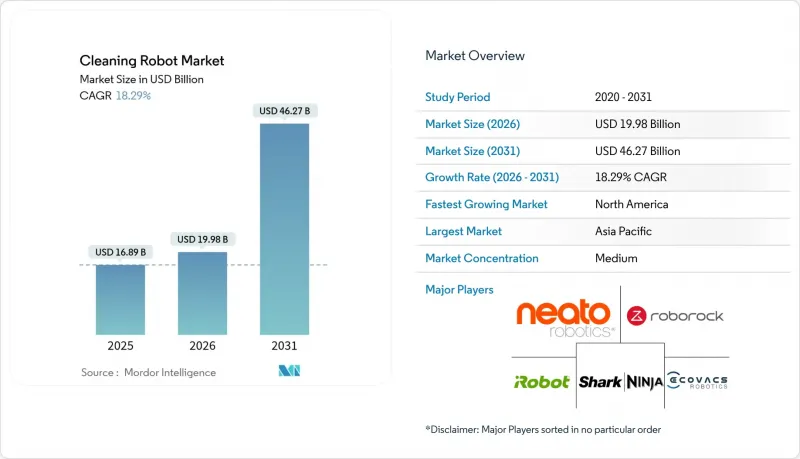
受非接触式清洁解决方案的强劲需求、智慧家庭的快速普及以及感测器组件成本的大幅下降的推动,清洁机器人市场持续成长。商业物业管理者日益认识到自主清洁是优化劳动力配置的关键环节,而住宅则受益于光达价格的下降以及电商渠道的便捷购买。固体雷射雷达的规模经济效益,加上机器人即服务(RaaS)订阅模式,透过降低拥有门槛,进一步扩大了清洁机器人市场。来自垂直整合的亚洲製造商日益激烈的竞争虽然给利润率带来了压力,但也加速了产品多样化和区域覆盖的扩大。
全球清洁机器人市场趋势与洞察
提高商业设施的后疫情时代卫生标准
大多数公共和私人机构都已将新冠疫情期间的清洁通讯协定製度化,从而维持了对自主地面清洁机器人和紫外线消毒机器人的需求。机场实施夜间机器人清洁作业已证明其能够节省人力并提升乘客信心。新加坡公共部门大规模竞标采购自主清洁机器人,反映了政府对持续卫生防疫工作的支持。医疗机构也依赖ISO 13482认证的机器人来降低感染风险,而无需增加人力投资。持续的监管关注和用户期望共同推动清洁机器人市场保持高速成长。
智慧家庭的快速普及和可支配收入的成长
智慧家庭中枢如今能够同步实现扫地机器人的日程安排、语音控制和远距离诊断,使其从普通的小工具跃升为家庭自动化系统的核心节点。来自主流厂商的Matter认证设备正在消除互通性障碍,并扩大目标用户群。在中国、印度和东南亚,中产阶级收入的成长推动了高级产品的购买,这些产品融合了基于人工智慧的障碍物感知和混合导航技术。这些趋势持续吸引新用户进入扫地机器人市场。
与传统设备初始成本比较
中小企业仍然犹豫是否要用价值 300 至 3000 美元的机器人来取代价值 50 至 200 美元的手动工具。希斯洛机场透过机器人每年节省了 124,175 英镑(155,219 美元)的人事费用,但需要证明投资回收期在两年以内才能获得董事会核准。机器人即服务 (ROaaS) 透过将资本支出转化为营运成本来降低前期成本,但供应商必须管理电池劣化和重新部署的风险,才能保持合约的吸引力。
细分市场分析
到2025年,住宅清洁机器人,尤其是地面清洁机器人,将占据清洁机器人市场71.32%的主导份额。价格下降和频繁的型号更新将支撑强劲的住宅需求,而泳池清洁机器人和窗户清洁机器人等细分市场将保持稳定,儘管规模较小。相较之下,商用机器人预计将以18.42%的复合年增长率成长,这主要得益于可衡量的投资回报率和设施维护中不断上涨的人事费用。消毒型机器人正在经历显着增长,这尤其受到医院对紫外线和等离子体消毒要求的推动。商业用户也重视耐环境腐蚀的底盘、可更换电池以及针对潮湿环境的认证防护等级。供应商的差异化优势正在转向车队管理仪表板和预测性维护数据分析,以减少非计划性停机时间。延长的服务合约进一步降低了整体拥有成本,并巩固了商用应用的路径。儘管初始成本较高,但投资回收期正在缩短,越来越多的产业,包括火车站、购物中心和政府大楼,都在购买自主清洁解决方案。
家用清洁机器人市场持续受惠于专业清洁车队所开发功能的连锁效应,例如多层次地图绘製和自适应吸力。能够干湿两用清洁的混合模式扩大了其在家庭中的吸引力,而订阅式耗材配送服务则巩固了客户在品牌生态系统中的地位。住宅环境相对宽鬆的监管环境加快了新功能的上市速度。整体而言,这两个市场相辅相成。消费级市场规模降低了硬体成本,而商用市场的平均售价则为先进的研发提供了资金,从而为清洁机器人市场形成良性循环。
到2025年,住宅用户将占总收入的57.41%,这反映了智慧家庭整合技术的广泛应用和口碑传播。然而,医院、诊所和养老机构的成长速度最快,复合年增长率将达到18.55%。由于需要投入大量预算来预防感染,因此在非工作时间运作的紫外线和过氧化氢消毒机器人价格较高也是合理的。设施管理人员认为,持续降低病原体载量和提高员工安全是主要的购买驱动因素。零售连锁店、饭店和餐厅正在部署小规模机器人团队,以在人手不足的情况下维持服务环境。机场正在利用24小时运作来应对客流高峰,而无需支付加班费。一些正在尝试灵活运转率的办公室正在实施由物联网占用感测器触发的按需清洁系统。
工厂和仓库需要通过ATEX认证的机器,能够安全地处理粉尘和挥发性化学品,这是清洁机器人市场中一个细分但利润丰厚的领域。随着终端用户群体日益多元化,市场细分也变得更加复杂,因为供应商必须根据具体应用场景自订有效载荷能力、导航演算法和抗菌材料选择。
区域分析
到2025年,北美将维持39.45%的收入份额,这主要得益于美国政府为机场、交通枢纽和学校购买自动地面清洁机器人。加州和纽约的医院在量化了减少医院感染的益处后,加速了机器人的应用。加拿大与美国供应商的监管一致性以及地理位置的接近性促进了跨境扩张,而墨西哥的加工出口区则吸引了组装投资,以规避关税风险。目前,该地区的成长主要由续约和维护合约驱动,而非新购,这表明清洁机器人市场已趋于成熟,但仍盈利潜力。
亚太地区是成长最快的地区,预计到2031年将以18.76%的年复合成长率(CAGR)。中国正将巨大的国内需求与垂直整合的供应链结合,大幅缩短交货时间。 「中国製造2025」计画下的政府补贴鼓励国内品牌出口东南亚和中东,加剧了它们在其他地区的竞争。在新加坡,一项多机构联合竞标展示了机器人技术在公共场所的可靠性;在日本,随着人口老化,为减轻护理人员的负担,对辅助设备的需求不断增长。澳洲和韩国仍然是高阶机型的早期采用者,而印度则以面向都市区中产阶级家庭的成本绩效产品进入市场。
儘管监管严格,欧洲市场仍维持稳定成长。德国和法国凭藉着严格的卫生标准,在工业和酒店业应用方面发挥主导作用。在英国,旅馆业扮演着主导角色,儘管关税不确定性,机场和零售业的部署仍在成长。符合欧盟机械指令2006/42/EC和EN 60335安全标准系列的要求增加了认证成本,这使得拥有充足测试预算的成熟品牌更具优势。能源成本和劳动力短缺持续推动自动化投资,该地区的清洁机器人市场份额保持两位数成长。
其他福利:
- Excel格式的市场预测(ME)表
- 分析师支持(3个月)
目录
第一章 引言
- 研究假设和市场定义
- 调查范围
第二章调查方法
第三章执行摘要
第四章 市场环境
- 市场概览
- 市场驱动因素
- 疫情后如何提高商业场所的卫生标准
- 智慧家庭的快速普及和可支配收入的成长
- 光达和感测器套件的平均售价降低,从而降低了物料清单成本。
- 电子商务通路的扩张加速了全球扩张
- 设施管理合约转向机器人即服务(RaaS)
- 政府采购用于公共基础设施的紫外线消毒机器人
- 市场限制
- 与传统设备相比,初始成本较高
- 关于摄影机/VSLAM地图的资料隐私问题
- 固体光达组件供应链中的脆弱性
- 对中国机器人出口征收新的贸易关税
- 产业价值链分析
- 监管环境
- 技术展望
- 波特五力分析
- 供应商的议价能力
- 买方的议价能力
- 新进入者的威胁
- 替代品的威胁
- 竞争对手之间的竞争
- 对宏观经济趋势的市场评估
第五章 市场规模与成长预测
- 按类型
- 家用机器人
- 吸尘器
- 泳池清洁
- 窗户清洁
- 草坪护理
- 其他家务/家庭清洁
- 商用机器人
- 地板清洁
- 储槽/管/管道清洗
- 消毒机器人
- 其他专业清洁
- 家用机器人
- 最终用户
- 住宅
- 商业的
- 饭店业
- 零售和购物中心
- 医疗设施
- 机场和交通枢纽
- 办公室和企业设施
- 其他商业设施
- 工业(製造业和仓储业)
- 透过导航技术
- LiDAR SLAM
- 视觉SLAM(vSLAM)
- 混合式(雷射雷达+视觉)
- 随机/红外线
- AI感测器融合套件
- 其他导航技术
- 按销售管道
- 在线的
- 离线
- 按地区
- 北美洲
- 我们
- 加拿大
- 墨西哥
- 南美洲
- 巴西
- 阿根廷
- 其他南美洲
- 欧洲
- 德国
- 英国
- 法国
- 义大利
- 西班牙
- 其他欧洲地区
- 亚太地区
- 中国
- 日本
- 印度
- 新加坡
- 韩国
- 澳洲
- 亚太其他地区
- 中东和非洲
- 中东
- 沙乌地阿拉伯
- 阿拉伯聯合大公国
- 土耳其
- 其他中东地区
- 非洲
- 南非
- 奈及利亚
- 其他非洲地区
- 中东
- 北美洲
第六章 竞争情势
- 市场集中度
- 策略趋势
- 市占率分析
- 公司简介
- iRobot Corporation
- Ecovacs Robotics Co., Ltd.
- Roborock Technology Co., Ltd.
- Neato Robotics Inc.
- Dreame Technology(Suzhou)Co., Ltd.
- Narwal Robotics Inc.
- SharkNinja Operating LLC
- ILIFE Innovation Ltd.
- Cecotec Innovaciones SL
- bObsweep Inc.
- Proscenic Technology Co., Ltd.
- Anker Innovations Ltd.(Eufy)
- SoftBank Robotics Corp.
- Tennant Company
- Alfred Karcher SE and Co. KG
- Nilfisk A/S
- Avidbots Corp.
- Gaussian Robotics Co., Ltd.(Gausium)
- Midea Group Co., Ltd.(Eureka)
- Tineco Intelligent Technology Co., Ltd.
第七章 市场机会与未来展望
The cleaning robot market is expected to grow from USD 16.89 billion in 2025 to USD 19.98 billion in 2026 and is forecast to reach USD 46.27 billion by 2031 at 18.29% CAGR over 2026-2031.
Strong demand for touch-free hygiene solutions, rapid smart-home adoption, and sharp declines in sensor bills of material continue to propel the cleaning robot market. Commercial property managers increasingly view autonomous cleaning as mission-critical for labor optimization, while residential buyers benefit from lower LiDAR prices and easy e-commerce access. Supply-side economies of scale in solid-state LiDAR, coupled with robots-as-a-service subscriptions, further expand the cleaning robot market by lowering ownership barriers. Intensifying competition from vertically integrated Asian manufacturers is compressing margins, yet it also accelerates product variety and regional availability.
Global Cleaning Robot Market Trends and Insights
Rising Post-Pandemic Hygiene Standards in Commercial Spaces
Most public and private facilities have institutionalized COVID-19-era cleaning protocols, sustaining demand for autonomous floor-care and UV-C disinfection robots. Airports that run robots overnight report measurable labor savings and better passenger confidence. Singapore's public-sector tenders for large fleets of autonomous cleaners underscore the government's endorsement of continuous hygiene programs. Healthcare operators also lean on ISO 13482-certified models to mitigate infection risks without adding staff. Sustained regulatory attention and user expectations together keep the cleaning robot market on a high-growth path.
Rapid Smart-Home Penetration and Disposable-Income Growth
Smart-home hubs now synchronize scheduling, voice control, and remote diagnostics for floor-care bots, elevating them from gadgets to integral home-automation nodes. Matter-certified devices from leading vendors remove interoperability friction and broaden the addressable base. In China, India, and Southeast Asia, rising middle-class income fuels premium purchases that bundle AI-based obstacle recognition and hybrid navigation. These dynamics continue to funnel new users into the cleaning robot market.
High Upfront Cost vs Conventional Equipment
Small businesses still hesitate to replace USD 50-200 manual tools with bots priced from USD 300 to USD 3,000. Even at Heathrow, where robots saved GBP 124,175 (USD 155,219) in annual labor, board-level approval required proof of sub-two-year payback. Robots-as-a-service mitigates sticker shock by converting capex into opex, but vendors must manage battery depreciation and redeployment risk to keep contracts attractive.
Other drivers and restraints analyzed in the detailed report include:
- Falling LiDAR and Sensor ASPs Reduce Bill of Materials
- E-Commerce Channel Scaling Accelerates Global Reach
- Data-Privacy Concerns Over Camera/VSLAM Mapping
For complete list of drivers and restraints, kindly check the Table Of Contents.
Segment Analysis
Domestic units, notably floor-vacuum robots, held a commanding 71.32% share of the cleaning robot market size in 2025. Consistent price erosion and frequent model refreshes keep household demand buoyant, while niche segments, such as pool and window cleaners, remain smaller yet stable. In contrast, professional robots are expected to book an 18.42% CAGR, driven by measurable ROI and rising labor costs in facility maintenance. Disinfection models are outpacing all others, thanks in part to hospital mandates for ultraviolet or plasma sterilization. Commercial buyers also value ruggedized chassis, replaceable batteries, and certified ingress protection for wet environments. Vendor differentiation is increasingly centered on fleet-management dashboards and predictive-maintenance data analytics that reduce unplanned downtime. Extended service contracts further improve the total cost of ownership, solidifying professional adoption pathways. Despite higher acquisition prices, payback periods are shrinking, tilting procurement toward autonomous solutions across various industries, including rail stations, shopping malls, and government buildings.
The domestic sphere continues to benefit from feature spillovers originally developed for professional fleets, such as multi-floor mapping and adaptive suction. Hybrids capable of wet and dry cleaning broaden household appeal, while subscription consumable deliveries lock customers into branded ecosystems. Regulatory attention is minimal in residential contexts, accelerating time-to-market for new features. Overall, both domains reinforce each other: the consumer scale reduces hardware costs, while commercial ASPs finance advanced R&D, sustaining a virtuous cycle for the cleaning robot market.
Residential users accounted for 57.41% of 2025 revenue, reflecting the widespread adoption of smart-home integration and word-of-mouth advocacy. Yet hospitals, clinics, and elder-care centers are the fastest movers with an 18.55% CAGR. Infection-prevention budgets justify premium pricing for UV-C or hydrogen-peroxide disinfection robots that operate after visiting hours. Facility managers cite consistent pathogen load reduction and enhanced staff safety as prime purchase triggers. Retail chains, hotels, and restaurants now deploy smaller fleets to maintain service ambiance amid staffing shortages. Airports leverage 24-hour robot operation to match passenger peaks without overtime premiums. Offices experimenting with flexible occupancy adopt on-demand cleaning triggered by IoT occupancy sensors.
Industrial plants and warehouses seek ATEX-certified units that safely handle dust and volatile chemicals, a niche yet high-margin segment of the cleaning robot market. As end-users diversify, vendors must tailor payload capacity, navigation algorithms, and antimicrobial material choices to distinct use cases, reinforcing segmentation complexity.
The Cleaning Robot Market is Segmented by Type (Domestic/Household Robots, Professional Robots), End-User (Residential, Commercial, Industrial), Navigation Technology (LiDAR SLAM, Visual SLAM, Hybrid, Random/Infrared, AI Sensor-Fusion), Sales Channel (Online, Offline), and Geography (North America, South America, Europe, Asia Pacific, Middle East and Africa). The Market Forecasts are Provided in Terms of Value (USD).
Geography Analysis
North America retained a 39.45% revenue share in 2025, led by the United States government's procurement of autonomous floor cleaners for airports, transit hubs, and schools. Hospitals in California and New York accelerated rollouts after quantifying reductions in hospital-acquired infections. Canada's regulatory alignment and proximity to U.S. vendors smooth cross-border expansion, while Mexico's maquiladora clusters attract assembly investments that hedge tariff exposure. Growth here now stems less from first-time purchases and more from refresh cycles and service contracts, signaling a maturing yet lucrative segment of the cleaning robot market.
The Asia-Pacific region is the fastest climber, with a 18.76% CAGR outlook to 2031. China blends massive domestic demand with vertically integrated supply chains, slashing delivery lead times. Government subsidies under the "Made in China 2025" initiative encourage domestic brands to export across Southeast Asia and the Middle East, thereby increasing competitive pressure elsewhere. Singapore's multi-agency tenders validate the credibility of robotics in public settings, while Japan's aging demographics elevate demand for caregiver adjuncts that relieve nursing staff. Australia and South Korea remain early adopters of premium models, whereas India is entering the market through value-oriented SKUs targeting urban middle-class households.
Europe demonstrates steady but regulation-heavy growth. Germany and France champion industrial and hospitality applications, leveraging stringent hygiene norms. The United Kingdom's service-sector dominance drives airport and retail deployments, even amid tariff uncertainties. Compliance with the EU Machinery Directive 2006/42/EC and the EN 60335 family of safety standards adds certification overhead, favoring established brands with deep testing budgets. Energy costs and tight labor pools continue to motivate automation investment, maintaining double-digit growth in the region's slice of the cleaning robot market.
- iRobot Corporation
- Ecovacs Robotics Co., Ltd.
- Roborock Technology Co., Ltd.
- Neato Robotics Inc.
- Dreame Technology (Suzhou) Co., Ltd.
- Narwal Robotics Inc.
- SharkNinja Operating LLC
- ILIFE Innovation Ltd.
- Cecotec Innovaciones S.L.
- bObsweep Inc.
- Proscenic Technology Co., Ltd.
- Anker Innovations Ltd. (Eufy)
- SoftBank Robotics Corp.
- Tennant Company
- Alfred Karcher SE and Co. KG
- Nilfisk A/S
- Avidbots Corp.
- Gaussian Robotics Co., Ltd. (Gausium)
- Midea Group Co., Ltd. (Eureka)
- Tineco Intelligent Technology Co., Ltd.
Additional Benefits:
- The market estimate (ME) sheet in Excel format
- 3 months of analyst support
TABLE OF CONTENTS
1 INTRODUCTION
- 1.1 Study Assumptions and Market Definition
- 1.2 Scope of the Study
2 RESEARCH METHODOLOGY
3 EXECUTIVE SUMMARY
4 MARKET LANDCSAPE
- 4.1 Market Overview
- 4.2 Market Drivers
- 4.2.1 Rising post-pandemic hygiene standards in commercial spaces
- 4.2.2 Rapid smart-home penetration and disposable-income growth
- 4.2.3 Falling LiDAR and sensor?suite ASPs reduce BOM cost
- 4.2.4 E-commerce channel scaling accelerates global reach
- 4.2.5 Facility-management contracts shifting to robots-as-a-service
- 4.2.6 Government procurement of UV-disinfection bots for public infrastructure
- 4.3 Market Restraints
- 4.3.1 High upfront cost vs. conventional equipment
- 4.3.2 Data-privacy concerns over camera/VSLAM mapping
- 4.3.3 Supply-chain fragility for solid-state LiDAR components
- 4.3.4 Emerging trade tariffs on Chinese robot exports
- 4.4 Industry Value Chain Analysis
- 4.5 Regulatory Landscape
- 4.6 Technological Outlook
- 4.7 Porter's Five Forces Analysis
- 4.7.1 Bargaining Power of Suppliers
- 4.7.2 Bargaining Power of Buyers
- 4.7.3 Threat of New Entrants
- 4.7.4 Threat of Substitutes
- 4.7.5 Intensity of Competitive Rivalry
- 4.8 Assessment of Macro-economic Trends on the Market
5 MARKET SIZE AND GROWTH FORECASTS (VALUE)
- 5.1 By Type
- 5.1.1 Domestic / Household Robots
- 5.1.1.1 Vacuum Floor Cleaner
- 5.1.1.2 Pool Cleaning
- 5.1.1.3 Window Cleaning
- 5.1.1.4 Lawn Cleaning
- 5.1.1.5 Other Domestic/Household Cleaning
- 5.1.2 Professional Robots
- 5.1.2.1 Floor Cleaning
- 5.1.2.2 Tank / Tube / Pipe Cleaning
- 5.1.2.3 Disinfection Robots
- 5.1.2.4 Other Professional Cleaning
- 5.1.1 Domestic / Household Robots
- 5.2 By End-User
- 5.2.1 Residential
- 5.2.2 Commercial
- 5.2.2.1 Hospitality
- 5.2.2.2 Retail and Shopping Centres
- 5.2.2.3 Healthcare Facilities
- 5.2.2.4 Airports and Transportation Hubs
- 5.2.2.5 Office and Corporate Facilities
- 5.2.2.6 Other Commercial Facilities
- 5.2.3 Industrial (Manufacturing and Warehousing)
- 5.3 By Navigation Technology
- 5.3.1 LiDAR SLAM
- 5.3.2 Visual SLAM (vSLAM)
- 5.3.3 Hybrid (LiDAR + Vision)
- 5.3.4 Random / Infra-red Based
- 5.3.5 AI Sensor-Fusion Suites
- 5.3.6 Other Navigation Technologies
- 5.4 By Sales Channel
- 5.4.1 Online
- 5.4.2 Offline
- 5.5 By Geography
- 5.5.1 North America
- 5.5.1.1 United States
- 5.5.1.2 Canada
- 5.5.1.3 Mexico
- 5.5.2 South America
- 5.5.2.1 Brazil
- 5.5.2.2 Argentina
- 5.5.2.3 Rest of South America
- 5.5.3 Europe
- 5.5.3.1 Germany
- 5.5.3.2 United Kingdom
- 5.5.3.3 France
- 5.5.3.4 Italy
- 5.5.3.5 Spain
- 5.5.3.6 Rest of Europe
- 5.5.4 Asia Pacific
- 5.5.4.1 China
- 5.5.4.2 Japan
- 5.5.4.3 India
- 5.5.4.4 Singapore
- 5.5.4.5 South korea
- 5.5.4.6 Australia
- 5.5.4.7 Rest of Asia Pacific
- 5.5.5 Middle East and Africa
- 5.5.5.1 Middle East
- 5.5.5.1.1 Saudi Arabia
- 5.5.5.1.2 United Arab Emirates
- 5.5.5.1.3 Turkey
- 5.5.5.1.4 Rest of Middle East
- 5.5.5.2 Africa
- 5.5.5.2.1 South Africa
- 5.5.5.2.2 Nigeria
- 5.5.5.2.3 Rest of Africa
- 5.5.5.1 Middle East
- 5.5.1 North America
6 COMPETITIVE LANDSCAPE
- 6.1 Market Concentration
- 6.2 Strategic Moves
- 6.3 Market Share Analysis
- 6.4 Company Profiles (includes Global level Overview, Market level overview, Core Segments, Financials as available, Strategic Information, Market Rank/Share for key companies, Products and Services, and Recent Developments)
- 6.4.1 iRobot Corporation
- 6.4.2 Ecovacs Robotics Co., Ltd.
- 6.4.3 Roborock Technology Co., Ltd.
- 6.4.4 Neato Robotics Inc.
- 6.4.5 Dreame Technology (Suzhou) Co., Ltd.
- 6.4.6 Narwal Robotics Inc.
- 6.4.7 SharkNinja Operating LLC
- 6.4.8 ILIFE Innovation Ltd.
- 6.4.9 Cecotec Innovaciones S.L.
- 6.4.10 bObsweep Inc.
- 6.4.11 Proscenic Technology Co., Ltd.
- 6.4.12 Anker Innovations Ltd. (Eufy)
- 6.4.13 SoftBank Robotics Corp.
- 6.4.14 Tennant Company
- 6.4.15 Alfred Karcher SE and Co. KG
- 6.4.16 Nilfisk A/S
- 6.4.17 Avidbots Corp.
- 6.4.18 Gaussian Robotics Co., Ltd. (Gausium)
- 6.4.19 Midea Group Co., Ltd. (Eureka)
- 6.4.20 Tineco Intelligent Technology Co., Ltd.
7 MARKET OPPORTUNITIES AND FUTURE OUTLOOK
- 7.1 White-space and Unmet-Need Assessment

 2026-2030年全球机器人擦窗机市场
 清洁机器人市场:2026-2032年全球市场预测(按产品类型、控制系统、技术、改进、应用和分销管道划分)
 泳池清洁机器人市场预测至2034年:全球分析(按泳池类型、动力来源、清洁类型、驱动机制、分销管道、最终用户和地区划分)清洁设备及用品市场:2026-2032年全球市场预测(依产品类型、材料类型、应用、最终用户及通路划分)智慧家庭清洁机器人市场:按机器人类型、连接方式、技术、应用和销售管道-2026-2032年全球预测游泳池清洁机器人市场按产品类型、最终用户、泳池类型、分销管道、驱动机制和电源划分,全球预测(2026-2032年)
 商用清洁用品市场机会、成长要素、产业趋势分析及2026年至2035年预测
 全球窗户清洁机器人市场规模、份额、趋势和成长分析报告(2026-2034年)
 2026年全球清洁机器人市场报告
 全球窗户清洁机器人市场-按产品类型、应用、地区和竞争格局分類的产业规模、份额、趋势、机会和预测(2021-2031年)