


 |
市场调查报告书
商品编码
1959666
太阳能逆变器市场机会、成长要素、产业趋势分析及2026年至2035年预测。PV Inverter Market Opportunity, Growth Drivers, Industry Trend Analysis, and Forecast 2026 - 2035 |
||||||

2025 年全球太阳能逆变器市场价值 483 亿美元,预计到 2035 年将达到 902 亿美元,年复合成长率为 7.2%。
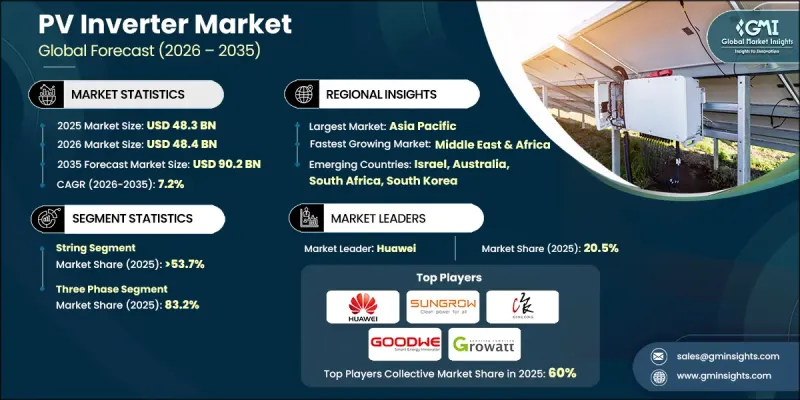
市场成长的驱动力在于大型电站、商业屋顶和住宅系统中太阳能发电的加速普及,这要求高效转换、严格的电网同步以及日益复杂的智慧电网支援能力。随着太阳能发电的日益普及,逆变器的功能也从单纯的转换硬体发展成为现代太阳能发电系统的控制层,发挥着至关重要的作用,管理电压和频率特性,提高电能质量,实现远距离诊断,并支持太阳能发电与储能相结合的混合配置。这种转变意味着,随着电网规范和安全要求的不断提高,尤其是在前期成本不断增加的情况下,客户更加重视长期可靠性、合规性和全生命週期性能。
| 市场范围 | |
|---|---|
| 开始年份 | 2025 |
| 预测年份 | 2026-2035 |
| 起始值 | 483亿美元 |
| 预测金额 | 902亿美元 |
| 复合年增长率 | 7.2% |
成长的主要支柱是数位化和物联网驱动的监控的快速转型。开发商和资产所有者希望透过即时了解逆变器效能、设定预测性维护触发条件以及加快故障排除速度,最大限度地减少停机时间并提高发电量。同时,混合太阳能和储能係统的普及正在推动市场发展,因为企业和家庭都在寻求透过备用电源、抑低尖峰负载和提高自用率来增强能源韧性并实现更优的能源经济效益。为了因应这些趋势,製造商正在努力开发具有更强大的併网/併网支援能力、改进的通讯协定和软体驱动优化功能的逆变器,使其发展成为能够与电网互动的设备,即使在可再生能源比例较高的环境中也能为电网稳定性做出贡献。
预计到2025年,串列型逆变器将占据53.7%的市场。组串式逆变器在住宅和小规模商业环境中仍是经济高效部署的核心产品,同时,由于额定功率的提升、多MPPT设计以及安全性和监控能力的增强,其应用范围也在不断扩大,涵盖了大规模屋顶安装和分散式计划。在不断成长的屋顶市场中,开发人员寻求在不牺牲性能的前提下优化系统平衡成本的设计方案,串列型逆变器持续吸引那些希望在效率、系统设计柔软性和易于维护性之间取得良好平衡的买家。
预计到2025年,三相逆变器市占率将达到83.2%,并在2026年至2035年间以7.5%的复合年增长率成长。太阳能发电系统在商业、工业和住宅领域的日益普及推动了三相光伏逆变器的应用,而三相逆变器需要平衡的功率分配、高效率和稳定的电网性能,以应对更大的负载和持续的能源消耗。此外,为了满足严格的併网标准和提高电能品质标准,多相逆变器的需求也不断增长。多相逆变器能够改善电压调节、降低谐波失真并增强频率稳定性,从而促进分散式太阳能发电平稳地併入本地电网。
预计到2025年,美国光电逆变器市占率将达到98.8%,到2035年将成长至90亿美元。联邦税额扣抵、各州可再生能源目标以及强劲的计划储备正在推动住宅、商业和公共产业太阳能领域对高效、併网兼容的电力转换解决方案的需求,同时,全国范围内大规模和分布式太阳能装置的快速扩张也促进了光伏逆变器的应用。主要行业参与者的存在及其在该地区持续推出先进产品系列的努力,预计将进一步支持市场的持续成长。
目录
第一章:调查方法和范围
第二章执行摘要
第三章业界考察
- 产业生态系统
- 原物料供应及采购分析
- 製造能力评估
- 供应链韧性与风险因素
- 电力分配网路分析
- 监管环境
- 影响产业的因素
- 促进因素
- 产业潜在风险与挑战
- 成长潜力分析
- 成本结构分析
- 价格趋势分析(美元/兆瓦)
- 副产品
- 波特五力分析
- PESTEL 分析
- 技术与创新现状
- 最大功率点追踪(MPPT)技术的进步
- 人工智慧智慧逆变器技术
- 混合逆变器集成
- 投资与资金筹措分析
- 创业投资与私募股权投资
- 政府奖励和补贴的影响
- 主要企业研发投资趋势
第四章 竞争情势
- 介绍
- 企业市占率分析:按地区划分
- 北美洲
- 欧洲
- 亚太地区
- 拉丁美洲
- 中东和非洲
- 战略仪錶板
- 策略倡议
- 企业标竿管理
- 创新与科技趋势
第五章 市场规模及预测:依产品划分,2022-2035年
- 细绳
- 微
- 中央
第六章 市场规模及预测:依阶段划分,2022-2035年
- 单相
- 三相
第七章 市场规模及预测:以连结方式划分,2022-2035年
- 独立的
- 并网型
第八章 市场规模及预测:以额定产量计算,2022-2035年
- ≤0.5千瓦
- 0.5–3千瓦
- 3~33 kW
- 33~110 kW
- 超过110千瓦
第九章 市场规模及预测:依额定输出电压划分,2022-2035年
- ≤230伏
- 230-400伏
- 400-600 V
- 超过600伏
第十章 市场规模及预测:依应用领域划分,2022-2035年
- 住宅
- 商业和工业
- 公共产业
第十一章 市场规模及预测:依地区划分,2022-2035年
- 北美洲
- 我们
- 加拿大
- 欧洲
- 德国
- 义大利
- 波兰
- 荷兰
- 奥地利
- 英国
- 法国
- 亚太地区
- 中国
- 澳洲
- 印度
- 日本
- 韩国
- 中东和非洲
- 以色列
- 沙乌地阿拉伯
- 阿拉伯聯合大公国
- 南非
- 拉丁美洲
- 巴西
- 墨西哥
- 智利
第十二章:公司简介
- Altenergy Power System
- Canadian Solar
- Darfon Electronics
- Delta Electronics
- Eaton
- Enphase Energy
- Fimer Group
- Fronius International
- General Electric
- Ginlong Technologies
- GoodWe
- Growatt New Energy
- Hitachi Hi-Rel Power Electronics
- Huawei Technologies
- Panasonic Corporation
- Schneider Electric
- SHENZHEN Sofarsolar
- Siemens
- SMA Solar Technology
- Sineng Electric
- SolarEdge Technologies
- Sungrow
- Tabuchi Electric
- TMEIC
The Global PV Inverter Market was valued at USD 48.3 billion in 2025 and is estimated to grow at a 7.2% CAGR to reach USD 90.2 billion by 2035.
Market growth is supported by accelerating solar PV deployments across utility-scale parks, commercial rooftops, and residential systems that require high-efficiency conversion, tight grid synchronization, and increasingly smart grid-support functionality. As solar penetration increases, inverters are no longer viewed as simple conversion hardware; they are becoming the control layer for modern PV systems, managing voltage and frequency behavior, improving power quality, enabling remote diagnostics, and increasingly supporting hybrid configurations that combine PV with energy storage. This shift is pushing customers to prioritize long-term reliability, compliance, and lifecycle performance, not just upfront pricing, especially where grid codes and safety requirements continue to tighten.
| Market Scope | |
|---|---|
| Start Year | 2025 |
| Forecast Year | 2026-2035 |
| Start Value | $48.3 Billion |
| Forecast Value | $90.2 Billion |
| CAGR | 7.2% |
A major growth pillar is the rapid movement toward digitalization and IoT-enabled monitoring, where developers and asset owners want real-time visibility of inverter performance, predictive maintenance triggers, and faster troubleshooting to minimize downtime and maximize yields. In parallel, the market is benefiting from the rise of hybrid solar and storage systems as businesses and households seek resilience and better energy economics through backup power, peak shaving, and improved self-consumption. These trends are encouraging manufacturers to deliver inverters with stronger grid-forming / grid-support capabilities, improved communication protocols, and software-driven optimization, turning the inverter into a grid-interactive device that helps stabilize networks under high renewable penetration.
The string inverters segment held 53.7% share in 2025, as they remain the workhorse for cost-effective deployments in residential and smaller commercial installations while also scaling into larger rooftop and distributed projects with improved power ratings, multi-MPPT designs, and enhanced safety and monitoring features. String inverters continue to attract buyers looking for a strong balance of efficiency, system design flexibility, and manageable maintenance in markets where rooftops are expanding, and developers want designs that optimize BOS costs without sacrificing performance.
The three-phase segment captured 83.2% share in 2025 and is projected to grow at a CAGR of 7.5% between 2026 and 2035. The expanding deployment of commercial, industrial, and multi-unit residential solar installations is driving the adoption of three-phase PV inverters, as these systems demand balanced power distribution, higher efficiency, and stable grid performance to handle larger loads and sustained energy consumption. Additionally, stricter grid-code compliance and rising power-quality standards are boosting the demand for multi-phase inverters, which provide enhanced voltage regulation, reduced harmonic distortion, and improved frequency stability, enabling smooth integration of distributed solar generation into regional transmission and distribution networks.
U.S. PV Inverter Market held 98.8% share in 2025 and is projected to generate USD 9 billion by 2035. Rapid growth of utility-scale and distributed solar installations across the country is fueling PV inverter adoption, as federal tax credits, state-level renewable energy targets, and extensive project pipelines drive demand for efficient, grid-compliant power conversion solutions across residential, commercial, and utility solar sectors. The presence of major industry players and their continued initiatives to introduce advanced product portfolios in the region are further expected to support sustained market expansion.
Key players involved in the Global PV Inverter Market include Huawei Technologies, Sungrow Power Supply, Ginlong Solis, Growatt, Enphase Energy, SolarEdge Technologies, SMA Solar Technology, GoodWe, Delta Electronics, Siemens, Schneider Electric, TMEIC, GE Vernova, Fronius International, Canadian Solar, Altenergy Power System (APsystems), Eaton, Panasonic, SINENG, Hitachi Hi-Rel Power Electronics, DARFON, MA Solar Italy, SOFARSOLAR, TABUCHI ELECTRIC. Companies are strengthening their foothold by pushing technology differentiation, grid-support inverters with reactive power control, voltage regulation, and advanced compliance features that make approvals smoother and performance more bankable. They are investing heavily in digital platforms (cloud monitoring, remote diagnostics, predictive maintenance) to reduce downtime and create recurring revenue through subscriptions, extended warranties, and lifecycle services. Another common strategy is expanding hybrid and storage-ready inverter portfolios to capture the fast-growing solar-plus-storage demand across residential and C&I sites.
Table of Contents
Chapter 1 Methodology & Scope
- 1.1 Research design
- 1.2 Quality commitment
- 1.2.1 GMI AI policy & data integrity commitment
- 1.2.1.1 Source consistency protocol
- 1.2.1 GMI AI policy & data integrity commitment
- 1.3 Research Trail & Confidence Scoring
- 1.3.1 Research Trail Components
- 1.3.2 Scoring Components
- 1.4 Data Collection
- 1.4.1 Partial list of primary sources
- 1.5 Data mining sources
- 1.5.1 Paid sources
- 1.5.1.1 Sources, by region
- 1.5.1 Paid sources
- 1.6 Base estimates and calculations
- 1.6.1 Base year calculation for any one approach
- 1.7 Forecast model
- 1.8 Research transparency addendum
- 1.8.1 Source attribution framework
- 1.8.2 Quality assurance metrics
- 1.8.3 Our commitment to trust
- 1.9 Market definitions
Chapter 2 Executive Summary
- 2.1 Industry synopsis, 2022 - 2035
- 2.2 Business trends
- 2.3 Product trends
- 2.4 Phase trends
- 2.5 Connectivity trends
- 2.6 Nominal Output Power trends
- 2.7 Nominal Output Voltage trends
- 2.8 Application trends
- 2.9 Regional trends
Chapter 3 Industry Insights
- 3.1 Industry ecosystem
- 3.1.1 Raw material availability & sourcing analysis
- 3.1.2 Manufacturing capacity assessment
- 3.1.3 Supply chain resilience & risk factors
- 3.1.4 Distribution network analysis
- 3.2 Regulatory landscape
- 3.3 Industry impact forces
- 3.3.1 Growth drivers
- 3.3.2 Industry pitfalls & challenges
- 3.4 Growth potential analysis
- 3.5 Cost structure analysis
- 3.6 Price trend analysis (USD/MW)
- 3.6.1 By product
- 3.7 Porter's analysis
- 3.7.1 Bargaining power of suppliers
- 3.7.2 Bargaining power of buyers
- 3.7.3 Threat of new entrants
- 3.7.4 Threat of substitutes
- 3.8 PESTEL analysis
- 3.8.1 Political factors
- 3.8.2 Economic factors
- 3.8.3 Social factors
- 3.8.4 Technological factors
- 3.8.5 Legal factors
- 3.8.6 Environmental factors
- 3.9 Technology & innovation landscape
- 3.9.1 Maximum power point tracking (MPPT) advancements
- 3.9.2 AI-powered & smart inverter technologies
- 3.9.3 Hybrid inverter integration
- 3.10 Investment & funding analysis
- 3.10.1 Venture capital & private equity investments
- 3.10.2 Government incentives & subsidies impact
- 3.10.3 R&D investment trends by leading players
Chapter 4 Competitive landscape, 2026
- 4.1 Introduction
- 4.2 Company market share analysis, by region, 2025
- 4.2.1 North America
- 4.2.2 Europe
- 4.2.3 Asia Pacific
- 4.2.4 Latin America
- 4.2.5 Middle East & Africa
- 4.3 Strategic dashboard
- 4.4 Strategic initiatives
- 4.5 Company benchmarking
- 4.6 Innovation & technology landscape
Chapter 5 Market Size and Forecast, By Product, 2022 - 2035 (USD Billion & MW)
- 5.1 Key trends
- 5.2 String
- 5.3 Micro
- 5.4 Central
Chapter 6 Market Size and Forecast, By Phase, 2022 - 2035 (USD Billion & MW)
- 6.1 Key trends
- 6.2 Single phase
- 6.3 Three phase
Chapter 7 Market Size and Forecast, By Connectivity, 2022 - 2035 (USD Billion & MW)
- 7.1 Key trends
- 7.2 Standalone
- 7.3 On grid
Chapter 8 Market Size and Forecast, By Nominal Output Power, 2022 - 2035 (USD Billion & MW)
- 8.1 Key trends
- 8.2 ≤ 0.5 kW
- 8.3 0.5 - 3 kW
- 8.4 3 - 33 kW
- 8.5 33 - 110 kW
- 8.6 > 110 kW
Chapter 9 Market Size and Forecast, By Nominal Output Voltage, 2022 - 2035 (USD Billion & MW)
- 9.1 Key trends
- 9.2 ≤ 230 V
- 9.3 230 - 400 V
- 9.4 400 - 600 V
- 9.5 > 600 V
Chapter 10 Market Size and Forecast, By Application, 2022 - 2035 (USD Billion & MW)
- 10.1 Key trends
- 10.2 Residential
- 10.3 Commercial & industrial
- 10.4 Utility
Chapter 11 Market Size and Forecast, By Region, 2022 - 2035 (USD Billion & MW)
- 11.1 Key trends
- 11.2 North America
- 11.2.1 U.S.
- 11.2.2 Canada
- 11.3 Europe
- 11.3.1 Germany
- 11.3.2 Italy
- 11.3.3 Poland
- 11.3.4 Netherlands
- 11.3.5 Austria
- 11.3.6 UK
- 11.3.7 France
- 11.4 Asia Pacific
- 11.4.1 China
- 11.4.2 Australia
- 11.4.3 India
- 11.4.4 Japan
- 11.4.5 South Korea
- 11.5 Middle East & Africa
- 11.5.1 Israel
- 11.5.2 Saudi Arabia
- 11.5.3 UAE
- 11.5.4 South Africa
- 11.6 Latin America
- 11.6.1 Brazil
- 11.6.2 Mexico
- 11.6.3 Chile
Chapter 12 Company Profiles
- 12.1 Altenergy Power System
- 12.2 Canadian Solar
- 12.3 Darfon Electronics
- 12.4 Delta Electronics
- 12.5 Eaton
- 12.6 Enphase Energy
- 12.7 Fimer Group
- 12.8 Fronius International
- 12.9 General Electric
- 12.10 Ginlong Technologies
- 12.11 GoodWe
- 12.12 Growatt New Energy
- 12.13 Hitachi Hi-Rel Power Electronics
- 12.14 Huawei Technologies
- 12.15 Panasonic Corporation
- 12.16 Schneider Electric
- 12.17 SHENZHEN Sofarsolar
- 12.18 Siemens
- 12.19 SMA Solar Technology
- 12.20 Sineng Electric
- 12.21 SolarEdge Technologies
- 12.22 Sungrow
- 12.23 Tabuchi Electric
- 12.24 TMEIC

 太阳能逆变器市场:按产品、组件、类型、相数、输出、销售管道和应用划分-2026-2032年全球市场预测太阳能逆变器市场:2026-2032年全球市场预测(依逆变器类型、相数、额定输出、系统类型、输出电压、应用、安装方式及销售管道)太阳能逆变器测试解决方案市场:按应用、逆变器类型、输出额定值和测试类型划分,全球预测(2026-2032年)
 太阳能逆变器:市场占有率分析、产业趋势与统计、成长预测(2026-2031)
 2026-2034年全球商用和工业用太阳能逆变器市场规模、份额、趋势和成长分析报告2026-2034年全球独立式太阳能逆变器市场规模、份额、趋势和成长分析报告全球太阳能微型逆变器市场规模、份额、趋势和成长分析报告(2026-2034年)全球太阳能逆变器市场规模、份额、趋势和成长分析报告(2026-2034)
 日本太阳能逆变器市场规模、份额、趋势和预测:按逆变器类型、应用和地区划分,2026-2034年
 2026年全球住宅太阳能逆变器市场报告