


 |
市场调查报告书
商品编码
1982324
交通运输用生质燃料的市场机会、成长要素、产业趋势分析及 2026-2035 年预测。Transportation Biofuel Market Opportunity, Growth Drivers, Industry Trend Analysis, and Forecast 2026 - 2035 |
||||||

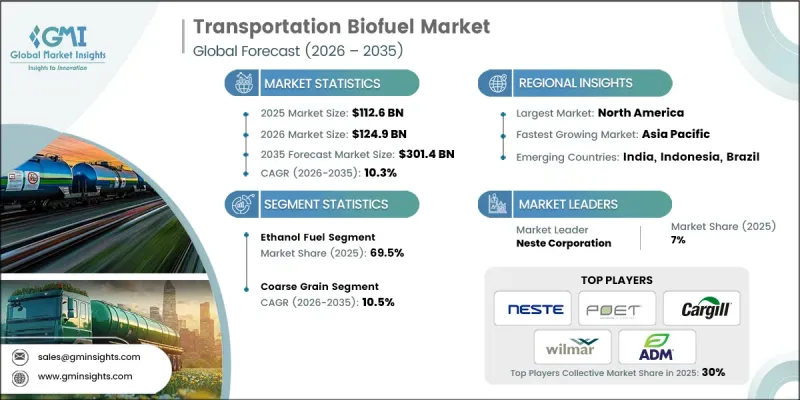
预计到 2025 年,全球运输生质燃料市场价值将达到 1,126 亿美元,并预计以 10.3% 的复合年增长率成长,到 2035 年达到 3,014 亿美元。
主要市场的政策框架正从宽泛的可再生能源目标转向具体的燃料强制性规定,将生质燃料纳入交通运输产业的长期脱碳策略。这种转变在航空、道路运输以及日益重要的海运领域尤其显着,这些领域透过合格规则和永续性标准来界定哪些燃料需要遵守监管规定。随着各国实施这些框架,专门的报告系统、註册系统和预设值正在创造一个规则主导的环境,从而支持对先进生质燃料和可再生替代燃料的投资。由于液态能源的替代能源有限,永续航空燃料(SAF)已成为航空业成长的主要驱动力。关于最低混合要求和永续性标准的监管确定性正在推动炼油厂的改造、协同加工倡议和新计画的开展。航空公司、机场和燃料供应商正在采用综合采购、认证和预订索赔(B&C)机制。随着SAF从试验计画过渡到常规供应,长期供应协议、产能扩张和原材料多样化正在经核准的生产管道中加速推进。
| 市场范围 | |
|---|---|
| 开始年份 | 2025 |
| 预测期 | 2026-2035 |
| 上市时的市场规模 | 1126亿美元 |
| 预测金额 | 3014亿美元 |
| 复合年增长率 | 10.3% |
预计到2025年,乙醇产业将占据69.5%的市场份额,并在2035年之前以10.5%的复合年增长率成长。这一增长主要得益于农业政策、炼油厂整合以及交通运输领域脱碳奖励的协同效应,这些措施鼓励降低碳辛烷值。各国政府持续扩大乙醇掺混义务和适用原料的范围,汽车製造商正在检验其产品是否适用于高浓度混合燃料,而燃料零售商则在增加供应以降低推广门槛。生产商正投资于製程优化、降低碳排放强度以及提升产品特定价值,以在不断变化的碳计量框架下增强自身竞争力。
预计到2025年,粗粒谷物乙醇市占率将达到37.8%,到2035年将以10.5%的复合年增长率成长。其地理分布广泛且储量丰富的供应来源、成熟的转化技术以及可预测的产品特定经济效益,使粗粒谷物成为乙醇生态系统的核心组成部分。儘管轻型车辆的电气化程度不断提高,但由于粗粒谷物乙醇有助于提高辛烷值、具有广泛的车辆相容性,并且有望成为未来生物中间体和电子燃料前体的生产平台,因此它在汽油市场中仍然扮演着重要的结构性角色。
美国运输生质燃料市场占93%的份额,预计2025年市场规模将达到339亿美元。这得益于健全的合规体系、成熟的供应链以及对全生命週期性能的重视。美国可再生燃料标准(RFS)透过信用市场、路线合格和年度标准为生产商和混合商提供支持,从而促进对纤维素乙醇、运输沼气、低碳乙醇和生物柴油的投资。联邦和地方政府计画正不断完善永续性指标,推动製程效率提升、碳排放强度降低、热能利用整合、碳捕获能力建设以及原料多样化。
目录
第一章:调查方法和范围
第二章执行摘要
第三章业界考察
- 生态系分析
- 监理情势
- 影响产业的因素
- 促进因素
- 产业潜在风险与挑战
- 成长潜力分析
- 波特的分析
- 供应商的议价能力
- 买方的议价能力
- 新进入者的威胁
- 替代品的威胁
- PESTEL 分析
- 新机会与趋势
- 数位化和物联网集成
- 进入新兴市场
第四章 竞争情势
- 介绍
- 企业市占率分析
- 北美洲
- 欧洲
- 亚太地区
- 中东和非洲
- 拉丁美洲
- 竞争性标竿分析
- 战略仪錶板
- 创新与科技趋势
第五章 市场规模及预测:依燃料类型划分,2022-2035年
- 生质柴油
- 乙醇
- 其他的
第六章 市场规模及预测:依原料划分,2022-2035年
- 粗粒颗粒
- 糖料作物
- 植物油
- 其他的
第七章 市场规模及预测:依地区划分,2022-2035年
- 北美洲
- 我们
- 加拿大
- 墨西哥
- 欧洲
- 德国
- 法国
- 西班牙
- 英国
- 义大利
- 亚太地区
- 中国
- 印度
- 印尼
- 澳洲
- 韩国
- 中东和非洲
- 沙乌地阿拉伯
- 南非
- 拉丁美洲
- 巴西
- 阿根廷
第八章:公司简介
- ADM
- Borregaard
- BTG Bioliquids
- Cargill
- Chevron Corporation
- Clariant
- COFCO
- FutureFuel
- Inpasa
- Munzer Bioindustrie
- My Eco Energy
- Neste Corporation
- POET
- Praj Industries
- The Andersons
- TotalEnergies
- UPM
- Verbio
- Wilmar International
- Zilor
The Global Transportation Biofuel Market was valued at USD 112.6 billion in 2025 and is estimated to grow at a CAGR of 10.3% to reach USD 301.4 billion by 2035.
Policy frameworks across key markets are evolving from broad renewable targets to precise fuel mandates that embed biofuels into long-term transport decarbonization strategies. This transition is evident across aviation, road transport, and increasingly maritime sectors, where eligibility rules and sustainability criteria define which fuels qualify for compliance. As nations implement these frameworks, professionalized reporting, registry systems, and default values create a rules-driven environment that supports investment in advanced biofuels and renewable drop-in fuels. Sustainable aviation fuel (SAF) is a major growth driver, given the limited alternatives to liquid energy in aviation. Regulatory certainty around minimum blending requirements and sustainability standards is encouraging refinery conversions, co-processing initiatives, and greenfield projects. Airlines, airports, and fuel suppliers are adopting integrated procurement, certification, and book-and-claim mechanisms. As SAF moves from pilot programs to routine supply, long-term offtake agreements, capacity expansion, and feedstock diversification are accelerating across approved production pathways.
| Market Scope | |
|---|---|
| Start Year | 2025 |
| Forecast Year | 2026-2035 |
| Start Value | $112.6 Billion |
| Forecast Value | $301.4 Billion |
| CAGR | 10.3% |
The ethanol segment held 69.5% share in 2025 and is expected to grow at a CAGR of 10.5% through 2035. Growth is driven by the convergence of agricultural policy, refinery integration, and transport decarbonization incentives rewarding low-carbon octane. Governments continue expanding blending mandates and eligible feedstocks, while automakers validate higher blend compatibility and fuel retailers increase availability, reducing adoption barriers. Producers are investing in process optimization, carbon intensity reduction, and coproduct valorization to enhance competitiveness under evolving carbon accounting frameworks.
The coarse grain segment accounted for 37.8% share in 2025 and is projected to grow at a CAGR of 10.5% by 2035. Its large, geographically diversified supply, mature conversion technologies, and predictable coproduct economics make coarse grains central to the ethanol ecosystem. Despite growing electrification in light-duty fleets, coarse-grain ethanol maintains a structural role in gasoline pools due to octane contribution, broad vehicle compatibility, and potential as a platform for future bio-intermediates and e-fuel precursors.
U.S. Transportation Biofuel Market held 93% share, generating USD 33.9 billion in 2025, driven by a robust compliance framework, mature supply chains, and focus on lifecycle performance. The U.S. Renewable Fuel Standard (RFS) underpins producer and blender behavior through credit markets, pathway eligibility, and annual standards, supporting investment in cellulosic ethanol, biogas for transport, and low-carbon ethanol and biodiesel. Federal and subnational programs increasingly refine sustainability measurement, promoting process efficiency, carbon intensity reduction, heat integration, carbon capture readiness, and feedstock diversification.
Key players in the Global Transportation Biofuel Market include Neste Corporation, POET, ADM, Praj Industries, Borregaard, FutureFuel, My Eco Energy, Wilmar International, Clariant, TotalEnergies, BTG Bioliquids, Chevron Corporation, Cargill, UPM, Inpasa, Verbio, The Andersons, Munzer Bioindustrie, COFCO, and Zilor. Companies in the Global Transportation Biofuel Market are employing multiple strategies to solidify their market position. They are investing in R&D to optimize conversion efficiency, reduce carbon intensity, and expand eligible feedstocks. Strategic partnerships with OEMs, fuel distributors, and aviation stakeholders enhance market access and long-term offtake agreements. Firms are also modernizing production infrastructure, adopting co-processing and integrated refinery approaches, and expanding geographically to capture emerging demand.
Table of Contents
Chapter 1 Methodology & Scope
- 1.1 Research approach
- 1.2 Quality commitment
- 1.2.1 GMI AI policy & data integrity commitment
- 1.2.1.1 Source consistency protocol
- 1.2.1 GMI AI policy & data integrity commitment
- 1.3 Research Trail & Confidence Scoring
- 1.3.1 Research Trail Components
- 1.3.2 Scoring Components
- 1.4 Data Collection
- 1.4.1 Partial list of primary sources
- 1.5 Data mining sources
- 1.5.1 Paid sources
- 1.5.1.1 Sources, by region
- 1.5.1 Paid sources
- 1.6 Base estimates and calculations
- 1.6.1 Base year calculation for any one approach
- 1.7 Forecast model
- 1.8 Research transparency addendum
- 1.8.1 Source attribution framework
- 1.8.2 Quality assurance metrics
- 1.8.3 Our commitment to trust
- 1.9 Market definitions
Chapter 2 Executive Summary
- 2.1 Industry synopsis, 2022 - 2035
- 2.1.1 Business trends
- 2.1.2 Fuel trends
- 2.1.3 Feedstock trends
- 2.1.4 Regional trends
Chapter 3 Industry Insights
- 3.1 Industry ecosystem analysis
- 3.2 Regulatory landscape
- 3.3 Industry impact forces
- 3.3.1 Growth drivers
- 3.3.2 Industry pitfalls & challenges
- 3.4 Growth potential analysis
- 3.5 Porter's analysis
- 3.5.1 Bargaining power of suppliers
- 3.5.2 Bargaining power of buyers
- 3.5.3 Threat of new entrants
- 3.5.4 Threat of substitutes
- 3.6 PESTEL analysis
- 3.6.1 Political factors
- 3.6.2 Economic factors
- 3.6.3 Social factors
- 3.6.4 Technology factors
- 3.6.5 environmental factors
- 3.6.6 Legal factors
- 3.7 Emerging opportunities & trends
- 3.7.1 Digitalization and IoT integration
- 3.7.2 Emerging market penetration
Chapter 4 Competitive landscape, 2025
- 4.1 Introduction
- 4.2 Company market share analysis, 2025
- 4.2.1 North America
- 4.2.2 Europe
- 4.2.3 Asia Pacific
- 4.2.4 Middle East & Africa
- 4.2.5 Latin America
- 4.3 Competitive benchmarking
- 4.4 Strategic dashboard
- 4.5 Innovation & technology landscape
Chapter 5 Market Size and Forecast, By Fuel, 2022 - 2035 (USD Million, Mtoe)
- 5.1 Key trends
- 5.2 Biodiesel
- 5.3 Ethanol
- 5.4 Others
Chapter 6 Market Size and Forecast, By Feedstock, 2022 - 2035 (USD Million, Mtoe)
- 6.1 Key trends
- 6.2 Coarse grain
- 6.3 Sugar crop
- 6.4 Vegetable oil
- 6.5 Others
Chapter 7 Market Size and Forecast, By Region, 2022 - 2035 (USD Million, Mtoe)
- 7.1 Key trends
- 7.2 North America
- 7.2.1 U.S.
- 7.2.2 Canada
- 7.2.3 Mexico
- 7.3 Europe
- 7.3.1 Germany
- 7.3.2 France
- 7.3.3 Spain
- 7.3.4 UK
- 7.3.5 Italy
- 7.4 Asia Pacific
- 7.4.1 China
- 7.4.2 India
- 7.4.3 Indonesia
- 7.4.4 Australia
- 7.4.5 South Korea
- 7.5 Middle East & Africa
- 7.5.1 Saudi Arabia
- 7.5.2 South Africa
- 7.6 Latin America
- 7.6.1 Brazil
- 7.6.2 Argentina
Chapter 8 Company Profiles
- 8.1 ADM
- 8.2 Borregaard
- 8.3 BTG Bioliquids
- 8.4 Cargill
- 8.5 Chevron Corporation
- 8.6 Clariant
- 8.7 COFCO
- 8.8 FutureFuel
- 8.9 Inpasa
- 8.10 Munzer Bioindustrie
- 8.11 My Eco Energy
- 8.12 Neste Corporation
- 8.13 POET
- 8.14 Praj Industries
- 8.15 The Andersons
- 8.16 TotalEnergies
- 8.17 UPM
- 8.18 Verbio
- 8.19 Wilmar International
- 8.20 Zilor

 生质燃料市场:2026-2032年全球市场预测(依生质燃料类型、製造流程、形态、原料类型、应用、最终用途及通路划分)乳化燃料市场:2026-2032年全球市场预测(按燃料类型、混合比例、分销管道、应用和最终用户划分)
 单细胞油市场规模、份额、成长及全球产业分析:按类型和应用、区域洞察及2026-2034年预测
 燃油品质感测器-全球市场份额和排名、总销售量和需求预测(2026-2032 年)
 2026年全球生质燃料催化剂市场研究报告
 生质燃料:市场占有率分析、产业趋势与统计、成长预测(2026-2031)全球交通运输用生质燃料市场:规模、份额、趋势和成长分析报告(2026-2034年)全球生物氢市场规模、份额、趋势和成长分析报告(2026-2034年)全球生质燃料市场规模、份额、趋势和成长分析报告(2026-2034年)
 日本生质燃料市场规模、份额、趋势和预测:按类型、原材料和地区划分,2026-2034年