


 |
市场调查报告书
商品编码
1982329
近红外线LED市场:成长机会、成长要素、产业趋势分析及2026-2035年预测。NIR LED Market Opportunity, Growth Drivers, Industry Trend Analysis, and Forecast 2026 - 2035 |
||||||

预计到 2025 年,全球近红外线LED 市场价值将达到 3.498 亿美元,预计到 2035 年将以 12.4% 的复合年增长率增长,达到 10.7 亿美元。
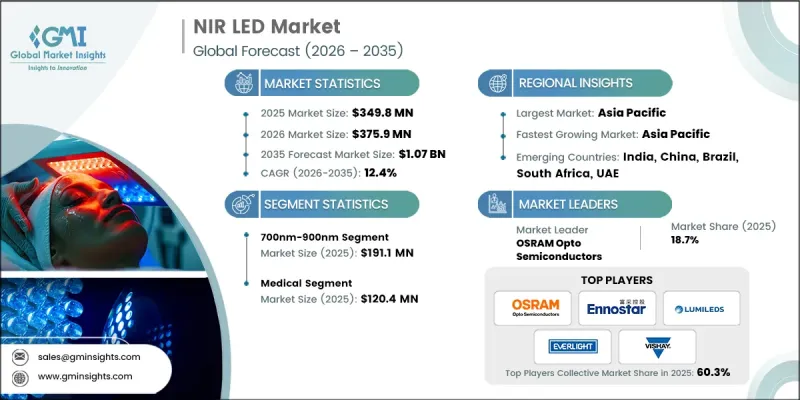
近红外线LED在医疗、生物医学成像、工业自动化、安防系统和家用电子电器等领域的日益普及推动了市场扩张。对非侵入式诊断技术和光学感测解决方案的需求不断增长,加速了其在医疗设备和监测系统中的应用。近红外线LED因其能够穿透生物组织而备受青睐,从而实现精确的生理测量和成像。各国政府和研究机构正优先推动光电和光学技术的进步,以提高诊断准确性并减少侵入性手术。同时,LED效率的提升、紧凑的设计和小型化正在推动其在穿戴式电子产品、监测平台和工业检测工具中的广泛应用。结合医疗保健领域的创新、先进的感测技术以及对节能组件日益增长的需求,近红外线LED市场正逐渐成为全球光电子产业的关键组成部分。
| 市场范围 | |
|---|---|
| 开始年份 | 2025 |
| 预测期 | 2026-2035 |
| 上市时的市场规模 | 3.498亿美元 |
| 预计金额 | 10.7亿美元 |
| 复合年增长率 | 12.4% |
近红外线波长能够可靠地穿透组织,支持生理监测、脉搏测量和穿戴式健康感测器等应用。这些技术有助于疾病早期检测、慢性病管理,并改善即时诊断的可近性,同时降低整体医疗成本。国防机构和国家研究机构也增加对光学感测和成像研究的投入,推动近红外线(NIR)LED在夜视系统、目标辨识和安防平台等领域的应用。公共资金对光电创新的投入也进一步加强了遥感探测和先进情境察觉技术的研究。
到2025年,700nm-900nm波段的市场规模将达到1.911亿美元。家用电子电器和生物识别系统的强劲需求正在推动该波长范围的应用,尤其是在脸部辨识、近距离检测和基于智慧型手机的健康监测等需要紧凑节能照明的功能领域。监控设备和汽车驾驶员监控解决方案的日益普及也进一步加速了这一增长,因为该波长范围在短距离夜视、车载感测和低光源环境下的影像增强方面表现出色。
预计到2025年,医疗产业市场规模将达到1.204亿美元。包括穿戴式监测设备和成像平台在内的非侵入式诊断设备的日益普及,推动了对近红外线LED的需求,因为近红外线LED能够实现精确的组织互动和即时生理测量。随着远端医疗服务和居家医疗系统的发展,紧凑、节能的近红外线LED组件在携带式医疗技术中的应用也呈现爆炸性成长。製造商正致力于开发小型、获得医疗认证、高精度的近红外线LED模组,这些模组针对可穿戴诊断和临床成像应用进行了优化,旨在加强与医疗设备製造商的长期伙伴关係。
预计到2025年,北美近红外线LED市场占有率将达到32.7%。该地区仍然是近红外线LED的主要应用中心,这得益于其在安防系统、汽车安全技术、工业自动化平台和先进医疗保健解决方案等领域的强劲应用。强大的研发基础设施、高额的技术投资以及对生物识别和机器视觉应用的旺盛需求,持续推动创新发展。公共部门对半导体和光电发展的支持,以及製造业奖励,正在促进区域市场成长。製造商正优先考虑为汽车感测和工业检测应用建立可扩展的生产能力,并利用先进的自动化基础设施来满足国防、医疗和工业领域的需求。
目录
第一章:调查方法和范围
第二章执行摘要
第三章业界考察
- 生态系分析
- 供应商情况
- 利润率
- 成本结构
- 每个阶段增加的价值
- 影响价值链的因素
- 中断
- 影响产业的因素
- 促进因素
- 扩大生物医学和医疗保健领域的招募。
- 对夜视和监控系统的需求日益增长
- 在工业检测和品管。
- LED效率和小型化的进展
- 家用电器整合的进展
- 陷阱与挑战
- 高性能近红外线LED的製造成本高昂
- 特定应用中波长范围的限制
- 促进因素
- 成长潜力分析
- 监理情势
- 北美洲
- 欧洲
- 亚太地区
- 拉丁美洲
- 中东和非洲
- 波特的分析
- PESTEL 分析
- 科技与创新趋势
- 当前技术趋势
- 新兴技术
- 新兴经营模式
- 合规要求
- 供应链韧性
- 地缘政治分析
第四章 竞争情势
- 介绍
- 企业市占率分析
- 按地区
- 北美洲
- 欧洲
- 亚太地区
- 拉丁美洲
- 中东和非洲
- 市场集中度分析
- 按地区
- 主要企业的竞争标竿分析
- 产品系列比较
- 产品线
- 科技
- 创新
- 区域部署对比
- 全球扩张分析
- 服务网路覆盖
- 按地区分類的市场渗透率
- 竞争定位矩阵
- 领导者
- 挑战者
- 追踪者
- 小众玩家
- 战略展望矩阵
- 产品系列比较
- 2022-2025 年重大发展
- 併购
- 伙伴关係和联盟
- 技术进步
- 业务拓展与投资策略
- 永续发展倡议
- 数位转型计划
- 新兴/Start-Ups竞争对手的发展趋势
第五章 市场估计与预测:依频谱范围划分,2022-2035年
- 700nm~900nm
- 900nm~1500nm
- 1500nm~2500nm
- 自订波段
第六章 市场估计与预测:依应用领域划分,2022-2035年
- 医疗保健
- 脉搏血氧计
- 皮肤科
- 动态疗法
- 其他的
- 太阳能发电模拟器
- 用于太阳能电池测试的太阳能模拟
- 太空船太阳能板模拟
- 其他的
- 机器视觉
- 食品检验
- 产品排序
- 品管
- 其他的
- 光学分选
- 材料分类与回收
- 其他的
- 感测器和检测
- 气体检测
- 环境监测
- 接近感测器
- 其他的
- 安全与监控
- 脸部辨识
- 夜视摄影机
- 监视器
- 其他的
第七章 市场估计与预测:依地区划分,2022-2035年
- 北美洲
- 我们
- 加拿大
- 欧洲
- 德国
- 英国
- 法国
- 西班牙
- 义大利
- 荷兰
- 亚太地区
- 中国
- 印度
- 日本
- 澳洲
- 韩国
- 拉丁美洲
- 巴西
- 墨西哥
- 阿根廷
- 中东和非洲
- 沙乌地阿拉伯
- 南非
- 阿拉伯聯合大公国
第八章:公司简介
- 主要企业
- OSRAM Opto Semiconductors Inc.
- Lumileds
- ON Semiconductor
- Excelitas Technologies Corporation
- Hamamatsu Photonics
- 按地区分類的主要企业
- 北美洲
- Vishay Intertechnology
- Marktech Optoelectronics
- High Power Lighting Corporation
- 欧洲
- Brightek (Europe) Limited
- Wurth Electronics Inc.
- Alpha One Electronics Ltd
- 亚太地区
- Epistar Corporation
- Everlight Electronics Co Ltd
- Lextar Electronics Corporation
- Lite-On Inc.
- Kingbright
- DOWA Electronics Materials Co., Ltd.
- 北美洲
- 小众/颠覆者
- EPILEDS
- Sensors Unlimited
- Ushio OPTO Semiconductors Inc.
The Global NIR LED Market was valued at USD 349.8 million in 2025 and is estimated to grow at a CAGR of 12.4% to reach USD 1.07 billion by 2035.
Market expansion is driven by increasing integration of near-infrared LEDs across healthcare, biomedical imaging, industrial automation, security systems, and consumer electronics. Rising demand for non-invasive diagnostic technologies and optical sensing solutions is accelerating adoption in medical devices and monitoring systems. NIR LEDs are widely recognized for their ability to penetrate biological tissue, enabling accurate physiological measurements and imaging capabilities. Governments and research institutions are prioritizing advancements in photonics and optical technologies to enhance diagnostic precision and reduce invasive procedures. At the same time, improvements in LED efficiency, compact design, and miniaturization are supporting broader integration into wearable electronics, surveillance platforms, and industrial inspection tools. The convergence of healthcare innovation, advanced sensing technologies, and growing demand for energy-efficient components is positioning the NIR LED market as a critical segment within the global optoelectronics industry.
| Market Scope | |
|---|---|
| Start Year | 2025 |
| Forecast Year | 2026-2035 |
| Start Value | $349.8 Million |
| Forecast Value | $1.07 Billion |
| CAGR | 12.4% |
Near-infrared wavelengths enable reliable tissue penetration, supporting applications such as physiological monitoring, pulse measurement, and wearable health sensors. These technologies contribute to early disease detection, chronic condition management, and improved accessibility to point-of-care diagnostics while helping reduce overall healthcare costs. Defense organizations and national research bodies are also investing in optical sensing and imaging research, increasing the deployment of NIR LEDs in night vision systems, target identification, and security platforms. Public funding directed toward photonics innovation is further strengthening research in remote sensing and advanced situational awareness technologies.
The 700nm-900nm segment generated USD 191.1 million in 2025. Strong demand from consumer electronics and biometric authentication systems is driving adoption within this spectral range, particularly for facial recognition, proximity detection, and smartphone-based health monitoring functions that require compact and energy-efficient illumination. Expanded deployment in surveillance equipment and automotive driver monitoring solutions is further accelerating growth, as this wavelength range delivers optimal performance for short-range night vision, cabin sensing, and low-light image enhancement.
The medical segment reached USD 120.4 million in 2025. Increasing adoption of non-invasive diagnostic devices, including wearable monitors and imaging platforms, is fueling demand for NIR LEDs capable of precise tissue interaction and real-time physiological measurement. Growth in telehealth services and home-based healthcare systems is encouraging integration of compact and energy-efficient NIR LED components into portable medical technologies. Manufacturers are focusing on developing medically certified, miniaturized, and high-accuracy NIR LED modules tailored for wearable diagnostics and clinical imaging applications to strengthen long-term partnerships with healthcare device manufacturers.
North America NIR LED Market accounted for 32.7% share in 2025. The region remains a leading center for adoption, supported by strong implementation across security systems, automotive safety technologies, industrial automation platforms, and advanced healthcare solutions. Robust research infrastructure, high technology spending, and strong demand for biometric and machine vision applications continue to drive innovation. Public sector support for semiconductor and photonics development, combined with manufacturing incentives, is reinforcing regional market growth. Manufacturers are prioritizing scalable production capabilities for automotive sensing and industrial inspection applications while leveraging advanced automation infrastructure to meet demand from defense, healthcare, and industrial sectors.
Key companies operating in the Global NIR LED Market include OSRAM Opto Semiconductors Inc., Lumileds, ON Semiconductor, Vishay Intertechnology, ROHM Semiconductor, Hamamatsu Photonics, Excelitas Technologies Corporation, Everlight Electronics Co Ltd, Epistar Corporation, Lextar Electronics Corporation, Lite-On Inc., Marktech Optoelectronics, Kingbright, Ushio OPTO Semiconductors Inc., Sensors Unlimited, Wurth Electronics Inc., EPILEDS, DOWA Electronics Materials Co., Ltd., Alpha One Electronics Ltd, High Power Lighting Corporation, and Brightek (Europe) Limited. Companies in the NIR LED Market are strengthening their competitive positioning through continuous innovation, product miniaturization, and strategic collaborations with OEMs across healthcare, automotive, and consumer electronics industries. Leading players are investing in advanced chip design, improved thermal management, and higher optical output efficiency to differentiate their offerings. Many manufacturers are expanding fabrication capacity and adopting automated production systems to achieve cost optimization and scalability. Partnerships with medical device manufacturers and automotive system integrators enable tailored solutions and long-term supply agreements.
Table of Contents
Chapter 1 Methodology and Scope
- 1.1 Market scope and definition
- 1.2 Research design
- 1.2.1 Research approach
- 1.2.2 Data collection methods
- 1.3 Data mining sources
- 1.3.1 Global
- 1.3.2 Regional/Country
- 1.4 Base estimates and calculations
- 1.4.1 Base year calculation
- 1.4.2 Key trends for market estimation
- 1.5 Primary research and validation
- 1.5.1 Primary sources
- 1.6 Forecast model
- 1.7 Research assumptions and limitations
Chapter 2 Executive Summary
- 2.1 Industry 360° synopsis
- 2.2 Key market trends
- 2.2.1 Spectral range trends
- 2.2.2 Application trends
- 2.2.3 Regional trends
- 2.3 TAM Analysis, 2026-2035 (USD Million)
- 2.4 CXO perspectives: Strategic imperatives
- 2.4.1 Executive decision points
- 2.4.2 Critical success factors
- 2.5 Future outlook and strategic recommendations
Chapter 3 Industry Insights
- 3.1 Industry ecosystem analysis
- 3.1.1 Supplier landscape
- 3.1.2 Profit margin
- 3.1.3 Cost structure
- 3.1.4 Value addition at each stage
- 3.1.5 Factor affecting the value chain
- 3.1.6 Disruptions
- 3.2 Industry impact forces
- 3.2.1 Growth drivers
- 3.2.1.1 Rising adoption in biomedical and healthcare applications
- 3.2.1.2 Increasing demand for night vision and surveillance systems
- 3.2.1.3 Growing use in industrial inspection and quality control
- 3.2.1.4 Advancements in LED efficiency and miniaturization
- 3.2.1.5 Rising consumer electronics integration
- 3.2.2 Pitfalls and challenges
- 3.2.2.1 High manufacturing costs of high-performance NIR LEDs
- 3.2.2.2 Limited wavelength range for specific applications
- 3.2.1 Growth drivers
- 3.3 Growth potential analysis
- 3.4 Regulatory landscape
- 3.4.1 North America
- 3.4.2 Europe
- 3.4.3 Asia Pacific
- 3.4.4 Latin America
- 3.4.5 Middle East & Africa
- 3.5 Porter’s analysis
- 3.6 PESTEL analysis
- 3.7 Technology and Innovation landscape
- 3.7.1 Current technological trends
- 3.7.2 Emerging technologies
- 3.8 Emerging Business Models
- 3.9 Compliance Requirements
- 3.10 Supply Chain Resilience
- 3.11 Geopolitical Analysis
Chapter 4 Competitive Landscape, 2025
- 4.1 Introduction
- 4.2 Company market share analysis
- 4.2.1 By region
- 4.2.1.1 North America
- 4.2.1.2 Europe
- 4.2.1.3 Asia Pacific
- 4.2.1.4 Latin America
- 4.2.1.5 Middle East & Africa
- 4.2.2 Market concentration analysis
- 4.2.1 By region
- 4.3 Competitive benchmarking of key players
- 4.3.1 Product portfolio comparison
- 4.3.1.1 Product range breadth
- 4.3.1.2 Technology
- 4.3.1.3 Innovation
- 4.3.2 Geographic presence comparison
- 4.3.2.1 Global footprint analysis
- 4.3.2.2 Service network coverage
- 4.3.2.3 Market penetration by region
- 4.3.3 Competitive positioning matrix
- 4.3.3.1 Leaders
- 4.3.3.2 Challengers
- 4.3.3.3 Followers
- 4.3.3.4 Niche players
- 4.3.4 Strategic outlook matrix
- 4.3.1 Product portfolio comparison
- 4.4 Key developments, 2022-2025
- 4.4.1 Mergers and acquisitions
- 4.4.2 Partnerships and collaborations
- 4.4.3 Technological advancements
- 4.4.4 Expansion and investment strategies
- 4.4.5 Sustainability initiatives
- 4.4.6 Digital transformation initiatives
- 4.5 Emerging/ startup competitors landscape
Chapter 5 Market Estimates and Forecast, By Spectral Range, 2022 - 2035 (USD Million)
- 5.1 Key trends
- 5.2 700nm-900nm
- 5.3 900nm-1500nm
- 5.4 1500nm-2500nm
- 5.5 Custom Wavelength Bands
Chapter 6 Market Estimates and Forecast, By Application, 2022 - 2035 (USD Million)
- 6.1 Key trends
- 6.2 Medical
- 6.2.1 Pulse Oximetry
- 6.2.2 Dermatology
- 6.2.3 Photodynamic Therapy
- 6.2.4 Others
- 6.3 Solar simulator
- 6.3.1 Simulating Sunlight for Solar Cell Testing
- 6.3.2 Spacecraft Solar Panel Simulation
- 6.3.3 Others
- 6.4 Machine vision
- 6.4.1 Food Inspection
- 6.4.2 Product Sorting
- 6.4.3 Quality Control
- 6.4.4 Others
- 6.5 Optical sorting
- 6.5.1 Sorting and recycling of materials
- 6.5.2 Others
- 6.6 Sensor and Detection
- 6.6.1 Gas Detection
- 6.6.2 Environmental Monitoring
- 6.6.3 Proximity Sensors
- 6.6.4 Others
- 6.7 Security and Surveillance
- 6.7.1 Facial Recognition
- 6.7.2 Night Vision Cameras
- 6.7.3 Security Cameras
- 6.7.4 Others
Chapter 7 Market Estimates and Forecast, By Region, 2022 - 2035 (USD Million)
- 7.1 Key trends
- 7.2 North America
- 7.2.1 U.S.
- 7.2.2 Canada
- 7.3 Europe
- 7.3.1 Germany
- 7.3.2 UK
- 7.3.3 France
- 7.3.4 Spain
- 7.3.5 Italy
- 7.3.6 Netherlands
- 7.4 Asia Pacific
- 7.4.1 China
- 7.4.2 India
- 7.4.3 Japan
- 7.4.4 Australia
- 7.4.5 South Korea
- 7.5 Latin America
- 7.5.1 Brazil
- 7.5.2 Mexico
- 7.5.3 Argentina
- 7.6 Middle East and Africa
- 7.6.1 Saudi Arabia
- 7.6.2 South Africa
- 7.6.3 UAE
Chapter 8 Company Profiles
- 8.1 Global Key Players
- 8.1.1 OSRAM Opto Semiconductors Inc.
- 8.1.2 Lumileds
- 8.1.3 ON Semiconductor
- 8.1.4 Excelitas Technologies Corporation
- 8.1.5 Hamamatsu Photonics
- 8.2 Regional Key Players
- 8.2.1 North America
- 8.2.1.1 Vishay Intertechnology
- 8.2.1.2 Marktech Optoelectronics
- 8.2.1.3 High Power Lighting Corporation
- 8.2.2 Europe
- 8.2.2.1 Brightek (Europe) Limited
- 8.2.2.2 Wurth Electronics Inc.
- 8.2.2.3 Alpha One Electronics Ltd
- 8.2.3 Asia Pacific
- 8.2.3.1 Epistar Corporation
- 8.2.3.2 Everlight Electronics Co Ltd
- 8.2.3.3 Lextar Electronics Corporation
- 8.2.3.4 Lite-On Inc.
- 8.2.3.5 Kingbright
- 8.2.3.6 DOWA Electronics Materials Co., Ltd.
- 8.2.1 North America
- 8.3 Niche / Disruptors
- 8.3.1 EPILEDS
- 8.3.2 Sensors Unlimited
- 8.3.3 Ushio OPTO Semiconductors Inc.

 零售冷藏库市场:2026-2032年全球市场预测(按产品类型、容量范围、安装配置、分销管道、应用和最终用户划分)冷藏箱市场:2026-2032年全球市场预测(依产品类型、容量、保温类型、通路和最终用户划分)
 保温冷却器市场分析及预测(至2035年):依类型、产品类型、材质、技术、应用、最终用户、安装方式、功能及形状划分冷藏保温袋市场:依产品类型、保温类型、销售、通路和最终用户划分,全球预测,2026-2032年无冰饮料冷却器市场按产品类型、技术、容量、温度控制、材质、应用和分销管道划分-2026年至2032年全球预测渔具储物箱市场:按类型、材质、应用、通路和最终用户划分-2026-2032年全球预测电动露营冷藏箱市场按类型、电源、容量、分销管道、应用和最终用户划分,全球预测(2026-2032)
 零售冷藏柜市场规模、份额及成长分析(按容量、分销通路及地区划分)-2026-2033年产业预测
 冷藏箱市场机会、成长动力、产业趋势分析及 2025 - 2034 年预测
 全球零售冷藏机市场