


 |
市场调查报告书
商品编码
1982381
汽车暖通空调市场机会、成长要素、产业趋势分析及2026-2035年预测Automotive HVAC Market Opportunity, Growth Drivers, Industry Trend Analysis, and Forecast 2026 - 2035 |
||||||

预计到 2025 年,全球汽车 HVAC 市场价值将达到 705 亿美元,并预计以 6.4% 的复合年增长率成长,到 2035 年达到 1,311 亿美元。
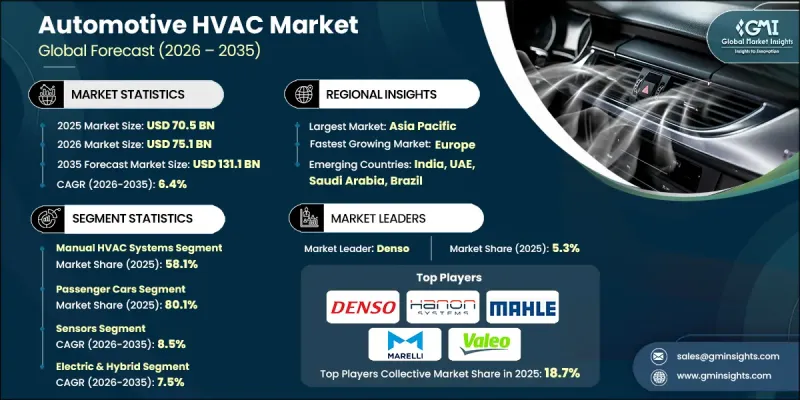
全球汽车保有量的成长推动了市场成长,而可支配收入的增加和消费者出行偏好的转变也为此提供了支撑。随着越来越多的消费者购买私家车,对先进的暖通空调(HVAC)系统的需求持续成长。在中檔和豪华车领域,能够提升车内舒适度和温度控制性能的先进HVAC技术正被日益广泛地采用。同时,製造商正在将智慧气候控制解决方案与先进的感测技术相结合,使车内乘客能够个性化调节气流和温度设定。随着电动车的快速普及,HVAC系统的效率变得愈发重要,因为这些系统直接影响电池性能和总续航里程。为了应对这项挑战,各公司正在开发节能解决方案,例如热泵系统和先进的温度控管模组。同时,日益严格的环境法规正在推动低全球暖化潜能值冷媒、改进的密封系统和可回收零件的应用,从而加速向永续汽车HVAC技术的转型。
| 市场范围 | |
|---|---|
| 开始年份 | 2025 |
| 预测期 | 2026-2035 |
| 初始市场规模 | 705亿美元 |
| 预测金额 | 1311亿美元 |
| 复合年增长率 | 6.4% |
预计到2025年,手动空调系统市占率将达到58.1%,市场规模将达到409亿美元。其主导地位源自于其相比自动化系统更高的成本效益、更简化的设计和结构,以及更低的製造成本和维护成本。由于电子元件和感测器数量较少,这些系统性能可靠且易于维护,使其成为大规模生产的大型车辆极具吸引力的选择。其耐用性和较低的技术复杂性也进一步支撑了市场的持续需求。
预计到2025年,乘用车市占率将达到80.1%,到2035年市场规模将达到1,076亿美元。由于乘用车的全球产量和销售量远高于商用车,因此该类别对空调系统的需求正在大幅增加。汽车製造商持续致力于提升车内舒适度以满足消费者期望,进一步巩固了乘用车市场的主导地位。乘用车正日益整合先进的气候控制技术,以优先考虑乘员的舒适度和车内体验。
受高汽车保有量和消费者对舒适性的强烈偏好推动,预计到2025年,美国汽车空调系统市场规模将达到780万美元。此外,电动和混合动力汽车销量的成长(这些汽车需要节能型空调系统)也促进了市场成长。包括区域管理和互联控制在内的智慧气候控制技术在原厂配套市场和售后市场通路中正得到越来越广泛的应用。监管措施日益重视车辆能源效率,推动了系统设计和零件优化的创新。
目录
第一章:调查方法
第二章执行摘要
第三章业界考察
- 生态系分析
- 供应商情况
- 利润率
- 成本结构
- 每个阶段增加的价值
- 影响价值链的因素
- 中断
- 影响产业的因素
- 促进因素
- 乘客舒适度需求日益增长
- 全球汽车产量增加
- 电动车和混合动力汽车的成长
- 暖通空调系统的技术进步
- 产业潜在风险与挑战
- 暖通空调系统整合的复杂性
- 严格的环境法规
- 市场机会
- 新兴市场需求不断成长
- 适用于电动车的轻巧紧凑型HVAC设计
- 售后空调升级和改装
- 与物联网和联网汽车系统的集成
- 促进因素
- 成长潜力分析
- 监理情势
- 北美洲
- 美国国家公路交通安全管理局(NHTSA)
- 美国环保署(EPA)
- 加州空气资源委员会(CARB)
- 加拿大标准协会(CSA)
- 欧洲
- 欧洲汽车製造商协会 (ACEA)
- 欧盟排放交易体系(EU ETS)
- 欧洲标准化委员会(CEN)
- 欧洲环境署(EEA)
- 亚太地区
- 公路运输和公路部(MoRTH)
- 印度能源效率局 (BEE)
- 中国汽车技术研究中心(CATARC)
- 日本汽车製造商协会(JAMA)
- 拉丁美洲
- INMETRO
- 运输部
- 国家陆路交通管理局(ANTT)
- 中东和非洲
- 波湾合作理事会标准化组织(GSO)
- ESMA(阿联酋标准化和计量局)
- 沙乌地阿拉伯标准、计量和品质组织(SASO)
- 南非标准局(SABS)
- 北美洲
- 波特的分析
- PESTEL 分析
- 科技与创新趋势
- 当前技术趋势
- 暖通空调系统的电气化
- 双区和多区气候控制
- 车载空气过滤净化系统
- 与车辆远端资讯处理和资讯娱乐系统的集成
- 新兴技术
- 热电式暖通空调系统
- 太阳能空调机组
- 智慧人工智慧空调控制
- 适用于电动车的轻巧紧凑型HVAC设计
- 当前技术趋势
- 价格趋势
- 按地区
- 副产品
- 成本細項分析
- 永续性和环境影响
- 环境影响评估
- 社会影响和对当地社区的贡献
- 公司管治与企业社会责任
- 永续金融与投资趋势
- 电气化对暖通空调架构的影响
- 高压和低压暖通空调系统的比较
- 车载环境与能源管理的预校准策略
- 解决有关驾驶距离的担忧
- 双源暖气系统
- OEM整合策略与平台方法
- 模组化暖通空调平台的开发
- 车辆架构整合(内燃机与电动车)面临的挑战
- 原始设备製造商和供应商之间的共同开发伙伴关係
- 客製化与标准化
- 健康与保健功能的整合
- 高效能空气过滤器和PM2.5去除功能
- 抗菌抗病毒涂层技术
- 湿度控制,以达到最佳健康状态
- 过敏原和病原体检测系统
- 芳香疗法和空气电离功能
- 案例研究
- 未来前景与机会
第四章 竞争情势
- 介绍
- 企业市占率分析
- 北美洲
- 欧洲
- 亚太地区
- 拉丁美洲
- 中东和非洲(MEA)
- 主要市场公司的竞争分析
- 竞争定位矩阵
- 主要进展
- 併购
- 伙伴关係与合作
- 新产品发布
- 业务拓展计划及资金筹措
第五章 市场估计与预测:依系统划分,2022-2035年
- 自动空调系统
- 手动空调系统
第六章 市场估计与预测:依组件划分,2022-2035年
- 感应器
- 温度感测器
- 湿度感测器
- 空气品质感测器
- 其他的
- 热交换器
- 冷凝器
- 蒸发器
- 压缩机
- 扩充设备
- 接收器/烘干机
- 鼓风机电机
- 其他的
第七章 市场估价与预测:依车辆类型划分,2022-2035年
- 搭乘用车
- 掀背车
- 轿车
- SUV
- 商用车辆
- LCV
- MCV
- 重型车辆(HCV)
第八章 市场估算与预测:依驱动因素划分,2022-2035年
- 内燃机(ICE)
- 电动/混合动力
- BEV
- HEV
- PHEV
- FCEV
第九章 市场估价与预测:依销售管道划分,2022-2035年
- OEM
- 售后市场
第十章 市场估价与预测:依地区划分,2022-2035年
- 北美洲
- 我们
- 加拿大
- 欧洲
- 德国
- 英国
- 法国
- 义大利
- 西班牙
- 捷克共和国
- 比利时
- 俄罗斯
- 荷兰
- 亚太地区
- 中国
- 印度
- 日本
- 韩国
- 澳洲
- 新加坡
- 马来西亚
- 印尼
- 越南
- 泰国
- 拉丁美洲
- 巴西
- 墨西哥
- 阿根廷
- 哥伦比亚
- 中东和非洲(MEA)
- 南非
- 沙乌地阿拉伯
- 阿拉伯聯合大公国
第十一章:公司简介
- 世界公司
- Denso
- Valeo
- Mahle
- Hanon Systems
- Sanden
- Marelli
- Delphi
- Visteon
- Johnson Electric
- 当地公司
- Air International Thermal Systems
- Subros
- Songz
- Shanghai Velle
- Hubei Meibiao
- Bergstrom
- 新兴企业
- Gentherm
- Behr Hella Service
- Trans Air Manufacturing
- Motherson
- Modine
The Global Automotive HVAC Market was valued at USD 70.5 billion in 2025 and is estimated to grow at a CAGR of 6.4% to reach USD 131.1 billion by 2035.
Market growth is driven by increasing vehicle ownership worldwide, supported by rising disposable income and shifting consumer mobility preferences. As more consumers invest in personal vehicles, demand for advanced heating, ventilation, and air conditioning systems continues to accelerate. Mid-range and premium vehicle categories are increasingly incorporating enhanced HVAC technologies that deliver improved cabin comfort and climate control performance. At the same time, manufacturers are integrating intelligent climate solutions equipped with advanced sensing technologies that allow occupants to personalize airflow and temperature settings. The rapid growth of electric vehicles has further elevated the importance of HVAC efficiency, as these systems directly influence battery performance and overall driving range. To address this, companies are developing energy-efficient solutions such as heat pump systems and advanced thermal management modules. In parallel, evolving environmental regulations are encouraging the adoption of low global warming potential refrigerants, improved sealing systems, and recyclable components, reinforcing the shift toward sustainable automotive HVAC technologies.
| Market Scope | |
|---|---|
| Start Year | 2025 |
| Forecast Year | 2026-2035 |
| Start Value | $70.5 Billion |
| Forecast Value | $131.1 Billion |
| CAGR | 6.4% |
The manual HVAC systems segment accounted for 58.1% share in 2025, generating USD 40.9 billion. Their leadership position stems from cost efficiency, simplified design architecture, and lower production and maintenance expenses compared to automatic systems. With fewer electronic components and sensors, these systems offer dependable performance and straightforward servicing, making them highly attractive across large vehicle production volumes. Their durability and reduced technical complexity further support sustained demand.
The passenger cars segment held 80.1% share in 2025 and is forecast to reach USD 107.6 billion by 2035. Higher global production and sales volumes of passenger vehicles compared to commercial vehicles significantly increase HVAC system demand within this category. Automakers continue to enhance cabin comfort features to meet consumer expectations, reinforcing segment dominance. Passenger vehicles prioritize occupant comfort and interior experience, which drives greater integration of advanced climate control technologies.
U.S. Automotive HVAC Market reached USD 7.8 million in 2025, supported by high vehicle ownership rates and strong consumer preference for comfort-oriented features. Growth is further driven by the expansion of electric and hybrid vehicle sales, which require optimized energy-efficient HVAC systems. Smart climate control technologies, including zonal management and connected controls, are gaining traction in both OEM and aftermarket channels. Regulatory measures increasingly emphasize vehicle energy efficiency, reinforcing innovation in system design and component optimization.
Leading companies operating in the Global Automotive HVAC Market include Valeo, Denso, Marelli, Hanon Systems, Sensata, Mahle, Air International Thermal Systems, Sanden, Johnson Electric, and Visteon. Companies in the Global Automotive HVAC Market are strengthening their competitive positions through continuous innovation and strategic partnerships. Major players are investing in advanced thermal management technologies, energy-efficient compressors, and intelligent climate control systems tailored for electric and hybrid vehicles. Collaboration with automakers enables early integration of next-generation HVAC platforms into new vehicle architectures. Firms are expanding global manufacturing footprints to improve supply chain resilience and reduce production costs. Research and development efforts focus on lightweight materials, smart sensors, and environmentally friendly refrigerants to comply with tightening emission regulations.
Table of Contents
Chapter 1 Methodology
- 1.1 Research approach
- 1.2 Quality commitments
- 1.2.1 GMI AI policy & data integrity commitment
- 1.3 Research trail & confidence scoring
- 1.3.1 Research trail components
- 1.3.2 Scoring components
- 1.4 Data collection
- 1.4.1 Partial list of primary sources
- 1.5 Data mining sources
- 1.5.1 Paid sources
- 1.6 Base estimates and calculations
- 1.6.1 Base year calculation
- 1.7 Forecast model
- 1.8 Research transparency addendum
Chapter 2 Executive Summary
- 2.1 Industry 360° synopsis
- 2.2 Key market trends
- 2.2.1 Regional
- 2.2.2 System
- 2.2.3 Component
- 2.2.4 Vehicle
- 2.2.5 Propulsion
- 2.2.6 Sales Channel
- 2.3 TAM analysis, 2026-2035
- 2.4 CXO perspectives: Strategic imperatives
Chapter 3 Industry Insights
- 3.1 Industry ecosystem analysis
- 3.1.1 Supplier landscape
- 3.1.2 Profit margin
- 3.1.3 Cost structure
- 3.1.4 Value addition at each stage
- 3.1.5 Factor affecting the value chain
- 3.1.6 Disruptions
- 3.2 Industry impact forces
- 3.2.1 Growth drivers
- 3.2.1.1 Increasing demand for passenger comfort
- 3.2.1.2 Rising vehicle production globally
- 3.2.1.3 Growth in electric and hybrid vehicles
- 3.2.1.4 Technological advancements in HVAC systems
- 3.2.2 Industry pitfalls and challenges
- 3.2.2.1 Complexity in HVAC system integration
- 3.2.2.2 Stringent environmental regulations
- 3.2.3 Market opportunities
- 3.2.3.1 Growing demand in emerging markets
- 3.2.3.2 Lightweight and compact HVAC designs for EVs
- 3.2.3.3 Aftermarket HVAC upgrades and retrofitting
- 3.2.3.4 Integration with IoT and connected vehicle systems
- 3.2.1 Growth drivers
- 3.3 Growth potential analysis
- 3.4 Regulatory landscape
- 3.4.1 North America
- 3.4.1.1 National Highway Traffic Safety Administration (NHTSA)
- 3.4.1.2 Environmental Protection Agency (EPA)
- 3.4.1.3 California Air Resources Board (CARB)
- 3.4.1.4 Canadian Standards Association (CSA)
- 3.4.2 Europe
- 3.4.2.1 European Automobile Manufacturers’ Association (ACEA)
- 3.4.2.2 European Union Emissions Trading System (EU ETS)
- 3.4.2.3 European Committee for Standardization (CEN)
- 3.4.2.4 European Environment Agency (EEA)
- 3.4.3 Asia Pacific
- 3.4.3.1 Ministry of Road Transport and Highways (MoRTH)
- 3.4.3.2 Bureau of Energy Efficiency (BEE)
- 3.4.3.3 China Automotive Technology & Research Center (CATARC)
- 3.4.3.4 Japan Automobile Manufacturers Association (JAMA)
- 3.4.4 Latin America
- 3.4.4.1 INMETRO
- 3.4.4.2 Ministry of Transport
- 3.4.4.3 National Agency for Land Transportation (ANTT)
- 3.4.5 Middle East & Africa
- 3.4.5.1 Gulf Cooperation Council Standardization Organization (GSO)
- 3.4.5.2 Emirates Authority for Standardization & Metrology (ESMA)
- 3.4.5.3 Saudi Standards, Metrology and Quality Organization (SASO)
- 3.4.5.4 South African Bureau of Standards (SABS)
- 3.4.1 North America
- 3.5 Porter’s analysis
- 3.6 PESTEL analysis
- 3.7 Technology and innovation landscape
- 3.7.1 Current technological trends
- 3.7.1.1 Electrification of HVAC Systems
- 3.7.1.2 Dual-Zone and Multi-Zone Climate Control
- 3.7.1.3 Cabin Air Filtration and Purification Systems
- 3.7.1.4 Integration with Vehicle Telematics and Infotainment
- 3.7.2 Emerging technologies
- 3.7.2.1 Thermoelectric HVAC Systems
- 3.7.2.2 Solar-Powered HVAC Units
- 3.7.2.3 Smart and AI-Enabled Climate Control
- 3.7.2.4 Lightweight and Compact HVAC Designs for EVs
- 3.7.1 Current technological trends
- 3.8 Price trends
- 3.8.1 By region
- 3.8.2 By product
- 3.9 Cost breakdown analysis
- 3.10 Sustainability and environmental impact
- 3.10.1 Environmental impact assessment
- 3.10.2 Social impact & community benefits
- 3.10.3 Governance & corporate responsibility
- 3.10.4 Sustainable finance & investment trends
- 3.11 Electrification impact on HVAC architecture
- 3.11.1 High voltage vs. low voltage HVAC system comparison
- 3.11.2 Cabin preconditioning strategies and energy management
- 3.11.3 Range anxiety mitigation
- 3.11.4 Dual-source heating systems
- 3.12 OEM integration strategies and platform approaches
- 3.12.1 Modular HVAC platform development
- 3.12.2 Vehicle architecture integration challenges (ICE vs. EV)
- 3.12.3 Co-development partnerships between OEMs and suppliers
- 3.12.4 Customization vs. standardization
- 3.13 Health and wellness feature integration
- 3.13.1 HEPA filtration and PM2.5 removal capabilities
- 3.13.2 Antimicrobial and antiviral coating technologies
- 3.13.3 Humidity control for health optimization
- 3.13.4 Allergen and pathogen detection systems
- 3.13.5 Aromatherapy and air ionization features
- 3.14 Case studies
- 3.15 Future outlook & opportunities
Chapter 4 Competitive Landscape, 2025
- 4.1 Introduction
- 4.2 Company market share analysis
- 4.2.1 North America
- 4.2.2 Europe
- 4.2.3 Asia Pacific
- 4.2.4 LATAM
- 4.2.5 MEA
- 4.3 Competitive analysis of major market players
- 4.4 Competitive positioning matrix
- 4.5 Key developments
- 4.5.1 Mergers & acquisitions
- 4.5.2 Partnerships & collaborations
- 4.5.3 New product launches
- 4.5.4 Expansion plans and funding
Chapter 5 Market Estimates & Forecast, By System, 2022 - 2035 ($Mn, Thousand Units)
- 5.1 Key trends
- 5.2 Automatic HVAC systems
- 5.3 Manual HVAC systems
Chapter 6 Market Estimates & Forecast, By Component, 2022 - 2035 ($Mn, Thousand Units)
- 6.1 Key trends
- 6.2 Sensors
- 6.2.1 Temperature sensors
- 6.2.2 Humidity sensors
- 6.2.3 Air quality sensors
- 6.2.4 Others
- 6.3 Heat exchangers
- 6.3.1 Condenser
- 6.3.2 Evaporator
- 6.4 Compressor
- 6.5 Expansion device
- 6.6 Receiver/drier
- 6.7 Blower motor
- 6.8 Others
Chapter 7 Market Estimates & Forecast, By Vehicle, 2022 - 2035 ($Mn, Thousand Units)
- 7.1 Key trends
- 7.2 Passenger cars
- 7.2.1 Hatchback
- 7.2.2 Sedan
- 7.2.3 SUV
- 7.3 Commercial vehicles
- 7.3.1 LCV
- 7.3.2 MCV
- 7.3.3 HCV
Chapter 8 Market Estimates & Forecast, By Propulsion, 2022 - 2035 ($Mn, Thousand Units)
- 8.1 Key trends
- 8.2 ICE
- 8.3 Electric & hybrid
- 8.3.1 BEV
- 8.3.2 HEV
- 8.3.3 PHEV
- 8.3.4 FCEV
Chapter 9 Market Estimates & Forecast, By Sales Channel, 2022 - 2035 ($Mn, Thousand Units)
- 9.1 Key trends
- 9.2 OEM
- 9.3 Aftermarket
Chapter 10 Market Estimates & Forecast, By Region, 2022 - 2035 ($Mn, Thousand Units)
- 10.1 Key trends
- 10.2 North America
- 10.2.1 US
- 10.2.2 Canada
- 10.3 Europe
- 10.3.1 Germany
- 10.3.2 UK
- 10.3.3 France
- 10.3.4 Italy
- 10.3.5 Spain
- 10.3.6 Czech Republic
- 10.3.7 Belgium
- 10.3.8 Russia
- 10.3.9 Netherlands
- 10.4 Asia Pacific
- 10.4.1 China
- 10.4.2 India
- 10.4.3 Japan
- 10.4.4 South Korea
- 10.4.5 Australia
- 10.4.6 Singapore
- 10.4.7 Malaysia
- 10.4.8 Indonesia
- 10.4.9 Vietnam
- 10.4.10 Thailand
- 10.5 Latin America
- 10.5.1 Brazil
- 10.5.2 Mexico
- 10.5.3 Argentina
- 10.5.4 Colombia
- 10.6 MEA
- 10.6.1 South Africa
- 10.6.2 Saudi Arabia
- 10.6.3 UAE
Chapter 11 Company Profiles
- 11.1 Global players
- 11.1.1 Denso
- 11.1.2 Valeo
- 11.1.3 Mahle
- 11.1.4 Hanon Systems
- 11.1.5 Sanden
- 11.1.6 Marelli
- 11.1.7 Delphi
- 11.1.8 Visteon
- 11.1.9 Johnson Electric
- 11.2 Regional players
- 11.2.1 Air International Thermal Systems
- 11.2.2 Subros
- 11.2.3 Songz
- 11.2.4 Shanghai Velle
- 11.2.5 Hubei Meibiao
- 11.2.6 Bergstrom
- 11.3 Emerging players
- 11.3.1 Gentherm
- 11.3.2 Behr Hella Service
- 11.3.3 Trans Air Manufacturing
- 11.3.4 Motherson
- 11.3.5 Modine

 汽车空调市场:2026-2032年全球市场预测(依产品类型、组件、车辆类型、最终用户类型和销售管道)
 汽车SMD分路电阻器市场报告:趋势、预测与竞争分析(至2035年)
 2034年全球空调市场预测-按系统类型、组件、部署模式、能源来源、技术、应用、最终用户和地区分類的分析汽车空调市场:依技术、产品类型、组件、车辆类型和销售管道划分-2026-2032年全球市场预测
 汽车空调市场规模、份额、成长率及全球产业分析:按类型、应用和地区分類的洞察,2026-2034 年预测汽车PTC加热器市场:2026年至2032年全球市场预测(按车辆类型、材料、额定功率、技术、燃料类型、应用和最终用户划分)
 汽车暖通空调系统市场规模、份额、趋势和预测报告:按组件、技术、车辆类型和地区划分,2026-2034年
 汽车空调系统:市占率分析、产业趋势与统计、成长预测(2026-2031)汽车暖通空调(HVAC)全球市场规模、份额、趋势和成长分析报告(2026-2034)汽车暖通空调市场:按类型、组件类型、销售管道、技术、国家及地区划分-全球产业分析、市场规模、市场份额及2025年至2032年预测