


 |
市场调查报告书
商品编码
1998710
海军遥控武器站市场机会、成长驱动因素、产业趋势分析及预测(2026-2035年)Naval-based Remote Weapons Station Market Opportunity, Growth Drivers, Industry Trend Analysis, and Forecast 2026 - 2035 |
||||||

全球海军遥控武器站市场预计到 2025 年价值 14 亿美元,预计到 2035 年将以 6.8% 的复合年增长率增长至 27 亿美元。
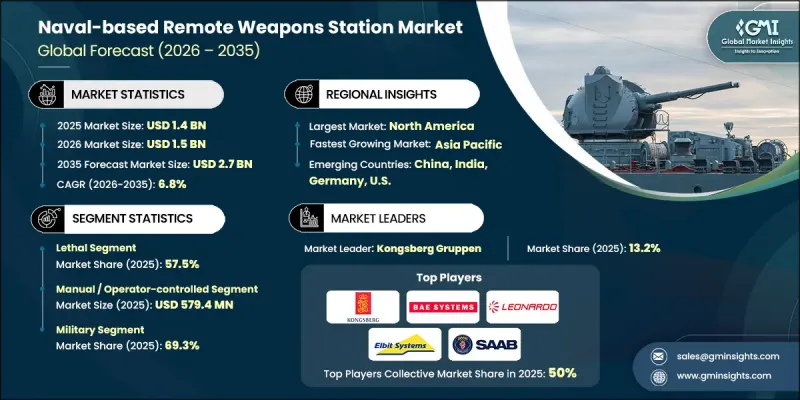
现代海军的需求日益凸显,其作战效能不再仅依赖火力,而是更注重多功能性,这推动了对紧凑、轻巧且高度先进的遥控武器的需求。海军部队正着力发展非对称作战战略,这要求舰艇能够在应对各种威胁的同时,并保障舰员的安全。遥控武器站能够使操作人员在舰内直接攻击目标,进而增强海上防御能力,即使在恶劣海况和敌对环境下也能保持作战效能。新型舰艇和整修舰艇越来越多地采用这些系统,加上对感测器整合、瞄准光学设备和中口径武器的投资不断增加,正在推动全球市场成长。此外,海军现代化专案预算的增加和舰队防御能力的提升也对市场产生了积极影响。
| 市场范围 | |
|---|---|
| 开始年份 | 2025 |
| 预测年份 | 2026-2035 |
| 起始金额 | 14亿美元 |
| 预测金额 | 27亿美元 |
| 复合年增长率 | 6.8% |
海军遥控武器站(RWS)正不断发展,以满足现代作战需求,其特点包括与无人舰艇相容、模组化设计以及先进的感测器融合技术。开发人员正在设计能够在各种海上环境中运作并符合国际标准的系统。在更广泛的舰艇相容性需求的推动下,该产业正从有人舰艇扩展到无人平台。轻质材料和高效能动力来源的创新也支持环保作业,同时又不影响性能。这些进步正在提高系统在多域海军任务中的柔软性、可靠性和整合性。
到2025年,致命型遥控武器站将占据57.5%的市场。致命型遥控武器站仍然是现代海军防御的核心,通常配备稳定式火炮、自动榴弹发射器或机关枪。这些系统使舰艇能够精确应对快速攻击艇、海盗威胁和非对称作战场景,同时确保舰上操作人员的安全。对能够在高速航行和恶劣海况下保持精度的系统的需求日益增长,使其成为舰队现代化计划中不可或缺的一部分。
预计到2025年,手动或操作员控制型遥控武器站(RWS)市场规模将达到5.794亿美元。在需要人为判断的场合,操作员控制型RWS仍然至关重要,它能够在复杂多变的作战环境中实现即时决策,同时遵守交战规则并最大限度地减少附带损害。符合人体工学的设计旨在减少操作员长时间操作的疲劳,并提高精度,从而使这些系统可靠且有效率。
到2025年,北美海军遥控武器站(RWS)市占率将达到38.5%。美国市场专注于技术进步和提升舰队作战能力。将人工智慧(AI)和自动化技术整合到RWS中,可实现自主操作并提高目标捕获精度。市场需求正转向能够与有人和无人平台(尤其是无人水面载具)无缝整合的客製化系统,以支援多样化的多域海军作战行动。
目录
第一章:调查方法和范围
第二章执行摘要
第三章业界考察
- 产业生态系分析
- 供应商情况
- 利润率
- 成本结构
- 每个阶段增加的价值
- 影响价值链的因素
- 中断
- 影响产业的因素
- 成长驱动因素
- 全球海军现代化进程持续进行
- 区域衝突加剧,海上安全面临威胁
- 扩大无人水面载具(USV)和无人机在海军作战中的使用
- 人工智慧、自动化和感测器技术的进步
- 专注于船员安全和营运效率
- 产业潜在风险与挑战
- 高昂的开发和采购成本
- 与旧有系统的集成
- 市场机会
- 对配备稳定遥控武器系统的传统平台维修
- 智慧弹药与精确导引舰载武器的融合
- 成长驱动因素
- 成长潜力分析
- 监理情势
- 波特五力分析
- PESTEL 分析
- 科技与创新趋势
- 当前技术趋势
- 新兴技术
- 新经营模式
- 合规要求
- 国防预算分析
- 全球国防费用趋势
- 区域国防预算分配
- 北美洲
- 欧洲
- 亚太地区
- 中东和非洲
- 拉丁美洲
- 主要国防现代化项目
- 预算预测(2025-2034 年)
- 对产业成长的影响
- 国防预算
- 分段式国防预算分配
- 人员
- 运作/维护
- 采购
- 研究、开发、测试和评估
- 基础设施和建筑
- 技术与创新
- 供应链韧性
- 地缘政治分析
- 劳动力分析
- 数位转型
- 併购和策略联盟的趋势
- 风险评估与管理
- 重大合约采购(2022-2025 年)
第四章 竞争情势
- 介绍
- 企业市占率分析
- 按地区
- 市场集中度分析
- 主要企业的竞争标竿分析
- 财务绩效比较
- 销售量
- 利润率
- 研究与发展(R&D)
- 产品系列比较
- 产品线宽度
- 科技
- 创新
- 区域扩张比较
- 全球扩张分析
- 服务网路覆盖
- 按地区分類的市场渗透率
- 竞争定位矩阵
- 领导者
- 挑战者
- 追踪者
- 小众玩家
- 战略展望矩阵
- 财务绩效比较
- 主要进展
- 併购
- 伙伴关係与合作
- 技术进步
- 业务拓展与投资策略
- 数位转型计划
- 新兴/Start-Ups竞争对手的发展趋势
第五章 市场估计与预测:依平台划分,2022-2035年
- 驱逐舰
- 巡防舰
- 克尔维特
- 巡逻和扫雷
- 近海巡逻舰(OPV)
- 两栖船
- 无人水面载具
第六章 市场估计与预测:依自主程度划分,2022-2035年
- 手动/操作控制
- 半自动
- 全自动/人工智慧驱动系统
第七章 市场估价与预测:依武器类型划分,2022-2035年
- 凶器
- 小直径
- 5.56mm
- 7.62mm
- 12.7mm
- 中口径
- 20mm
- 25mm
- 30mm
- 40mm
- 小直径
- 非致命性武器
第八章 市场估计与预测:依应用领域划分,2022-2035年
- 军队
- 国防安全保障
- 海事执法
- 边防安全和反走私活动
- 其他的
第九章 市场估计与预测:依地区划分,2022-2035年
- 北美洲
- 我们
- 加拿大
- 欧洲
- 德国
- 英国
- 法国
- 西班牙
- 义大利
- 俄罗斯
- 其他欧洲地区
- 亚太地区
- 中国
- 印度
- 日本
- 澳洲
- 韩国
- 亚太其他地区
- 拉丁美洲
- 巴西
- 墨西哥
- 阿根廷
- 其他拉丁美洲地区
- 中东和非洲
- 南非
- 沙乌地阿拉伯
- 阿拉伯聯合大公国
- 其他中东和非洲地区
第十章:公司简介
- 主要企业
- BAE Systems
- Leonardo
- Rheinmetall AG
- Northrop Grumman
- Raytheon Technologies
- Thales Group
- General Dynamics
- 该地区的主要企业
- Rafael Advanced Defense Systems
- Kongsberg Gruppen
- Aselsan
- FN Herstal
- Israel Aerospace Industries
- KNDS
- Saab
- Elbit Systems
- 特殊玩家/干扰者
- MSI-Defence Systems
- Electro Optic Systems
- EM&E GROUP
The Global Naval-based Remote Weapons Station Market was valued at USD 1.4 billion in 2025 and is estimated to grow at a CAGR of 6.8% to reach USD 2.7 billion by 2035.
The increasing demand for compact, lightweight, and advanced remote-controlled weapons is being driven by modern naval requirements that prioritize multi-role operational capabilities over sheer firepower. Navies are focusing on asymmetric warfare strategies, which require vessels to handle diverse threats while keeping the crew safe inside the ship. Remote weapons stations enhance maritime defense by enabling operators to engage targets from within the vessel, maintaining effectiveness in rough weather and under hostile conditions. Rising adoption of these systems in both new and retrofitted ships, coupled with growing investment in sensor integration, targeting optics, and medium-caliber weaponry, is propelling market expansion globally. The market is also benefiting from naval modernization programs and increasing budgets for fleet defense upgrades.
| Market Scope | |
|---|---|
| Start Year | 2025 |
| Forecast Year | 2026-2035 |
| Start Value | $1.4 Billion |
| Forecast Value | $2.7 Billion |
| CAGR | 6.8% |
Naval RWS are evolving with features like unmanned vehicle compatibility, modular designs, and advanced sensor fusion, enabling them to meet contemporary operational needs. Developers are designing systems to operate in multiple marine environments while maintaining compliance with international standards. The industry has expanded beyond crewed vessels to include non-crewed platforms, driven by a demand for broader vessel compatibility. Innovations in lightweight materials and efficient power sources are also supporting environmentally responsible operations without compromising performance. These advancements are improving flexibility, reliability, and integration across multi-domain naval missions.
The lethal segment accounted for 57.5% share in 2025. Lethal RWS remain central to modern naval defense, typically outfitted with stabilized cannons, automatic grenade launchers, or heavy machine guns. These systems allow vessels to counter fast attack craft, piracy threats, and asymmetric warfare scenarios with precision while keeping operators protected inside the ship. High demand exists for systems capable of maintaining accuracy in high-speed maneuvers and rough seas, making them essential for fleet modernization programs.
The manual or operator-controlled segment reached USD 579.4 million in 2025. Operator-controlled RWS continue to be vital where human judgment is crucial, allowing real-time decision-making in complex and ambiguous combat scenarios while adhering to rules of engagement and minimizing collateral damage. Ergonomic designs are being emphasized to reduce operator fatigue and enhance accuracy during extended operations, making these systems reliable and operationally effective.
North America Naval-based Remote Weapons Station Market held 38.5% share in 2025. The U.S. market is focusing on technological advancements and fleet capability enhancement. Integration of artificial intelligence and automation into RWS has facilitated autonomous operations and improved targeting precision. Market demand is shifting toward customized systems that can seamlessly integrate with both manned and unmanned platforms, particularly unmanned surface vessels, to support versatile multi-domain naval operations.
Key players operating in the Global Naval-based Remote Weapons Station Market include BAE Systems, Rafael Advanced Defense Systems, Kongsberg Gruppen, MSI-Defence Systems, Leonardo, FN Herstal, and Aselsan. Companies in the Naval-based Remote Weapons Station Market are pursuing strategies such as enhancing R&D for modular and multi-platform systems, expanding into international naval markets, and collaborating with defense agencies to customize solutions for specific fleet requirements. Firms are investing in AI, automation, and advanced sensor integration to improve targeting accuracy and operational efficiency. Strategic partnerships and joint ventures are being leveraged to strengthen supply chains and access emerging markets. Continuous product innovation, upgrades to lethal and non-lethal systems, and robust after-sales support help these companies maintain a competitive advantage while meeting modern naval defense needs.
Table of Contents
Chapter 1 Methodology and Scope
- 1.1 Market scope and definition
- 1.2 Research design
- 1.2.1 Research approach
- 1.2.2 Data collection methods
- 1.3 Data mining sources
- 1.3.1 Global
- 1.3.2 Regional/Country
- 1.4 Base estimates and calculations
- 1.4.1 Base year calculation
- 1.4.2 Key trends for market estimation
- 1.5 Primary research and validation
- 1.5.1 Primary sources
- 1.6 Forecast model
- 1.7 Research assumptions and limitations
Chapter 2 Executive Summary
- 2.1 Industry 360° synopsis, 2022 - 2035
- 2.2 Key market trends
- 2.2.1 Platform trends
- 2.2.2 Degree of autonomy trends
- 2.2.3 Weapon type trends
- 2.2.4 Application type trends
- 2.2.5 Regional trends
- 2.3 TAM Analysis, 2026-2035
- 2.4 CXO perspectives: Strategic imperatives
Chapter 3 Industry Insights
- 3.1 Industry ecosystem analysis
- 3.1.1 Supplier Landscape
- 3.1.2 Profit Margin
- 3.1.3 Cost structure
- 3.1.4 Value addition at each stage
- 3.1.5 Factor affecting the value chain
- 3.1.6 Disruptions
- 3.2 Industry impact forces
- 3.2.1 Growth drivers
- 3.2.1.1 Ongoing global naval modernization efforts
- 3.2.1.2 Escalating regional conflicts and maritime security threats
- 3.2.1.3 Increasing use of unmanned surface vessels (USVs) and drones in naval operations
- 3.2.1.4 Advancements in AI, automation, and sensor technologies
- 3.2.1.5 Focus on crew safety and operational efficiency
- 3.2.2 Industry pitfalls and challenges
- 3.2.2.1 High development and acquisition costs
- 3.2.2.2 Integration with legacy systems
- 3.2.3 Market opportunities
- 3.2.3.1 Retrofitting legacy platforms with stabilized remote weapon systems
- 3.2.3.2 Smart ammunition and precision-guided naval weapon integration
- 3.2.1 Growth drivers
- 3.3 Growth potential analysis
- 3.4 Regulatory landscape
- 3.4.1 North America
- 3.4.2 Europe
- 3.4.3 Asia Pacific
- 3.4.4 Latin America
- 3.4.5 Middle East & Africa
- 3.5 Porter's analysis
- 3.6 PESTEL analysis
- 3.7 Technology and Innovation landscape
- 3.7.1 Current technological trends
- 3.7.2 Emerging technologies
- 3.8 Emerging business models
- 3.9 Compliance requirements
- 3.10 Defense budget analysis
- 3.11 Global defense spending trends
- 3.12 Regional defense budget allocation
- 3.12.1 North America
- 3.12.2 Europe
- 3.12.3 Asia Pacific
- 3.12.4 Middle East and Africa
- 3.12.5 Latin America
- 3.13 Key defense modernization programs
- 3.14 Budget forecast (2025-2034)
- 3.14.1 Impact on industry growth
- 3.14.2 Defense budgets by country
- 3.14.3 Defense budget allocation by segment
- 3.14.3.1 Personnel
- 3.14.3.2 Operations and maintenance
- 3.14.3.3 Procurement
- 3.14.3.4 Research, development, test and evaluation
- 3.14.3.5 Infrastructure and construction
- 3.14.3.6 Technology and innovation
- 3.15 Supply chain resilience
- 3.16 Geopolitical analysis
- 3.17 Workforce analysis
- 3.18 Digital transformation
- 3.19 Mergers, acquisitions, and strategic partnerships landscape
- 3.20 Risk assessment and management
- 3.21 Major contract awards (2022-2025)
Chapter 4 Competitive Landscape, 2025
- 4.1 Introduction
- 4.2 Company market share analysis
- 4.2.1 By region
- 4.2.1.1 North America
- 4.2.1.2 Europe
- 4.2.1.3 Asia Pacific
- 4.2.1.4 Latin America
- 4.2.1.5 Middle East & Africa
- 4.2.2 Market concentration analysis
- 4.2.1 By region
- 4.3 Competitive benchmarking of key players
- 4.3.1 Financial performance comparison
- 4.3.1.1 Revenue
- 4.3.1.2 Profit margin
- 4.3.1.3 R&D
- 4.3.2 Product portfolio comparison
- 4.3.2.1 Product range breadth
- 4.3.2.2 Technology
- 4.3.2.3 Innovation
- 4.3.3 Geographic presence comparison
- 4.3.3.1 Global footprint analysis
- 4.3.3.2 Service network coverage
- 4.3.3.3 Market penetration by region
- 4.3.4 Competitive positioning matrix
- 4.3.4.1 Leaders
- 4.3.4.2 Challengers
- 4.3.4.3 Followers
- 4.3.4.4 Niche players
- 4.3.5 Strategic outlook matrix
- 4.3.1 Financial performance comparison
- 4.4 Key developments
- 4.4.1 Mergers and acquisitions
- 4.4.2 Partnerships and collaborations
- 4.4.3 Technological advancements
- 4.4.4 Expansion and investment strategies
- 4.4.5 Digital transformation initiatives
- 4.5 Emerging/ startup competitors landscape
Chapter 5 Market Estimates and Forecast, By Platform, 2022 - 2035 (USD Million)
- 5.1 Key trends
- 5.2 Destroyers
- 5.3 Frigates
- 5.4 Corvettes
- 5.5 Patrol & mine countermeasures vessels
- 5.6 Offshore patrol vessels (OPVs)
- 5.7 Amphibious vessels
- 5.8 Unmanned surface vehicles
Chapter 6 Market Estimates and Forecast, By Degree of Autonomy, 2022 - 2035 (USD Million)
- 6.1 Key trends
- 6.2 Manual / operator controlled
- 6.3 Semi automated
- 6.4 Fully automated / AI-enabled systems
Chapter 7 Market Estimates and Forecast, By Weapon Type, 2022 - 2035 (USD Million)
- 7.1 Key trends
- 7.2 Lethal weapons
- 7.2.1 Small caliber
- 7.2.1.1 5.56mm
- 7.2.1.2 7.62mm
- 7.2.1.3 12.7mm
- 7.2.2 Medium caliber
- 7.2.2.1 20mm
- 7.2.2.2 25mm
- 7.2.2.3 30mm
- 7.2.2.4 40mm
- 7.2.1 Small caliber
- 7.3 Non-lethal weapons
Chapter 8 Market Estimates and Forecast, By Application, 2022 - 2035 (USD Million)
- 8.1 Key trends
- 8.2 Military
- 8.3 Homeland security
- 8.3.1 Maritime law enforcement
- 8.3.2 Border patrol & anti-smuggling operations
- 8.3.3 Others
Chapter 9 Market Estimates and Forecast, By Region, 2022 - 2035 (USD Million)
- 9.1 Key trends
- 9.2 North America
- 9.2.1 U.S.
- 9.2.2 Canada
- 9.3 Europe
- 9.3.1 Germany
- 9.3.2 UK
- 9.3.3 France
- 9.3.4 Spain
- 9.3.5 Italy
- 9.3.6 Russia
- 9.3.7 Rest of Europe
- 9.4 Asia Pacific
- 9.4.1 China
- 9.4.2 India
- 9.4.3 Japan
- 9.4.4 Australia
- 9.4.5 South Korea
- 9.4.6 Rest of Asia Pacific
- 9.5 Latin America
- 9.5.1 Brazil
- 9.5.2 Mexico
- 9.5.3 Argentina
- 9.5.4 Rest of Latin America
- 9.6 Middle East and Africa
- 9.6.1 South Africa
- 9.6.2 Saudi Arabia
- 9.6.3 UAE
- 9.6.4 Rest of Middle East & Africa
Chapter 10 Company Profiles
- 10.1 Global Key Players
- 10.1.1 BAE Systems
- 10.1.2 Leonardo
- 10.1.3 Rheinmetall AG
- 10.1.4 Northrop Grumman
- 10.1.5 Raytheon Technologies
- 10.1.6 Thales Group
- 10.1.7 General Dynamics
- 10.2 Regional key players
- 10.2.1 Rafael Advanced Defense Systems
- 10.2.2 Kongsberg Gruppen
- 10.2.3 Aselsan
- 10.2.4 FN Herstal
- 10.2.5 Israel Aerospace Industries
- 10.2.6 KNDS
- 10.2.7 Saab
- 10.2.8 Elbit Systems
- 10.3 Niche Players/Disruptors
- 10.3.1 MSI-Defence Systems
- 10.3.2 Electro Optic Systems
- 10.3.3 EM&E GROUP

 2026年全球海军遥控武器系统(RWS)市场报告2026年全球遥控武器系统市场报告2026年全球遥控武器系统(RWS)市场报告
 遥控武器站市场机会、成长要素、产业趋势分析及2026-2035年预测
 遥控武器系统(RCWS)市场规模、份额、成长率及全球产业分析:按类型、应用和地区划分,并提供2026-2034年的洞察与预测
 遥控武器系统市场-全球产业规模、份额、趋势、机会、预测:按组件、武器类型、平台、地区和竞争对手划分,2021-2031年
 遥控武器站市场规模、份额和成长分析(按平台、应用、组件、武器类型、技术、移动性和地区划分)-2026-2033年产业预测
 RWS(远程武器系统Remote Weapon System的)全球市场的评估:各系统,武器类别,各零件,各地区,机会,预测(2018年~2032年)
 2025-2029年全球远程武器系统市场遥控枪系统 (RWS) 市场:2033 年的机会与策略