


 |
市场调查报告书
商品编码
1998722
热塑性硫化橡胶市场机会、成长要素、产业趋势分析及2026-2035年预测。Thermoplastic Vulcanizates Market Opportunity, Growth Drivers, Industry Trend Analysis, and Forecast 2026 - 2035 |
||||||

全球热塑性硫化橡胶市场预计到 2025 年将价值 29 亿美元,预计到 2035 年将以 6.6% 的复合年增长率增长至 52 亿美元。
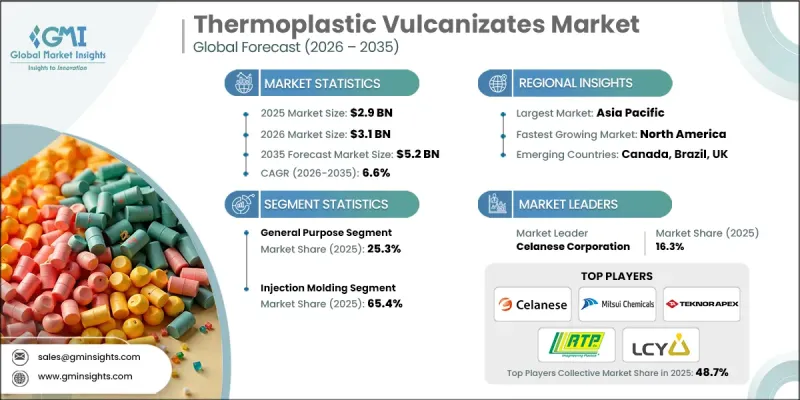
热塑性硫化橡胶 (TPV) 是一种热可塑性橡胶,它兼具橡胶固有的柔软性和弹性以及热塑性树脂的加工优势。这种独特的性能组合使得各行各业对这类材料的需求显着增长。 TPV 是一种合成弹性体材料,以其耐久性和结构完整性而着称,即使在严苛的温度条件下也能保持性能。对轻质材料日益增长的需求促使製造商用更先进的聚合物解决方案来取代传统的笨重橡胶零件。这些材料能够提供现代产品设计所需的弹性、强度和耐久性之间的理想平衡。此外,由于热塑性硫化橡胶可以重新加热和重塑,因此与传统硫化橡胶相比,它具有环境优势,使製造商能够减少生产废弃物并提高资源利用效率。 TPV 配方的不断创新正在提高其耐热性、耐化学性和耐环境腐蚀性,从而拓展其潜在应用范围。汽车产业仍然是热塑性硫化橡胶的主要需求来源,预计在整个预测期内将继续推动市场需求,因为製造商越来越多地采用尖端材料来提高零件製造的性能、效率和永续性。
| 市场范围 | |
|---|---|
| 开始年份 | 2025 |
| 预测期 | 2026-2035 |
| 上市时的市场规模 | 29亿美元 |
| 预计金额 | 52亿美元 |
| 复合年增长率 | 6.6% |
预计到2025年,射出成型成型将占据65.4%的市占率。由于其能够高效生产大量复杂、高精度的零件,这种製造方法仍然很受欢迎。射出成型技术透过引入自动化流程,实现了快速的生产週期,同时降低了人事费用并提高了生产效率。该技术使製造商能够生产出需要精细设计和一致品质标准的耐用零件。随着各行业对更高精度、更高可靠性零件的需求不断增长,射出成型仍是生产热塑性硫化橡胶(TPV)基产品的关键製造方法。
热塑性硫化树脂 (TPV) 市场预计在 2026 年至 2035 年间以 6.6% 的复合年增长率成长。该地区的需求成长主要得益于各行业对先进聚合物材料日益增长的需求。与传统材料相比,热塑性硫化树脂具有更高的可回收性,并能更好地支持永续性目标,因此製造商正逐步采用此类材料。其兼具耐用性和环保性,推动了热塑性硫化树脂在各种产品製造过程中的应用。人们对环保材料的日益关注,以及不断扩大的工业产能,共同推动了热塑性硫化树脂需求的持续成长。主要参与者包括塞拉尼斯公司、三井化学、Elastron、LCY、RTP 公司、FlexiShine Polyblends、SantopSeal 和 VKS Plastic Compound Private Limited。热塑性硫化橡胶市场的企业正致力于多项策略性倡议,以提升自身竞争力并扩大全球市场份额。许多企业正在加大研发投入,以提升热塑性硫化橡胶的材料性能、增强耐久性并拓展其应用范围。聚合物配方方面的创新使製造商能够提供耐热性、化学稳定性和加工效率更高的材料。企业也与各行各业的製造商建立策略合作伙伴关係,以加强供应链并加快产品分销。扩大产能和强化分销网络也是满足日益增长的全球需求的强大策略。
目录
第一章:调查方法和范围
第二章执行摘要
第三章业界考察
- 生态系分析
- 供应商情况
- 利润率
- 每个阶段增加的价值
- 影响价值链的因素
- 中断
- 影响产业的因素
- 促进因素
- 对永续和环保材料的需求日益增长
- 在汽车和医疗领域不断拓展应用。
- 材料技术的进步
- 产业潜在风险与挑战
- 生产成本高和原物料价格波动
- 监理限制和合规要求
- 市场机会
- 汽车和消费品行业对兼具耐用性和柔软性的材料的需求日益增长。
- 由于其具有良好的生物相容性和灭菌能力,其在医疗设备中的应用日益广泛。
- 促进因素
- 成长潜力分析
- 监理情势
- 北美洲
- 欧洲
- 亚太地区
- 拉丁美洲
- 中东和非洲
- 波特五力分析
- PESTEL 分析
- 价格趋势
- 按地区
- 按年级
- 未来市场趋势
- 科技与创新趋势
- 当前技术趋势
- 新兴技术
- 专利趋势
- 贸易统计(HS编码)
- 主要进口国
- 主要出口国
- 永续性和环境方面
- 永续倡议
- 减少废弃物策略
- 生产中的能源效率
- 具有环保意识的倡议
- 考虑碳足迹
第四章 竞争情势
- 介绍
- 企业市占率分析
- 按地区
- 北美洲
- 欧洲
- 亚太地区
- 拉丁美洲
- 中东和非洲
- 按地区
- 主要市场公司的竞争分析
- 竞争定位矩阵
- 主要进展
- 併购
- 伙伴关係与合作
- 新产品发布
- 业务拓展计划
第五章 市场估算与预测:依等级划分,2022-2035年
- 一般
- 医疗的
- 紫外线稳定级
- 阻燃等级
- 黏合剂TPV
- 添加润滑剂的TPV
- 其他的
第六章 市场估算与预测:依加工方式划分,2022-2035年
- 射出成型
- 挤出成型
- 吹塑成型
- 日历
- 其他的
第七章 市场估计与预测:依应用领域划分,2022-2035年
- 汽车零件
- 密封系统
- 引擎室部件
- 电动车(EV)零件
- 转向和悬吊
- 内部和外部部件
- 其他的
- 消费品
- 鞋类
- 体育用品
- 个人护理
- 家居用品
- 其他的
- 建材
- 密封和防水
- 屋顶材料与防水卷材
- 管道和排水
- 工业应用
- 电线电缆
- 医疗设备
- 其他的
第八章 市场估计与预测:依地区划分,2022-2035年
- 北美洲
- 我们
- 加拿大
- 欧洲
- 德国
- 英国
- 法国
- 西班牙
- 义大利
- 其他欧洲地区
- 亚太地区
- 中国
- 印度
- 日本
- 澳洲
- 韩国
- 亚太其他地区
- 拉丁美洲
- 巴西
- 墨西哥
- 阿根廷
- 其他拉丁美洲地区
- 中东和非洲
- 沙乌地阿拉伯
- 南非
- 阿拉伯聯合大公国
- 其他中东和非洲地区
第九章:公司简介
- Apar Industries
- Celanese Corporation
- Elastron
- Elastron Kimya Sanayi Ticaret AS
- FlexiShine Polyblends
- LCY
- Mitsui Chemicals, Inc.
- RTP Company
- SantopSeal
- Teknor Apex
The Global Thermoplastic Vulcanizates Market was valued at USD 2.9 billion in 2025 and is estimated to grow at a CAGR of 6.6% to reach USD 5.2 billion by 2035.
Thermoplastic vulcanizates are a specialized category of thermoplastic elastomers that combine the flexibility and resilience typically associated with rubber with the processing advantages of thermoplastics. This unique combination of characteristics has contributed significantly to the rising demand for these materials across multiple industries. TPVs are synthetic elastomer materials known for their ability to maintain performance under demanding temperature conditions while also offering durability and structural integrity. Increasing demand for lightweight materials is encouraging manufacturers to replace heavier conventional rubber components with more advanced polymer solutions. These materials provide the desired balance of elasticity, strength, and durability required in modern product designs. Thermoplastic vulcanizates also offer environmental advantages compared with traditional vulcanized rubber because they can be reheated and reshaped, allowing manufacturers to reduce production waste and improve resource efficiency. Continuous innovation in TPV formulations has resulted in improved resistance to heat, chemicals, and environmental exposure, which is expanding their potential applications. The automotive industry remains the primary consumer of thermoplastic vulcanizates and is expected to continue driving market demand throughout the forecast period as manufacturers increasingly adopt advanced materials to improve performance, efficiency, and sustainability in component manufacturing.
| Market Scope | |
|---|---|
| Start Year | 2025 |
| Forecast Year | 2026-2035 |
| Start Value | $2.9 Billion |
| Forecast Value | $5.2 Billion |
| CAGR | 6.6% |
The injection molding segment accounted for 65.4% share in 2025. This processing method remains widely preferred because it enables the efficient production of complex and high-precision components in large volumes. Injection molding technology supports rapid production cycles while incorporating automated processes that reduce labor requirements and enhance manufacturing efficiency. The technique allows manufacturers to produce durable components that require detailed designs and consistent quality standards. As industries continue to demand components with greater precision and reliability, injection molding remains a critical processing approach for producing thermoplastic vulcanizate-based products.
The thermoplastic vulcanizates segment is expected to grow at a CAGR of 6.6% between 2026 and 2035. Demand across the region is being supported by the increasing use of advanced polymer materials across several industries. Manufacturers are gradually adopting thermoplastic vulcanizates as they offer improved recyclability and support sustainability goals compared with traditional materials. The material's ability to combine durability with environmental benefits is encouraging its integration into various product manufacturing processes. Growing awareness regarding environmentally responsible materials, along with expanding industrial production capabilities, continues to strengthen demand for thermoplastic Company, Celanese Corporation, Mitsui Chemicals, Inc., Elastron, LCY, RTP Company, FlexiShine Polyblends, SantopSeal, and VKS Plastic Compound Private Limited. Companies active in the Thermoplastic Vulcanizates Market are focusing on several strategic initiatives to strengthen their competitive position and expand their global presence. Many organizations are increasing investments in research and development to improve material performance, enhance durability, and expand the application scope of thermoplastic vulcanizates. Innovation in polymer formulation is enabling manufacturers to deliver materials with improved thermal resistance, chemical stability, and processing efficiency. Businesses are also forming strategic partnerships with manufacturers across multiple industries to strengthen supply chains and increase product adoption. Expanding production capacity and enhancing distribution networks are additional strategies used to meet rising global demand. KK
Table of Contents
Chapter 1 Methodology & Scope
- 1.1 Market scope and definition
- 1.2 Research design
- 1.2.1 Research approach
- 1.2.2 Data collection methods
- 1.3 Data mining sources
- 1.3.1 Global
- 1.3.2 Regional/Country
- 1.4 Base estimates and calculations
- 1.4.1 Base year calculation
- 1.4.2 Key trends for market estimation
- 1.5 Primary research and validation
- 1.5.1 Primary sources
- 1.6 Forecast model
- 1.7 Research assumptions and limitations
Chapter 2 Executive Summary
- 2.1 Industry 360° synopsis
- 2.2 Key market trends
- 2.2.1 Regional
- 2.2.2 Grade
- 2.2.3 Processing method
- 2.2.4 Application
- 2.3 TAM Analysis, 2026-2035
- 2.4 CXO perspectives: Strategic imperatives
Chapter 3 Industry Insights
- 3.1 Industry ecosystem analysis
- 3.1.1 Supplier landscape
- 3.1.2 Profit margin
- 3.1.3 Value addition at each stage
- 3.1.4 Factor affecting the value chain
- 3.1.5 Disruptions
- 3.2 Industry impact forces
- 3.2.1 Growth drivers
- 3.2.1.1 Rising demand for sustainable and eco-friendly materials
- 3.2.1.2 Increasing applications in automotive and medical sectors
- 3.2.1.3 Advancements in material technology
- 3.2.2 Industry pitfalls and challenges
- 3.2.2.1 High production costs and raw material price volatility
- 3.2.2.2 Regulatory restrictions and compliance requirements
- 3.2.3 Market opportunities
- 3.2.3.1 Growing demand for durable and flexible materials in automotive and consumer goods
- 3.2.3.2 Increasing adoption in medical devices due to biocompatibility and sterilizability
- 3.2.1 Growth drivers
- 3.3 Growth potential analysis
- 3.4 Regulatory landscape
- 3.4.1 North America
- 3.4.2 Europe
- 3.4.3 Asia Pacific
- 3.4.4 Latin America
- 3.4.5 Middle East & Africa
- 3.5 Porter's analysis
- 3.6 PESTEL analysis
- 3.7 Price trends
- 3.7.1 By region
- 3.7.2 By grade
- 3.8 Future market trends
- 3.9 Technology and innovation landscape
- 3.9.1 Current technological trends
- 3.9.2 Emerging technologies
- 3.10 Patent Landscape
- 3.11 Trade statistics (HS code)
- 3.11.1 Major importing countries
- 3.11.2 Major exporting countries
- 3.12 Sustainability and environmental aspects
- 3.12.1 Sustainable practices
- 3.12.2 Waste reduction strategies
- 3.12.3 Energy efficiency in production
- 3.12.4 Eco-friendly initiatives
- 3.13 Carbon footprint consideration
Chapter 4 Competitive Landscape, 2025
- 4.1 Introduction
- 4.2 Company market share analysis
- 4.2.1 By region
- 4.2.1.1 North America
- 4.2.1.2 Europe
- 4.2.1.3 Asia Pacific
- 4.2.1.4 LATAM
- 4.2.1.5 MEA
- 4.2.1 By region
- 4.3 Competitive analysis of major market players
- 4.4 Competitive positioning matrix
- 4.5 Key developments
- 4.5.1 Mergers & acquisitions
- 4.5.2 Partnerships & collaborations
- 4.5.3 New Product Launches
- 4.5.4 Expansion Plans
Chapter 5 Market Estimates and Forecast, By Grade, 2022-2035 (USD Billion) (Kilo Tons)
- 5.1 Key trends
- 5.2 General purpose
- 5.3 Medical
- 5.4 UV stabilized grade
- 5.5 Flame retardant grade
- 5.6 Bonding TPV
- 5.7 Lubricated TPV
- 5.8 Others
Chapter 6 Market Estimates and Forecast, By Processing Method, 2022-2035 (USD Billion) (Kilo Tons)
- 6.1 Key trends
- 6.2 Injection molding
- 6.3 Extrusion
- 6.4 Blow molding
- 6.5 Calendaring
- 6.6 Others
Chapter 7 Market Estimates and Forecast, By Application, 2022-2035 (USD Billion) (Kilo Tons)
- 7.1 Key trends
- 7.2 Automotive parts
- 7.2.1 Sealing systems
- 7.2.2 Under-hood components
- 7.2.3 Electric vehicle (EV) components
- 7.2.4 Steering & suspension
- 7.2.5 Interior & exterior components
- 7.2.6 Others
- 7.3 Consumer products
- 7.3.1 Footwear
- 7.3.2 Sporting goods
- 7.3.3 Personal care
- 7.3.4 Household products
- 7.3.5 Others
- 7.4 Construction material
- 7.4.1 Sealing & waterproofing
- 7.4.2 Roofing & membranes
- 7.4.3 Plumbing & drainage
- 7.5 Industrial applications
- 7.6 Electrical wire/cables
- 7.7 Medical devices
- 7.8 Others
Chapter 8 Market Estimates and Forecast, By Region, 2022-2035 (USD Billion) (Kilo Tons)
- 8.1 Key trends
- 8.2 North America
- 8.2.1 U.S.
- 8.2.2 Canada
- 8.3 Europe
- 8.3.1 Germany
- 8.3.2 UK
- 8.3.3 France
- 8.3.4 Spain
- 8.3.5 Italy
- 8.3.6 Rest of Europe
- 8.4 Asia Pacific
- 8.4.1 China
- 8.4.2 India
- 8.4.3 Japan
- 8.4.4 Australia
- 8.4.5 South Korea
- 8.4.6 Rest of Asia Pacific
- 8.5 Latin America
- 8.5.1 Brazil
- 8.5.2 Mexico
- 8.5.3 Argentina
- 8.5.4 Rest of Latin America
- 8.6 Middle East and Africa
- 8.6.1 Saudi Arabia
- 8.6.2 South Africa
- 8.6.3 UAE
- 8.6.4 Rest of Middle East and Africa
Chapter 9 Company Profiles
- 9.1 Apar Industries
- 9.2 Celanese Corporation
- 9.3 Elastron
- 9.4 Elastron Kimya Sanayi Ticaret A.S
- 9.5 FlexiShine Polyblends
- 9.6 LCY
- 9.7 Mitsui Chemicals, Inc.
- 9.8 RTP Company
- 9.9 SantopSeal
- 9.10 Teknor Apex

 热塑性硫化橡胶市场:2026-2032年全球市场预测(依产品类型、加工技术、终端用途产业及分销通路划分)
 全球热塑性硫化橡胶市场规模、份额、趋势和成长分析报告(2026-2034)
 动态交联热可塑性橡胶(TPV):市场份额分析、产业趋势与统计、成长预测(2026-2031)
 热塑性硫化橡胶市场规模、份额和趋势分析报告:按等级、加工方法、应用、地区和细分市场预测(2026-2033 年)
 热塑性硫化橡胶市场规模、份额和成长分析(按等级、加工方法和地区划分)-2026-2033年产业预测
 全球热塑性硫化橡胶(TPV)市场
 动态交联热可塑性橡胶(TPV) 市场,依类型、应用进行的需求分析,预测至 2034 年热塑性硫化剂市场:现状分析与未来预测 (2024年~2032年)动态交联热塑性弹性体(TPV)市场(2018-2034)全球热塑性硫化橡胶(TPV)市场规模:依应用、竞争格局、区域格局、预测