


 |
市场调查报告书
商品编码
1934673
动态交联热可塑性橡胶(TPV):市场份额分析、产业趋势与统计、成长预测(2026-2031)Thermoplastic Vulcanizate (TPV) - Market Share Analysis, Industry Trends & Statistics, Growth Forecasts (2026 - 2031) |
||||||

※ 本网页内容可能与最新版本有所差异。详细情况请与我们联繫。
动态交联热可塑性橡胶(TPV)市场规模预计到 2026 年将达到 476.56 千吨,高于 2025 年的 452.75 千吨,预计到 2031 年将达到 616.2 千吨。
预计2026年至2031年年复合成长率(CAGR)为5.26%。
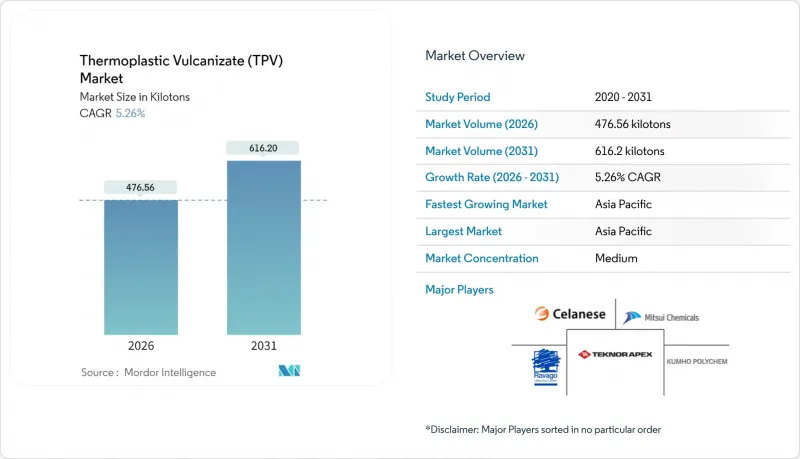
这一稳定成长反映了汽车製造商、医疗设备製造商和消费品製造商向可再生弹性体领域的果断转型。再生弹性体性能可与热固性材料媲美,同时也能降低整体系统成本。电动车轻量化的趋势、循环经济监管压力以及电子产品对柔软触感表面处理日益增长的需求,都在加速各地区的采用。成本分析表明,与三元乙丙橡胶 (EPDM) 相比,热塑性弹性体 (TPV) 可将零件製造成本降低 60% 以上,这主要得益于更快的生产週期和省去后固化步骤。供应商目前正在推广生物基和再生材料含量的产品,这些产品可将製造过程的碳足迹降低高达 50%,为原始设备製造商 (OEM) 实现科学排放目标提供了清晰的路径。这些特性使得动态交联热可塑性橡胶(TPV) 市场成为首选材料解决方案。同时,丙烯和三元乙丙橡胶 (EPDM) 原料价格的波动限制了传统热固性材料的吸引力。
全球动态交联热可塑性橡胶(TPV)市场趋势及洞察
汽车OEM製造商对轻量化的需求日益增长
汽车製造商正在加速材料替代,以减轻车辆重量并达到二氧化碳排放目标。热塑性硫化橡胶 (TPV) 零件比同类三元乙丙橡胶 (EPDM) 密封件轻约 30%,同时保持了良好的抗压缩永久变形性能,从而进一步延长了电池式电动车的续航里程。动态硫化技术的最新进展消除了长期疲劳性能的差距,使得 TPV 无需更换模具即可取代车门、玻璃滑轨和天窗系统中的热固性材料。欧盟 2025 年二氧化碳排放上限的压力正在加速这项变革,并确保热塑性硫化橡胶市场需求的持续成长。
家用电子电器用TPV软触感组件的快速成长
携带式电子产品品牌正采用热塑性聚苯乙烯(TPV)材料,以实现优质的触感,同时避免喷漆和包覆成型等复杂工艺,从而简化回收流程。这种树脂表面可直接成型,无需二次涂层,降低了手柄、保险桿和可穿戴设备机壳等零件的总成本。添加25-40%的回收材料可进一步减少产品固有排放,同时降低资本门槛,使亚洲的代工製造商能够使用标准射出成型机。更快的生产週期以及符合RoHS和REACH法规,正在推动TPV材料的进一步普及。
与热固性橡胶相比,其长期耐化学性和耐磨性较差。
在强酸性、油田或磨蚀性环境中,TPV在150°C以上会逐渐失去性能,因此特种热固性树脂仍是首选。聚丙烯酸酯改质TPV虽然可以延长使用寿命,但在腐蚀性介质中的管路应用方面仍属于次要选择。
细分市场分析
到2025年,标准EPDM/PP复合材料将占据热塑性硫化橡胶市场45.05%的份额,这主要得益于其低成本和广泛的模具相容性。成熟的配方能够满足大多数密封条和内装件的规格要求,并获得OEM厂商认可的性能认证。製造商采用双螺桿混炼生产线来平衡交联密度和聚丙烯熔体流动性,从而在高产量下实现严格的尺寸公差。因此,在成本竞争力高于性能优势的项目中,全球加工商仍优先考虑标准等级的产品。
生物基和再生材料产品的产量成长比例将持续提高,这与企业排放目标一致。在欧洲循环经济合规要求的推动下,生物基热塑性聚苯乙烯(TPV)预计将以6.76%的复合年增长率(CAGR)实现最快成长。工业废弃物材料含量高达40%的TPV产品,为原始设备製造商(OEM)提供了一条无需更改零件设计即可快速满足再生材料标准的途径。高温TPV产品虽然应用领域较为小众,但其策略定位十分重要,例如涡轮增压器软管和引擎室垫片等需要在150°C高温下持续使用的应用。
动态交联热可塑性橡胶(TPV) 报告按产品类型(例如,标准 EPDM/PP TPV、高性能/耐热 TPV)、应用(例如,密封系统/密封条、室内/室外装饰)、终端用户行业(例如,汽车、建筑/施工、消费品)和地区(例如,亚太地区、北美)进行细分。市场预测以千吨为单位。
区域分析
预计到2025年,亚太地区将占全球收入的45.70%,复合年增长率达6.10%,成长率超过其他地区。中国每年超过2500万辆的汽车产量支撑了对TPV密封条的快速需求,而日本在材料科学领域的专业优势则推动了特种等级产品的研发。印度新兴的汽车市场也刺激了市场需求,当地挤出製造商越来越多地用TPV取代EPDM型材以缩短生产週期。区域原料整合降低了聚丙烯和EPDM的成本,从而创造了单位成本优势,并推动了对欧洲和北美市场的出口。 Avient计划于2025年在中国扩大医用级TPU的生产规模,这标誌着其对亚洲医疗设备OEM厂商的供应优势将会加强。
在北美,需求集中在以密西根州为中心的汽车产业中心和墨西哥不断扩张的组装走廊,并保持稳定。通货膨胀控制法案提供的电动车激励措施正在加速电池组的生产,从而带动低导电性TPV冷却软管订单的成长。 Serenes在苏州新成立的认证混炼厂为本地和出口市场的注塑成型製程供应亚洲产的Santoprene颗粒,体现了跨区域的供应链设计。欧洲是永续性发展应用的标竿地区,获得ISCC-PLUS认证的TPV在豪华车和绿色建筑外墙领域实现了两位数的成长。报废车辆指令要求原始设备製造商(OEM)对回收成分进行认证,从而推动了对PCR混合TPV的需求。南美、中东和非洲合计占据动态交联热可塑性橡胶(TPV)市场较小但不断增长的份额。在巴西,汽车生产的復苏正在活性化对当地挤出工厂的投资。沿岸地区的生产商正在探索利用丰富的C3和二烯原料进入下游TPV复合材料业务的机会。在非洲,建筑业的蓬勃发展推动了基础设施计划对TPV防水型材的需求成长,但回收物流的限制延缓了完全循环经济效益的实现。
其他福利:
- Excel格式的市场预测(ME)表
- 3个月的分析师支持
目录
第一章 引言
- 研究假设和市场定义
- 调查范围
第二章调查方法
第三章执行摘要
第四章 市场情势
- 市场概览
- 市场驱动因素
- 全球汽车製造商对轻型汽车的需求不断增长
- 基于TPV的软触元件在家用电子电器的广泛应用
- 原始设备製造商转向可再生弹性体材料
- 电动车电池组密封技术的应用范围不断扩大
- 生物基热塑性塑胶等级的崛起
- 市场限制
- 丙烯和三元乙丙橡胶原料价格波动
- 与热固性橡胶相比,其长期耐化学性和耐磨性较差。
- 缺乏TPV废料的闭合迴路回收基础设施
- 价值链分析
- 波特五力模型
- 供应商的议价能力
- 买方的议价能力
- 新进入者的威胁
- 替代品的威胁
- 竞争程度
第五章 市场规模与成长预测
- 依产品类型
- 标准EPDM/PP TPV
- 高性能/耐热TPV
- 生物基TPV
- 含有回收材料的TPV
- 透过使用
- 密封系统和密封条
- 内装和外饰
- 引擎室内部件
- 软管和管件
- 电线电缆
- 医疗设备
- 消费品和体育用品零件
- 按最终用户行业划分
- 车
- 建筑/施工
- 消费品
- 卫生保健
- 其他终端用户产业
- 按地区
- 亚太地区
- 中国
- 印度
- 日本
- 韩国
- 印尼
- 马来西亚
- 泰国
- 越南
- 亚太其他地区
- 北美洲
- 我们
- 加拿大
- 墨西哥
- 欧洲
- 德国
- 英国
- 法国
- 义大利
- 西班牙
- 北欧国家
- 俄罗斯
- 其他欧洲地区
- 南美洲
- 巴西
- 阿根廷
- 哥伦比亚
- 其他南美洲
- 中东和非洲
- 沙乌地阿拉伯
- 卡达
- 阿拉伯聯合大公国
- 奈及利亚
- 埃及
- 南非
- 其他中东和非洲地区
- 亚太地区
第六章 竞争情势
- 市场集中度
- 策略趋势
- 市占率(%)/排名分析
- 公司简介
- Avient Corporation
- Celanese Corporation
- DuPont
- Elastron TPE
- FM Plastics
- HEXPOL AB
- Kumho Polychem
- LCY
- LOTTE Chemical CORPORATION
- Mitsubishi Chemical Group Corporation
- Mitsui Chemicals Inc.
- Orbia(Alphagary)
- Ravago
- RTP Company
- Shandong Dawn Polymer Materials Co. Ltd
- Teknor Apex
- Trinseo
- Zylog ElastoComp LLP
第七章 市场机会与未来展望
Thermoplastic Vulcanizate market size in 2026 is estimated at 476.56 kilotons, growing from 2025 value of 452.75 kilotons with 2031 projections showing 616.2 kilotons, growing at 5.26% CAGR over 2026-2031.
This steady expansion reflects a decisive shift by automakers, medical-device firms, and consumer-goods producers toward recyclable elastomers that offer thermoset-like performance at lower overall system costs. Lightweighting imperatives in electric vehicles, regulatory pressure for circular-economy compliance, and rising demand for soft-touch finishes in electronics amplify adoption across regions. Cost analyses show that TPVs can lower part manufacturing expenses by more than 60% versus EPDM rubber, mainly through shorter cycle times and elimination of post-curing steps. Suppliers now promote bio-based and recycled-content grades that cut cradle-to-gate carbon footprints by as much as 50%, providing a credible path for original equipment manufacturers (OEMs) to meet science-based emissions targets. These attributes position the Thermoplastic Vulcanizate market as a material solution of choice, while propylene and EPDM feedstock volatility limits the attractiveness of legacy thermosets.
Global Thermoplastic Vulcanizate (TPV) Market Trends and Insights
Rising Lightweighting Demand from Automotive OEMs
Automakers accelerate material substitution to cut vehicle mass and meet carbon-dioxide fleet targets. TPV components weigh roughly 30% less than comparable EPDM seals yet maintain compression-set resilience, allowing battery-electric models to gain additional driving range. Recent dynamic-vulcanization advances have closed the gap in long-term fatigue performance, enabling TPVs to replace thermosets in door, glass-run, and sunroof systems without altering tooling. Regulatory pressure under the European Union's 2025 CO2 cap magnifies this shift, ensuring sustained demand inflow to the Thermoplastic Vulcanizate market.
Surge in TPV-based Soft-Touch Parts for Consumer Electronics
Handheld electronics brands adopt TPVs to deliver a premium tactile feel while avoiding paint or over-mold steps that complicate recycling streams. The resin's direct-moldable surface eliminates secondary coatings and drops total part cost for grips, bumpers, and wearable-device housings. Integrating 25%-40% recycled content further slashes embodied emissions, and Asia-based contract molders can use standard injection machines, reducing capital barriers. Faster cycle times and compliance with RoHS and REACH regulations reinforce momentum.
Inferior Long-Term Chemical/Wear Resistance vs. Thermoset Rubber
High-acid, oil-field, or abrasive environments still favor specialty thermosets because TPVs can suffer gradual property loss beyond 150 °C. Although polyacrylate-modified TPVs extend service life, they remain a secondary choice for aggressive-media service lines.
Other drivers and restraints analyzed in the detailed report include:
- OEM Shift Toward Recyclable Elastomeric Materials
- Emergence of Bio-based TPV Grades
- Lack of Closed-Loop Recycling Infrastructure for TPV Scrap
For complete list of drivers and restraints, kindly check the Table Of Contents.
Segment Analysis
Standard EPDM/PP compounds accounted for 45.05% of the Thermoplastic Vulcanizate market size in 2025, thanks to lower cost and broad tooling compatibility. The mature formulations meet the majority of weather-seal and interior-trim specifications, offering OEM-qualified performance certifications. Manufacturers leverage twin-screw compounding lines to balance crosslink density and polypropylene melt-flow, enabling tight dimensional tolerances at high throughputs. As a result, global processors continue to prioritize standard grades for programs where cost competitiveness outweighs incremental performance gains.
Volume growth will increasingly originate from bio-based and recycled-content offerings that align with corporate emissions goals. Bio-attributed TPVs are projected to post the fastest 6.76% CAGR, aided by European mandates for circular-economy compliance. Recycled-content variants containing up to 40% post-industrial material give OEMs an immediate path to hit recycled-material thresholds without redesigning parts. High-temperature TPV grades remain niche but strategic, supplying turbo-charger hoses and under-hood gaskets that demand 150 °C continuous use.
The Thermoplastic Vulcanizate Report is Segmented by Product Type (Standard EPDM/PP TPV, High-Performance/Heat-Resistant TPV, and More), Application (Sealing Systems and Weather-Strips, Interior and Exterior Trim, and More), End-User Industry (Automotive, Building and Construction, Consumer Goods, and More), and Geography (Asia-Pacific, North America, and More). The Market Forecasts are Provided in Terms of Volume (Kilo Tons).
Geography Analysis
Asia-Pacific led with a 45.70% revenue share in 2025 and is forecast to grow at 6.10% CAGR, outpacing other regions. China's annual production of over 25 million vehicles underpins surging demand for TPV weatherstrips, while Japan's material-science expertise spurs specialty-grade development. India's emerging car market adds incremental volume through local extrusion houses that substitute EPDM profiles with TPV to trim cycle times. Regional feedstock integration lowers polypropylene and EPDM costs, creating a unit-cost advantage that drives exports to Europe and North America. Avient's 2025 expansion of medical-grade TPU output in China evidences supplier commitment to serve Asia-based medical-device OEMs.
North America records steady demand concentrated in Michigan-centric automotive hubs and Mexico's expanding assembly corridors. The Inflation Reduction Act's EV incentives accelerate battery-pack production, boosting call-offs for low-conductivity TPV coolant hoses. Celanese's newly qualified compounder in Suzhou provides Asian-sourced Santoprene pellets for local and export molding operations, illustrating cross-regional supply-chain design. Europe remains the bellwether for sustainability adoption, where ISCC-PLUS-certified TPVs enjoy double-digit growth in premium vehicle lines and green-building facades. The End-of-Life Vehicles Directive pushes OEMs to document recycled content, lifting demand for PCR-infused TPV grades. South America, the Middle East, and Africa together occupy a smaller but rising stake in the Thermoplastic Vulcanizate market. Brazil's revived auto output sparks investments in local extrusion plants, while Gulf-region producers consider downstream TPV compounding leveraging abundant C3 and diene feedstocks. Africa's construction boom increases consumption of TPV water-stop profiles in infrastructure projects, yet limited recycling logistics delay full circularity benefits.
- Avient Corporation
- Celanese Corporation
- DuPont
- Elastron TPE
- FM Plastics
- HEXPOL AB
- Kumho Polychem
- LCY
- LOTTE Chemical CORPORATION
- Mitsubishi Chemical Group Corporation
- Mitsui Chemicals Inc.
- Orbia (Alphagary)
- Ravago
- RTP Company
- Shandong Dawn Polymer Materials Co. Ltd
- Teknor Apex
- Trinseo
- Zylog ElastoComp LLP
Additional Benefits:
- The market estimate (ME) sheet in Excel format
- 3 months of analyst support
TABLE OF CONTENTS
1 Introduction
- 1.1 Study Assumptions and Market Definition
- 1.2 Scope of the Study
2 Research Methodology
3 Executive Summary
4 Market Landscape
- 4.1 Market Overview
- 4.2 Market Drivers
- 4.2.1 Rising Lightweighting Demand from Global Automotive OEMs
- 4.2.2 Surge in TPV-Based Soft-Touch Parts for Consumer Electronics
- 4.2.3 OEM Shift Toward Recyclable Elastomeric Materials
- 4.2.4 Expansion of EV Battery-Pack Sealing Applications
- 4.2.5 Emergence of Bio-Based TPV Grades
- 4.3 Market Restraints
- 4.3.1 Volatility in Propylene and EPDM Feedstock Prices
- 4.3.2 Inferior Long-Term Chemical/Wear Resistance Vs. Thermoset Rubber
- 4.3.3 Lack of Closed-Loop Recycling Infrastructure for TPV Scrap
- 4.4 Value Chain Analysis
- 4.5 Porter's Five Forces
- 4.5.1 Bargaining Power of Suppliers
- 4.5.2 Bargaining Power of Buyers
- 4.5.3 Threat of New Entrants
- 4.5.4 Threat of Substitute Products
- 4.5.5 Degree of Competition
5 Market Size and Growth Forecasts (Volume)
- 5.1 By Product Type
- 5.1.1 Standard EPDM/PP TPV
- 5.1.2 High-Performance / Heat-Resistant TPV
- 5.1.3 Bio-based TPV
- 5.1.4 Recycled-content TPV
- 5.2 By Application
- 5.2.1 Sealing Systems and Weather-strips
- 5.2.2 Interior and Exterior Trim
- 5.2.3 Under-the-Hood Components
- 5.2.4 Hose and Tubing
- 5.2.5 Wire and Cable
- 5.2.6 Medical Devices
- 5.2.7 Consumer and Sporting Goods Parts
- 5.3 By End-User Industry
- 5.3.1 Automotive
- 5.3.2 Building and Construction
- 5.3.3 Consumer Goods
- 5.3.4 Healthcare
- 5.3.5 Other End-user Industries
- 5.4 By Geography
- 5.4.1 Asia-Pacific
- 5.4.1.1 China
- 5.4.1.2 India
- 5.4.1.3 Japan
- 5.4.1.4 South Korea
- 5.4.1.5 Indonesia
- 5.4.1.6 Malaysia
- 5.4.1.7 Thailand
- 5.4.1.8 Vietnam
- 5.4.1.9 Rest of Asia-Pacific
- 5.4.2 North America
- 5.4.2.1 United States
- 5.4.2.2 Canada
- 5.4.2.3 Mexico
- 5.4.3 Europe
- 5.4.3.1 Germany
- 5.4.3.2 United Kingdom
- 5.4.3.3 France
- 5.4.3.4 Italy
- 5.4.3.5 Spain
- 5.4.3.6 Nordic Countries
- 5.4.3.7 Russia
- 5.4.3.8 Rest of Europe
- 5.4.4 South America
- 5.4.4.1 Brazil
- 5.4.4.2 Argentina
- 5.4.4.3 Colombia
- 5.4.4.4 Rest of South America
- 5.4.5 Middle-East and Africa
- 5.4.5.1 Saudi Arabia
- 5.4.5.2 Qatar
- 5.4.5.3 United Arab Emirates
- 5.4.5.4 Nigeria
- 5.4.5.5 Egypt
- 5.4.5.6 South Africa
- 5.4.5.7 Rest of Middle-East and Africa
- 5.4.1 Asia-Pacific
6 Competitive Landscape
- 6.1 Market Concentration
- 6.2 Strategic Moves
- 6.3 Market Share (%)/Ranking Analysis
- 6.4 Company Profiles {(includes Global level Overview, Market level overview, Core Segments, Financials as available, Strategic Information, Market Rank/Share for key companies, Products and Services, and Recent Developments)}
- 6.4.1 Avient Corporation
- 6.4.2 Celanese Corporation
- 6.4.3 DuPont
- 6.4.4 Elastron TPE
- 6.4.5 FM Plastics
- 6.4.6 HEXPOL AB
- 6.4.7 Kumho Polychem
- 6.4.8 LCY
- 6.4.9 LOTTE Chemical CORPORATION
- 6.4.10 Mitsubishi Chemical Group Corporation
- 6.4.11 Mitsui Chemicals Inc.
- 6.4.12 Orbia (Alphagary)
- 6.4.13 Ravago
- 6.4.14 RTP Company
- 6.4.15 Shandong Dawn Polymer Materials Co. Ltd
- 6.4.16 Teknor Apex
- 6.4.17 Trinseo
- 6.4.18 Zylog ElastoComp LLP
7 Market Opportunities and Future Outlook
- 7.1 White-space and Unmet-Need Assessment

 热塑性硫化橡胶市场:2026-2032年全球市场预测(依产品类型、加工技术、终端用途产业及分销通路划分)
 热塑性硫化橡胶市场机会、成长要素、产业趋势分析及2026-2035年预测。
 全球热塑性硫化橡胶市场规模、份额、趋势和成长分析报告(2026-2034)
 热塑性硫化橡胶市场规模、份额和趋势分析报告:按等级、加工方法、应用、地区和细分市场预测(2026-2033 年)
 热塑性硫化橡胶市场规模、份额和成长分析(按等级、加工方法和地区划分)-2026-2033年产业预测
 全球热塑性硫化橡胶(TPV)市场
 动态交联热可塑性橡胶(TPV) 市场,依类型、应用进行的需求分析,预测至 2034 年热塑性硫化剂市场:现状分析与未来预测 (2024年~2032年)动态交联热塑性弹性体(TPV)市场(2018-2034)全球热塑性硫化橡胶(TPV)市场规模:依应用、竞争格局、区域格局、预测