


 |
市场调查报告书
商品编码
1998763
退磁系统市场:商业机会、成长要素、产业趋势分析及2026-2035年预测Degaussing System Market Opportunity, Growth Drivers, Industry Trend Analysis, and Forecast 2026 - 2035 |
||||||

全球退磁系统市场预计到 2025 年将达到 6.624 亿美元,年复合成长率为 5.6%,到 2035 年将达到 11 亿美元。
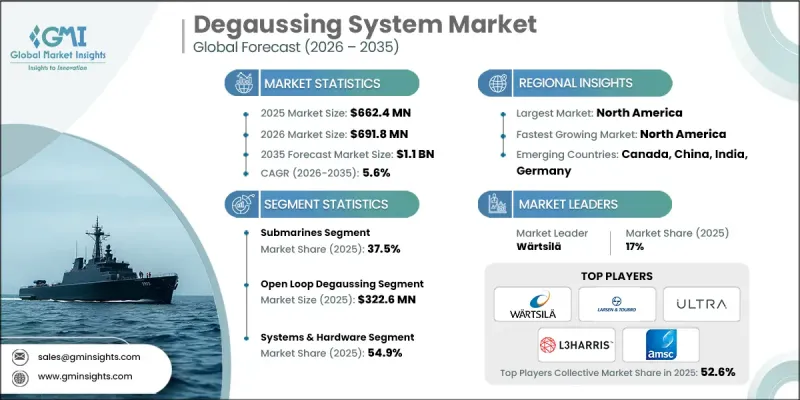
市场扩张的驱动力来自海军现代化项目的进展、舰队规模的扩大以及应对磁性水雷和水下侵入性武器威胁日益增长的需求。世界各国海军正在整合先进的数位监视技术,以增强舰队的生存能力和防护能力,同时优先考虑舰艇的隐身性能和磁性特征管理。地缘政治紧张局势和海上安全问题正在加速消磁系统的部署,而对节能和低维护技术的日益重视也推动了市场需求。军舰现代化和反水雷战计画进一步提升了磁性特征控制系统的重要性,尤其是在潜舰和先进作战舰艇上。预计舰队对数位监视的持续投入以及降低营运成本的努力将使市场保持成长势头直至2035年。
| 市场范围 | |
|---|---|
| 开始年份 | 2025 |
| 预测期 | 2026-2035 |
| 上市时的市场规模 | 6.624亿美元 |
| 预测金额 | 11亿美元 |
| 复合年增长率 | 5.6% |
由于降低磁特征对隐身作战至关重要,预计到2025年,潜舰领域将占据37.5%的市场份额。潜水艇在高度隐密且充满敌意的水下环境中作业,极易受到探测和磁性水雷的威胁。世界主要海军持续部署常规潜舰和核能,将确保对先进消磁系统(旨在维护作战安全并增强隐身能力)的稳定需求。
预计2025年,开放回路型消磁系统市场规模将达3.226亿美元,为海军舰艇提供可靠的磁场抑制方案。这些系统利用预设电流等级消除舰艇内部的永磁和感应磁,在降低复杂性的同时提高了运作效率。其久经考验的可靠性、易于整合以及对各种海军平台的适应性,使其成为长期磁场管理和舰队安全的关键。
受持续推进的海军现代化倡议的推动,预计到2025年,北美消磁系统市占率将达到36.5%。该地区拥有先进的海军舰队,并聚集了许多专注于磁性特征管理解决方案的领先国防承包商。各国政府正大力投资水雷对抗措施、舰队生存技术和数位化舰艇监视平台。在充足的国防预算和技术进步的支持下,加上持续的升级和舰队维护计划,预计北美将在2035年之前继续保持消磁系统部署的主要贡献者地位。
目录
第一章:调查方法和范围
第二章执行摘要
第三章业界考察
- 生态系分析
- 供应商情况
- 利润率
- 成本结构
- 每个阶段增加的价值
- 影响价值链的因素
- 中断
- 影响产业的因素
- 促进因素
- 海军现代化和舰队扩充计画的扩展
- 磁性水雷和鱼雷构成的威胁日益加剧。
- 人们越来越关注舰船的隐身性和生存能力
- 自动去磁技术进步
- 资料中心和安全资料擦除要求
- 产业潜在风险与挑战
- 对固态储存设备的影响有限。
- 透过替代消防技术展开竞争
- 市场机会
- 与无人船平台集成
- 与数位监控/物联网系统集成
- 促进因素
- 成长潜力分析
- 监理情势
- 北美洲
- 欧洲
- 亚太地区
- 拉丁美洲
- 中东和非洲
- 波特五力分析
- PESTEL 分析
- 科技与创新趋势
- 当前技术趋势
- 新兴技术
- 价格趋势
- 按地区
- 副产品
- 定价策略
- 新兴经营模式
- 合规要求
- 专利和智慧财产权分析
第四章 竞争情势
- 介绍
- 企业市占率分析
- 按地区
- 北美洲
- 欧洲
- 亚太地区
- 拉丁美洲
- 中东和非洲
- 市场集中度分析
- 按地区
- 主要企业的竞争标竿分析
- 财务绩效比较
- 销售量
- 利润率
- 研究与开发
- 产品系列比较
- 产品线宽度
- 科技
- 创新
- 区域扩张比较
- 全球扩张分析
- 服务网路覆盖
- 按地区分類的市场渗透率
- 竞争定位矩阵
- 领导者
- 挑战者
- 追踪者
- 小众玩家
- 战略展望矩阵
- 财务绩效比较
- 主要进展
- 併购
- 伙伴关係与合作
- 技术进步
- 扩张和投资策略
- 数位转型计划
- 新兴竞争对手和Start-Ups竞争对手的发展趋势
第五章 市场估算与预测:依船舶类型划分,2022-2035年
- 水面作战舰艇
- 巡防舰
- 驱逐舰
- 克尔维特
- 巡洋舰
- 航空母舰和两栖攻击舰
- 直升机登陆舰(LHD)
- 登陆平台船坞(LPD)
- 两栖运输舰(LST)
- 潜水艇
- 攻击型潜水艇
- 弹道导弹潜舰
- 巡弋飞弹潜舰
- 巡逻和支援船隻
- 近海巡逻舰(OPV)
- 扫雷(MCMV)
- 高速攻击艇(FAC)
- 辅助/支援船
第六章 市场估计与预测:依系统类型划分,2022-2035年
- 开放回路退磁
- 陀螺仪/地磁地图控制
- 手动模式系统
- 旧式船舶系统
- 封闭回路型退磁
- 基于磁力计的控制
- 签章预测系统
- 一种降低距离依赖性的系统。
- 混合系统
- 多模系统
- 可升级平台
- 模组化系统
第七章 市场估算与预测:依产品/服务分类,2022-2035年
- 系统硬体
- 退磁线圈组件
- 电源单元
- 控制面板
- 磁力计和感测器
- 双极放大器和导体
- 嵌入式控制软体
- 服务
- 安装和试运行
- 预防性保养
- 维修和故障排除
- 系统现代化
- 校准与检验
- 技术支援和培训
第八章 市场估算与预测:依安装类型划分,2022-2035年
- 新安装(OEM整合)
- 维修/现代化
第九章 市场估计与预测:依地区划分,2022-2035年
- 北美洲
- 我们
- 加拿大
- 欧洲
- 德国
- 英国
- 法国
- 西班牙
- 义大利
- 亚太地区
- 中国
- 印度
- 日本
- 澳洲
- 韩国
- 拉丁美洲
- 巴西
- 墨西哥
- 阿根廷
- 中东和非洲
- 南非
- 沙乌地阿拉伯
- 阿拉伯聯合大公国
第十章:公司简介
- 主要企业
- Wartsila
- L3Harris Technologies Inc.
- Larsen &Toubro Limited
- Ultra Electronics Holdings Plc
- 按地区分類的主要企业
- 北美洲
- American Superconductor Corporation
- Magnetics International
- 亚太地区
- Surma Ltd.
- Dayatech Merin
- 欧洲
- Polyamp
- Hitzinger GmbH
- STL Systems AG
- 北美洲
- 特殊玩家/干扰者
- IFEN
- K&G Marine
- Meriton Industries
- DA-Group
- HAELOG
The Global Degaussing System Market was valued at USD 662.4 million in 2025 and is estimated to grow at a CAGR of 5.6% to reach USD 1.1 billion in 2035.
The market expansion is driven by growing naval modernization programs, increasing fleet expansions, and the rising need to counter threats from magnetic mines and influence-based underwater weapons. Navies worldwide emphasize vessel stealth and magnetic signature management while integrating advanced digital monitoring technologies to enhance fleet survivability and protection. Geopolitical tensions and maritime security concerns are accelerating the adoption of degaussing systems, while the increasing focus on energy-efficient and low-maintenance technologies reinforce demand. The modernization of warships and mine countermeasure programs has elevated the significance of magnetic signature control systems, particularly in submarines and advanced combat vessels. Rising investment in digital monitoring and operational cost reduction across fleets is expected to sustain market momentum through 2035.
| Market Scope | |
|---|---|
| Start Year | 2025 |
| Forecast Year | 2026-2035 |
| Start Value | $662.4 Million |
| Forecast Value | $1.1 Billion |
| CAGR | 5.6% |
The submarines segment held a 37.5% share in 2025, due to the critical requirement for magnetic signature reduction in stealth operations. Submarines operate in sensitive and hostile underwater environments, making them highly vulnerable to detection and magnetic mines. The continuous deployment of conventional and nuclear-powered submarines by major navies globally ensures consistent demand for advanced degaussing systems designed to maintain operational security and enhance stealth capabilities.
The open-loop degaussing systems segment generated USD 322.6 million in 2025, as they provide reliable magnetic reduction for naval vessels. These systems use predetermined electrical current levels to neutralize permanent and induced magnetism in ships, offering operational efficiency with reduced complexity. Their proven reliability, straightforward integration, and adaptability across a range of naval platforms make them essential for long-term magnetic management and fleet safety.
North America Degaussing System Market held 36.5% share in 2025, driven by continuous naval modernization initiatives. The region benefits from advanced naval fleets and the presence of leading defense contractors specializing in magnetic signature management solutions. Governments are investing heavily in mine countermeasure systems, fleet survivability technologies, and digital vessel monitoring platforms. Continuous upgrades and fleet sustainment programs are expected to maintain North America as a key contributor to degaussing system adoption through 2035, underpinned by strong defense budgets and technological advancements.
Leading companies operating in the Global Degaussing System Market include Ultra Electronics Holdings Plc, Polyamp, American Superconductor Corporation, Larsen & Toubro Limited, HAELOG, Hitzinger GmbH, L3Harris Technologies Inc., DA-Group, Dayatech Merin, STL Systems AG, K&G Marine, Surma Ltd., Wartsila, IFEN, and Magnetics International. Key players in the Global Degaussing System Market are employing strategies to strengthen their foothold and expand their market presence. Companies are investing in R&D to develop energy-efficient, low-maintenance, and digitally integrated degaussing solutions suitable for modern naval fleets. Strategic partnerships with defense contractors, governments, and shipbuilding companies enhance technology adoption and global reach. Firms are also focusing on modular and scalable systems to address different vessel classes, including submarines and surface combatants. Expanding into emerging maritime markets and offering maintenance, training, and lifecycle support services further improves customer retention.
Table of Contents
Chapter 1 Methodology and Scope
- 1.1 Market scope and definition
- 1.2 Research design
- 1.2.1 Research approach
- 1.2.2 Data collection methods
- 1.3 Data mining sources
- 1.3.1 Global
- 1.3.2 Regional/Country
- 1.4 Base estimates and calculations
- 1.4.1 Base year calculation
- 1.4.2 Key trends for market estimation
- 1.5 Primary research and validation
- 1.5.1 Primary sources
- 1.6 Forecast model
- 1.7 Research assumptions and limitations
Chapter 2 Executive Summary
- 2.1 Industry 360° synopsis, 2022 - 2035
- 2.2 Key market trends
- 2.2.1 Vessel type trends
- 2.2.2 System type trends
- 2.2.3 Offering trends
- 2.2.4 Installation type trends
- 2.2.5 Regional trends
- 2.3 TAM Analysis, 2026-2035
- 2.4 CXO perspectives: Strategic imperatives
Chapter 3 Industry Insights
- 3.1 Industry ecosystem analysis
- 3.1.1 Supplier Landscape
- 3.1.2 Profit Margin
- 3.1.3 Cost structure
- 3.1.4 Value addition at each stage
- 3.1.5 Factor affecting the value chain
- 3.1.6 Disruptions
- 3.2 Industry impact forces
- 3.2.1 Growth drivers
- 3.2.1.1 Rising naval modernization and fleet expansion programs
- 3.2.1.2 Growing threats from magnetic mines/torpedoes
- 3.2.1.3 Increased focus on vessel stealth and survivability
- 3.2.1.4 Technological advances in degaussing automation
- 3.2.1.5 Data center and secure data destruction requirements
- 3.2.2 Industry pitfalls and challenges
- 3.2.2.1 Limited impact on solid-state storage devices
- 3.2.2.2 Competition from alternative suppression technologies
- 3.2.3 Market opportunities
- 3.2.3.1 Integration with unmanned vessel platforms
- 3.2.3.2 Integration with digital monitoring/IoT systems
- 3.2.1 Growth drivers
- 3.3 Growth potential analysis
- 3.4 Regulatory landscape
- 3.4.1 North America
- 3.4.2 Europe
- 3.4.3 Asia Pacific
- 3.4.4 Latin America
- 3.4.5 Middle East & Africa
- 3.5 Porter's analysis
- 3.6 PESTEL analysis
- 3.7 Technology and Innovation landscape
- 3.7.1 Current technological trends
- 3.7.2 Emerging technologies
- 3.8 Price trends
- 3.8.1 By region
- 3.8.2 By product
- 3.9 Pricing Strategies
- 3.10 Emerging Business Models
- 3.11 Compliance Requirements
- 3.12 Patent and IP analysis
Chapter 4 Competitive Landscape, 2025
- 4.1 Introduction
- 4.2 Company market share analysis
- 4.2.1 By region
- 4.2.1.1 North America
- 4.2.1.2 Europe
- 4.2.1.3 Asia Pacific
- 4.2.1.4 Latin America
- 4.2.1.5 Middle East & Africa
- 4.2.2 Market concentration analysis
- 4.2.1 By region
- 4.3 Competitive benchmarking of key players
- 4.3.1 Financial performance comparison
- 4.3.1.1 Revenue
- 4.3.1.2 Profit margin
- 4.3.1.3 R&D
- 4.3.2 Product portfolio comparison
- 4.3.2.1 Product range breadth
- 4.3.2.2 Technology
- 4.3.2.3 Innovation
- 4.3.3 Geographic presence comparison
- 4.3.3.1 Global footprint analysis
- 4.3.3.2 Service network coverage
- 4.3.3.3 Market penetration by region
- 4.3.4 Competitive positioning matrix
- 4.3.4.1 Leaders
- 4.3.4.2 Challengers
- 4.3.4.3 Followers
- 4.3.4.4 Niche players
- 4.3.5 Strategic outlook matrix
- 4.3.1 Financial performance comparison
- 4.4 Key developments
- 4.4.1 Mergers and acquisitions
- 4.4.2 Partnerships and collaborations
- 4.4.3 Technological advancements
- 4.4.4 Expansion and investment strategies
- 4.4.5 Digital transformation initiatives
- 4.5 Emerging/ startup competitors landscape
Chapter 5 Market Estimates and Forecast, By Vessel Type, 2022 - 2035 (USD Million)
- 5.1 Key trends
- 5.2 Surface combatants
- 5.2.1 Frigates
- 5.2.2 Destroyers
- 5.2.3 Corvettes
- 5.2.4 Cruisers
- 5.3 Aircraft carriers & amphibious vessels
- 5.3.1 Landing helicopter dock (LHD)
- 5.3.2 Landing platform dock (LPD)
- 5.3.3 Landing ship tank (LST)
- 5.4 Submarines
- 5.4.1 Attack submarines
- 5.4.2 Ballistic missile submarines
- 5.4.3 Cruise missile submarines
- 5.5 Patrol & support vessels
- 5.5.1 Offshore patrol vessels (OPV)
- 5.5.2 Mine countermeasure vessels (MCMV)
- 5.5.3 Fast attack craft (FAC)
- 5.5.4 Auxiliary & support ships
Chapter 6 Market Estimates and Forecast, By System Type, 2022 - 2035 (USD Million)
- 6.1 Key trends
- 6.2 Open loop degaussing
- 6.2.1 Gyro / geomagnetic map control
- 6.2.2 Manual mode systems
- 6.2.3 Legacy fleet systems
- 6.3 Closed loop degaussing
- 6.3.1 Magnetometer-based control
- 6.3.2 Signature prediction systems
- 6.3.3 Reduced range dependency systems
- 6.4 Hybrid systems
- 6.4.1 Multi-mode systems
- 6.4.2 Upgrade-ready platforms
- 6.4.3 Modular systems
Chapter 7 Market Estimates and Forecast, By Offering, 2022 - 2035 (USD Million)
- 7.1 Key trends
- 7.2 Systems & hardware
- 7.2.1 Degaussing coil assemblies
- 7.2.2 Power supply units
- 7.2.3 Control cabinets
- 7.2.4 Magnetometers & sensors
- 7.2.5 Bipolar amplifiers & conductors
- 7.2.6 Embedded control software
- 7.3 Services
- 7.3.1 Installation & commissioning
- 7.3.2 Preventive maintenance
- 7.3.3 Repairs & troubleshooting
- 7.3.4 System modernization
- 7.3.5 Calibration & verification
- 7.3.6 Technical support & training
Chapter 8 Market Estimates and Forecast, By Installation Type, 2022 - 2035 (USD Million)
- 8.1 Key trends
- 8.2 New build (OEM integration)
- 8.3 Retrofit / modernization
Chapter 9 Market Estimates and Forecast, By Region, 2022 - 2035 (USD Million)
- 9.1 Key trends
- 9.2 North America
- 9.2.1 U.S.
- 9.2.2 Canada
- 9.3 Europe
- 9.3.1 Germany
- 9.3.2 UK
- 9.3.3 France
- 9.3.4 Spain
- 9.3.5 Italy
- 9.4 Asia Pacific
- 9.4.1 China
- 9.4.2 India
- 9.4.3 Japan
- 9.4.4 Australia
- 9.4.5 South Korea
- 9.5 Latin America
- 9.5.1 Brazil
- 9.5.2 Mexico
- 9.5.3 Argentina
- 9.6 Middle East and Africa
- 9.6.1 South Africa
- 9.6.2 Saudi Arabia
- 9.6.3 UAE
Chapter 10 Company Profiles
- 10.1 Global Key Players
- 10.1.1 Wartsila
- 10.1.2 L3Harris Technologies Inc.
- 10.1.3 Larsen & Toubro Limited
- 10.1.4 Ultra Electronics Holdings Plc
- 10.2 Regional key players
- 10.2.1 North America
- 10.2.1.1 American Superconductor Corporation
- 10.2.1.2 Magnetics International
- 10.2.2 Asia Pacific
- 10.2.2.1 Surma Ltd.
- 10.2.2.2 Dayatech Merin
- 10.2.3 Europe
- 10.2.3.1 Polyamp
- 10.2.3.2 Hitzinger GmbH
- 10.2.3.3 STL Systems AG
- 10.2.1 North America
- 10.3 Niche Players/Disruptors
- 10.3.1 IFEN
- 10.3.2 K&G Marine
- 10.3.3 Meriton Industries
- 10.3.4 DA-Group
- 10.3.5 HAELOG

 退磁系统市场:依产品类型、技术、应用和最终用户划分-2026-2032年全球市场预测海军舰艇消磁系统市场:按舰艇类型、组件、安装类型、技术和最终用途分類的全球预测,2026-2032年
 退磁系统市场 - 全球产业规模、份额、趋势、机会、预测:按船舶类型、解决方案、地区和竞争对手划分,2021-2031年
 船舶类型、解决方案、最终用户和地区分類的退磁系统市场规模、份额和成长分析 - 2026-2033 年产业预测
 消磁系统:市场占有率分析、产业趋势、统计数据和成长预测(2025-2030 年)
 消磁系统市场分析及预测(截至 2033 年),按类型、产品、服务、技术、组件、应用、最终用户、安装类型、设备分类
 消磁系统市场,按组件、按解决方案、按船舶类型、按最终用户、按国家和地区 - 2024-2032 年行业分析、市场规模、市场份额和预测
 消磁系统市场规模、份额、趋势分析报告:按组件、按解决方案、按容器类型、按最终用途、按地区、按细分市场、预测,2024-2030 年