


 |
市场调查报告书
商品编码
1998811
升糖素市场机会、成长要素、产业趋势分析及2026-2035年预测Glucagon Market Opportunity, Growth Drivers, Industry Trend Analysis, and Forecast 2026 - 2035 |
||||||

2025 年全球升糖素市值为 4.665 亿美元,预计到 2035 年将以 6.5% 的复合年增长率增长至 8.668 亿美元。
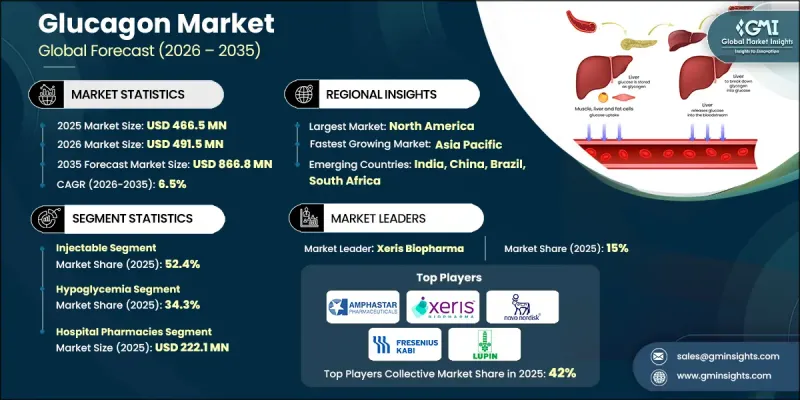
市场扩张的驱动因素是糖尿病盛行率的上升和低血糖发作频率的增加,这持续对全球医疗保健带来沉重负担。除了糖尿病相关紧急情况所带来的需求成长外,升糖素给药系统的创新也正在改变市场格局。糖尿病护理领域正日益采用由数位健康生态系统支援的整合、自动化和以患者为中心的解决方案。升糖素製剂的进步正在革新严重低血糖的治疗,使其从多步骤的配製试剂盒转变为即用型、稳定且便捷的选择。稳定的液体升糖素製剂现在可以在室温下储存,并透过自动注射器或预填充式注射器,无需复杂的配製步骤。这些创新缩短了给药时间,提高了看护者和急救人员的便利性,并增加了在严重低血糖发作期间获得适当治疗的可能性。
| 市场范围 | |
|---|---|
| 开始年份 | 2025 |
| 预测期 | 2026-2035 |
| 上市时的市场规模 | 4.665亿美元 |
| 预计金额 | 8.668亿美元 |
| 复合年增长率 | 6.5% |
到2025年,注射剂药物将占据52.4%的市场。注射用胰高升糖素对于预防严重低血糖引起的癫痫发作、意识丧失或长期神经损伤至关重要,因为它通常在几分钟内即可起效。注射剂药物给药途径柔软性,包括皮下、肌肉和静脉注射,从而能够在家庭、诊所和医院等各种环境中实现以患者为中心的治疗。这种适应性满足了不同患者的需求和紧急医疗要求,使该细分市场能够保持主导地位。
预计到2025年,医院药局市场规模将达到2.221亿美元,确保急诊室、加护病房和检查室中升糖素的持续供应和安全使用。医院药剂师负责监督升糖素的正确储存、配製和使用,维持其稳定性,并训练护理人员和辅助人员在紧急情况下正确使用。这些场所也是重要的教育中心,强调准确剂量、给药程序和治疗后监测,以确保病人安全。
2025年,北美胰升糖素市场占最大份额。这主要得益于先进的医疗基础设施、糖尿病急救治疗方法的高普及率以及速效升糖素製剂的广泛应用。完善的医院网络、便捷的药房管道以及健全的法规结构,为创新型升糖素产品的快速分销和核准提供了有力支持。医院药房将胰升糖素作为重要的急救药物进行管理,确保其在严重低血糖的即时应对、儿童剂量配製以及诊断程序中的应用。零售药局和线上药局则作为医院分销的补充,为病患提供方便的处方胰高升糖素家用购买管道。
目录
第一章:调查方法和范围
第二章执行摘要
第三章业界考察
- 生态系分析
- 影响产业的因素
- 促进因素
- 全球糖尿病盛行率正在上升。
- 胰升糖素给药方法的技术进步
- 研发活动活性化
- 产业潜在风险与挑战
- 药物高成本
- 与升糖素相关的副作用
- 市场机会
- 扩大紧急应变系统的应用范围
- 促进因素
- 成长潜力分析
- 监理情势
- 技术格局
- 目前技术
- 新兴技术
- 未来市场趋势
- 人工智慧和生成式人工智慧对市场的影响
- 波特五力分析
- PESTEL 分析
第四章 竞争情势
- 介绍
- 企业市占率分析
- 世界
- 北美洲
- 欧洲
- 企业矩阵分析
- 主要市场公司的竞争分析
- 竞争定位矩阵
- 主要进展
- 併购
- 伙伴关係与合作
- 新产品发布
- 业务拓展计划
第五章 市场估算与预测:依产品类型划分,2022-2035年
- 注射药物
- 吸入剂
第六章 市场估计与预测:依应用领域划分,2022-2035年
- 低血糖
- 诊断辅助
- 消化系统疾病
- 心源性休克
- 其他用途
第七章 市场估价与预测:依通路划分,2022-2035年
- 医院药房
- 零售药房
- 网路药房
第八章 市场估计与预测:依地区划分,2022-2035年
- 北美洲
- 我们
- 加拿大
- 欧洲
- 德国
- 英国
- 法国
- 西班牙
- 义大利
- 俄罗斯
- 荷兰
- 亚太地区
- 中国
- 日本
- 印度
- 澳洲
- 韩国
- 拉丁美洲
- 巴西
- 墨西哥
- 阿根廷
- 中东和非洲
- 南非
- 沙乌地阿拉伯
- 阿拉伯聯合大公国
第九章:公司简介
- Amphastar Pharmaceuticals
- Avalon Pharma
- Eli Lilly and Company
- Fresenius Kabi
- Hanmi Pharmaceutical
- Lupin Limited
- Novo Nordisk A/S
- Taj Pharmaceuticals
- Xeris Biopharma Holdings
- Zealand Pharma
The Global Glucagon Market was valued at USD 466.5 million in 2025 and is estimated to grow at a CAGR of 6.5% to reach USD 866.8 million by 2035.
Market expansion is fueled by the rising prevalence of diabetes and the increasing frequency of hypoglycemic episodes, which continue to impose a significant healthcare burden worldwide. Beyond the growing demand driven by diabetes-related emergencies, innovations in glucagon delivery systems are reshaping the market landscape. The diabetes care sector is increasingly adopting integrated, automated, and patient-friendly solutions supported by digital health ecosystems. Advances in glucagon formulations have transformed severe hypoglycemia management, moving away from multi-step reconstitution kits to ready-to-use, highly stable, and convenient options. Stable liquid glucagon formulations now remain usable at room temperature and can be delivered via autoinjectors or prefilled syringes, eliminating complicated preparation. These innovations reduce administration time, enhance ease of use for caregivers and emergency responders, and improve the likelihood of timely treatment during critical hypoglycemia events.
| Market Scope | |
|---|---|
| Start Year | 2025 |
| Forecast Year | 2026-2035 |
| Start Value | $466.5 Million |
| Forecast Value | $866.8 Million |
| CAGR | 6.5% |
The injectable segment held 52.4% share in 2025. Injectable glucagon provides a rapid onset of action, often within minutes, making it crucial in severe hypoglycemia scenarios to prevent seizures, unconsciousness, or long-term neurological damage. Injectable formulations offer flexibility in administration routes, including subcutaneous, intramuscular, and intravenous options, allowing tailored treatment across home, clinical, and hospital settings. This adaptability ensures the segment retains leadership by meeting diverse patient needs and urgent care requirements.
The hospital pharmacies segment contributed USD 222.1 million in 2025, ensuring continuous availability and safe handling of glucagon across emergency departments, inpatient wards, intensive care units, and diagnostic suites. Hospital pharmacists oversee the correct storage, preparation, and administration of glucagon, maintain its stability, and train nursing and support staff on proper emergency use. These environments also serve as critical educational hubs, emphasizing accurate dosage, administration steps, and post-treatment monitoring to ensure patient safety.
North America Glucagon Market held the largest share in 2025, driven by advanced healthcare infrastructure, high adoption of emergency diabetes therapies, and widespread use of ready-to-use glucagon formulations. Well-established hospital networks, pharmacy accessibility, and robust regulatory frameworks support rapid distribution and approval of innovative glucagon products. Hospital pharmacies maintain glucagon as a vital emergency medication, ensuring immediate access for severe hypoglycemia, preparation of pediatric doses, and use in diagnostic procedures. Retail and online pharmacies complement hospital distribution, providing convenient access to prescription glucagon for home use.
Prominent companies operating in the Global Glucagon Market include Amphastar Pharmaceuticals, Avalon Pharma, Eli Lilly and Company, Fresenius Kabi, Hanmi Pharmaceutical, Lupin Limited, Novo Nordisk A/S, Taj Pharmaceuticals, Xeris Biopharma Holdings, and Zealand Pharma. Companies in the Global Glucagon Market are strengthening their presence through multiple strategic approaches. Firms are investing in research and development to innovate stable, ready-to-use formulations and advanced autoinjector devices that improve ease of administration and patient compliance. Expanding distribution channels, including hospitals, retail, and online pharmacies, ensures broad product availability. Strategic collaborations with healthcare providers, emergency response networks, and patient advocacy organizations enhance education and awareness about timely hypoglycemia management. Regulatory engagement and fast-track approvals for innovative products help accelerate market entry.
Table of Contents
Chapter 1 Methodology and Scope
- 1.1 Research design
- 1.1.1 Research approach
- 1.1.2 Data collection methods
- 1.2 Data mining sources
- 1.2.1 Global
- 1.2.2 Regional/Country
- 1.3 Base estimates and calculations
- 1.3.1 Base year calculation
- 1.3.2 Key trends for market estimation
- 1.4 Primary research and validation
- 1.4.1 Primary sources
- 1.5 Forecast model
- 1.6 Research assumptions and limitations
Chapter 2 Executive Summary
- 2.1 Industry 360° synopsis
- 2.2 Key market trends
- 2.2.1 Product type trends
- 2.2.2 Application trends
- 2.2.3 Distribution channel trends
- 2.3 CXO perspectives: Strategic imperatives
Chapter 3 Industry Insights
- 3.1 Industry ecosystem analysis
- 3.2 Industry impact forces
- 3.2.1 Growth drivers
- 3.2.1.1 Rising prevalence of diabetes worldwide
- 3.2.1.2 Technological advancements in glucagon delivery methods
- 3.2.1.3 Increasing research and development activities
- 3.2.2 Industry pitfalls and challenges
- 3.2.2.1 High cost of medications
- 3.2.2.2 Side effects associated with glucagon
- 3.2.3 Market opportunity
- 3.2.3.1 Growing adoption in emergency response systems
- 3.2.1 Growth drivers
- 3.3 Growth potential analysis
- 3.4 Regulatory landscape
- 3.5 Technological landscape
- 3.5.1 Current technologies
- 3.5.2 Emerging technologies
- 3.6 Future market trends
- 3.7 Impact of AI and generative AI on the market
- 3.8 Porter's analysis
- 3.9 PESTEL analysis
Chapter 4 Competitive Landscape, 2025
- 4.1 Introduction
- 4.2 Company market share analysis
- 4.2.1 Global
- 4.2.2 North America
- 4.2.3 Europe
- 4.3 Company matrix analysis
- 4.4 Competitive analysis of major market players
- 4.5 Competitive positioning matrix
- 4.6 Key developments
- 4.6.1 Merger and acquisition
- 4.6.2 Partnership and collaboration
- 4.6.3 New product launches
- 4.6.4 Expansion plans
Chapter 5 Market Estimates and Forecast, By Product Type, 2022 - 2035 ($ Mn)
- 5.1 Key trends
- 5.2 Injectable
- 5.3 Inhalation
Chapter 6 Market Estimates and Forecast, By Application, 2022 - 2035 ($ Mn)
- 6.1 Key trends
- 6.2 Hypoglycemia
- 6.3 Diagnostic aid
- 6.4 Gastrointestinal disorders
- 6.5 Cardiogenic shock
- 6.6 Other applications
Chapter 7 Market Estimates and Forecast, By Distribution Channel, 2022 - 2035 ($ Mn)
- 7.1 Key trends
- 7.2 Hospital pharmacies
- 7.3 Retail pharmacies
- 7.4 Online pharmacies
Chapter 8 Market Estimates and Forecast, By Region, 2022 - 2035 ($ Mn)
- 8.1 Key trends
- 8.2 North America
- 8.2.1 U.S.
- 8.2.2 Canada
- 8.3 Europe
- 8.3.1 Germany
- 8.3.2 UK
- 8.3.3 France
- 8.3.4 Spain
- 8.3.5 Italy
- 8.3.6 Russia
- 8.3.7 Netherlands
- 8.4 Asia Pacific
- 8.4.1 China
- 8.4.2 Japan
- 8.4.3 India
- 8.4.4 Australia
- 8.4.5 South Korea
- 8.5 Latin America
- 8.5.1 Brazil
- 8.5.2 Mexico
- 8.5.3 Argentina
- 8.6 Middle East and Africa
- 8.6.1 South Africa
- 8.6.2 Saudi Arabia
- 8.6.3 UAE
Chapter 9 Company Profiles
- 9.1 Amphastar Pharmaceuticals
- 9.2 Avalon Pharma
- 9.3 Eli Lilly and Company
- 9.4 Fresenius Kabi
- 9.5 Hanmi Pharmaceutical
- 9.6 Lupin Limited
- 9.7 Novo Nordisk A/S
- 9.8 Taj Pharmaceuticals
- 9.9 Xeris Biopharma Holdings
- 9.10 Zealand Pharma

 升糖素市场规模、份额和成长分析(按适应症、给药途径、剂型、最终用户和地区划分)-2026-2033年产业预测
 全球GLP-1类似物市场
 GLP-1类比的全球市场:各适应症,各用途,各流通管道,各地区,机会,预测,2018年~2032年
 GLP-1 市场:依分子类型、所用活性化合物、GLP-1 促效剂药物类型、促效剂类型、给药途径、目标适应症和关键区域分:至2035年的行业趋势和全球预测
 GLP-1 类似物市场:现况分析与未来预测(2024-2032)
 GLP-1类比市场,规模,占有率,趋势,产业分析报告:各给药途径,各产品,各用途,各流通管道,各地区 - 市场预测,2025年~2034年