


 |
市场调查报告书
商品编码
2019107
美甲市场机会、成长要素、产业趋势分析及2026-2035年预测。Nail Polish Market Opportunity, Growth Drivers, Industry Trend Analysis, and Forecast 2026 - 2035 |
||||||

全球美甲市场预计到 2025 年将价值 176 亿美元,预计到 2035 年将以 8.7% 的复合年增长率增长至 397 亿美元。
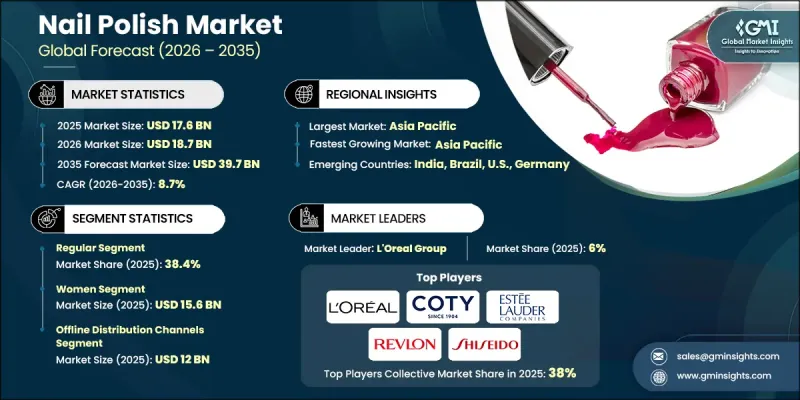
随着消费者偏好的转变、对永续性的日益重视以及产品创新重塑市场动态,美甲行业正经历着快速变化。消费者对更清洁配方的需求不断增长,促使製造商致力于开发纯素、透气、低化学成分的产品,并采用植物来源成分和先进技术。同时,可支配收入的增加以及消费者对高端美妆产品日益增长的偏好,也推动了已开发地区高端指甲油市场的扩张。数位商务的日益普及也在改变消费者的购买行为,使品牌能够透过D2C(直接面向消费者)策略和更优质的线上体验接触更广泛的客户群。企业透过采用环保包装和改进采购惯例来满足环保期望。支持性的法规结构和以创新为导向的倡议,正在促进更安全的产品开发和永续材料的应用,从而增强市场的长期成长。
| 市场范围 | |
|---|---|
| 开始年份 | 2025 |
| 预测期 | 2026-2035 |
| 上市时的市场规模 | 176亿美元 |
| 预测金额 | 397亿美元 |
| 复合年增长率 | 8.7% |
到2025年,一般指甲油市占率将达到38.4%,销售额将达到68亿美元。其广受欢迎的原因在于价格亲民、易于涂抹且色彩丰富。这些传统配方无需特殊工具或固化步骤,使用起来方便快捷,是理想的选择。
预计到2025年,线下通路将占据68%的市场份额,销售额将达到120亿美元。实体零售仍然占据主导地位,因为消费者偏好在购买前亲身体验产品的质地、颜色和做工。零售环境使消费者能够直接查看产品,从而能够立即做出明智的购买决策。
预计到2025年,美国指甲油市占率将达到84.2%,市场规模将达48亿美元。这一增长主要得益于消费者较高的意识、强大的购买力以及根深蒂固的美容文化。消费者对高效且更清洁的美容解决方案的需求,推动了创新和高端配方指甲油的持续成长。完善的零售体系和成熟的专业美甲产业也进一步促进了需求的持续成长和产品认知度的提升。
目录
第一章:调查方法和范围
第二章执行摘要
第三章业界考察
- 生态系分析
- 供应商情况
- 利润率
- 每个阶段增加的价值
- 影响价值链的因素
- 影响产业的因素
- 促进因素
- 对持久性凝胶和丙烯酸配方的需求不断增长
- 男士仪容和中性美容的流行趋势。
- 清洁美容无毒配方创新
- 产业潜在风险与挑战
- 来自自有品牌和独立品牌的激烈竞争。
- 在多个市场遵守监管规定
- 机会
- 电子商务与D2C通路的扩张
- 智慧包装与永续发展倡议的融合
- 促进因素
- 成长潜力分析
- 未来市场趋势
- 科技与创新趋势
- 当前技术趋势
- 新兴技术
- 价格趋势
- 对过去价格趋势的分析(基于初步研究)
- 根据业务类型分類的定价策略(高端/价值/成本加成)(基于初步调查)
- 区域价格波动(基于初步调查)
- 监理情势
- 波特五力分析
- PESTEL 分析
- 交易数据分析
- 进出口数量和价值的变化趋势(基于初步调查)
- 主要贸易走廊及关税影响(基于初步调查)
- 主要进口国和出口国(根据初步调查)
- 人工智慧和生成式人工智慧对市场的影响
- 利用人工智慧改造现有经营模式
- 预测分析在产品开发的应用
- 风险、限制和监管考量
- 分销基础设施和通路渗透状况(基于初步调查)
- 按地区和业态(现代零售与传统零售)分類的通路覆盖率(基于初步调查)
- 末端物流基础设施的差异以及新通路的变化(基于初步研究)
第四章 竞争情势
- 介绍
- 企业市占率分析
- 按地区
- 企业矩阵分析
- 主要市场公司的竞争分析
- 竞争定位矩阵
- 主要进展
- 併购
- 伙伴关係与合作
- 新产品发布
- 业务拓展计划
第五章 市场估算与预测:依产品类型划分,2022-2035年
- 主要趋势
- 普通版
- 凝胶
- 丙烯酸纤维
- 聚合物凝胶
- 沾粉
- 其他(延长胶、硬质凝胶指甲油等)
第六章 市场估计与预测:依价格区间划分,2022-2035年
- 低价位
- 中价位(25-50美元)
- 高价位(超过50美元)
第七章 市场估计与预测:依消费群组划分,2022-2035年
- 男性
- 女士
- 适合儿童
第八章 市场估算与预测:依通路划分,2022-2035年
- 在线的
- 电子商务
- 企业网站
- 离线
- 超级市场/大卖场
- 专业美容零售商
- 其他零售店
第九章 市场估计与预测:依地区划分,2022-2035年
- 北美洲
- 我们
- 加拿大
- 欧洲
- 德国
- 英国
- 法国
- 义大利
- 西班牙
- 亚太地区
- 中国
- 日本
- 印度
- 澳洲
- 韩国
- 拉丁美洲
- 巴西
- 墨西哥
- 阿根廷
- 中东和非洲
- 南非
- 沙乌地阿拉伯
- 阿拉伯聯合大公国
第十章:公司简介
- China Glaze
- Coty, Inc.
- Dior Vernis(LVMH)
- Essie(L'Oreal Group)
- 雅诗兰黛公司
- Lakme
- L'Oreal Group
- L'Oreal Paris
- LVMH
- OPI Products, Inc.(Coty)
- Revlon, Inc.
- Rimmel London(Coty)
- Sally Hansen(Coty)
- Shiseido Co., Ltd.
- Unilever Group
The Global Nail Polish Market was valued at USD 17.6 billion in 2025 and is estimated to grow at a CAGR of 8.7% to reach USD 39.7 billion by 2035.
The industry is evolving rapidly as changing consumer preferences, sustainability priorities, and product innovation reshape market dynamics. Demand for cleaner formulations is increasing, encouraging manufacturers to develop vegan, breathable, and low-chemical products using plant-based ingredients and advanced technologies. At the same time, rising disposable incomes and a growing inclination toward premium beauty products are supporting the expansion of high-end nail polish segments across developed regions. The growing influence of digital commerce is also transforming purchasing behavior, with direct-to-consumer strategies and enhanced online experiences helping brands reach broader audiences. Companies are further aligning with environmental expectations by introducing eco-conscious packaging formats and improving sourcing practices. Supportive regulatory frameworks and innovation-focused initiatives encourage safer product development and advancing sustainable material adoption, strengthening long-term market growth.
| Market Scope | |
|---|---|
| Start Year | 2025 |
| Forecast Year | 2026-2035 |
| Start Value | $17.6 Billion |
| Forecast Value | $39.7 Billion |
| CAGR | 8.7% |
The regular nail polish segment accounted for 38.4% share in 2025, generating USD 6.8 billion. Its widespread popularity is driven by affordability, ease of application, and a broad range of color options. These traditional formulations remain highly accessible as they do not require specialized tools or curing processes, making them ideal for quick and convenient use.
The offline distribution segment held a 68% share in 2025, contributing USD 12 billion. Physical retail continues to dominate due to consumer preference for experiencing product texture, shade accuracy, and finish before making a purchase. Retail environments provide immediate availability and enable informed decision-making through direct interaction with products.
United States Nail Polish Market held an 84.2% share, generating USD 4.8 billion in 2025. Growth in the region is supported by strong consumer awareness, high spending capacity, and a deeply rooted beauty culture. Demand for innovative and premium formulations remains strong, driven by consumers seeking performance-oriented and cleaner beauty solutions. A well-established retail ecosystem and a mature professional nail care industry further contribute to sustained demand and product visibility.
Key companies operating in the Global Nail Polish Market include LVMH, L'Oreal Group, Coty, Inc., Unilever Group, Estee Lauder Companies, Shiseido Co., Ltd., Revlon, Inc., China Glaze, Lakme, Essie, Dior Vernis, OPI Products, Inc., Rimmel London, Sally Hansen, and L'Oreal Paris. Companies in the Nail Polish Market are strengthening their position by focusing on innovation in clean and sustainable formulations, including vegan and breathable products. They are expanding their digital presence through direct-to-consumer platforms and enhancing online shopping with virtual tools. Strategic collaborations, influencer marketing, and targeted campaigns are increasing brand visibility and consumer engagement. Investments in eco-friendly packaging and sustainable sourcing are improving brand perception. Additionally, companies are broadening product portfolios, entering emerging markets, and leveraging advanced R&D to deliver long-lasting, high-performance solutions that align with evolving consumer expectations.
Table of Contents
Chapter 1 Methodology and Scope
- 1.1 Market scope and definition
- 1.2 Research design
- 1.2.1 Research approach
- 1.2.2 Data collection methods
- 1.3 Data mining sources
- 1.3.1 Global
- 1.3.2 Regional/Country
- 1.4 Base estimates and calculations
- 1.4.1 Base year calculation
- 1.4.2 Key trends for market estimation
- 1.5 Primary research and validation
- 1.5.1 Primary sources
- 1.6 Forecast model
- 1.7 Research assumptions and limitations
Chapter 2 Executive Summary
- 2.1 Industry 360° synopsis
- 2.2 Key market trends
- 2.2.1 Regional
- 2.2.2 Product Type
- 2.2.3 Price Range
- 2.2.4 Consumer Group
- 2.2.5 Distribution Channel
- 2.3 CXO perspectives: Strategic imperatives
- 2.3.1 Key decision points for industry executives
- 2.3.2 Critical success factors for market players
- 2.4 Future outlook and strategic recommendations
Chapter 3 Industry Insights
- 3.1 Industry ecosystem analysis
- 3.1.1 Supplier landscape
- 3.1.2 Profit margin
- 3.1.3 Value addition at each stage
- 3.1.4 Factor affecting the value chain
- 3.2 Industry impact forces
- 3.2.1 Growth drivers
- 3.2.1.1 Growing demand for long-lasting gel and acrylic formulations
- 3.2.1.2 Rising male grooming and gender-neutral beauty trends
- 3.2.1.3 Innovation in clean beauty and non-toxic formulations
- 3.2.2 Industry pitfalls & challenges
- 3.2.2.1 High competition from private label and indie brands
- 3.2.2.2 Regulatory compliance across multiple markets
- 3.2.3 Opportunities
- 3.2.3.1 Expansion of e-commerce and direct-to-consumer channels
- 3.2.3.2 Integration of smart packaging and sustainability initiatives
- 3.2.1 Growth drivers
- 3.3 Growth potential analysis
- 3.4 Future market trends
- 3.5 Technology and innovation landscape
- 3.5.1 Current technological trends
- 3.5.2 Emerging technologies
- 3.6 Price trends
- 3.6.1 Historical Price Trend Analysis (Driven by Primary Research)
- 3.6.2 Pricing Strategy by Player Type (Premium / Value / Cost-plus) (Driven by Primary Research)
- 3.6.3 Regional Price Variations (Driven by Primary Research)
- 3.7 Regulatory landscape
- 3.8 Porter's analysis
- 3.9 PESTEL analysis
- 3.10 Trade Data Analysis
- 3.10.1 Import & Export Volume & Value Trends(Driven by Primary Research)
- 3.10.2 Key Trade Corridors & Tariff Impact(Driven by Primary Research)
- 3.10.3 Top Importing & Exporting Countries (Driven by Primary Research)
- 3.11 Impact of AI & Generative AI on the Market
- 3.11.1 AI-Driven Disruption of Existing Business Models
- 3.11.2 Predictive Analytics for Product Development
- 3.11.3 Risks, Limitations & Regulatory Considerations
- 3.12 Distribution Infrastructure & Channel Penetration Landscape (Driven by Primary Research)
- 3.12.1 Channel Coverage by Region & Format (Modern vs. Traditional Trade) (Driven by Primary Research)
- 3.12.2 Last-Mile Infrastructure Gaps & Emerging Channel Shifts (Driven by Primary Research)
Chapter 4 Competitive Landscape, 2025
- 4.1 Introduction
- 4.2 Company market share analysis
- 4.2.1 By region
- 4.2.1.1 North America
- 4.2.1.2 Europe
- 4.2.1.3 Asia Pacific
- 4.2.1.4 Latin America
- 4.2.1.5 Middle East and Africa
- 4.2.1 By region
- 4.3 Company matrix analysis
- 4.4 Competitive analysis of major market players
- 4.5 Competitive positioning matrix
- 4.6 Key developments
- 4.6.1 Mergers & acquisitions
- 4.6.2 Partnerships & collaborations
- 4.6.3 New product launches
- 4.6.4 Expansion plans
Chapter 5 Market Estimates & Forecast, By Product Type, 2022 - 2035, (USD Billion) (Million Unit)
- 5.1 Key Trends
- 5.2 Regular
- 5.3 Gel
- 5.4 Acrylic
- 5.5 Polygel
- 5.6 Dip Powder
- 5.7 Others (Builder Gel, Hard Gel Nail Polish, etc.)
Chapter 6 Market Estimates & Forecast, By Price Range, 2022 - 2035, (USD Billion) (Million Unit)
- 6.1 Key trends
- 6.2 Low
- 6.3 Mid (USD 25- USD 50)
- 6.4 High (>USD 50)
Chapter 7 Market Estimates & Forecast, By Consumer Group, 2022 - 2035, (USD Billion) (Million Unit)
- 7.1 Key trends
- 7.2 Men
- 7.3 Women
- 7.4 Kids
Chapter 8 Market Estimates & Forecast, By Distribution Channel, 2022 - 2035, (USD Billion) (Million Unit)
- 8.1 Key trends
- 8.2 Online
- 8.2.1 E-commerce
- 8.2.2 Company websites
- 8.3 Offline
- 8.3.1 Supermarkets/Hypermarkets
- 8.3.2 Specialty beauty retailers
- 8.3.3 Other retail stores
Chapter 9 Market Estimates and Forecast, By Region, 2022 - 2035 (USD Billion) (Million Unit)
- 9.1 Key trends
- 9.2 North America
- 9.2.1 U.S.
- 9.2.2 Canada
- 9.3 Europe
- 9.3.1 Germany
- 9.3.2 UK
- 9.3.3 France
- 9.3.4 Italy
- 9.3.5 Spain
- 9.4 Asia Pacific
- 9.4.1 China
- 9.4.2 Japan
- 9.4.3 India
- 9.4.4 Australia
- 9.4.5 South Korea
- 9.5 Latin America
- 9.5.1 Brazil
- 9.5.2 Mexico
- 9.5.3 Argentina
- 9.6 Middle East and Africa
- 9.6.1 South Africa
- 9.6.2 Saudi Arabia
- 9.6.3 UAE
Chapter 10 Company Profiles
- 10.1 China Glaze
- 10.2 Coty, Inc.
- 10.3 Dior Vernis (LVMH)
- 10.4 Essie (L'Oreal Group)
- 10.5 Estee Lauder Companies
- 10.6 Lakme
- 10.7 L'Oreal Group
- 10.8 L'Oreal Paris
- 10.9 LVMH
- 10.10 OPI Products, Inc. (Coty)
- 10.11 Revlon, Inc.
- 10.12 Rimmel London (Coty)
- 10.13 Sally Hansen (Coty)
- 10.14 Shiseido Co., Ltd.
- 10.15 Unilever Group

 指甲油市场:全球市场按产品类型、分销管道、最终用户、颜色和光泽度分類的预测 - 2026-2032年UV美甲凝胶市场:2026-2032年全球市场预测(按产品类型、包装类型、成分类型、固化技术、应用、最终用户和分销管道划分)蛋白质指甲油市场按价格范围、配方、成分类型、分销管道和最终用户划分-全球预测,2026-2032年
 2026-2034年全球家用凝胶美甲套装市场规模、份额、趋势和成长分析报告全球指甲油市场规模、份额、趋势和成长分析报告(2026-2034)UV美甲凝胶市场规模、份额、成长及全球产业分析:按类型、应用和区域划分,2026-2034年预测雾面指甲油市场按产品类型、价格范围、配方、包装类型、应用、最终用户和分销管道划分-2026-2032年全球预测
 指甲油市场规模、份额和成长分析(按产品、分销管道、价格分布范围、消费群组和地区划分)-2026-2033年产业预测指甲修復套件市场(按产品、类型、年龄层、性别、分销管道和最终用户划分)—2025-2030 年全球预测香水美甲市场按产品类型、香氛类型、基质、包装、最终用户和分销管道划分 - 全球预测,2025-2030 年