


 |
市场调查报告书
商品编码
2019165
肺功能检测系统市场:商业机会、成长要素、产业趋势分析及2026-2035年预测Pulmonary Function Testing Systems Market Opportunity, Growth Drivers, Industry Trend Analysis, and Forecast 2026 - 2035 |
||||||

全球肺功能测试系统市场预计到 2025 年将达到 31 亿美元,预计到 2035 年将以 6.9% 的复合年增长率增长至 59 亿美元。
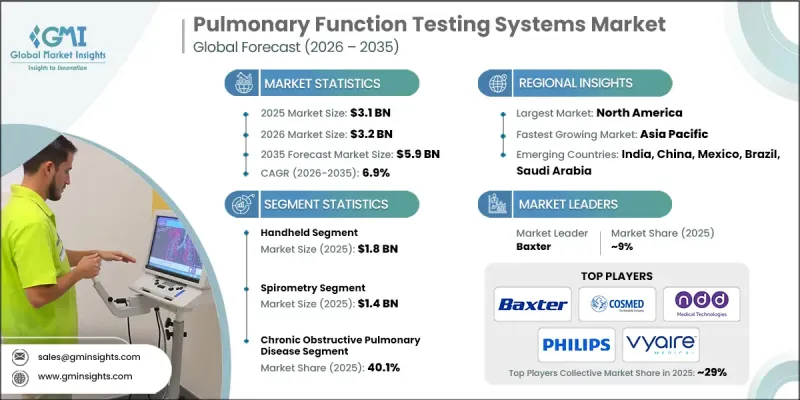
由于慢性呼吸系统疾病盛行率不断上升,以及政府推出鼓励早期诊断和管理的扶持措施,市场正经历强劲成长。肺功能检测系统是评估肺功能、测量气流、肺容量和气体交换效率的重要工具。气喘、慢性阻塞性肺病(COPD)和其他肺部疾病病例的增加,推动了医院、诊所和居家照护机构对肺功能检测系统的应用。携带式设备、先进的肺计量计和整合分析软体等技术创新,提高了诊断准确性和患者舒适度,加速了市场渗透。肺功能检测系统在职业健康监测、工业应用和家庭呼吸照护领域的应用也不断扩展。对数位健康、远端监测功能以及紧凑易用设备整合的需求日益增长,正在加速肺功能检测系统市场的扩张,尤其是在重视预防医学和远端医疗解决方案的地区。
| 市场范围 | |
|---|---|
| 开始年份 | 2025 |
| 预测期 | 2026-2035 |
| 上市时的市场规模 | 31亿美元 |
| 预测金额 | 59亿美元 |
| 复合年增长率 | 6.9% |
预计到2025年,手持式肺功能检测市场规模将达18亿美元。这些携带式设备因其设计紧凑、价格实惠且易于使用而备受青睐,是临床和家庭监测的理想选择。手持式肺功能检测系统使医护人员和患者能够在各种环境下进行检测,从而提高了柔软性和便利性。这些设备的高性价比正推动其在小规模诊所、基层医疗中心和资源匮乏地区广泛应用。便利性、便携性和使用者友善性的完美结合,使手持式肺功能检测市场能够满足临床和个人健康监测的双重需求,从而保持其市场主导地位。
预计到2025年,肺功能仪市场规模将达到14亿美元,并在2035年之前以7.2%的复合年增长率成长。肺功能仪仍然是评估肺功能和检测呼吸系统疾病(例如气道阻塞和气流障碍)的重要诊断测试。数位介面、无线连接以及与健康数据平台整合等技术进步,使现代肺计量计更加精准、直觉和便携。这些改进提高了患者依从性,并提升了临床和居家照护环境中的操作效率,从而促进了其更广泛的应用。随着对精准、快速且易于使用的肺功能评估的需求不断增长,肺功能仪系统预计将继续成为市场的主要收入来源。
美国肺功能检测系统市场预计到2025年将达到14亿美元,并在2026年至2035年间以5.8%的复合年增长率成长。北美在医疗技术创新领域的主导地位推动了先进肺功能检测系统(包括具备无线连接功能的数位携带式设备)的快速普及。医疗服务提供者正增加对精准、有效率且便于患者使用的诊断工具的投资。不断增长的医疗支出,以及强调品质和早期检测的法规结构,进一步刺激了对肺功能检测解决方案的需求。美国市场受惠于多种因素的共同作用,包括先进的基础设施、人们对呼吸系统健康的日益重视,以及慢性肺病盛行率的上升——而慢性肺病正是全球市场成长的主要驱动力。
目录
第一章:调查方法
- 研究途径
- 品质改进计划
- GMI人工智慧政策和资料完整性倡议
- 资讯来源一致性协议
- GMI人工智慧政策和资料完整性倡议
- 调查过程和可靠性评分
- 调查过程的组成部分
- 评分组成部分
- 数据收集
- 主要来源部分列表
- 资料探勘资讯来源
- 付费资讯来源
- 区域资讯来源
- 付费资讯来源
- 基本估算和计算方法
- 每种方法中基准年的计算
- 预测模型
- 量化市场影响分析
- 生长参数对预测的数学影响
- 量化市场影响分析
- 关于调查透明度的补充信息
- 资讯来源归属框架
- 品质保证指标
- 对信任的承诺
第二章执行摘要
第三章业界考察
- 生态系分析
- 影响产业的因素
- 促进因素
- 慢性呼吸系统疾病盛行率增加
- 技术进步
- 有利的政府倡议
- 产业潜在风险与挑战
- 严格的法规结构
- 肺功能测试设备高成本
- 市场机会
- 携带式和无线PFT设备的扩展
- 促进因素
- 成长潜力分析
- 监理情势
- 北美洲
- 欧洲
- 亚太地区
- 技术趋势(基于初步调查)
- 当前技术趋势
- 新兴技术
- 未来市场趋势(基于初步研究)
- 人工智慧和生成式人工智慧对市场的影响(基于初步研究)
- 专利分析
- 价格分析(2025 年)(基于初步调查)
- 客户洞察
- 波特五力分析
- PESTEL 分析
- 差距分析
第四章 竞争情势
- 介绍
- 企业矩阵分析
- 企业市占率分析
- 世界
- 北美洲
- 欧洲
- 亚太地区
- LAMEA
- 竞争定位矩阵
- 主要市场公司的竞争分析
- 主要进展
- 併购
- 伙伴关係与合作
- 新产品类型发布
- 业务拓展计划
第五章 市场估价与预测:依产品划分,2022-2035年
- 手持式
- 桌面型
第六章 市场估计与预测:依测试类型划分,2022-2035年
- 肺功能测定
- 运动压力测试
- 肺容量测试
- 高空模拟试验
- 气体扩散试验
- 其他类型的测试
第七章 市场估计与预测:依应用领域划分,2022-2035年
- 慢性阻塞性肺病
- 气喘
- 慢性呼吸困难
- 肺纤维化
- 其他用途
第八章 市场估算与预测:依最终用途划分,2022-2035年
- 医院和诊所
- 诊断中心
- 居家医疗环境
- 其他最终用户
第九章 市场估计与预测:依地区划分,2022-2035年
- 北美洲
- 我们
- 加拿大
- 欧洲
- 德国
- 英国
- 法国
- 西班牙
- 义大利
- 荷兰
- 亚太地区
- 中国
- 日本
- 印度
- 澳洲
- 韩国
- 拉丁美洲
- 巴西
- 墨西哥
- 阿根廷
- 中东和非洲
- 南非
- 沙乌地阿拉伯
- 阿拉伯聯合大公国
第十章:公司简介
- Baxter
- CHEST MI
- COSMED
- ECO MEDICS
- FUKUDA SANGYO
- GANSHORN SCHILLER GROUP
- Geratherm Respiratory
- 欧洲医疗设备
- MGC DIAGNOSTICS
- MINATO MEDICAL SCIENCE
- MORGAN
- ndd Medical Technologies
- PHILIPS
- Vitalograph
- Vyaire MEDICAL
The Global Pulmonary Function Testing Systems Market was valued at USD 3.1 billion in 2025 and is estimated to grow at a CAGR of 6.9% to reach USD 5.9 billion by 2035.
The market is experiencing robust growth due to the rising prevalence of chronic respiratory conditions and supportive government initiatives that promote early diagnosis and management. Pulmonary function testing systems are critical tools for assessing lung performance, measuring airflow, lung volumes, and gas exchange efficiency. Increasing cases of respiratory diseases, such as asthma, chronic obstructive pulmonary disease (COPD), and other pulmonary disorders, are driving adoption across hospitals, clinics, and home care settings. Innovations, including portable devices, advanced spirometers, and integrated analytical software, are enhancing diagnostic accuracy and patient comfort while promoting widespread acceptance. The industry is also witnessing growing use in occupational health monitoring, industrial applications, and home-based respiratory care. Digital health integration, remote monitoring capabilities, and the rising demand for compact, easy-to-use devices are accelerating the expansion of the pulmonary function testing systems market, particularly in regions emphasizing preventive healthcare and telemedicine solutions.
| Market Scope | |
|---|---|
| Start Year | 2025 |
| Forecast Year | 2026-2035 |
| Start Value | $3.1 Billion |
| Forecast Value | $5.9 Billion |
| CAGR | 6.9% |
The handheld segment reached USD 1.8 billion in 2025. These portable devices are favored for their compact design, affordability, and ease of use, making them ideal for point-of-care and home-based monitoring. Handheld pulmonary function testing systems allow healthcare providers and patients to conduct assessments across diverse environments, promoting flexibility and convenience. The devices' cost-effectiveness enhances their adoption in small clinics, primary care centers, and resource-limited settings. The combination of accessibility, portability, and user-friendly features ensures that the handheld segment maintains its dominance, catering to both clinical and personal health monitoring needs.
The spirometry segment accounted for USD 1.4 billion in 2025 and is expected to grow at a CAGR of 7.2% through 2035. Spirometry remains a cornerstone diagnostic test for assessing lung function and detecting respiratory issues, such as airway obstruction and impaired airflow. Technological advancements, including digital interfaces, wireless connectivity, and integration with health data platforms, have made modern spirometers more precise, intuitive, and portable. These enhancements increase patient compliance and operational efficiency in clinical and home care environments, supporting wider adoption. As the demand for accurate, rapid, and user-friendly pulmonary assessments rises, spirometry systems are anticipated to remain a primary revenue contributor within the market.
U.S. Pulmonary Function Testing Systems Market captured USD 1.4 billion in 2025 and is projected to grow at a CAGR of 5.8% from 2026 to 2035. North America's leadership in medical technology innovation supports the rapid adoption of advanced pulmonary function testing systems, including digital and portable devices with wireless connectivity. Healthcare providers are increasingly investing in accurate, efficient, and patient-friendly diagnostic tools. Rising healthcare expenditure, coupled with regulatory frameworks emphasizing quality and early detection, further stimulates demand for pulmonary testing solutions. The U.S. market benefits from a combination of advanced infrastructure, high awareness of respiratory health, and increasing prevalence of chronic lung conditions, making it a key driver of global market growth.
Prominent players in the Global Pulmonary Function Testing Systems Market include Baxter, CHEST M.I, COSMED, ECO MEDICS, FUKUDA SANGYO, GANSHORN SCHILLER GROUP, Geratherm Respiratory, Medical Equipment Europe, MGC DIAGNOSTICS, MINATO MEDICAL SCIENCE, MORGAN, ndd Medical Technologies, PHILIPS, Vitalograph, and Vyaire MEDICAL. Key strategies adopted by companies in the Global Pulmonary Function Testing Systems Market focus on innovation, technological integration, and global expansion to strengthen market presence. Businesses are investing in R&D to develop portable, digital, and connected devices that enhance usability, accuracy, and patient engagement. Strategic partnerships, acquisitions, and collaborations are enabling access to new markets, advanced technologies, and manufacturing capabilities. Companies are also emphasizing customized solutions tailored for hospitals, clinics, and home-based monitoring to meet diverse consumer needs. Expanding distribution networks, enhancing customer support, and maintaining compliance with regulatory standards are critical tactics to improve brand trust and penetration. Additionally, firms are leveraging digital platforms to offer remote monitoring, data analytics, and telehealth solutions, ensuring a stronger foothold and competitive advantage in the market.
Table of Contents
Chapter 1 Research Methodology
- 1.1 Research approach
- 1.2 Quality commitments
- 1.2.1 GMI AI policy & data integrity commitment
- 1.2.1.1 Source consistency protocol
- 1.2.1 GMI AI policy & data integrity commitment
- 1.3 Research trail & confidence scoring
- 1.3.1 Research trail components
- 1.3.2 Scoring components
- 1.4 Data collection
- 1.4.1 Partial list of primary sources
- 1.5 Data mining sources
- 1.5.1 Paid sources
- 1.5.1.1 Sources, by region
- 1.5.1 Paid sources
- 1.6 Base estimates and calculations
- 1.6.1 Base year calculation for any one approach
- 1.7 Forecast model
- 1.7.1 Quantified market impact analysis
- 1.7.1.1 Mathematical impact of growth parameters on forecast
- 1.7.1 Quantified market impact analysis
- 1.8 Research transparency addendum
- 1.8.1 Source attribution framework
- 1.8.2 Quality assurance metrics
- 1.8.3 Our commitment to trust
Chapter 2 Executive Summary
- 2.1 Industry 360° synopsis
- 2.2 Key market trends
- 2.2.1 Regional trends
- 2.2.2 Product trends
- 2.2.3 Test type trends
- 2.2.4 Application trends
- 2.2.5 End use trends
- 2.3 CXO perspectives: Strategic imperatives
Chapter 3 Industry Insights
- 3.1 Industry ecosystem analysis
- 3.2 Industry impact forces
- 3.2.1 Growth drivers
- 3.2.1.1 Increase in prevalence of chronic respiratory diseases
- 3.2.1.2 Technological advancements
- 3.2.1.3 Favourable government initiatives
- 3.2.2 Industry pitfalls and challenges
- 3.2.2.1 Stringent regulatory framework
- 3.2.2.2 High cost associated with pulmonary function testing devices
- 3.2.3 Market opportunities
- 3.2.3.1 Expansion of portable & wireless PFT devices
- 3.2.1 Growth drivers
- 3.3 Growth potential analysis
- 3.4 Regulatory landscape
- 3.4.1 North America
- 3.4.2 Europe
- 3.4.3 Asia Pacific
- 3.5 Technology landscape (Driven by Primary Research)
- 3.5.1 Current technological trends
- 3.5.2 Emerging technologies
- 3.6 Future market trends (Driven by Primary Research)
- 3.7 Impact of AI and Generative AI on the Market (Driven by Primary Research)
- 3.8 Patent analysis
- 3.9 Pricing analysis, 2025 (Driven by Primary Research)
- 3.10 Customer insights
- 3.11 Porter's analysis
- 3.12 PESTEL analysis
- 3.13 Gap analysis
Chapter 4 Competitive Landscape, 2025
- 4.1 Introduction
- 4.2 Company matrix analysis
- 4.3 Company market share analysis
- 4.3.1 Global
- 4.3.2 North America
- 4.3.3 Europe
- 4.3.4 Asia Pacific
- 4.3.5 LAMEA
- 4.4 Competitive positioning matrix
- 4.5 Competitive analysis of major market players
- 4.6 Key developments
- 4.6.1 Mergers & acquisitions
- 4.6.2 Partnerships & collaborations
- 4.6.3 New product type launches
- 4.6.4 Expansion plans
Chapter 5 Market Estimates and Forecast, By Product, 2022 - 2035 ($ Mn)
- 5.1 Key trends
- 5.2 Handheld
- 5.3 Tabletop
Chapter 6 Market Estimates and Forecast, By Test Type, 2022 - 2035 ($ Mn)
- 6.1 Key trends
- 6.2 Spirometry
- 6.3 Exercise stress test
- 6.4 Lung volume test
- 6.5 High altitude simulation testing
- 6.6 Gas diffusion test
- 6.7 Other test types
Chapter 7 Market Estimates and Forecast, By Application, 2022 - 2035 ($ Mn)
- 7.1 Key trends
- 7.2 Chronic obstructive pulmonary disease
- 7.3 Asthma
- 7.4 Chronic shortness of breath
- 7.5 Pulmonary fibrosis
- 7.6 Other applications
Chapter 8 Market Estimates and Forecast, By End Use, 2022 - 2035 ($ Mn)
- 8.1 Key trends
- 8.2 Hospitals & clinics
- 8.3 Diagnostic centers
- 8.4 Homecare settings
- 8.5 Other end users
Chapter 9 Market Estimates and Forecast, By Region, 2022 - 2035 ($ Mn)
- 9.1 Key trends
- 9.2 North America
- 9.2.1 U.S.
- 9.2.2 Canada
- 9.3 Europe
- 9.3.1 Germany
- 9.3.2 UK
- 9.3.3 France
- 9.3.4 Spain
- 9.3.5 Italy
- 9.3.6 Netherlands
- 9.4 Asia Pacific
- 9.4.1 China
- 9.4.2 Japan
- 9.4.3 India
- 9.4.4 Australia
- 9.4.5 South Korea
- 9.5 Latin America
- 9.5.1 Brazil
- 9.5.2 Mexico
- 9.5.3 Argentina
- 9.6 Middle East and Africa
- 9.6.1 South Africa
- 9.6.2 Saudi Arabia
- 9.6.3 UAE
Chapter 10 Company Profiles
- 10.1 Baxter
- 10.2 CHEST M.I
- 10.3 COSMED
- 10.4 ECO MEDICS
- 10.5 FUKUDA SANGYO
- 10.6 GANSHORN SCHILLER GROUP
- 10.7 Geratherm Respiratory
- 10.8 medical equipment Europe
- 10.9 MGC DIAGNOSTICS
- 10.10 MINATO MEDICAL SCIENCE
- 10.11 MORGAN
- 10.12 ndd Medical Technologies
- 10.13 PHILIPS
- 10.14 Vitalograph
- 10.15 Vyaire MEDICAL

 心肺压力测试系统市场:依产品类型、技术、最终用户和应用划分-2026-2032年全球市场预测
 全球肺功能检测系统市场规模、份额、趋势和成长分析报告(2026-2034年)
 2026年全球心肺压力测试系统市场报告全球心肺运动测试市场规模、份额、趋势和成长分析报告(2026-2034年)全球肺功能检测系统市场:市场规模、占有率、成长率、行业分析、依类型、应用和地区划分的分析以及未来预测(2026-2034 年)
 心肺运动测试市场规模、份额及成长分析(按产品、应用、最终用户和地区划分)-2026-2033年产业预测
 气体交换肺功能检测市场机会、成长驱动因素、产业趋势分析及预测(2025-2034年)
 全球气体交换肺功能测试市场
 2025-2029年全球心肺压力测试系统市场
 心肺压力测试系统市场 - 全球产业规模、份额、趋势、机会和预测,按产品、应用、最终用户、地区和竞争细分,2020-2030F