


 |
市场调查报告书
商品编码
2019237
人工草皮市场机会、成长要素、产业趋势分析及2026-2035年预测Synthetic Turf Market Opportunity, Growth Drivers, Industry Trend Analysis, and Forecast 2026 - 2035 |
||||||

全球人造草坪市场预计到 2025 年将价值 92 亿美元,预计到 2035 年将以 5.3% 的复合年增长率增长至 153 亿美元。
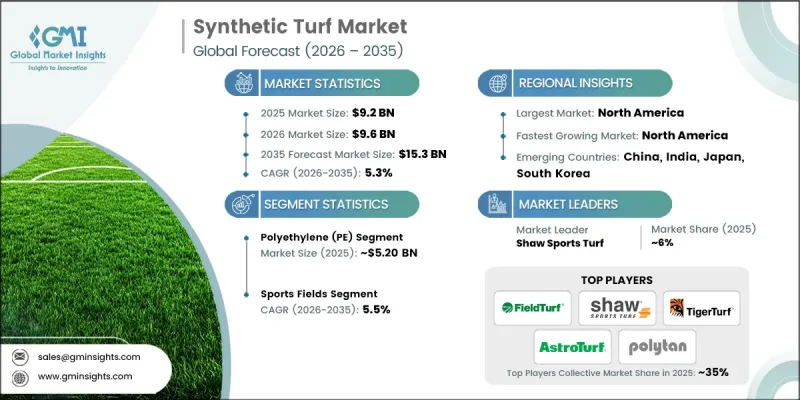
为了促进体育活动和参与,政府和私人机构正增加对体育场馆、训练场地和社区体育设施的投资。人工草皮因其耐用性、可靠性和低维护成本而备受职业联赛、中小学和大学的青睐。水资源短缺和气候变迁等环境因素也加速了人工草皮的普及,因为它能减少用水量和维护成本。人造草坪用途人工草皮,可满足多种运动项目的需求,加之材料技术的进步提高了运动员的安全、舒适度和运动表现,进一步增强了其吸引力。此外,人们对住宅和商业房地产景观美化的日益关注也创造了新的市场机会,因为人工草皮为城市空间和小规模户外区域提供了一种美观且无需维护的选择。
| 市场规模 | |
|---|---|
| 开始年份 | 2025 |
| 预测期 | 2026-2035 |
| 上市时的市场规模 | 92亿美元 |
| 预测金额 | 153亿美元 |
| 复合年增长率 | 5.3% |
预计到2025年,聚乙烯市场销售额将达到52亿美元,并在2035年之前以5.5%的复合年增长率成长。聚乙烯质地柔软、耐用,外观酷似天然草坪,使其成为运动场、休閒区和住宅应用的理想材料。其抗紫外线、保色性和在恶劣条件下的耐磨性进一步提升了其受欢迎程度,并确保了其长期性能。
预计到 2025 年,运动场地市占率将达到 59%,并从 2026 年到 2035 年以 5.5% 的复合年增长率成长。专业球队、学校和市政休閒设施的高需求正在推动人造草皮的普及,因为人工草皮能够保证场地平整、延长比赛赛季并减少维护需求。
美国人造草坪市场预计到2025年将达到27.1亿美元,到2035年将以5.7%的复合年增长率成长。市场需求主要来自体育组织、教育机构、住宅和商业设施。人工草皮的应用不仅支持体育项目、节水景观设计,还能提升商业和住宅空间的美观。此外,宠物草坪、游乐场地面材料和屋顶铺设等特殊应用也正在拓展市场成长潜力。
目录
第一章:调查方法和范围
第二章执行摘要
第三章业界考察
- 生态系分析
- 供应商情况
- 利润率
- 每个阶段增加的价值
- 影响价值链的因素
- 影响产业的因素
- 促进因素
- 增加对体育基础设施和休閒设施的投资
- 水资源短缺日益严重,人们对环境永续性的担忧也日益加剧。
- 住宅和商业景观应用范围的扩大
- 陷阱与挑战
- 前期实施成本高
- 与微塑胶的释放和处置相关的环境问题
- 机会
- 开发环保可回收的人工草皮材料
- 对宠物友善和特殊用途草坪的需求不断增长。
- 促进因素
- 成长潜力分析
- 未来市场趋势
- 科技与创新趋势
- 当前技术趋势
- 新兴技术
- 价格趋势和价格分析(基于初步调查)
- 价格分析(基于初步调查)
- 对过去价格趋势的分析(基于初步研究)
- 根据业务类型分類的定价策略(高端/价值/成本加成)(基于初步调查)
- 价格波动与材料类型和应用有关
- 监理情势
- 标准和合规要求
- 区域法规结构
- 认证标准
- 波特五力分析
- PESTEL 分析
- 贸易数据分析(基于初步调查)
- 进出口数量和价值趋势(基于初步调查)
- 主要贸易走廊及关税影响(基于初步调查)
- 区域贸易趋势和跨境分销
- 人工智慧和生成式人工智慧对市场的影响
- 人工智慧驱动的製造流程转型
- 生成式人工智慧的应用案例(设计优化、预测性维护)
- 风险、限制和监管考量
- 生产能力和生产趋势(基于初步调查)
- 按地区和主要生产商分類的已安装产能(基于初步调查)
- 运转率和扩张计划(基于初步调查)
第四章 竞争情势
- 介绍
- 企业市占率分析
- 按地区
- 企业矩阵分析
- 主要市场公司的竞争分析
- 竞争定位矩阵
- 主要进展
- 併购
- 伙伴关係与合作
- 新产品发布
- 业务拓展计划
第五章 市场估计与预测:依材料划分,2022-2035年
- 聚乙烯(PE)
- 聚丙烯(PP)
- 尼龙
第六章 市场估价与预测:依填充材类型划分,2022-2035年
- 蛤壳橡胶
- 涂层砂
- 有机填充材
- 热可塑性橡胶(TPE)
- 无填充材系统
第七章 市场估计与预测:依应用领域划分,2022-2035年
- 运动场
- 足球
- 棒球
- 高尔夫(果岭、发球檯)
- 其他运动(曲棍球、橄榄球等)
- 住宅景观设计
- 商业景观设计
- 其他(屋顶花园、宠物人工草皮等)
第八章 市场估算与预测:依销售管道划分,2022-2035年
- 在线的
- 离线
第九章 市场估计与预测:依地区划分,2022-2035年
- 北美洲
- 我们
- 加拿大
- 欧洲
- 德国
- 英国
- 法国
- 义大利
- 西班牙
- 亚太地区
- 中国
- 印度
- 日本
- 韩国
- 澳洲
- 拉丁美洲
- 巴西
- 墨西哥
- 阿根廷
- 中东和非洲(MEA)
- 沙乌地阿拉伯
- 阿拉伯聯合大公国
- 南非
第十章:公司简介
- AstroTurf
- CCGrass
- EasyTurf
- FieldTurf
- ForeverLawn
- Global Syn-Turf
- Hellas Construction
- K9Grass
- Polytan
- Shaw Sports Turf
- Sprinturf
- SYNLawn
- Synthetic Turf International
- Tarkett Sports
- TigerTurf
The Global Synthetic Turf Market was valued at USD 9.2 billion in 2025 and is estimated to grow at a CAGR of 5.3% to reach USD 15.3 billion by 2035.
Governments and private organizations are increasingly funding stadiums, training grounds, and community sports facilities to encourage physical activity and sports participation. Synthetic turf is favored in professional leagues, schools, and universities for its durability, reliability, and low-maintenance advantages. Environmental factors such as water scarcity and climate change are accelerating adoption, as synthetic surfaces reduce water usage and maintenance efforts. Its versatility for multiple sports, combined with advancements in materials enhancing player safety, comfort, and performance, has broadened its appeal. Additionally, growing interest in residential and commercial landscaping is creating new market opportunities, as synthetic turf offers a visually appealing, maintenance-free alternative for urban spaces and small outdoor areas.
| Market Scope | |
|---|---|
| Start Year | 2025 |
| Forecast Year | 2026-2035 |
| Start Value | $9.2 Billion |
| Forecast Value | $15.3 Billion |
| CAGR | 5.3% |
The polyethylene segment generated USD 5.20 billion in 2025 and is expected to grow at a CAGR of 5.5% through 2035. Its soft texture, durability, and grass-like appearance make polyethylene ideal for sports fields, recreational zones, and residential applications. UV resistance, color retention, and resilience under heavy use reinforce its popularity, ensuring long-lasting performance.
The sports fields segment accounted for 59% share in 2025, with a projected CAGR of 5.5% from 2026 to 2035. High demand from professional teams, schools, and municipal recreation facilities drives adoption, as synthetic turf ensures consistent surfaces, extended play seasons, and reduced maintenance requirements.
U.S. Synthetic Turf Market reached USD 2.71 billion in 2025, with a forecasted CAGR of 5.7% through 2035. Demand stems from sports organizations, educational institutions, residential customers, and commercial properties. Synthetic turf adoption supports athletic programs, water-efficient landscaping, and aesthetic enhancements in commercial and residential spaces, while specialty applications like pet turf, playground surfaces, and rooftop installations expand growth potential.
Key players in the Global Synthetic Turf Market include FieldTurf, SYNLawn, ForeverLawn, AstroTurf, Sprinturf, CCGrass, K9Grass, Tarkett Sports, EasyTurf, Shaw Sports Turf, Polytan, Synthetic Turf International, TigerTurf, Global Syn-Turf, and Hellas Construction. Companies in the Global Synthetic Turf Market strengthen their foothold through continuous product innovation, developing high-performance, durable, and visually appealing turf systems for diverse applications. Strategic partnerships with sports organizations, educational institutions, and landscaping contractors enhance distribution and brand visibility. Investment in R&D to improve UV resistance, player safety, and environmental sustainability drives competitive advantage. Expanding presence in emerging markets, offering customizable solutions, and providing installation and maintenance services reinforce customer loyalty. Additionally, digital marketing campaigns, direct-to-consumer sales channels, and collaborations with residential and commercial developers further consolidate market position and stimulate adoption.
Table of Contents
Chapter 1 Methodology & Scope
- 1.1 Market scope and definition
- 1.2 Research design
- 1.2.1 Research approach
- 1.2.2 Data collection methods
- 1.3 Data mining sources
- 1.3.1 Global
- 1.3.2 Regional/Country
- 1.4 Base estimates and calculations
- 1.4.1 Base year calculation
- 1.4.2 Key trends for market estimation
- 1.5 Primary research and validation
- 1.5.1 Primary sources
- 1.6 Forecast model
- 1.7 Research assumptions and limitations
Chapter 2 Executive Summary
- 2.1 Industry 360° synopsis
- 2.2 Key market trends
- 2.2.1 Regional
- 2.2.2 Material
- 2.2.3 Infill Type
- 2.2.4 Application
- 2.2.5 Distribution Channel
- 2.3 CXO perspectives: Strategic imperatives
- 2.3.1 Key decision points for industry executives
- 2.3.2 Critical success factors for market players
- 2.4 Future outlook and strategic recommendations
Chapter 3 Industry Insights
- 3.1 Industry ecosystem analysis
- 3.1.1 Supplier landscape
- 3.1.2 Profit margin
- 3.1.3 Value addition at each stage
- 3.1.4 Factor affecting the value chain
- 3.2 Industry impact forces
- 3.2.1 Growth drivers
- 3.2.1.1 Growing investment in sports infrastructure and recreational facilities
- 3.2.1.2 Rising water scarcity and environmental sustainability concerns
- 3.2.1.3 Expansion of residential and commercial landscaping applications
- 3.2.2 Pitfalls & Challenges
- 3.2.2.1 High initial installation costs
- 3.2.2.2 Environmental concerns related to microplastic shedding and disposal
- 3.2.3 Opportunities
- 3.2.3.1 Development of eco-friendly and recyclable synthetic turf materials
- 3.2.3.2 Growing demand for pet-friendly and specialty turf applications
- 3.2.1 Growth drivers
- 3.3 Growth potential analysis
- 3.4 Future market trends
- 3.5 Technology and innovation landscape
- 3.5.1 Current technological trends
- 3.5.2 Emerging technologies
- 3.6 Price trends Pricing Analysis (Driven by Primary Research)
- 3.6.1 Pricing Analysis (Driven by Primary Research)
- 3.6.2 Historical Price Trend Analysis (Driven by Primary Research)
- 3.6.3 Pricing Strategy by Player Type (Premium / Value / Cost-plus) (Driven by Primary Research)
- 3.6.4 Price Variation by Material Type & Application
- 3.7 Regulatory landscape
- 3.7.1 Standards and compliance requirements
- 3.7.2 Regional regulatory frameworks
- 3.7.3 Certification standards
- 3.8 Porter's analysis
- 3.9 PESTEL analysis
- 3.10 Trade Data Analysis (Driven by Primary Research)
- 3.10.1 Import/Export Volume & Value Trends (Driven by Primary Research)
- 3.10.2 Key Trade Corridors & Tariff Impact (Driven by Primary Research)
- 3.10.3 Regional Trade Dynamics & Cross-border Flow
- 3.11 Impact of AI & Generative AI on the Market
- 3.11.1 AI-Driven Disruption of Manufacturing Processes
- 3.11.2 GenAI Use Cases (Design Optimization, Predictive Maintenance)
- 3.11.3 Risks, Limitations & Regulatory Considerations
- 3.12 Capacity & Production Landscape (Driven by Primary Research)
- 3.12.1 Installed Capacity by Region & Key Producer (Driven by Primary Research)
- 3.12.2 Capacity Utilization Rates & Expansion Pipelines (Driven by Primary Research)
Chapter 4 Competitive Landscape, 2025
- 4.1 Introduction
- 4.2 Company market share analysis
- 4.2.1 By Region
- 4.2.1.1 North America
- 4.2.1.2 Europe
- 4.2.1.3 Asia Pacific
- 4.2.1.4 Latin America
- 4.2.1.5 Middle East & Africa
- 4.2.1 By Region
- 4.3 Company matrix analysis
- 4.4 Competitive analysis of major market players
- 4.5 Competitive positioning matrix
- 4.6 Key developments
- 4.6.1 Mergers & acquisitions
- 4.6.2 Partnerships & collaborations
- 4.6.3 New product launches
- 4.6.4 Expansion plans
Chapter 5 Market Estimates & Forecast, By Material, 2022 - 2035, (USD Billion) (Billions Square Feet)
- 5.1 Key trends
- 5.2 Polyethylene (PE)
- 5.3 Polypropylene (PP)
- 5.4 Nylon
Chapter 6 Market Estimates & Forecast, By Infill Type, 2022 - 2035, (USD Billion) (Billions Square Feet)
- 6.1 Key trends
- 6.2 Crumb Rubber
- 6.3 Coated Sand
- 6.4 Organic Infill
- 6.5 Thermoplastic Elastomer (TPE)
- 6.6 Infill-Free Systems
Chapter 7 Market Estimates & Forecast, By Application, 2022 - 2035, (USD Billion) (Billions Square Feet)
- 7.1 Key trends
- 7.2 Sports Fields
- 7.2.1 Soccer/Football
- 7.2.2 Baseball
- 7.2.3 Golf (putting greens, tee lines)
- 7.2.4 Others (Hockey, Rugby, Etc)
- 7.3 Residential Landscaping
- 7.4 Commercial Landscaping
- 7.5 Others (Rooftop Gardens, Pet Turf, Etc)
Chapter 8 Market Estimates & Forecast, By Distribution Channel, 2022 - 2035, (USD Billion) (Billions Square Feet)
- 8.1 Key trends
- 8.2 Online
- 8.3 Offline
Chapter 9 Market Estimates & Forecast, By Region, 2022 - 2035, (USD Billion) (Billions Square Feet)
- 9.1 Key trends
- 9.2 North America
- 9.2.1 U.S.
- 9.2.2 Canada
- 9.3 Europe
- 9.3.1 Germany
- 9.3.2 UK
- 9.3.3 France
- 9.3.4 Italy
- 9.3.5 Spain
- 9.4 Asia Pacific
- 9.4.1 China
- 9.4.2 India
- 9.4.3 Japan
- 9.4.4 South Korea
- 9.4.5 Australia
- 9.5 Latin America
- 9.5.1 Brazil
- 9.5.2 Mexico
- 9.5.3 Argentina
- 9.6 MEA
- 9.6.1 Saudi Arabia
- 9.6.2 UAE
- 9.6.3 South Africa
Chapter 10 Company Profiles
- 10.1 AstroTurf
- 10.2 CCGrass
- 10.3 EasyTurf
- 10.4 FieldTurf
- 10.5 ForeverLawn
- 10.6 Global Syn-Turf
- 10.7 Hellas Construction
- 10.8 K9Grass
- 10.9 Polytan
- 10.10 Shaw Sports Turf
- 10.11 Sprinturf
- 10.12 SYNLawn
- 10.13 Synthetic Turf International
- 10.14 Tarkett Sports
- 10.15 TigerTurf


