


 |
市场调查报告书
商品编码
1886133
汽车光达专利趋势分析(2025)LiDAR for Automotive Patent Landscape Analysis 2025 |
||||||

全球范围内的智慧财产权争夺战日趋激烈。哪些是关键参与者?哪些技术将塑造汽车光达的未来?
主要特点:
- 包含超过 160 张投影片的 PDF 檔案
- Excel 文件(超过 36,200 个专利族)
- 全球专利趋势(例如,专利公开趋势随时间的变化、按申请国家划分的分布)
- 各细分领域的主要专利持有人和智慧财产权领域的新进入者
- 主要进入者的智慧财产权地位和专利组合的相对实力
- 专利持有人知识产权领导地位的演变(2021 年与 2025 年比较)
- 智慧财产权生态系统,包括共同拥有的专利,包括集团内部和与外部各方的共同申请
- 以 18 个技术领域分类的专利(飞行时间、FMCW、相移、MEMS、混合、OPA、快闪记忆体、超表面、晶片上雷射雷达、1550 奈米、VCSEL、 SPAD/SiPM、APD、封装、校准、抗干扰、人工智慧、融合技术)
- 30家领先公司的智慧财产权概况(包括专利组合概述、技术覆盖范围、地域覆盖范围以及已授权和待授权的重要专利)
- 本报告分析的所有专利的Excel资料库(包含专利分类和指向最新线上资料库的超连结)
全球雷射雷达智慧财产权(IP)快速成长趋势
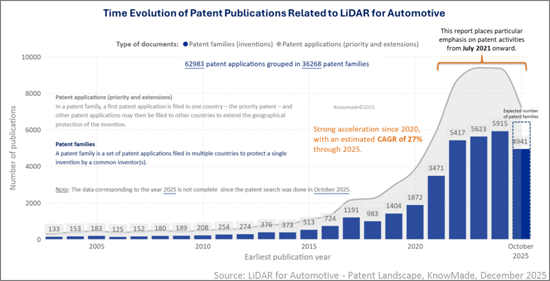
凭藉着厘米级的精度和在各种光照条件下的稳健性能,雷射雷达正迅速成为ADAS、L2-L4级自动驾驶、无人出租车以及日益增长的机器人和基础设施应用的核心感测技术。反映这项技术变革的是,与雷射雷达相关的专利活动正在迅速增长,使其从一项实验性技术转变为先进出行领域最具竞争力的智慧财产权环境中的主导感知感测器。截至2025年10月,全球汽车应用雷射雷达专利领域已拥有超过36,200个专利族和超过62,900项单一专利,展现出调频连续波雷射雷达、固态架构、光子整合、先进光束控制和人工智慧驱动感知技术等领域的显着增长。仅自2021年7月以来,就已提交超过24,300个专利族,是KnowMade先前数据集的三倍,标誌着该领域正从早期研究阶段迈向全面产业化。 2020年至2025年,雷射雷达相关专利申请的复合年增长率预计将达到27%,凸显了该领域创新的爆炸性成长。
全球智慧财产权趋势及策略参与者
雷射雷达专利环境的一个关键结构性变化是,中国迅速且持续地崛起为全球最大的雷射雷达相关智慧财产权来源国。预计到2025年,中国光达专利公开数量将占全球总量的约40%,无论在数量或成长率方面都将超过美国。这一趋势伴随着参与者的广泛多元化,包括光达纯技术公司、一级供应商、汽车製造商、自动驾驶开发商、半导体公司和研究机构。这些参与者的智慧财产权活动总体上反映了雷射雷达技术的日益成熟,以及专利组合与长期技术路线图之间策略契合度的不断提高。
包括合赛电子、RoboSense、华为银网、VanJee、Zvision、Benewake 和雷神智能在内的中国企业在雷射雷达的关键技术领域表现活跃,展现出2021年至2025年间的强劲发展势头。同时,美国在通用汽车、Alphabet-Waymo、Aurora、Ouster、Seyond 和 Aeva 等公司的推动下,继续保持核心地位。在欧洲,博世、大陆集团和法雷奥等汽车和光子学公司集群积极参与其中,多家原始设备製造商 (OEM) 专注于零件、封装、校准和车用级雷射雷达整合。日本和韩国则透过索尼、电装、丰田、三星、Infoworks 和现代起亚等公司持续做出稳定贡献,展现出全球分散的创新努力。
这种地域格局的重新平衡凸显了专利环境的转变,即从传统上由美国和欧洲主导的环境,转向由中国不断发展的光子学和半导体生态系统塑造的环境。
智慧财产权领导地位的转变:2021 年与 2025 年
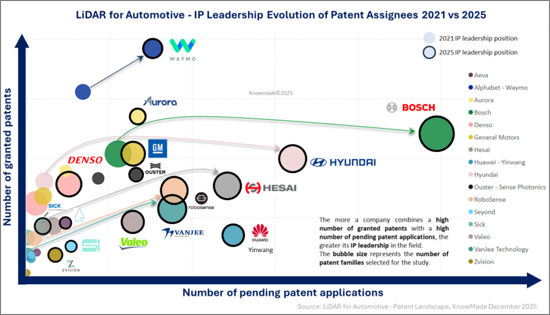
从 2021 年到 2025 年,随着跨技术、跨地区和跨行业领域的竞争日益激烈,雷射雷达 (LiDAR) 智慧财产权的领导地位发生了显着变化。该生态系统由四大类组成:纯光达公司、一级供应商、汽车製造商和自动驾驶公司。本报告对每一类公司进行了更深入、更详细的分析,揭示了随着竞争加剧,2021 年至 2025 年间领导地位、技术能力和智慧财产权组合的变化。尤其值得注意的是,在过去几年里,专注于雷射雷达(LiDAR)领域的公司在智慧财产权(IP)活动方面明显加速发展,许多公司在2021年以前所未有的速度强化了其智慧财产权组合。详细分析显示,儘管一级供应商在2021年拥有更具竞争力和更成熟的智慧财产权组合,但市场格局正在改变。到2025年,一些专注于光达领域的新兴企业将展现出必要的规模、品质和技术深度,从而在多个高成长的雷射雷达细分市场中确立其新兴智慧财产权领导者的地位。该报告还揭示了知识产权领域新进入者数量的不断增长,其中包括快速增长的专注于雷射雷达领域的新兴企业、自动驾驶公司和汽车製造商。这些公司快速扩张其智慧财产权组合,显示其策略影响力日益增强。这些变化预示着雷射雷达生态系统领导地位的重新分配,从而打造出先进感测领域最具活力和竞争性的智慧财产权环境之一。
雷射雷达技术创新差异化显着
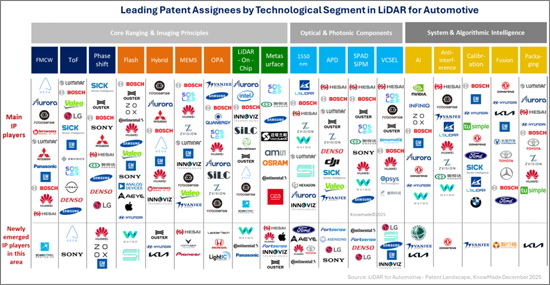
本报告揭示了雷射雷达关键技术层面的强劲创新活动。专利主要集中在以下五个领域:
- 核心测距和成像原理:脉衝飞行时间 (ToF)、调频连续波 (FMCW) 和相移测距,以及微机电系统 (MEMS)、混合扫描、光参量放大器 (OPA) 和闪光光束控制结构。先进的光束控制技术,例如超表面和奈米光子学,以及光子整合雷射雷达。
- 光学与光子元件:1550 nm 雷射光源、垂直腔面发射雷射 (VCSEL) 阵列、单光子雪崩二极体/硅光电倍增管 (SPAD/SiPM) 侦测器和雪崩光电二极体 (APD)。
- 系统与演算法智慧: 固态封装、校准、干扰抑制、人工智慧、多感测器融合。
依关键产业细分领域划分的详细智慧财产权概况
本报告对30家具有影响力的雷射雷达专利持有者进行了系统、数据驱动的智慧财产权概况分析。这些持有者是根据其在智慧财产权领域的领先地位以及2021年至2025年期间的最新动态而遴选出来的。分析对象包括纯雷射雷达公司(Hesai、RoboSense、Ouster/Sense Photonics、VanJee、Seyond、Zvision、Aeva、Leishen Intelligent、Sick、Benewake、SOSLAB、Oradar、Luminar、SiLC Technologies、Innoviz、MicroVision、Ibeo Automotive、Mobiltech、Infoworks、Blickfeld、OLEI、LiangDao、Aeye)、一级供应商(Bosch、华为银王、Valeo)、自动驾驶公司(Aurora、Alphabet-Waymo)以及汽车製造商(现代、通用汽车)。该报告针对每家公司,提供一致的智慧财产权领导力演变、组合趋势、地理扩张、技术领域分析以及近期专利活动评估。
实用Excel专利资料库
本报告包含一个内容丰富的Excel资料库,其中包含本研究分析的超过36,200个专利族(发明),以及过去四年新增的超过24,300个相关专利族。该资料库包含专利资讯(公开号、所有者、日期、标题、摘要等)、指向更新的在线资料库(来源资料、法律状态等)的超链接,以及按技术领域(飞行时间、调频连续波、相移、微机电系统、混合、光参量放大器、快闪记忆体、超表面、片上雷射雷达、1550奈米、垂直腔面发射雷射、单光子雪崩二极体/硅光电倍增管、雪崩光电二极体、封装、校准、抗干扰、人工智慧、融合)进行的结构化分类。该专利资料库支援高级多条件搜索,并提供对更新记录的直接存取。这使用户能够对其投资组合进行基准测试、监控竞争对手、识别潜在合作伙伴或收购目标,并评估执业自由的限制。
本报告中提及的公司(节录):
|
|
等等。
目录
引言
摘要整理
专利概览
- 专利公开历史
- 主要专利受让人
- 知识产权公司时间线
- 专利受让人知识产权领导地位的演变:2021 年和 2025 年
- 主要专利的地域覆盖范围
- 有影响力的专利受让人
- 主要共同拥有的智慧财产权
专利细分
- 测距与成像的核心原理:测距:脉衝飞行时间 (ToF)、调频连续波 (FMCW)、相移
- 光束控制:微机电系统 (MEMS)、混合扫描、光参量放大器 (OPA)、闪光法
- 高阶光束控制:晶片级光达、超表面
- 光学与光子元件:1550 nm、VCSEL、SPAD/SiPM、APD
- 系统和演算法智慧:人工智慧、干扰抑制、封装和整合、相机和雷达融合、校准
- 各细分领域简介:
- 细分领域定义
- 专利组合概览
- 主要专利受让人
- 重要专利
专利受让人智慧财产权概况
- 纯光达厂商:
- 专利受让人知识产权领导地位的演变:2021 年和 2025 年
- 2025 年专利受让人智慧财产权领导地位展望
- 7 家雷射雷达厂商的专利组合概览、分析和近期专利活动专用雷射雷达製造商(Hesai、RoboSense、Ouster-Sense Photonics、VanJee Technology、Seyond、Zvision、Aeva)
- 16 家专用雷射雷达製造商的专利组合概况:Leishen Intelligent、Sick、Benewake、SOSLAB、Oradar、Luminar、SiLC Technologies、Innoviz、MicroVision、Ibeo Automotive、Mobiltech、Infoworks、Blickfeld、OLEI、LiangDao、Aeye
- 一级供应商:
- 专利受让人知识产权领导地位的演变:2021 年和 2025 年
- 一级供应商专利组合概况、分析与近期专利活动说明(3):Bosch、华为-银王、Valeo
- 自动驾驶/汽车公司:
- 专利受让人知识产权领导地位的演变: 2021 年和 2025 年
- 自动驾驶/车辆公司专利组合概览、分析及近期专利活动说明(2):Aurora、Alphabet、Waymo
- 汽车製造商:
- 专利受让人的智慧财产权领导地位演变:2021 年和 2025 年
- 汽车製造商专利组合概况、分析及近期专利活动说明(2):现代、通用汽车
专利诉讼
附录
KNOWMADE 简报
The global IP battlefield is heating up: who are the key players, and which technologies will shape the future of LiDAR for automotive?
Key Features:
- PDF with > 160 slides
- Excel file > 36,200 patent families
- Global patenting trends, including time evolution of patent publications, countries of patent filings, etc.
- Main patent assignees and IP newcomers in the different segments
- Key players' IP position and the relative strength of their patent portfolio
- IP leadership evolution of patent assignees 2021 vs 2025
- IP ecosystems including co-owned patents including group-internal and external collaboration, etc.
- Patents categorized by 18 technological segments (ToF, FMCW, phase-shift, MEMS, hybrid, OPA, flash, metasurface, LiDAR-On-Chip, 1550 nm, VCSEL, SPAD/SiPM, APD, packaging, calibration, Anti-interference, AI, fusion)
- IP profile of 30 key players (patent portfolio overview, technical coverage, geographical coverage, notable granted and pending patents, etc.)
- Excel database containing all patents analyzed in the report, including patent segmentations and hyperlinks to an updated online database
A Rapidly Expanding Global LiDAR IP Landscape
With centimeter-level accuracy and consistent performance across varied lighting conditions, LiDAR is becoming a core sensing modality for ADAS, L2-L4 autonomous driving, robotaxis and a growing range of robotics and infrastructure applications. Its rapidly expanding patent activity reflects this shift, marking LiDAR's transition from an experimental technology to a primary perception sensor in one of the most competitive IP landscapes in advanced mobility. As of October 2025, the global LiDAR patent landscape for automotive applications includes more than 36,200 patent families and over 62,900 individual patents, with strong growth across FMCW LiDAR, solid-state architectures, photonic integration, advanced beam steering and AI-driven perception. Over 24,300 patent families were filed since July 2021 alone, tripling KnowMade's previous dataset and signalling the move from early research to full-scale industrialization. Between 2020 and 2025, LiDAR-related patenting increased at an estimated CAGR of 27%, highlighting the explosive pace of innovation across the sector.
Global IP Trends and Strategic Players
A major structural shift in the LiDAR patent landscape is the rapid and sustained rise of China as the world's largest source of LiDAR-related intellectual property. By 2025, China accounts for around 40% of global LiDAR patent publications, surpassing the United States in both volume and growth rate. This trend is accompanied by a broad diversification of contributors, including LiDAR pure players, Tier-1 suppliers, automotive OEMs, autonomous-driving developers, semiconductor companies and research institutes. Their collective IP activity reflects the growing maturity of LiDAR technologies and the increasingly strategic alignment between patent portfolios and long-term technology roadmaps.
Chinese companies such as Hesai, RoboSense, Huawei Yinwang, VanJee, Zvision, Benewake and Leishen Intelligent are active across all major LiDAR technology domains and demonstrate significant momentum from 2021 to 2025. In parallel, the United States maintains a central role driven by General Motors, Alphabet-Waymo, Aurora, Ouster, Seyond and Aeva, while Europe contributes substantial activity through its automotive and photonics sectors, led by Bosch, Continental, Valeo and several OEMs focusing on components, packaging, calibration and vehicle-grade LiDAR integration. Japan and South Korea remain steady contributors through Sony, Denso, Toyota, Samsung, Infoworks and Hyundai-Kia, illustrating the global distribution of innovation efforts.
This geographic rebalancing highlights the shift from a historically U.S.- and Europe-led patent landscape toward one increasingly shaped by China's expanding photonics and semiconductor ecosystem.
Evolution of IP Leadership 2021 vs 2025
Between 2021 and 2025, LiDAR IP leadership evolved significantly as competition intensified across technologies, regions and industry segments. While the ecosystem is structured around four major categories: LiDAR pure players, Tier-1 suppliers, car makers and autonomous-driving companies, the report provides a deeper, fine-grained examination within each group, revealing how leadership positions, technology strengths and IP portfolios have shifted between 2021 and 2025 as competition intensified. In particular, LiDAR pure players show a clear acceleration in IP activity over the past few years, with many strengthening their portfolios at a pace unmatched in 2021. Detailed analysis reveals that although Tier-1 suppliers held more competitive and mature portfolios in 2021, the landscape has shifted: by 2025, multiple pure players demonstrate the scale, quality and technological depth required to position themselves as emerging IP leaders in several high-growth LiDAR domains. The report also identifies a growing cohort of IP newcomers including fast-moving pure players, autonomous-driving companies and car makers who's rapidly expanding portfolios signal their rising strategic influence. Together, these shifts illustrate how leadership is being redistributed across the LiDAR ecosystem, making this one of the most dynamic and contested IP environments in advanced sensing.
Clear Segmentation of Innovation Across LiDAR Technologies
The report reveals strong innovation activity across all major LiDAR technology layers. Patents are concentrated in five key areas:
- Core Ranging & Imaging Principles: Pulsed ToF, FMCW and phase-shift ranging, along with MEMS, hybrid scanning, OPA and flash beam-steering architectures; advanced beam steering technologies as metasurface and nanophotonic approaches, as well as photonic-integrated LiDAR.
- Optical & Photonic Components: 1550 nm laser sources, VCSEL arrays, SPAD/SiPM detectors and APDs.
- System & Algorithmic Intelligence: Solid-state packaging, calibration, interference mitigation, AI and multi-sensor fusion.
In-Depth IP Profiles Across Key Industry Segments
This report delivers a structured and data-driven IP profile analysis of 30 influential LiDAR patent assignees, selected based on their IP leadership and recent activity from 2021 to 2025. The analysis covers the full spectrum of ecosystem actors, including LiDAR pure players (Hesai, RoboSense, Ouster/Sense Photonics, VanJee, Seyond, Zvision, Aeva, Leishen Intelligent, Sick, Benewake, SOSLAB, Oradar, Luminar, SiLC Technologies, Innoviz, MicroVision, Ibeo Automotive, Mobiltech, Infoworks, Blickfeld, OLEI, LiangDao, Aeye), Tier-1 suppliers (Bosch, Huawei-Yinwang, Valeo), autonomous-driving companies (Aurora, Alphabet-Waymo) and car makers (Hyundai, General Motors). For each company, the report provides a consistent assessment of IP leadership evolution, portfolio dynamics, geographic footprint, technical segmentation and recent patent activities.
Useful Excel patent database
This report includes an extensive Excel database with the 36,200+ patent families (inventions) analyzed in this study and a focus set of 24,300+ families added in the last four years, including patent information (publication numbers, assignees, dates, title, abstract, etc.), hyperlinks to an updated online database (original documents, legal status, etc.), and structured classification by technological segments (ToF, FMCW, phase-shift, MEMS, hybrid, OPA, flash, metasurface, LiDAR-On-Chip, 1550 nm, VCSEL, SPAD/SiPM, APD, packaging, calibration, Anti- interference, AI, fusion). This patent database supports advanced multi-criteria searches and provides direct access to updated records, enabling users to benchmark portfolios, monitor competitors, identify potential partners or acquisition targets and evaluate freedom-to-operate constraints.
Companies mentioned in the report (non-exhaustive):
|
|
and more.
TABLE OF CONTENTS
INTRODUCTION
- Context of the report
- Scope and objectives of the report
- Reading guide
- Excel database
EXECUTIVE SUMMARY
PATENT LANDSCAPE OVERVIEW
- Time evolution of patent publications
- Main patent assignees
- Timeline of IP players
- IP leadership of patent assignees evolution 2021 vs 2025
- Geographical coverage of main players' patents
- High-impact patent assignees
- Main co-owned IP
PATENT SEGMENTATION
- Core Ranging & Imaging Principles:Ranging: Pulsed ToF, FMCW, Phase Shift
- Beam Steering: MEMS, Hybrid Scanning, OPA, Flash
- Advanced beam steering: LiDAR-On-Chip, Metasurface
- Optical & Photonic Components: 1550 nm, VCSEL, SPAD / SiPM, APD
- System & Algorithmic Intelligence: AI, Anti-Interference, Packaging & Integration, Fusion with Camera and Radar, Calibration
- For each segment:
- Segment definition
- Patent portfolio overview
- Main patent assignees
- Notable patents
IP PROFILE OF A SELECTION OF PATENT ASSIGNEES
- LiDAR pure player:
- IP leadership of patent assignees evolution 2021 vs 2025
- IP leadership of patent assignees 2025
- Patent portfolio overview, analysis and description of recent patent activities for LiDAR pure players (7) : Hesai, RoboSense, Ouster -Sense Photonics, VanJee Technology, Seyond, Zvision, Aeva
- Patent portfolio overview for LiDAR pure players (16) : Leishen Intelligent, Sick, Benewake, SOSLAB, Oradar, Luminar, SiLC Technologies, Innoviz, MicroVision, Ibeo Automotive, Mobiltech, Infoworks, Blickfeld, OLEI, LiangDao, Aeye
- Tier one suppliers:
- IP leadership of patent assignees evolution 2021 vs 2025
- Patent portfolio overview, analysis and description of recent patent activities for Tier one suppliers (3) : Bosch, Huawei -Yinwang, Valeo
- Autonomous driving/vehicle players:
- IP leadership of patent assignees evolution 2021 vs 2025
- Patent portfolio overview, analysis and description of recent patent activities for Autonomous driving/vehicle players (2) : Aurora, Alphabet -Waymo
- Car makers:
- IP leadership of patent assignees evolution 2021 vs 2025
- Patent portfolio overview, analysis and description of recent patent activities for Car makers (2) : Hyundai, General Motors
PATENT LITIGATION
ANNEX
- Methodology for patent search, selection and analysis
- Terminology
KNOWMADE PRESENTATION

 汽车光达感测器市场:按组件、侦测范围、光达类型、应用、车辆类型和销售管道划分-2026-2032年全球市场预测汽车光达系统晶片市场:2026-2032年全球市场预测(依光达技术、推进方式、侦测范围、感知方式、应用及车辆类型划分)
 2026年全球汽车光达市场报告
 北美汽车专利演变策略分析:1976-2025年
 针对自动驾驶汽车的4D雷射雷达市场分析及预测(至2035年):按类型、产品类型、技术、组件、应用、部署类型、最终用户、功能、安装类型和解决方案划分
 汽车光达感测器市场 - 全球产业规模、份额、趋势、机会及预测(按车辆类型、应用、技术、影像类型、位置、地区和竞争格局划分,2021-2031年)
 全球汽车雷射雷达市场:依技术类型、成像类型、内燃机车辆类型、检测范围、自动驾驶等级、电动车类型和地区划分-市场规模、产业趋势、机会分析和预测(2026-2035 年)光达光学窗口市场按材料、波长范围、镀膜类型和最终用户划分,全球预测(2026-2032年)全球ADAS雷射雷达市场:以雷射雷达技术、工作范围、动力传动系统、最终用途、输出尺寸、应用和ADAS等级划分,2026-2032年预测无人驾驶汽车的 LiDAR 市场:未来预测(2025-2030 年)