


 |
市场调查报告书
商品编码
1881291
全球生物界面活性剂市场(至2030年):依类型(醣脂(槐醣脂、鼠李醣脂、脂肽)、应用(清洁剂、个人护理、食品加工、农药)及地区划分Biosurfactants Market by Type (Glycolipids (Sophorolipids, Rhamnolipids) and Lipopeptides), Application (Detergent, Personal Care, Food Processing, Agricultural Chemicals), and Region - Global Forecast to 2030 |
||||||


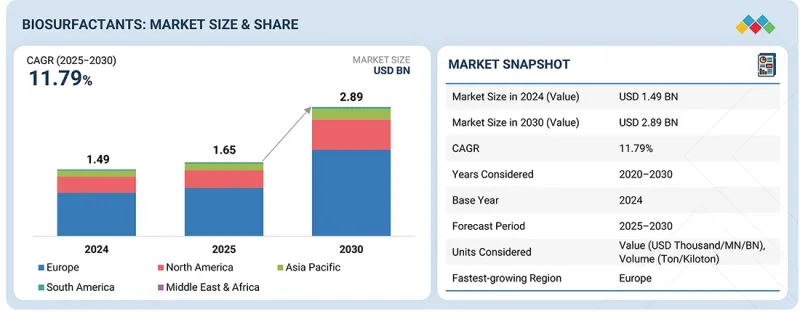
预计生物界面活性剂市场将从 2025 年的 16.5 亿美元成长到 2030 年的 28.9 亿美元,预测期内复合年增长率为 11.79%。
研究与开发不断推动下一代生物界面活性剂的研发,这些表面活性剂具有更高的表面活性、稳定性和更低的成本。
| 调查范围 | |
|---|---|
| 调查期 | 2020-2030 |
| 基准年 | 2024 |
| 预测期 | 2025-2030 |
| 单元 | 金阁币(美元)和数量(吨/千吨) |
| 部分 | 类型、用途、区域 |
| 目标区域 | 亚太地区、欧洲、北美、中东和非洲、南美 |
醣脂类生物生物界面活性剂,例如槐醣脂和鼠李醣脂,正被重新设计,以改善其在清洁剂、个人护理和食品加工等领域的发泡、乳化性和抗菌性能。生物标记工程、生物製程优化、发酵产量提高和酵素工程方面的进步,也使生产商能够以更低的用量获得更强的性能,从而降低生产成本和环境影响。透过生物技术改良菌株和使用可再生原料也是该产业为实现循环经济目标而重点关注的领域。製造商正不断增加对具有天然、无毒和可生物降解特性的绿色多功能生物界面活性剂的投资,从而推动全球市场的显着成长。
“醣脂类产品将在2024年占据最大的市场份额”
2024年,醣脂(包括槐醣脂和鼠李醣脂)因其高生物降解性、乳化能力和温和性,占据了最大的市场份额。醣脂因其性能稳定且环境友好,被广泛应用于清洁剂、化妆品和家用清洁产品。其无刺激性且清洁力强、发泡好的特点,正迅速推动其在消费品和工业产品中的应用。此外,发酵和下游回收技术的进步使得生产规模得以扩大,使其比合成界面活性剂更具成本效益和竞争力。随着永续性持续影响消费者趋势和监管政策,醣脂可望成为推动全球生物界面活性剂市场成长的关键因素。
“从应用角度来看,个人保健部门排在第二位”
添加生物界面活性剂的个人保健产品具有温和性、优异的发泡和高乳化性,使其对皮肤亲和性且环境安全。这些天然来源的界面活性剂能够很好地满足洗髮精、洗面乳和化妆品中对可生物降解、无毒成分的需求。生物界面活性剂,例如槐醣脂和鼠李醣脂,能够有效清洁和应对力,且不会引起刺激,从而满足此要求。此外,它们还能帮助配方师在维持产品质地、稳定性和感官特性的同时,支持清洁标籤和永续性声明。随着消费者对天然来源、温和且永续性配方的需求日益增长,生物界面活性剂在个人护理行业中的作用正在显着扩大。它们具有乳化能力和抗菌活性等多功能特性,使其成为21世纪及未来生物界面活性剂个人保健产品开发的关键成分。
“按地区划分,欧洲将在2024年成为最大的市场。”
欧洲凭藉着健全的监管机制,持续主导着生物界面活性剂市场,这些机制促进了可生物降解和可再生界面活性剂的使用。该地区对生物表面活性剂的高需求源于其在清洁剂、个人护理和食品加工领域的广泛应用,而这些领域对环境合规性和绿色认证的要求至关重要。欧洲消费者对永续的植物来源产品需求旺盛,对这一趋势的认知将进一步加速从石化产品向生物基界面活性剂的转型。此外,德国、法国和荷兰等国的国内外製造商正利用生物技术和发酵效率来扩大产能。这些区域性主导,加上对研发的大力投入和有利的法规环境,使欧洲继续保持全球生物界面活性剂市场主要发展中心的地位。
本报告调查了全球生物界面活性剂市场,并提供了市场概况、影响市场成长的各种因素分析、技术和专利趋势、法律制度、案例研究、市场规模趋势和预测、按各个细分市场、地区/主要国家进行的详细分析、竞争格局以及主要企业的概况。
目录
第一章 引言
第二章执行摘要
第三章重要考察
第四章 市场概览
- 市场动态
- 司机
- 抑制因素
- 机会
- 任务
- 相互关联的市场与跨产业机会
- 一级/二级/三级公司的策略性倡议
第五章 产业趋势
- 波特五力分析
- 宏观经济展望
- 供应链分析
- 生态系分析
- 定价分析
- 贸易分析
- 2025-2026 年重要会议与活动
- 影响您业务的趋势/颠覆性因素
- 投资和资金筹措方案
- 案例研究分析
- 2025年美国关税的影响概述
第六章:技术进步、人工智慧影响、专利、创新与未来应用
- 关键新兴技术
- 互补技术
- 技术/产品蓝图
- 专利分析
- 人工智慧/生成式人工智慧对生物界面活性剂市场的影响
第七章永续性和监管环境
- 地方法规和合规性
- 对永续性的承诺
- 永续性影响和监管政策倡议
- 认证、标籤和环境标准
第八章:顾客状况与购买行为
- 决策流程
- 相关利益者和采购标准
- 采用障碍和内部挑战
- 各种应用中尚未满足的需求
第九章生物界面活性剂市场(按类型划分)
- 醣脂
- 脂肽
第十章生物界面活性剂市场及其应用
- 清洁剂
- 个人护理
- 食品加工
- 杀虫剂
- 其他的
第十一章生物界面活性剂市场(按地区划分)
- 欧洲
- 德国
- 英国
- 法国
- 北美洲
- 美国
- 亚太地区
- 日本
- 中国
- 韩国
- 南美洲
- 巴西
- 中东和非洲
第十二章 竞争格局
- 概述
- 主要企业/主要企业的策略
- 市占率分析
- 收入分析
- 公司评估矩阵:主要企业
- 公司估值矩阵:Start-Ups/中小企业
- 品牌对比
- 估值和财务指标
- 竞争场景
第十三章:公司简介
- 主要企业
- EVONIK INDUSTRIES AG
- SHAANXI DEGUAN BIOTECHNOLOGY CO., LTD.
- BIOTENSIDON GMBH
- SARAYA CO., LTD.
- ALLIED CARBON SOLUTIONS CO., LTD.
- STEPAN COMPANY
- DAQING VICTEX CHEMICAL INDUSTRIES CO., LTD.
- HOLIFERM LIMITED
- SOLVAY SA
- DOW INC.
- GIVAUDAN SA
- AGAE TECHNOLOGIES, LLC
- BIOSURFACTANTS LLC
- KANEKA CORPORATION
- KEMIN INDUSTRIES, INC.
- Start-Ups/中小企业
- WHEATOLEO
- JENEIL BIOTECH, INC.
- GLYCOSURF, LLC
- TENSIOGREEN TECHNOLOGY CORP.
- DISPERSA INC.
- ZFA TECHNOLOGIES INC.
- HUB.TECH. SA
- MG INTOBIO CO., LTD.
- SYNTHEZYME LLC
- SASOL LIMITED
- TEEGENE BIOTECH LTD.
- BIOFUTURE LTD.
- TOYOBO CO., LTD.
- VETLINE
- KANEBO COSMETICS INC.
- FRAUNHOFER IGB
- LOCUS FERMENTATION SOLUTIONS
第十四章调查方法
第十五章:邻近及相关市场
第十六章附录
The biosurfactants market is expected to grow from USD 1.65 billion in 2025 to USD 2.89 billion by 2030, at a compound annual growth rate (CAGR) of 11.79% during the forecast period. R&D is being used in the continuous development of next-generation biosurfactants that have a superior surfacing property, stability, and lower cost than previous bio-based formulations.
| Scope of the Report | |
|---|---|
| Years Considered for the Study | 2020-2030 |
| Base Year | 2024 |
| Forecast Period | 2025-2030 |
| Units Considered | Value (USD Thousand/MN/BN) and Volume (Ton/Kiloton) |
| Segments | Type, Application, and Region |
| Regions covered | Asia Pacific, Europe, North America, the Middle East & Africa, and South America |
Glycolipid biosurfactants are being reformulated to enhance foaming, emulsification, and antimicrobial performance in challenging applications in detergents, personal care, and food processing, such as sophorolipids and rhamnolipids. Biomark engineering, optimization of bioprocesses, and the increase in fermentation yields, as well as enzyme engineering, are also enabling producers to achieve more powerful performance with fewer dosage needs, thereby reducing production costs and environmental impact. Enhancing strains via biotechnology and utilizing renewable feedstocks are also areas that the industry is targeting to achieve the aims of the circular economy. The manufacturers are also investing more money in green and multifunctional biosurfactants, which are natural, non-toxic, and biodegradable substances, thereby driving significant growth in the global market.
Glycolipids segment accounted for the largest share in the biosurfactants market, in terms of value, in 2024.
In 2024, the glycolipids segment, including sophorolipids and rhamnolipids, had the highest percentage of the biosurfactants market share due to its high rate of biodegradation, emulsification capability, and mildness. The use of glycolipids in detergents, cosmetics, and household cleaning products is high due to their performance consistency and environmental compliance. They possess strong cleaning and foaming properties that are non-irritating, which has led to their rapid adoption in both consumer and industrial formulations. Moreover, advancements in fermentation technologies and downstream recovery technologies have enabled an increase in production scale, making them cost-effective and more competitive than synthetic surfactants. With sustainability still influencing consumer trends and regulatory policies, glycolipids are poised to be the primary driver of growth in the biosurfactants market globally.
The personal care segment was the second-largest application, in terms of value, in the global biosurfactants market.
Personal care products that utilize biosurfactants offer mildness, enhanced foaming capacity, and superior emulsification, making them skin-compatible and environmentally safe. These naturally obtained surfactants are gaining sufficient response to the demand for biodegradable and non-toxic ingredients in shampoos, facial cleansers, and cosmetics. Biosurfactants, such as sophorolipids and rhamnolipids, meet this requirement, offering effective levels of cleansing and conditioning functionality without irritation. Moreover, they enable formulators to preserve product texture, stability, and sensory qualities, while also addressing clean-labeling and sustainability statements. With the ever-growing demand from consumers for naturally produced, mild, and eco-friendly formulations, the role of biosurfactants in the personal care industry has expanded significantly. Their versatility, including the ability to emulsify, antimicrobial activity, and so on, is making biosurfactants an important ingredient in the development of personal care in the twenty-first century and beyond.
Europe is estimated to be the largest regional market for biosurfactants, in terms of value, in 2024
Europe continues to dominate the biosurfactants market due to its robust regulatory mechanisms, which promote the use of biodegradable and renewable surfactants. The high demand in the region is due to the widespread use in the detergents, personal care, and food processing sectors, where environmental compliance and green certification will be of high importance. The demand for sustainable, plant-based products among European consumers is high, and awareness of this trend will further accelerate the shift from petrochemical to bio-based surfactants. Additionally, local and foreign manufacturers are expanding their manufacturing capacities in countries such as Germany, France, and the Netherlands, leveraging biotechnology and fermentation efficiency. This local leadership, combined with strong investment in research and development and a favorable regulatory environment, continues to make Europe a key development center in the global biosurfactants market.
- By Company Type: Tier 1 - 55%, Tier 2 - 25%, and Tier 3 - 20%
- By Designation: Directors - 50%, Managers - 30%, and Others - 20%
- By Region: North America - 40%, Europe - 35%, Asia Pacific - 20%, Rest of World - 5%
The key players profiled in the report include Evonik Industries AG (Germany), Shaanxi Deguan Biotechnology Co., Ltd (China), Biotensidon GmbH (Germany), Saraya Co., Ltd. (Japan), Allied Carbon Solutions Co., Ltd. (Japan), Daqing VICTEX Chemical Industries Co., Ltd. (China), Stepan Company (US), Holiferm Limited (UK), Dow Inc. (US), Solvay SA (Belgium), Givaudan SA (Switzerland), AGAE Technologies, LLC (US), Biosurfactants LLC (US), Kaneka Corporation (Japan), and Kemin Industries, Inc. (US).
Research Coverage
This report segments the biosurfactants market by type, application, and region, and provides estimations of value (in USD thousand) for the overall market size across various regions. A detailed analysis of key industry players has been conducted to provide insights into their business overviews, services, and key strategies associated with the biosurfactants market.
Reasons to Buy this Report
This research report is focused on various levels of analysis - industry analysis (industry trends), market share analysis of top players, and company profiles, which together provide an overall view of the competitive landscape, emerging and high-growth segments of the biosurfactants market, high-growth regions, and market drivers, restraints, and opportunities.
The report provides insights into the following points:
- Market Penetration: Comprehensive information on biosurfactants offered by top players in the global market
- Analysis of key drivers: (Increasing demand for green solutions, regulations on use of synthetic surfactants, personal care product manufacturers going green) restraints (Less commercialization due to high production cost, conventional bio-based products gaining popularity) opportunities (Development of cost-effective production techniques, rhamnolipids as antitumor agents and immunomodulators, rising demand from petroleum industry), and challenges (Lack of production technology and cost-competitiveness of rhamnolipids) influencing the growth of the biosurfactants market
- Product Development/Innovation: Detailed insights on upcoming technologies, research & development activities, and new product & service launches in the biosurfactants market
- Market Development: Comprehensive information about lucrative emerging markets - the report analyzes the markets for biosurfactants across regions
- Market Diversification: Exhaustive information about new products, untapped regions, and recent developments in the global biosurfactants market
- Competitive Assessment: In-depth assessment of market shares, strategies, products, and manufacturing capabilities of leading players in the biosurfactants market
TABLE OF CONTENTS
1 INTRODUCTION
- 1.1 STUDY OBJECTIVES
- 1.2 MARKET DEFINITION
- 1.3 STUDY SCOPE
- 1.3.1 MARKETS COVERED AND REGIONAL SCOPE
- 1.3.2 INCLUSIONS AND EXCLUSIONS
- 1.3.3 MARKET DEFINITION AND INCLUSIONS, BY TYPE
- 1.3.4 MARKET DEFINITION AND INCLUSIONS, BY APPLICATION
- 1.3.5 YEARS CONSIDERED
- 1.3.6 CURRENCY CONSIDERED
- 1.3.7 UNIT CONSIDERED
- 1.4 STAKEHOLDERS
- 1.5 SUMMARY OF CHANGES
2 EXECUTIVE SUMMARY
- 2.1 MARKET HIGHLIGHTS AND KEY INSIGHTS
- 2.2 KEY MARKET PARTICIPANTS: MAPPING OF STRATEGIC DEVELOPMENTS
- 2.3 DISRUPTIVE TRENDS IN BIOSURFACTANTS MARKET
- 2.4 HIGH-GROWTH SEGMENTS & EMERGING FRONTIERS
- 2.5 EUROPE: MARKET SIZE, GROWTH RATE, AND FORECAST
3 PREMIUM INSIGHTS
- 3.1 ATTRACTIVE OPPORTUNITIES FOR PLAYERS IN BIOSURFACTANTS MARKET
- 3.2 BIOSURFACTANTS MARKET, BY REGION
- 3.3 EUROPE: BIOSURFACTANTS MARKET, BY APPLICATION AND COUNTRY, 2024
- 3.4 BIOSURFACTANTS MARKET, BY APPLICATION
- 3.5 BIOSURFACTANTS MARKET, APPLICATION VS. REGION
- 3.6 BIOSURFACTANTS MARKET: MAJOR COUNTRIES
4 MARKET OVERVIEW
- 4.1 INTRODUCTION
- 4.2 MARKET DYNAMICS
- 4.2.1 DRIVERS
- 4.2.1.1 Increasing demand for green solutions
- 4.2.1.2 Regulations on use of synthetic surfactants
- 4.2.1.3 Personal care brands shifting toward sustainable solutions
- 4.2.2 RESTRAINTS
- 4.2.2.1 Less commercialization due to high production cost
- 4.2.2.2 Conventional bio-based products gaining popularity
- 4.2.3 OPPORTUNITIES
- 4.2.3.1 Development of cost-effective production techniques
- 4.2.3.2 Use of rhamnolipids as antitumor agents and immunomodulators
- 4.2.3.3 Rising demand from petroleum industry
- 4.2.4 CHALLENGES
- 4.2.4.1 Lack of production technology and cost-competitiveness of rhamnolipids
- 4.2.1 DRIVERS
- 4.3 INTERCONNECTED MARKETS AND CROSS-SECTOR OPPORTUNITIES
- 4.3.1 INTERCONNECTED MARKETS
- 4.3.2 CROSS-SECTOR OPPORTUNITIES
- 4.4 STRATEGIC MOVES BY TIER-1/2/3 PLAYERS
- 4.4.1 KEY MOVES AND STRATEGIC FOCUS
5 INDUSTRY TRENDS
- 5.1 PORTER'S FIVE FORCES ANALYSIS
- 5.1.1 THREAT OF SUBSTITUTES
- 5.1.2 BARGAINING POWER OF SUPPLIERS
- 5.1.3 BARGAINING POWER OF BUYERS
- 5.1.4 THREAT OF NEW ENTRANTS
- 5.1.5 INTENSITY OF COMPETITIVE RIVALRY
- 5.2 MACROECONOMIC OUTLOOK
- 5.2.1 INTRODUCTION
- 5.2.2 GDP TRENDS AND FORECAST FOR MAJOR ECONOMIES
- 5.2.3 TRENDS IN GLOBAL BIOSURFACTANT APPLICATIONS
- 5.3 SUPPLY CHAIN ANALYSIS
- 5.4 ECOSYSTEM ANALYSIS
- 5.5 PRICING ANALYSIS
- 5.5.1 AVERAGE SELLING PRICE OF KEY PLAYERS, BY APPLICATION
- 5.5.2 AVERAGE SELLING PRICE TREND, BY REGION
- 5.6 TRADE ANALYSIS
- 5.6.1 IMPORT SCENARIO
- 5.6.2 EXPORT SCENARIO
- 5.7 KEY CONFERENCES & EVENTS, 2025-2026
- 5.8 TRENDS/DISRUPTIONS IMPACTING CUSTOMER BUSINESS
- 5.8.1 REVENUE SHIFTS & NEW REVENUE POCKETS FOR BIOSURFACTANTS MARKET
- 5.9 INVESTMENT AND FUNDING SCENARIO
- 5.10 CASE STUDY ANALYSIS
- 5.10.1 CASE STUDY ON EVONIK-BRAND PARTNERSHIPS ON RHAMNOLIPIDS
- 5.10.2 CASE STUDY ON BIOSURFACTANT FLUSHING WITH MULTI-PHASE EXTRACTION
- 5.11 IMPACT OF 2025 US TARIFF - OVERVIEW
- 5.11.1 INTRODUCTION
- 5.11.2 KEY TARIFF RATES
- 5.11.3 PRICE IMPACT ANALYSIS
- 5.11.4 IMPACT ON COUNTRIES/REGIONS
- 5.11.4.1 US
- 5.11.4.2 Europe
- 5.11.4.3 Asia Pacific
- 5.11.5 IMPACT ON END-USE INDUSTRIES
6 TECHNOLOGICAL ADVANCEMENTS, AI-DRIVEN IMPACT, PATENTS, INNOVATIONS, AND FUTURE APPLICATIONS
- 6.1 KEY EMERGING TECHNOLOGIES
- 6.1.1 STRAIN ENGINEERING AND SYNTHETIC BIOLOGY
- 6.1.2 FERMENTATION PROCESS OPTIMIZATION
- 6.1.3 DOWNSTREAM PROCESSING AND PURIFICATION, ALONG WITH APPLICATION ENGINEERING
- 6.2 COMPLEMENTARY TECHNOLOGIES
- 6.2.1 FEEDSTOCK VALORIZATION AND CIRCULAR ECONOMY INTEGRATION
- 6.2.2 GREEN CHEMISTRY AND ENZYMATIC PROCESSING
- 6.3 TECHNOLOGY/PRODUCT ROADMAP
- 6.3.1 SHORT-TERM (2025-2027) | FOUNDATION & EARLY COMMERCIALIZATION
- 6.3.2 MID-TERM (2027-2030) | EXPANSION & STANDARDIZATION
- 6.3.3 LONG-TERM (2030-2035+) | MASS COMMERCIALIZATION & CIRCULAR INTEGRATION
- 6.4 PATENT ANALYSIS
- 6.4.1 APPROACH
- 6.4.2 DOCUMENT TYPES
- 6.4.3 TOP APPLICANTS
- 6.4.4 JURISDICTION ANALYSIS
- 6.5 IMPACT OF AI/GEN AI ON BIOSURFACTANTS MARKET
7 SUSTAINABILITY AND REGULATORY LANDSCAPE
- 7.1 REGIONAL REGULATIONS AND COMPLIANCE
- 7.1.1 REGULATORY BODIES, GOVERNMENT AGENCIES, AND OTHER ORGANIZATIONS
- 7.1.2 INDUSTRY STANDARDS
- 7.1.2.1 ISO 14001: Environmental management systems
- 7.1.2.2 ISO 9001: Quality management systems
- 7.2 SUSTAINABILITY INITIATIVES
- 7.2.1 CARBON IMPACT REDUCTION
- 7.2.2 ECO-APPLICATIONS
- 7.3 SUSTAINABILITY IMPACT AND REGULATORY POLICY INITIATIVES
- 7.4 CERTIFICATIONS, LABELING, AND ECO-STANDARDS
8 CUSTOMER LANDSCAPE & BUYER BEHAVIOR
- 8.1 DECISION-MAKING PROCESS
- 8.2 BUYER STAKEHOLDERS AND BUYING EVALUATION CRITERIA
- 8.2.1 KEY STAKEHOLDERS IN BUYING PROCESS
- 8.2.2 BUYING CRITERIA
- 8.3 ADOPTION BARRIERS & INTERNAL CHALLENGES
- 8.4 UNMET NEEDS IN VARIOUS APPLICATIONS
9 BIOSURFACTANTS MARKET, BY TYPE
- 9.1 INTRODUCTION
- 9.2 GLYCOLIPIDS
- 9.2.1 HIGH BIODEGRADABILITY AND ENVIRONMENTAL COMPATIBILITY TO DRIVE MARKET
- 9.3 LIPOPEPTIDES
- 9.3.1 ECO-FRIENDLINESS, LESS TOXICITY, BIODEGRADABILITY, AND BIOCOMPATIBILITY CHARACTERISTICS TO DRIVE DEMAND
10 BIOSURFACTANTS MARKET, BY APPLICATION
- 10.1 INTRODUCTION
- 10.2 DETERGENTS
- 10.2.1 INCREASING USE OF ENVIRONMENTALLY FRIENDLY DETERGENTS IN HOME CARE INDUSTRY TO DRIVE DEMAND
- 10.3 PERSONAL CARE
- 10.3.1 CONSUMER AWARENESS REGARDING USE OF ENVIRONMENTALLY FRIENDLY PRODUCTS TO DRIVE MARKET
- 10.4 FOOD PROCESSING
- 10.4.1 RISING ADOPTION IN FOOD INDUSTRY TO BOOST MARKET GROWTH
- 10.5 AGRICULTURAL CHEMICALS
- 10.5.1 DEMAND FOR CROP PROTECTION AND IMPROVED SHELF LIFE TO DRIVE MARKET
- 10.6 OTHERS
11 BIOSURFACTANTS MARKET, BY REGION
- 11.1 INTRODUCTION
- 11.2 EUROPE
- 11.2.1 GERMANY
- 11.2.1.1 Investments by major biosurfactant manufacturing companies to support market growth
- 11.2.2 UK
- 11.2.2.1 Strong industrial base and easy availability of raw materials to drive market
- 11.2.3 FRANCE
- 11.2.3.1 Economic stability, progressive industrial hubs, and high labor productivity to fuel market
- 11.2.1 GERMANY
- 11.3 NORTH AMERICA
- 11.3.1 US
- 11.3.1.1 Shift in focus toward use of sustainable plastics across industries to support demand
- 11.3.1 US
- 11.4 ASIA PACIFIC
- 11.4.1 JAPAN
- 11.4.1.1 Increasing shift toward sustainable and biodegradable products to support market growth
- 11.4.2 CHINA
- 11.4.2.1 Changing consumer demand and increase in industrial output to drive market growth
- 11.4.3 SOUTH KOREA
- 11.4.3.1 Presence of technologically advanced manufacturers supporting market growth
- 11.4.1 JAPAN
- 11.5 SOUTH AMERICA
- 11.5.1 BRAZIL
- 11.5.1.1 Rising exploration activities and discovery of new oilfields to fuel demand
- 11.5.1 BRAZIL
- 11.6 MIDDLE EAST & AFRICA
12 COMPETITIVE LANDSCAPE
- 12.1 OVERVIEW
- 12.2 KEY PLAYERS' STRATEGIES/RIGHT TO WIN
- 12.3 MARKET SHARE ANALYSIS
- 12.4 REVENUE ANALYSIS
- 12.5 COMPANY EVALUATION MATRIX: KEY PLAYERS, 2024
- 12.5.1 STARS
- 12.5.2 EMERGING LEADERS
- 12.5.3 PERVASIVE PLAYERS
- 12.5.4 PARTICIPANTS
- 12.5.5 COMPANY FOOTPRINT: KEY PLAYERS, 2024
- 12.5.5.1 Company footprint
- 12.5.5.2 Region footprint
- 12.5.5.3 Type footprint
- 12.5.5.4 Application footprint
- 12.6 COMPANY EVALUATION MATRIX: STARTUPS/SMES, 2024
- 12.6.1 PROGRESSIVE COMPANIES
- 12.6.2 RESPONSIVE COMPANIES
- 12.6.3 DYNAMIC COMPANIES
- 12.6.4 STARTING BLOCKS
- 12.6.5 COMPETITIVE BENCHMARKING: STARTUPS/SMES, 2024
- 12.6.5.1 Detailed list of key startups/SMES
- 12.6.5.2 Competitive benchmarking of key startups/SMEs
- 12.7 BRAND COMPARISON
- 12.8 COMPANY VALUATION AND FINANCIAL METRICS
- 12.9 COMPETITIVE SCENARIO
- 12.9.1 PRODUCT LAUNCHES
- 12.9.2 DEALS
- 12.9.3 EXPANSIONS
- 12.9.4 OTHER DEVELOPMENTS
13 COMPANY PROFILES
- 13.1 KEY PLAYERS
- 13.1.1 EVONIK INDUSTRIES AG
- 13.1.1.1 Business overview
- 13.1.1.2 Products/Solutions/Services offered
- 13.1.1.3 Recent developments
- 13.1.1.3.1 Expansions
- 13.1.1.3.2 Other developments
- 13.1.1.4 MnM view
- 13.1.1.4.1 Right to win
- 13.1.1.4.2 Strategic choices
- 13.1.1.4.3 Weaknesses and competitive threats
- 13.1.2 SHAANXI DEGUAN BIOTECHNOLOGY CO., LTD.
- 13.1.2.1 Business overview
- 13.1.2.2 Products/Solutions/Services offered
- 13.1.2.3 MnM view
- 13.1.2.3.1 Right to win
- 13.1.2.3.2 Strategic choices
- 13.1.2.3.3 Weaknesses and competitive threats
- 13.1.3 BIOTENSIDON GMBH
- 13.1.3.1 Business overview
- 13.1.3.2 Products/Solutions/Services offered
- 13.1.3.3 MnM view
- 13.1.3.3.1 Right to win
- 13.1.3.3.2 Strategic choices
- 13.1.3.3.3 Weaknesses and competitive threats
- 13.1.4 SARAYA CO., LTD.
- 13.1.4.1 Business overview
- 13.1.4.2 Products/Solutions/Services offered
- 13.1.4.3 MnM view
- 13.1.4.3.1 Right to win
- 13.1.4.3.2 Strategic choices
- 13.1.4.3.3 Weaknesses and competitive threats
- 13.1.5 ALLIED CARBON SOLUTIONS CO., LTD.
- 13.1.5.1 Business overview
- 13.1.5.2 Products/Solutions/Services offered
- 13.1.5.3 Recent developments
- 13.1.5.3.1 Deals
- 13.1.5.4 MnM view
- 13.1.5.4.1 Right to win
- 13.1.5.4.2 Strategic choices
- 13.1.5.4.3 Weaknesses and competitive threats
- 13.1.6 STEPAN COMPANY
- 13.1.6.1 Business overview
- 13.1.6.2 Products/Solutions/Services offered
- 13.1.6.3 Recent developments
- 13.1.6.3.1 Deals
- 13.1.6.3.2 Expansions
- 13.1.6.4 MnM view
- 13.1.6.4.1 Right to win
- 13.1.6.4.2 Strategic choices
- 13.1.6.4.3 Weaknesses and competitive threats
- 13.1.7 DAQING VICTEX CHEMICAL INDUSTRIES CO., LTD.
- 13.1.7.1 Business overview
- 13.1.7.2 Products/Solutions/Services offered
- 13.1.8 HOLIFERM LIMITED
- 13.1.8.1 Business overview
- 13.1.8.2 Products/Solutions/Services offered
- 13.1.8.3 Recent developments
- 13.1.8.3.1 Deals
- 13.1.8.3.2 Expansions
- 13.1.9 SOLVAY SA
- 13.1.9.1 Business overview
- 13.1.9.2 Products/Solutions/Services offered
- 13.1.9.3 Recent developments
- 13.1.9.3.1 Product launches
- 13.1.10 DOW INC.
- 13.1.10.1 Business overview
- 13.1.10.2 Products/Solutions/Services offered
- 13.1.10.3 Recent developments
- 13.1.10.3.1 Deals
- 13.1.11 GIVAUDAN SA
- 13.1.11.1 Business overview
- 13.1.11.2 Products/Solutions/Services offered
- 13.1.12 AGAE TECHNOLOGIES, LLC
- 13.1.12.1 Business overview
- 13.1.12.2 Products/Solutions/Services offered
- 13.1.12.3 Recent developments
- 13.1.12.3.1 Expansions
- 13.1.12.3.2 Other developments
- 13.1.13 BIOSURFACTANTS LLC
- 13.1.13.1 Business overview
- 13.1.13.2 Products/Solutions/Services offered
- 13.1.14 KANEKA CORPORATION
- 13.1.14.1 Business overview
- 13.1.14.2 Products/Solutions/Services offered
- 13.1.15 KEMIN INDUSTRIES, INC.
- 13.1.15.1 Business overview
- 13.1.15.2 Products/Solutions/Services offered
- 13.1.1 EVONIK INDUSTRIES AG
- 13.2 START-UP/SMES PLAYERS
- 13.2.1 WHEATOLEO
- 13.2.2 JENEIL BIOTECH, INC.
- 13.2.3 GLYCOSURF, LLC
- 13.2.4 TENSIOGREEN TECHNOLOGY CORP.
- 13.2.5 DISPERSA INC.
- 13.2.6 ZFA TECHNOLOGIES INC.
- 13.2.7 HUB.TECH. S.A.
- 13.2.8 MG INTOBIO CO., LTD.
- 13.2.9 SYNTHEZYME LLC
- 13.2.10 SASOL LIMITED
- 13.2.11 TEEGENE BIOTECH LTD.
- 13.2.12 BIOFUTURE LTD.
- 13.2.13 TOYOBO CO., LTD.
- 13.2.14 VETLINE
- 13.2.15 KANEBO COSMETICS INC.
- 13.2.16 FRAUNHOFER IGB
- 13.2.17 LOCUS FERMENTATION SOLUTIONS
14 RESEARCH METHODOLOGY
- 14.1 RESEARCH DATA
- 14.1.1 SECONDARY DATA
- 14.1.1.1 Key data from secondary sources
- 14.1.2 PRIMARY DATA
- 14.1.2.1 Key data from primary sources
- 14.1.2.2 Key primary participants
- 14.1.2.3 Breakdown of primary interviews
- 14.1.2.4 Key industry insights
- 14.1.1 SECONDARY DATA
- 14.2 MARKET SIZE ESTIMATION
- 14.2.1 BOTTOM-UP APPROACH
- 14.2.2 TOP-DOWN APPROACH
- 14.3 GROWTH FORECAST
- 14.3.1 SUPPLY-SIDE ANALYSIS
- 14.3.2 DEMAND-SIDE ANALYSIS
- 14.4 DATA TRIANGULATION
- 14.5 RESEARCH ASSUMPTIONS
- 14.6 RESEARCH LIMITATIONS
- 14.7 RISK ASSESSMENT
15 ADJACENT & RELATED MARKETS
- 15.1 INTRODUCTION
- 15.2 LIMITATIONS
- 15.3 SURFACTANTS MARKET
- 15.3.1 MARKET DEFINITION
- 15.3.2 MARKET OVERVIEW
- 15.4 SURFACTANTS MARKET, BY REGION
- 15.4.1 ASIA PACIFIC
- 15.4.2 EUROPE
- 15.4.3 NORTH AMERICA
- 15.4.4 MIDDLE EAST & AFRICA
- 15.4.5 SOUTH AMERICA
16 APPENDIX
- 16.1 DISCUSSION GUIDE
- 16.2 KNOWLEDGESTORE: MARKETSANDMARKETS' SUBSCRIPTION PORTAL
- 16.3 CUSTOMIZATION OPTIONS
- 16.4 RELATED REPORTS
- 16.5 AUTHOR DETAILS
List of Tables
- TABLE 1 POTENTIAL APPLICATIONS OF BIOSURFACTANTS FOR INDUSTRIAL USES
- TABLE 2 BIOSURFACTANTS MARKET: IMPACT OF PORTER'S FIVE FORCES
- TABLE 3 GDP TRENDS AND FORECAST OF MAJOR ECONOMIES, 2020-2028 (USD BILLION)
- TABLE 4 BIOSURFACTANTS MARKET: ROLE OF COMPANIES IN ECOSYSTEM
- TABLE 5 AVERAGE SELLING PRICE OF KEY PLAYERS FOR TOP THREE APPLICATIONS, 2024 (USD/KG)
- TABLE 6 AVERAGE SELLING PRICE TREND OF BIOSURFACTANTS, BY REGION, 2022-2030 (USD/KG)
- TABLE 7 IMPORTS OF SURFACTANTS, BY REGION, 2012-2021 (USD MILLION)
- TABLE 8 EXPORTS OF SURFACTANTS, BY REGION, 2012-2021 (USD MILLION)
- TABLE 9 BIOSURFACTANTS MARKET: LIST OF CONFERENCES & EVENTS, 2025-2026
- TABLE 10 BIOSURFACTANTS MARKET: FUNDING/INVESTMENT SCENARIO, 2021-2024
- TABLE 11 US ADJUSTED RECIPROCAL TARIFF RATES
- TABLE 12 LIST OF MAJOR PATENTS RELATED TO BIOSURFACTANTS, 2014-2024
- TABLE 13 GLOBAL: REGULATORY BODIES, GOVERNMENT AGENCIES, AND OTHER ORGANIZATIONS
- TABLE 14 NORTH AMERICA: REGULATORY BODIES, GOVERNMENT AGENCIES, AND OTHER ORGANIZATIONS
- TABLE 15 EUROPE: REGULATORY BODIES, GOVERNMENT AGENCIES, AND OTHER ORGANIZATIONS
- TABLE 16 ASIA PACIFIC: REGULATORY BODIES, GOVERNMENT AGENCIES, AND OTHER ORGANIZATIONS
- TABLE 17 SOUTH AMERICA: REGULATORY BODIES, GOVERNMENT AGENCIES, AND OTHER ORGANIZATIONS
- TABLE 18 MIDDLE EAST & AFRICA: REGULATORY BODIES, GOVERNMENT AGENCIES, AND OTHER ORGANIZATIONS
- TABLE 19 CERTIFICATIONS, LABELING, AND ECO-STANDARDS IN BIOSURFACTANTS MARKET
- TABLE 20 INFLUENCE OF STAKEHOLDERS ON BUYING PROCESS FOR TOP THREE APPLICATIONS (%)
- TABLE 21 KEY BUYING CRITERIA FOR TOP THREE APPLICATIONS
- TABLE 22 BIOSURFACTANTS MARKET: UNMET NEEDS IN KEY APPLICATIONS
- TABLE 23 BIOSURFACTANTS: BREAKDOWN OF TYPES AND MICROORGANISMS
- TABLE 24 BIOSURFACTANTS MARKET, BY TYPE, 2020-2024 (USD THOUSAND)
- TABLE 25 BIOSURFACTANTS MARKET, BY TYPE, 2025-2030 (USD THOUSAND)
- TABLE 26 BIOSURFACTANTS MARKET, BY TYPE, 2020-2024 (TON)
- TABLE 27 BIOSURFACTANTS MARKET, BY TYPE, 2025-2030 (TON)
- TABLE 28 BIOSURFACTANTS MARKET: BREAKDOWN OF APPLICATIONS
- TABLE 29 BIOSURFACTANTS MARKET, BY APPLICATION, 2020-2024 (USD THOUSAND)
- TABLE 30 BIOSURFACTANTS MARKET, BY APPLICATION, 2025-2030 (USD THOUSAND)
- TABLE 31 BIOSURFACTANTS MARKET, BY APPLICATION, 2020-2024 (TON)
- TABLE 32 BIOSURFACTANTS MARKET, BY APPLICATION, 2025-2030 (TON)
- TABLE 33 DETERGENTS: BIOSURFACTANTS MARKET, BY REGION, 2020-2024 (USD THOUSAND)
- TABLE 34 DETERGENTS: BIOSURFACTANTS MARKET, BY REGION, 2025-2030 (USD THOUSAND)
- TABLE 35 DETERGENTS: BIOSURFACTANTS MARKET, BY REGION, 2020-2024 (TON)
- TABLE 36 DETERGENTS: BIOSURFACTANTS MARKET, BY REGION, 2025-2030 (TON)
- TABLE 37 PERSONAL CARE: BIOSURFACTANTS MARKET, BY REGION, 2020-2024 (USD THOUSAND)
- TABLE 38 PERSONAL CARE: BIOSURFACTANTS MARKET, BY REGION, 2025-2030 (USD THOUSAND)
- TABLE 39 PERSONAL CARE: BIOSURFACTANTS MARKET, BY REGION, 2020-2024 (TON)
- TABLE 40 PERSONAL CARE: BIOSURFACTANTS MARKET, BY REGION, 2025-2030 (TON)
- TABLE 41 FOOD PROCESSING: BIOSURFACTANTS MARKET, BY REGION, 2020-2024 (USD THOUSAND)
- TABLE 42 FOOD PROCESSING: BIOSURFACTANTS MARKET, BY REGION, 2025-2030 (USD THOUSAND)
- TABLE 43 FOOD PROCESSING: BIOSURFACTANTS MARKET, BY REGION, 2020-2024 (TON)
- TABLE 44 FOOD PROCESSING: BIOSURFACTANTS MARKET, BY REGION, 2025-2030 (TON)
- TABLE 45 AGRICULTURAL CHEMICALS: BIOSURFACTANTS MARKET, BY REGION, 2020-2024 (USD THOUSAND)
- TABLE 46 AGRICULTURAL CHEMICALS: BIOSURFACTANTS MARKET, BY REGION, 2025-2030 (USD THOUSAND)
- TABLE 47 AGRICULTURAL CHEMICALS: BIOSURFACTANTS MARKET, BY REGION, 2020-2024 (TON)
- TABLE 48 AGRICULTURAL CHEMICALS: BIOSURFACTANTS MARKET, BY REGION, 2025-2030 (TON)
- TABLE 49 OTHERS: BIOSURFACTANTS MARKET, BY REGION, 2020-2024 (USD THOUSAND)
- TABLE 50 OTHERS: BIOSURFACTANTS MARKET, BY REGION, 2025-2030 (USD THOUSAND)
- TABLE 51 OTHERS: BIOSURFACTANTS MARKET, BY REGION, 2020-2024 (TON)
- TABLE 52 OTHERS: BIOSURFACTANTS MARKET, BY REGION, 2025-2030 (TON)
- TABLE 53 BIOSURFACTANTS MARKET, BY REGION, 2020-2024 (USD THOUSAND)
- TABLE 54 BIOSURFACTANTS MARKET, BY REGION, 2025-2030 (USD THOUSAND)
- TABLE 55 BIOSURFACTANTS MARKET, BY REGION, 2020-2024 (TON)
- TABLE 56 BIOSURFACTANTS MARKET, BY REGION, 2025-2030 (TON)
- TABLE 57 EUROPE: BIOSURFACTANTS MARKET, BY APPLICATION, 2020-2024 (USD THOUSAND)
- TABLE 58 EUROPE: BIOSURFACTANTS MARKET, BY APPLICATION, 2025-2030 (USD THOUSAND)
- TABLE 59 EUROPE: BIOSURFACTANTS MARKET, BY APPLICATION, 2020-2024 (TON)
- TABLE 60 EUROPE: BIOSURFACTANTS MARKET, BY APPLICATION, 2025-2030 (TON)
- TABLE 61 EUROPE: BIOSURFACTANTS MARKET, BY COUNTRY, 2020-2024 (USD THOUSAND)
- TABLE 62 EUROPE: BIOSURFACTANTS MARKET, BY COUNTRY, 2025-2030 (USD THOUSAND)
- TABLE 63 EUROPE: BIOSURFACTANTS MARKET, BY COUNTRY, 2020-2024 (TON)
- TABLE 64 EUROPE: BIOSURFACTANTS MARKET, BY COUNTRY, 2025-2030 (TON)
- TABLE 65 GERMANY: BIOSURFACTANTS MARKET, BY APPLICATION, 2020-2024 (USD THOUSAND)
- TABLE 66 GERMANY: BIOSURFACTANTS MARKET, BY APPLICATION, 2025-2030 (USD THOUSAND)
- TABLE 67 GERMANY: BIOSURFACTANTS MARKET, BY APPLICATION, 2020-2024 (TON)
- TABLE 68 GERMANY: BIOSURFACTANTS MARKET, BY APPLICATION, 2025-2030 (TON)
- TABLE 69 UK: BIOSURFACTANTS MARKET, BY APPLICATION, 2020-2024 (USD THOUSAND)
- TABLE 70 UK: BIOSURFACTANTS MARKET, BY APPLICATION, 2025-2030 (USD THOUSAND)
- TABLE 71 UK: BIOSURFACTANTS MARKET, BY APPLICATION, 2020-2024 (TON)
- TABLE 72 UK: BIOSURFACTANTS MARKET, BY APPLICATION, 2025-2030 (TON)
- TABLE 73 FRANCE: BIOSURFACTANTS MARKET, BY APPLICATION, 2020-2024 (USD THOUSAND)
- TABLE 74 FRANCE: BIOSURFACTANTS MARKET, BY APPLICATION, 2025-2030 (USD THOUSAND)
- TABLE 75 FRANCE: BIOSURFACTANTS MARKET, BY APPLICATION, 2020-2024 (TON)
- TABLE 76 FRANCE: BIOSURFACTANTS MARKET, BY APPLICATION, 2025-2030 (TON)
- TABLE 77 NORTH AMERICA: BIOSURFACTANTS MARKET, BY APPLICATION, 2020-2024 (USD THOUSAND)
- TABLE 78 NORTH AMERICA: BIOSURFACTANTS MARKET, BY APPLICATION, 2025-2030 (USD THOUSAND)
- TABLE 79 NORTH AMERICA: BIOSURFACTANTS MARKET, BY APPLICATION, 2020-2024 (TON)
- TABLE 80 NORTH AMERICA: BIOSURFACTANTS MARKET, BY APPLICATION, 2025-2030 (TON)
- TABLE 81 NORTH AMERICA: BIOSURFACTANTS MARKET, BY COUNTRY, 2020-2024 (USD THOUSAND)
- TABLE 82 NORTH AMERICA: BIOSURFACTANTS MARKET, BY COUNTRY, 2025-2030 (USD THOUSAND)
- TABLE 83 NORTH AMERICA: BIOSURFACTANTS MARKET, BY COUNTRY, 2020-2024 (TON)
- TABLE 84 NORTH AMERICA: BIOSURFACTANTS MARKET, BY COUNTRY, 2025-2030 (TON)
- TABLE 85 US: BIOSURFACTANTS MARKET, BY APPLICATION, 2020-2024 (USD THOUSAND)
- TABLE 86 US: BIOSURFACTANTS MARKET, BY APPLICATION, 2025-2030 (USD THOUSAND)
- TABLE 87 US: BIOSURFACTANTS MARKET, BY APPLICATION, 2020-2024 (TON)
- TABLE 88 US: BIOSURFACTANTS MARKET, BY APPLICATION, 2025-2030 (TON)
- TABLE 89 ASIA PACIFIC: BIOSURFACTANTS MARKET, BY APPLICATION, 2020-2024 (USD THOUSAND)
- TABLE 90 ASIA PACIFIC: BIOSURFACTANTS MARKET, BY APPLICATION, 2025-2030 (USD THOUSAND)
- TABLE 91 ASIA PACIFIC: BIOSURFACTANTS MARKET, BY APPLICATION, 2020-2024 (TON)
- TABLE 92 ASIA PACIFIC: BIOSURFACTANTS MARKET, BY APPLICATION, 2025-2030 (TON)
- TABLE 93 ASIA PACIFIC: BIOSURFACTANTS MARKET, BY COUNTRY, 2020-2024 (USD THOUSAND)
- TABLE 94 ASIA PACIFIC: BIOSURFACTANTS MARKET, BY COUNTRY, 2025-2030 (USD THOUSAND)
- TABLE 95 ASIA PACIFIC: BIOSURFACTANTS MARKET, BY COUNTRY, 2020-2024 (TON)
- TABLE 96 ASIA PACIFIC: BIOSURFACTANTS MARKET, BY COUNTRY, 2025-2030 (TON)
- TABLE 97 JAPAN: BIOSURFACTANTS MARKET, BY APPLICATION, 2020-2024 (USD THOUSAND)
- TABLE 98 JAPAN: BIOSURFACTANTS MARKET, BY APPLICATION, 2025-2030 (USD THOUSAND)
- TABLE 99 JAPAN: BIOSURFACTANTS MARKET, BY APPLICATION, 2020-2024 (TON)
- TABLE 100 JAPAN: BIOSURFACTANTS MARKET, BY APPLICATION, 2025-2030 (TON)
- TABLE 101 CHINA: BIOSURFACTANTS MARKET, BY APPLICATION, 2020-2024 (USD THOUSAND)
- TABLE 102 CHINA: BIOSURFACTANTS MARKET, BY APPLICATION, 2025-2030 (USD THOUSAND)
- TABLE 103 CHINA: BIOSURFACTANTS MARKET, BY APPLICATION, 2020-2024 (TON)
- TABLE 104 CHINA: BIOSURFACTANTS MARKET, BY APPLICATION, 2025-2030 (TON)
- TABLE 105 SOUTH KOREA: BIOSURFACTANTS MARKET, BY APPLICATION, 2020-2024 (USD THOUSAND)
- TABLE 106 SOUTH KOREA: BIOSURFACTANTS MARKET, BY APPLICATION, 2025-2030 (USD THOUSAND)
- TABLE 107 SOUTH KOREA: BIOSURFACTANTS MARKET, BY APPLICATION, 2020-2024 (TON)
- TABLE 108 SOUTH KOREA: BIOSURFACTANTS MARKET, BY APPLICATION, 2025-2030 (TON)
- TABLE 109 SOUTH AMERICA: BIOSURFACTANTS MARKET, BY APPLICATION, 2020-2024 (USD THOUSAND)
- TABLE 110 SOUTH AMERICA: BIOSURFACTANTS MARKET, BY APPLICATION, 2025-2030 (USD THOUSAND)
- TABLE 111 SOUTH AMERICA: BIOSURFACTANTS MARKET, BY APPLICATION, 2020-2024 (TON)
- TABLE 112 SOUTH AMERICA: BIOSURFACTANTS MARKET, BY APPLICATION, 2025-2030 (TON)
- TABLE 113 SOUTH AMERICA: BIOSURFACTANTS MARKET, BY COUNTRY, 2020-2024 (USD THOUSAND)
- TABLE 114 SOUTH AMERICA: BIOSURFACTANTS MARKET, BY COUNTRY, 2025-2030 (USD THOUSAND)
- TABLE 115 SOUTH AMERICA: BIOSURFACTANTS MARKET, BY COUNTRY, 2020-2024 (TON)
- TABLE 116 SOUTH AMERICA: BIOSURFACTANTS MARKET, BY COUNTRY, 2025-2030 (TON)
- TABLE 117 BRAZIL: BIOSURFACTANTS MARKET, BY APPLICATION, 2020-2024 (USD THOUSAND)
- TABLE 118 BRAZIL: BIOSURFACTANTS MARKET, BY APPLICATION, 2025-2030 (USD THOUSAND)
- TABLE 119 BRAZIL: BIOSURFACTANTS MARKET, BY APPLICATION, 2020-2024 (TON)
- TABLE 120 BRAZIL: BIOSURFACTANTS MARKET, BY APPLICATION, 2025-2030 (TON)
- TABLE 121 MIDDLE EAST & AFRICA: BIOSURFACTANTS MARKET, BY APPLICATION, 2020-2024 (USD THOUSAND)
- TABLE 122 MIDDLE EAST & AFRICA: BIOSURFACTANTS MARKET, BY APPLICATION, 2025-2030 (USD THOUSAND)
- TABLE 123 MIDDLE EAST & AFRICA: BIOSURFACTANTS MARKET, BY APPLICATION, 2020-2024 (TON)
- TABLE 124 MIDDLE EAST & AFRICA BIOSURFACTANTS MARKET, BY APPLICATION, 2025-2030 (TON)
- TABLE 125 STRATEGIES ADOPTED BY KEY BIOSURFACTANT MANUFACTURERS, JANUARY 2020-NOVEMBER 2025
- TABLE 126 BIOSURFACTANTS MARKET: DEGREE OF COMPETITION
- TABLE 127 BIOSURFACTANTS MARKET: REGION FOOTPRINT
- TABLE 128 BIOSURFACTANTS MARKET: TYPE FOOTPRINT
- TABLE 129 BIOSURFACTANTS MARKET: APPLICATION FOOTPRINT
- TABLE 130 BIOSURFACTANTS MARKET: DETAILED LIST OF KEY STARTUPS/SMES
- TABLE 131 BIOSURFACTANTS MARKET: COMPETITIVE BENCHMARKING OF KEY STARTUPS/SMES
- TABLE 132 BIOSURFACTANTS MARKET: PRODUCT LAUNCHES, JANUARY 2020 TO NOVEMBER 2025
- TABLE 133 BIOSURFACTANTS MARKET: DEALS, JANUARY 2020 TO NOVEMBER 2025
- TABLE 134 BIOSURFACTANTS MARKET: EXPANSIONS, JANUARY 2020 TO NOVEMBER 2025
- TABLE 135 BIOSURFACTANTS MARKET: OTHER DEVELOPMENTS, JANUARY 2020 TO NOVEMBER 2025
- TABLE 136 EVONIK INDUSTRIES AG: COMPANY OVERVIEW
- TABLE 137 EVONIK INDUSTRIES AG: PRODUCTS/SOLUTIONS/SERVICES OFFERED
- TABLE 138 EVONIK INDUSTRIES AG: EXPANSIONS
- TABLE 139 EVONIK INDUSTRIES AG: OTHER DEVELOPMENTS
- TABLE 140 SHAANXI DEGUAN BIOTECHNOLOGY CO., LTD.: COMPANY OVERVIEW
- TABLE 141 SHAANXI DEGUAN BIOTECHNOLOGY CO., LTD.: PRODUCTS/SOLUTIONS/ SERVICES OFFERED
- TABLE 142 BIOTENSIDON GMBH: COMPANY OVERVIEW
- TABLE 143 BIOTENSIDON GMBH: PRODUCTS/SOLUTIONS/SERVICES OFFERED
- TABLE 144 SARAYA CO., LTD.: COMPANY OVERVIEW
- TABLE 145 SARAYA CO., LTD.: PRODUCTS/SOLUTIONS/SERVICES OFFERED
- TABLE 146 ALLIED CARBON SOLUTIONS CO., LTD.: COMPANY OVERVIEW
- TABLE 147 ALLIED CARBON SOLUTIONS CO., LTD.: PRODUCTS/SOLUTIONS/ SERVICES OFFERED
- TABLE 148 ALLIED CARBON SOLUTIONS CO., LTD.: DEALS
- TABLE 149 STEPAN COMPANY: COMPANY OVERVIEW
- TABLE 150 STEPAN COMPANY: PRODUCTS/SOLUTIONS/SERVICES OFFERED
- TABLE 151 STEPAN COMPANY: DEALS
- TABLE 152 STEPAN COMPANY: EXPANSIONS
- TABLE 153 DAQING VICTEX CHEMICAL INDUSTRIES CO., LTD.: COMPANY OVERVIEW
- TABLE 154 DAQING VICTEX CHEMICAL INDUSTRIES CO., LTD.: PRODUCTS/SOLUTIONS/SERVICES OFFERED
- TABLE 155 HOLIFERM LIMITED: COMPANY OVERVIEW
- TABLE 156 HOLIFERM LIMITED: PRODUCTS/SOLUTIONS/SERVICES OFFERED
- TABLE 157 HOLIFERM LIMITED: DEALS
- TABLE 158 HOLIFERM LIMITED: EXPANSIONS
- TABLE 159 SOLVAY SA: COMPANY OVERVIEW
- TABLE 160 SOLVAY SA: PRODUCTS/SOLUTIONS/SERVICES OFFERED
- TABLE 161 SOLVAY SA: PRODUCT LAUNCHES
- TABLE 162 DOW INC.: COMPANY OVERVIEW
- TABLE 163 DOW INC.: PRODUCTS/SOLUTIONS/SERVICES OFFERED
- TABLE 164 DOW INC.: DEALS
- TABLE 165 GIVAUDAN SA: COMPANY OVERVIEW
- TABLE 166 GIVAUDAN SA: PRODUCTS/SOLUTIONS/SERVICES OFFERED
- TABLE 167 AGAE TECHNOLOGIES, LLC: COMPANY OVERVIEW
- TABLE 168 AGAE TECHNOLOGIES, LLC: PRODUCTS/SOLUTIONS/SERVICES OFFERED
- TABLE 169 AGAE TECHNOLOGIES, LLC: EXPANSIONS
- TABLE 170 AGAE TECHNOLOGIES, LLC: OTHER DEVELOPMENTS
- TABLE 171 BIOSURFACTANTS LLC: COMPANY OVERVIEW
- TABLE 172 BIOSURFACTANTS LLC: PRODUCTS/SOLUTIONS/SERVICES OFFERED
- TABLE 173 KANEKA CORPORATION: COMPANY OVERVIEW
- TABLE 174 KANEKA CORPORATION: PRODUCTS/SOLUTIONS/SERVICES OFFERED
- TABLE 175 KEMIN INDUSTRIES, INC.: COMPANY OVERVIEW
- TABLE 176 KEMIN INDUSTRIES, INC.: PRODUCTS/SOLUTIONS/SERVICES OFFERED
- TABLE 177 WHEATOLEO: COMPANY OVERVIEW
- TABLE 178 JENEIL BIOTECH, INC.: COMPANY OVERVIEW
- TABLE 179 GLYCOSURF, LLC: COMPANY OVERVIEW
- TABLE 180 TENSIOGREEN TECHNOLOGY CORP.: COMPANY OVERVIEW
- TABLE 181 DISPERSA INC.: COMPANY OVERVIEW
- TABLE 182 ZFA TECHNOLOGIES INC.: COMPANY OVERVIEW
- TABLE 183 HUB.TECH. S.A.: COMPANY OVERVIEW
- TABLE 184 MG INTOBIO CO., LTD.: COMPANY OVERVIEW
- TABLE 185 SYNTHEZYME LLC: COMPANY OVERVIEW
- TABLE 186 SASOL LIMITED: COMPANY OVERVIEW
- TABLE 187 TEEGENE BIOTECH LTD.: COMPANY OVERVIEW
- TABLE 188 BIOFUTURE LTD.: COMPANY OVERVIEW
- TABLE 189 TOYOBO CO., LTD.: COMPANY OVERVIEW
- TABLE 190 VETLINE: COMPANY OVERVIEW
- TABLE 191 KANEBO COSMETICS INC.: COMPANY OVERVIEW
- TABLE 192 FRAUNHOFER IGB: COMPANY OVERVIEW
- TABLE 193 LOCUS FERMENTATION SOLUTIONS: COMPANY OVERVIEW
- TABLE 194 BIOSURFACTANTS MARKET: RISK ASSESSMENT
- TABLE 195 SURFACTANTS MARKET, BY REGION, 2018-2021 (USD MILLION)
- TABLE 196 SURFACTANTS MARKET, BY REGION, 2022-2028 (USD MILLION)
- TABLE 197 SURFACTANTS MARKET, BY REGION, 2018-2021 (KILOTON)
- TABLE 198 SURFACTANTS MARKET, BY REGION, 2022-2028 (KILOTON)
- TABLE 199 ASIA PACIFIC: SURFACTANTS MARKET, BY COUNTRY, 2018-2021 (USD MILLION)
- TABLE 200 ASIA PACIFIC: SURFACTANTS MARKET, BY COUNTRY, 2022-2028 (USD MILLION)
- TABLE 201 ASIA PACIFIC: SURFACTANTS MARKET, BY COUNTRY, 2018-2021 (KILOTON)
- TABLE 202 ASIA PACIFIC: SURFACTANTS MARKET, BY COUNTRY, 2022-2028 (KILOTON)
- TABLE 203 EUROPE: SURFACTANTS MARKET, BY COUNTRY, 2018-2021 (USD MILLION)
- TABLE 204 EUROPE: SURFACTANTS MARKET, BY COUNTRY, 2022-2028 (USD MILLION)
- TABLE 205 EUROPE: SURFACTANTS MARKET, BY COUNTRY, 2018-2021 (KILOTON)
- TABLE 206 EUROPE: SURFACTANTS MARKET, BY COUNTRY, 2022-2028 (KILOTON)
- TABLE 207 NORTH AMERICA: SURFACTANTS MARKET, BY COUNTRY, 2018-2021 (USD MILLION)
- TABLE 208 NORTH AMERICA: SURFACTANTS MARKET, BY COUNTRY, 2022-2028 (USD MILLION)
- TABLE 209 NORTH AMERICA: SURFACTANTS MARKET, BY COUNTRY, 2018-2021 (KILOTON)
- TABLE 210 NORTH AMERICA: SURFACTANTS MARKET, BY COUNTRY, 2022-2028 (KILOTON)
- TABLE 211 MIDDLE EAST & AFRICA: SURFACTANTS MARKET, BY COUNTRY, 2018-2021 (USD MILLION)
- TABLE 212 MIDDLE EAST & AFRICA: SURFACTANTS MARKET, BY COUNTRY, 2022-2028 (USD MILLION)
- TABLE 213 MIDDLE EAST & AFRICA: SURFACTANTS MARKET, BY COUNTRY, 2018-2021 (KILOTON)
- TABLE 214 MIDDLE EAST & AFRICA: SURFACTANTS MARKET, BY COUNTRY, 2022-2028 (KILOTON)
- TABLE 215 SOUTH AMERICA: SURFACTANTS MARKET, BY COUNTRY, 2018-2021 (USD MILLION)
- TABLE 216 SOUTH AMERICA: SURFACTANTS MARKET, BY COUNTRY, 2022-2028 (USD MILLION)
- TABLE 217 SOUTH AMERICA: SURFACTANTS MARKET, BY COUNTRY, 2018-2021 (KILOTON)
- TABLE 218 SOUTH AMERICA: SURFACTANTS MARKET, BY COUNTRY, 2022-2028 (KILOTON)
List of Figures
- FIGURE 1 BIOSURFACTANTS MARKET SEGMENTATION AND REGIONAL SCOPE
- FIGURE 2 MARKET HIGHLIGHTS AND KEY INSIGHTS
- FIGURE 3 GLOBAL BIOSURFACTANTS MARKET, 2025-2030
- FIGURE 4 MAJOR STRATEGIES ADOPTED BY KEY PLAYERS IN BIOSURFACTANTS MARKET (2020-2025)
- FIGURE 5 DISRUPTIVE TRENDS IMPACTING GROWTH OF BIOSURFACTANTS MARKET
- FIGURE 6 HIGH-GROWTH SEGMENTS AND EMERGING FRONTIERS IN BIOSURFACTANTS MARKET, 2024
- FIGURE 7 EUROPE TO ACCOUNT FOR LARGEST MARKET SHARE IN 2025
- FIGURE 8 RISING DEMAND FOR PERSONAL CARE TO CREATE GROWTH OPPORTUNITIES FOR MARKET PLAYERS
- FIGURE 9 EUROPE TO BE LARGEST MARKET FOR BIOSURFACTANTS DURING FORECAST PERIOD
- FIGURE 10 GERMANY DOMINATED BIOSURFACTANTS MARKET IN EUROPE
- FIGURE 11 SOPHOROLIPIDS TO ACCOUNT FOR LARGEST MARKET SHARE DURING FORECAST PERIOD
- FIGURE 12 DETERGENTS SEGMENT LED BIOSURFACTANTS MARKET ACROSS REGIONS IN 2024
- FIGURE 13 GERMANY TO REGISTER HIGHEST CAGR BETWEEN 2025 AND 2030
- FIGURE 14 DRIVERS, RESTRAINTS, OPPORTUNITIES, AND CHALLENGES IN BIOSURFACTANTS MARKET
- FIGURE 15 BIOSURFACTANTS MARKET: PORTER'S FIVE FORCES ANALYSIS
- FIGURE 16 BIOSURFACTANTS MARKET: SUPPLY CHAIN ANALYSIS
- FIGURE 17 BIOSURFACTANTS MARKET: KEY PARTICIPANTS IN ECOSYSTEM
- FIGURE 18 BIOSURFACTANTS MARKET: ECOSYSTEM ANALYSIS
- FIGURE 19 AVERAGE SELLING PRICE OF KEY PLAYERS FOR TOP THREE APPLICATIONS, 2024
- FIGURE 20 AVERAGE SELLING PRICE TREND OF BIOSURFACTANTS, BY REGION, 2022-2030
- FIGURE 21 IMPORTS OF SURFACTANTS, BY KEY COUNTRIES (2012-2021)
- FIGURE 22 EXPORTS OF SURFACTANTS, BY KEY COUNTRIES (2012-2021)
- FIGURE 23 REVENUE SHIFT & NEW REVENUE POCKETS IN BIOSURFACTANTS MARKET
- FIGURE 24 PATENTS REGISTERED FOR BIOSURFACTANTS, 2014-2024
- FIGURE 25 MAJOR PATENTS RELATED TO BIOSURFACTANTS, 2014-2024
- FIGURE 26 LEGAL STATUS OF PATENTS FILED RELATED TO BIOSURFACTANTS, 2014-2024
- FIGURE 27 MAXIMUM PATENTS FILED IN JURISDICTION OF US, 2014-2024
- FIGURE 28 IMPACT OF AI/GEN AI ON BIOSURFACTANTS MARKET
- FIGURE 29 BIOSURFACTANTS MARKET: DECISION-MAKING FACTORS
- FIGURE 30 INFLUENCE OF STAKEHOLDERS ON BUYING PROCESS FOR TOP THREE APPLICATIONS
- FIGURE 31 KEY BUYING CRITERIA FOR TOP THREE APPLICATIONS
- FIGURE 32 ADOPTION BARRIERS & INTERNAL CHALLENGES
- FIGURE 33 RAMNOLIPIDIS TO REGISTER HIGHEST CAGR DURING FORECAST PERIOD
- FIGURE 34 PERSONAL CARE TO BE FASTEST-GROWING APPLICATION OF BIOSURFACTANTS
- FIGURE 35 EUROPE TO BE FASTEST-GROWING BIOSURFACTANTS MARKET BETWEEN 2025 AND 2030
- FIGURE 36 EUROPE: BIOSURFACTANTS MARKET SNAPSHOT
- FIGURE 37 NORTH AMERICA: BIOSURFACTANTS MARKET SNAPSHOT
- FIGURE 38 ASIA PACIFIC: BIOSURFACTANTS MARKET SNAPSHOT
- FIGURE 39 BIOSURFACTANTS MARKET SHARE ANALYSIS, 2024
- FIGURE 40 BIOSURFACTANTS MARKET: REVENUE ANALYSIS OF KEY PLAYERS, 2020-2024
- FIGURE 41 BIOSURFACTANTS MARKET: COMPANY EVALUATION MATRIX (KEY PLAYERS), 2024
- FIGURE 42 BIOSURFACTANTS MARKET: COMPANY FOOTPRINT
- FIGURE 43 BIOSURFACTANTS MARKET: COMPANY EVALUATION MATRIX (STARTUPS/SMES), 2024
- FIGURE 44 BIOSURFACTANTS MARKET: BRAND COMPARISON
- FIGURE 45 BIOSURFACTANTS MARKET: EV/EBITDA OF KEY MANUFACTURERS
- FIGURE 46 BIOSURFACTANTS MARKET: ENTERPRISE VALUATION OF KEY PLAYERS
- FIGURE 47 EVONIK INDUSTRIES AG: COMPANY SNAPSHOT
- FIGURE 48 STEPAN COMPANY: COMPANY SNAPSHOT
- FIGURE 49 SOLVAY SA: COMPANY SNAPSHOT
- FIGURE 50 DOW INC.: COMPANY SNAPSHOT
- FIGURE 51 GIVAUDAN SA: COMPANY SNAPSHOT
- FIGURE 52 KANEKA CORPORATION: COMPANY SNAPSHOT
- FIGURE 53 BIOSURFACTANTS MARKET: RESEARCH DESIGN
- FIGURE 54 MARKET SIZE ESTIMATION METHODOLOGY: APPROACH 1 (SUPPLY SIDE) - COLLECTIVE MARKET SHARE OF KEY PLAYERS
- FIGURE 55 MARKET SIZE ESTIMATION METHODOLOGY: APPROACH 2 - BOTTOM-UP (SUPPLY SIDE), COLLECTIVE REVENUE OF ALL PRODUCTS
- FIGURE 56 MARKET SIZE ESTIMATION METHODOLOGY: APPROACH 3 - BOTTOM-UP (DEMAND SIDE)
- FIGURE 57 MARKET SIZE ESTIMATION METHODOLOGY: APPROACH 4 - TOP-DOWN
- FIGURE 58 MARKET CAGR PROJECTIONS FROM SUPPLY SIDE
- FIGURE 59 MARKET GROWTH PROJECTIONS FROM DEMAND-SIDE DRIVERS AND OPPORTUNITIES
- FIGURE 60 BIOSURFACTANTS MARKET: DATA TRIANGULATION

 生物界面活性剂市场:依类型(醣脂、脂肽、磷脂质、聚合物生物界面活性剂)、应用和来源(微生物来源、植物来源) - 全球预测(~2036年)
 生物表面活性剂:市场占有率分析、产业趋势与统计、成长预测(2026-2031)
 2026年全球植物来源生物界面活性剂市场报告2026年全球生物界面活性剂市场报告
 生物界面活性剂市场机会、成长要素、产业趋势分析及预测(2026-2035年)
 生物界面活性剂市场-全球产业规模、份额、趋势、机会及按类型、应用、地区和竞争格局分類的预测(2021-2031年)
 生物界面活性剂市场规模、份额及成长分析(按产品类型、原料、应用及地区划分)-2026-2033年产业预测
 全球可生物降解界面活性剂市场预测(至2032年):依产品类型、原料、应用、最终用户及地区划分
 日本生物界面活性剂市场报告:按产品、原料、应用和地区划分(2026-2034年)生物界面活性剂市场报告(按产品(鼠李醣脂、槐醣脂、甲酯磺酸盐、烷基多醣苷、脱水山梨醇酯、蔗糖酯等)、来源、应用和地区划分,2025-2033 年