


 |
市场调查报告书
商品编码
1950786
全球加工油市场按类型、应用、功能和地区划分-预测(至2030年)Process Oil Market by Type (Aromatic, Paraffinic, Naphthenic, Non-Carcinogenic), Application (Tire & Rubber, Polymer, Personal Care, Textile), Function (Extender Oil, Plasticizer, Solvent, Defoamer), and Region - Global Forecast to 2030 |
||||||


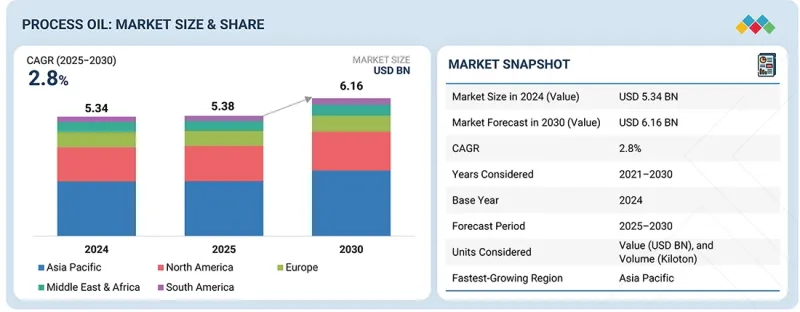
全球加工油市场规模预计将从 2025 年的 53.8 亿美元成长到 2030 年的 61.6 亿美元,预测期内复合年增长率为 2.8%。
加工油在提高各行业材料的性能、柔软性和可加工性方面发挥着至关重要的作用,这些行业包括轮胎和橡胶、聚合物、个人护理、纺织品和其他应用。
| 调查范围 | |
|---|---|
| 调查期 | 2021-2030 |
| 基准年 | 2024 |
| 预测期 | 2025-2030 |
| 单元 | 百万美元每千吨 |
| 部分 | 类型、用途、功能、生产流程、原料、最终用户 |
| 目标区域 | 北美洲、亚太地区、欧洲、中东和非洲、南美洲 |
油类能够改善轮胎和工业橡胶製品等产品的弹性、耐用性和加工性能。在聚合物领域,它们具有增塑作用,并能增强消费品、工业零件和包装材料的加工性能。在个人护理领域,加工油用于改善乳霜、乳液和化妆品的质地、润肤性能和保湿效果。在纺织品领域,它们可用作纤维和织物的润滑剂和整理加工剂。在黏合剂、涂料、油漆和油墨等其他应用领域,它们能够优化加工性能和整体性能。市场成长的驱动力来自汽车和消费品行业日益增长的需求、监管机构对更安全、无致癌性油类的关注,以及诸如气转液(GTL)和生物基油技术创新,这些创新提供了高纯度和永续的替代方案。
“按类型划分,预计在预测期内,非致癌性细分市场的以金额为准将占第二大份额。”
非致癌性加工油是指在提供高性能的同时,最大限度地降低传统芳香油相关健康风险的精炼油。按类型划分,非致癌性加工油预计将在预测期内占据全球加工油市场第二大份额,这反映了其在各行业的广泛应用。它们被用于轮胎、橡胶和聚合物等领域,以提高产品的弹性、耐久性和加工性能。在轮胎和橡胶领域,非致癌性加工油能够提升轮胎和工业橡胶製品的性能和柔软性。在聚合物领域,它们有助于提高工程塑胶和一般塑胶的塑化性能、柔软性和加工性能。市场成长的驱动因素包括:监管机构对安全化学品的关注、汽车和消费品行业对非致癌性加工油日益增长的需求、职业安全意识的提高以及高纯度、无毒油品技术的进步。
“按应用领域划分,预计聚合物领域在预测期内将占据第二大市场份额。”
按应用领域划分,聚合物领域将在预测期内占据全球加工油市场第二大份额。该领域的加工油用于改善聚合物材料的柔软性、塑化性、柔软性和加工性能,从而提高生产效率和成品品质。在聚合物应用中,这些油品有助于生产消费品、工业零件和包装用塑料,确保成品强度高、易于操作并满足性能要求。聚合物领域的成长推动了整个加工油市场的发展,其稳定的需求来自依赖高性能塑胶的产业。此外,对高纯度、永续加工油的法规遵循、材料安全性和技术进步的日益重视,也进一步促进了市场对该领域加工油的接受度。
“预计在预测期内,北美将占据第二大市场份额。”
预计在预测期内,北美将占据全球加工油市场第二大份额。该地区的需求主要得益于加工油在轮胎和橡胶、聚合物、个人护理、纺织品及其他领域的广泛应用。加工油能够改善材料的柔软性、耐久性、塑化性和加工性能。在轮胎和橡胶领域,加工油可以提高轮胎和工业橡胶製品的弹性和性能。在聚合物领域,加工油有助于软化、塑化和改善用于消费品、包装和工业部件的塑胶的加工性能。在个人护理领域,加工油有助于改善质地、增强润肤性能并提升产品性能;在纺织品领域,加工油则用作润滑剂和整理加工剂。其他应用领域包括黏合剂、涂料、油漆和油墨,加工油在这些领域能够优化加工性能和产品品质。北美市场的成长主要得益于汽车、製造业和消费品行业的强劲工业活动,以及对无致癌性和永续油脂日益严格的监管。高纯度生物基油脂技术的进步进一步促进了其应用,使製造商能够有效地满足性能、安全和环境要求。
本报告分析了全球加工油市场,并深入探讨了关键驱动因素和限制因素、产品开发和创新以及竞争格局。
目录
第一章 引言
第二章执行摘要
第三章 主要发现
- 加工油市场对企业而言极具吸引力的机会
- 加工油市场:按功能和地区划分
- 按应用分類的加工油市场
- 按类型加工油市场
- 按国家/地区加工油市场
第四章 市场概览
- 市场动态
- 司机
- 抑制因素
- 机会
- 任务
- 未满足的需求和閒置频段
- 加工油市场未满足的需求
- 閒置频段机会
- 相互关联的市场与跨产业机会
- 互联市场
- 跨职能机会
- 一级/二级/三级公司的策略性倡议
第五章 产业趋势
- 波特五力分析
- 全球宏观经济展望
- GDP趋势与预测
- 全球加工油产业的发展趋势
- 供应链分析
- 生态系分析
- 定价分析
- 各地区加工油平均售价趋势(2022-2025)
- 主要企业各类加工油平均售价(2025 年)
- 贸易分析
- 进口场景(HS编码2709)
- 出口方案(HS编码2709)
- 重大会议和活动(2025-2026)
- 影响客户业务的趋势/颠覆性因素
- 投资和资金筹措方案
- 案例研究分析
- 2025年美国关税对加工油市场的影响
- 影响市场的主要关税
- 价格影响分析
- 对各个地区产生重大影响
- 对加工油终端用户产业的影响
第六章:技术进步、人工智慧影响、专利、创新与未来应用
- 主要新技术
- 互补技术
- 技术/产品蓝图
- 近期目标 | 流程效率及向低PCA过渡(2025-2027年)
- 中期规划 | 製造流程的演进与特殊牌号的扩展(2027-2030 年)
- 长期规划 | 向生物基润滑油和下一代高性能润滑油过渡(2030-2035 年及以后)
- 专利分析
- 未来应用
- 轮胎和橡胶:提高柔软性、柔软度和加工效率
- 聚合物:改善熔体流动性、分散性和可成型性
- 个人护理:改善肌肤触感和配方稳定性
- 纺织品:改善纱线润滑性、平滑度和后整理效果
- 生成式人工智慧对加工油市场的影响
- 人工智慧驱动的流程优化
- 人工智慧驱动的预测性维护和可靠性
- 人工智慧支援的品质保证和产品一致性
- 人工智慧驱动的供应链和需求预测
第七章:监理环境与永续性倡议
- 地方法规和合规性
- 监管机构、政府机构和其他组织
- 业界标准
- 认证、标籤和环境标准
- 对永续性的承诺
- 监管政策对永续性努力的影响
第八章:顾客状况与购买行为
- 决策流程
- 主要相关利益者和采购标准
- 招募障碍和内部挑战
- 各种应用中尚未满足的需求
- 市场盈利
- 潜在收入
- 成本动态
- 关键应用领域的利润机会
第九章 依原料加工油市场
- 油
- 天然气
- 煤焦油
第十章 以最终用户加工油市场
- 车
- 建造
- 製造业
- 活力
- 製药
- 石油和天然气
第十一章 按类型分類的加工油市场
- 环烷烃
- 石蜡
- 芳香
- 非致癌性
第十二章 依生产技术加工油市场
- 传统路线
- GTL(Gas-To-Liquid)
- 生物基
第十三章加工油市场:依功能划分
- 增效油
- 增塑剂
- 溶剂
- 消泡剂
- 其他功能
第十四章 按应用分類的加工油市场
- 轮胎和橡胶
- 聚合物
- 个人护理
- 纺织品
- 其他用途
第十五章 各地区的加工油市场
- 亚太地区
- 中国
- 日本
- 印度
- 韩国
- 印尼
- 泰国
- 亚太其他地区
- 北美洲
- 我们
- 加拿大
- 墨西哥
- 欧洲
- 俄罗斯
- 德国
- 英国
- 法国
- 西班牙
- 义大利
- 其他欧洲
- 中东和非洲
- 海湾合作委员会国家
- 其他中东和非洲地区
- 南美洲
- 巴西
- 阿根廷
- 南美洲其他地区
第十六章 竞争格局
- 主要参与企业的策略/优势
- 收入分析
- 市占率分析(2024 年)
- 品牌/产品对比
- 公司估值和财务指标
- 企业评估矩阵:主要企业(2024)
- 公司评估矩阵:Start-Ups/中小企业(2024 年)
- 竞争场景
第十七章:公司简介
- 主要企业
- SHELL
- EXXON MOBIL CORPORATION
- CHEVRON CORPORATION
- PETROLIAM NASIONAL BERHAD(PETRONAS)
- IDEMITSU KOSAN CO., LTD.
- INDIAN OIL CORPORATION LTD.
- GANDHAR OIL REFINERY(INDIA)LIMITED
- HF SINCLAIR CORPORATION
- BEHRAN OIL CO.
- ORGKHIM BIOCHEMICAL HOLDING
- REPSOL
- HINDUSTAN PETROLEUM CORPORATION LIMITED
- ORLEN UNIPETROL
- PANAMA PETROCHEM LTD.
- NYNAS AB
- H&R GROUP
- CPC CORPORATION
- IRANOL COMPANY
- ERGON, INC.
- 其他公司
- APAR INDUSTRIES LTD.
- CROSS OIL
- EASTERN PETROLEUM
- GPPL
- LODHA PETRO
- PETRO GULF INTERNATIONAL FZE
- STERLITE LUBRICANTS
- TAURUS PETROLEUMS PRIVATE LIMITED
- VINTROL LUBES PRIVATE LIMITED
- WITMANS INDUSTRIES PVT. LTD
第十八章调查方法
第十九章附录
The global process oil market is projected to grow from USD 5.38 billion in 2025 to USD 6.16 billion in 2030, at a CAGR of 2.8% during the forecast period. Process oils play a vital role in enhancing the performance, flexibility, and processability of materials across multiple industries. By application, the market is segmented into tire & rubber, polymer, personal care, textile, and other applications.
| Scope of the Report | |
|---|---|
| Years Considered for the Study | 2021-2030 |
| Base Year | 2024 |
| Forecast Period | 2025-2030 |
| Units Considered | Value (USD Million), and Volume (Kiloton) |
| Segments | Type, Application, Function, Production Technology, Feedstock, and End User |
| Regions covered | North America, Asia Pacific, Europe, Middle East & Africa, and South America |
Oils improve elasticity, durability, and processing of products such as tires and industrial rubber goods. In polymers, they enhance plasticization and processability for consumer goods, industrial components, and packaging materials. Personal care uses process oils to improve texture, emollient properties, and moisturization in creams, lotions, and cosmetics. In textiles, they act as lubricants and finishing agents for fibers and fabrics; in other applications, such as adhesives, coatings, paints, and inks, oils optimize workability and performance. Market growth is driven by rising demand from the automotive and consumer goods industries, regulatory focus on safer non-carcinogenic oils, and technological innovations such as gas-to-liquid (GTL) and bio-based oils, offering high purity and sustainable alternatives.
"By type, the non-carcinogenic segment is expected to account for the second-largest share during the forecast period, in terms of value."
Non-carcinogenic process oils are refined oils that deliver high performance while minimizing health risks associated with conventional aromatic oils. By type, Non-Carcinogenic process oils account for the second-largest share of the global process oil market during the forecast period, reflecting their widespread use across industries. They are applied in Tire & Rubber, Polymer, and Other Applications, enhancing elasticity, durability, and processability. In Tire & Rubber, Non-Carcinogenic process oils improve the performance and flexibility of tires and industrial rubber products. In Polymer applications, they aid in plasticization, softness, and handling of engineering and commodity plastics. Market growth is driven by regulatory emphasis on safe chemicals, rising adoption in automotive and consumer goods, growing awareness of occupational safety, and technological advancements in high-purity, non-toxic oils.
"By application, the polymer segment will account for the second-largest market share during the forecast period."
The polymer segment, by application, accounts for the second-largest share of the global process oil market during the forecast period. Process oils in this segment are used to enhance flexibility, plasticization, softness, and processability of polymer materials, improving manufacturing efficiency and the quality of finished products. In polymer applications, these oils support the production of plastics for consumer goods, industrial components, and packaging, ensuring that the resulting materials are durable, easy to handle, and meet performance requirements. The growth of the Polymer segment drives the overall process oil market by creating consistent demand from industries that rely on high-performance plastics. Additionally, increased focus on regulatory compliance, material safety, and technological advancements in high-purity, sustainable process oils is further strengthening market adoption.
"North America is projected to account for the second-largest market share during the forecast period."
North America accounts for the second-largest share of the global process oil market during the forecast period. The region's demand is supported by extensive applications across Tire & Rubber, Polymer, Personal Care, Textile, and Other Applications, where process oils enhance flexibility, durability, plasticization, and processability of materials. In tire & rubber, oils improve the elasticity and performance of tires and industrial rubber products. In Polymer applications, they aid in softening, plasticization, and handling of plastics used in consumer goods, packaging, and industrial components. Personal Care applications benefit from oils that improve texture, enhance emollient properties, and enhance product performance, while in textile applications, they serve as lubricants and finishing agents for fibers and fabrics. Other applications include adhesives, coatings, paints, and inks, where oils optimize workability and quality. Market growth in North America is driven by strong industrial activity in the automotive, manufacturing, and consumer goods sectors, combined with increased regulatory focus on non-carcinogenic, sustainable oils. Technological advancements in high-purity, bio-based oils further strengthen adoption, enabling manufacturers to meet performance, safety, and environmental requirements efficiently.
Profile break-up of primary participants for the report:
- By Company Type: Tier 1 - 65%, Tier 2 - 20%, and Tier 3 - 15%
- By Designation: Directors - 25%, Managers - 30%, and Others - 45%
- By Region: North America - 30%, Asia Pacific - 40%, Europe - 20%, Middle East & Africa - 7%, and South America - 3%
Exxon Mobil Corporation (US), Chevron Corporation (US), Shell (UK), Petroliam Nasional Berhad (PETRONAS) (Malaysia), and Idemitsu Kosan Co., Ltd. (Japan) are some of the major players operating in the process oil market.
Research Coverage:
The report segments the process oil market based on type, application, function, production technology, feedstock, end user, and region. It provides detailed information on the major factors influencing the market's growth, including drivers, restraints, opportunities, and challenges. It strategically profiles process oil manufacturers, comprehensively analyzing their market shares and core competencies.
Reasons to Buy the Report:
The report is expected to help market leaders/new entrants by providing the closest approximations of revenue figures for the process oil market and its segments. This report is also expected to help stakeholders gain a better understanding of the market's competitive landscape, develop insights to improve their businesses' positions, and develop suitable go-to-market strategies. It also enables stakeholders to understand the market's pulse and provides information on key market drivers, restraints, challenges, and opportunities.
The report provides insights into the following pointers:
- Analysis of critical Drivers (Growth in tire production and polymer-processing industries supporting steady demand for process oils; and Industrialization and urban growth increasing the use of plastics, adhesives, and other materials that rely on process oils), Restraints (Regulations limiting high-PAH aromatic oils reducing the use of certain traditional grades; and Increasing shift toward vegetable oils and synthetic alternatives in select applications), Opportunities (Rising demand for low-PAH, hydrotreated, and eco-friendly process oils), and Challenges (Crude-oil price volatility posing ongoing challenges to cost stability and production planning)
- Product Development/Innovation: Detailed insights on upcoming technologies and research & development activities in the process oil market
- Market Development: Comprehensive information about lucrative markets - the report analyses the process oil market across varied regions.
- Competitive Assessment: In-depth assessment of market shares, growth strategies, and product offerings of leading players such as Exxon Mobil Corporation (US), Chevron Corporation (US), Shell (UK), Petroliam Nasional Berhad (PETRONAS) (Malaysia), and Idemitsu Kosan Co., Ltd. (Japan) in the process oil market
TABLE OF CONTENTS
1 INTRODUCTION
- 1.1 STUDY OBJECTIVES
- 1.2 MARKET DEFINITION
- 1.3 MARKET SCOPE
- 1.3.1 MARKET SEGMENTATION AND REGIONAL SCOPE
- 1.3.2 INCLUSIONS AND EXCLUSIONS
- 1.3.3 YEARS CONSIDERED
- 1.3.4 CURRENCY CONSIDERED
- 1.3.5 UNITS CONSIDERED
- 1.4 STAKEHOLDERS
- 1.5 SUMMARY OF CHANGES
2 EXECUTIVE SUMMARY
- 2.1 MARKET HIGHLIGHTS AND KEY INSIGHTS
- 2.2 KEY MARKET PARTICIPANTS: MAPPING OF STRATEGIC DEVELOPMENTS
- 2.3 DISRUPTIVE TRENDS IN PROCESS OIL MARKET
- 2.4 HIGH GROWTH SEGMENTS
- 2.5 REGIONAL SNAPSHOT: MARKET SIZE, GROWTH RATE, AND FORECAST
3 PREMIUM INSIGHTS
- 3.1 ATTRACTIVE OPPORTUNITIES FOR PLAYERS IN PROCESS OIL MARKET
- 3.2 PROCESS OIL MARKET, BY FUNCTION AND REGION
- 3.3 PROCESS OIL MARKET, BY APPLICATION
- 3.4 PROCESS OIL MARKET, BY TYPE
- 3.5 PROCESS OIL MARKET, BY COUNTRY
4 MARKET OVERVIEW
- 4.1 INTRODUCTION
- 4.2 MARKET DYNAMICS
- 4.2.1 DRIVERS
- 4.2.1.1 Growth in tire production and polymer-processing industries supporting steady demand for process oils
- 4.2.1.2 Extensive use of plastics, adhesives, and other materials to increase demand
- 4.2.2 RESTRAINTS
- 4.2.2.1 Regulations limiting high-PAH aromatic oils, reducing use of certain traditional grades
- 4.2.2.2 Increasing shift toward vegetable oils and synthetic alternatives in select applications
- 4.2.3 OPPORTUNITIES
- 4.2.3.1 Rising demand for low-PAH, hydrotreated, and eco-friendly process oils
- 4.2.4 CHALLENGES
- 4.2.4.1 Impact on cost and production planning due to crude oil price volatility
- 4.2.1 DRIVERS
- 4.3 UNMET NEEDS AND WHITE SPACES
- 4.3.1 UNMET NEEDS IN PROCESS OIL MARKET
- 4.3.2 WHITE SPACE OPPORTUNITIES
- 4.4 INTERCONNECTED MARKETS AND CROSS-SECTOR OPPORTUNITIES
- 4.4.1 INTERCONNECTED MARKETS
- 4.4.2 CROSS-SECTOR OPPORTUNITIES
- 4.5 STRATEGIC MOVES BY TIER-1/2/3 PLAYERS
- 4.5.1 KEY MOVES AND STRATEGIC FOCUS
5 INDUSTRY TRENDS
- 5.1 PORTER'S FIVE FORCES ANALYSIS
- 5.1.1 BARGAINING POWER OF SUPPLIERS
- 5.1.2 BARGAINING POWER OF BUYERS
- 5.1.3 THREAT OF NEW ENTRANTS
- 5.1.4 THREAT OF SUBSTITUTES
- 5.1.5 INTENSITY OF COMPETITIVE RIVALRY
- 5.2 GLOBAL MACROECONOMIC OUTLOOK
- 5.2.1 INTRODUCTION
- 5.2.2 GDP TRENDS AND FORECAST
- 5.2.3 TRENDS IN GLOBAL PROCESS OIL INDUSTRY
- 5.3 SUPPLY CHAIN ANALYSIS
- 5.4 ECOSYSTEM ANALYSIS
- 5.5 PRICING ANALYSIS
- 5.5.1 AVERAGE SELLING PRICE TREND OF PROCESS OIL, BY REGION, 2022-2025
- 5.5.2 AVERAGE SELLING PRICE OF PROCESS OIL TYPE, BY KEY PLAYERS, 2025
- 5.6 TRADE ANALYSIS
- 5.6.1 IMPORT SCENARIO (HS CODE 2709)
- 5.6.2 EXPORT SCENARIO (HS CODE 2709)
- 5.7 KEY CONFERENCES AND EVENTS, 2025-2026
- 5.8 TRENDS/DISRUPTIONS IMPACTING CUSTOMER BUSINESS
- 5.9 INVESTMENT AND FUNDING SCENARIO
- 5.10 CASE STUDY ANALYSIS
- 5.10.1 RRII(RUBBER RESEARCH INSTITUTE)-INDIAN OIL COLLABORATION ON ADVANCED PROCESS OIL APPLICATIONS
- 5.10.2 REPSOL'S BIOEXTENSOIL - A CIRCULAR AND HIGH-PERFORMANCE ALTERNATIVE TO MINERAL PROCESS OILS
- 5.10.3 SHELL FLAVEX 595 - ENABLING COMPLIANCE AND HIGH-PERFORMANCE TIRE MANUFACTURING
- 5.11 IMPACT OF 2025 US TARIFF - PROCESS OIL MARKET
- 5.11.1 KEY TARIFF RATES IMPACTING MARKET
- 5.11.2 PRICE IMPACT ANALYSIS
- 5.11.3 KEY IMPACT ON VARIOUS REGIONS
- 5.11.3.1 US
- 5.11.3.2 Europe
- 5.11.3.3 Asia Pacific
- 5.11.4 IMPACT ON END-USE INDUSTRIES OF PROCESS OIL
- 5.11.4.1 Tire & rubber industry
- 5.11.4.2 Personal care industry
- 5.11.4.3 Textile industry
- 5.11.4.4 Polymer industry
6 TECHNOLOGICAL ADVANCEMENTS, AI-DRIVEN IMPACT, PATENTS, INNOVATIONS, AND FUTURE APPLICATIONS
- 6.1 KEY EMERGING TECHNOLOGIES
- 6.1.1 GREEN RUBBER PROCESS OIL
- 6.2 COMPLEMENTARY TECHNOLOGIES
- 6.2.1 BIO-BASED BASE OIL
- 6.3 TECHNOLOGY/PRODUCT ROADMAP
- 6.3.1 SHORT-TERM (2025-2027) | PROCESS EFFICIENCY & LOW-PCA TRANSITION
- 6.3.2 MID-TERM (2027-2030) | FORMULATION ADVANCEMENT & SPECIALTY GRADE EXPANSION
- 6.3.3 LONG-TERM (2030-2035+) | BIO-BASED TRANSITION & NEXT-GEN PERFORMANCE OILS
- 6.4 PATENT ANALYSIS
- 6.4.1 METHODOLOGY
- 6.5 FUTURE APPLICATIONS
- 6.5.1 TIRE & RUBBER: IMPROVED FLEXIBILITY, SOFTENING, AND PROCESSING EFFICIENCY
- 6.5.2 POLYMER: ENHANCED MELT FLOW, DISPERSION, AND MOLDABILITY
- 6.5.3 PERSONAL CARE: ENHANCED SKIN FEEL AND FORMULATION STABILITY
- 6.5.4 TEXTILE: IMPROVED YARN LUBRICATION, SMOOTHNESS, AND FINISHING
- 6.6 IMPACT OF GENERATIVE AI ON PROCESS OIL MARKET
- 6.6.1 INTRODUCTION
- 6.6.2 AI-ENABLED PROCESS OPTIMIZATION
- 6.6.3 AI-DRIVEN PREDICTIVE MAINTENANCE AND RELIABILITY
- 6.6.4 AI-SUPPORTED QUALITY ASSURANCE AND PRODUCT CONSISTENCY
- 6.6.5 AI-ENHANCED SUPPLY CHAIN AND DEMAND FORECASTING
7 REGULATORY LANDSCAPE AND SUSTAINABILITY INITIATIVES
- 7.1 REGIONAL REGULATIONS AND COMPLIANCE
- 7.1.1 REGULATORY BODIES, GOVERNMENT AGENCIES, AND OTHER ORGANIZATIONS
- 7.1.2 INDUSTRY STANDARDS
- 7.1.3 CERTIFICATIONS, LABELING, AND ECO-STANDARDS
- 7.2 SUSTAINABILITY INITIATIVES
- 7.2.1 CARBON IMPACT AND ECO-APPLICATIONS OF PROCESS OIL
- 7.2.1.1 Carbon impact reduction
- 7.2.1.2 Eco-applications
- 7.2.1 CARBON IMPACT AND ECO-APPLICATIONS OF PROCESS OIL
- 7.3 IMPACT OF REGULATORY POLICIES ON SUSTAINABILITY INITIATIVES
8 CUSTOMER LANDSCAPE & BUYER BEHAVIOR
- 8.1 INTRODUCTION
- 8.2 DECISION-MAKING PROCESS
- 8.3 KEY STAKEHOLDERS AND BUYING CRITERIA
- 8.3.1 KEY STAKEHOLDERS IN BUYING PROCESS
- 8.3.2 BUYING CRITERIA
- 8.4 ADOPTION BARRIERS & INTERNAL CHALLENGES
- 8.5 UNMET NEEDS IN VARIOUS APPLICATIONS
- 8.6 MARKET PROFITABILITY
- 8.6.1 REVENUE POTENTIAL
- 8.6.2 COST DYNAMICS
- 8.6.3 MARGIN OPPORTUNITIES IN KEY APPLICATIONS
9 PROCESS OIL MARKET, BY FEEDSTOCK
- 9.1 INTRODUCTION
- 9.2 PETROLEUM
- 9.2.1 BROAD AVAILABILITY AND WELL-ESTABLISHED REFINING INFRASTRUCTURE TO DRIVE MARKET
- 9.3 NATURAL GAS
- 9.3.1 EMERGING CLEANER ALTERNATIVES IN PROCESS OIL PRODUCTION TO INCREASE DEMAND
- 9.4 COAL TAR
- 9.4.1 NICHE AROMATIC SOURCE FOR HIGH-SOLVENCY PROCESS OILS TO PROPEL MARKET
10 PROCESS OIL MARKET, BY END USER
- 10.1 INTRODUCTION
- 10.2 AUTOMOTIVE
- 10.2.1 EXTENSIVE ROLE IN RUBBER AND POLYMER TO DRIVE MARKET
- 10.3 CONSTRUCTION
- 10.3.1 SUPPORTING DURABILITY AND FLEXIBILITY IN INFRASTRUCTURE MATERIALS TO PROPEL MARKET
- 10.4 MANUFACTURING
- 10.4.1 BROAD-BASED CONSUMPTION ACROSS INDUSTRIAL PROCESSING ACTIVITIES TO INCREASE DEMAND
- 10.5 ENERGY
- 10.5.1 USE IN POWER GENERATION EQUIPMENT, ELECTRICAL INSULATION MATERIALS, AND SPECIALTY LUBRICATING SYSTEMS TO INCREASE DEMAND
- 10.6 PHARMACEUTICALS
- 10.6.1 USE IN OINTMENTS, CREAMS, GELS, AND MEDICAL-GRADE ELASTOMERS TO PROPEL MARKET
- 10.7 OIL AND GAS
- 10.7.1 ENABLING PERFORMANCE AND RELIABILITY IN HARSH OPERATING ENVIRONMENTS TO DRIVE MARKET
11 PROCESS OIL MARKET, BY TYPE
- 11.1 INTRODUCTION
- 11.2 NAPHTHENIC
- 11.2.1 VERSATILITY AND RELIABLE PERFORMANCE ACROSS MULTIPLE MANUFACTURING APPLICATIONS
- 11.3 PARAFFINIC
- 11.3.1 NEED FOR CONSISTENT, RELIABLE, AND STABLE PROCESSING IN HIGH-VOLUME MANUFACTURING TO DRIVE DEMAND
- 11.4 AROMATIC
- 11.4.1 ESTABLISHED USE IN TRADITIONAL RUBBER AND INDUSTRIAL MANUFACTURING
- 11.5 NON-CARCINOGENIC
- 11.5.1 GROWING EMPHASIS ON SAFETY, REGULATORY COMPLIANCE, AND SUSTAINABLE PRACTICES
12 PROCESS OIL MARKET, BY PRODUCTION TECHNOLOGY
- 12.1 INTRODUCTION
- 12.2 CONVENTION ROUTE
- 12.2.1 ESTABLISHED REFINING INFRASTRUCTURE AND RELIABLE LARGE-SCALE SUPPLY
- 12.3 GAS-TO-LIQUID (GTL)
- 12.3.1 DEMAND FOR HIGH-PURITY, PERFORMANCE-CONSISTENT PROCESS OILS WITH STABLE PROCESSING BEHAVIOR
- 12.4 BIO-BASED
- 12.4.1 GROWING EMPHASIS ON RENEWABLE SOURCING AND SUSTAINABILITY-ALIGNED MANUFACTURING
13 PROCESS OIL MARKET, BY FUNCTION
- 13.1 INTRODUCTION
- 13.2 EXTENDER OIL
- 13.2.1 WIDESPREAD USE OF PROCESS OILS AS EXTENDERS IN RUBBER AND POLYMER FORMULATIONS
- 13.3 PLASTICIZER
- 13.3.1 DEMAND FOR FLEXIBLE AND EFFICIENTLY PROCESSED RUBBER AND POLYMER PRODUCTS
- 13.4 SOLVENT
- 13.4.1 NEED FOR STABLE FORMULATIONS AND EFFICIENT DISPERSION ACROSS INDUSTRIAL AND CONSUMER APPLICATIONS
- 13.5 DEFOAMER
- 13.5.1 NEED TO CONTROL FOAM AND MAINTAIN STABLE, EFFICIENT MANUFACTURING PROCESSES
- 13.6 OTHER FUNCTIONS
14 PROCESS OIL MARKET, BY APPLICATION
- 14.1 INTRODUCTION
- 14.2 TIRE & RUBBER
- 14.2.1 LARGEST AND MOST ESTABLISHED USE OF PROCESS OIL TO DRIVE MARKET
- 14.3 POLYMER
- 14.3.1 MODIFY VISCOSITY, IMPROVE FLOW BEHAVIOR, AND ENHANCE COMPATIBILITY DURING PROCESSING
- 14.4 PERSONAL CARE
- 14.4.1 HIGH-PURITY PROCESS OILS FOR STABILITY AND SENSORY PERFORMANCE TO INCREASE DEMAND
- 14.5 TEXTILE
- 14.5.1 ENHANCES PRODUCTIVITY AND MINIMIZES DEFECTS DURING HIGH-SPEED TEXTILE PROCESSING TO INCREASE DEMAND
- 14.6 OTHER APPLICATIONS
15 PROCESS OIL MARKET, BY REGION
- 15.1 INTRODUCTION
- 15.2 ASIA PACIFIC
- 15.2.1 CHINA
- 15.2.1.1 Rising passenger car and commercial vehicle production, translating into higher tire manufacturing output
- 15.2.2 JAPAN
- 15.2.2.1 Steady production of automotive tires and rubber components, coupled with high demand for compliant non-carcinogenic process oil
- 15.2.3 INDIA
- 15.2.3.1 Rising replacement tire demand, expanding automotive production, and focus on quality and regulatory compliance
- 15.2.4 SOUTH KOREA
- 15.2.4.1 Rising passenger car and commercial vehicle production, leading to higher tire and automotive rubber manufacturing activity
- 15.2.5 INDONESIA
- 15.2.5.1 Expanding automotive production, supported by strong domestic rubber processing and rising replacement tire demand
- 15.2.6 THAILAND
- 15.2.6.1 Strong automotive-driven tire manufacturing, supported by polymer processing and textile industry activities
- 15.2.7 REST OF ASIA PACIFIC
- 15.2.1 CHINA
- 15.3 NORTH AMERICA
- 15.3.1 US
- 15.3.1.1 Rising electric vehicle adoption, driving demand for specialized tire production and rubber processing
- 15.3.2 CANADA
- 15.3.2.1 Steady rubber and polymer processing activities to drive market
- 15.3.3 MEXICO
- 15.3.3.1 Sustained automotive production and tire manufacturing activity driving market
- 15.3.1 US
- 15.4 EUROPE
- 15.4.1 RUSSIA
- 15.4.1.1 Steady rubber and polymer processing activity, supported by domestic manufacturing and automotive-related demand
- 15.4.2 GERMANY
- 15.4.2.1 Rising BEV and PHEV registrations, replacement tire demand, and polymer processing activities
- 15.4.3 UK
- 15.4.3.1 Replacement-driven tire demand, supported by polymer and personal care manufacturing activity
- 15.4.4 FRANCE
- 15.4.4.1 Rising new car registrations, supported by steady polymer and personal care manufacturing activities
- 15.4.5 SPAIN
- 15.4.5.1 Ongoing tire and rubber manufacturing, supported by polymer processing and textile applications
- 15.4.6 ITALY
- 15.4.6.1 Demand from value-added rubber goods, polymer processing, and specialty textile manufacturing
- 15.4.7 REST OF EUROPE
- 15.4.1 RUSSIA
- 15.5 MIDDLE EAST & AFRICA
- 15.5.1 GCC COUNTRIES
- 15.5.1.1 Saudi Arabia
- 15.5.1.1.1 Rising vehicle registrations and Vision 2030 to drive market
- 15.5.1.2 UAE
- 15.5.1.2.1 Replacement-driven automotive activity, supported by polymer and personal care manufacturing
- 15.5.1.3 Rest of GCC countries
- 15.5.1.1 Saudi Arabia
- 15.5.2 REST OF MIDDLE EAST & AFRICA
- 15.5.1 GCC COUNTRIES
- 15.6 SOUTH AMERICA
- 15.6.1 BRAZIL
- 15.6.1.1 Strong automotive and tire manufacturing, supported by polymer, textile, and personal care production
- 15.6.2 ARGENTINA
- 15.6.2.1 Growing domestic tire and rubber manufacturing, supported by polymer processing
- 15.6.3 REST OF SOUTH AMERICA
- 15.6.1 BRAZIL
16 COMPETITIVE LANDSCAPE
- 16.1 INTRODUCTION
- 16.2 KEY PLAYERS' STRATEGIES/RIGHT TO WIN
- 16.3 REVENUE ANALYSIS
- 16.4 MARKET SHARE ANALYSIS, 2024
- 16.5 BRAND/PRODUCT COMPARISON
- 16.6 COMPANY VALUATION AND FINANCIAL METRICS
- 16.7 COMPANY EVALUATION MATRIX: KEY PLAYERS, 2024
- 16.7.1 STARS
- 16.7.2 EMERGING LEADERS
- 16.7.3 PERVASIVE PLAYERS
- 16.7.4 PARTICIPANTS
- 16.7.5 COMPANY FOOTPRINT: KEY PLAYERS, 2024
- 16.7.5.1 Company footprint
- 16.7.5.2 Region footprint
- 16.7.5.3 Type footprint
- 16.7.5.4 Application footprint
- 16.7.5.5 End user footprint
- 16.8 COMPANY EVALUATION MATRIX: STARTUPS/SMES, 2024
- 16.8.1 PROGRESSIVE COMPANIES
- 16.8.2 RESPONSIVE COMPANIES
- 16.8.3 DYNAMIC COMPANIES
- 16.8.4 STARTING BLOCKS
- 16.8.5 COMPETITIVE BENCHMARKING: STARTUPS/SMES, 2024
- 16.8.5.1 Detailed list of key startups/SMEs
- 16.8.6 COMPETITIVE BENCHMARKING OF KEY STARTUPS/SMES
- 16.9 COMPETITIVE SCENARIO
- 16.9.1 PRODUCT LAUNCHES
- 16.9.2 DEALS
17 COMPANY PROFILES
- 17.1 MAJOR PLAYERS
- 17.1.1 SHELL
- 17.1.1.1 Business overview
- 17.1.1.2 Products/Solutions/Services offered
- 17.1.1.3 Recent developments
- 17.1.1.3.1 Deals
- 17.1.1.4 MnM view
- 17.1.1.4.1 Right to win
- 17.1.1.4.2 Strategic choices
- 17.1.1.4.3 Weaknesses and competitive threats
- 17.1.2 EXXON MOBIL CORPORATION
- 17.1.2.1 Business overview
- 17.1.2.2 Products/Solutions/Services offered
- 17.1.2.3 MnM view
- 17.1.2.3.1 Right to win
- 17.1.2.3.2 Strategic choices
- 17.1.2.3.3 Weaknesses and competitive threats
- 17.1.3 CHEVRON CORPORATION
- 17.1.3.1 Business overview
- 17.1.3.2 Products/Solutions/Services offered
- 17.1.3.3 MnM view
- 17.1.3.3.1 Right to win
- 17.1.3.3.2 Strategic choices
- 17.1.3.3.3 Weaknesses and competitive threats
- 17.1.4 PETROLIAM NASIONAL BERHAD (PETRONAS)
- 17.1.4.1 Business overview
- 17.1.4.2 Products/Solutions/Services offered
- 17.1.4.3 MnM view
- 17.1.4.3.1 Right to win
- 17.1.4.3.2 Strategic choices
- 17.1.4.3.3 Weaknesses and competitive threats
- 17.1.5 IDEMITSU KOSAN CO., LTD.
- 17.1.5.1 Business overview
- 17.1.5.2 Products/Solutions/Services offered
- 17.1.5.3 MnM view
- 17.1.5.3.1 Right to win
- 17.1.5.3.2 Strategic choices
- 17.1.5.3.3 Weaknesses and competitive threats
- 17.1.6 INDIAN OIL CORPORATION LTD.
- 17.1.6.1 Business overview
- 17.1.6.2 Products/Solutions/Services offered
- 17.1.7 GANDHAR OIL REFINERY (INDIA) LIMITED
- 17.1.7.1 Business overview
- 17.1.7.2 Products/Solutions/Services offered
- 17.1.8 HF SINCLAIR CORPORATION
- 17.1.8.1 Business overview
- 17.1.8.2 Products offered
- 17.1.9 BEHRAN OIL CO.
- 17.1.9.1 Business overview
- 17.1.9.2 Products/Solutions/Services offered
- 17.1.10 ORGKHIM BIOCHEMICAL HOLDING
- 17.1.10.1 Business overview
- 17.1.10.2 Products offered
- 17.1.11 REPSOL
- 17.1.11.1 Business overview
- 17.1.11.2 Products/Solutions/Services offered
- 17.1.12 HINDUSTAN PETROLEUM CORPORATION LIMITED
- 17.1.12.1 Business overview
- 17.1.12.2 Products/Solutions/Services offered
- 17.1.13 ORLEN UNIPETROL
- 17.1.13.1 Business overview
- 17.1.13.2 Products/Solutions/Services offered
- 17.1.14 PANAMA PETROCHEM LTD.
- 17.1.14.1 Business overview
- 17.1.14.2 Products/Solutions/Services offered
- 17.1.14.3 Recent developments
- 17.1.15 NYNAS AB
- 17.1.15.1 Business overview
- 17.1.15.2 Products/Solutions/Services offered
- 17.1.15.3 Recent developments
- 17.1.16 H&R GROUP
- 17.1.16.1 Business overview
- 17.1.16.2 Products/Solutions/Services offered
- 17.1.16.3 Recent developments
- 17.1.17 CPC CORPORATION
- 17.1.17.1 Business overview
- 17.1.17.2 Products/Solutions/Services offered
- 17.1.17.3 Recent developments
- 17.1.18 IRANOL COMPANY
- 17.1.18.1 Business overview
- 17.1.18.2 Products/Solutions/Services offered
- 17.1.18.3 Recent developments
- 17.1.19 ERGON, INC.
- 17.1.19.1 Business overview
- 17.1.19.2 Products/Solutions/Services offered
- 17.1.19.3 Recent developments
- 17.1.1 SHELL
- 17.2 OTHER PLAYERS
- 17.2.1 APAR INDUSTRIES LTD.
- 17.2.2 CROSS OIL
- 17.2.2.1 Recent developments
- 17.2.2.1.1 Deals
- 17.2.2.1 Recent developments
- 17.2.3 EASTERN PETROLEUM
- 17.2.4 GPPL
- 17.2.5 LODHA PETRO
- 17.2.6 PETRO GULF INTERNATIONAL FZE
- 17.2.7 STERLITE LUBRICANTS
- 17.2.8 TAURUS PETROLEUMS PRIVATE LIMITED
- 17.2.9 VINTROL LUBES PRIVATE LIMITED
- 17.2.10 WITMANS INDUSTRIES PVT. LTD
18 RESEARCH METHODOLOGY
- 18.1 RESEARCH DATA
- 18.1.1 SECONDARY DATA
- 18.1.1.1 Key data from secondary sources
- 18.1.2 PRIMARY DATA
- 18.1.2.1 Key data from primary sources
- 18.1.2.2 List of primary interview participants (demand and supply sides)
- 18.1.2.3 Key industry insights
- 18.1.2.4 Breakdown of interviews with experts
- 18.1.1 SECONDARY DATA
- 18.2 MATRIX CONSIDERED FOR DEMAND-SIDE ANALYSIS
- 18.3 MARKET SIZE ESTIMATION
- 18.3.1 BOTTOM-UP APPROACH & TOP-DOWN APPROACH
- 18.3.1.1 Calculations for supply-side analysis
- 18.3.1 BOTTOM-UP APPROACH & TOP-DOWN APPROACH
- 18.4 GROWTH FORECAST
- 18.5 DATA TRIANGULATION
- 18.6 RESEARCH ASSUMPTIONS
- 18.7 RESEARCH LIMITATIONS
- 18.8 RISK ASSESSMENT
19 APPENDIX
- 19.1 DISCUSSION GUIDE
- 19.2 KNOWLEDGESTORE: MARKETSANDMARKETS' SUBSCRIPTION PORTAL
- 19.3 CUSTOMIZATION OPTIONS
- 19.4 RELATED REPORTS
- 19.5 AUTHOR DETAILS
List of Tables
- TABLE 1 PROCESS OIL MARKET: PORTER'S FIVE FORCES ANALYSIS
- TABLE 2 REAL GDP GROWTH (ANNUAL PERCENTAGE CHANGE), BY KEY COUNTRY, 2022-2024 (%)
- TABLE 3 UNEMPLOYMENT RATE, BY KEY COUNTRY, 2022-2024 (%)
- TABLE 4 INFLATION RATE AVERAGE CONSUMER PRICES, BY KEY COUNTRY, 2022-2024 (%)
- TABLE 5 FOREIGN DIRECT INVESTMENT, BY REGION, 2022-2023 (USD BILLION)
- TABLE 6 ROLES OF COMPANIES IN PROCESS OIL ECOSYSTEM
- TABLE 7 AVERAGE SELLING PRICE TREND OF PROCESS OIL, BY REGION, 2022-2025 (USD/TON)
- TABLE 8 AVERAGE SELLING PRICE OF PROCESS OIL TYPE, BY KEY PLAYERS, 2025 (USD/TON)
- TABLE 9 IMPORT DATA FOR HS CODE 2709, BY KEY COUNTRY, 2021-2024 (USD THOUSAND)
- TABLE 10 EXPORT DATA FOR HS CODE 2709, BY KEY COUNTRY, 2021-2024 (USD THOUSAND)
- TABLE 11 PROCESS OIL MARKET: KEY CONFERENCES AND EVENTS, 2025-2026
- TABLE 12 PROCESS OIL MARKET: LIST OF MAJOR PATENTS, 2014-2024
- TABLE 13 NORTH AMERICA: REGULATORY BODIES, GOVERNMENT AGENCIES, AND OTHER ORGANIZATIONS
- TABLE 14 EUROPE: REGULATORY BODIES, GOVERNMENT AGENCIES, AND OTHER ORGANIZATIONS
- TABLE 15 ASIA PACIFIC: REGULATORY BODIES, GOVERNMENT AGENCIES, AND OTHER ORGANIZATIONS
- TABLE 16 GLOBAL STANDARDS IN PROCESS OIL MARKET
- TABLE 17 CERTIFICATIONS, LABELING, AND ECO-STANDARDS IN THE PROCESS OIL MARKET
- TABLE 18 INFLUENCE OF STAKEHOLDERS ON BUYING PROCESS, BY APPLICATION (%)
- TABLE 19 KEY BUYING CRITERIA, BY APPLICATION
- TABLE 20 PROCESS OIL MARKET: UNMET NEEDS IN KEY APPLICATIONS
- TABLE 21 PROCESS OIL MARKET, BY TYPE, 2021-2024 (USD MILLION)
- TABLE 22 PROCESS OIL MARKET, BY TYPE, 2025-2030 (USD MILLION)
- TABLE 23 PROCESS OIL MARKET, BY TYPE, 2021-2024 (KILOTON)
- TABLE 24 PROCESS OIL MARKET, BY TYPE, 2025-2030 (KILOTON)
- TABLE 25 NAPHTHENIC: PROCESS OIL MARKET, BY REGION, 2021-2024 (USD MILLION)
- TABLE 26 NAPHTHENIC: PROCESS OIL MARKET, BY REGION, 2025-2030 (USD MILLION)
- TABLE 27 NAPHTHENIC: PROCESS OIL MARKET, BY REGION, 2021-2024 (KILOTON)
- TABLE 28 NAPHTHENIC: PROCESS OIL MARKET, BY REGION, 2025-2030 (KILOTON)
- TABLE 29 PARAFFINIC PROCESS OIL MARKET, BY REGION, 2021-2024 (USD MILLION)
- TABLE 30 PARAFFINIC PROCESS OIL MARKET, BY REGION, 2025-2030 (USD MILLION)
- TABLE 31 PARAFFINIC PROCESS OIL MARKET, BY REGION, 2021-2024 (KILOTON)
- TABLE 32 PARAFFINIC PROCESS OIL MARKET, BY REGION, 2025-2030 (KILOTON)
- TABLE 33 AROMATIC: PROCESS OIL MARKET, BY REGION, 2021-2024 (USD MILLION)
- TABLE 34 AROMATIC: PROCESS OIL MARKET, BY REGION, 2025-2030 (USD MILLION)
- TABLE 35 AROMATIC: PROCESS OIL MARKET, BY REGION, 2021-2024 (KILOTON)
- TABLE 36 AROMATIC: PROCESS OIL MARKET, BY REGION, 2025-2030 (KILOTON)
- TABLE 37 NON-CARCINOGENIC: PROCESS OIL MARKET, BY REGION, 2021-2024 (USD MILLION)
- TABLE 38 NON-CARCINOGENIC: PROCESS OIL MARKET, BY REGION, 2025-2030 (USD MILLION)
- TABLE 39 NON-CARCINOGENIC: PROCESS OIL MARKET, BY REGION, 2021-2024 (KILOTON)
- TABLE 40 NON-CARCINOGENIC: PROCESS OIL MARKET, BY REGION, 2025-2030 (KILOTON)
- TABLE 41 PROCESS OIL MARKET, BY FUNCTION, 2021-2024 (USD MILLION)
- TABLE 42 PROCESS OIL MARKET, BY FUNCTION, 2025-2030 (USD MILLION)
- TABLE 43 PROCESS OIL MARKET, BY FUNCTION, 2021-2024 (KILOTON)
- TABLE 44 PROCESS OIL MARKET, BY FUNCTION, 2025-2030 (KILOTON)
- TABLE 45 PROCESS OIL MARKET, BY APPLICATION, 2021-2024 (USD MILLION)
- TABLE 46 PROCESS OIL MARKET, BY APPLICATION, 2025-2030 (USD MILLION)
- TABLE 47 PROCESS OIL MARKET, BY APPLICATION, 2021-2024 (KILOTON)
- TABLE 48 PROCESS OIL MARKET, BY APPLICATION, 2025-2030 (KILOTON)
- TABLE 49 PROCESS OIL MARKET, BY REGION, 2021-2024 (USD MILLION)
- TABLE 50 PROCESS OIL MARKET, BY REGION, 2025-2030 (USD MILLION)
- TABLE 51 PROCESS OIL MARKET, BY REGION, 2021-2024 (KILOTON)
- TABLE 52 PROCESS OIL MARKET, BY REGION, 2025-2030 (KILOTON)
- TABLE 53 ASIA PACIFIC: PROCESS OIL MARKET, BY COUNTRY, 2021-2024 (USD MILLION)
- TABLE 54 ASIA PACIFIC: PROCESS OIL MARKET, BY COUNTRY, 2025-2030 (USD MILLION)
- TABLE 55 ASIA PACIFIC: PROCESS OIL MARKET, BY COUNTRY, 2021-2024 (KILOTON)
- TABLE 56 ASIA PACIFIC: PROCESS OIL MARKET, BY COUNTRY, 2025-2030 (KILOTON)
- TABLE 57 ASIA PACIFIC: PROCESS OIL MARKET, BY TYPE, 2021-2024 (USD MILLION)
- TABLE 58 ASIA PACIFIC: PROCESS OIL MARKET, BY TYPE, 2025-2030 (USD MILLION)
- TABLE 59 ASIA PACIFIC: PROCESS OIL MARKET, BY TYPE, 2021-2024 (KILOTON)
- TABLE 60 ASIA PACIFIC: PROCESS OIL MARKET, BY TYPE, 2025-2030 (KILOTON)
- TABLE 61 ASIA PACIFIC: PROCESS OIL MARKET, BY APPLICATION, 2021-2024 (USD MILLION)
- TABLE 62 ASIA PACIFIC: PROCESS OIL MARKET, BY APPLICATION, 2025-2030 (USD MILLION)
- TABLE 63 ASIA PACIFIC: PROCESS OIL MARKET, BY APPLICATION, 2021-2024 (KILOTON)
- TABLE 64 ASIA PACIFIC: PROCESS OIL MARKET, BY APPLICATION, 2025-2030 (KILOTON)
- TABLE 65 CHINA: PROCESS OIL MARKET, BY APPLICATION, 2021-2024 (USD MILLION)
- TABLE 66 CHINA: PROCESS OIL MARKET, BY APPLICATION, 2025-2030 (USD MILLION)
- TABLE 67 CHINA: PROCESS OIL MARKET, BY APPLICATION, 2021-2024 (KILOTON)
- TABLE 68 CHINA: PROCESS OIL MARKET, BY APPLICATION, 2025-2030 (KILOTON)
- TABLE 69 JAPAN: PROCESS OIL MARKET, BY APPLICATION, 2021-2024 (USD MILLION)
- TABLE 70 JAPAN: PROCESS OIL MARKET, BY APPLICATION, 2025-2030 (USD MILLION)
- TABLE 71 JAPAN: PROCESS OIL MARKET, BY APPLICATION, 2021-2024 (KILOTON)
- TABLE 72 JAPAN: PROCESS OIL MARKET, BY APPLICATION, 2025-2030 (KILOTON)
- TABLE 73 INDIA: PROCESS OIL MARKET, BY APPLICATION, 2021-2024 (USD MILLION)
- TABLE 74 INDIA: PROCESS OIL MARKET, BY APPLICATION, 2025-2030 (USD MILLION)
- TABLE 75 INDIA: PROCESS OIL MARKET, BY APPLICATION, 2021-2024 (KILOTON)
- TABLE 76 INDIA: PROCESS OIL MARKET, BY APPLICATION, 2025-2030 (KILOTON)
- TABLE 77 SOUTH KOREA: PROCESS OIL MARKET, BY APPLICATION, 2021-2024 (USD MILLION)
- TABLE 78 SOUTH KOREA: PROCESS OIL MARKET, BY APPLICATION, 2025-2030 (USD MILLION)
- TABLE 79 SOUTH KOREA: PROCESS OIL MARKET, BY APPLICATION, 2021-2024 (KILOTON)
- TABLE 80 SOUTH KOREA: PROCESS OIL MARKET, BY APPLICATION, 2025-2030 (KILOTON)
- TABLE 81 INDONESIA: PROCESS OIL MARKET, BY APPLICATION, 2021-2024 (USD MILLION)
- TABLE 82 INDONESIA: PROCESS OIL MARKET, BY APPLICATION, 2025-2030 (USD MILLION)
- TABLE 83 INDONESIA: PROCESS OIL MARKET, BY APPLICATION, 2021-2024 (KILOTON)
- TABLE 84 INDONESIA: PROCESS OIL MARKET, BY APPLICATION, 2025-2030 (KILOTON)
- TABLE 85 THAILAND: PROCESS OIL MARKET, BY APPLICATION, 2021-2024 (USD MILLION)
- TABLE 86 THAILAND: PROCESS OIL MARKET, BY APPLICATION, 2025-2030 (USD MILLION)
- TABLE 87 THAILAND: PROCESS OIL MARKET, BY APPLICATION, 2021-2024 (KILOTON)
- TABLE 88 THAILAND: PROCESS OIL MARKET, BY APPLICATION, 2025-2030 (KILOTON)
- TABLE 89 REST OF THE ASIA PACIFIC: PROCESS OIL MARKET, BY APPLICATION, 2021-2024 (USD MILLION)
- TABLE 90 REST OF THE ASIA PACIFIC: PROCESS OIL MARKET, BY APPLICATION, 2025-2030 (USD MILLION)
- TABLE 91 REST OF THE ASIA PACIFIC: PROCESS OIL MARKET, BY APPLICATION, 2021-2024 (KILOTON)
- TABLE 92 REST OF THE ASIA PACIFIC: PROCESS OIL MARKET, BY APPLICATION, 2025-2030 (KILOTON)
- TABLE 93 NORTH AMERICA: PROCESS OIL MARKET, BY COUNTRY, 2021-2024 (USD MILLION)
- TABLE 94 NORTH AMERICA: PROCESS OIL MARKET, BY COUNTRY, 2025-2030 (USD MILLION)
- TABLE 95 NORTH AMERICA: PROCESS OIL MARKET, BY COUNTRY, 2021-2024 (KILOTON)
- TABLE 96 NORTH AMERICA: PROCESS OIL MARKET, BY COUNTRY, 2025-2030 (KILOTON)
- TABLE 97 NORTH AMERICA: PROCESS OIL MARKET, BY TYPE, 2021-2024 (USD MILLION)
- TABLE 98 NORTH AMERICA: PROCESS OIL MARKET, BY TYPE, 2025-2030 (USD MILLION)
- TABLE 99 NORTH AMERICA: PROCESS OIL MARKET, BY TYPE, 2021-2024 (KILOTON)
- TABLE 100 NORTH AMERICA: PROCESS OIL MARKET, BY TYPE, 2025-2030 (KILOTON)
- TABLE 101 NORTH AMERICA: PROCESS OIL MARKET, BY APPLICATION, 2021-2024 (USD MILLION)
- TABLE 102 NORTH AMERICA: PROCESS OIL MARKET, BY APPLICATION, 2025-2030 (USD MILLION)
- TABLE 103 NORTH AMERICA: PROCESS OIL MARKET, BY APPLICATION, 2021-2024 (KILOTON)
- TABLE 104 NORTH AMERICA: PROCESS OIL MARKET, BY APPLICATION, 2025-2030 (KILOTON)
- TABLE 105 US: PROCESS OIL MARKET, BY APPLICATION, 2021-2024 (USD MILLION)
- TABLE 106 US: PROCESS OIL MARKET, BY APPLICATION, 2025-2030 (USD MILLION)
- TABLE 107 US: PROCESS OIL MARKET, BY APPLICATION, 2021-2024 (KILOTON)
- TABLE 108 US: PROCESS OIL MARKET, BY APPLICATION, 2025-2030 (KILOTON)
- TABLE 109 CANADA: PROCESS OIL MARKET, BY APPLICATION, 2021-2024 (USD MILLION)
- TABLE 110 CANADA: PROCESS OIL MARKET, BY APPLICATION, 2025-2030 (USD MILLION)
- TABLE 111 CANADA: PROCESS OIL MARKET, BY APPLICATION, 2021-2024 (KILOTON)
- TABLE 112 CANADA: PROCESS OIL MARKET, BY APPLICATION, 2025-2030 (KILOTON)
- TABLE 113 MEXICO: PROCESS OIL MARKET, BY APPLICATION, 2021-2024 (USD MILLION)
- TABLE 114 MEXICO: PROCESS OIL MARKET, BY APPLICATION, 2025-2030 (USD MILLION)
- TABLE 115 MEXICO: PROCESS OIL MARKET, BY APPLICATION, 2021-2024 (KILOTON)
- TABLE 116 MEXICO: PROCESS OIL MARKET, BY APPLICATION, 2025-2030 (KILOTON)
- TABLE 117 EUROPE: PROCESS OIL MARKET, BY COUNTRY, 2021-2024 (USD MILLION)
- TABLE 118 EUROPE: PROCESS OIL MARKET, BY COUNTRY, 2025-2030 (USD MILLION)
- TABLE 119 EUROPE: PROCESS OIL MARKET, BY COUNTRY, 2021-2024 (KILOTON)
- TABLE 120 EUROPE: PROCESS OIL MARKET, BY COUNTRY, 2025-2030 (KILOTON)
- TABLE 121 EUROPE: PROCESS OIL MARKET, BY TYPE, 2021-2024 (USD MILLION)
- TABLE 122 EUROPE: PROCESS OIL MARKET, BY TYPE, 2025-2030 (USD MILLION)
- TABLE 123 EUROPE: PROCESS OIL MARKET, BY TYPE, 2021-2024 (KILOTON)
- TABLE 124 EUROPE: PROCESS OIL MARKET, BY TYPE, 2025-2030 (KILOTON)
- TABLE 125 EUROPE: PROCESS OIL MARKET, BY APPLICATION, 2021-2024 (USD MILLION)
- TABLE 126 EUROPE: PROCESS OIL MARKET, BY APPLICATION, 2025-2030 (USD MILLION)
- TABLE 127 EUROPE: PROCESS OIL MARKET, BY APPLICATION, 2021-2024 (KILOTON)
- TABLE 128 EUROPE: PROCESS OIL MARKET, BY APPLICATION, 2025-2030 (KILOTON)
- TABLE 129 RUSSIA: PROCESS OIL MARKET, BY APPLICATION, 2021-2024 (USD MILLION)
- TABLE 130 RUSSIA: PROCESS OIL MARKET, BY APPLICATION, 2025-2030 (USD MILLION)
- TABLE 131 RUSSIA: PROCESS OIL MARKET, BY APPLICATION, 2021-2024 (KILOTON)
- TABLE 132 RUSSIA: PROCESS OIL MARKET, BY APPLICATION, 2025-2030 (KILOTON)
- TABLE 133 GERMANY: PROCESS OIL MARKET, BY APPLICATION, 2021-2024 (USD MILLION)
- TABLE 134 GERMANY: PROCESS OIL MARKET, BY APPLICATION, 2025-2030 (USD MILLION)
- TABLE 135 GERMANY: PROCESS OIL MARKET, BY APPLICATION, 2021-2024 (KILOTON)
- TABLE 136 GERMANY: PROCESS OIL MARKET, BY APPLICATION, 2025-2030 (KILOTON)
- TABLE 137 UK: PROCESS OIL MARKET, BY APPLICATION, 2021-2024 (USD MILLION)
- TABLE 138 UK: PROCESS OIL MARKET, BY APPLICATION, 2025-2030 (USD MILLION)
- TABLE 139 UK: PROCESS OIL MARKET, BY APPLICATION, 2021-2024 (KILOTON)
- TABLE 140 UK: PROCESS OIL MARKET, BY APPLICATION, 2025-2030 (KILOTON)
- TABLE 141 FRANCE: PROCESS OIL MARKET, BY APPLICATION, 2021-2024 (USD MILLION)
- TABLE 142 FRANCE: PROCESS OIL MARKET, BY APPLICATION, 2025-2030 (USD MILLION)
- TABLE 143 FRANCE: PROCESS OIL MARKET, BY APPLICATION, 2021-2024 (KILOTON)
- TABLE 144 FRANCE: PROCESS OIL MARKET, BY APPLICATION, 2025-2030 (KILOTON)
- TABLE 145 SPAIN: PROCESS OIL MARKET, BY APPLICATION, 2021-2024 (USD MILLION)
- TABLE 146 SPAIN: PROCESS OIL MARKET, BY APPLICATION, 2025-2030 (USD MILLION)
- TABLE 147 SPAIN: PROCESS OIL MARKET, BY APPLICATION, 2021-2024 (KILOTON)
- TABLE 148 SPAIN: PROCESS OIL MARKET, BY APPLICATION, 2025-2030 (KILOTON)
- TABLE 149 ITALY: PROCESS OIL MARKET, BY APPLICATION, 2021-2024 (USD MILLION)
- TABLE 150 ITALY: PROCESS OIL MARKET, BY APPLICATION, 2025-2030 (USD MILLION)
- TABLE 151 ITALY: PROCESS OIL MARKET, BY APPLICATION, 2021-2024 (KILOTON)
- TABLE 152 ITALY: PROCESS OIL MARKET, BY APPLICATION, 2025-2030 (KILOTON)
- TABLE 153 REST OF EUROPE: PROCESS OIL MARKET, BY APPLICATION, 2021-2024 (USD MILLION)
- TABLE 154 REST OF EUROPE: PROCESS OIL MARKET, BY APPLICATION, 2025-2030 (USD MILLION)
- TABLE 155 REST OF EUROPE: PROCESS OIL MARKET, BY APPLICATION, 2021-2024 (KILOTON)
- TABLE 156 REST OF EUROPE: PROCESS OIL MARKET, BY APPLICATION, 2025-2030 (KILOTON)
- TABLE 157 MIDDLE EAST & AFRICA: PROCESS OIL MARKET, BY COUNTRY, 2021-2024 (USD MILLION)
- TABLE 158 MIDDLE EAST & AFRICA: PROCESS OIL MARKET, BY COUNTRY, 2025-2030 (USD MILLION)
- TABLE 159 MIDDLE EAST & AFRICA: PROCESS OIL MARKET, BY COUNTRY, 2021-2024 (KILOTON)
- TABLE 160 MIDDLE EAST & AFRICA: PROCESS OIL MARKET, BY COUNTRY, 2025-2030 (KILOTON)
- TABLE 161 MIDDLE EAST & AFRICA: PROCESS OIL MARKET, BY TYPE, 2021-2024 (USD MILLION)
- TABLE 162 MIDDLE EAST & AFRICA: PROCESS OIL MARKET, BY TYPE, 2025-2030 (USD MILLION)
- TABLE 163 MIDDLE EAST & AFRICA: PROCESS OIL MARKET, BY TYPE, 2021-2024 (KILOTON)
- TABLE 164 MIDDLE EAST & AFRICA: PROCESS OIL MARKET, BY TYPE, 2025-2030 (KILOTON)
- TABLE 165 MIDDLE EAST & AFRICA: PROCESS OIL MARKET, BY APPLICATION, 2021-2024 (USD MILLION)
- TABLE 166 MIDDLE EAST & AFRICA: PROCESS OIL MARKET, BY APPLICATION, 2025-2030 (USD MILLION)
- TABLE 167 MIDDLE EAST & AFRICA: PROCESS OIL MARKET, BY APPLICATION, 2021-2024 (KILOTON)
- TABLE 168 MIDDLE EAST & AFRICA: PROCESS OIL MARKET, BY APPLICATION, 2025-2030 (KILOTON)
- TABLE 169 SAUDI ARABIA: PROCESS OIL MARKET, BY APPLICATION, 2021-2024 (USD MILLION)
- TABLE 170 SAUDI ARABIA: PROCESS OIL MARKET, BY APPLICATION, 2025-2030 (USD MILLION)
- TABLE 171 SAUDI ARABIA: PROCESS OIL MARKET, BY APPLICATION, 2021-2024 (KILOTON)
- TABLE 172 SAUDI ARABIA: PROCESS OIL MARKET, BY APPLICATION, 2025-2030 (KILOTON)
- TABLE 173 UAE: PROCESS OIL MARKET, BY APPLICATION, 2021-2024 (USD MILLION)
- TABLE 174 UAE: PROCESS OIL MARKET, BY APPLICATION, 2025-2030 (USD MILLION)
- TABLE 175 UAE: PROCESS OIL MARKET, BY APPLICATION, 2021-2024 (KILOTON)
- TABLE 176 UAE: PROCESS OIL MARKET, BY APPLICATION, 2025-2030 (KILOTON)
- TABLE 177 REST OF GCC COUNTRIES: PROCESS OIL MARKET, BY APPLICATION, 2021-2024 (USD MILLION)
- TABLE 178 REST OF GCC COUNTRIES: PROCESS OIL MARKET, BY APPLICATION, 2025-2030 (USD MILLION)
- TABLE 179 REST OF GCC COUNTRIES: PROCESS OIL MARKET, BY APPLICATION, 2021-2024 (KILOTON)
- TABLE 180 REST OF GCC COUNTRIES: PROCESS OIL MARKET, BY APPLICATION, 2025-2030 (KILOTON)
- TABLE 181 REST OF MIDDLE EAST & AFRICA: PROCESS OIL MARKET, BY APPLICATION, 2021-2024 (USD MILLION)
- TABLE 182 REST OF MIDDLE EAST & AFRICA: PROCESS OIL MARKET, BY APPLICATION, 2025-2030 (USD MILLION)
- TABLE 183 REST OF MIDDLE EAST & AFRICA: PROCESS OIL MARKET, BY APPLICATION, 2021-2024 (KILOTON)
- TABLE 184 REST OF MIDDLE EAST & AFRICA: PROCESS OIL MARKET, BY APPLICATION, 2025-2030 (KILOTON)
- TABLE 185 SOUTH AMERICA: PROCESS OIL MARKET, BY COUNTRY, 2021-2024 (USD MILLION)
- TABLE 186 SOUTH AMERICA: PROCESS OIL MARKET, BY COUNTRY, 2025-2030 (USD MILLION)
- TABLE 187 SOUTH AMERICA: PROCESS OIL MARKET, BY COUNTRY, 2021-2024 (KILOTON)
- TABLE 188 SOUTH AMERICA: PROCESS OIL MARKET, BY COUNTRY, 2025-2030 (KILOTON)
- TABLE 189 SOUTH AMERICA: PROCESS OIL MARKET, BY TYPE, 2021-2024 (USD MILLION)
- TABLE 190 SOUTH AMERICA: PROCESS OIL MARKET, BY TYPE, 2025-2030 (USD MILLION)
- TABLE 191 SOUTH AMERICA: PROCESS OIL MARKET, BY TYPE, 2021-2024 (KILOTON)
- TABLE 192 SOUTH AMERICA: PROCESS OIL MARKET, BY TYPE, 2025-2030 (KILOTON)
- TABLE 193 SOUTH AMERICA: PROCESS OIL MARKET, BY APPLICATION, 2021-2024 (USD MILLION)
- TABLE 194 SOUTH AMERICA: PROCESS OIL MARKET, BY APPLICATION, 2025-2030 (USD MILLION)
- TABLE 195 SOUTH AMERICA: PROCESS OIL MARKET, BY APPLICATION, 2021-2024 (KILOTON)
- TABLE 196 SOUTH AMERICA: PROCESS OIL MARKET, BY APPLICATION, 2025-2030 (KILOTON)
- TABLE 197 BRAZIL: PROCESS OIL MARKET, BY APPLICATION, 2021-2024 (USD MILLION)
- TABLE 198 BRAZIL: PROCESS OIL MARKET, BY APPLICATION, 2025-2030 (USD MILLION)
- TABLE 199 BRAZIL: PROCESS OIL MARKET, BY APPLICATION, 2021-2024 (KILOTON)
- TABLE 200 BRAZIL: PROCESS OIL MARKET, BY APPLICATION, 2025-2030 (KILOTON)
- TABLE 201 ARGENTINA: PROCESS OIL MARKET, BY APPLICATION, 2021-2024 (USD MILLION)
- TABLE 202 ARGENTINA: PROCESS OIL MARKET, BY APPLICATION, 2025-2030 (USD MILLION)
- TABLE 203 ARGENTINA: PROCESS OIL MARKET, BY APPLICATION, 2021-2024 (KILOTON)
- TABLE 204 ARGENTINA: PROCESS OIL MARKET, BY APPLICATION, 2025-2030 (KILOTON)
- TABLE 205 REST OF SOUTH AMERICA: PROCESS OIL MARKET, BY APPLICATION, 2021-2024 (USD MILLION)
- TABLE 206 REST OF SOUTH AMERICA: PROCESS OIL MARKET, BY APPLICATION, 2025-2030 (USD MILLION)
- TABLE 207 REST OF SOUTH AMERICA: PROCESS OIL MARKET, BY APPLICATION, 2021-2024 (KILOTON)
- TABLE 208 REST OF SOUTH AMERICA: PROCESS OIL MARKET, BY APPLICATION, 2025-2030 (KILOTON)
- TABLE 209 PROCESS OIL MARKET: OVERVIEW OF STRATEGIES ADOPTED BY KEY PLAYERS, 2020-2025
- TABLE 210 PROCESS OIL MARKET: DEGREE OF COMPETITION, 2024
- TABLE 211 PROCESS OIL MARKET: REGION FOOTPRINT
- TABLE 212 PROCESS OIL MARKET: TYPE FOOTPRINT
- TABLE 213 PROCESS OIL MARKET: APPLICATION FOOTPRINT
- TABLE 214 PROCESS OIL MARKET: END USER FOOTPRINT
- TABLE 215 PROCESS OIL MARKET: DETAILED LIST OF KEY STARTUPS/SMES
- TABLE 216 PROCESS OIL MARKET: COMPETITIVE BENCHMARKING OF KEY STARTUPS/SMES (1/2)
- TABLE 217 PROCESS OIL MARKET: COMPETITIVE BENCHMARKING OF KEY STARTUPS/SMES (2/2)
- TABLE 218 PROCESS OIL MARKET: PRODUCT LAUNCHES, JANUARY 2020-NOVEMBER 2025
- TABLE 219 PROCESS OIL MARKET: DEALS, JANUARY 2020-NOVEMBER 2025
- TABLE 220 SHELL: COMPANY OVERVIEW
- TABLE 221 SHELL: PRODUCTS/SOLUTIONS/SERVICES OFFERED
- TABLE 222 SHELL: DEALS
- TABLE 223 EXXON MOBIL CORPORATION: COMPANY OVERVIEW
- TABLE 224 EXXON MOBIL CORPORATION: PRODUCTS/SOLUTIONS/SERVICES OFFERED
- TABLE 225 CHEVRON CORPORATION: COMPANY OVERVIEW
- TABLE 226 CHEVRON CORPORATION: PRODUCTS/SOLUTIONS/SERVICES OFFERED
- TABLE 227 PETROLIAM NASIONAL BERHAD (PETRONAS): COMPANY OVERVIEW
- TABLE 228 PETROLIAM NASIONAL BERHAD (PETRONAS): PRODUCTS/SOLUTIONS/ SERVICES OFFERED
- TABLE 229 IDEMITSU KOSAN CO., LTD.: COMPANY OVERVIEW
- TABLE 230 IDEMITSU KOSAN CO., LTD.: PRODUCTS/SOLUTIONS/SERVICES OFFERED
- TABLE 231 INDIAN OIL CORPORATION LTD.: COMPANY OVERVIEW
- TABLE 232 INDIAN OIL CORPORATION LTD.: PRODUCTS/SOLUTIONS/SERVICES OFFERED
- TABLE 233 GANDHAR OIL REFINERY (INDIA) LIMITED: COMPANY OVERVIEW
- TABLE 234 GANDHAR OIL REFINERY (INDIA) LIMITED: PRODUCTS/SOLUTIONS/ SERVICES OFFERED
- TABLE 235 HF SINCLAIR CORPORATION: COMPANY OVERVIEW
- TABLE 236 HF SINCLAIR CORPORATION: PRODUCTS OFFERED
- TABLE 237 BEHRAN OIL CO.: COMPANY OVERVIEW
- TABLE 238 BEHRAN OIL CO.: PRODUCTS/SOLUTIONS/SERVICES OFFERED
- TABLE 239 ORGKHIM BIOCHEMICAL HOLDING: COMPANY OVERVIEW
- TABLE 240 ORGKHIM BIOCHEMICAL HOLDING: PRODUCTS OFFERED
- TABLE 241 REPSOL: COMPANY OVERVIEW
- TABLE 242 REPSOL: PRODUCTS/SOLUTIONS/SERVICES OFFERED
- TABLE 243 HINDUSTAN PETROLEUM CORPORATION LIMITED: COMPANY OVERVIEW
- TABLE 244 HINDUSTAN PETROLEUM CORPORATION LIMITED: PRODUCTS/ SOLUTIONS/SERVICES OFFERED
- TABLE 245 ORLEN UNIPETROL: COMPANY OVERVIEW
- TABLE 246 ORLEN UNIPETROL: PRODUCTS/SOLUTIONS/SERVICES OFFERED
- TABLE 247 PANAMA PETROCHEM LTD.: COMPANY OVERVIEW
- TABLE 248 PANAMA PETROCHEM LTD.: PRODUCTS/SOLUTIONS/SERVICES OFFERED
- TABLE 249 NYNAS AB: COMPANY OVERVIEW
- TABLE 250 NYNAS AB: PRODUCTS/SOLUTIONS/SERVICES OFFERED
- TABLE 251 NYNAS AB: PRODUCT LAUNCHES
- TABLE 252 H&R GROUP: COMPANY OVERVIEW
- TABLE 253 H&R GROUP: PRODUCTS/SOLUTIONS/SERVICES OFFERED
- TABLE 254 CPC CORPORATION: COMPANY OVERVIEW
- TABLE 255 CPC CORPORATION: PRODUCTS/SOLUTIONS/SERVICES OFFERED
- TABLE 256 IRANOL COMPANY: COMPANY OVERVIEW
- TABLE 257 IRANOL COMPANY: PRODUCTS/SOLUTIONS/SERVICES OFFERED
- TABLE 258 ERGON, INC.: COMPANY OVERVIEW
- TABLE 259 ERGON, INC.: PRODUCTS/SOLUTIONS/SERVICES OFFERED
- TABLE 260 APAR INDUSTRIES LTD.: COMPANY OVERVIEW
- TABLE 261 CROSS OIL: COMPANY OVERVIEW
- TABLE 262 CROSS OIL: DEALS
- TABLE 263 EASTERN PETROLEUM: COMPANY OVERVIEW
- TABLE 264 GPPL: COMPANY OVERVIEW
- TABLE 265 LODHA PETRO: COMPANY OVERVIEW
- TABLE 266 PETRO GULF INTERNATIONAL FZE: COMPANY OVERVIEW
- TABLE 267 STERLITE LUBRICANTS: COMPANY OVERVIEW
- TABLE 268 TAURUS PETROLEUMS PRIVATE LIMITED: COMPANY OVERVIEW
- TABLE 269 VINTROL LUBES PRIVATE LIMITED: COMPANY OVERVIEW
- TABLE 270 WITMANS INDUSTRIES PVT. LTD: COMPANY OVERVIEW
List of Figures
- FIGURE 1 PROCESS OIL MARKET SEGMENTATION AND REGIONAL SCOPE
- FIGURE 2 MARKET SCENARIO
- FIGURE 3 GLOBAL PROCESS OIL MARKET, 2021-2030
- FIGURE 4 MAJOR STRATEGIES ADOPTED BY KEY PLAYERS IN PROCESS OIL MARKET, 2020-2025
- FIGURE 5 DISRUPTIONS INFLUENCING GROWTH OF PROCESS OIL MARKET
- FIGURE 6 HIGH-GROWTH SEGMENTS IN PROCESS OIL MARKET 2025-2030
- FIGURE 7 ASIA PACIFIC TO LEAD THE PROCESS OIL MARKET, IN TERMS OF VALUE, DURING FORECAST PERIOD
- FIGURE 8 RISING DEMAND FOR LOW-PAH, HYDROTREATED, AND ECO-FRIENDLY PROCESS OILS TO CREATE LUCRATIVE OPPORTUNITIES FOR MARKET PLAYERS
- FIGURE 9 EXTENDER OIL ACCOUNTED FOR LARGEST MARKET SHARE IN 2024
- FIGURE 10 TIRE & RUBBER SEGMENT ACCOUNTED FOR LARGEST MARKET SHARE IN 2024
- FIGURE 11 NAPHTHENIC SEGMENT ACCOUNTED FOR LARGEST MARKET SHARE IN 2024
- FIGURE 12 BRAZIL TO REGISTER HIGHEST CAGR DURING FORECAST PERIOD
- FIGURE 13 PROCESS OIL MARKET: DRIVERS, RESTRAINTS, OPPORTUNITIES, AND CHALLENGES
- FIGURE 14 MOTOR VEHICLES (CARS AND COMMERCIAL VEHICLES) PRODUCTION, 2021-2024, (MILLION UNITS)
- FIGURE 15 GLOBAL AUTOMOTIVE TIRE MARKET (MILLION UNITS): 2022-2033
- FIGURE 16 NEW CAR REGISTRATIONS, 2023-2024, (MILLION UNITS)
- FIGURE 17 CRUDE OIL FIRST PURCHASE PRICES, 2011-2024
- FIGURE 18 PROCESS OIL MARKET: PORTER'S FIVE FORCES ANALYSIS
- FIGURE 19 PROCESS OIL MARKET: SUPPLY CHAIN ANALYSIS
- FIGURE 20 PROCESS OIL MARKET: ECOSYSTEM MAPPING
- FIGURE 21 AVERAGE SELLING PRICE TREND OF PROCESS OIL, BY REGION, 2022-2025 (USD/TON)
- FIGURE 22 AVERAGE SELLING PRICE OF PROCESS OIL TYPE, BY KEY PLAYERS, 2025 (USD/TON)
- FIGURE 23 IMPORT DATA RELATED TO HS CODE 2709, BY KEY COUNTRY, 2021-2024 (USD THOUSAND)
- FIGURE 24 EXPORT DATA RELATED TO HS CODE 2709, BY KEY COUNTRY, 2021-2024 (USD THOUSAND)
- FIGURE 25 TRENDS/DISRUPTIONS INFLUENCING CUSTOMER BUSINESS
- FIGURE 26 PROCESS OIL MARKET: INVESTMENT AND FUNDING SCENARIO, 2020-2025
- FIGURE 27 LIST OF MAJOR PATENTS RELATED TO PROCESS OIL, 2014-2024
- FIGURE 28 FUTURE APPLICATIONS OF RUBBER PROCESS OIL
- FIGURE 29 PROCESS OIL MARKET: DECISION-MAKING FACTORS
- FIGURE 30 INFLUENCE OF STAKEHOLDERS ON BUYING PROCESS, BY APPLICATION
- FIGURE 31 KEY BUYING CRITERIA, BY APPLICATION
- FIGURE 32 ADOPTION BARRIERS & INTERNAL CHALLENGES
- FIGURE 33 NAPHTHENIC SEGMENT ACCOUNTS FOR LARGEST SHARE OF OVERALL MARKET
- FIGURE 34 EXTENDER OIL SEGMENT ACCOUNTS FOR THE LARGEST SHARE OF OVERALL MARKET
- FIGURE 35 TIRE & RUBBER SEGMENT TO BE THE FASTEST-GROWING SEGMENT IN THE MARKET DURING THE FORECAST PERIOD
- FIGURE 36 ASIA PACIFIC TO LEAD PROCESS OIL MARKET DURING FORECAST PERIOD
- FIGURE 37 ASIA PACIFIC: PROCESS OIL MARKET SNAPSHOT
- FIGURE 38 NORTH AMERICA: PROCESS OIL MARKET SNAPSHOT
- FIGURE 39 EUROPE: PROCESS OIL MARKET SNAPSHOT
- FIGURE 40 PROCESS OIL MARKET: REVENUE ANALYSIS OF KEY PLAYERS, 2020-2024
- FIGURE 41 PROCESS OIL MARKET SHARE ANALYSIS, 2024
- FIGURE 42 PROCESS OIL MARKET: BRAND/PRODUCT COMPARISON
- FIGURE 43 PROCESS OIL MARKET: EV/EBITDA
- FIGURE 44 PROCESS OIL MARKET: EV/REVENUE
- FIGURE 45 PROCESS OIL MARKET: YEAR-TO-DATE (YTD) PRICE TOTAL RETURN AND FIVE-YEAR STOCK BETA OF KEY MANUFACTURERS
- FIGURE 46 PROCESS OIL MARKET: COMPANY EVALUATION MATRIX (KEY PLAYERS), 2024
- FIGURE 47 PROCESS OIL MARKET: COMPANY FOOTPRINT
- FIGURE 48 PROCESS OIL MARKET: COMPANY EVALUATION MATRIX (STARTUPS/SMES), 2024
- FIGURE 49 SHELL: COMPANY SNAPSHOT
- FIGURE 50 EXXON MOBIL CORPORATION: COMPANY SNAPSHOT
- FIGURE 51 CHEVRON CORPORATION: COMPANY SNAPSHOT
- FIGURE 52 PETROLIAM NASIONAL BERHAD (PETRONAS): COMPANY SNAPSHOT
- FIGURE 53 IDEMITSU KOSAN CO., LTD.: COMPANY SNAPSHOT
- FIGURE 54 INDIAN OIL CORPORATION LTD.: COMPANY SNAPSHOT
- FIGURE 55 GANDHAR OIL REFINERY (INDIA) LIMITED: COMPANY SNAPSHOT
- FIGURE 56 HF SINCLAIR CORPORATION: COMPANY SNAPSHOT
- FIGURE 57 REPSOL: COMPANY SNAPSHOT
- FIGURE 58 HINDUSTAN PETROLEUM CORPORATION LIMITED: COMPANY SNAPSHOT
- FIGURE 59 ORLEN UNIPETROL: COMPANY SNAPSHOT
- FIGURE 60 PANAMA PETROCHEM LTD.: COMPANY SNAPSHOT
- FIGURE 61 NYNAS AB: COMPANY SNAPSHOT
- FIGURE 62 H&R GROUP: COMPANY SNAPSHOT
- FIGURE 63 RESEARCH DESIGN
- FIGURE 64 BOTTOM-UP APPROACH & TOP-DOWN APPROACH
- FIGURE 65 METHODOLOGY FOR SUPPLY-SIDE SIZING OF PROCESS OIL MARKET (1/2)
- FIGURE 66 METHODOLOGY FOR SUPPLY-SIDE SIZING OF PROCESS OIL MARKET (2/2)
- FIGURE 67 DATA TRIANGULATION

 加工油市场:按产品类型、黏度等级、原料和应用分類的全球市场预测,2026-2032年
 2026年全球加工油市场报告
 加工油市场规模、份额和成长分析(按类型、功能、生产技术、应用和地区划分)-2026-2033年产业预测
 加工油的全球市场 (~2035年):油类型·生产技术·用途·终端用户·流通管道·各地区
 全球加工油市场,2024-2031年
 工艺油市场-全球产业规模、份额、趋势、机会和预测,按类型、功能、应用、生产技术、地区和竞争细分,2020-2030 年
 全球加工油市场:产业分析、规模、占有率、成长、趋势、预测(2024-2031)