


 |
市场调查报告书
商品编码
1993566
全球汽车通讯协定市场(至2033年):依车辆类型(经济型、中型、豪华型)、通讯协定(LIN、CAN、FlexRay、乙太网路、其他)、应用(动力传动系统、安全与ADAS、其他)、推进系统(内燃机、电动车)和地区划分Automotive Communication Protocol Market by Vehicle Class (Economy, Mid-size, Luxury), Protocol (LIN, CAN, FlexRay, Ethernet, Others), Application (Powertrain, Safety & ADAS, Others), Propulsion (ICE, EV), and Region - Global Forecast to 2033 |
||||||


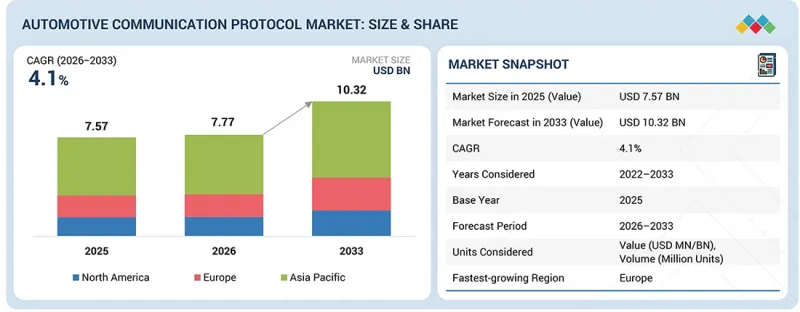
汽车通讯协定市场预计将从 2026 年的 77.7 亿美元成长到 2033 年的 103.2 亿美元,复合年增长率为 4.1%。
这种成长主要是由不断增长的车载资料交换需求驱动的,这是由于乘用车内部通讯密度更高造成的,因为多个网路节点、感测器和控制器在车身、底盘、资讯娱乐和动力传动系统领域同时进行互动。
| 调查范围 | |
|---|---|
| 调查期 | 2022-2033 |
| 基准年 | 2025 |
| 预测期 | 2026-2033 |
| 单元 | 数量(单位)和金额(美元) |
| 部分 | 通讯协定、应用、车辆类型、推进系统、区域 |
| 目标区域 | 亚太地区、欧洲、北美 |
为了应对日益增长的讯息流量,加快诊断速度,并允许未来在无需重复硬体重新设计的情况下扩展功能,原始设备製造商 (OEM) 正在投资建造高度扩充性的车载网路。更长的平台生命週期也是成长要素,跨多个车型代的稳定通讯协定部署维持了对通讯积体电路和软体堆迭的持续需求。
在预测期内,乙太网路有望成为成长最快的通讯协定。
车载乙太网路支援从 100 Mbps 到多Gigabit位元的高频宽资料传输。这对于现代内燃机汽车中的高解析度摄影机、雷达系统、车载资讯娱乐系统、中央网关、网域控制器、区域架构、高级驾驶辅助系统 (ADAS) 和高级自动化系统至关重要。基于摄影机和雷达的安全系统的激增产生了海量数据,远远超过了传统 CAN 总线的处理能力,从而加速了乙太网路作为骨干网路的普及。大众、宝马、梅赛德斯-奔驰、通用汽车和丰田等汽车製造商正在向基于域和区域的电子电气 (E/E) 架构迁移,其中以太网作为核心通信技术,支援与软体定义车辆 (SDV) 战略相一致的可扩展网路拓扑。此外,诸如时间可扩展网路 (TSN) 等确定性增强技术消除了延迟问题,使乙太网路适用于安全相关应用。随着每辆内燃机汽车的电子元件数量持续成长,汽车製造商正从分散式CAN网路转向以乙太网路为中心的网关架构,包括越来越多地采用Gigabit乙太网路来实现ADAS资料融合。同样,汽车通讯协定供应商也在透过整合乙太网路PHY、交换器、TSN功能和网路安全解决方案来丰富产品系列。
“我们预计北美市场在预测期内将呈现显着增长。”
美国是北美最大的乘用车市场,先进安全、动力传动系统和资讯娱乐网路节点的广泛应用推动了对CAN、CAN FD、LIN和汽车乙太网路的需求。儘管美国和加拿大车辆中ADAS和安全功能的普及促进了乙太网路的采用,但CAN和LIN在子系统层面仍然占据主导地位。两国的OEM厂商正加速向集中式和基于域的电子电气架构转型,导致网关复杂性和通讯协定密度增加。众多半导体供应商和一级汽车电子製造商的存在进一步推动了先进通讯标准的快速普及。北美拥有德州仪器公司、亚德诺半导体公司和微芯科技公司等领先的汽车通讯协定供应商。例如,在 2026 年 1 月,德州仪器在 CES 2026 上展示了其面向汽车应用的 10BASE-T1S PHY产品系列。这为感测器网路、基于区域的网路或边缘节点架构提供了多点和点对点 10 Mb/s 单对乙太网路连接。
本报告考察了全球汽车通讯协定市场,提供了市场概述、影响市场成长的各种因素分析、技术和专利趋势、法律制度、案例研究、历史和预测市场规模、按各个细分市场和地区/主要国家进行的详细分析、竞争格局以及主要企业的概况。
目录
第一章:引言
第二章执行摘要
第三章重要考察
第四章 市场概览
- 市场动态
- 促进因素
- 抑制因子
- 机器
- 任务
- 未满足的需求和閒置频段
- 与相关市场和不同产业相关的跨领域机会
- 一、二、三级企业的策略性倡议
第五章 产业趋势
- 总体经济指标
- GDP趋势与预测
- 全球乘用车市场趋势
- 联网汽车产业的全球趋势
- 影响客户业务的趋势/颠覆性因素
- 价格分析
- 生态系分析
- 供应链分析
- 案例研究分析
- 投资和资金筹措场景
- 贸易分析
- 2026-2027 年主要会议和活动
- 即将推出的汽车乙太网路标准及其应用案例
第六章 OEM 分析:製造、生产与电子/电气架构策略
- OEM製造地和生产能力
- 电子/电气架构演进策略
- 新一代OEM厂商
- 传统 OEM
- OEM厂商间合作与标准化现状
第七章:技术进步、人工智慧的影响、专利与创新
- 主要技术
- 车载乙太网路
- 车载SerDes/摄影机连接
- 软体定义网路
- 互补技术
- CAN FD 和 CAN XL
- 汽车网路安全
- 技术/产品蓝图
- 短期(2026-2027年):基础建设与初步商业化
- 中期计画(2028-2030年):扩张与标准化
- 长期(2031-2035年及以后):大规模商业化与颠覆性变革
- 专利分析
- 人工智慧/通用人工智慧的影响
- 技术分析和合作关係的见解
- BROADCOM
- TEXAS INSTRUMENTS INCORPORATED
- NXP SEMICONDUCTORS
- STMICROELECTRONICS
- INFINION TECHNOLOGIES AG
- RENESAS ELECTRONICS CORPORATION
- XILINX
- QUALCOMM TECHNOLOGIES, INC.
- NVIDIA CORPORATION
- ANALOG DEVICES INC.
- MICROCHIP TECHNOLOGY
- MARVELL TECHNOLOGY
- ROHM CO., LTD.
- MELEXIS
- VALENS SEMICONDUCTOR
- SONY GROUP CORPORATION
第八章:顾客趋势与购买行为
- 决策流程
- 采购过程中的关键相关利益者及其评估标准
- 实施障碍和内部挑战
第九章:监理情势与永续性倡议
- 当地法规和合规性
- 对永续性的承诺
第十章:OEM与一级供应商供应链策略的转型
- 关税和贸易争端概述
- 对全球汽车生产和本地化的影响
- OEM供应链、生产和在地化策略
- 一级供应商的供应链调整与在地化策略
- 欧洲-印度贸易协定的影响
第十一章 汽车通讯协定市场:依通讯协定类型划分
- LIN
- CAN
- FLEXRAY
- 乙太网路
- OEPNGMSL
- FPD LINK
- MIPI A-PHY
- GVIF
- HSMT
- A2B
- ASA-ML
- APIX
- MOST
- 关键见解
第十二章 汽车通讯协定市场:依车辆类型划分
- 经济
- 中型
- 奢华
- 关键见解
第十三章 汽车通讯协定市场:按应用领域划分
- 动力传动系统
- 使用者控制和舒适功能
- 资讯娱乐与通信
- 安全和ADAS
- 车载资讯系统
- 中央计算单元
- 音讯放大器
- 区域控制器
- 展示
- 关键见解
第十四章:汽车通讯协定市场:依推进系统划分
- ICE
- 电
- 关键见解
第十五章 汽车通讯协定市场:按地区划分
- 亚太地区
- 中国
- 印度
- 日本
- 韩国
- 其他的
- 欧洲
- 德国
- 法国
- 英国
- 西班牙
- 其他的
- 北美洲
- 我们
- 加拿大
第十六章 竞争格局
- 概述
- 主要参与企业的策略/优势
- 市占率分析
- 收入分析
- 企业估值和财务指标
- 品牌/产品对比
- 企业估值矩阵:主要企业
- 公司评估矩阵:Start-Ups/中小企业
- 竞争格局
第十七章:公司简介
- 主要企业
- NXP SEMICONDUCTORS
- ROBERT BOSCH GMBH
- INFINEON TECHNOLOGIES AG
- STMICROELECTRONICS
- TEXAS INSTRUMENTS INCORPORATED
- VECTOR INFORMATIK GMBH
- RENESAS ELECTRONICS CORPORATION
- MICROCHIP TECHNOLOGY INC.
- ELMOS SEMICONDUCTOR SE
- BROADCOM
- ANALOG DEVICES, INC.
- ALPS ALPINE CO., LTD.
- 主要区域控制器公司
- AUMOVIO SE
- VALEO
- APTIV
- SCHAEFFLER AG
- MARELLI HOLDINGS CO., LTD.
- 其他公司
- DSPACE
- EXCELFORE
- TE CONNECTIVITY
- TECHNICA ENGINEERING GMBH
- REALTEK SEMICONDUCTOR CORP
- KNOWLEDGE DEVELOPMENT FOR POF SL
- INTREPID CONTROL SYSTEMS
- VALENS SEMICONDUCTOR
- CADENCE DESIGN SYSTEMS, INC.
- SYNOPSYS, INC.
- NOVOSENSE
- ROHM CO., LTD.
- MELEXIS
第十八章:调查方法
第十九章附录
The automotive communication protocol market is expected to reach USD 10.32 billion by 2033, from USD 7.77 billion in 2026, with a CAGR of 4.1%. This growth is mainly driven by increasing in-vehicle data exchange requirements, which are shaped by greater communication density within passenger cars, as multiple network nodes, sensors, and controllers interact simultaneously across body, chassis, infotainment, and powertrain domains.
| Scope of the Report | |
|---|---|
| Years Considered for the Study | 2022-2033 |
| Base Year | 2025 |
| Forecast Period | 2026-2033 |
| Units Considered | Volume (Million Units) and Value (USD MN/BN) |
| Segments | Protocol, Application, Vehicle Class, Propulsion, and Region |
| Regions covered | Asia Pacific, Europe, and North America |
OEMs are investing in scalable in-vehicle networks to handle higher message traffic, enable faster diagnostics, and allow for future feature expansion without repeated hardware redesigns. The market is also driven by longer platform lifecycles, where stable protocol deployment across multiple model generations maintains recurring demand for communication ICs and software stacks.
Ethernet is expected to be the fastest-growing protocol during the forecast period.
Automotive Ethernet enables high-bandwidth data transmission from 100 Mbps to multi-gigabit speeds, which is increasingly required for high-resolution cameras, radar systems, in-vehicle infotainment, central gateways, domain controllers, zonal architectures, ADAS, and higher levels of automation in modern ICE vehicles. The growing use of camera- and radar-based safety systems generates large data volumes that exceed the capabilities of Classical CAN, accelerating the adoption of Ethernet as a backbone network. OEMs such as Volkswagen, BMW, Mercedes-Benz, General Motors, and Toyota are moving toward domain- and zonal-based E/E architectures, where Ethernet functions as the core communication technology and supports scalable network topologies aligned with software-defined vehicle strategies. Deterministic enhancements such as TSN address latency concerns, making Ethernet suitable for safety-related applications. As electronic content per ICE vehicle continues to increase, OEMs are shifting from distributed CAN networks to Ethernet-centric gateway architectures, including wider deployment of gigabit Ethernet for ADAS data fusion. Similarly, automotive communication protocol suppliers are diversifying their portfolios to include Ethernet PHYs, switches, TSN capabilities, and cybersecurity-ready solutions.
Mid-size passenger cars are expected to be the largest vehicle class during the forecast period.
Mid-size passenger cars account for the highest global production and sales volumes, particularly in North America, Europe, and parts of Asia, which drives demand for automotive communication protocols. This vehicle segment balances cost and feature content by integrating ADAS, infotainment, and connectivity solutions, resulting in higher network node counts per vehicle. Compared to entry-level vehicles, mid-size models adopt CAN FD and Ethernet-enabled gateways more rapidly to support enhanced safety, comfort, and data throughput requirements. LIN and CAN are universally used in mid-size vehicles for body electronics such as door modules, lighting, climate control, seat control, and core powertrain and chassis functions. Ethernet penetration is significant due to the need to handle high data volumes from cameras, radar, infotainment, and centralized gateways, while FlexRay remains present in legacy architectures because of its deterministic and fault-tolerant performance for safety-critical applications. OEMs often prioritize mid-size models for early technology deployment, making this segment the first ICE category to adopt upgraded network architectures.
"North America is expected to grow at a significant rate during the forecast period."
The US represents the largest passenger car market in North America, with extensive use of advanced safety, powertrain, and infotainment network nodes, which boosts demand for CAN, CAN FD, LIN, and automotive Ethernet. Widespread deployment of ADAS and safety features in vehicles across the US and Canada is driving increased Ethernet adoption, while CAN and LIN continue to dominate at the subsystem level. OEMs in both countries are accelerating the transition toward centralized and domain-based E/E architectures, leading to higher gateway complexity and greater protocol density. The significant presence of semiconductor suppliers and Tier-1 automotive electronics manufacturers further supports the rapid incorporation of advanced communication standards. North America is home to major automotive communication protocol providers such as TEXAS INSTRUMENTS INCORPORATED, Analog Devices, Inc., and Microchip Technology. For instance, in January 2026, TEXAS INSTRUMENTS showcased its automotive 10BASE-T1S PHY product portfolio at CES 2026, enabling multidrop and point-to-point 10 Mb/s single-pair Ethernet for sensor networks and zonal or edge-node architectures.
In-depth interviews were conducted with CEOs, marketing directors, other innovation and technology directors, and executives from various key organizations operating in this market.
- By Company Type: OEMs - 25%, Tier 1 - 60%, and Tier 2 - 15%
- By Designation: CXOs - 29%, Managers - 58%, and Executives - 13%
- By Region: North America - 29%, Europe - 23%, and Asia Pacific - 48%
The automotive communication protocol market is dominated by major players, such as NXP Semiconductors (Netherlands), Robert Bosch GmbH (Germany), Infineon Technologies AG (Germany), STMicroelectronics (Switzerland), and TEXAS INSTRUMENTS INCORPORATED (US).
Research Coverage:
This research report categorizes the automotive communication protocol market by vehicle class (economy, mid-size, luxury), protocol (LIN, CAN, FlexRay, Ethernet, others), application (powertrain, safety & ADAS, others), propulsion type (ICE, EV), and region. It covers the competitive landscape and profiles of the major players of the automotive communication protocol market. The study also includes an in-depth competitive analysis of the key market players, along with their company profiles, key observations related to product and business offerings, recent developments, and key market strategies.
Key Benefits of Buying the Report:
- The report will help market leaders/new entrants with information on the closest approximations of revenue numbers for the overall automotive communication protocol market and its subsegments.
- This report will help stakeholders understand the competitive landscape and gain more insights to position their businesses better and plan suitable go-to-market strategies.
- The report will also help stakeholders understand the market pulse and provide information on key market drivers, restraints, challenges, and opportunities.
The report provides insight into the following pointers:
- Analysis of key drivers (bandwidth escalation from ADAS sensor proliferation, growth of high-resolution displays and digital cockpit architectures, electrification and high-voltage powertrain communication complexity), restraints (legacy network entrenchment and backward compatibility constraints, functional safety certification burden), opportunities (multi-gigabit sensor connectivity for ADAS and autonomous architectures, in-vehicle high-bandwidth infotainment and display networking), and challenges (multi-protocol coexistence and network integration complexity, growing cybersecurity threats in modern vehicle networks)
- Product Development/Innovation: Detailed insights into upcoming technologies and R&D activities in the automotive communication protocol market
- Market Development: Comprehensive information about lucrative markets (the report analyzes the automotive communication protocol market across varied regions)
- Market Diversification: Exhaustive information about untapped geographies, recent developments, and investments in the automotive communication protocol market
- Competitive Assessment: In-depth assessment of market share, growth strategies, and product offerings of leading players such as NXP Semiconductors (Netherlands), Robert Bosch GmbH (Germany), Infineon Technologies AG (Germany), STMicroelectronics (Switzerland), and TEXAS INSTRUMENTS INCORPORATED (US) in the automotive communication protocol market
TABLE OF CONTENTS
1 INTRODUCTION
- 1.1 STUDY OBJECTIVES
- 1.2 MARKET DEFINITION
- 1.3 STUDY SCOPE
- 1.3.1 MARKET SEGMENTATION AND REGIONAL SCOPE
- 1.3.2 INCLUSIONS AND EXCLUSIONS
- 1.3.3 YEARS CONSIDERED
- 1.4 CURRENCY CONSIDERED
- 1.5 UNIT CONSIDERED
- 1.6 STAKEHOLDERS
- 1.7 SUMMARY OF CHANGES
2 EXECUTIVE SUMMARY
- 2.1 KEY INSIGHTS AND MARKET HIGHLIGHTS
- 2.2 KEY MARKET PARTICIPANTS: MAPPING OF STRATEGIC DEVELOPMENTS
- 2.3 DISRUPTIVE TRENDS SHAPING AUTOMOTIVE COMMUNICATION PROTOCOL MARKET
- 2.4 HIGH-GROWTH SEGMENTS
- 2.5 REGIONAL SNAPSHOT: MARKET SIZE, GROWTH RATE, AND FORECAST
3 PREMIUM INSIGHTS
- 3.1 ATTRACTIVE OPPORTUNITIES FOR PLAYERS IN AUTOMOTIVE COMMUNICATION PROTOCOL MARKET
- 3.2 AUTOMOTIVE COMMUNICATION PROTOCOL MARKET, BY REGION
- 3.3 AUTOMOTIVE COMMUNICATION PROTOCOL MARKET, BY PROTOCOL TYPE
- 3.4 AUTOMOTIVE COMMUNICATION PROTOCOL MARKET, BY APPLICATION
- 3.5 AUTOMOTIVE COMMUNICATION PROTOCOL MARKET, BY VEHICLE CLASS
- 3.6 AUTOMOTIVE COMMUNICATION PROTOCOL MARKET, BY PROPULSION
4 MARKET OVERVIEW
- 4.1 INTRODUCTION
- 4.2 MARKET DYNAMICS
- 4.2.1 DRIVERS
- 4.2.1.1 Increased bandwidth requirements due to ADAS sensor proliferation
- 4.2.1.2 Expansion of high-resolution displays and digital cockpit architectures
- 4.2.1.3 Need for advanced communication in high-voltage electrified powertrains
- 4.2.2 RESTRAINTS
- 4.2.2.1 Legacy network entrenchment and backward compatibility constraints
- 4.2.2.2 Functional safety certification burden
- 4.2.3 OPPORTUNITIES
- 4.2.3.1 Multi-gigabit sensor connectivity for ADAS and autonomous architectures
- 4.2.3.2 Rise of high-bandwidth in-vehicle infotainment networking
- 4.2.4 CHALLENGES
- 4.2.4.1 Multi-protocol coexistence and network integration complexity
- 4.2.4.2 Heightened cybersecurity threats in modern vehicle networks
- 4.2.1 DRIVERS
- 4.3 UNMET NEEDS AND WHITE SPACES
- 4.3.1 UNMET NEEDS IN AUTOMOTIVE COMMUNICATION PROTOCOL MARKET
- 4.3.2 WHITE SPACE OPPORTUNITIES
- 4.4 INTERCONNECTED MARKETS AND CROSS-SECTOR OPPORTUNITIES
- 4.4.1 INTERCONNECTED MARKETS
- 4.4.2 CROSS-SECTOR OPPORTUNITIES
- 4.5 STRATEGIC MOVES BY TIER 1/2/3 PLAYERS
5 INDUSTRY TRENDS
- 5.1 MACROECONOMIC INDICATORS
- 5.1.1 GDP TRENDS AND FORECAST
- 5.1.2 TRENDS IN GLOBAL PASSENGER CAR MARKET
- 5.1.3 TRENDS IN GLOBAL CONNECTED VEHICLE INDUSTRY
- 5.2 TRENDS/DISRUPTIONS IMPACTING CUSTOMER BUSINESS
- 5.3 PRICING ANALYSIS
- 5.3.1 AVERAGE SELLING PRICE TREND, BY PROTOCOL, 2024-2026
- 5.3.2 AVERAGE SELLING PRICE TREND OF PROTOCOL, BY REGION, 2024-2026
- 5.3.2.1 Average selling price trend of LIN, by region, 2024-2026
- 5.3.2.2 Average selling price trend of CAN, by region, 2024-2026
- 5.3.2.3 Average selling price trend of FlexRay, by region, 2024-2026
- 5.3.2.4 Average selling price trend of Ethernet, by region, 2024-2026
- 5.4 ECOSYSTEM ANALYSIS
- 5.5 SUPPLY CHAIN ANALYSIS
- 5.6 CASE STUDY ANALYSIS
- 5.6.1 ACCELERATING AUTOMOTIVE ETHERNET ADOPTION THROUGH END-TO-END VALIDATION STRATEGY
- 5.6.2 ENHANCING HIGH-SPEED AUTOMOTIVE ETHERNET VALIDATION FOR ADVANCED VEHICLE SYSTEMS
- 5.6.3 MODERNIZING SUPER CRUISE THROUGH AUTOMOTIVE ETHERNET INTEGRATION
- 5.7 INVESTMENT AND FUNDING SCENARIO
- 5.8 TRADE ANALYSIS
- 5.8.1 IMPORT SCENARIO (HS CODE 8542)
- 5.8.2 EXPORT SCENARIO (HS CODE 8542)
- 5.9 KEY CONFERENCES AND EVENTS, 2026-2027
- 5.10 UPCOMING AUTOMOTIVE ETHERNET STANDARDS AND THEIR USE CASES
- 5.10.1 TIMELINE OF IEEE AND OPEN ALLIANCE DEVELOPMENTS
- 5.10.2 TECHNICAL SPECIFICATIONS OF 10G+ AUTOMOTIVE ETHERNET
- 5.10.3 VEHICLE USE CASES
- 5.10.3.1 ADAS/Autonomous driving
- 5.10.3.2 Infotainment/Digital cockpit
- 5.10.3.3 Zonal/Electrical architecture
- 5.10.3.4 V2X and OTA
- 5.10.4 COPPER VS. FIBER FOR HIGH-SPEED LINKS
- 5.10.4.1 Copper
- 5.10.4.2 Fiber optics
6 OEM ANALYSIS - MANUFACTURING, PRODUCTION, AND E/E ARCHITECTURE STRATEGY
- 6.1 OEM MANUFACTURING FOOTPRINT AND PRODUCTION CAPACITY
- 6.2 E/E ARCHITECTURE EVOLUTION STRATEGY
- 6.2.1 NEW GENERATION OEMS
- 6.2.1.1 BYD
- 6.2.1.2 XPENG
- 6.2.1.3 NIO
- 6.2.1.4 Li Auto
- 6.2.1.5 Tesla
- 6.2.1.6 Rivian
- 6.2.1.7 Lucid Motors
- 6.2.1.8 Polestar
- 6.2.1.9 Leapmotor
- 6.2.1.10 Faraday Future
- 6.2.2 LEGACY OEMS
- 6.2.2.1 Toyota Motor Corporation
- 6.2.2.2 Volkswagen Group
- 6.2.2.3 Hyundai Motor Company
- 6.2.2.4 Honda Motor Co., Ltd.
- 6.2.2.5 Mahindra & Mahindra
- 6.2.2.6 Tata Motors
- 6.2.2.7 Audi AG
- 6.2.2.8 Mercedes-Benz AG
- 6.2.2.9 BMW Group
- 6.2.2.10 General Motors
- 6.2.3 OEM COLLABORATIONS AND STANDARDIZATION LANDSCAPE
- 6.2.1 NEW GENERATION OEMS
7 TECHNOLOGICAL ADVANCEMENTS, AI-DRIVEN IMPACT, PATENTS, AND INNOVATIONS
- 7.1 KEY TECHNOLOGIES
- 7.1.1 AUTOMOTIVE ETHERNET
- 7.1.2 AUTOMOTIVE SERDES/CAMERA CONNECTIVITY
- 7.1.3 SOFTWARE-DEFINED NETWORKING
- 7.2 COMPLEMENTARY TECHNOLOGIES
- 7.2.1 CAN FD AND CAN XL
- 7.2.2 IN-VEHICLE CYBERSECURITY
- 7.3 TECHNOLOGY/PRODUCT ROADMAP
- 7.3.1 SHORT-TERM (2026-2027): FOUNDATION AND EARLY COMMERCIALIZATION
- 7.3.2 MID-TERM (2028-2030): EXPANSION AND STANDARDIZATION
- 7.3.3 LONG-TERM (2031-2035+): MASS COMMERCIALIZATION AND DISRUPTION
- 7.4 PATENT ANALYSIS
- 7.5 IMPACT OF AI/GEN AI
- 7.5.1 TOP USE CASES AND MARKET POTENTIAL
- 7.5.1.1 Security and anomaly detection
- 7.5.1.2 Network design and optimization
- 7.5.1.3 Testing and virtualization
- 7.5.1.4 Data compression and semantic streaming
- 7.5.2 BEST PRACTICES FOLLOWED BY MANUFACTURERS
- 7.5.2.1 Model-based designs and standards compliance
- 7.5.2.2 Integrated development environments
- 7.5.2.3 Cybersecurity focus
- 7.5.2.4 Simulation and continuous testing
- 7.5.2.5 Zonal architectures and gateway designs
- 7.5.2.6 Data-driven calibration
- 7.5.3 CASE STUDIES RELATED TO AI IMPLEMENTATION
- 7.5.3.1 Transforming vehicle cybersecurity with edge-based intrusion detection
- 7.5.3.2 Accelerating automotive software validation with Gen AI
- 7.5.3.3 Enhancing in-vehicle voice interaction with GPT-powered assistants
- 7.5.4 INTERCONNECTED ECOSYSTEM AND IMPACT OF MARKET PLAYERS
- 7.5.4.1 Semiconductor
- 7.5.4.2 Telecom and cloud
- 7.5.4.3 IoT and V2X
- 7.5.4.4 Standards bodies and consortia
- 7.5.4.5 Software platforms
- 7.5.5 CLIENTS' READINESS TO ADOPT AI
- 7.5.1 TOP USE CASES AND MARKET POTENTIAL
- 7.6 INSIGHTS ON TECHNOLOGY ANALYSIS AND WHO WORKS WITH WHOM
- 7.6.1 BROADCOM
- 7.6.2 TEXAS INSTRUMENTS INCORPORATED
- 7.6.3 NXP SEMICONDUCTORS
- 7.6.4 STMICROELECTRONICS
- 7.6.5 INFINION TECHNOLOGIES AG
- 7.6.6 RENESAS ELECTRONICS CORPORATION
- 7.6.7 XILINX
- 7.6.8 QUALCOMM TECHNOLOGIES, INC.
- 7.6.9 NVIDIA CORPORATION
- 7.6.10 ANALOG DEVICES INC.
- 7.6.11 MICROCHIP TECHNOLOGY
- 7.6.12 MARVELL TECHNOLOGY
- 7.6.13 ROHM CO., LTD.
- 7.6.14 MELEXIS
- 7.6.15 VALENS SEMICONDUCTOR
- 7.6.16 SONY GROUP CORPORATION
8 CUSTOMER LANDSCAPE AND BUYER BEHAVIOR
- 8.1 DECISION-MAKING PROCESS
- 8.2 KEY STAKEHOLDERS IN BUYING PROCESS AND THEIR EVALUATION CRITERIA
- 8.2.1 KEY STAKEHOLDERS IN BUYING PROCESS
- 8.2.2 BUYING CRITERIA
- 8.3 ADOPTION BARRIERS AND INTERNAL CHALLENGES
9 REGULATORY LANDSCAPE AND SUSTAINABILITY INITIATIVES
- 9.1 REGIONAL REGULATIONS AND COMPLIANCE
- 9.1.1 REGULATORY BODIES, GOVERNMENT AGENCIES, AND OTHER ORGANIZATIONS
- 9.1.2 INDUSTRY STANDARDS
- 9.1.2.1 OpenGMSL (Open Gigabit Multimedia Serial Link)
- 9.1.2.2 FPD-Link (Flat Panel Display Link)
- 9.1.2.3 MIPI A-PHY (Automotive Physical Layer)
- 9.1.2.4 GVIF (Gigabit Video Interface)
- 9.1.2.5 HSMT (High-Speed Media Transmission)
- 9.1.2.6 A2B (Audio to Bus)
- 9.1.2.7 ASA-ML (Automotive SerDes Alliance - Motion Link)
- 9.1.2.8 CAN (Controller Area Network)
- 9.1.2.9 LIN (Local Interconnect Network)
- 9.1.2.10 FlexRay
- 9.1.2.11 Automotive Ethernet
- 9.1.2.12 APIX (Automotive Pixel Link)
- 9.1.2.13 MOST (Media Oriented Systems Transport)
- 9.2 SUSTAINABILITY INITIATIVES
- 9.2.1 CARBON IMPACT AND ECO-APPLICATIONS
- 9.2.2 SUSTAINABILITY IMPACT AND REGULATORY POLICY INITIATIVES
- 9.2.3 CERTIFICATIONS, LABELING, AND ECO-STANDARDS
10 OEM AND TIER-1 SUPPLY CHAIN STRATEGY SHIFT
- 10.1 OVERVIEW OF TARIFF AND TRADE CONFLICTS
- 10.1.1 US-CHINA
- 10.1.2 US-EU
- 10.1.3 EU-CHINA
- 10.1.4 INDIA-CHINA
- 10.2 IMPACT ON GLOBAL AUTOMOTIVE PRODUCTION AND LOCALIZATION
- 10.3 OEM SUPPLY CHAIN, PRODUCTION, AND LOCALIZATION STRATEGY
- 10.4 TIER-1 SUPPLIER SUPPLY CHAIN ADAPTATION AND LOCALIZATION STRATEGY
- 10.5 IMPACT OF EUROPE-INDIA TRADE DEALS
- 10.5.1 EU TARIFFS
- 10.5.2 IMPORTS TO INDIA
- 10.5.3 EXPORTS FROM INDIA
11 AUTOMOTIVE COMMUNICATION PROTOCOL MARKET, BY PROTOCOL TYPE
- 11.1 INTRODUCTION
- 11.2 LIN
- 11.2.1 DEMAND FOR LOW-COST BODY CONTROL APPLICATIONS IN VEHICLES TO DRIVE MARKET
- 11.3 CAN
- 11.3.1 RAPID INTEGRATION OF REAL-TIME POWERTRAIN, CHASSIS, AND SAFETY CONTROL SYSTEMS INTO VEHICLES TO DRIVE MARKET
- 11.4 FLEXRAY
- 11.4.1 ADVANCED POWERTRAIN APPLICATIONS IN LUXURY VEHICLES TO DRIVE MARKET
- 11.5 ETHERNET
- 11.5.1 SURGE IN DEMAND FOR HIGH-BANDWIDTH ADAS, INFOTAINMENT, AND ZONAL VEHICLE ARCHITECTURES TO DRIVE MARKET
- 11.6 OEPNGMSL
- 11.7 FPD LINK
- 11.8 MIPI A-PHY
- 11.9 GVIF
- 11.10 HSMT
- 11.11 A2B
- 11.12 ASA-ML
- 11.13 APIX
- 11.14 MOST
- 11.15 PRIMARY INSIGHTS
12 AUTOMOTIVE COMMUNICATION PROTOCOL MARKET, BY VEHICLE CLASS
- 12.1 INTRODUCTION
- 12.2 ECONOMY
- 12.2.1 INCORPORATION OF MANDATORY SAFETY SYSTEMS AND BASIC INFOTAINMENT TO DRIVE MARKET
- 12.3 MID-SIZE
- 12.3.1 INTRODUCTION OF NEW NETWORKING TECHNOLOGIES BY OEMS TO DRIVE MARKET
- 12.4 LUXURY
- 12.4.1 ADVANCED INFOTAINMENT SYSTEMS, LARGE DIGITAL COCKPITS, AND IMMERSIVE DISPLAYS REQUIREMENTS TO DRIVE MARKET
- 12.5 PRIMARY INSIGHTS
13 AUTOMOTIVE COMMUNICATION PROTOCOL MARKET, BY APPLICATION
- 13.1 INTRODUCTION
- 13.2 POWERTRAIN
- 13.2.1 INCREASING CONTROL COMPLEXITY AND REGULATORY PRESSURE TO DRIVE MARKET
- 13.3 BODY CONTROL & COMFORT
- 13.3.1 RISING FEATURE PENETRATION IN ECONOMY AND MID-SIZE VEHICLES TO DRIVE MARKET
- 13.4 INFOTAINMENT & COMMUNICATION
- 13.4.1 EXPANDING DIGITAL COCKPIT SYSTEMS AND CONNECTED VEHICLE SERVICES TO DRIVE MARKET
- 13.5 SAFETY & ADAS
- 13.5.1 RISING INTEGRATION OF LEVEL 2 AND LEVEL 2+ ADAS FEATURES IN MID-SIZE VEHICLES TO DRIVE MARKET
- 13.6 TELEMATICS
- 13.6.1 REGULATORY REQUIREMENTS FOR EMERGENCY CALL SYSTEMS TO DRIVE MARKET
- 13.7 CENTRAL COMPUTING UNITS
- 13.8 AUDIO AMPLIFIERS
- 13.9 ZONAL CONTROLLERS
- 13.10 DISPLAYS
- 13.11 PRIMARY INSIGHTS
14 AUTOMOTIVE COMMUNICATION PROTOCOL MARKET, BY PROPULSION
- 14.1 INTRODUCTION
- 14.2 ICE
- 14.2.1 HEIGHTENED DEMAND FOR ADVANCED POWERTRAIN SOLUTIONS TO DRIVE MARKET
- 14.3 ELECTRIC
- 14.3.1 SHIFT FROM DISTRIBUTED ECUS TO CENTRALIZED AND ZONAL ARCHITECTURES TO DRIVE MARKET
- 14.4 PRIMARY INSIGHTS
15 AUTOMOTIVE COMMUNICATION PROTOCOL MARKET, BY REGION
- 15.1 INTRODUCTION
- 15.2 ASIA PACIFIC
- 15.2.1 CHINA
- 15.2.1.1 Level 2 ADAS and advanced emission control system mandates to drive market
- 15.2.2 INDIA
- 15.2.2.1 Mandatory safety requirements like dual airbags and electronic stability control to drive market
- 15.2.3 JAPAN
- 15.2.3.1 High integration of advanced powertrain control systems to drive market
- 15.2.4 SOUTH KOREA
- 15.2.4.1 Tighter emission regulations to drive market
- 15.2.5 REST OF ASIA PACIFIC
- 15.2.1 CHINA
- 15.3 EUROPE
- 15.3.1 GERMANY
- 15.3.1.1 High ECU density in mid-size and luxury ICE vehicles to drive market
- 15.3.2 FRANCE
- 15.3.2.1 ADAS integration into mainstream ICE hatchbacks and crossovers to drive market
- 15.3.3 UK
- 15.3.3.1 High penetration of ADAS, digital instrument clusters, and connected infotainment to drive market
- 15.3.4 SPAIN
- 15.3.4.1 Strong base of compact and mid-size vehicle manufacturing to drive market
- 15.3.5 REST OF EUROPE
- 15.3.1 GERMANY
- 15.4 NORTH AMERICA
- 15.4.1 US
- 15.4.1.1 Early software-defined architecture adoption and connected vehicle integration to drive market
- 15.4.2 CANADA
- 15.4.2.1 Advanced safety integration in mainstream ICE sedans and compact SUVs to drive market
- 15.4.1 US
16 COMPETITIVE LANDSCAPE
- 16.1 OVERVIEW
- 16.2 KEY PLAYER STRATEGIES/RIGHT TO WIN, 2022-2026
- 16.3 MARKET SHARE ANALYSIS, 2025
- 16.4 REVENUE ANALYSIS, 2021-2025
- 16.5 COMPANY VALUATION AND FINANCIAL METRICS
- 16.6 BRAND/PRODUCT COMPARISON
- 16.7 COMPANY EVALUATION MATRIX: KEY PLAYERS, 2025
- 16.7.1 STARS
- 16.7.2 EMERGING LEADERS
- 16.7.3 PERVASIVE PLAYERS
- 16.7.4 PARTICIPANTS
- 16.7.5 COMPANY FOOTPRINT
- 16.7.5.1 Company footprint
- 16.7.5.2 Region footprint
- 16.7.5.3 Protocol type footprint
- 16.7.5.4 Application footprint
- 16.7.5.5 Vehicle class footprint
- 16.8 COMPANY EVALUATION MATRIX: START-UPS/SMES, 2025
- 16.8.1 PROGRESSIVE COMPANIES
- 16.8.2 RESPONSIVE COMPANIES
- 16.8.3 DYNAMIC COMPANIES
- 16.8.4 STARTING BLOCKS
- 16.8.5 COMPETITIVE BENCHMARKING
- 16.8.5.1 List of start-ups/SMEs
- 16.8.5.2 Competitive benchmarking of start-ups/SMEs
- 16.9 COMPETITIVE SCENARIO
- 16.9.1 PRODUCT LAUNCHES/DEVELOPMENTS
- 16.9.2 DEALS
- 16.9.3 OTHER DEVELOPMENTS
17 COMPANY PROFILES
- 17.1 KEY PLAYERS
- 17.1.1 NXP SEMICONDUCTORS
- 17.1.1.1 Business overview
- 17.1.1.2 Products offered
- 17.1.1.3 Recent developments
- 17.1.1.3.1 Product launches/developments
- 17.1.1.3.2 Deals
- 17.1.1.4 MnM view
- 17.1.1.4.1 Key strengths
- 17.1.1.4.2 Strategic choices
- 17.1.1.4.3 Weaknesses and competitive threats
- 17.1.2 ROBERT BOSCH GMBH
- 17.1.2.1 Business overview
- 17.1.2.2 Products offered
- 17.1.2.3 Recent developments
- 17.1.2.3.1 Product launches/developments
- 17.1.2.3.2 Other developments
- 17.1.2.4 MnM view
- 17.1.2.4.1 Key strengths
- 17.1.2.4.2 Strategic choices
- 17.1.2.4.3 Weaknesses and competitive threats
- 17.1.3 INFINEON TECHNOLOGIES AG
- 17.1.3.1 Business overview
- 17.1.3.2 Products offered
- 17.1.3.3 Recent developments
- 17.1.3.3.1 Deals
- 17.1.3.4 MnM view
- 17.1.3.4.1 Key strengths
- 17.1.3.4.2 Strategic choices
- 17.1.3.4.3 Weaknesses and competitive threats
- 17.1.4 STMICROELECTRONICS
- 17.1.4.1 Business overview
- 17.1.4.2 Products offered
- 17.1.4.3 MnM view
- 17.1.4.3.1 Key strengths
- 17.1.4.3.2 Strategic choices
- 17.1.4.3.3 Weaknesses and competitive threats
- 17.1.5 TEXAS INSTRUMENTS INCORPORATED
- 17.1.5.1 Business overview
- 17.1.5.2 Products offered
- 17.1.5.3 Recent developments
- 17.1.5.3.1 Other developments
- 17.1.5.4 MnM view
- 17.1.5.4.1 Key strengths
- 17.1.5.4.2 Strategic choices
- 17.1.5.4.3 Weaknesses and competitive threats
- 17.1.6 VECTOR INFORMATIK GMBH
- 17.1.6.1 Business overview
- 17.1.6.2 Products offered
- 17.1.6.3 Recent developments
- 17.1.6.3.1 Product launches/developments
- 17.1.6.3.2 Deals
- 17.1.7 RENESAS ELECTRONICS CORPORATION
- 17.1.7.1 Business overview
- 17.1.7.2 Products offered
- 17.1.8 MICROCHIP TECHNOLOGY INC.
- 17.1.8.1 Business overview
- 17.1.8.2 Products offered
- 17.1.8.3 Recent developments
- 17.1.8.3.1 Deals
- 17.1.9 ELMOS SEMICONDUCTOR SE
- 17.1.9.1 Business overview
- 17.1.9.2 Products offered
- 17.1.9.3 Recent developments
- 17.1.9.3.1 Other developments
- 17.1.10 BROADCOM
- 17.1.10.1 Business overview
- 17.1.10.2 Products offered
- 17.1.11 ANALOG DEVICES, INC.
- 17.1.11.1 Business overview
- 17.1.11.2 Products offered
- 17.1.11.3 Recent developments
- 17.1.11.3.1 Deals
- 17.1.12 ALPS ALPINE CO., LTD.
- 17.1.12.1 Business overview
- 17.1.12.2 Products offered
- 17.1.12.3 Recent developments
- 17.1.12.3.1 Deals
- 17.1.1 NXP SEMICONDUCTORS
- 17.2 KEY ZONE CONTROLLER PLAYERS
- 17.2.1 AUMOVIO SE
- 17.2.1.1 Business overview
- 17.2.1.2 Products offered
- 17.2.1.3 Recent developments
- 17.2.1.3.1 Product launches/developments
- 17.2.1.3.2 Deals
- 17.2.1.3.3 Expansions
- 17.2.1.3.4 Other developments
- 17.2.2 VALEO
- 17.2.2.1 Business overview
- 17.2.2.2 Products offered
- 17.2.2.3 Recent developments
- 17.2.2.3.1 Deals
- 17.2.2.3.2 Other developments
- 17.2.3 APTIV
- 17.2.3.1 Business overview
- 17.2.3.2 Products offered
- 17.2.3.3 Recent developments
- 17.2.3.3.1 Deals
- 17.2.3.3.2 Other developments
- 17.2.4 SCHAEFFLER AG
- 17.2.4.1 Business overview
- 17.2.4.2 Products offered
- 17.2.4.3 Recent developments
- 17.2.4.3.1 Deals
- 17.2.4.3.2 Other developments
- 17.2.5 MARELLI HOLDINGS CO., LTD.
- 17.2.5.1 Business overview
- 17.2.5.2 Products offered
- 17.2.5.3 Recent developments
- 17.2.5.3.1 Product launches/developments
- 17.2.5.3.2 Deals
- 17.2.5.3.3 Other developments
- 17.2.1 AUMOVIO SE
- 17.3 OTHER PLAYERS
- 17.3.1 DSPACE
- 17.3.2 EXCELFORE
- 17.3.3 TE CONNECTIVITY
- 17.3.4 TECHNICA ENGINEERING GMBH
- 17.3.5 REALTEK SEMICONDUCTOR CORP
- 17.3.6 KNOWLEDGE DEVELOPMENT FOR POF S.L.
- 17.3.7 INTREPID CONTROL SYSTEMS
- 17.3.8 VALENS SEMICONDUCTOR
- 17.3.9 CADENCE DESIGN SYSTEMS, INC.
- 17.3.10 SYNOPSYS, INC.
- 17.3.11 NOVOSENSE
- 17.3.12 ROHM CO., LTD.
- 17.3.13 MELEXIS
18 RESEARCH METHODOLOGY
- 18.1 RESEARCH DATA
- 18.1.1 SECONDARY DATA
- 18.1.1.1 List of secondary sources
- 18.1.1.2 Key data from secondary sources
- 18.1.2 PRIMARY DATA
- 18.1.2.1 Primary interviewees from demand and supply sides
- 18.1.2.2 Breakdown of primary interviews
- 18.1.2.3 List of primary interview participants
- 18.1.1 SECONDARY DATA
- 18.2 MARKET SIZE ESTIMATION
- 18.2.1 BOTTOM-UP APPROACH
- 18.2.2 TOP-DOWN APPROACH
- 18.3 DATA TRIANGULATION
- 18.4 FACTOR ANALYSIS
- 18.5 RESEARCH ASSUMPTIONS
- 18.6 RESEARCH LIMITATIONS
- 18.7 RISK ASSESSMENT
19 APPENDIX
- 19.1 DISCUSSION GUIDE
- 19.2 KNOWLEDGESTORE: MARKETSANDMARKETS' SUBSCRIPTION PORTAL
- 19.3 CUSTOMIZATION OPTIONS
- 19.3.1 AUTOMOTIVE COMMUNICATION PROTOCOL MARKET, BY APPLICATION, AT COUNTRY LEVEL
- 19.3.2 AUTOMOTIVE COMMUNICATION PROTOCOL MARKET, BY PROTOCOL, AT COUNTRY LEVEL
- 19.3.3 COMPANY INFORMATION
- 19.3.3.1 Profiling of additional market players (up to five)
- 19.4 RELATED REPORTS
- 19.5 AUTHOR DETAILS
List of Tables
- TABLE 1 MARKET DEFINITION, BY PROTOCOL TYPE
- TABLE 2 MARKET DEFINITION, BY APPLICATION
- TABLE 3 MARKET DEFINITION, BY VEHICLE CLASS
- TABLE 4 MARKET DEFINITION, BY PROPULSION
- TABLE 5 USD EXCHANGE RATES, 2021-2025
- TABLE 6 DATA GENERATED IN ZONAL ARCHITECTURES
- TABLE 7 IMPACT OF MARKET DYNAMICS
- TABLE 8 STRATEGIC MOVES BY TIER-1/2/3 PLAYERS
- TABLE 9 GDP PERCENTAGE CHANGE, BY COUNTRY, 2021-2030
- TABLE 10 AVERAGE SELLING PRICE TREND, BY PROTOCOL, 2024-2026 (USD/UNIT)
- TABLE 11 AVERAGE SELLING PRICE TREND OF LIN, BY REGION, 2024-2026 (USD/UNIT)
- TABLE 12 AVERAGE SELLING PRICE TREND OF CAN, BY REGION, 2024-2026 (USD/UNIT)
- TABLE 13 AVERAGE SELLING PRICE TREND OF FLEXRAY, BY REGION, 2024-2026 (USD/UNIT)
- TABLE 14 AVERAGE SELLING PRICE TREND OF ETHERNET, BY REGION, 2024-2026 (USD/UNIT)
- TABLE 15 ROLE OF COMPANIES IN ECOSYSTEM
- TABLE 16 IMPORT DATA FOR HS CODE 8542-COMPLIANT PRODUCTS, BY COUNTRY, 2021-2024 (USD BILLION)
- TABLE 17 EXPORT DATA FOR HS CODE 8542-COMPLIANT PRODUCTS, BY COUNTRY, 2021-2024 (USD BILLION)
- TABLE 18 KEY CONFERENCES AND EVENTS, 2026-2027
- TABLE 19 TECHNICAL SPECIFICATIONS OF 10G+ AUTOMOTIVE ETHERNET
- TABLE 20 FINAL ASSEMBLY PLANTS AND THEIR ANNUAL CAPACITY
- TABLE 21 NEW GENERATION OEMS' E/E ARCHITECTURE EVOLUTION ROADMAP
- TABLE 22 BYD: E/E ARCHITECTURE AND PLATFORM OVERVIEW
- TABLE 23 XPENG: E/E ARCHITECTURE AND PLATFORM OVERVIEW
- TABLE 24 NIO: E/E ARCHITECTURE AND PLATFORM OVERVIEW
- TABLE 25 LI AUTO: E/E ARCHITECTURE AND PLATFORM OVERVIEW
- TABLE 26 TESLA: E/E ARCHITECTURE AND PLATFORM OVERVIEW
- TABLE 27 RIVIAN: E/E ARCHITECTURE AND PLATFORM OVERVIEW
- TABLE 28 LUCID MOTORS: E/E ARCHITECTURE AND PLATFORM OVERVIEW
- TABLE 29 POLESTAR: E/E ARCHITECTURE AND PLATFORM OVERVIEW
- TABLE 30 LEAPMOTOR: E/E ARCHITECTURE AND PLATFORM OVERVIEW
- TABLE 31 FARADAY FUTURE: E/E ARCHITECTURE AND PLATFORM OVERVIEW
- TABLE 32 LEGACY OEMS' E/E ARCHITECTURE EVOLUTION ROADMAP
- TABLE 33 OEM COLLABORATIONS AND STANDARDIZATION LANDSCAPE IN E/E ARCHITECTURES
- TABLE 34 CAN BUS CHARACTERISTICS
- TABLE 35 PATENT ANALYSIS
- TABLE 36 TECHNOLOGY LANDSCAPE AND OEM PARTNERSHIPS
- TABLE 37 INFLUENCE OF STAKEHOLDERS ON BUYING PROCESS, BY VEHICLE CLASS (%)
- TABLE 38 KEY BUYING CRITERIA, BY VEHICLE CLASS
- TABLE 39 NORTH AMERICA: REGULATORY BODIES, GOVERNMENT AGENCIES, AND OTHER ORGANIZATIONS
- TABLE 40 EUROPE: REGULATORY BODIES, GOVERNMENT AGENCIES, AND OTHER ORGANIZATIONS
- TABLE 41 ASIA PACIFIC: REGULATORY BODIES, GOVERNMENT AGENCIES, AND OTHER ORGANIZATIONS
- TABLE 42 REGULATORY COMPLIANCE FRAMEWORK FOR AUTOMOTIVE COMMUNICATION PROTOCOLS
- TABLE 43 GLOBAL AUTOMOTIVE TRADE POLICY AND TARIFF LANDSCAPE, 2024-2026
- TABLE 44 OEM SUPPLY CHAIN, PRODUCTION, AND LOCALIZATION STRATEGY
- TABLE 45 TIER-1 SUPPLIER SUPPLY CHAIN ADAPTATION AND LOCALIZATION STRATEGY
- TABLE 46 IMPORT TARIFFS ON AUTOMOTIVE COMMUNICATION COMPONENTS IN INDIA
- TABLE 47 IMPACT OF TRADE LIBERALIZATION ON AUTOMOTIVE COMMUNICATION COMPONENT IMPORTS TO INDIA
- TABLE 48 IMPACT OF TRADE LIBERALIZATION ON AUTOMOTIVE COMMUNICATION COMPONENT EXPORTS FROM INDIA
- TABLE 49 AUTOMOTIVE COMMUNICATION PROTOCOL MARKET, BY PROTOCOL TYPE, 2022-2025 (MILLION UNITS)
- TABLE 50 AUTOMOTIVE COMMUNICATION PROTOCOL MARKET, BY PROTOCOL TYPE, 2026-2033 (MILLION UNITS)
- TABLE 51 AUTOMOTIVE COMMUNICATION PROTOCOL MARKET, BY PROTOCOL TYPE, 2022-2025 (USD MILLION)
- TABLE 52 AUTOMOTIVE COMMUNICATION PROTOCOL MARKET, BY PROTOCOL TYPE, 2026-2033 (USD MILLION)
- TABLE 53 LIN: AUTOMOTIVE COMMUNICATION PROTOCOL MARKET, BY REGION, 2022-2025 (MILLION UNITS)
- TABLE 54 LIN: AUTOMOTIVE COMMUNICATION PROTOCOL MARKET, BY REGION, 2026-2033 (MILLION UNITS)
- TABLE 55 LIN: AUTOMOTIVE COMMUNICATION PROTOCOL MARKET, BY REGION, 2022-2025 (USD MILLION)
- TABLE 56 LIN: AUTOMOTIVE COMMUNICATION PROTOCOL MARKET, BY REGION, 2026-2033 (USD MILLION)
- TABLE 57 CAN: AUTOMOTIVE COMMUNICATION PROTOCOL MARKET, BY REGION, 2022-2025 (MILLION UNITS)
- TABLE 58 CAN: AUTOMOTIVE COMMUNICATION PROTOCOL MARKET, BY REGION, 2026-2033 (MILLION UNITS)
- TABLE 59 CAN: AUTOMOTIVE COMMUNICATION PROTOCOL MARKET, BY REGION, 2022-2025 (USD MILLION)
- TABLE 60 CAN: AUTOMOTIVE COMMUNICATION PROTOCOL MARKET, BY REGION, 2026-2033 (USD MILLION)
- TABLE 61 FLEXRAY: AUTOMOTIVE COMMUNICATION PROTOCOL MARKET, BY REGION, 2022-2025 (MILLION UNITS)
- TABLE 62 FLEXRAY: AUTOMOTIVE COMMUNICATION PROTOCOL MARKET, BY REGION, 2026-2033 (MILLION UNITS)
- TABLE 63 FLEXRAY: AUTOMOTIVE COMMUNICATION PROTOCOL MARKET, BY REGION, 2022-2025 (USD MILLION)
- TABLE 64 FLEXRAY: AUTOMOTIVE COMMUNICATION PROTOCOL MARKET, BY REGION, 2026-2033 (USD MILLION)
- TABLE 65 ETHERNET: AUTOMOTIVE COMMUNICATION PROTOCOL MARKET, BY REGION, 2022-2025 (MILLION UNITS)
- TABLE 66 ETHERNET: AUTOMOTIVE COMMUNICATION PROTOCOL MARKET, BY REGION, 2026-2033 (MILLION UNITS)
- TABLE 67 ETHERNET: AUTOMOTIVE COMMUNICATION PROTOCOL MARKET, BY REGION, 2022-2025 (USD MILLION)
- TABLE 68 ETHERNET: AUTOMOTIVE COMMUNICATION PROTOCOL MARKET, BY REGION, 2026-2033 (USD MILLION)
- TABLE 69 AUTOMOTIVE COMMUNICATION PROTOCOL MARKET, BY VEHICLE CLASS, 2022-2025 (MILLION UNITS)
- TABLE 70 AUTOMOTIVE COMMUNICATION PROTOCOL MARKET, BY VEHICLE CLASS, 2026-2033 (MILLION UNITS)
- TABLE 71 AUTOMOTIVE COMMUNICATION PROTOCOL MARKET, BY VEHICLE CLASS, 2022-2025 (USD MILLION)
- TABLE 72 AUTOMOTIVE COMMUNICATION PROTOCOL MARKET, BY VEHICLE CLASS, 2026-2033 (USD MILLION)
- TABLE 73 ECONOMY: AUTOMOTIVE COMMUNICATION PROTOCOL MARKET, BY REGION, 2022-2025 (MILLION UNITS)
- TABLE 74 ECONOMY: AUTOMOTIVE COMMUNICATION PROTOCOL MARKET, BY REGION, 2026-2033 (MILLION UNITS)
- TABLE 75 ECONOMY: AUTOMOTIVE COMMUNICATION PROTOCOL MARKET, BY REGION, 2022-2025 (USD MILLION)
- TABLE 76 ECONOMY: AUTOMOTIVE COMMUNICATION PROTOCOL MARKET, BY REGION, 2026-2033 (USD MILLION)
- TABLE 77 MID-SIZE: AUTOMOTIVE COMMUNICATION PROTOCOL MARKET, BY REGION, 2022-2025 (MILLION UNITS)
- TABLE 78 MID-SIZE: AUTOMOTIVE COMMUNICATION PROTOCOL MARKET, BY REGION, 2026-2033 (MILLION UNITS)
- TABLE 79 MID-SIZE: AUTOMOTIVE COMMUNICATION PROTOCOL MARKET, BY REGION, 2022-2025 (USD MILLION)
- TABLE 80 MID-SIZE: AUTOMOTIVE COMMUNICATION PROTOCOL MARKET, BY REGION, 2026-2033 (USD MILLION)
- TABLE 81 LUXURY: AUTOMOTIVE COMMUNICATION PROTOCOL MARKET, BY REGION, 2022-2025 (MILLION UNITS)
- TABLE 82 LUXURY: AUTOMOTIVE COMMUNICATION PROTOCOL MARKET, BY REGION, 2026-2033 (MILLION UNITS)
- TABLE 83 LUXURY: AUTOMOTIVE COMMUNICATION PROTOCOL MARKET, BY REGION, 2022-2025 (USD MILLION)
- TABLE 84 LUXURY: AUTOMOTIVE COMMUNICATION PROTOCOL MARKET, BY REGION, 2026-2033 (USD MILLION)
- TABLE 85 AUTOMOTIVE COMMUNICATION PROTOCOL MARKET, BY APPLICATION, 2022-2025 (MILLION UNITS)
- TABLE 86 AUTOMOTIVE COMMUNICATION PROTOCOL MARKET, BY APPLICATION, 2026-2033 (MILLION UNITS)
- TABLE 87 AUTOMOTIVE COMMUNICATION PROTOCOL MARKET, BY APPLICATION, 2022-2025 (USD MILLION)
- TABLE 88 AUTOMOTIVE COMMUNICATION PROTOCOL MARKET, BY APPLICATION, 2026-2033 (USD MILLION)
- TABLE 89 POWERTRAIN: AUTOMOTIVE COMMUNICATION PROTOCOL MARKET, BY REGION, 2022-2025 (MILLION UNITS)
- TABLE 90 POWERTRAIN: AUTOMOTIVE COMMUNICATION PROTOCOL MARKET, BY REGION, 2026-2033 (MILLION UNITS)
- TABLE 91 POWERTRAIN: AUTOMOTIVE COMMUNICATION PROTOCOL MARKET, BY REGION, 2022-2025 (USD MILLION)
- TABLE 92 POWERTRAIN: AUTOMOTIVE COMMUNICATION PROTOCOL MARKET, BY REGION, 2026-2033 (USD MILLION)
- TABLE 93 BODY CONTROL & COMFORT: AUTOMOTIVE COMMUNICATION PROTOCOL MARKET, BY REGION, 2022-2025 (MILLION UNITS)
- TABLE 94 BODY CONTROL & COMFORT: AUTOMOTIVE COMMUNICATION PROTOCOL MARKET, BY REGION, 2026-2033 (MILLION UNITS)
- TABLE 95 BODY CONTROL & COMFORT: AUTOMOTIVE COMMUNICATION PROTOCOL MARKET, BY REGION, 2022-2025 (USD MILLION)
- TABLE 96 BODY CONTROL & COMFORT: AUTOMOTIVE COMMUNICATION PROTOCOL MARKET, BY REGION, 2026-2033 (USD MILLION)
- TABLE 97 INFOTAINMENT & COMMUNICATION: AUTOMOTIVE COMMUNICATION PROTOCOL MARKET, BY REGION, 2022-2025 (MILLION UNITS)
- TABLE 98 INFOTAINMENT & COMMUNICATION: AUTOMOTIVE COMMUNICATION PROTOCOL MARKET, BY REGION, 2026-2033 (MILLION UNITS)
- TABLE 99 INFOTAINMENT & COMMUNICATION: AUTOMOTIVE COMMUNICATION PROTOCOL MARKET, BY REGION, 2022-2025 (USD MILLION)
- TABLE 100 INFOTAINMENT & COMMUNICATION: AUTOMOTIVE COMMUNICATION PROTOCOL MARKET, BY REGION, 2026-2033 (USD MILLION)
- TABLE 101 SAFETY & ADAS: AUTOMOTIVE COMMUNICATION PROTOCOL MARKET, BY REGION, 2022-2025 (MILLION UNITS)
- TABLE 102 SAFETY & ADAS: AUTOMOTIVE COMMUNICATION PROTOCOL MARKET, BY REGION, 2026-2033 (MILLION UNITS)
- TABLE 103 SAFETY & ADAS: AUTOMOTIVE COMMUNICATION PROTOCOL MARKET, BY REGION, 2022-2025 (USD MILLION)
- TABLE 104 SAFETY & ADAS: AUTOMOTIVE COMMUNICATION PROTOCOL MARKET, BY REGION, 2026-2033 (USD MILLION)
- TABLE 105 TELEMATICS: AUTOMOTIVE COMMUNICATION PROTOCOL MARKET, BY REGION, 2022-2025 (MILLION UNITS)
- TABLE 106 TELEMATICS: AUTOMOTIVE COMMUNICATION PROTOCOL MARKET, BY REGION, 2026-2033 (MILLION UNITS)
- TABLE 107 TELEMATICS: AUTOMOTIVE COMMUNICATION PROTOCOL MARKET, BY REGION, 2022-2025 (USD MILLION)
- TABLE 108 TELEMATICS: AUTOMOTIVE COMMUNICATION PROTOCOL MARKET, BY REGION, 2026-2033 (USD MILLION)
- TABLE 109 AUTOMOTIVE COMMUNICATION PROTOCOL MARKET, BY PROPULSION, 2022-2025 (MILLION UNITS)
- TABLE 110 AUTOMOTIVE COMMUNICATION PROTOCOL MARKET, BY PROPULSION, 2026-2033 (MILLION UNITS)
- TABLE 111 AUTOMOTIVE COMMUNICATION PROTOCOL MARKET, BY PROPULSION, 2022-2025 (USD MILLION)
- TABLE 112 AUTOMOTIVE COMMUNICATION PROTOCOL MARKET, BY PROPULSION, 2026-2033 (USD MILLION)
- TABLE 113 ICE: AUTOMOTIVE COMMUNICATION PROTOCOL MARKET, BY REGION, 2022-2025 (MILLION UNITS)
- TABLE 114 ICE: AUTOMOTIVE COMMUNICATION PROTOCOL MARKET, BY REGION, 2026-2033 (MILLION UNITS)
- TABLE 115 ICE: AUTOMOTIVE COMMUNICATION PROTOCOL MARKET, BY REGION, 2022-2025 (USD MILLION)
- TABLE 116 ICE: AUTOMOTIVE COMMUNICATION PROTOCOL MARKET, BY REGION, 2026-2033 (USD MILLION)
- TABLE 117 ELECTRIC: AUTOMOTIVE COMMUNICATION PROTOCOL MARKET, BY REGION, 2022-2025 (MILLION UNITS)
- TABLE 118 ELECTRIC: AUTOMOTIVE COMMUNICATION PROTOCOL MARKET, BY REGION, 2026-2033 (MILLION UNITS)
- TABLE 119 ELECTRIC: AUTOMOTIVE COMMUNICATION PROTOCOL MARKET, BY REGION, 2022-2025 (USD MILLION)
- TABLE 120 ELECTRIC: AUTOMOTIVE COMMUNICATION PROTOCOL MARKET, BY REGION, 2026-2033 (USD MILLION)
- TABLE 121 AUTOMOTIVE COMMUNICATION PROTOCOL MARKET, BY REGION, 2022-2025 (MILLION UNITS)
- TABLE 122 AUTOMOTIVE COMMUNICATION PROTOCOL MARKET, BY REGION, 2026-2033 (MILLION UNITS)
- TABLE 123 AUTOMOTIVE COMMUNICATION PROTOCOL MARKET, BY REGION, 2022-2025 (USD MILLION)
- TABLE 124 AUTOMOTIVE COMMUNICATION PROTOCOL MARKET, BY REGION, 2026-2033 (USD MILLION)
- TABLE 125 ASIA PACIFIC: AUTOMOTIVE COMMUNICATION PROTOCOL MARKET, BY COUNTRY, 2022-2025 (MILLION UNITS)
- TABLE 126 ASIA PACIFIC: AUTOMOTIVE COMMUNICATION PROTOCOL MARKET, BY COUNTRY, 2026-2033 (MILLION UNITS)
- TABLE 127 ASIA PACIFIC: AUTOMOTIVE COMMUNICATION PROTOCOL MARKET, BY COUNTRY, 2022-2025 (USD MILLION)
- TABLE 128 ASIA PACIFIC: AUTOMOTIVE COMMUNICATION PROTOCOL MARKET, BY COUNTRY, 2026-2033 (USD MILLION)
- TABLE 129 CHINA: AUTOMOTIVE COMMUNICATION PROTOCOL MARKET, BY VEHICLE CLASS, 2022-2025 (MILLION UNITS)
- TABLE 130 CHINA: AUTOMOTIVE COMMUNICATION PROTOCOL MARKET, BY VEHICLE CLASS, 2026-2033 (MILLION UNITS)
- TABLE 131 CHINA: AUTOMOTIVE COMMUNICATION PROTOCOL MARKET, BY VEHICLE CLASS, 2022-2025 (USD MILLION)
- TABLE 132 CHINA: AUTOMOTIVE COMMUNICATION PROTOCOL MARKET, BY VEHICLE CLASS, 2026-2033 (USD MILLION)
- TABLE 133 INDIA: AUTOMOTIVE COMMUNICATION PROTOCOL MARKET, BY VEHICLE CLASS, 2022-2025 (MILLION UNITS)
- TABLE 134 INDIA: AUTOMOTIVE COMMUNICATION PROTOCOL MARKET, BY VEHICLE CLASS, 2026-2033 (MILLION UNITS)
- TABLE 135 INDIA: AUTOMOTIVE COMMUNICATION PROTOCOL MARKET, BY VEHICLE CLASS, 2022-2025 (USD MILLION)
- TABLE 136 INDIA: AUTOMOTIVE COMMUNICATION PROTOCOL MARKET, BY VEHICLE CLASS, 2026-2033 (USD MILLION)
- TABLE 137 JAPAN: AUTOMOTIVE COMMUNICATION PROTOCOL MARKET, BY VEHICLE CLASS, 2022-2025 (MILLION UNITS)
- TABLE 138 JAPAN: AUTOMOTIVE COMMUNICATION PROTOCOL MARKET, BY VEHICLE CLASS, 2026-2033 (MILLION UNITS)
- TABLE 139 JAPAN: AUTOMOTIVE COMMUNICATION PROTOCOL MARKET, BY VEHICLE CLASS, 2022-2025 (USD MILLION)
- TABLE 140 JAPAN: AUTOMOTIVE COMMUNICATION PROTOCOL MARKET, BY VEHICLE CLASS, 2026-2033 (USD MILLION)
- TABLE 141 SOUTH KOREA: AUTOMOTIVE COMMUNICATION PROTOCOL MARKET, BY VEHICLE CLASS, 2022-2025 (MILLION UNITS)
- TABLE 142 SOUTH KOREA: AUTOMOTIVE COMMUNICATION PROTOCOL MARKET, BY VEHICLE CLASS, 2026-2033 (MILLION UNITS)
- TABLE 143 SOUTH KOREA: AUTOMOTIVE COMMUNICATION PROTOCOL MARKET, BY VEHICLE CLASS, 2022-2025 (USD MILLION)
- TABLE 144 SOUTH KOREA: AUTOMOTIVE COMMUNICATION PROTOCOL MARKET, BY VEHICLE CLASS, 2026-2033 (USD MILLION)
- TABLE 145 REST OF ASIA PACIFIC: AUTOMOTIVE COMMUNICATION PROTOCOL MARKET, BY VEHICLE CLASS, 2022-2025 (MILLION UNITS)
- TABLE 146 REST OF ASIA PACIFIC: AUTOMOTIVE COMMUNICATION PROTOCOL MARKET, BY VEHICLE CLASS, 2026-2033 (MILLION UNITS)
- TABLE 147 REST OF ASIA PACIFIC: AUTOMOTIVE COMMUNICATION PROTOCOL MARKET, BY VEHICLE CLASS, 2022-2025 (USD MILLION)
- TABLE 148 REST OF ASIA PACIFIC: AUTOMOTIVE COMMUNICATION PROTOCOL MARKET, BY VEHICLE CLASS, 2026-2033 (USD MILLION)
- TABLE 149 EUROPE: AUTOMOTIVE COMMUNICATION PROTOCOL MARKET, BY COUNTRY, 2022-2025 (MILLION UNITS)
- TABLE 150 EUROPE: AUTOMOTIVE COMMUNICATION PROTOCOL MARKET, BY COUNTRY, 2026-2033 (MILLION UNITS)
- TABLE 151 EUROPE: AUTOMOTIVE COMMUNICATION PROTOCOL MARKET, BY COUNTRY, 2022-2025 (USD MILLION)
- TABLE 152 EUROPE: AUTOMOTIVE COMMUNICATION PROTOCOL MARKET, BY COUNTRY, 2026-2033 (USD MILLION)
- TABLE 153 GERMANY: AUTOMOTIVE COMMUNICATION PROTOCOL MARKET, BY VEHICLE CLASS, 2022-2025 (MILLION UNITS)
- TABLE 154 GERMANY: AUTOMOTIVE COMMUNICATION PROTOCOL MARKET, BY VEHICLE CLASS, 2026-2033 (MILLION UNITS)
- TABLE 155 GERMANY: AUTOMOTIVE COMMUNICATION PROTOCOL MARKET, BY VEHICLE CLASS, 2022-2025 (USD MILLION)
- TABLE 156 GERMANY: AUTOMOTIVE COMMUNICATION PROTOCOL MARKET, BY VEHICLE CLASS, 2026-2033 (USD MILLION)
- TABLE 157 FRANCE: AUTOMOTIVE COMMUNICATION PROTOCOL MARKET, BY VEHICLE CLASS, 2022-2025 (MILLION UNITS)
- TABLE 158 FRANCE: AUTOMOTIVE COMMUNICATION PROTOCOL MARKET, BY VEHICLE CLASS, 2026-2033 (MILLION UNITS)
- TABLE 159 FRANCE: AUTOMOTIVE COMMUNICATION PROTOCOL MARKET, BY VEHICLE CLASS, 2022-2025 (USD MILLION)
- TABLE 160 FRANCE: AUTOMOTIVE COMMUNICATION PROTOCOL MARKET, BY VEHICLE CLASS, 2026-2033 (USD MILLION)
- TABLE 161 UK: AUTOMOTIVE COMMUNICATION PROTOCOL MARKET, BY VEHICLE CLASS, 2022-2025 (MILLION UNITS)
- TABLE 162 UK: AUTOMOTIVE COMMUNICATION PROTOCOL MARKET, BY VEHICLE CLASS, 2026-2033 (MILLION UNITS)
- TABLE 163 UK: AUTOMOTIVE COMMUNICATION PROTOCOL MARKET, BY VEHICLE CLASS, 2022-2025 (USD MILLION)
- TABLE 164 UK: AUTOMOTIVE COMMUNICATION PROTOCOL MARKET, BY VEHICLE CLASS, 2026-2033 (USD MILLION)
- TABLE 165 SPAIN: AUTOMOTIVE COMMUNICATION PROTOCOL MARKET, BY VEHICLE CLASS, 2022-2025 (MILLION UNITS)
- TABLE 166 SPAIN: AUTOMOTIVE COMMUNICATION PROTOCOL MARKET, BY VEHICLE CLASS, 2026-2033 (MILLION UNITS)
- TABLE 167 SPAIN: AUTOMOTIVE COMMUNICATION PROTOCOL MARKET, BY VEHICLE CLASS, 2022-2025 (USD MILLION)
- TABLE 168 SPAIN: AUTOMOTIVE COMMUNICATION PROTOCOL MARKET, BY VEHICLE CLASS, 2026-2033 (USD MILLION)
- TABLE 169 REST OF EUROPE: AUTOMOTIVE COMMUNICATION PROTOCOL MARKET, BY VEHICLE CLASS, 2022-2025 (MILLION UNITS)
- TABLE 170 REST OF EUROPE: AUTOMOTIVE COMMUNICATION PROTOCOL MARKET, BY VEHICLE CLASS, 2026-2033 (MILLION UNITS)
- TABLE 171 REST OF EUROPE: AUTOMOTIVE COMMUNICATION PROTOCOL MARKET, BY VEHICLE CLASS, 2022-2025 (USD MILLION)
- TABLE 172 REST OF EUROPE: AUTOMOTIVE COMMUNICATION PROTOCOL MARKET, BY VEHICLE CLASS, 2026-2033 (USD MILLION)
- TABLE 173 NORTH AMERICA: AUTOMOTIVE COMMUNICATION PROTOCOL MARKET, BY COUNTRY, 2022-2025 (MILLION UNITS)
- TABLE 174 NORTH AMERICA: AUTOMOTIVE COMMUNICATION PROTOCOL MARKET, BY COUNTRY, 2026-2033 (MILLION UNITS)
- TABLE 175 NORTH AMERICA: AUTOMOTIVE COMMUNICATION PROTOCOL MARKET, BY COUNTRY, 2022-2025 (USD MILLION)
- TABLE 176 NORTH AMERICA: AUTOMOTIVE COMMUNICATION PROTOCOL MARKET, BY COUNTRY, 2026-2033 (USD MILLION)
- TABLE 177 US: AUTOMOTIVE COMMUNICATION PROTOCOL MARKET, BY VEHICLE CLASS, 2022-2025 (MILLION UNITS)
- TABLE 178 US: AUTOMOTIVE COMMUNICATION PROTOCOL MARKET, BY VEHICLE CLASS, 2026-2033 (MILLION UNITS)
- TABLE 179 US: AUTOMOTIVE COMMUNICATION PROTOCOL MARKET, BY VEHICLE CLASS, 2022-2025 (USD MILLION)
- TABLE 180 US: AUTOMOTIVE COMMUNICATION PROTOCOL MARKET, BY VEHICLE CLASS, 2026-2033 (USD MILLION)
- TABLE 181 CANADA: AUTOMOTIVE COMMUNICATION PROTOCOL MARKET, BY VEHICLE CLASS, 2022-2025 (MILLION UNITS)
- TABLE 182 CANADA: AUTOMOTIVE COMMUNICATION PROTOCOL MARKET, BY VEHICLE CLASS, 2026-2033 (MILLION UNITS)
- TABLE 183 CANADA: AUTOMOTIVE COMMUNICATION PROTOCOL MARKET, BY VEHICLE CLASS, 2022-2025 (USD MILLION)
- TABLE 184 CANADA: AUTOMOTIVE COMMUNICATION PROTOCOL MARKET, BY VEHICLE CLASS, 2026-2033 (USD MILLION)
- TABLE 185 KEY PLAYER STRATEGIES/RIGHT TO WIN, 2022-2026
- TABLE 186 MARKET SHARE ANALYSIS OF KEY PLAYERS, 2025
- TABLE 187 REGION FOOTPRINT
- TABLE 188 PROTOCOL TYPE FOOTPRINT
- TABLE 189 APPLICATION FOOTPRINT
- TABLE 190 VEHICLE CLASS FOOTPRINT
- TABLE 191 LIST OF START-UPS/SMES
- TABLE 192 COMPETITIVE BENCHMARKING OF START-UPS/SMES
- TABLE 193 AUTOMOTIVE COMMUNICATION PROTOCOL MARKET: PRODUCT LAUNCHES/DEVELOPMENTS, 2022-2026
- TABLE 194 AUTOMOTIVE COMMUNICATION PROTOCOL MARKET: DEALS, 2022-2026
- TABLE 195 AUTOMOTIVE COMMUNICATION PROTOCOL MARKET: OTHER DEVELOPMENTS, 2022-2026
- TABLE 196 NXP SEMICONDUCTORS: COMPANY OVERVIEW
- TABLE 197 NXP SEMICONDUCTORS: PRODUCTS OFFERED
- TABLE 198 NXP SEMICONDUCTORS: PRODUCT LAUNCHES/DEVELOPMENTS
- TABLE 199 NXP SEMICONDUCTORS: DEALS
- TABLE 200 ROBERT BOSCH GMBH: COMPANY OVERVIEW
- TABLE 201 ROBERT BOSCH GMBH: PRODUCTS OFFERED
- TABLE 202 ROBERT BOSCH GMBH: PRODUCT LAUNCHES/DEVELOPMENTS
- TABLE 203 ROBERT BOSCH GMBH: OTHER DEVELOPMENTS
- TABLE 204 INFINEON TECHNOLOGIES AG: COMPANY OVERVIEW
- TABLE 205 INFINEON TECHNOLOGIES AG: PRODUCTS OFFERED
- TABLE 206 INFINEON TECHNOLOGIES AG: DEALS
- TABLE 207 STMICROELECTRONICS: COMPANY OVERVIEW
- TABLE 208 STMICROELECTRONICS: PRODUCTS OFFERED
- TABLE 209 TEXAS INSTRUMENTS INCORPORATED: COMPANY OVERVIEW
- TABLE 210 TEXAS INSTRUMENTS INCORPORATED: PRODUCTS OFFERED
- TABLE 211 TEXAS INSTRUMENTS INCORPORATED: OTHER DEVELOPMENTS
- TABLE 212 VECTOR INFORMATIK GMBH: COMPANY OVERVIEW
- TABLE 213 VECTOR INFORMATIK GMBH: PRODUCTS OFFERED
- TABLE 214 VECTOR INFORMATIK GMBH: PRODUCT LAUNCHES/DEVELOPMENTS
- TABLE 215 VECTOR INFORMATIK GMBH: DEALS
- TABLE 216 RENESAS ELECTRONICS CORPORATION: COMPANY OVERVIEW
- TABLE 217 RENESAS ELECTRONICS CORPORATION: PRODUCTS OFFERED
- TABLE 218 MICROCHIP TECHNOLOGY INC.: COMPANY OVERVIEW
- TABLE 219 MICROCHIP TECHNOLOGY INC.: PRODUCTS OFFERED
- TABLE 220 MICROCHIP TECHNOLOGY INC.: DEALS
- TABLE 221 ELMOS SEMICONDUCTOR SE: COMPANY OVERVIEW
- TABLE 222 ELMOS SEMICONDUCTOR SE: PRODUCTS OFFERED
- TABLE 223 ELMOS SEMICONDUCTOR SE: OTHER DEVELOPMENTS
- TABLE 224 BROADCOM: COMPANY OVERVIEW
- TABLE 225 BROADCOM: PRODUCTS OFFERED
- TABLE 226 ANALOG DEVICES, INC.: COMPANY OVERVIEW
- TABLE 227 ANALOG DEVICES, INC.: PRODUCTS OFFERED
- TABLE 228 ANALOG DEVICES, INC.: DEALS
- TABLE 229 ALPS ALPINE CO., LTD.: COMPANY OVERVIEW
- TABLE 230 ALPS ALPINE CO., LTD.: PRODUCTS OFFERED
- TABLE 231 ALPS ALPINE CO., LTD.: DEALS
- TABLE 232 AUMOVIO SE: COMPANY OVERVIEW
- TABLE 233 AUMOVIO SE: PRODUCTS OFFERED
- TABLE 234 AUMOVIO SE: PRODUCT LAUNCHES/DEVELOPMENTS
- TABLE 235 AUMOVIO SE: DEALS
- TABLE 236 AUMOVIO SE: EXPANSIONS
- TABLE 237 AUMOVIO SE: OTHER DEVELOPMENTS
- TABLE 238 VALEO: COMPANY OVERVIEW
- TABLE 239 VALEO: PRODUCTS OFFERED
- TABLE 240 VALEO: DEALS
- TABLE 241 VALEO: OTHER DEVELOPMENTS
- TABLE 242 APTIV: COMPANY OVERVIEW
- TABLE 243 APTIV: PRODUCTS OFFERED
- TABLE 244 APTIV: DEALS
- TABLE 245 APTIV: OTHER DEVELOPMENTS
- TABLE 246 SCHAEFFLER AG: COMPANY OVERVIEW
- TABLE 247 SCHAEFFLER AG: PRODUCTS OFFERED
- TABLE 248 SCHAEFFLER AG: DEALS
- TABLE 249 SCHAEFFLER AG: OTHER DEVELOPMENTS
- TABLE 250 MARELLI HOLDINGS CO., LTD.: COMPANY OVERVIEW
- TABLE 251 MARELLI HOLDINGS CO., LTD.: PRODUCTS OFFERED
- TABLE 252 MARELLI HOLDINGS CO., LTD.: PRODUCT LAUNCHES/DEVELOPMENTS
- TABLE 253 MARELLI HOLDINGS CO., LTD.: DEALS
- TABLE 254 MARELLI HOLDINGS CO., LTD.: OTHER DEVELOPMENTS
List of Figures
- FIGURE 1 MARKET SCENARIO
- FIGURE 2 AUTOMOTIVE COMMUNICATION PROTOCOL MARKET, 2022-2033
- FIGURE 3 MAJOR STRATEGIES ADOPTED BY KEY PLAYERS IN AUTOMOTIVE COMMUNICATION PROTOCOL MARKET
- FIGURE 4 DISRUPTIONS INFLUENCING GROWTH OF AUTOMOTIVE COMMUNICATION PROTOCOL MARKET
- FIGURE 5 HIGH-GROWTH SEGMENTS IN AUTOMOTIVE COMMUNICATION PROTOCOL MARKET
- FIGURE 6 ASIA PACIFIC TO BE LARGEST MARKET DURING FORECAST PERIOD
- FIGURE 7 GROWTH IN ADAS AND ECU DENSITY REQUIRING HIGH-BANDWIDTH AND RELIABLE IN-VEHICLE COMMUNICATION
- FIGURE 8 EUROPE TO REGISTER HIGHEST CAGR DURING FORECAST PERIOD
- FIGURE 9 ETHERNET TO BE FASTEST-GROWING SEGMENT DURING FORECAST PERIOD
- FIGURE 10 SAFETY & ADAS TO SURPASS OTHER SEGMENTS DURING FORECAST PERIOD
- FIGURE 11 LUXURY SEGMENT TO EXHIBIT FASTEST GROWTH DURING FORECAST PERIOD
- FIGURE 12 ELECTRIC TO RECORD FASTER GROWTH THAN ICE DURING FORECAST PERIOD
- FIGURE 13 IN-VEHICLE NETWORK ARCHITECTURE
- FIGURE 14 AUTOMOTIVE COMMUNICATION PROTOCOL MARKET DYNAMICS
- FIGURE 15 AUTOMOTIVE ETHERNET WITH OTHER IN-VEHICLE NETWORKS
- FIGURE 16 IN-VEHICLE NETWORKING IN VOLKSWAGEN ID.4
- FIGURE 17 TRENDS/DISRUPTIONS IMPACTING CUSTOMER BUSINESS
- FIGURE 18 AVERAGE SELLING PRICE TREND, BY PROTOCOL, 2024-2026 (USD/UNIT)
- FIGURE 19 AVERAGE SELLING PRICE TREND OF LIN, BY REGION, 2024-2026 (USD/UNIT)
- FIGURE 20 AVERAGE SELLING PRICE TREND OF CAN, BY REGION, 2024-2026 (USD/UNIT)
- FIGURE 21 AVERAGE SELLING PRICE TREND OF FLEXRAY, BY REGION, 2024-2026 (USD/UNIT)
- FIGURE 22 AVERAGE SELLING PRICE TREND OF ETHERNET, BY REGION, 2024-2026 (USD/UNIT)
- FIGURE 23 ECOSYSTEM ANALYSIS
- FIGURE 24 SUPPLY CHAIN ANALYSIS
- FIGURE 25 INVESTMENT AND FUNDING SCENARIO, 2023-2026
- FIGURE 26 IMPORT DATA FOR HS CODE 8542-COMPLIANT PRODUCTS, BY COUNTRY, 2021-2024 (USD BILLION)
- FIGURE 27 EXPORT DATA FOR HS CODE 8542-COMPLIANT PRODUCTS, BY COUNTRY, 2021-2024 (USD BILLION)
- FIGURE 28 ARENE: TOYOTA'S SOFTWARE-DEFINED FUTURE
- FIGURE 29 NEUE KLASSE HARDWARE AND SOFTWARE STACK
- FIGURE 30 A-PHY APPLICATIONS IN AUTOMOTIVE
- FIGURE 31 SOFTWARE-DEFINED VEHICLE ARCHITECTURE
- FIGURE 32 PATENT ANALYSIS
- FIGURE 33 LEGAL STATUS OF PATENTS, 2016-2025
- FIGURE 34 INFLUENCE OF STAKEHOLDERS ON BUYING PROCESS, BY VEHICLE CLASS (%)
- FIGURE 35 KEY BUYING CRITERIA, BY VEHICLE CLASS
- FIGURE 36 AUTOMOTIVE COMMUNICATION PROTOCOL MARKET, BY PROTOCOL TYPE, 2026 VS. 2033 (USD MILLION)
- FIGURE 37 AUTOMOTIVE COMMUNICATION PROTOCOL MARKET, BY VEHICLE CLASS, 2026 VS. 2033 (USD MILLION)
- FIGURE 38 AUTOMOTIVE COMMUNICATION PROTOCOL MARKET, BY APPLICATION, 2026 VS. 2033 (USD MILLION)
- FIGURE 39 AUTOMOTIVE COMMUNICATION PROTOCOL MARKET, BY PROPULSION, 2026 VS. 2033 (USD MILLION)
- FIGURE 40 AUTOMOTIVE COMMUNICATION PROTOCOL MARKET, BY REGION, 2026 VS. 2033 (USD MILLION)
- FIGURE 41 ASIA PACIFIC: AUTOMOTIVE COMMUNICATION PROTOCOL MARKET SNAPSHOT
- FIGURE 42 EUROPE: AUTOMOTIVE COMMUNICATION PROTOCOL MARKET, BY COUNTRY, 2026 VS. 2033 (USD MILLION)
- FIGURE 43 NORTH AMERICA: AUTOMOTIVE COMMUNICATION PROTOCOL MARKET SNAPSHOT
- FIGURE 44 MARKET SHARE ANALYSIS OF KEY PLAYERS, 2025
- FIGURE 45 REVENUE ANALYSIS OF TOP FIVE PLAYERS, 2021-2025
- FIGURE 46 COMPANY VALUATION (USD BILLION)
- FIGURE 47 FINANCIAL MATRIX (EV/EBITDA)
- FIGURE 48 BRAND/PRODUCT COMPARISON
- FIGURE 49 COMPANY EVALUATION MATRIX (KEY PLAYERS), 2025
- FIGURE 50 COMPANY FOOTPRINT
- FIGURE 51 COMPANY EVALUATION MATRIX (START-UPS/SMES), 2025
- FIGURE 52 NXP SEMICONDUCTORS: COMPANY SNAPSHOT
- FIGURE 53 ROBERT BOSCH GMBH: COMPANY SNAPSHOT
- FIGURE 54 ROBERT BOSCH GMBH: EVOLUTION OF CAN TECHNOLOGY, 1990-2025
- FIGURE 55 INFINEON TECHNOLOGIES AG: COMPANY SNAPSHOT
- FIGURE 56 STMICROELECTRONICS: COMPANY SNAPSHOT
- FIGURE 57 TEXAS INSTRUMENTS INCORPORATED: COMPANY SNAPSHOT
- FIGURE 58 RENESAS ELECTRONICS CORPORATION: COMPANY SNAPSHOT
- FIGURE 59 MICROCHIP TECHNOLOGY INC.: COMPANY SNAPSHOT
- FIGURE 60 ELMOS SEMICONDUCTOR SE: COMPANY SNAPSHOT
- FIGURE 61 BROADCOM: COMPANY SNAPSHOT
- FIGURE 62 ANALOG DEVICES, INC.: COMPANY SNAPSHOT
- FIGURE 63 ALPS ALPINE CO., LTD.: COMPANY SNAPSHOT
- FIGURE 64 VALEO: COMPANY SNAPSHOT
- FIGURE 65 APTIV: COMPANY SNAPSHOT
- FIGURE 66 SCHAEFFLER AG: COMPANY SNAPSHOT
- FIGURE 67 RESEARCH DESIGN
- FIGURE 68 RESEARCH DESIGN MODEL
- FIGURE 69 INSIGHTS FROM INDUSTRY EXPERTS
- FIGURE 70 RESEARCH METHODOLOGY: HYPOTHESIS BUILDING
- FIGURE 71 BOTTOM-UP APPROACH
- FIGURE 72 TOP-DOWN APPROACH
- FIGURE 73 DATA TRIANGULATION
- FIGURE 74 GROWTH PROJECTIONS FROM DEMAND-SIDE DRIVERS
- FIGURE 75 DEMAND- AND SUPPLY-SIDE FACTOR ANALYSIS

 通讯介面市场:依产品类型、部署模式、最终用户和通路划分-2026-2032年全球市场预测网际网路通讯协定版本6市场:按组件、部署模式、组织规模、应用程式和最终用户划分-2026年至2032年全球预测
 託管 MPLS 市场报告:按服务、最终用户和地区划分(2026-2034 年)
 通讯介面市场规模、份额和成长分析:按通讯类型、资料传输类型、最终用途和地区划分-2026-2033年产业预测
 全球通讯介面市场规模、份额、趋势和成长分析报告(2026-2034)
 全球车载通讯协定市场全球 IPv6 市场:未来预测(2025-2030 年)
 託管多重协定标籤交换(MPLS) 市场 - 全球 2025-2029
 类比和混合讯号 IP:市场占有率分析、行业趋势和统计、成长预测(2025-2030 年)
 汽车通讯协定市场,2025-2029 年