


 |
市场调查报告书
商品编码
1846241
薄壁包装:市场占有率分析、产业趋势、统计数据和成长预测(2025-2030 年)Thin Wall Packaging - Market Share Analysis, Industry Trends & Statistics, Growth Forecasts (2025 - 2030) |
||||||

※ 本网页内容可能与最新版本有所差异。详细情况请与我们联繫。
预计到 2025 年,薄壁包装市场规模将达到 477.5 亿美元,到 2030 年将达到 689.5 亿美元。
这反映了 7.63% 的健康复合年增长率,凸显了食品、食品饮料、化妆品和电子商务管道日益增长的需求。
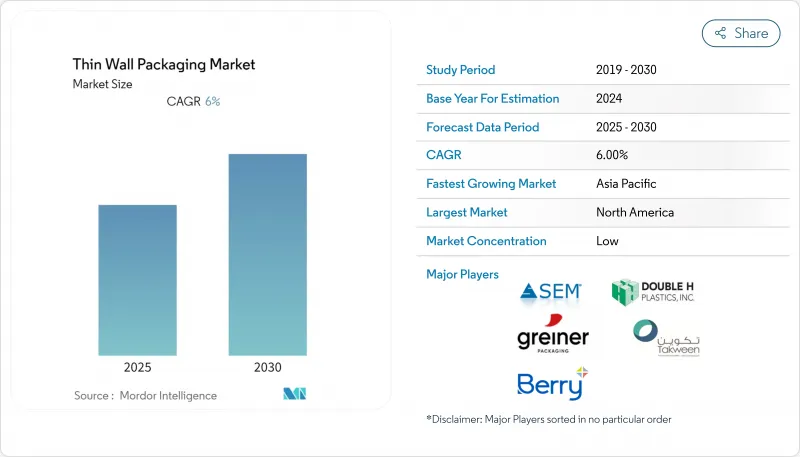
推动薄壁包装市场成长的因素包括:线上零售物流的蓬勃发展、降低运费的材料高效利用设计理念,以及对可回收包装形式的立法支持力度不断加大。儘管聚丙烯仍是市场主导树脂,但随着品牌商竞相遵守生产者延伸责任法规,生物聚合物的应用正在加速。热流道射出成型和在线挤出热成型等製造技术的创新,在维持高产能的同时,还能将壁厚降低至1毫米以下。从区域来看,北美仍然是销售领先者,但亚太地区由于都市化、外卖服务的兴起以及可支配收入的成长,正以最快的速度扩张。这些因素共同作用,使得薄壁包装市场在未来五年内成为品牌差异化、成本控制和减碳的关键平台。
全球薄壁包装市场趋势与洞察
电子商务物流的激增
线上零售的快速扩张正推动薄壁包装市场朝着能够承受自动化分类并最大限度降低体积重量费用的设计方向发展。像 Levain Bakery 这样的品牌透过采用亚毫米级尺寸的包装容器,将生产流程从八道工序简化到四道工序,并将包装效率提高了 50%。这些包装容器随后可在履约中心无缝流转。 ReadyWise 透过按需使用合适尺寸的包装,每週可交付 100 万个包装袋,同时降低运输成本和储存空间。易于自动化且空间优化的薄壁包装容器,不再只是节约成本的措施,而是电子商务扩充性的关键基础设施要素。
对便利已调理食品的需求
都市区消费者越来越倾向选择可微波加热、分量可控的餐食,这要求包装能够安全加热而不破坏食材。 Curefit 目前每天出货 35,000 份已调理食品,其包装容器的设计旨在保持食物新鲜并快速加热,这表明餐饮业的复苏正在推动对高阻隔性、薄壁包装树脂需求的增长。透明盖可以促进衝动消费,而热成型底座则利用精确的壁厚校准来节约树脂并保持结构完整性。
塑胶税和生产者责任延伸法
英国目前对再生材料含量低于30%的包装课税每吨200英镑的税,每年征收7亿英镑,却没有为回收基础建设提供资金。西班牙将于2023年开始对原生塑胶征收每公斤课税,而德国则将实施时间推迟到2025年,这让投资预测蒙上了一层阴影。这些政策将推高合规成本,并加速向经认证的再生材料流和封闭式伙伴关係关係的转变。
细分市场分析
受餐饮业重新开放和人们日益增长的便捷饮用习惯的推动,预计到2024年,杯子将占据薄壁包装市场36.3%的份额。此细分市场具有许多优势,例如材料体积比低、相容自动填充系统以及便于品牌印刷的表面。随着咖啡连锁店和快餐店越来越多地试用能够承受100°C填充温度而不变形的永续杯子,这一增长势头将持续到2030年。
预计到2030年,碗和盖品类将以7.9%的复合年增长率成长。业者优先选择透明盖,以保持产品新鲜度,并透过气体冲洗延长保质期。线上热成型技术的进步使得碗的平均壁厚达到400微米,满足了以往仅适用于较重竞争对手的跌落测试标准。托盘、软管和罐子在乳製品、糖果甜点和个人护理等细分市场仍然十分重要,它们都透过形状和阻隔性能的客製化来维持货架差异化优势。
聚丙烯凭藉其多功能的加工窗口、耐湿性和良好的性价比,将在2024年占据薄壁包装市场43.2%的份额。然而,随着加工商努力满足可堆肥性和再生材料含量的要求,薄壁包装市场对PLA和PHA树脂的采用率正在不断提高,年复合成长率达到8.3%。
弗劳恩霍夫研究所推出了一种生物基含量高达80%的柔性PLA薄膜,可在传统的LDPE生产线上生产。同时,PHA先驱Green Team检验了一种可在六个月内完全降解且不留微塑胶痕迹的家用可堆肥容器。 PET在对氧气敏感的已调理沙拉中仍占有一席之地,而聚苯乙烯和PVC在监管审查日益严格的背景下,市场份额持续下滑。
薄壁包装市场依包装类型(管状、罐状、盒状及其他)、材料(聚丙烯、聚对苯二甲酸乙二醇酯、聚苯乙烯及其他)、製造工艺(射出成型及其他)、终端用户行业(食品饮料、化妆品及个人护理、药品及营养补充剂、工业及家居用品)及地区进行细分。市场预测以美元计价。
区域分析
到2024年,北美将维持28.2%的薄壁包装市场份额,这主要得益于其成熟的餐饮服务体系、完善的回收通路以及对轻量化套件包的早期应用。品牌拥有者为了获得符合联邦和州塑胶法规的合规包装,继续承担高昂的树脂价格。美国仍然是先进热流道系统的创新中心,而加拿大则在引导公共部门采购政策,推动机构餐饮计画中采用消费后回收树脂(PCR)。
亚太地区预计到2030年将以9.5%的复合年增长率增长,这主要得益于快速的都市化、中阶购买力的提升以及全渠道食品杂货消费模式的兴起。中国在销售方面领先,但印度和印尼的人均成长速度最快。印度食品安全标准局批准再生塑胶用于食品接触领域,进一步降低了消费后再生塑胶(PCR)密集型薄壁塑胶设计的进入门槛。区域加工商正大力投资建造能够同时加工聚丙烯和新兴生物基树脂的多层挤出和热成型生产线,从而增强供应链的韧性。
由于欧洲较早推行永续性政策,并重视循环经济,因此欧洲占了相当大的市场。塑胶税和生产者责任延伸制度虽然增加了成本压力,但同时也奖励了那些能够在不牺牲密封完整性的前提下实现30%或更高回收率的企业。德国、法国和北欧国家一直是模内贴标(IML)技术的推广中心,因为零售商正在推动使用单一材料包装并搭配自有品牌产品。东欧国家受惠于低廉的劳动成本,正崛起为契约製造中心,在满足西方需求的同时,也面临同样的监管门槛。
中东和非洲的丛集展现出早期但前景可观的潜力,尤其是在冷冻乳製品出口和寻求耐高温聚丙烯杯的区域性快餐连锁店方面。南美洲的成长与农产品附加价值以及日益壮大的中阶对便利消费品的需求密切相关。巴西本地树脂生产具有成本优势,但其不完善的回收基础设施限制了循环材料的获取,并减缓了富含消费后回收树脂(PCR)的薄壁产品的普及。
其他福利:
- Excel格式的市场预测(ME)表
- 3个月的分析师支持
目录
第一章 引言
- 研究假设和市场定义
- 调查范围
第二章调查方法
第三章执行摘要
第四章 市场情势
- 市场概览
- 市场驱动因素
- 电子商务物流的激增
- 对方便的已调理食品的需求
- 减轻重量以降低成本和减少二氧化碳排放
- 套模贴标 (IML) 可提高可回收性
- 填充用的较薄包装
- 低温运输食材自煮包热潮
- 市场限制
- 塑胶税和生产者责任延伸法
- 树脂价格波动
- 转向使用单一材料柔性薄膜
- 高空化模具资本投资
- 供应链分析
- 监管状况
- 技术展望
- 五力分析
- 新进入者的威胁
- 买方的议价能力
- 供应商的议价能力
- 替代品的威胁
- 竞争对手之间的竞争
- 对宏观经济因素的市场评估
第五章 市场规模与成长预测
- 按包装类型
- 管子
- 罐
- 锅
- 杯子
- 托盘
- 碗和盖子
- 按材质
- 聚丙烯(PP)
- 聚对苯二甲酸乙二醇酯(PET)
- 聚苯乙烯(PS)
- 聚乙烯(PE)
- 聚氯乙烯(PVC)
- 生物聚合物(PLA、PHA)
- 透过製造工艺
- 射出成型
- 热成型
- 挤压成型等。
- 按最终用户产业
- 饮食
- 乳製品
- 调理食品
- 水果和蔬菜
- 肉类、家禽和鱼贝类
- 糖果甜点和零嘴零食
- 化妆品和个人护理
- 药品和营养补充剂
- 工业/家用物品
- 饮食
- 按地区
- 北美洲
- 美国
- 加拿大
- 墨西哥
- 南美洲
- 巴西
- 阿根廷
- 其他南美
- 欧洲
- 德国
- 英国
- 法国
- 义大利
- 西班牙
- 俄罗斯
- 其他欧洲国家
- 亚太地区
- 中国
- 日本
- 印度
- 澳洲
- 韩国
- 其他亚太地区
- 中东
- 沙乌地阿拉伯
- 阿拉伯聯合大公国
- 土耳其
- 其他中东地区
- 非洲
- 南非
- 埃及
- 奈及利亚
- 其他非洲国家
- 北美洲
第六章 竞争情势
- 市场集中度
- 策略倡议
- 市占率分析
- 公司简介
- Berry Global Group
- Greiner Packaging International
- Faerch Group
- Silgan Holdings Inc.
- Huhtamaki Oyj
- Novio Packaging BV
- Groupe Guillin SA
- Omniform SA
- Takween Advanced Industries
- Saudi Basic Industries Corporation(SABIC)
- Plastipak Holdings Inc.
- Sem Plastik Sanayi
- Dampack International
- Double H Plastics Inc.
- Greif Inc.
- Paccor Packaging
- Jabil Packaging Solutions
- IPL Plastics
- Visy Industries
- Supreme Industries
- Insta Polypack
第七章 市场机会与未来展望
The thin wall packaging market stands at USD 47.75 billion in 2025 and is forecast to reach USD 68.95 billion by 2030, reflecting a healthy 7.63% CAGR that underscores rising demand across food, beverage, cosmetics and e-commerce channels.
Upward momentum is fuelled by logistics growth tied to online retail, material-efficient design targets that cut freight charges, and tightening legislative support for recyclable formats. Polypropylene remains the workhorse resin, yet biopolymer penetration is accelerating as brand owners race to meet extended producer responsibility rules. Manufacturing innovation in hot-runner injection molding and inline extrusion-thermoforming keeps throughput high while driving wall thickness below 1 mm. Regionally, North America retains volume leadership, but Asia-Pacific is expanding fastest on the back of urbanization, meal-delivery adoption and rising disposable incomes. These converging factors combine to position the thin wall packaging market as a central platform for brand differentiation, cost containment and carbon reduction over the next five years.
Global Thin Wall Packaging Market Trends and Insights
Surge in E-commerce Logistics
Rapid online retail expansion pushes the thin wall packaging market toward designs that withstand automated sortation while minimizing dimensional weight fees. Brands such as Levain Bakery cut process steps from eight to four and achieved a 50% packaging-efficiency gain by adopting sub-millimeter containers that flow smoothly through fulfillment centers.ReadyWise uses on-demand right-sized packs to move 1 million pouches weekly, trimming freight costs and floor space simultaneously. Automation compatibility and space optimization make thin wall formats infrastructure-critical for e-commerce scalability rather than a simple cost lever.
Demand for Convenient Ready-to-Eat Meals
Urban consumers gravitate to microwave-ready, portion-controlled fare that requires packaging capable of safe heating without material distortion. Curefit now dispatches 35,000 ready meals daily in containers engineered for freshness retention and rapid reheat cycles, illustrating how food-service recovery steers incremental resin demand toward high-barrier thin wall designs. Transparent lids encourage impulse purchase while thermoformed bases exploit precise wall calibration to conserve resin and uphold structural integrity.
Plastic-tax and EPR Legislation
The United Kingdom now levies GBP 200 per tonne on packaging below 30% recycled content, extracting an anticipated GBP 700 million annually without earmarking funds for recycling infrastructure. Spain launched a per-kilogram tax on virgin plastic in 2023, while Germany's implementation delay until 2025 clouds investment forecasts. These policies inflate compliance costs and encourage accelerated transitions toward certified recyclate streams and closed-loop partnerships.
Other drivers and restraints analyzed in the detailed report include:
- Lightweighting for Cost-Down and CO2 Reduction
- In-mold Labelling (IML) Boosts Recyclability
- Resin Price Volatility
For complete list of drivers and restraints, kindly check the Table Of Contents.
Segment Analysis
Cups generated a 36.3% share of the thin wall packaging market in 2024, underpinned by food-service reopenings and robust on-the-go beverage rituals. The segment benefits from low material-to-volume ratios, automated filling compatibility and brand-friendly print surfaces. Growth persists through 2030 as coffee chains and quick-service restaurants widen sustainable cup trials capable of withstanding 100 °C fill temperatures without deformation.
The bowls and lids category is projected to post a 7.9% CAGR to 2030, catalyzed by global meal-kit subscriptions and refrigerated fresh-cut produce. Operators prioritize transparent lids that showcase product freshness and support gas-flush shelf-life extensions. Advances in inline thermoforming enable bowls with 400-micron average wall sections that match drop-test standards formerly associated only with heavier rivals. Trays, tubs and jars remain vital for dairy, confectionery and personal-care niches, each leveraging geometry and barrier customization to maintain shelf differentiation.
Polypropylene captured 43.2% of thin wall packaging market share in 2024 due to its versatile processing window, moisture resistance and favorable price-performance ratio. Yet, the thin wall packaging market is witnessing brisk uptake of PLA and PHA resins, which are expanding at an 8.3% CAGR as converters scramble to meet compostability and recycled-content mandates.
The Fraunhofer Institute unveiled an 80% bio-based flexible PLA film that runs on conventional LDPE lines, signaling cost-effective integration potential for high-clarity applications. Meanwhile, PHA pioneer Green Team validated home-compostable pots that decompose within six months without microplastic traces. PET sustains niche relevance in oxygen-sensitive prepared salads, while polystyrene and PVC continue to lose share amid tightening regulatory scrutiny.
Thin Wall Packaging Marke is Segmented by Packaging Type (Tubs, Jars, Pots, and More), Material (Polypropylene, Polyethylene Terephthalate, Polystyrene, and More), Manufacturing Process (Injection Molding, and More), End-User Industry (Food and Beverage, Cosmetics and Personal Care, Pharmaceuticals and Nutraceuticals, Industrial and Household Goods), and by Geography. The Market Forecasts are Provided in Terms of Value (USD).
Geography Analysis
North America retained 28.2% of the thin wall packaging market in 2024 on the back of entrenched meal-service businesses, sophisticated recycling channels and early adoption of light-weighting toolkits. Brand owners continue to absorb premium resin pricing in return for compliance-ready packs that navigate federal and state plastics legislation. The United States remains the innovation locus for advanced hot-runner systems, while Canada channels public-sector procurement policies toward PCR adoption in institutional food programmes.
Asia-Pacific is projected to achieve a 9.5% CAGR to 2030, underpinned by rapid urbanization, growing middle-class purchasing power and a sharp shift toward omni-channel grocery. China leads volume, but India and Indonesia post the fastest per-capita expansion. The Food Safety and Standards Authority of India's clearance for recycled plastic in food contact applications further lowers entry barriers for PCR-rich thin wall designs. Regional converters invest heavily in multilayer extrusion-thermoforming lines configurable for both polypropylene and emerging bio-resins, boosting supply resilience.
Europe commands significant share by virtue of early sustainability mandates and a continental focus on circularity. Plastic taxes and EPR regimes intensify cost pressures yet simultaneously reward companies capable of delivering 30% or greater recycled content without sacrificing seal integrity. Germany, France and the Nordics are hotbeds for IML adoption as retailers push mono-material packaging in private-label assortments. Eastern European nations, aided by lower labour costs, emerge as contract-manufacturing hubs that feed Western demand while navigating identical regulatory thresholds.
The Middle East and Africa cluster offers nascent but promising prospects, particularly in frozen-dairy exports and regional QSR chains that seek high-heat-resistant PP cups. South American growth is tethered to agricultural value-addition and an expanding middle class attracted to convenience formats. Local resin production in Brazil provides cost advantage; however, unreliable recycling infrastructure limits circular material sourcing, slowing penetration of PCR-rich thin wall offerings.
- Berry Global Group
- Greiner Packaging International
- Faerch Group
- Silgan Holdings Inc.
- Huhtamaki Oyj
- Novio Packaging B.V.
- Groupe Guillin SA
- Omniform SA
- Takween Advanced Industries
- Saudi Basic Industries Corporation (SABIC)
- Plastipak Holdings Inc.
- Sem Plastik Sanayi
- Dampack International
- Double H Plastics Inc.
- Greif Inc.
- Paccor Packaging
- Jabil Packaging Solutions
- IPL Plastics
- Visy Industries
- Supreme Industries
- Insta Polypack
Additional Benefits:
- The market estimate (ME) sheet in Excel format
- 3 months of analyst support
TABLE OF CONTENTS
1 INTRODUCTION
- 1.1 Study Assumptions and Market Definition
- 1.2 Scope of the Study
2 RESEARCH METHODOLOGY
3 EXECUTIVE SUMMARY
4 MARKET LANDSCAPE
- 4.1 Market Overview
- 4.2 Market Drivers
- 4.2.1 Surge in e-commerce logistics
- 4.2.2 Demand for convenient ready-to-eat meals
- 4.2.3 Lightweighting for cost-down and CO2 reduction
- 4.2.4 In-mold labelling (IML) boosts recyclability
- 4.2.5 Refill-friendly thin-wall packs in cosmetics
- 4.2.6 Cold-chain meal-kit boom
- 4.3 Market Restraints
- 4.3.1 Plastic-tax and EPR legislation
- 4.3.2 Resin price volatility
- 4.3.3 Shift to mono-material flexible films
- 4.3.4 High-cavitation tooling cap-ex
- 4.4 Supply-Chain Analysis
- 4.5 Regulatory Landscape
- 4.6 Technological Outlook
- 4.7 Porter's Five Forces
- 4.7.1 Threat of New Entrants
- 4.7.2 Bargaining Power of Buyers
- 4.7.3 Bargaining Power of Suppliers
- 4.7.4 Threat of Substitutes
- 4.7.5 Competitive Rivalry
- 4.8 Assesment of macroeconomic Factors on the market
5 MARKET SIZE AND GROWTH FORECASTS (VALUE)
- 5.1 By Packaging Type
- 5.1.1 Tubs
- 5.1.2 Jars
- 5.1.3 Pots
- 5.1.4 Cups
- 5.1.5 Trays
- 5.1.6 Bowls and Lids
- 5.2 By Material
- 5.2.1 Polypropylene (PP)
- 5.2.2 Polyethylene Terephthalate (PET)
- 5.2.3 Polystyrene (PS)
- 5.2.4 Polyethylene (PE)
- 5.2.5 Polyvinyl Chloride (PVC)
- 5.2.6 Biopolymers (PLA, PHA)
- 5.3 By Manufacturing Process
- 5.3.1 Injection Molding
- 5.3.2 Thermoforming
- 5.3.3 Extrusion and Others
- 5.4 By End-User Industry
- 5.4.1 Food and Beverage
- 5.4.1.1 Dairy Products
- 5.4.1.2 Ready Meals
- 5.4.1.3 Fruits and Vegetables
- 5.4.1.4 Meat, Poultry and Seafood
- 5.4.1.5 Confectionery and Snacks
- 5.4.2 Cosmetics and Personal Care
- 5.4.3 Pharmaceuticals and Nutraceuticals
- 5.4.4 Industrial and Household Goods
- 5.4.1 Food and Beverage
- 5.5 By Geography
- 5.5.1 North America
- 5.5.1.1 United States
- 5.5.1.2 Canada
- 5.5.1.3 Mexico
- 5.5.2 South America
- 5.5.2.1 Brazil
- 5.5.2.2 Argentina
- 5.5.2.3 Rest of South America
- 5.5.3 Europe
- 5.5.3.1 Germany
- 5.5.3.2 United Kingdom
- 5.5.3.3 France
- 5.5.3.4 Italy
- 5.5.3.5 Spain
- 5.5.3.6 Russia
- 5.5.3.7 Rest of Europe
- 5.5.4 Asia-Pacific
- 5.5.4.1 China
- 5.5.4.2 Japan
- 5.5.4.3 India
- 5.5.4.4 Australia
- 5.5.4.5 South Korea
- 5.5.4.6 Rest of Asia-Pacific
- 5.5.5 Middle East
- 5.5.5.1 Saudi Arabia
- 5.5.5.2 United Arab Emirates
- 5.5.5.3 Turkey
- 5.5.5.4 Rest of Middle East
- 5.5.6 Africa
- 5.5.6.1 South Africa
- 5.5.6.2 Egypt
- 5.5.6.3 Nigeria
- 5.5.6.4 Rest of Africa
- 5.5.1 North America
6 COMPETITIVE LANDSCAPE
- 6.1 Market Concentration
- 6.2 Strategic Moves
- 6.3 Market Share Analysis
- 6.4 Company Profiles (includes Global level Overview, Market level overview, Core Segments, Financials as available, Strategic Information, Market Rank/Share for key companies, Products and Services, and Recent Developments)
- 6.4.1 Berry Global Group
- 6.4.2 Greiner Packaging International
- 6.4.3 Faerch Group
- 6.4.4 Silgan Holdings Inc.
- 6.4.5 Huhtamaki Oyj
- 6.4.6 Novio Packaging B.V.
- 6.4.7 Groupe Guillin SA
- 6.4.8 Omniform SA
- 6.4.9 Takween Advanced Industries
- 6.4.10 Saudi Basic Industries Corporation (SABIC)
- 6.4.11 Plastipak Holdings Inc.
- 6.4.12 Sem Plastik Sanayi
- 6.4.13 Dampack International
- 6.4.14 Double H Plastics Inc.
- 6.4.15 Greif Inc.
- 6.4.16 Paccor Packaging
- 6.4.17 Jabil Packaging Solutions
- 6.4.18 IPL Plastics
- 6.4.19 Visy Industries
- 6.4.20 Supreme Industries
- 6.4.21 Insta Polypack
7 MARKET OPPORTUNITIES AND FUTURE OUTLOOK
- 7.1 White-space and Unmet-Need Assessment

 薄壁包装市场规模、份额、成长及全球产业分析:按类型、应用和地区分類的洞察,2026-2034 年预测
 全球薄壁包装市场成长、规模和趋势分析(按产品类型、材料、製造流程和应用划分)-区域展望、竞争策略和细分市场预测(至2034年)薄壁包装市场-2026年至2031年预测
 薄壁包装市场机会、成长动力、产业趋势分析及 2025 - 2034 年预测
 薄壁包装市场(按类型、材料、最终用户行业、国家和地区)- 2024 年至 2032 年行业分析、市场规模、市场份额及预测
 全球薄壁包装市场规模研究,依材料、产品类型、生产流程、应用和区域预测 2022-2032薄壁包装市场报告:趋势、预测和竞争分析(至 2031 年)