


 |
市场调查报告书
商品编码
1849958
Glyphosate:市场份额分析、行业趋势、统计数据、成长预测(2025-2030 年)Glyphosate - Market Share Analysis, Industry Trends & Statistics, Growth Forecasts (2025 - 2030) |
||||||

※ 本网页内容可能与最新版本有所差异。详细情况请与我们联繫。
全球Glyphosate市场预计到 2025 年将达到 95 亿美元,到 2030 年将达到 110 亿美元,复合年增长率为 3.6%。
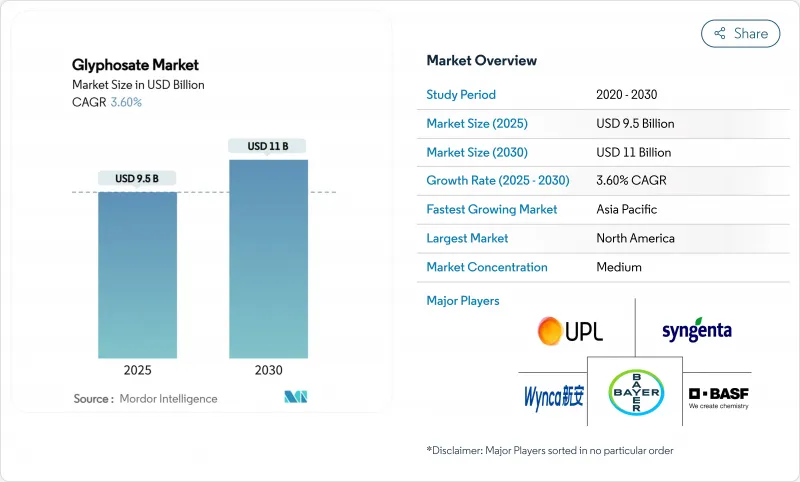
Glyphosate的稳定需求反映了其在保护性耕作、大规模连作系统以及与碳信用相关的犁地项目中的既有地位。北美地区早期推广耐除草剂作物支撑了草甘膦的稳定使用,而亚太地区机械化和生物技术种植面积的快速增长则推动了草甘膦用量的增长。由于供应全球80%以上出口量的中国工厂为满足环保法规而减产,以及拜耳公司警告可能因诉讼成本而退出生产,Glyphosate基本面仍面临挑战。随着产能整合降低价格的极端波动,价格前景正在改善,为生产商提供了更清晰的成本预测,儘管面临监管方面的阻力,草甘膦的使用量仍在稳步增长。动态基本面影响市场:中国原药生产商控制全球80%以上的出口量,而拜耳仍是最主要的品牌製剂生产商。
全球Glyphosate市场趋势与洞察
基因改造耐除草剂作物的商业化
中国核准2024年起推广耐Glyphosate种子性状,这意味着超过100万英亩的土地可以种植美国和巴西早已广泛应用的生物品种。诸如耐五种除草剂(包括Glyphosate)的Bykonic大豆等新型复合技术,可望带来更广泛的杂草控制潜力。持续的性状升级将维持除草剂防治方案的有效性,从而满足大面积作物对Glyphosate的长期需求。
高效除草方案的需求日益增长
全球农民面临530种已知的抗除草剂杂草,因此对可靠的频谱除草剂的需求日益增长。Glyphosate的作用机制、施用灵活性以及与精准施药平台的兼容性对于杂草综合治理至关重要。在许多非洲市场,非专利製剂的价格越来越亲民,也更容易取得,这促使以前依赖人工除草的小农户开始更多地使用嘉磷塞。
监管限制
欧盟于2023年将Glyphosate的使用许可延长了10年,但允许成员国自行製定更严格的限制措施。德国于2024年从全面禁用转为限制使用,但法律挑战仍在继续。纽西兰也出现了类似的不确定性,该国针对提案收到了3,100份公众意见。基准值,并可能导致需求转向那些拥有更清晰授权框架的国家。
细分市场分析
到2024年,谷类将占Glyphosate市场份额的43.5%,这反映出草甘膦在全球玉米和小麦保护性耕作系统中的大量使用。巴西持续的双季种植和中国高粱种植面积的扩大支撑了市场需求。豆类和油籽市场预计到2030年将以5.6%的复合年增长率成长,主要受南美洲大豆种植面积和印度芥菜种植面积增加的推动。
变数喷雾器等技术进步优化了施药量,但总施药面积保持稳定。棉花和甘蔗在人工除草成本高的热带地区仍然十分重要。园艺种植者正在采用更严格的施药系统,但滴灌喷雾器和筛网喷雾器仍然是果园和葡萄园的基本施药方式。
区域分析
预计到2024年,北美将占据Glyphosate市场34%的份额,这主要得益于大规模犁地大豆和玉米种植系统,其中超过80%的种植户依赖根除式和作物内除草剂。在加拿大,草原地区的小麦和油菜种植也采用了类似的耕作方式;而在墨西哥,玉米种植机械化的不断提高正稳步推高草甘膦的需求。诉讼仍然是一个主要的不稳定因素,如果拜耳公司退出市场,未决诉讼将威胁到国内供应。乔治亚和其他一些地区颁布的州级责任豁免条款旨在保护草甘膦的持续生产。
预计亚太地区将实现最快成长,到2030年复合年增长率将达到5.86%。中国农药产量稳定在24万至25万吨左右,Glyphosate仍名列非专利活性成分之列。印度农药价值链正在扩展,随着农民采用低成本除草方法,通用Glyphosate的使用量不断增加。印尼、越南和泰国正在增加播前除草剂的使用,以支持双季种植。澳洲的大面积谷物农场儘管已步入成熟期,但需求仍保持稳定,这得益于精准的喷洒系统,该系统能够更好地控制喷洒作业。
南美洲是全球消费量,这主要得益于巴西2025年预计3.223亿吨的粮食产量,从而推动了除草剂使用强度的增加。犁地种植面积超过3500万公顷,因此Glyphosate对于播种前杂草的控制至关重要。阿根廷的货币困境加剧了价格敏感性,但对种植面积的依赖并未降低。像先正达在保利尼亚投资6,500万美元的新型区域技术中心,专注于研发在热带气候下仍能维持药效的配方,这些都为长期成长提供了支持。
其他福利:
- Excel格式的市场预测(ME)表
- 3个月的分析师支持
目录
第一章 引言
- 研究假设和市场定义
- 调查范围
第二章调查方法
第三章执行摘要
第四章 市场情势
- 市场概览
- 市场驱动因素
- 基因改造耐除草剂作物的商业化
- 高效除草方案的需求日益增长
- 扩大耕地面积及农业集约化
- 将Glyphosate耐受性状整合到基因编辑作物中
- 再生犁地信用计画推动了碳信用额度的采用
- 整合的生产能力有助于稳定长期价格。
- 市场限制
- 监管限制
- 向有机和生物除草剂的转变
- 品牌供应商提起诉讼可能导致撤回订单的风险
- 在主要作物区推广杂草抗性
- 监管环境
- 技术展望
- 波特五力分析
- 供应商的议价能力
- 买方的议价能力
- 新进入者的威胁
- 替代品的威胁
- 竞争对手之间的竞争
第五章 市场规模与成长预测
- 按作物类型
- 粮食
- 豆类和油籽
- 水果和蔬菜
- 经济作物
- 其他作物
- 透过采用基因改造生物
- 基因改造作物
- 非基因改造
- 按地区
- 北美洲
- 美国
- 加拿大
- 墨西哥
- 北美其他地区
- 南美洲
- 巴西
- 阿根廷
- 其他南美洲
- 欧洲
- 德国
- 法国
- 义大利
- 西班牙
- 英国
- 俄罗斯
- 其他欧洲地区
- 亚太地区
- 中国
- 印度
- 日本
- 澳洲
- 亚太其他地区
- 中东
- 沙乌地阿拉伯
- 阿拉伯聯合大公国
- 土耳其
- 其他中东地区
- 非洲
- 南非
- 其他非洲地区
- 北美洲
第六章 竞争情势
- 市场集中度
- 策略趋势
- 市占率分析
- 公司简介
- Bayer AG
- Zhejiang Xinan(Wynca)
- Syngenta AG
- BASF SE
- UPL Ltd
- Corteva, Inc.
- FMC Corporation
- Nufarm Ltd
- Zhejiang Jiangshan Agrochemical(Jiangshan Chemical Co.)
- Jiangsu Yangnong Chemical(Sinochem Holdings)
- Albaugh LLC(Albaugh Group)
- Bharat Rasayan
- Jiangsu Good-Harvest(Good Harvest Weien Co.)
- King Quenson Industry(King Quenson Group)
第七章 市场机会与未来展望
The global glyphosate market stands at USD 9.5 billion in 2025 and is forecast to reach USD 11 billion by 2030, advancing at a 3.6% CAGR.
Stable demand reflects glyphosate's entrenched role in conservation tillage, large-scale row-crop systems, and carbon-credit-linked no-till programs. North America's early adoption of herbicide-tolerant crops underpins consistent usage, while Asia-Pacific's rapid mechanization and rise in biotech acreage accelerate volume growth. Supply fundamentals remain tight because Chinese plants that supply more than 80% of global exports are curbing output to meet environmental rules, and Bayer has warned of a possible production exit amid litigation costs. Price visibility has improved as capacity consolidation limits extreme volatility, giving growers clearer cost forecasts and supporting steady adoption despite regulatory headwinds. Competitive dynamics also shape the glyphosate market: Chinese technical-grade producers control more than 80% of global export volume, while Bayer remains the most visible branded formulator.
Global Glyphosate Market Trends and Insights
Commercialization of GM Herbicide-Tolerant Crops
China's 2024 approval of glyphosate-tolerant seed traits opened more than 1 million mu to biotech varieties, echoing long-running adoption in the United States and Brazil. New stacked technologies, such as Bayer's Vyconic soybeans, tolerant to five herbicides, including glyphosate, promise broader weed-control windows. Continuous trait upgrades ensure herbicide programs remain effective, anchoring long-term glyphosate demand across large acreage crops.
Rising Demand for Effective Weed Control Solutions
Farmers face 530 confirmed herbicide-resistant weed biotypes worldwide, increasing the urgency for reliable broad-spectrum options. Glyphosate's mode of action, application flexibility, and compatibility with precision spraying platforms make it integral to integrated weed management. In many African markets, generic formulations have improved affordability, driving uptake among smallholders who previously relied on manual weeding.
Regulatory Restrictions
The European Union renewed glyphosate for 10 years in 2023 but gave member states leeway to impose stricter limits. Germany moved from an outright ban to restricted use in 2024, and legal challenges continue. Similar uncertainties have surfaced in New Zealand, where proposals to raise residue limits prompted 3,100 public submissions. Fragmented rules complicate stewardship, raise compliance costs, and may shift demand toward countries with clearer approval frameworks.
Other drivers and restraints analyzed in the detailed report include:
- Expansion of Agricultural Land and Intensified Farming
- Integration of Glyphosate-Tolerant Traits in Gene-Edited Crops
- Shift Toward Organic and Bio-Herbicides
For complete list of drivers and restraints, kindly check the Table Of Contents.
Segment Analysis
Grains and cereals generated 43.5% of the glyphosate market in 2024, reflecting heavy use in corn and wheat conservation systems worldwide. Continued double-cropping in Brazil and expanded sorghum acreage in China anchor demand. The pulses and oilseeds segment is forecast to post a 5.6% CAGR through 2030 as South American soybean hectares and Indian mustard cultivation rise.
Technology advances such as variable-rate sprayers optimize doses, yet total treated hectares keep volumes steady. Cotton and sugarcane remain important in tropical zones where manual weeding costs are high. Although horticultural producers apply more restrictive regimes, dripline injection, and shielded sprayers maintain a baseline of usage in orchards and vineyards.
The Glyphosate Market is Segmented by Crop Type (Grains and Cereals, Commercial Crops, and More), by GMO Adoption (GM Crops and Non-GM Crops), and by Geography (Asia-Pacific, North America, South America, Europe, Middle East, and Africa). The Market Forecasts are Provided in Terms of Value (USD).
Geography Analysis
North America's 34% share of the glyphosate market in 2024 stems from extensive no-till soy and corn systems, where over 80% of growers depend on herbicides for burndown and in-crop applications. Canada mirrors these practices across prairie wheat and canola, while Mexico's transition to mechanized maize farming introduces steady incremental demand. Litigation remains the main destabilizer, with pending cases threatening domestic supply if Bayer exits. State-level liability shields enacted in Georgia and other jurisdictions aim to safeguard continued manufacture.
Asia-Pacific is projected to deliver the fastest regional growth at a 5.86% CAGR by 2030. China's pesticide volumes have stabilized at around 240,000-250,000 tons, yet glyphosate remains a top-10 active ingredient. India's agrochemical value chain is scaling, and generic glyphosate volumes rise as farmers adopt low-cost weed control. Indonesia, Vietnam, and Thailand show growing adoption of pre-plant burndown to support double-cropping. Australia's broadacre cereal farms maintain mature but steady demand, reinforced by precision guidance systems that fine-tune application.
South America ranks second in overall consumption, anchored by Brazil's 322.3 million-ton grain harvest in 2025, which drives high herbicide intensity. No-till covers more than 35 million hectares, making glyphosate indispensable for grass weed control before planting. Argentina's currency challenges add price sensitivity but do not diminish acreage reliance. New regional tech hubs, such as Syngenta's USD 65 million facility in Paulinia, focus on tropical-climate formulations that preserve efficacy under high humidity, supporting long-term growth.
- Bayer AG
- Zhejiang Xinan (Wynca)
- Syngenta AG
- BASF SE
- UPL Ltd
- Corteva, Inc.
- FMC Corporation
- Nufarm Ltd
- Zhejiang Jiangshan Agrochemical (Jiangshan Chemical Co.)
- Jiangsu Yangnong Chemical (Sinochem Holdings)
- Albaugh LLC (Albaugh Group)
- Bharat Rasayan
- Jiangsu Good-Harvest (Good Harvest Weien Co.)
- King Quenson Industry (King Quenson Group)
Additional Benefits:
- The market estimate (ME) sheet in Excel format
- 3 months of analyst support
TABLE OF CONTENTS
1 Introduction
- 1.1 Study Assumptions and Market Definition
- 1.2 Scope of the Study
2 Research Methodology
3 Executive Summary
4 Market Landscape
- 4.1 Market Overview
- 4.2 Market Drivers
- 4.2.1 Commercialization of GM herbicide-tolerant crops
- 4.2.2 Rising demand for effective weed control solutions
- 4.2.3 Expansion of agricultural land and intensified farming
- 4.2.4 Integration of glyphosate-tolerant traits in gene-edited crops
- 4.2.5 Regenerative no-till carbon-credit programmes boost usage
- 4.2.6 Capacity consolidation stabilises long-term prices
- 4.3 Market Restraints
- 4.3.1 Regulatory restrictions
- 4.3.2 Shift toward organic and bio-herbicides
- 4.3.3 Litigation-driven exit risk of branded suppliers
- 4.3.4 Accelerating weed resistance in major crop belts
- 4.4 Regulatory Landscape
- 4.5 Technological Outlook
- 4.6 Porter's Five Forces Analysis
- 4.6.1 Bargaining Power of Suppliers
- 4.6.2 Bargaining Power of Buyers
- 4.6.3 Threat of New Entrants
- 4.6.4 Threat of Substitutes
- 4.6.5 Intensity of Competitive Rivalry
5 Market Size and Growth Forecasts (Value, USD)
- 5.1 By Crop Type
- 5.1.1 Grains and Cereals
- 5.1.2 Pulses and Oilseeds
- 5.1.3 Fruits and Vegetables
- 5.1.4 Commercial Crops
- 5.1.5 Other Crops
- 5.2 By GMO Adoption
- 5.2.1 GM Crops
- 5.2.2 Non-GM Crops
- 5.3 By Geography
- 5.3.1 North America
- 5.3.1.1 United States
- 5.3.1.2 Canada
- 5.3.1.3 Mexico
- 5.3.1.4 Rest of North America
- 5.3.2 South America
- 5.3.2.1 Brazil
- 5.3.2.2 Argentina
- 5.3.2.3 Rest of South America
- 5.3.3 Europe
- 5.3.3.1 Germany
- 5.3.3.2 France
- 5.3.3.3 Italy
- 5.3.3.4 Spain
- 5.3.3.5 United Kingdom
- 5.3.3.6 Russia
- 5.3.3.7 Rest of Europe
- 5.3.4 Asia-Pacific
- 5.3.4.1 China
- 5.3.4.2 India
- 5.3.4.3 Japan
- 5.3.4.4 Australia
- 5.3.4.5 Rest of Asia-Pacific
- 5.3.5 Middle East
- 5.3.5.1 Saudi Arabia
- 5.3.5.2 UAE
- 5.3.5.3 Turkey
- 5.3.5.4 Rest of Middle East
- 5.3.6 Africa
- 5.3.6.1 South Africa
- 5.3.6.2 Rest of Africa
- 5.3.1 North America
6 Competitive Landscape
- 6.1 Market Concentration
- 6.2 Strategic Moves
- 6.3 Market Share Analysis
- 6.4 Company Profiles (includes Global level Overview, Market level overview, Core Segments, Financials as available, Strategic Information, Market Rank/Share, Products and Services, Recent Developments)
- 6.4.1 Bayer AG
- 6.4.2 Zhejiang Xinan (Wynca)
- 6.4.3 Syngenta AG
- 6.4.4 BASF SE
- 6.4.5 UPL Ltd
- 6.4.6 Corteva, Inc.
- 6.4.7 FMC Corporation
- 6.4.8 Nufarm Ltd
- 6.4.9 Zhejiang Jiangshan Agrochemical (Jiangshan Chemical Co.)
- 6.4.10 Jiangsu Yangnong Chemical (Sinochem Holdings)
- 6.4.11 Albaugh LLC (Albaugh Group)
- 6.4.12 Bharat Rasayan
- 6.4.13 Jiangsu Good-Harvest (Good Harvest Weien Co.)
- 6.4.14 King Quenson Industry (King Quenson Group)
7 Market Opportunities and Future Outlook

 日本Glyphosate市场规模、份额、趋势和预测:按作物类型、基因改造生物 (GMO) 状态和地区划分,2026-2034 年
 2026年全球Glyphosate市场报告
 Glyphosate市场规模、份额和成长分析(按最终用户、应用、剂型、通路、作物类型和地区划分)—2026-2033年产业预测
 草甘膦市场机会、成长驱动因素、产业趋势分析及预测(2026-2035年)
 Glyphosate市场按最终用户、应用、剂型、分销管道和作物类型划分-2025-2032年全球预测
 草甘膦市场 - 全球产业规模、份额、趋势、机会和预测,按类型、应用、地区和竞争细分,2020-2030 年
 全球Glyphosate市场
 全球Glyphosate市场评估:依作物类型、形式、应用、地区、机会和预测(2018-2032年)
 全球Glyphosate市场:成长、未来展望与竞争分析(2025-2033)