


 |
市场调查报告书
商品编码
1905993
石膏板:市场占有率分析、产业趋势与统计、成长预测(2026-2031)Plasterboard - Market Share Analysis, Industry Trends & Statistics, Growth Forecasts (2026 - 2031) |
||||||

※ 本网页内容可能与最新版本有所差异。详细情况请与我们联繫。
2025年石膏板市场价值为122.5亿平方公尺,预计到2031年将达到163.1亿平方公尺,而2026年为128.5亿平方公尺。
预计在预测期(2026-2031 年)内,复合年增长率将达到 4.88%。
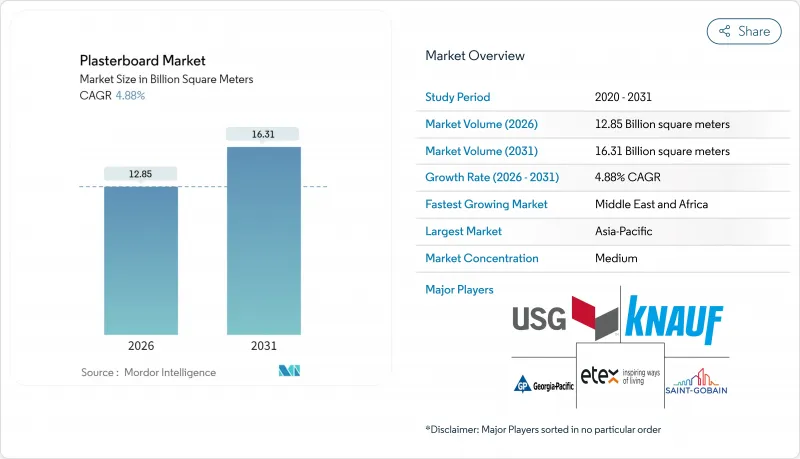
这一成长轨迹反映了干式施工方法的加速普及、绿色建筑法规的日益严格以及合成石膏供应链的扩张。为了加快施工进度,建筑商倾向于选择轻质板材以减少工时;监管机构也正在实施低挥发性有机化合物(VOC)排放标准,这有利于采用再生材料製成的石膏解决方案。亚太地区的快速都市化、沿岸地区的大型企划以及北美和欧洲商业地产的復苏,都在扩大石膏板的潜在市场。来自煤炭依赖型经济体排烟脱硫厂的合成石膏价格具有竞争力,降低了原料成本,从而鼓励製造商扩大生产。随着各大品牌实施闭合迴路回收系统以满足掩埋限制并透过永续性实现差异化,预计市场竞争将更加激烈。
全球石膏板市场趋势与洞察
快速从湿式施工方法过渡到干式施工方法
承包商青睐石膏板系统,因为它施工效率高,工期可预测。沙乌地阿拉伯的大型开发计划,例如NEOM,都指定使用标准化的石膏板组装,以最大限度地减少现场维护延误。建筑规范认可石膏板品质稳定,且不易受潮。此外,安装工具、接缝密封剂和饰面配件的需求也在不断增长,从而扩大了石膏板市场。製造商正在开发更薄、尺寸更稳定的板材,使其与预製模组相容。
亚洲和海湾合作委员会地区规划的大型住宅大型企划将推动需求成长
印度、印尼和沙乌地阿拉伯的都市化政策正在推动大规模住宅建设计画,而这些建设为与板材生产商签订长期供应协议奠定了基础。印度的基础建设计画(预计到2035年投资额将达到1.4兆美元)正在支持区域製造商扩大产能。密集型发展缩短了物流距离,提高了板材规格的一致性,从而增强了规模经济效益。
对潮湿的敏感性和霉菌风险会增加修復成本。
潮湿的石膏板会导致霉菌滋生,造成住宅平均1.5万至5万美元的保险索赔。沿海地区的建筑管理部门现在指定使用防潮等级的石膏板,但这些产品的价格高出15%至25%。一些开发商在高风险地区改用纤维水泥板。新兴地区缺乏技术纯熟劳工,减缓了石膏板的市场普及速度。
细分市场分析
截至2025年,斜边石膏板将占石膏板市场61.42%的份额。其凹形边缘简化了接缝处理,已成为住宅室内装修的标准配置。然而,随着模组化建筑的普及,斜边石膏板的市场规模预计将低于整体需求成长。同时,由于建筑师越来越多地采用外露接缝以配合物流设施和工业计划的极简主义设计,预计到2031年,方边石膏板的市场将以5.03%的复合年增长率增长。
方边石膏板可与工厂预製建筑中使用的金属框架和预製面板无缝衔接,减少了打磨和腻子的工作量。承包商认为,减少低技能工人的工时是其主要优势之一。与此同时,住宅和室内维修仍然偏爱斜边带来的无缝外观。製造商正在推出带有微倒角边缘的混合型石膏板,兼顾了速度和美观性,征兆石膏板市场在形状偏好正在趋于融合。
石膏板市场报告按形状(直角边和斜角边)、类型(标准型、防火型、隔热型、防潮型、隔音型和抗衝击型)、最终用途(住宅和非住宅)以及地区(亚太地区、北美地区、欧洲地区、南美地区以及中东和非洲地区)进行细分。市场预测以平方公尺为单位。
区域分析
亚太地区石膏板市场受益于持续的公共住宅政策以及以石膏板为标准建材的工厂化生产规模的扩大。来自区域发电厂的合成石膏有助于降低成本,从而支撑了价格竞争力。随着各国政府实施抗震防火法规并提高板材厚度标准,每平方公尺的平均材料用量也增加。
在中东和非洲,由于沙乌地阿拉伯、科威特和埃及的大型计划,板材消费量正在成长。恶劣的气候条件和紧迫的工期推动了对防潮轻质板材的需求。当地製造商正与全球大型企业合作,促进技术转移并建立联合物流网络,以减少对进口的依赖。
欧洲正优先发展循环经济,奖励那些拥有回收计画和近乎零废弃物记录的工厂。英国石膏公司(British Gypsum)的再生石膏板产品Soundblock符合严格的掩埋限制。北美正在投资兴建以可再生能源为动力的电气化工厂,将该地区打造成为零碳石膏板生产的试验场。拉丁美洲的人均消费量虽然落后,但随着商业建筑的现代化,其消费量正稳定成长。
其他福利:
- Excel格式的市场预测(ME)表
- 3个月的分析师支持
目录
第一章 引言
- 调查先决条件
- 调查范围
第二章调查方法
第三章执行摘要
第四章 市场情势
- 市场概览
- 市场驱动因素
- 快速从湿式施工方法过渡到干式施工方法
- 亚洲和海湾合作委员会地区的大型企划住宅规划将推动需求成长
- 更严格的绿建筑标准要求板材VOC含量低、再生材料含量高。
- 新兴市场价格竞争力强的合成石膏供应量不断扩大,将推动其应用。
- 欧洲和美国回收再生用石膏短缺,推动了对循环系统的投资。
- 市场限制
- 潮湿敏感性和霉菌滋生风险会增加修復成本。
- 石膏和能源价格的波动正在给生产商的利润率带来压力。
- 严格的石膏废弃物掩埋禁令增加了处置成本。
- 价值链分析
- 波特五力模型
- 供应商的议价能力
- 消费者议价能力
- 新进入者的威胁
- 替代品的威胁
- 竞争程度
第五章 市场规模与成长预测
- 按形式
- 方边
- 锥形
- 按类型
- 标准
- 耐火性能
- 隔热
- 防潮性能
- 隔音
- 抗衝击性
- 透过使用
- 住宅
- 非住宅
- 按地区
- 亚太地区
- 中国
- 印度
- 日本
- 韩国
- 东南亚国协
- 亚太其他地区
- 北美洲
- 美国
- 加拿大
- 墨西哥
- 欧洲
- 德国
- 英国
- 义大利
- 法国
- 北欧国家
- 其他欧洲地区
- 南美洲
- 巴西
- 阿根廷
- 其他南美洲
- 中东和非洲
- 沙乌地阿拉伯
- 南非
- 其他中东和非洲地区
- 亚太地区
第六章 竞争情势
- 市场集中度
- 策略趋势
- 市占率/排名分析
- 公司简介
- Ahmed Yousuf & Hassan Abdullah Co.(AYHACO)
- American Gypsum Company LLC
- AtIskan AlcI
- AWI Licensing LLC
- CSR Limited
- Etex Group
- Fletcher Building
- Georgia-Pacific
- GYPSEMNA CO LLC
- Gyptec Iberica
- Holcim
- Jason New Materials
- Knauf Group
- Mada Gypsum Company
- National Gypsum Services Company
- Saint-Gobain
- USG Boral
- VOLMA
第七章 市场机会与未来展望
The Plasterboard Market was valued at 12.25 Billion square meters in 2025 and estimated to grow from 12.85 Billion square meters in 2026 to reach 16.31 Billion square meters by 2031, at a CAGR of 4.88% during the forecast period (2026-2031).
This growth trajectory reflects the accelerating adoption of dry construction techniques, stricter green-building mandates, and the expansion of synthetic gypsum supply chains. Contractors seeking shorter project cycles are opting for lightweight boards that reduce labor hours, while regulators are implementing low-VOC requirements that favor gypsum solutions formulated with recycled content. Rapid urbanization in the Asia-Pacific, megaprojects in the Gulf, and commercial real-estate recovery in North America and Europe are widening the addressable plasterboard market. Price-competitive synthetic gypsum sourced from flue-gas desulfurization plants in coal-reliant economies is lowering raw material costs, encouraging manufacturers to scale up their output. Competitive intensity is poised to rise as leading brands deploy closed-loop recycling systems to comply with landfill restrictions and differentiate on sustainability.
Global Plasterboard Market Trends and Insights
Rapid Shift Toward Dry Construction Techniques Over Wet Methods
Builders favor dry systems for labor efficiency and predictable timelines. Saudi mega-developments, such as NEOM, specify standardized drywall assemblies to minimize on-site curing delays. Building codes now recognize drywall for its consistent quality and reduced moisture defects. Demand is spreading to installation tools, joint compounds, and finishing accessories, enlarging the plasterboard market. Manufacturers are engineering thinner, dimensionally stable boards compatible with prefabricated modules.
Residential Megaproject Pipelines in Asia and GCC Boost Volume Demand
Urbanization policies in India, Indonesia, and Saudi Arabia are driving mass housing programs that anchor long-term supply contracts with board producers. India's infrastructure plan valued at USD 1.4 trillion up to 2035 underpins capacity expansions by regional manufacturers. Clustered developments reduce logistics miles and promote consistent board specifications, reinforcing economies of scale.
Moisture Sensitivity and Mold Risk Increase Remediation Costs
Boards that remain damp can foster mold, triggering insurance claims that average USD 15,000-50,000 per dwelling. Building authorities in coastal zones now specify moisture-resistant grades, yet these products cost 15-25% more. Some developers switch to fiber cement in high-risk sites. Skilled labor for correct vapor-barrier installation is limited in emerging regions, which slows the uptake of plasterboard in the market.
Other drivers and restraints analyzed in the detailed report include:
- Tightening Green-Building Codes Mandate Low-VOC, High-Recycled-Content Boards
- Price-Competitive Synthetic Gypsum Supply in Emerging Markets Widens Adoption
- Volatile Gypsum and Energy Prices Squeeze Producer Margins
For complete list of drivers and restraints, kindly check the Table Of Contents.
Segment Analysis
Tapered-edge boards commanded 61.42% of the plasterboard market share in 2025. Their recessed edges simplify joint finishing and remain the default for residential interiors. The plasterboard market size for tapered boards is expected to grow at a slower pace than overall demand as modular construction gains ground. Square-edge products are projected to advance at a 5.03% CAGR through 2031, as architects in logistics and industrial projects increasingly adopt exposed joints that align with minimalist design.
Square-edge boards integrate seamlessly with metal framing and pre-finished panels used in factory-built construction, reducing the need for sanding and compound use. Contractors cite lower-skilled labor hours as the chief gain. In contrast, homeowners and interior renovators still prefer the seamless appearance enabled by tapered edges. Manufacturers are marketing hybrid boards with micro-beveled edges that balance speed and aesthetics, a sign of converging form preferences within the plasterboard market.
The Plasterboard Market Report is Segmented by Form (Square-Edge and Tapered), Type (Standard, Fire-Resistant, Thermal-Insulated, Moisture-Resistant, Sound-Resistant, and Impact-Resistant), End-Use Sector (Residential and Non-Residential), and Geography (Asia-Pacific, North America, Europe, South America, and Middle East and Africa). The Market Forecasts are Provided in Terms of Volume (Square Meters).
Geography Analysis
The Asia-Pacific's plasterboard market benefits from sustained public housing initiatives and factory construction that adopts drywalling as the default. Synthetic gypsum sourced from regional power plants lowers costs and supports competitive pricing. Governments are adopting seismic and fire regulations that increase board thickness standards, pushing average material intensity per square meter higher.
The Middle East and Africa region is scaling board consumption through giga-projects in Saudi Arabia, Kuwait, and Egypt. Harsh climate conditions and rapid schedules make moisture-resistant and lightweight boards attractive. Local producers partner with global majors to facilitate technology transfer and establish joint logistics networks, thereby reducing import dependency.
Europe emphasizes circular economy objectives, rewarding plants with take-back schemes and near-zero-waste performance. British Gypsum's recycled-content SoundBloc line meets stringent landfill limits. North America invests in electrified factories sourcing renewable power, positioning the region as a testing ground for zero-carbon board production. Latin America lags in per-capita consumption but is seeing gradual growth tied to commercial interiors modernization.
- Ahmed Yousuf & Hassan Abdullah Co. (AYHACO)
- American Gypsum Company LLC
- AtIskan AlcI
- AWI Licensing LLC
- CSR Limited
- Etex Group
- Fletcher Building
- Georgia-Pacific
- GYPSEMNA CO LLC
- Gyptec Iberica
- Holcim
- Jason New Materials
- Knauf Group
- Mada Gypsum Company
- National Gypsum Services Company
- Saint-Gobain
- USG Boral
- VOLMA
Additional Benefits:
- The market estimate (ME) sheet in Excel format
- 3 months of analyst support
TABLE OF CONTENTS
1 Introduction
- 1.1 Study Assumptions
- 1.2 Scope of the Study
2 Research Methodology
3 Executive Summary
4 Market Landscape
- 4.1 Market Overview
- 4.2 Market Drivers
- 4.2.1 Rapid shift toward dry construction techniques over wet methods
- 4.2.2 Residential megaproject pipelines in Asia and GCC boost volume demand
- 4.2.3 Tightening green-building codes mandate low-VOC, high-recycled-content boards
- 4.2.4 Price-competitive synthetic gypsum supply in emerging markets widens adoption
- 4.2.5 Recycling-grade gypsum shortages in the West spur investment in closed-loop systems
- 4.3 Market Restraints
- 4.3.1 Moisture sensitivity and mould risk increase remediation costs
- 4.3.2 Volatile gypsum/energy prices squeeze producer margins
- 4.3.3 Stringent landfill bans on gypsum waste raise disposal costs
- 4.4 Value Chain Analysis
- 4.5 Porter's Five Forces
- 4.5.1 Bargaining Power of Suppliers
- 4.5.2 Bargaining Power of Consumers
- 4.5.3 Threat of New Entrants
- 4.5.4 Threat of Substitutes
- 4.5.5 Degree of Competition
5 Market Size & Growth Forecasts (Volume)
- 5.1 By Form
- 5.1.1 Square-edge
- 5.1.2 Tapered
- 5.2 By Type
- 5.2.1 Standard
- 5.2.2 Fire-resistant
- 5.2.3 Thermal-insulated
- 5.2.4 Moisture-resistant
- 5.2.5 Sound-resistant
- 5.2.6 Impact-resistant
- 5.3 By End-use Sector
- 5.3.1 Residential
- 5.3.2 Non-residential
- 5.4 By Geography
- 5.4.1 Asia-Pacific
- 5.4.1.1 China
- 5.4.1.2 India
- 5.4.1.3 Japan
- 5.4.1.4 South Korea
- 5.4.1.5 ASEAN Countries
- 5.4.1.6 Rest of Asia-Pacific
- 5.4.2 North America
- 5.4.2.1 United States
- 5.4.2.2 Canada
- 5.4.2.3 Mexico
- 5.4.3 Europe
- 5.4.3.1 Germany
- 5.4.3.2 United Kingdom
- 5.4.3.3 Italy
- 5.4.3.4 France
- 5.4.3.5 Nordic Countries
- 5.4.3.6 Rest of Europe
- 5.4.4 South America
- 5.4.4.1 Brazil
- 5.4.4.2 Argentina
- 5.4.4.3 Rest of South America
- 5.4.5 Middle East and Africa
- 5.4.5.1 Saudi Arabia
- 5.4.5.2 South Africa
- 5.4.5.3 Rest of Middle East and Africa
- 5.4.1 Asia-Pacific
6 Competitive Landscape
- 6.1 Market Concentration
- 6.2 Strategic Moves
- 6.3 Market Share**/Ranking Analysis
- 6.4 Company Profiles (includes Global level Overview, Market level overview, Core Segments, Financials as available, Strategic Information, Market Rank/Share, Products & Services, Recent Developments)
- 6.4.1 Ahmed Yousuf & Hassan Abdullah Co. (AYHACO)
- 6.4.2 American Gypsum Company LLC
- 6.4.3 AtIskan AlcI
- 6.4.4 AWI Licensing LLC
- 6.4.5 CSR Limited
- 6.4.6 Etex Group
- 6.4.7 Fletcher Building
- 6.4.8 Georgia-Pacific
- 6.4.9 GYPSEMNA CO LLC
- 6.4.10 Gyptec Iberica
- 6.4.11 Holcim
- 6.4.12 Jason New Materials
- 6.4.13 Knauf Group
- 6.4.14 Mada Gypsum Company
- 6.4.15 National Gypsum Services Company
- 6.4.16 Saint-Gobain
- 6.4.17 USG Boral
- 6.4.18 VOLMA
7 Market Opportunities & Future Outlook
- 7.1 White-space and Unmet-need Assessment

 防水防潮石膏板市场:依产品类型、应用、最终用户和通路划分-2026-2032年全球预测
 全球石膏板市场规模、份额、趋势和成长分析报告(2026-2034)
 日本石膏板市场规模、份额、趋势和预测:按形态、类型、最终用途行业和地区划分,2026-2034年
 石膏板市场-全球产业规模、份额、趋势、机会、预测:按类型、形式、最终用户、地区和竞争格局划分,2021-2031年全球防潮防霉石膏板市场(按产品类型、最终用途、应用、安装类型和分销管道划分)预测(2026-2032年)天花板辐射板市场按产品类型、安装类型、原料、应用、最终用户产业和分销管道划分-2026-2032年全球预测石膏纤维板市场按类型、厚度、应用和最终用户划分,全球预测(2026-2032)
 石膏板:市场占有率分析、产业趋势与统计、成长预测(2026-2031)日本石膏板市场规模、份额、趋势及预测(按产品类型、最终用途和地区划分,2026-2034年)全球石膏板市场:市场规模、占有率、成长率、行业分析、按类型、应用和地区划分的考虑因素以及未来预测(2026-2034)