


 |
市场调查报告书
商品编码
1906084
低密度聚乙烯:市占率分析、产业趋势与统计、成长预测(2026-2031)Low Density Polyethylene - Market Share Analysis, Industry Trends & Statistics, Growth Forecasts (2026 - 2031) |
||||||

※ 本网页内容可能与最新版本有所差异。详细情况请与我们联繫。
预计低密度聚乙烯市场将从 2025 年的 2,623 万吨增长到 2026 年的 2,716 万吨,到 2031 年将达到 3,235 万吨,2026 年至 2031 年的复合年增长率为 3.56%。
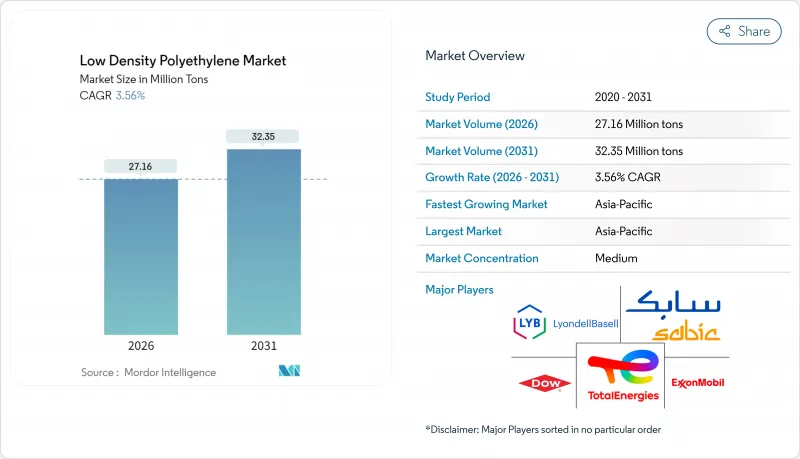
这一成长轨迹反映了柔性薄膜、隔热材料、涂料和农产品领域的强劲消费,即便监管压力加速了向循环包装解决方案的转型。薄膜仍然是关键应用领域,因为加工商优先考虑低密度聚乙烯(LDPE)的密封强度和光学透明度。同时,亚太地区产能的持续扩张正在加强对可再生能源基础设施、精密农业和电子商务物流的供应基础。技术许可,尤其是在中国,正在扩大先进管状和高压釜製程的应用范围,以生产高价值等级的产品。同时,欧盟的循环经济指令正在透过评估消费后回收塑胶的含量和限制复杂的多层结构来重塑筹资策略。受与原油价格挂钩的乙烯价格的影响,原料成本波动促使利润管理成为一项策略重点,并促使生产商优化其在具有定价权的特殊应用领域产品组合。
全球低密度聚乙烯市场趋势及洞察
电子商务软包装的成长推动了薄膜创新
为了应对快速增长的小包裹量,加工商正致力于开发轻质、抗穿刺的单组分薄膜,以减轻运输重量并简化回收流程。埃克森美孚以Exceed和Enable聚合物为基础的全聚乙烯复合材料平台,可生产97%聚乙烯含量的包装袋,同时具备优异的氧气阻隔性。物流业者受益于较薄的壁厚结构,在不牺牲密封强度的前提下减少了材料用量,而这种规格也符合欧洲针对难以回收的多层薄膜所实施的关税协调制度。零售商正在指定使用分子量分布窄的低密度聚乙烯(LDPE)等级产品,以兼顾耐衝击和透明度,从而推动了低密度聚乙烯市场的需求成长。
农业薄膜受益于对永续性和提高生产力的需求。
精密农业、温室栽培和青贮饲料保藏技术的进步推动了低密度聚乙烯(LDPE)在覆盖物、熏蒸和温室薄膜等领域的消费成长。BASF估计,农业薄膜的年需求量为700万吨,年成长7%,凸显了该材料在减少水分流失和杂草压力、提高作物产量方面的重要性。然而,监管机构正在收紧废弃物处理限制,推动生物基材料和光降解混合物的试验。为了应对替代风险,製造商正在将Oxo生物降解母粒商业化,这些母料在使用过程中保持薄膜强度,同时在回收后促进链断裂,从而确保LDPE在高性能应用领域的竞争力。
在通用应用领域,与线性低密度聚乙烯(LLDPE)和高密度聚乙烯(HDPE)的竞争日益加剧
茂金属催化剂的进步正在缩小低密度聚乙烯(LDPE)和锁状高密度聚苯乙烯( HDPE)之间的性能差距。现代线性低密度聚乙烯(LLDPE)具有高抗穿刺性和薄壁特性,适用于重型运输袋,从而蚕食了传统LDPE的订单量。同时,HDPE在T恤袋和薄壁容器等应用中持续获得认可,这些应用对刚性和环境应力开裂性能要求较高。 LDPE生产商正透过将产能转移到重型收缩罩和黏合剂衬里等细分应用领域来捍卫市场份额,在这些领域,支链结构能够提供线性LDPE无法实现的热封和光学性能。
细分市场分析
到2025年,薄膜将占低密度聚乙烯市场份额的56.60%,这反映了其在食品柔软性袋、工业内衬和农业覆盖物等领域的成熟应用。加工者对薄壁单层结构越来越感兴趣,这种结构可实现15微米的拉伸膜厚度,从而在不牺牲撕裂强度的前提下减少树脂用量。儘管电线电缆绝缘材料的销量目前小规模,但预计到2031年,其复合年增长率将达到4.07%,这主要得益于可再生能源网路和电动汽车线束的广泛应用。吹塑成型容器由于兼具透明度和抗衝击性,有望保持稳定的低密度聚乙烯市场份额。同时,射出成型零件正在满足市场对耐化学腐蚀瓶盖和封口的需求。
随着线性聚乙烯替代需求的持续增长,低密度聚乙烯(LDPE)供应商正在开发用于发泡体和片材应用的高熔体强度树脂,以满足其能量吸收和柔软性需求。发泡床垫和运动地板製造商重视LDPE的泡孔结构稳定性,而建筑包覆材料製造商则利用其防潮性能。采用无过氧化物高压高压釜技术的特种反应器生产线进一步拓展了产品范围,提供专为医疗设备包覆成型设计的超洁净等级产品,凸显了低密度聚乙烯市场产品组合的不断演变。
低密度聚乙烯市场报告按产品类型(吹塑成型、薄膜、射出成型、片材、发泡体等)、终端用户行业(农业、电气电子、包装、建筑、汽车、消费品、医疗保健和製药)以及地区(亚太、北美、欧洲、南美、中东和非洲)进行细分。市场预测以吨为单位。
区域分析
预计到2025年,亚太地区将占据低密度聚乙烯市场47.30%的份额,这主要得益于中国产能的大规模扩张以及东南亚製造业的成长。中国的树脂产量激增,宁夏和山东的新管材和旋转式聚乙烯生产装置计划运作,其中许多计划都采用了利安德巴塞尔的技术许可。
北美拥有极具竞争力的原料成本优势,这得益于其丰富的乙烷页岩资源。一体化生产商将剩余的低密度聚乙烯(LDPE)策略性地出口到拉丁美洲和亚洲,而国内加工商则利用其原材料采购能力来支援永续薄膜专案。在欧洲,诸如《包装废弃物法规》等严格的强制规定正在推动对先进回收基础设施和再生低密度聚乙烯产品的投资。儘管原生树脂的成长缓慢,但高价值的循环产品正在为欧洲供应商开闢高端市场。
中东和非洲地区受益于具有竞争力的原料价格和快速成长的人口。阿拉伯湾地区的乙烷裂解装置和一体化低密度聚乙烯(LDPE)工厂正向东部输送大量产品,而快速成长的国内建筑业和农业部门则推动了当地的消费。南美洲,特别是巴西和阿根廷,对作物保护膜和消费品包装的需求保持稳定且适度。然而,货币波动和经济不稳定限制了投资决策。印度加强原生聚乙烯品质标准可望提高供应链透明度,同时支持农业和消费品产业的基建扩张。
其他福利:
- Excel格式的市场预测(ME)表
- 3个月的分析师支持
目录
第一章 引言
- 研究假设和市场定义
- 调查范围
第二章调查方法
第三章执行摘要
第四章 市场情势
- 市场概览
- 市场驱动因素
- 电子商务软包装的成长
- 对农业薄膜的需求不断增长
- 适用于挤压涂布应用
- 先进的回收技术可生产优质LDPE等级产品
- 太阳能板封装膜的需求趋势
- 市场限制
- 来自线性低密度聚乙烯(LLDPE)和高密度聚乙烯(HDPE)的竞争
- 乙烯原料价格波动
- 欧盟禁止使用单层聚烯薄膜
- 资本转向生物基聚烯
- 价值链分析
- 监管环境
- 技术展望
- 波特五力分析
- 供应商的议价能力
- 买方的议价能力
- 新进入者的威胁
- 替代品的威胁
- 竞争程度
第五章 市场规模与成长预测
- 依产品类型
- 吹塑成型
- 电影
- 射出成型
- 床单
- 形式
- 电线电缆绝缘
- 按最终用户行业划分
- 农业
- 电气和电子设备
- 包装
- 建造
- 车
- 消费品
- 医疗/製药
- 按地区
- 亚太地区
- 中国
- 印度
- 日本
- 韩国
- 马来西亚
- 泰国
- 印尼
- 越南
- 亚太其他地区
- 北美洲
- 美国
- 加拿大
- 墨西哥
- 欧洲
- 德国
- 英国
- 法国
- 义大利
- 西班牙
- 北欧国家
- 土耳其
- 俄罗斯
- 其他欧洲
- 南美洲
- 巴西
- 阿根廷
- 哥伦比亚
- 南美洲其他地区
- 中东和非洲
- 沙乌地阿拉伯
- 卡达
- 阿拉伯聯合大公国
- 奈及利亚
- 埃及
- 南非
- 其他中东和非洲地区
- 亚太地区
第六章 竞争情势
- 市场集中度
- 策略趋势
- 市占率(%)/排名分析
- 公司简介
- Borealis AG
- Braskem SA
- Chevron Phillips Chemical Company LLC
- China Petrochemical Corporation.
- Dow
- ExxonMobil Corporation
- Formosa Plastics Corporation
- Hanwha Solutions Chemical Division Corporation
- INEOS Group
- LG Chem
- LyondellBasell Industries Holdings BV
- Mitsui Chemicals, Inc.
- NOVA Chemicals Corporation
- PetroChina
- PTT Global Chemical PLC
- Qatar Chemical Company Ltd
- Reliance Industries Limited
- Repsol SA
- SABIC
- Sumitomo Chemical Co., Ltd.
- TotalEnergies SE
- Versalis SpA(Eni)
- Westlake Corporation
第七章 市场机会与未来展望
The Low Density Polyethylene market is expected to grow from 26.23 million tons in 2025 to 27.16 million tons in 2026 and is forecast to reach 32.35 million tons by 2031 at 3.56% CAGR over 2026-2031.
This trajectory reflects entrenched consumption in flexible films, insulation, coatings, and agricultural products, even as regulatory pressures accelerate the shift toward circular packaging solutions. Films retain primacy because converters value LDPE's seal integrity and optical clarity, while sustained capacity additions in Asia-Pacific underpin a supply landscape that feeds renewable-energy infrastructure, precision farming, and e-commerce fulfillment. Technology licensing, particularly in China, is widening access to advanced tubular and autoclave processes that yield higher-value grades. Meanwhile, circular-economy mandates in the European Union are reshaping procurement strategies by rewarding post-consumer-recycled content and penalizing complex multilayer structures. Input-cost volatility tied to crude-driven ethylene prices keeps margin management at the forefront of corporate strategy, encouraging producers to optimize product slates toward specialty applications that command pricing power.
Global Low Density Polyethylene Market Trends and Insights
Growth in E-commerce Flexible Packaging Drives Film Innovation
Surging parcel volumes push converters to engineer lightweight, puncture-resistant mono-material films that slash shipping mass and simplify recycling streams. ExxonMobil's full-polyethylene laminated platforms, built on Exceed and Enable polymers, deliver pouches composed of 97% PE while achieving high oxygen barriers. Logistics operators benefit from down-gauged structures that cut material intensity without sacrificing seal integrity, and the format aligns with European fee modulation schemes that penalize difficult-to-recycle multilayers. Retailers are specifying LDPE grades with narrow molecular-weight distributions that balance dart-impact resistance and clarity, driving incremental demand within the low density polyethylene market.
Agricultural Films Benefit from Sustainability and Productivity Imperatives
Precision farming, greenhouse cultivation, and silage preservation are accelerating LDPE consumption in mulch, fumigation, and greenhouse covers. BASF estimates annual agricultural-film demand at 7 million tons and a 7% growth rate, underscoring the material's role in boosting crop yields by limiting moisture loss and weed pressure. Yet regulators are tightening end-of-life controls, prompting trials of bio-based and photodegradable blends. Producers are countering substitution risk by commercializing oxo-biodegradable masterbatches that retain film strength during field use but accelerate chain scission once recovered, ensuring LDPE remains competitive in high-performance installations.
Competition from LLDPE and HDPE Intensifies in Commodity Applications
Metallocene catalyst advances have narrowed the performance gap between LDPE and its linear and high-density counterparts. Modern LLDPE delivers higher puncture resistance and downgauging potential in heavy-duty shipping sacks, eroding traditional LDPE contract volumes. HDPE, meanwhile, continues to gain traction in t-shirt bags and thin-wall containers, where stiffness and environmental stress crack resistance are prized. LDPE producers are defending share by steering capacity toward niche areas, such as heavy-duty shrink hoods and hot-melt-adhesive backings, where branching architecture delivers heat-seal and optical benefits unattainable with linear grades.
Other drivers and restraints analyzed in the detailed report include:
- Extrusion-Coated Applications Expand Through Technical Innovation
- Advanced Recycling Technologies Enable Premium Grade Recovery
- Ethylene Feedstock Price Volatility Constrains Margin Predictability
For complete list of drivers and restraints, kindly check the Table Of Contents.
Segment Analysis
Films accounted for 56.60% of low density polyethylene market size in 2025, reflecting entrenched usage in flexible food pouches, industrial liners, and agricultural covers. Converter interest in downgauged mono-material structures has intensified, enabling 15-micron oriented webs that cut resin input without compromising tear strength. Wire and cable insulation, although representing a smaller volume base, is set to post a 4.07% CAGR through 2031 as renewable-energy grids and electric-vehicle harnesses proliferate. The low density polyethylene market share commanded by blow-molded containers remains steady due to their balance of clarity and impact resistance, whereas injection-molded components satisfy chemical-resistant caps and closures.
Continuing substitution pressure from linear grades forces LDPE suppliers to cultivate high-melt-strength resins for foams and sheet applications that demand energy absorption and softness. Foam bedding and sports-flooring producers value LDPE's cell-structure stability, while construction wrap manufacturers leverage its moisture-barrier attributes. Specialty reactor lines equipped with peroxide-free autoclave technology further broaden the offering by delivering ultra-clean grades tailored to medical device over-molding, underscoring the evolving product mix inside the low density polyethylene market.
The Low Density Polyethylene Market Report is Segmented by Product Type (Blow Molded, Films, Injection Molded, Sheets, Foams, and More), End-User Industry (Agriculture, Electrical and Electronics, Packaging, Construction, Automotive, Consumer Goods, Healthcare and Pharma), and Geography (Asia-Pacific, North America, Europe, South America, Middle East and Africa). The Market Forecasts are Provided in Terms of Volume (Tons).
Geography Analysis
Asia-Pacific held 47.30% of low density polyethylene market share in 2025, buoyed by China's large-scale capacity additions and Southeast Asia's manufacturing growth. Chinese resin output surged as new tubular and swing-plant projects came online in Ningxia and Shandong provinces, many underpinned by technology licenses from LyondellBasell.
North America enjoys feedstock cost leadership owing to an ethane-rich shale inventory. Integrated producers strategically export surplus LDPE to Latin America and Asia, while domestic converters leverage material availability to support sustainable film programs. Europe confronts stringent directives such as the Packaging and Packaging Waste Regulation, steering investment into advanced recycling infrastructure and post-consumer-recycled LDPE grades. Although virgin-resin growth is modest, value-added circular offerings open premium niches for European suppliers.
The Middle East and Africa capitalize on competitively priced feedstocks and rapid demographic growth. LDPE plants integrated with ethane crackers in the Arabian Gulf ship substantial volumes eastward, but burgeoning domestic construction and agriculture are lifting local off-take. South America, especially Brazil and Argentina, sustains moderate demand tied to crop-protection films and consumer packaging, though currency fluctuation and economic volatility temper investment decisions. India's tightening quality-standard framework for virgin polyethylene is expected to enhance supply-chain transparency while supporting infrastructure expansion in agriculture and fast-moving consumer goods.
- Borealis AG
- Braskem S.A.
- Chevron Phillips Chemical Company LLC
- China Petrochemical Corporation.
- Dow
- ExxonMobil Corporation
- Formosa Plastics Corporation
- Hanwha Solutions Chemical Division Corporation
- INEOS Group
- LG Chem
- LyondellBasell Industries Holdings BV
- Mitsui Chemicals, Inc.
- NOVA Chemicals Corporation
- PetroChina
- PTT Global Chemical PLC
- Qatar Chemical Company Ltd
- Reliance Industries Limited
- Repsol S.A.
- SABIC
- Sumitomo Chemical Co., Ltd.
- TotalEnergies SE
- Versalis S.p.A. (Eni)
- Westlake Corporation
Additional Benefits:
- The market estimate (ME) sheet in Excel format
- 3 months of analyst support
TABLE OF CONTENTS
1 Introduction
- 1.1 Study Assumptions and Market Definition
- 1.2 Scope of the Study
2 Research Methodology
3 Executive Summary
4 Market Landscape
- 4.1 Market Overview
- 4.2 Market Drivers
- 4.2.1 Growth in e-commerce flexible packaging
- 4.2.2 Rising demand for agricultural films
- 4.2.3 Preference for extrusion-coated applications
- 4.2.4 Advanced recycling enabling premium LDPE grades
- 4.2.5 Solar-panel encapsulant film uptake
- 4.3 Market Restraints
- 4.3.1 Competition from LLDPE and HDPE
- 4.3.2 Ethylene feedstock price volatility
- 4.3.3 EU bans on mono-layer polyolefin films
- 4.3.4 Capital shift to bio-based polyolefins
- 4.4 Value Chain Analysis
- 4.5 Regulatory Landscape
- 4.6 Technological Outlook
- 4.7 Porter's Five Forces Analysis
- 4.7.1 Bargaining Power of Suppliers
- 4.7.2 Bargaining Power of Buyers
- 4.7.3 Threat of New Entrants
- 4.7.4 Threat of Substitutes
- 4.7.5 Degree of Competition
5 Market Size and Growth Forecasts (Volume)
- 5.1 By Product Type
- 5.1.1 Blow Molded
- 5.1.2 Films
- 5.1.3 Injection Molded
- 5.1.4 Sheets
- 5.1.5 Foams
- 5.1.6 Wire and Cable Insulation
- 5.2 By End-user Industry
- 5.2.1 Agriculture
- 5.2.2 Electrical and Electronics
- 5.2.3 Packaging
- 5.2.4 Construction
- 5.2.5 Automotive
- 5.2.6 Consumer Goods
- 5.2.7 Healthcare and Pharma
- 5.3 By Geography
- 5.3.1 Asia-Pacific
- 5.3.1.1 China
- 5.3.1.2 India
- 5.3.1.3 Japan
- 5.3.1.4 South Korea
- 5.3.1.5 Malaysia
- 5.3.1.6 Thailand
- 5.3.1.7 Indonesia
- 5.3.1.8 Vietnam
- 5.3.1.9 Rest of Asia-Pacific
- 5.3.2 North America
- 5.3.2.1 United States
- 5.3.2.2 Canada
- 5.3.2.3 Mexico
- 5.3.3 Europe
- 5.3.3.1 Germany
- 5.3.3.2 United Kingdom
- 5.3.3.3 France
- 5.3.3.4 Italy
- 5.3.3.5 Spain
- 5.3.3.6 Nordic Countries
- 5.3.3.7 Turkey
- 5.3.3.8 Russia
- 5.3.3.9 Rest of Europe
- 5.3.4 South America
- 5.3.4.1 Brazil
- 5.3.4.2 Argentina
- 5.3.4.3 Colombia
- 5.3.4.4 Rest of South America
- 5.3.5 Middle-East and Africa
- 5.3.5.1 Saudi Arabia
- 5.3.5.2 Qatar
- 5.3.5.3 United Arab Emirates
- 5.3.5.4 Nigeria
- 5.3.5.5 Egypt
- 5.3.5.6 South Africa
- 5.3.5.7 Rest of Middle-East and Africa
- 5.3.1 Asia-Pacific
6 Competitive Landscape
- 6.1 Market Concentration
- 6.2 Strategic Moves
- 6.3 Market Share (%)/Ranking Analysis
- 6.4 Company Profiles (includes Global level Overview, Market level overview, Core Segments, Financials, Strategic Info, Market Rank/Share, Products and Services, Recent Developments)
- 6.4.1 Borealis AG
- 6.4.2 Braskem S.A.
- 6.4.3 Chevron Phillips Chemical Company LLC
- 6.4.4 China Petrochemical Corporation.
- 6.4.5 Dow
- 6.4.6 ExxonMobil Corporation
- 6.4.7 Formosa Plastics Corporation
- 6.4.8 Hanwha Solutions Chemical Division Corporation
- 6.4.9 INEOS Group
- 6.4.10 LG Chem
- 6.4.11 LyondellBasell Industries Holdings BV
- 6.4.12 Mitsui Chemicals, Inc.
- 6.4.13 NOVA Chemicals Corporation
- 6.4.14 PetroChina
- 6.4.15 PTT Global Chemical PLC
- 6.4.16 Qatar Chemical Company Ltd
- 6.4.17 Reliance Industries Limited
- 6.4.18 Repsol S.A.
- 6.4.19 SABIC
- 6.4.20 Sumitomo Chemical Co., Ltd.
- 6.4.21 TotalEnergies SE
- 6.4.22 Versalis S.p.A. (Eni)
- 6.4.23 Westlake Corporation
7 Market Opportunities and Future Outlook
- 7.1 White-space and Unmet-need Assessment

 低密度聚乙烯市场分析及预测(至2035年):类型、产品、应用、技术、形式、最终用户、材料类型、製程、功能与组件
 2026年全球低密度聚乙烯市场报告
 低密度聚乙烯(LDPE)市场,全球市场,2025-2029年
 生物质聚乙烯低密度聚乙烯市场按等级、原料、产品形式、应用和分销管道划分,全球预测,2026-2032年
 全球低密度聚乙烯市场:市场规模、占有率、成长率、产业分析、依类型、应用和地区划分的考察、未来预测(2026-2034)挤压低密度聚乙烯(LDPE)市场:未来预测(2025-2030)
 线型低密度聚乙烯(LLDPE)的全球市场:类别,各应用领域,各终端用户产业,各地区,机会,预测,2018年~2032年线型低密度聚乙烯(LLDPE)的印度市场:类别,各应用领域,各终端用户产业,各地区,机会,预测,2019年~2033年
 低密度聚乙烯市场(按技术、应用和地区划分)
 低密度聚乙烯包装(LDPE)市场机会、成长动力、产业趋势分析及2025-2034年预测