


 |
市场调查报告书
商品编码
1906225
欧洲定向纤维板(OSB):市场占有率分析、产业趋势与统计、成长预测(2026-2031)Europe Oriented Strand Board - Market Share Analysis, Industry Trends & Statistics, Growth Forecasts (2026 - 2031) |
||||||

※ 本网页内容可能与最新版本有所差异。详细情况请与我们联繫。
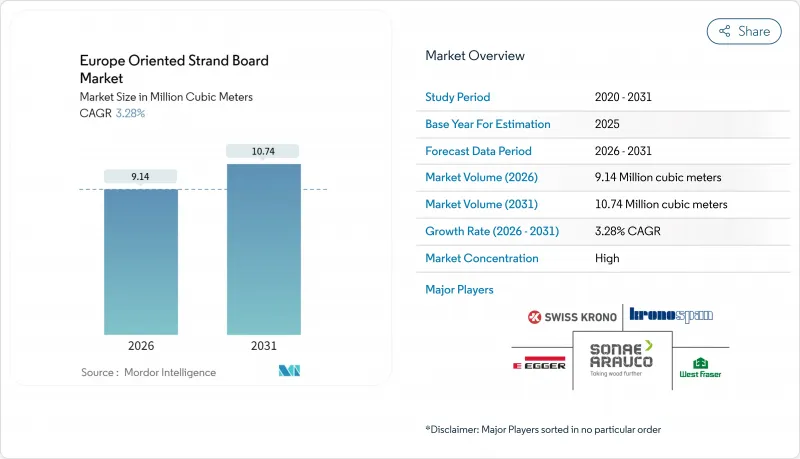
欧洲定向纤维板(OSB) 市场预计将从 2025 年的 885 万立方米增长到 2026 年的 914 万立方米,预计到 2031 年将达到 1074 万立方米,2026 年至 2031 年的复合年增长率为 3.28%。
与胶合板相比,定向刨花板(OSB)具有成本优势,加上其优异的设计强度和不断提升的永续性标准,使得欧洲OSB市场保持强劲势头,即便传统木材供应面临气候变迁带来的波动。 OSB/3在结构应用领域的领先地位,源自于建筑商对其承载能力和防潮性能平衡的认可,这也与欧盟节能维修和模组化建筑的发展趋势相契合。
欧洲定向纤维板(OSB)市场趋势与洞察
疫情后多层木造建筑的復苏
欧洲各大城市正在核准高层木造建筑的建设方案,全球已建成约300座六层楼以上的此类建筑,其中巴黎和伦敦尤为集中。这一趋势正推动欧洲定向刨花板(OSB)市场朝向大型连续板材方向发展,这些板材可轻鬆与交错层压木材(CLT)和复合板框架结构相结合。布拉格新建的62套获得BREEAM高级认证的公寓几乎全部采用大型木模组建造,充分展现了OSB在提升结构抗剪强度和实现碳减排目标方面的卓越性能。随着越来越多的城市采用碳蕴藏量建筑标准,开发商越来越多地指定使用OSB/3板材作为墙体和楼板的隔板,因为这种板材不仅具有可预测的抗剪强度,还能实现快速的现场组装。
REPowerEU隔热维修提升了OSB的需求
欧盟四分之三的建筑需要进行大规模节能维修才能达到2050年的碳排放目标。 REPowerEU计划将向建筑围护结构维修注入公共资金。定向刨花板(OSB)基材可作为外墙外隔热系统(ETICS)的坚固背衬,能够抵抗湿度波动引起的尺寸变化,并保持隔热材料与外墙之间的黏合力。实验室测试证实,聚氨酯黏合的OSB板在ETICS组装中的黏合强度超过80 kPa,超过了欧洲最低标准。在德国,2024年发放的维修许可证数量增加了12%,用于墙体衬垫的OSB采购量超过了建筑总产量。这证实了维修需求对欧洲OSB市场的驱动作用。 OSB板材与生物定向纤维板保温垫结合使用,既能降低运作能耗,也能储存碳。随着成员国对维修建筑实施生命週期排放上限,这项价值变得日益重要。
更严格的甲醛和挥发性有机化合物排放限制
欧盟法规2023/1464规定,自2026年8月起,定向刨花板(OSB)的排放上限为0.062毫克/立方米,迫使OSB生产商用MDI基树脂取代酚醛树脂。这将使生产成本增加15%至20%。瑞典实施了更严格的临时限值0.124毫克/立方米,而丹麦则要求每次发货都必须提供文件,这增加了合规性方面的文书工作。儘管欧洲OSB市场在低排放化学技术方面取得了进展,但维修老旧的压机生产线仍需要大量资金,尤其是对于中小型生产商而言。然而,研究表明,当排放低于基准值时,高品质OSB的暴露风险极低,知名品牌也以此为由提高价格。同时,经销商开始销售双重认证的「添加甲醛」产品,这不仅分散了市场需求,也创造了一个增值层,可以部分抵消不断上涨的黏合剂成本。
细分市场分析
预计到2025年,OSB/3将占总产量的83.10%,并继续成为欧洲定向纤维板(OSB)市场的支柱,到2031年将以3.47%的复合年增长率成长。此等级产品符合EN 300承重和防潮标准,是新建和维修工程中屋顶、墙体底层和地板材料的理想选择。建设公司青睐OSB/3,因为它与胶合板相比可节省20-30%的材料,同时保持相当的钉子固定强度。对于利润空间有限的模组化计划承包商而言,这无疑是一项显着的成本节约措施。製造商也围绕OSB/3优化生产计划,从而实现规模经济,降低单位能耗。这项优势目前已在公共采购机构要求的环境产品声明(EPD)中得到强调。
OSB/4 在重工业地板材料和夹层结构领域保持着一定的市场份额,随着仓库跨度的增加,其市场份额虽小但稳步增长。由于德国和法国建筑规范的变更,要求室内隔间墙使用防潮垫层,OSB/2 的市场份额持续下降。这实际上将低等级板材限制在了家具和包装市场。 OSB/1 处于 OSB 等级的最低端,主要用于非结构性装饰应用和 DIY 应用,在这些应用中,薄板即可满足需求。因此,欧洲 OSB 市场正日益围绕 OSB/3 展开,製造商们正在优化树脂体系和板材几何形状,以最大限度地提高生产线效率。
欧洲定向纤维板(OSB)市场报告按等级(OSB/1、OSB/2、OSB/3、OSB/4)、终端用户产业(家具、建筑、包装)和地区(德国、英国、法国、义大利、西班牙、瑞士、奥地利、欧洲其他地区)进行细分。市场预测以销售量(百万立方米)为单位。
其他福利:
- Excel格式的市场预测(ME)表
- 3个月的分析师支持
目录
第一章 引言
- 研究假设和市场定义
- 调查范围
第二章调查方法
第三章执行摘要
第四章 市场情势
- 市场概览
- 市场驱动因素
- 疫情后多层木造建筑的復苏
- REPowerEU隔热维修提升了OSB的需求
- 模组化异地建造工厂的激增
- 建设产业成长
- 与胶合板相比,定向刨花板具有价格优势
- 市场限制
- 更严格的甲醛和挥发性有机化合物排放法规
- 中欧软木纤维供应的波动性。
- 室内空气品质引发的健康问题
- 价值链分析
- 波特五力模型
- 供应商的议价能力
- 买方的议价能力
- 新进入者的威胁
- 替代产品和服务的威胁
- 竞争程度
第五章 市场规模与成长预测
- 按年级
- OSB/1
- OSB/2
- OSB/3
- OSB/4
- 按最终用户行业划分
- 家具
- 住宅
- 商业
- 建造
- 地板和屋顶
- 墙
- 门
- 柱和樑
- 楼梯
- 其他建筑用途
- 包装
- 食品/饮料
- 产业
- 製药
- 化妆品
- 其他包装
- 家具
- 按地区
- 德国
- 英国
- 法国
- 义大利
- 西班牙
- 瑞士
- 奥地利
- 其他欧洲地区
第六章 竞争情势
- 市场集中度
- 策略趋势
- 市占率(%)/排名分析
- 公司简介
- Coillte
- Egger
- HEM DENMARK A/S
- Kronoplus Limited
- Sonae Arauco
- Steico SE
- SWISS KRONO Group
- West Fraser
第七章 市场机会与未来展望
The Europe Oriented Strand Board market is expected to grow from 8.85 million cubic meters in 2025 to 9.14 million cubic meters in 2026 and is forecast to reach 10.74 million cubic meters by 2031 at 3.28% CAGR over 2026-2031.
OSB's cost advantage versus plywood, its engineered strength profile, and tightening sustainability standards together keep the Europe Oriented Strand Board market resilient even as traditional lumber supply faces climate-related volatility. Structural applications dominate because builders value OSB/3's balance of load-bearing capacity and moisture resistance, a pairing that aligns with EU energy-efficiency retrofits and modular construction trends.
Europe Oriented Strand Board Market Trends and Insights
Post-pandemic Rebound in Multi-storey Timber Buildings
European cities are approving an expanding pipeline of tall timber structures, with roughly 300 buildings of six stories or more completed globally and concentrations emerging in Paris and London. This shift pushes the Europe-oriented strand Board market toward larger, continuous-panel formats that integrate easily with CLT and glulam frames. Prague's new 62-unit BREEAM-Excellent apartment block, built almost entirely from mass-timber modules, demonstrates how OSB contributes both to structural shear resistance and to embodied-carbon reduction goals. As more municipalities adopt carbon-based building codes, developers increasingly specify OSB/3 panels for wall and floor diaphragms because they deliver predictable racking resistance while enabling rapid on-site assembly.
REPowerEU Insulation Retrofits Boosting OSB Demand
Three-quarters of EU buildings need deep energy renovation to meet 2050 carbon targets, and the REPowerEU plan channels state aid into envelope upgrades. OSB substrates serve as robust backers for external insulation systems because they resist dimensional change when moisture levels fluctuate, preserving the bond between insulation and facade. Laboratory work shows polyurethane-bonded OSB boards achieving bond strengths above 80 kPa in ETICS assemblies, exceeding European code minima. In Germany, renovation permits issued in 2024 rose 12%, with wall-sheathing OSB purchases outpacing overall construction output, confirming the retrofit pull-through for the Europe Oriented Strand Board market. When paired with bio-based insulation mats, panels store carbon while lowering operational energy, an increasingly valuable proposition as member states introduce lifecycle-emissions caps for renovated stock.
Stricter Formaldehyde and VOC Emission Caps
EU Regulation 2023/1464 fixes a 0.062 mg/m3 emission ceiling from August 2026, compelling OSB mills to replace phenol-formaldehyde resins with MDI-based systems that raise manufacturing cost by 15-20%. Sweden applies an even tighter 0.124 mg/m3 interim limit, and Denmark enforces documentation for every shipment, elevating compliance paperwork. While the Europe Oriented Strand Board market has advanced in low-emission chemistry, retrofitting older press lines remains capital-intensive, especially for small producers. Research nonetheless indicates that high-grade OSB poses minimal exposure risk when emissions stay below code, a narrative larger brands use to justify price premiums. In parallel, merchants are starting to stock dual-certified "Zero-added-formaldehyde" lines, splitting demand but also creating a value-added tier that partially offsets higher binder costs.
Other drivers and restraints analyzed in the detailed report include:
- Construction Industry Growth
- Surge in Modular Off-site Construction Factories
- Volatile Soft-wood Fibre Supply in Central Europe
For complete list of drivers and restraints, kindly check the Table Of Contents.
Segment Analysis
OSB/3 generated 83.10% of 2025 volume and will remain the backbone of the Europe-oriented strand Board market through 2031 with a 3.47% CAGR. The grade satisfies EN 300 load-bearing and humidity standards, making it the default for roof decks, wall sheathing, and flooring under both new-build and retrofit programs. Construction firms prefer OSB/3 because it offers 20-30% material savings versus plywood while delivering comparable nail-holding strength, a key cost lever as contractors navigate tight margins on modular projects. Manufacturers also optimize production scheduling around OSB/3, creating economies of scale that suppress per-unit energy use-an advantage now highlighted in Environmental Product Declarations requested by public-tender authorities.
OSB/4 retains niche demand in heavy-duty industrial flooring and mezzanine applications, capturing a modest but stable share as larger spans become common in logistics warehouses. OSB/2 continues to recede as building codes across Germany and France now require moisture-resistant sheathing even for interior partitions, effectively pushing lower-grade boards toward furniture and packaging outlets. OSB/1 occupies the bottom of the hierarchy, used mainly in non-structural decor or DIY markets where thin panels suffice. As a result, the Europe Oriented Strand Board market increasingly revolves around OSB/3, allowing producers to streamline resin systems and strand geometry for peak line efficiency.
The Europe Oriented Strand Board Market Report is Segmented by Grade (OSB/1, OSB/2, OSB/3, and OSB/4), End-User Industry (Furniture, Construction, and Packaging), and Geography (Germany, United Kingdom, France, Italy, Spain, Switzerland, Austria, and Rest of Europe). The Market Forecasts are Provided in Terms of Volume (Million Cubic Meters).
List of Companies Covered in this Report:
- Coillte
- Egger
- HEM DENMARK A/S
- Kronoplus Limited
- Sonae Arauco
- Steico SE
- SWISS KRONO Group
- West Fraser
Additional Benefits:
- The market estimate (ME) sheet in Excel format
- 3 months of analyst support
TABLE OF CONTENTS
1 Introduction
- 1.1 Study Assumptions and Market Definition
- 1.2 Scope of the Study
2 Research Methodology
3 Executive Summary
4 Market Landscape
- 4.1 Market Overview
- 4.2 Market Drivers
- 4.2.1 Post-Pandemic Rebound in Multi-Storey Timber Buildings
- 4.2.2 REPowerEU Insulation Retrofits Boosting OSB Demand
- 4.2.3 Surge in Modular Off-Site Construction Factories
- 4.2.4 Construction Industry Growth
- 4.2.5 OSB Price Advantage Vs Plywood
- 4.3 Market Restraints
- 4.3.1 Stricter Formaldehyde and VOC Emission Caps
- 4.3.2 Volatile Soft-Wood Fibre Supply in Central Europe
- 4.3.3 Health Concerns over Indoor Air Quality
- 4.4 Value Chain Analysis
- 4.5 Porter's Five Forces
- 4.5.1 Bargaining Power of Suppliers
- 4.5.2 Bargaining Power of Buyers
- 4.5.3 Threat of New Entrants
- 4.5.4 Threat of Substitute Products and Services
- 4.5.5 Degree of Competition
5 Market Size and Growth Forecasts (Volume)
- 5.1 By Grade
- 5.1.1 OSB/1
- 5.1.2 OSB/2
- 5.1.3 OSB/3
- 5.1.4 OSB/4
- 5.2 By End-user Industry
- 5.2.1 Furniture
- 5.2.1.1 Residential
- 5.2.1.2 Commercial
- 5.2.2 Construction
- 5.2.2.1 Floor and Roof
- 5.2.2.2 Wall
- 5.2.2.3 Door
- 5.2.2.4 Column and Beam
- 5.2.2.5 Staircase
- 5.2.2.6 Other Constructions
- 5.2.3 Packaging
- 5.2.3.1 Food and Beverage
- 5.2.3.2 Industrial
- 5.2.3.3 Pharmaceutical
- 5.2.3.4 Cosmetics
- 5.2.3.5 Other Packaging
- 5.2.1 Furniture
- 5.3 By Geography
- 5.3.1 Germany
- 5.3.2 United Kingdom
- 5.3.3 France
- 5.3.4 Italy
- 5.3.5 Spain
- 5.3.6 Switzerland
- 5.3.7 Austria
- 5.3.8 Rest of Europe
6 Competitive Landscape
- 6.1 Market Concentration
- 6.2 Strategic Moves
- 6.3 Market Share (%)/Ranking Analysis
- 6.4 Company Profiles (includes Global level Overview, Market level overview, Core Segments, Financials as available, Strategic Information, Market Rank/Share for key companies, Products and Services, and Recent Developments)
- 6.4.1 Coillte
- 6.4.2 Egger
- 6.4.3 HEM DENMARK A/S
- 6.4.4 Kronoplus Limited
- 6.4.5 Sonae Arauco
- 6.4.6 Steico SE
- 6.4.7 SWISS KRONO Group
- 6.4.8 West Fraser
7 Market Opportunities and Future Outlook
- 7.1 White-space and Unmet-need Assessment

 全球定向刨花板市场规模、份额、趋势和成长分析报告(2026-2034年)
 日本定向纤维板(OSB)市场规模、份额、趋势和预测:按等级、应用、最终用户和地区划分,2026-2034年
 2026年全球定向刨花板市场报告
 定向纤维板(OSB):市场占有率分析、产业趋势与统计、成长预测(2026-2031)
 OSB护墙板:全球市场份额和排名、总收入和需求预测(2025-2031年)
 定向纤维板市场:按应用、终端用户产业、厚度、树脂类型和分销管道划分-2025-2032年全球预测2025 年至 2033 年定向刨花板 (OSB) 市场规模、份额、趋势及预测(按等级、应用、最终用户和地区)
 定向纤维板市场规模、份额和成长分析(按类型、应用、最终用户和地区)- 产业预测 2025-2032定向纤维板(OSB) 市场 - 2024 年至 2029 年预测
 全球定向纤维板市场,2024-2028