


 |
市场调查报告书
商品编码
1906254
塑胶托盘:市场占有率分析、产业趋势与统计、成长预测(2026-2031)Plastic Pallets - Market Share Analysis, Industry Trends & Statistics, Growth Forecasts (2026 - 2031) |
||||||

※ 本网页内容可能与最新版本有所差异。详细情况请与我们联繫。
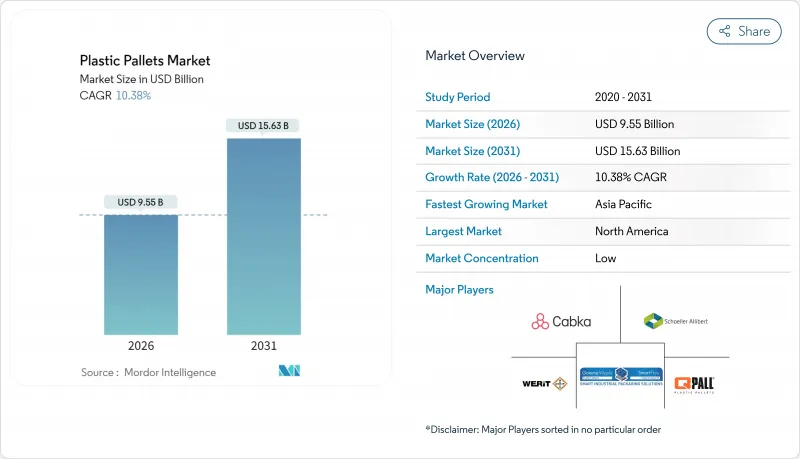
预计塑胶托盘市场将从 2025 年的 86.5 亿美元成长到 2026 年的 95.5 亿美元,到 2031 年将达到 156.3 亿美元,2026 年至 2031 年的复合年增长率为 10.38%。
药品低温运输卫生标准的加强、木材符合ISPM-15标准的成本以及自动化仓库设计是推动塑胶托盘市场成长要素。将资本支出转化为营运成本的共享系统也促进了需求的成长,使共用资产对第三方物流公司更具吸引力。欧盟范围内的聚烯树脂回收计画进一步推动了市场发展,使托盘符合循环经济目标。同时,与原油价格相关的树脂价格波动给製造商的短期利润率带来了压力。
全球塑胶托盘市场趋势与洞察
在药品低温运输中采用卫生塑胶托盘
根据美国食品药物管理局 (FDA) 的规定,托盘被归类为运输设备,因此其可清洗、无孔的设计对于药品物流至关重要。塑胶托盘具有防潮性能,并且在温度波动期间能够保持结构稳定,与木质托盘相比,降低了污染风险。欧洲製造商,例如 Schoeller Allibert,提供专为无菌药品生产设计的无尘室相容型托盘。由于产品召回成本不断攀升,塑胶托盘正逐渐成为受监管低温运输的标准基础设施。北美地区对塑胶托盘的需求强劲,这主要得益于疫苗的持续高需求,而类似的卫生标准也正在欧洲各地推广。
ISPM-15合规性要求推动木材向塑胶的转型
国际植物检疫措施标准第15号(ISPM-15)要求木质包装必须经过热处理或熏蒸,增加了亚洲出口的成本和延误。塑胶托盘符合豁免条件,在中国、越南和泰国等国家/地区具有即时的合规优势。出口商可以避免每个托盘12至15美元的加工费,进而提高大宗货物的利润率。美国木材标准委员会严格的审核程序增加了行政负担,进一步抑制了木材的使用。随着贸易路线前置作业时间的缩短,塑胶托盘在已签署ISPM-15的182个国家提供了确定性,并加快了清关速度。
新兴东南亚中小企业面临的初始资本成本障碍
塑胶托盘的成本是木製托盘的三到五倍,这给融资紧张的中小型企业带来了沉重的负担,而中小型企业占该地区企业总数的98.7%。虽然有补贴贷款,但这些贷款很少能涵盖如此大规模的营运资金升级。在印尼,小规模加工商主导塑胶生产,投资回收期远超过一般的规划週期。如果没有成本分摊机制,采用塑胶托盘的将仅限于大型出口商和那些能够透过高周转率摊销投资的企业。目前,製造商提供价格较低的再生材料托盘,但资金筹措缺口依然存在。
细分市场分析
截至2025年,高密度聚乙烯(HDPE)凭藉其优异的耐化学腐蚀性能,在塑胶托盘市场占据了66.03%的份额,深受製药和食品生产商的青睐。目前,塑胶托盘市场高度重视再生树脂,受欧盟强化的再生材料含量要求影响,预计到2031年,再生材料市场将以12.29%的复合年增长率成长。由于原生树脂价格与原油价格密切相关,波动性较大,再生HDPE更具经济吸引力,能有效降低生产商的原料成本。 Q-Pall等製造商已开始生产98%再生材料製成的托盘,证明了大规模生产的技术可行性。随着欧洲市场需求的激增,持续的监管压力预计将进一步缩小再生材料与原生材料之间的价格差距。
再生聚合物也符合企业ESG政策,因此,运输包装领域对审核的永续性认证的需求日益增长。塑胶托盘市场受益于其可反覆破碎和重塑而不劣化的特性,这使其能够融入木栈板无法实现的循环经济模式。生产商正在投资建造清洗生产线,以确保去除污染物,使再生高密度聚乙烯(HDPE)达到食品级标准。北美买家正在试用再生材料产品,以对冲树脂价格上涨的风险,而亚洲出口商则积极采用此类产品,以在竞标中凸显其低碳足迹。
到2025年,可堆迭托盘将占全球收入的42.10%,这主要得益于其能够将空载回运成本降低高达80%。然而,货架式托盘市场预计将以11.62%的复合年增长率成长。这是因为自动化仓库对托盘挠度有严格的要求,而可堆迭托盘往往无法满足这项要求。采用自动化立体仓库(AS/RS)系统的零售商更倾向于使用货架式托盘,因为这种托盘在承受一吨静态负载的情况下,挠度可以保持在6毫米或以下,从而确保输送机的运作。製造商正在利用玻璃纤维增强高密度聚乙烯(HDPE)来解决这个问题,这种材料可以在不增加重量的情况下提高托盘的刚度。
可堆迭托盘在重工业应用中仍占有一席之地,这些应用需要坚固的平台来实现两层或三层的堆迭,但其增长速度低于货架式托盘。展示托盘是一个细分市场,主要用于大型零售商店的促销活动,但其独特的尺寸限制了需求的波动。塑胶托盘市场仍在努力平衡嵌套式设计(强调节省空间的运输)和货架式托盘(适用于自动化物流),许多货运公司透过结合使用这两种托盘形式来优化其供应链。
区域分析
到2025年,北美将占全球收入的29.20%,这得益于成熟的托盘池网路和FDA的卫生法规(推动了可重复使用和可清洗托盘平台的发展)。 ORBIS位于德克萨斯州格林维尔的新工厂表明,该公司将继续投资以满足当地对自动化相容托盘的需求。零售配送中心的自动化进一步推动了托盘的普及,塑胶托盘的尺寸公差比木质托盘更小,从而减少了输送机的停机时间。
亚太地区是成长最快的地区,预计到2031年将维持14.10%的复合年增长率,这主要得益于出口导向企业为规避ISPM-15规定的加工成本而转向使用塑胶。中国锂电池产业的蓬勃发展刺激了对防静电托盘的需求,而泰国和越南正在试行Roscam公司设计的跨境,以促进区域间物流。然而,资金筹措缺口和有限的回收管道仍然阻碍东南亚中小企业采用塑胶托盘。
在欧洲,严格的包装和包装废弃物配额制度(要求到2030年40%的运输包装必须可回收)正在推动耐用塑胶托盘的普及。现有的托盘共享业者可以利用其现有的逆向物流网络,以经济高效的方式实现这些目标。中东、非洲和南美洲的回收网路薄弱,营运复杂性和遗失风险抵消了塑胶托盘相对于木质托盘在生命週期成本上的优势,因此在这些地区,塑胶托盘的普及程度相对落后。
其他福利:
- Excel格式的市场预测(ME)表
- 3个月的分析师支持
目录
第一章 引言
- 研究假设和市场定义
- 调查范围
第二章调查方法
第三章执行摘要
第四章 市场情势
- 市场概览
- 市场驱动因素
- 北美和欧洲医药低温运输中卫生塑胶托盘的应用
- 强制性ISPM-15合规性推动亚洲出口中心从木材转向塑料
- 一种降低欧洲第三方物流业者整体拥有成本的资源共享模式
- 美国零售自动化(自动化仓库系统和输送系统)需要尺寸稳定的托盘
- 欧盟循环经济目标推动了对再生高密度聚乙烯托盘的需求。
- 中国电池和化工锂供应链首选防静电塑胶托盘
- 市场限制
- 高昂的初始资本成本是新兴东南亚地区中小企业面临的一大障碍。
- 非洲和南美洲缺乏用于大宗托盘退货的逆向物流基础设施
- 原油价格波动导致原生聚烯树脂价格波动
- 建设产业重型用户普遍认为,与硬木托盘相比,塑胶托盘的有效载荷能力较低。
- 供应链分析
- 技术展望
- 塑胶托盘的永续性和回收/再利用性
- 法规结构和标准
- 波特五力分析
- 供应商的议价能力
- 买方的议价能力
- 新进入者的威胁
- 替代品的威胁
- 竞争对手之间的竞争
第五章 市场规模与成长预测
- 依材料类型
- 高密度聚苯乙烯(HDPE)
- 聚丙烯(PP)
- 回收材料
- 按托盘类型
- 可嵌套
- 可拆卸
- 可堆迭
- 查看/自订
- 按最终用户行业划分
- 食品/饮料
- 化学
- 製药和医疗保健
- 零售与电子商务
- 物流和仓储管理
- 车
- 其他终端用户产业
- 按负载容量
- 轻型托盘
- 中型托盘
- 高耐久性托盘
- 按地区
- 北美洲
- 美国
- 加拿大
- 墨西哥
- 欧洲
- 德国
- 英国
- 法国
- 义大利
- 西班牙
- 俄罗斯
- 其他欧洲地区
- 亚太地区
- 中国
- 印度
- 日本
- 韩国
- 澳洲和纽西兰
- 亚太其他地区
- 中东和非洲
- 中东
- 阿拉伯聯合大公国
- 沙乌地阿拉伯
- 土耳其
- 其他中东地区
- 非洲
- 南非
- 奈及利亚
- 埃及
- 其他非洲地区
- 中东
- 南美洲
- 巴西
- 阿根廷
- 其他南美洲
- 北美洲
第六章 竞争情势
- 市场集中度
- 策略趋势
- 市占率分析
- 公司简介
- Brambles Limited(CHEP)
- CABKA Group GmbH
- Orbis Corporation(Menasha)
- Schoeller Allibert Group BV
- Rehrig Pacific Company
- Tosca Services, LLC
- Loscam International Holdings
- Craemer Holding GmbH
- Gamma-Wopla NV/Smart-Flow NV
- Q-Pall BV
- Plasgad Plastic Products ACS Ltd.
- NAECO SL
- Polymer Solutions International Inc.
- RPP Containers
- IPS Plastics Pallets(IPS Group)
- Shandong Huaxiang Plastic Co., Ltd.
- Beijing Jingliang United Plastic Products Co., Ltd.
- TranPak Inc.
- Allied Plastics, Inc.
- Falkenhahn AG
- Buckhorn Inc.
- iGPS Logistics LLC
第七章 市场机会与未来展望
The plastic pallets market is expected to grow from USD 8.65 billion in 2025 to USD 9.55 billion in 2026 and is forecast to reach USD 15.63 billion by 2031 at 10.38% CAGR over 2026-2031.
Rising hygiene rules in pharmaceutical cold chains, ISPM-15 compliance costs for wood, and automation-ready warehouse designs are the central growth catalysts shaping the plastic pallets market. Demand also benefits from pooling systems that convert capital expenditure into an operating fee, making shared assets attractive to third-party logistics firms. Polyolefin resin recycling initiatives across the EU add further momentum by aligning pallets with circular-economy targets. Conversely, resin price swings tied to crude oil pose near-term margin pressure for manufacturers.
Global Plastic Pallets Market Trends and Insights
Adoption of Hygienic Plastic Pallets in Pharmaceutical Cold Chains
FDA rules classify pallets as transportation equipment, making cleanable, non-porous designs mandatory in pharma logistics. Plastic pallets resist moisture and maintain structure during temperature swings, lowering contamination risk compared with wood. European producers such as Schoeller Allibert now supply cleanroom-grade pallets tailored to sterile drug manufacturing. The rising cost of product recalls cements adoption, turning plastic units into standard infrastructure for regulated cold chains. As vaccine volumes stay elevated, North American demand remains strong, and similar hygienic standards are spreading across Europe.
Mandates for ISPM-15 Compliance Driving Shift from Wood to Plastic
ISPM-15 requires heat treatment or fumigation for wooden packaging, adding cost and delays to Asia's exports. Plastic pallets are exempt, giving them an immediate compliance advantage in China, Vietnam, and Thailand. Exporters avoid the USD 12-15 per-pallet treatment fee, improving margin on high-volume shipments. The American Lumber Standard Committee's rigorous audit schedule further dissuades wood use by raising administrative burde. As trade lanes tighten lead-time windows, plastic pallets offer certainty, speeding clearance in 182 ISPM-15-signatory nations.
High Upfront Capital Cost Barrier for SMEs in Emerging Southeast Asia
Plastic pallets cost three-to-five times more than wood, deterring cash-constrained SMEs that represent 98.7% of firms in the region. Subsidized loans exist but rarely cover working-capital upgrades of this scale. In Indonesia, where small processors dominate local plastics output, payback periods exceed typical planning horizons. Without cost-sharing pools, adoption remains limited to large exporters who can amortize investment over high rotation counts. Manufacturers now market lower-priced recycled-content pallets, yet financing gaps persist.
Other drivers and restraints analyzed in the detailed report include:
- Pooling Models Reducing Total Cost of Ownership for 3PLs
- Retail Automation Requiring Dimensionally Stable Pallets
- Limited Reverse Logistics Infrastructure for Bulk Return of Pallets
For complete list of drivers and restraints, kindly check the Table Of Contents.
Segment Analysis
HDPE retained 66.03% plastic pallets market share in 2025 thanks to chemical resistance demanded by pharma and food handlers. The plastic pallets market now places premium value on recycled resin, pushing the recycled materials segment toward a 12.29% CAGR through 2031 as EU content mandates tighten. Virgin-resin volatility tied to crude prices makes recycled HDPE more financially attractive, smoothing input costs for manufacturers. Producers such as Q-Pall already manufacture pallets using 98% recycled feedstock, demonstrating technical feasibility at scale.Continued regulatory pressure will likely narrow the cost delta between recycled and virgin grades as demand spikes across Europe.
Recycled polymers also appeal to corporate ESG agendas, which increasingly require transport packaging to carry audited sustainability credentials. The plastic pallets market benefits because pallets can be ground and remolded repeatedly without degrading performance, fitting circular-economy loops that wooden pallets cannot replicate. Producers invest in wash-line capacity to guarantee contaminant removal, thereby meeting food-grade standards for recycled HDPE. North American buyers also test recycled-content offerings to hedge against resin price spikes, while Asian exporters adopt them to highlight low-carbon credentials in tender bids.
Nestable pallets accounted for 42.10% of global revenue in 2025 owing to their ability to cut empty-return freight by up to 80%. Yet the rackable segment will expand at an 11.62% CAGR because automated warehouses demand stable deflection limits that nestable designs seldom meet. Retailers installing AS/RS systems prefer rackable pallets that keep load sag below 6 mm under 1 ton static loads, safeguarding conveyor uptime. Producers answer with glass-fiber-reinforced HDPE to boost stiffness without adding weight.
Stackable pallets hold share in heavy manufacturing where columns two or three loads high demand rigid decks, but growth remains slower than rackable units. Display pallets, a niche sub-group, support promotional formats in big-box retail yet face limited churn due to specialized dimensions. The plastic pallets market continues to balance space-saving nestable designs for transport against rack-ready units for automated fulfillment, with many shippers dual-sourcing both formats to optimize supply chain nodes.
The Plastic Pallets Market Report is Segmented by Material Type (High-Density Polyethylene, and More), Pallet Type (Nestable, Rackable, Stackable, Display/Custom), End-User Industry (Food and Beverage, Chemical, and More), Load Capacity (Light-Duty, Medium-Duty, High-Duty), and Geography (North America, Europe, Asia-Pacific, Middle East and Africa, South America). The Market Forecasts are Provided in Terms of Value (USD).
Geography Analysis
North America commanded 29.20% of global revenue in 2025, supported by mature pooling networks and FDA hygiene regulations that encourage reusable, cleanable platforms. ORBIS's new Greenville, Texas plant shows continuing investment to meet local demand for automation-ready pallets. Retail DC automation further boosts adoption because plastic units maintain tighter dimensional tolerances than wood, reducing conveyor downtime.
Asia-Pacific is the fastest-growing territory, posting a 14.10% CAGR to 2031 as export-oriented firms switch to plastic to avoid ISPM-15 treatment fees. China's lithium battery boom spurs demand for anti-static pallets, while Thailand and Vietnam test cross-border designs launched by Loscam to ease regional flows. Yet financing gaps and limited return loops continue to slow adoption among Southeast Asian SMEs.
Europe benefits from stringent Packaging and Packaging Waste Regulation quotas, which require 40% reusability for transport packaging by 2030, furthering the shift to durable plastic pallets. Established pooling operators can exploit existing reverse-logistics density to hit those targets cost-effectively. Middle East & Africa and South America trail due to weaker retrieval networks, adding operational complexity and loss risk that undercut the life-cycle savings plastic offers over wood.
- Brambles Limited (CHEP)
- CABKA Group GmbH
- Orbis Corporation (Menasha)
- Schoeller Allibert Group BV
- Rehrig Pacific Company
- Tosca Services, LLC
- Loscam International Holdings
- Craemer Holding GmbH
- Gamma-Wopla NV / Smart-Flow NV
- Q-Pall BV
- Plasgad Plastic Products ACS Ltd.
- NAECO S.L.
- Polymer Solutions International Inc.
- RPP Containers
- IPS Plastics Pallets (IPS Group)
- Shandong Huaxiang Plastic Co., Ltd.
- Beijing Jingliang United Plastic Products Co., Ltd.
- TranPak Inc.
- Allied Plastics, Inc.
- Falkenhahn AG
- Buckhorn Inc.
- iGPS Logistics LLC
Additional Benefits:
- The market estimate (ME) sheet in Excel format
- 3 months of analyst support
TABLE OF CONTENTS
1 INTRODUCTION
- 1.1 Study Assumptions and Market Definition
- 1.2 Scope of the Study
2 RESEARCH METHODOLOGY
3 EXECUTIVE SUMMARY
4 MARKET LANDSCAPE
- 4.1 Market Overview
- 4.2 Market Drivers
- 4.2.1 Adoption of Hygienic Plastic Pallets in Pharmaceutical Cold Chains across North America and Europe
- 4.2.2 Mandates for ISPM-15 Compliance Driving Shift from Wood to Plastic in Asia Export Hubs
- 4.2.3 Pooling Models Reducing Total Cost of Ownership for 3PLs in Europe
- 4.2.4 Retail Automation (AS/RS and Conveyor Systems) Requiring Dimensionally Stable Pallets in the U.S.
- 4.2.5 Circular Economy Targets Pushing Demand for Recyclate-Based HDPE Pallets in the EU
- 4.2.6 Battery and Chemical Lithium Supply Chains Preferring Anti-Static Plastic Pallets in China
- 4.3 Market Restraints
- 4.3.1 High Upfront Capital Cost Barrier for SMEs in Emerging Southeast Asia
- 4.3.2 Limited Reverse Logistics Infrastructure for Bulk Return of Pallets in Africa and South America
- 4.3.3 Price Volatility of Virgin Polyolefin Resins Linked to Crude-Oil Swings
- 4.3.4 Perception of Lower Load Capacity Versus Hardwood Pallets Among Heavy-Duty Users in Construction
- 4.4 Supply-Chain Analysis
- 4.5 Technological Outlook
- 4.6 Sustainability and Recycling/Reusability of Plastic Pallets
- 4.7 Regulatory Framework and Standards
- 4.8 Porter's Five Forces Analysis
- 4.8.1 Bargaining Power of Suppliers
- 4.8.2 Bargaining Power of Buyers
- 4.8.3 Threat of New Entrants
- 4.8.4 Threat of Substitutes
- 4.8.5 Intensity of Competitive Rivalry
5 MARKET SIZE AND GROWTH FORECASTS (VALUE)
- 5.1 By Material Type
- 5.1.1 High-Density Polyethylene (HDPE)
- 5.1.2 Polypropylene (PP)
- 5.1.3 Recycled Materials
- 5.2 By Pallet Type
- 5.2.1 Nestable
- 5.2.2 Rackable
- 5.2.3 Stackable
- 5.2.4 Display / Custom
- 5.3 By End-User Industry
- 5.3.1 Food and Beverage
- 5.3.2 Chemical
- 5.3.3 Pharmaceutical and Healthcare
- 5.3.4 Retail and E-Commerce
- 5.3.5 Logistics and Warehousing
- 5.3.6 Automotive
- 5.3.7 Other End-User Industry
- 5.4 By Load Capacity
- 5.4.1 Light - Duty Pallets
- 5.4.2 Medium - Duty Pallets
- 5.4.3 High - Duty Pallets
- 5.5 By Geography
- 5.5.1 North America
- 5.5.1.1 United States
- 5.5.1.2 Canada
- 5.5.1.3 Mexico
- 5.5.2 Europe
- 5.5.2.1 Germany
- 5.5.2.2 United Kingdom
- 5.5.2.3 France
- 5.5.2.4 Italy
- 5.5.2.5 Spain
- 5.5.2.6 Russia
- 5.5.2.7 Rest of Europe
- 5.5.3 Asia-Pacific
- 5.5.3.1 China
- 5.5.3.2 India
- 5.5.3.3 Japan
- 5.5.3.4 South Korea
- 5.5.3.5 Australia and New Zealand
- 5.5.3.6 Rest of Asia-Pacific
- 5.5.4 Middle East and Africa
- 5.5.4.1 Middle East
- 5.5.4.1.1 United Arab Emirates
- 5.5.4.1.2 Saudi Arabia
- 5.5.4.1.3 Turkey
- 5.5.4.1.4 Rest of Middle East
- 5.5.4.2 Africa
- 5.5.4.2.1 South Africa
- 5.5.4.2.2 Nigeria
- 5.5.4.2.3 Egypt
- 5.5.4.2.4 Rest of Africa
- 5.5.4.1 Middle East
- 5.5.5 South America
- 5.5.5.1 Brazil
- 5.5.5.2 Argentina
- 5.5.5.3 Rest of South America
- 5.5.1 North America
6 COMPETITIVE LANDSCAPE
- 6.1 Market Concentration
- 6.2 Strategic Moves
- 6.3 Market Share Analysis
- 6.4 Company Profiles (includes Global level Overview, Market level overview, Core Segments, Financials as available, Strategic Information, Market Rank/Share for key companies, Products and Services, and Recent Developments)
- 6.4.1 Brambles Limited (CHEP)
- 6.4.2 CABKA Group GmbH
- 6.4.3 Orbis Corporation (Menasha)
- 6.4.4 Schoeller Allibert Group BV
- 6.4.5 Rehrig Pacific Company
- 6.4.6 Tosca Services, LLC
- 6.4.7 Loscam International Holdings
- 6.4.8 Craemer Holding GmbH
- 6.4.9 Gamma-Wopla NV / Smart-Flow NV
- 6.4.10 Q-Pall BV
- 6.4.11 Plasgad Plastic Products ACS Ltd.
- 6.4.12 NAECO S.L.
- 6.4.13 Polymer Solutions International Inc.
- 6.4.14 RPP Containers
- 6.4.15 IPS Plastics Pallets (IPS Group)
- 6.4.16 Shandong Huaxiang Plastic Co., Ltd.
- 6.4.17 Beijing Jingliang United Plastic Products Co., Ltd.
- 6.4.18 TranPak Inc.
- 6.4.19 Allied Plastics, Inc.
- 6.4.20 Falkenhahn AG
- 6.4.21 Buckhorn Inc.
- 6.4.22 iGPS Logistics LLC
7 MARKET OPPORTUNITIES AND FUTURE OUTLOOK
- 7.1 White-space and Unmet-Need Assessment

 塑胶托盘市场:按产品类型、材料类型、承载能力、尺寸、最终用户、应用和销售管道划分-全球市场预测(2026-2032 年)
 全球塑胶托盘市场规模、份额、趋势和成长分析报告(2026-2034年)
 塑胶托盘市场规模、份额和成长分析(按产品类型、托盘类型、材料、最终用途产业和地区划分)-2026-2033年产业预测
 塑胶托盘市场-全球产业规模、份额、趋势、机会与预测,依材料(高密度聚乙烯、低密度聚乙烯、聚丙烯等)、类型、应用、地区和竞争情况细分,2020-2030 年预测
 塑胶托盘市场:依产品类型、按托盘类型、依最终用途产业、按地区
 塑胶托盘市场机会、成长动力、产业趋势分析及 2025 - 2034 年预测
 北美塑胶托盘市场规模、份额、趋势分析报告:按材料、按产品、按应用、按国家、细分市场预测,2024-2030
 2024-2028年全球塑胶托盘市场